Research Article
Iterative Equalization and Interference Alignment for
Multiuser MIMO HetNets with Imperfect CSI
Daniel Castanheira,
1Jorge Aido,
1Roberto Magueta,
1Adão Silva,
1Atilio Gameiro,
1and Rui Dinis
21Instituto de Telecomunicac¸˜oes, University of Aveiro, 3810-193 Aveiro, Portugal
2Instituto de Telecomunicac¸˜oes, Faculdade de Ciˆencias e Tecnologia, Universidade Nova de Lisboa, 2829-516 Lisboa, Portugal
Correspondence should be addressed to Daniel Castanheira; [email protected] Received 31 July 2015; Revised 23 October 2015; Accepted 8 December 2015 Academic Editor: Francesco Gringoli
Copyright © 2015 Daniel Castanheira et al. This is an open access article distributed under the Creative Commons Attribution License, which permits unrestricted use, distribution, and reproduction in any medium, provided the original work is properly cited.
In this paper we consider a scenario, where several small-cells work under the same coverage area and spectrum of a macrocell. The signals stemming from the small-cell (macrocell) users if not carefully dealt with will generate harmful interference into the macrocell (small-cell). To tackle this problem interference alignment and iterative equalization techniques are considered. By using IA all interference generated by the small-cell (macrocell) users is aligned along a low dimensional subspace, at the macrocell (small-cells). This reduces considerably the amount of resources allocated, to enable the coexistence of the two systems. However, perfect IA requires the availability of error-free channel state information (CSI) at the transmitters. Due to CSI errors one can have substantial performance degradation due to imperfect alignments. Since in this work the IA precoders are based on imperfect CSI, an efficient iterative space-frequency equalization is designed at the receiver side to cope with the residual aligned interference. The results demonstrate that iterative equalization is robust to imperfect CSI and removes efficiently the interference generated by the poorly aligned interference. Close to matched filter bound performance is achieved, with a very few number of iterations.
1. Introduction
The operators are considering the deployment of smaller cells (e.g., picocells and femtocells) along its macrocells to cope with the exponential demand for data traffic verified in the last years [1, 2]. However, a higher network densification has also its limitations. More cells per unit area leads to higher levels of interference and as a consequence the system performance is degraded [2, 3]. To deal with this interference, the small-cells must reuse the macrocell resources, since the macrocell is the owner of the spectrum.
The use of the space domain is of special importance when dealing with interference in an heterogeneous based network environment. Zero-forcing (ZF) is the most com-monly used technique to deal with interference. ZF works by inserting a null in the direction of the terminal subject to interference. Interference alignment (IA) is another option to deal with this type of interference, especially when the interference is generated by several terminals. IA is a linear
precoding technique that manages this type of interference by aligning the multiterminal interference along a low dimen-sional subspace, whereas the intended signal space spans a different subspace. For the interference channel, IA has been shown to achieve the degrees of freedom outer bound [4, 5]. Closed-form solutions are only available for some specific cases [6], while for the general case IA approaches are based on iterative methods [6–8]. In [6], two iterative algorithms were proposed that take advantage of reciprocity in wireless networks to achieve IA, with only local channel knowledge at each node. A convergent alternating minimization approach to IA was proposed in [7]. In [8] the authors presented two algorithms that optimize the precoding subspaces by maximizing the data rate performance while maintaining the achievable degrees of freedom.
In the context of heterogeneous networks, the works in [9–12] studied some IA techniques to deal with the interference generated by the small-cell user terminals (UTs) towards the macrocell. In [9] the authors proposed a new
Volume 2015, Article ID 605250, 8 pages http://dx.doi.org/10.1155/2015/605250
IA scheme that successively creates transmit beamforming vectors for the small-cell terminals and for the macro-BS assuming that they have different number of transmit antennas. The work in [10] studied IA techniques with different levels of intersystem information exchange. In [11] the spatial dimensions left available by the macrocell were used to transmit the small-cells data. In this work only a single macrocell UT is scheduled per subcarrier and perfect CSI is available at the transmitters. The interference generated by the small-cells is aligned in an orthogonal subspace to the macrocell received signal subspace. The case of IA precoder designed under limited information exchange has been ana-lytically tackled in [13], for narrowband heterogeneous based networks.
Single-carrier frequency division multiple access (SC-FDMA) has a lower peak-to-average power ratio (PAPR) than OFDMA [14]. As the mobile terminals are low power devices SC-FDMA has been adopted, for the uplink, as the multiple access scheme of the current long-term evolution (LTE) cellular system [13]. It is also a promising solution technique for high data rate uplink communications in future cellular systems. Single-carrier frequency domain equalization (SC-FDE) is widely recognized as an excellent alternative to OFDM, especially for the uplink of broadband wireless systems [15, 16]. The SC-FDE based schemes may be either linear or nonlinear. Optimized linear frequency domain equalization (FDE) is widely used in conventional SC-FDE schemes. However, it suffers from high residual interference levels, leading to poor performance, that is, several dB from the matched filter bound (MFB) [17]. On the other hand, nonlinear FDE even if more complex do not suffer from this drawback. For this reason, the designing of nonlinear FDE in general and decision-feedback FDE in particular, with the iterative block decision-feedback equalization (IB-DFE) being the most promising nonlinear FDE [17] has gained significant attention lately. IB-DFE was originally proposed in [18] and was extended for a wide range of scenarios in the last years, ranging between diversity scenarios, multiplexing MIMO, and MC-CDMA systems, among many others [19– 26].
Contributions. In this paper we design a practical and efficient
multitier IA-precoding with iterative space-frequency equal-ization approach to cope with the residual intertier alignment interference, caused by the imperfect knowledge of the CSI at the terminals. The main contributions of the paper are as follows.
(i) We extend the work of [11] by considering a more general and realistic case, where the macrocell serves more than one user per subcarrier. The schemes proposed in [14], were designed by assuming that the macrocell only serves a single user. Therefore, we use IA to align the generated interference along two predefined subspaces (one for the macrocell and another for the small-cells). These subspaces are assumed to be known in advance at both cells. Furthermore, a generic number of antenna terminals are considered contrarily to [11], where the schemes were designed for a specific set of antennas.
(ii) The proposed iterative equalizer scheme is designed considering explicitly imperfect CSI, contrarily to [14], where perfect CSI was assumed. Furthermore, as SC-FDMA terminals are also prone to intercarrier interference (ICI) the equalizer design takes into account not only the residual interference but also the ICI.
(iii) Additionally, a simple and accurate semianalytical approach is proposed to obtain the performance of the proposed receiver structure.
The results demonstrate that the proposed iterative algorithm achieves good performance with imperfect CSI, since it efficiently removes the residual intertier interference generated by the poor interference alignment. Moreover, the proposed schemes achieve a performance close to matched filter bound, with only 2–4 iterations. This means that with the proposed scheme the small-cell users can coexist under the same spectrum of the macrocell without significant interference, even under imperfect CSI knowledge, and with moderate complexity.
Organization. This paper is organized as follows. Section 2
presents the system model. In Section 3, we start by designing the IA precoder. Then the proposed receiver structures are presented in detail and a semianalytical approach for obtaining the performance is discussed. Section 4 presents the main simulation results. The conclusions will be drawn in Section 5.
Notation. Boldface capital letters denote matrices and
bold-face lowercase letters denote column vectors. The operations (⋅)𝐻and tr(⋅) represent the Hermitian transpose and the trace of a matrix.{𝛼𝑙}𝐿𝑙=1 represents𝐿 length sequence. I𝑁 is the identity matrix with size𝑁 × 𝑁. null(A) denotes a matrix whose columns span the null space of matrix A. d(𝑝) and
D(𝑝) denote the element 𝑝 of vector d and the entry (𝑝, 𝑝) of
diagonal matrix D, respectively. The indexes 𝑠 and 𝑚 are used to represent the small-cell and the macrocell, respectively.
2. System Model
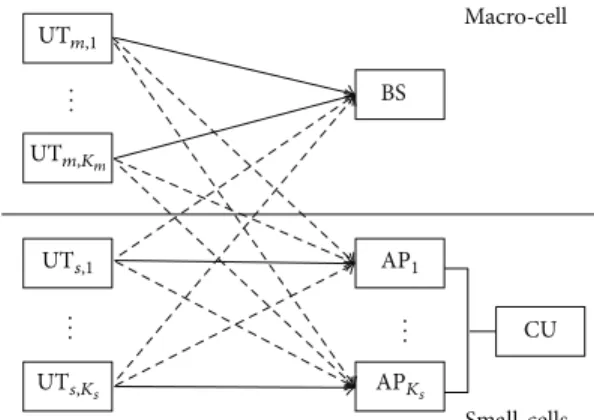
Let us consider 𝐾𝑠 small-cells working under the same spectrum and under the coverage area of a macrocell, as depicted in Figure 1. Both macro- and small-cell terminals use as access technique SC-FDMA with𝐿 available subcarriers. The macrocell serves 𝐾𝑚 UT’s and each small-cell serves one UT. In the following, the macrocell𝑘th user terminal is denominated by UT𝑚,𝑘and the UT small-cell by UT𝑠,𝑘. The index𝑙 is used to denote a given subcarrier of the 𝐿 available.
2.1. Macrocell System. At the macrocell a BS serves 𝐾𝑚
associated UTs, where the number of antennas at the BS and each UT is𝑀𝑟and𝑀𝑡, respectively. The received frequency domain signal (i.e., after cyclic prefix removal and FFT operation) at the macrocell BS on the𝑙th subcarrier is given by y𝑙𝑚= H⏟⏟⏟⏟⏟⏟⏟⏟⏟⏟⏟⏟⏟𝑙𝑚𝑚x𝑙𝑚 Desired Signal + H𝑙 𝑚𝑠x𝑙𝑠 ⏟⏟⏟⏟⏟⏟⏟⏟⏟⏟⏟ Inter-System Interference + n𝑙 𝑚 ⏟⏟⏟⏟⏟⏟⏟ Noise , (1)
CU Macro-cell BS Small-cells AP1 UTm,1 UTm,K𝑚 UTs,1 UTs,K𝑠 ··· ··· ··· APK𝑠
Figure 1: Block diagram of the considered heterogeneous system.
where H𝑙𝑚𝑚 and H𝑙𝑚𝑠 are block matrices; that is,
H𝑙𝑚𝑚 = [H𝑙𝑚𝑚,1, . . . , H𝑙𝑚𝑚,𝐾𝑚] ∈ C𝑀𝑟×𝐾𝑚𝑀𝑡 and
H𝑙𝑚𝑠 = [H𝑙𝑚𝑠,1, . . . , H𝑙𝑚𝑠,𝐾] ∈ C𝑀𝑟×𝑁𝑡𝐾𝑠. H𝑙
𝑚𝑚,𝐾(H𝑙𝑚𝑠,𝐾)
denotes the channel matrix between UT𝑚,𝐾(UT𝑠,𝐾) and the BS on the 𝑙th subcarrier. x𝑙𝑚 = [x𝐻𝑚,1, . . . , x𝐻𝑚,𝐾𝑚]𝐻 ∈ C𝑆𝑚𝐾𝑚 (x𝑙
𝑠 = [x𝐻𝑠,1, . . . , x𝐻𝑠,𝐾𝑠]
𝐻 ∈ C𝑆𝑠𝐾𝑠) represents the
concatenation of all macrocell UTs (small-cells UT) transmit signals on the𝑙th subcarrier, and n𝑙𝑚 white Gaussian noise with variance𝜎noise2 .𝑆𝑚denotes the number of streams sent by each macrocell terminal and𝑆𝑠 denotes the number of streams sent by each small-cell terminal.
The macro-UT𝑚,𝑘transmit signal is given by
x𝑙𝑚,𝑘= V𝑙𝑚,𝑘z𝑙𝑚,𝑘,
{z𝑙𝑚,𝑘(𝑝)}𝐿𝑙=1= DFT ({d𝑙𝑚,𝑘(𝑝)}𝐿𝑙=1) , (2) where z𝑙𝑚,𝑘(𝑝) is the discrete Fourier transform (DFT) of the sequence {d𝑙𝑚,𝑘(𝑝)}𝐿𝑙=1, V𝑙𝑚,𝑘 ∈ C𝑀𝑡×𝑆𝑚 is a unitary linear
precoder((V𝑙𝑚,𝑘)𝐻V𝑙𝑚,𝑘 = I𝑆𝑚), and d
𝑙
𝑚,𝑘 ∈ C𝑀𝑡 denotes the
vector of data symbols transmitted by UT𝑚,𝑘at subcarrier𝑙. The data symbols are drawn from a𝑀-QAM constellation.
d𝑙𝑚,𝑘(𝑝) is the 𝑝 element of d𝑙𝑚,𝑘 whose average power is constrained toE[|d𝑙𝑚,𝑘(𝑝)|2] = 𝑃𝑚.
2.2. Small-Cells. Each small-cell has one access point (AP)
and an associated UT. It is assumed that each AP and UT is equipped with𝑁𝑟and𝑁𝑡antennas, respectively. The received signal y𝑙𝑠 ∈ C𝑁𝑟𝐾𝑠×1 in frequency domain at the central unit,
where the joint processing of all APs signals is done, and subcarrier𝑙 is y𝑙𝑠= H⏟⏟⏟⏟⏟⏟⏟⏟⏟𝑙𝑠𝑠x𝑙𝑠 Desired Signal + H⏟⏟⏟⏟⏟⏟⏟⏟⏟⏟⏟𝑙𝑠𝑚x𝑙𝑚 Inter-System Interference + n⏟⏟⏟⏟⏟⏟⏟𝑙𝑠 Noise , (3) where H𝑙𝑠𝑠 ∈ C𝑁𝑟𝐾𝑠×𝑁𝑡𝐾𝑠 and H𝑙 𝑠𝑚 ∈ C𝑁𝑟𝐾𝑠×𝑀𝑡𝐾𝑚
denote the overall channels between the small-cell UTs to the APs and channel between the macrocell UTs to the APs on the 𝑙th subcarrier, respectively. The matrix
H𝑙𝑠𝑠 = [H𝑙𝑠𝑠,1 ⋅ ⋅ ⋅ H𝑠𝑠,𝑛𝑙 ⋅ ⋅ ⋅ H𝑙𝑠𝑠,𝐾𝑠], where H𝑙𝑠𝑠,𝑛 =
[H𝑙𝐻𝑠𝑠,𝑛,1 ⋅ ⋅ ⋅ H𝑙𝐻
𝑠𝑠,𝑛,𝑖 ⋅ ⋅ ⋅ H𝑙𝐻𝑠𝑠,𝑛,𝐾𝑠] and H
𝑙𝐻
𝑠𝑠,𝑛,𝑖 represents the
channel matrix between the𝑛th small-cell UT and the 𝑖th AP. The same applies to channel matrix H𝑙𝑠𝑚. n𝑙𝑠is the zero mean white Gaussian noise with variance𝜎noise2 . The transmit signal at small-cell UT𝑠,𝑘is obtained through the linear map V𝑙𝑠,𝑘:
x𝑙𝑠,𝑘= V𝑙𝑠,𝑘z𝑙𝑠,𝑘. (4) The sequence {z𝑙𝑠,𝑘(𝑝)}𝐿𝑙=1 is the DFT of the data symbols {d𝑙
𝑠,𝑘(𝑝)}𝐿𝑙=1, withE[|d𝑙𝑠,𝑘(𝑝)|2] = 𝑃𝑠. The data symbols are
drawn from a𝑀-QAM constellation. The precoder V𝑙𝑠,𝑘 ∈ C𝑁𝑡×𝑆𝑠, ∀𝑘 ∈ {1, . . . , 𝐾} is unitary; that is, (V𝑙
𝑠,𝑘)𝐻V𝑙𝑠,𝑘= I𝑆𝑠.
3. Precoders and Equalizers Design
In this section, we design the IA precoders and derive new iterative frequency domain equalizers by taking into account both the ICI and residual intertier interference. Due to the symmetry of the scenario considered, we will only describe the design of the IA precoders at the small-cell UTs and the iterative equalizer for the macro BS.
3.1. Signal Quantization. To compute the small-cell𝑘
pre-coder V𝑙𝑠,𝑘 the knowledge of the cross-tier channel H𝑙𝑚𝑠,𝑘 is required. In the following, we assume that this information is made available to the corresponding small-cell after being quantized:
̂
H𝑙𝑚𝑠,𝑘= 𝑓𝑄(Re {H𝑙𝑚𝑠,𝑘}) + 𝑗𝑓𝑄(Im {H𝑙𝑚𝑠,𝑘}) , (5)
where𝑓𝑄(⋅) denotes a quantization function and the opera-tors Re{⋅} and Im{⋅} denote the real and imaginary part of
H𝑙𝑚𝑠,𝑘. In the next sections we will consider only uniform quantizers with 2𝐵 levels equally spaced between the clip-ping levels −𝐴𝑚 and 𝐴𝑚. The quantization of a matrix is performed element wise.
3.2. Precoders Design. To design the small-cell UT precoders
we use IA and enforce that all interference is contained within the column space of matrix A𝑙𝑠. The interference subspace matrix may be optimized to maximize some system metric. For simplicity, we consider this matrix randomly selected accordingly to a given probability distribution, known by all terminals. The UT𝑠,𝑘 precoder can be mathematically described by
V𝑙𝑠,𝑘= null (Q𝑙𝑠H𝑙𝑚𝑠,𝑘) , (6) where Q𝑙𝑠 = null(A𝑙𝑠) denotes the orthogonal complement of the subspace defined by matrix A𝑙𝑠. The use of a random matrix reduces the need for information exchange between the two tiers.
3.3. Iterative Equalizer Design for the Macro-Cell. The
equal-izer must deal with both the ICI and the intertier interference. Linear equalizers have poor performance for SC-FDMA
Fl,im Bl,im + ̃zl,im zl,i−1m IDFT DFT ̃dl,i m dl,i−1m Soft demod. Delay dl,im − yl Σ
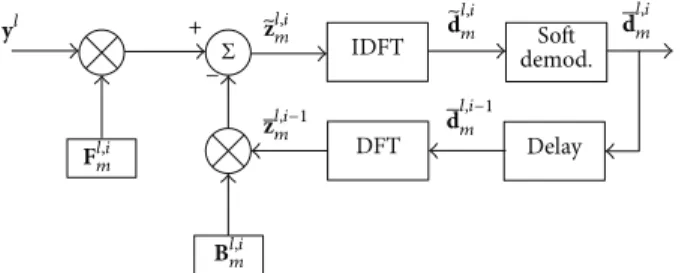
Figure 2: Iterative macrocell receiver structure based on IB-DFE principle.
based systems, due to the residual ICI, and consequently they are not well suited also for heterogeneous systems. Consequently, we consider instead an iterative nonlinear equalizer, the IB-DFE, to tackle at the same time both the ICI intertier and the interference.
In Figure 2 we present the proposed IB-DFE receiver structure, for the𝑖th iteration. The received signal on the 𝑙th subcarrier and𝑖th iteration, before the IDFT operation, is
̃x𝑙,𝑖𝑚 = F𝑙,𝑖𝑚y𝑚𝑙 − B𝑙,𝑖𝑚x𝑙,𝑖−1𝑚 , (7) where x𝑙,𝑖𝑚 = [x𝑙,𝑖𝑚(1), . . . , x𝑙,𝑖𝑚(𝑝), . . . , x𝑚𝑙,𝑖(𝑆𝑚𝐾𝑚)]𝑇. F𝑙,𝑖𝑚 ∈ C𝑆𝑚𝐾𝑚×𝑀𝑟 denotes the feedforward matrix and B𝑙,𝑖
𝑚 ∈
C𝑆𝑚𝐾𝑚×𝑆𝑚𝐾𝑚 the feedback matrix. The sequence{x𝑙,𝑖
𝑚(𝑝)}𝐿𝑙=1is
the IDFT of the detector output{d𝑙,𝑖𝑚(𝑝)}𝐿𝑙=1. For normalized QPSK constellations (i.e., d𝑙,𝑖𝑚(𝑝) = ±1 ± 𝑗) the average values are given by (see [23] for details),
d𝑙,𝑖𝑚(𝑝) = tanh (L (𝑙,𝑖)Re 𝑚 (𝑝) 2 ) + 𝑗 tanh ( L(𝑙,𝑖)Im𝑚 (𝑝) 2 ) , (8) where L(𝑙,𝑖)Re𝑚 (𝑝) = 2 𝜎(𝑙,𝑖)2 𝑚 Re{d𝑙,𝑖𝑚(𝑝)} , L(𝑙,𝑖)Im𝑚 (𝑝) = 2 𝜎𝑚(𝑙,𝑖)2 Im{d𝑙,𝑖𝑚(𝑝)} , 𝜎𝑚(𝑙,𝑖)2 = 1 2𝐿 𝐿−1 ∑ 𝑙=0 ̂d𝑙𝑚,𝑖(𝑝) − d 𝑙,𝑖 𝑚 (𝑝) 2 . (9)
The extension to other constellations is considered in [24]. The hard decision ̂d𝑙,𝑖𝑚(𝑝) associated with data symbol d𝑙𝑚(𝑝)
is
̂d𝑙,𝑖
𝑚(𝑝) = sign (Re {̃d𝑙,𝑖𝑚(𝑝)})
+ 𝑗 sign (Im {̃d𝑙,𝑖𝑚(𝑝)}) .
(10)
It can be shown that x𝑙,𝑖𝑚 ≈ Ψ𝑖𝑚2x𝑙𝑚 + Ψ𝑖𝑚e𝑙𝑚, where e𝑙𝑚 is a zero mean error vector andΨ𝑖𝑚a diagonal correlation matrix.
The correlation coefficient computed for the𝑗th 𝐿-length data block is Ψ𝑖𝑚(𝑝) = E [̂d 𝑙,𝑖−1 𝑚 (𝑝) d𝑙 ∗ 𝑚(𝑝)] E [d𝑙 𝑚(𝑝)2] , 𝑙 = 1, . . . , 𝐿. (11)
This scalarΨ𝑖𝑚(𝑝) represents a measure of the reliability of the estimates of the𝑝th 𝐿-length data block associated with the 𝑖th iteration, which can be approximately given by
Ψ𝑖𝑚(𝑝) ≈ 1 2𝐿 𝐿−1 ∑ 𝑙=0Ψ (𝑙,𝑖)Re 𝑚 (𝑝) + Ψ(𝑙,𝑖)Im𝑚 (𝑝) 2 , (12) where Ψ(𝑙,𝑖)Re𝑚 (𝑝) = tanh (L (𝑙,𝑖)Re 𝑚 (𝑝) 2 ) , Ψ(𝑙,𝑖)Im𝑚 (𝑝) = tanh (L (𝑙,𝑖)Im 𝑚 (𝑝) 2 ) . (13)
For a given iteration, we have seen that the iterative nonlinear equalizer is characterized by the matrices F𝑙,𝑖𝑚 and
B𝑙,𝑖𝑚, which are selected to minimize the average bit error rate (BER). For a QPSK constellation with Gray mapping the BER is approximately given by [23] BER𝑙≈ 𝑄 (𝑃𝑚(1 𝐿 𝐿 ∑ 𝑙=1 MSE𝑙,𝑖) −1 ) , (14) where 𝑄(𝑥) denotes the 𝑄 function and MSE𝑙 denotes the mean square error on the frequency domain samples ̃z𝑙𝑚, which is given by
MSE𝑙,𝑖= E [̃z𝑙,𝑖𝑚− z𝑙𝑚2]
= E [tr ((̃z𝑙,𝑖𝑚− z𝑙𝑚) (̃z𝑙,𝑖𝑚− z𝑙𝑚)𝐻)] .
(15)
After some mathematical manipulations, it can be shown that (15) can be reduced to
MSE𝑙,𝑖= tr (F𝑙,𝑖𝑚R𝑙y𝑙 𝑚F (𝑙,𝑖)𝐻 𝑚 ) + tr (B𝑙,𝑖𝑚R𝑖−1z𝑚,z𝑚B (𝑙,𝑖)𝐻 𝑚 ) + 𝑆𝑚𝐾𝑚− 2 tr (Re {F𝑙,𝑖𝑚R𝑙y𝑙 𝑚,z𝑚}) + 2 tr (Re {B𝑙,𝑖 𝑚R𝑖−1z𝑚,z𝑚}) − 2 tr (Re {B𝑙,𝑖 𝑚R𝑙,𝑖−1z𝑚,y𝑙 𝑚F (𝑙,𝑖)𝐻 𝑚 }) . (16)
The different correlation matrices of (16) are given by R𝑙y𝑙 𝑚 = E [y 𝑙∗ 𝑚y𝑙 𝑇 𝑚] = H𝑙𝑚𝑚R𝑚H𝑙 𝐻 𝑚𝑚+ 𝐾𝑠𝑆𝑠A𝑙𝑠A𝑙 𝐻 𝑠 + R𝑛, Rz𝑚𝑖−1,z𝑚 = E [z∗𝑚z𝑇𝑚] = Ψ(𝑖−1)𝑚 2R𝑚, Rz𝑚𝑖−1,z𝑚 = E [z∗𝑚z𝑚] = Ψ(𝑖−1) 2 𝑚 R𝑚, R𝑙y𝑙 𝑚,z𝑚 = E [y 𝑙∗ 𝑚z𝑚] = H𝑙𝑚𝑚R𝑚, R𝑙,𝑖−1z 𝑚,y𝑚𝑙 = E [z ∗ 𝑚y𝑙𝑚] = Ψ(𝑖−1) 2 𝑚 R𝑚H𝑙 𝐻 𝑚𝑚 (17) with R𝑚 = 𝑃𝑚I𝑆𝑚𝐾𝑚 and R𝑛 = (𝜎 2 noise/𝑃𝑚 + 𝜎2𝑄)I𝑀𝑟 being
the correlation matrices of the data symbols and of the residual noise, respectively.𝜎𝑄2 denotes the power of the noise introduced by the quantization procedure, which is assumed approximately Gaussian distributed.
To optimize the parameters of the iterative equalizer, that is, matrices F𝑙,𝑖𝑚and B𝑙,𝑖𝑚, we use as a metric the average BER (14). This optimization problem may be mathematically formulated as follows: min F𝑙,𝑖 𝑚,B𝑙,𝑖𝑚 MSE𝑙,𝑖 s.t 1𝐿∑𝐿 𝑙=1 tr(F𝑙,𝑖𝑚H𝑙𝑚𝑚) = 𝑆𝑚𝐾𝑚. (18)
The Lagrangian and Karush-Kuhn-Tucker (KKT) conditions [27, 28] of optimization problem (18) are, respectively,
L (F𝑙,𝑖𝑚, B𝑙,𝑖𝑚, 𝜇𝑚) = MSE𝑙,𝑖− 𝜇𝑚(𝐿1∑𝐿 𝑙 tr(F𝑙,𝑖𝑚H𝑙𝑚𝑚) − 𝑆𝑚𝐾𝑚) , ∇F𝑙,𝑖 𝑚L (F 𝑙,𝑖 𝑚, B𝑙,𝑖𝑚, 𝜇𝑚) = 0, ∇B𝑙,𝑖 𝑚L (F 𝑙,𝑖 𝑚, B𝑙,𝑖𝑚, 𝜇𝑚) = 0, 1 𝐿 𝐿 ∑ 𝑙=1 tr(F𝑙,𝑖𝑚H𝑙𝑚𝑚) − 𝑆𝑚𝐾𝑚= 0, (19)
where 𝜇𝑚 is the Lagrangian multiplier. The solution to optimization problem (18) is F𝑙,𝑖𝑚 = Ω𝑖𝑚H𝑙𝑚𝑚𝐻 (A𝑙𝑚)−1, B𝑙,𝑖𝑚 = F𝑙,𝑖𝑚H𝑙𝑚𝑚− I𝑆𝑚𝐾𝑚, Ω𝑖 𝑚 = (I𝑀0− Ψ (𝑖−1)2 𝑚 ) − 𝜇𝑚I𝑀0, (20) where A𝑙𝑚 = H𝑙𝑚𝑚(I𝑆𝑚𝐾𝑚 − Ψ(𝑖−1)𝑚 2)H𝑙𝑚𝑚𝐻 + 𝐾𝑠𝑆𝑠A𝑙𝑠A𝑙𝑠𝐻 + (𝜎2
noise/𝑃𝑚+ 𝜎𝑄2)I, 𝜇𝑚is the Lagrangian multiplier, and𝜎𝑄2 is
the quantization noise power. For the first iteration(𝑖 = 1) matrixΨ0𝑚and vector x𝑙,0𝑚 are a null matrix and a null vector, respectively.
As discussed above, the macrocell UTs precoders and the iterative equalizer used at the CU can be easily obtained by following the same procedure used to compute the small-cell UTs precoders and the macrocell BS equalizer, respectively.
The semianalytical approach consists in using (16) and (17) to obtain an estimate of the average BER; see (14). Relatively to the complexity, each iteration of the proposed receiver structures is similar to the linear MMSE based equalizer, since the most part of complexity comes from the matrix inversion to compute the feedforward coefficients. Therefore, the additional complexity of the proposed receiver is basically given by the number of equalizer iterations.
4. Performance Results
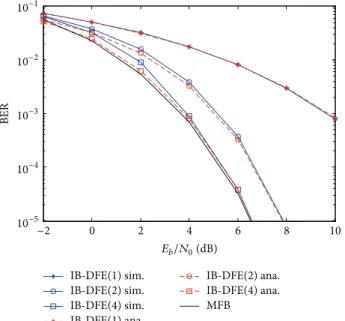
In this section we access the performance of the proposed multitier IA-precoding and IB-DFE techniques. The number of antennas at the macro-BS, macro-UTs, small-cell APs, and small-cell UTs is set to𝑀𝑟 = 4, 𝑀𝑡 = 3, 𝑁𝑟 = 3, and 𝑁𝑡 = 3, respectively. Each user terminal, both macro- and small-cell UTs, transmits one stream; that is,𝑆𝑚 = 𝑆𝑠 = 1. The number of macrocell UTs and the number of small-cells are set to𝐾𝑚 = 𝐾𝑠 = 2. The block and FFT size are set both to𝐿 = 128 and QPSK with Gray mapping was adopted. The channels between each transmitter and receiver pair are uncorrelated and severely time-dispersive, each one with rich multipath propagation and uncorrelated Rayleigh fading for different multipath components. Specifically, we assume𝐿𝑝= 32 symbol spaced paths with uniform power delay profile and uncorrelated Rayleigh fading. The same conclusions could be drawn for other multipath fading channels, if the number of separable multipath components is high. In addition, we assume perfect CSI at the receiver side (the cross-tier channels are quantized) and synchronization. We use as a metric for performance evaluation the average bit error rate (BER) as a function of𝐸𝑏/𝑁0, with𝐸𝑏denoting the average bit energy and𝑁0denoting the one-sided noise power spectral density. For the sake of comparisons we also include the MFB. Let us start by considering the case without cross-tier quantization(𝐵 = ∞). In Figures 3 and 4 we present results for the macrocell and small-cells (i.e., at the CU), respectively. In these two figures, we present results for the first, second, and fourth iterations of the proposed iterative equalizer. The MFB curve is also plotted as a baseline. For the first iteration the IB-DFE reduces to the linear MMSE based equalizer, since
Ψ0
𝑚and x𝑙,0𝑚 are a null matrix and a null vector, respectively.
As the iteration number increases the performance of the proposed method improves. For the 4th iteration and for high SNR a performance close to MFB is reached. This indicates that the proposed multitier IA in conjunction with IB-DFE efficiently removes the generated ICI and intertier interfer-ences. Moreover, the semianalytical approximation is quite precise. Indeed, for the first iteration, where the IB-DFE based equalizer reduces to a linear MMSE based frequency domain equalizer, they almost overlap. This is a consequence of the accuracy of the Gaussian assumption made to derive the
IB-DFE(1) sim. IB-DFE(2) sim. IB-DFE(4) sim. IB-DFE(1) ana. IB-DFE(2) ana. IB-DFE(4) ana. MFB 10−5 10−4 10−3 10−2 10−1 BER −2 0 2 4 6 8 10 Eb/N0(dB)
Figure 3: Performance evaluation at the macrocell, no quantization.
IB-DFE(1) sim. IB-DFE(2) sim. IB-DFE(4) sim. IB-DFE(1) ana. IB-DFE(2) ana. IB-DFE(4) ana. MFB 0 2 4 6 8 10 −2 10−5 10−4 10−3 10−2 10−1 BER Eb/N0(dB)
Figure 4: Performance evaluation at the central unit, no quantiza-tion.
proposed semianalytical results. For highly time-dispersive channels with rich multipath propagation the inter-symbol-interference (ISI) is high and therefore the signals of interest may be assumed Gaussian. Nevertheless, at the second and fourth iterations the ISI is already significantly reduced. Therefore, the Gaussian approximation of the residual ISI is less accurate, mainly for low𝐸𝑏/𝑁0values.
Now let us consider the case with quantization. The results for this case are presented in Figures 5 and 6 for macrocell and central unit, respectively. For this case, due to the quantization procedure there is residual interference between the UTs’ signals that may affect significantly the system performance. From these figures, we can verify that
0 2 4 6 8 10 4-bit sim. 4-bit ana. 6-bit sim. 6-bit ana. MFB IB-DFE(1) IB-DFE(4) 10−5 10−4 10−3 10−2 10−1 BER −2 Eb/N0(dB)
Figure 5: Performance evaluation at the macrocell, with quantiza-tion. 4-bit sim. 4-bit ana. 6-bit sim. 6-bit ana. MFB IB-DFE(1) IB-DFE(4) 0 2 4 6 8 10 −2 10−5 10−4 10−3 10−2 10−1 BER Eb/N0(dB)
Figure 6: Performance evaluation at the central unit, with quanti-zation.
the semianalytic results are still close to the ones obtained by simulation. Furthermore, with just four iterations and 6 bits we achieve close to the MFB performance. We also can see that when we have a single iteration there is a significant performance degradation from the 4-bit to the 6-bit performance since the interuser interference increases as the number of quantization bits decreases. For the 4th iteration the performance degradation from the 4 bit to the 6 bit curve is lower, which means that increasing the number of iterations of the equalizer reduces considerably the impact inherent to the noise introduction by the quantization. Furthermore, with just four iterations and 6 bits we achieve close to the MFB performance and we verify that as the
number of quantization bits increases the performance of the proposed method improves. With just 6 bits the achieved performance is very close to the unquantized approach and for the fourth iteration it is even very close to the MFB.
By comparing the results at the small-cells to the ones at the macro we verify that the performance of the macro is slightly degraded in comparison to the small-cells. This fact stems from the additional degrees of freedom available at the CU, in comparison with the macro-BS. The macro-BS has 3 antennas and the CU has 4 antennas, 2 from each aggregated AP.
5. Conclusions
In this paper, we proposed the use of IA in conjunction with iterative space-frequency equalization to enable the coexistence of a set of small-cells within the coverage area of a macrocell. A frequency reuse of one has been considered. By using IA the intertier/system interference is aligned at a predefined subspace, at both cells. Nevertheless, due to the availability of only imperfect channel knowledge at the user terminals the alignment is poor and this results in severe interference. To deal with this type of interference we proposed to adapt the IB-DFE from the single-tier case to the multitier scenario. To achieve this the optimization of the iterative equalizer was done by taking into account this additional interference. We also proposed an accurate semianalytical approach for obtaining the performance of the proposed schemes. The results showed that IA-precoding works well with iterative equalization allowing a close-to-optimum space-diversity gain; that is, for the considered scenario 4 iterations were sufficient to achieve close to MFB performance. Therefore, the proposed equalizers are robust to the intertier interference and well suited to deal with the intertier interference limitations of the heterogeneous networks.
Conflict of Interests
The authors declare that there is no conflict of interests regarding the publication of this paper.
Acknowledgments
This work was supported by the Portuguese Fundac¸˜ao para a Ciˆencia e Tecnologia (FCT) COPWIN (PTDC/EEI-TEL/1417/2012), ADIN (PTDC/EEI-TEL/2990/2012), and HETCOP (UID/EEA/50008/2013) projects. The work of D. Castanheira was supported by FCT under a postdoctoral grant SFRH/BPD/95375/2013.
References
[1] J. Hoadley and P. Maveddat, “Enabling small cell deployment with HetNet,” IEEE Wireless Communications, vol. 19, no. 2, pp. 4–5, 2012.
[2] Z. Becvar and P. Mach, “Mitigation of redundant handovers to femtocells by estimation of throughput gain,” Mobile Informa-tion Systems, vol. 9, no. 4, pp. 315–330, 2013.
[3] A. Goldsmith, S. A. Jafar, I. Maric, and S. Srinivasa, “Breaking spectrum gridlock with cognitive radios: an information the-oretic perspective,” Proceedings of the IEEE, vol. 97, no. 5, pp. 894–914, 2009.
[4] V. R. Cadambe and S. A. Jafar, “Interference alignment and degrees of freedom of the K-user interference channel,” IEEE Transactions on Information Theory, vol. 54, no. 8, pp. 3425– 3441, 2008.
[5] M. A. Maddah-Ali, A. S. Motahari, and A. K. Khandani, “Com-munication over MIMO X channels: interference alignment, decomposition, and performance analysis,” IEEE Transactions on Information Theory, vol. 54, no. 8, pp. 3457–3470, 2008. [6] K. Gomadam, V. R. Cadambe, and S. A. Jafar, “A distributed
numerical approach to interference alignment and applications to wireless interference networks,” IEEE Transactions on Infor-mation Theory, vol. 57, no. 6, pp. 3309–3322, 2011.
[7] S. W. Peters and R. W. Heath Jr., “Cooperative algorithms for MIMO interference channels,” IEEE Transactions on Vehicular Technology, vol. 60, no. 1, pp. 206–218, 2011.
[8] D. Kim and M. Torlak, “Optimization of interference alignment beamforming vectors,” IEEE Journal on Selected Areas in Com-munications, vol. 28, no. 9, pp. 1425–1434, 2010.
[9] W. Shin, W. Noh, K. Jang, and H.-H. Choi, “Hierarchical interference alignment for downlink heterogeneous networks,” IEEE Transactions on Wireless Communications, vol. 11, no. 12, pp. 4549–4559, 2012.
[10] S. K. Sharma, S. Chatzinotas, and B. Ottersten, “Interference alignment for spectral coexistence of heterogeneous networks,” EURASIP Journal on Wireless Communications and Networking, vol. 2013, no. 1, article 46, 2013.
[11] J. Assunc¸˜ao, D. Castanheira, F. Oliveira, A. Silva, and A. Gameiro, “IA-precoding with IB-DFE scheme for uplink SC-FDMA heterogeneous networks,” in Proceedings of the Inter-national Conference on Wireless and Mobile Communication Systems (WMCS ’14), Lisbon, Portugal, October-November 2014.
[12] D. Castanheira, A. Silva, and A. Gameiro, “Set optimization for efficient interference alignment in heterogeneous networks,” IEEE Transactions on Wireless Communications, vol. 13, no. 10, pp. 5648–5660, 2014.
[13] H. Holma and A. Toskala, LTE for UMTS-OFDMA and SC-FDMA Based Radio Access, John Wiley & Sons, 2009.
[14] H. G. Myung and D. J. Goodman, Single Carrier FDMA: A New Air Interface for Long Term Evolution, John Wiley & Sons, Chichester, UK, 2008.
[15] D. Falconer, S. L. Ariyavisitakul, A. Benyamin-Seeyar, and B. Eidson, “Frequency domain equalization for single-carrier broadband wireless systems,” IEEE Communications Magazine, vol. 40, no. 4, pp. 58–66, 2002.
[16] A. Gusm˜ao, R. Dinis, J. Conceic¸˜ao, and N. Esteves, “Comparison of two modulation choices for broadband wireless communi-cations,” in Proceedings of the 51st IEEE Vehicular Technology Conference Proceedings (VTC-Spring ’00), vol. 2, pp. 1300–1305, IEEE, Tokyo, Japan, May 2000.
[17] N. Benvenuto, R. Dinis, D. Falconer, and S. Tomasin, “Single carrier modulation with nonlinear frequency domain equaliza-tion: an idea whose time has come—again,” Proceedings of the IEEE, vol. 98, no. 1, pp. 69–96, 2010.
[18] N. Benvenuto and S. Tomasin, “Block iterative DFE for single carrier modulation,” Electronics Letters, vol. 38, no. 19, pp. 1144– 1145, 2002.
[19] N. Benvenuto and S. Tomasin, “Iterative design and detection of a DFE in the frequency domain,” IEEE Transactions on Communications, vol. 53, no. 11, pp. 1867–1875, 2005.
[20] R. Dinis, P. Silva, and T. Ara´ujo, “Turbo equalization with cance-lation of nonlinear distortion for CP-assisted and zero-padded MC-CDM schemes,” IEEE Transactions on Communications, vol. 57, no. 8, pp. 2185–2189, 2009.
[21] M. Luzio, R. Dinis, and P. Montezuma, “SC-FDE for offset modulations: an efficient transmission technique for broadband wireless systems,” IEEE Transactions on Communications, vol. 60, no. 7, pp. 1851–1861, 2012.
[22] A. Silva, S. Teodoro, R. Dinis, and A. Gameiro, “Iterative frequency-domain detection for IA-precoded MC-CDMA sys-tems,” IEEE Transactions on Communications, vol. 62, no. 4, pp. 1240–1248, 2014.
[23] R. Dinis, P. Silva, and A. Gusm˜ao, “IB-DFE receivers with space diversity for CP-assisted DS-CDMA and MC-CDMA systems,” European Transactions on Telecommunications, vol. 18, no. 7, pp. 791–802, 2007.
[24] J. Silva, R. Dinis, N. Souto, and P. Montezuma, “Single-carrier frequency domain equalisation with hierarchical constellations: an efficient transmission technique for broadcast and multicast systems,” IET Communications, vol. 6, no. 13, pp. 2065–2073, 2012.
[25] A. Gusm˜ao, P. Torres, R. Dinis, and N. Esteves, “A turbo FDE technique for reduced-CP SC-based block transmission systems,” IEEE Transactions on Communications, vol. 55, no. 1, pp. 16–20, 2007.
[26] H. Nam and Y. Kim, “A low-complexity single-carrier frequency-division multiple access transmitter,” International Journal of Communication Systems, vol. 25, no. 11, pp. 1489–1495, 2012.
[27] S. Boyd and V. Lieven, Convex Optimization, Cambridge Uni-versity Press, Cambridge, UK, 2009.
[28] R. T. Rockafellar, Convex Analysis, vol. 28 of Princeton Land-marks in Mathematics and Physics, Princeton University Press, 1997.
Submit your manuscripts at
http://www.hindawi.com
Computer Games Technology International Journal of
Hindawi Publishing Corporation
http://www.hindawi.com Volume 2014
Hindawi Publishing Corporation
http://www.hindawi.com Volume 2014 Distributed Sensor Networks International Journal of Advances in
Fuzzy
Systems
Hindawi Publishing Corporation
http://www.hindawi.com Volume 2014
International Journal of
Reconfigurable Computing
Hindawi Publishing Corporation
http://www.hindawi.com Volume 2014
Hindawi Publishing Corporation
http://www.hindawi.com Volume 2014
Applied
Computational
Intelligence and Soft
Computing
Advances inArtificial
Intelligence
Hindawi Publishing Corporation http://www.hindawi.com Volume 2014 Advances in Software Engineering Hindawi Publishing Corporationhttp://www.hindawi.com Volume 2014
Hindawi Publishing Corporation
http://www.hindawi.com Volume 2014
Electrical and Computer Engineering
Journal of
Journal of
Computer Networks and Communications
Hindawi Publishing Corporation
http://www.hindawi.com Volume 2014
Hindawi Publishing Corporation
http://www.hindawi.com Volume 2014
Multimedia
International Journal of
Biomedical Imaging
Hindawi Publishing Corporation
http://www.hindawi.com Volume 2014
Artificial
Neural Systems
Advances inHindawi Publishing Corporation
http://www.hindawi.com Volume 2014
Robotics
Journal ofHindawi Publishing Corporation
http://www.hindawi.com Volume 2014 Hindawi Publishing Corporationhttp://www.hindawi.com Volume 2014 Computational Intelligence and Neuroscience
Hindawi Publishing Corporation
http://www.hindawi.com Volume 2014
Modelling & Simulation in Engineering
Hindawi Publishing Corporation
http://www.hindawi.com Volume 2014
The Scientific
World Journal
Hindawi Publishing Corporation
http://www.hindawi.com Volume 2014
Hindawi Publishing Corporation
http://www.hindawi.com Volume 2014
Human-Computer Interaction Advances in
Computer EngineeringAdvances in
Hindawi Publishing Corporation