www.scielo.br/aabc
Rhizophores in
Rhizophora mangle
L: an alternative interpretation
of so-called “aerial roots”
NANUZA L. DE MENEZES*
Instituto de Biociências, Universidade de São Paulo, Caixa Postal 11461, 05422-970 São Paulo, SP, Brasil
Manuscript received on August 31, 2005; accepted for publication on September 6, 2005.
ABSTRACT
Rhizophora mangleL., one of the most common mangrove species, has an aerial structure system that gives it
stability in permanently swampy soils. In fact, these structures, known as “aerial roots” or “stilt roots”, have proven to be peculiar branches with positive geotropism, which form a large number of roots when in contact with swampy soils. These organs have a sympodial branching system, wide pith, slightly thickened cortex, collateral vascular bundles, polyarch stele and endarch protoxylem, as in the stem, and a periderm produced by a phellogen at the apex similar to a root cap. They also have the same type of trichosclereid that occurs in the stem, with negative geotropism, unlike trueRhizophoraroots, which do not form trichosclereids at all. On
the other hand, these branches do not form leaves and in this respect they are similar to roots. These peculiar branches are rhizophores or special root-bearing branches, analogous to those found in Lepidodendrales and other Carboniferous tree ferns that grew in swampy soils.
Key words:Rhizophora mangleL, rhizophore, “aerial roots”, “stilt roots”.
INTRODUCTION
One of the few tree species of the Brazilian mangrove is Rhizophora mangle, belonging to a widespread genus in the Americas, Africa, Asia, Madagascar and Australia (Juncosa and Tomlinson 1988a). According to Juncosa and Tomlinson (1988b), the generic epithet means “root-bearer”. However, according to Plumier (1703), the name Rhizophorawas attributed by G. Pisone to the fact that in the propagule of the viviparous plant “the radicle is located at the extremity of an axis, the rhi-zophore”. In fact, Pisone considered the rhizophore to be the exposed hypocotyl of the viviparous pro-pagule itself.
One of the most striking features of this species
*Member Academia Brasileira de Ciências E-mail: [email protected]
is the presence of structures that expand its support-ing base. These structures are defined as aerial roots by most authors, including Warming (1883), Hou (1958), Gill and Tomlinson (1969, 1971a, b, 1977), Sporne (1974), Chapman (1976), Hallé et al. (1978), Ellmore et al. (1983), Tomlinson (1986), Juncosa and Tomlinson (1988a, b), Mauseth (1988), Huang and Huang (1990) and Raven et al. (1992). Some of these authors have carried out extensive anatom-ical studies on these structures (Gill and Tomlinson 1971a, Chapman 1976, Ellmore et al. 1983), and concluded that they are roots, although they men-tion that they have detected stem-like characteristics in these organs. They also mention a strong char-acteristic of roots, which is the presence of a root cap.
root” in inverted commas, (“racine échasse”), but also referred to these structures as rhizophores, and advocated that they are part stem and part root. According to Pitot (1951, 1958), the rhizophore grows with a stem-like structure (sometimes as much as several meters) until it reaches the swampy soil, the apex of the rhizophore transforming itself into a root upon contact with the water. According to this author, the submerged portion is, therefore, a root, and all the aerial part, a stem.
On the other hand, Huang and Huang (1990), working with several mangrove species, refer to the fact that “the structure of the aerial root in Rhizophora mangle resembles that of the stem”, although they do not explicitly refer to the structure as a stem.
The presence of H-trichosclereids in the cor-tex was observed, in both the stem and root of Rhi-zophora mangle,by Gill and Tomlinson (1971a, b) and in the stem and aerial root, by Warming (1883) and Karsten (1891). The last two authors demon-strate that there is a system of brachiform cells in the submerged root cortex, with a special thicken-ing in the cell walls, which prevents the collapse of the cell due to the large air spaces within it. Refer-ring to these cells observed by Warming (1883), Gill and Tomlinson (1971a) propose that this was a tech-nical flaw, once Warming’s observations were made on pickled specimens. Gill and Tomlinson (1971a, p. 63) emphasize that, as their laboratory was di-rectly in front of the mangrove, they were working with recently collected material, and were able to affirm that the root does have H-trichosclereids.
The present study offers an alternative inter-pretation for the aerial structure system that provides stability toRhizophora manglein swampy soils, and seeks to understand this structure by comparing it with rhizophores, which are root-bearing organs of the CarboniferousLepidodendron(Stewart 1983), a plant which also grows in swampy soils. In relation to Lepidodendrales, Stewart (1983, p. 103) writes that: “these plants have a main axis that grows and branches at both ends. The branches of the aerial part form a three-dimensional system of
dichoto-mous or pseudomonopodial branches, with spirally arranged leaves and terminal cones. The basal end also branches dichotomously to form the anchoring and water-absorption system, which is comprised of rhizophores bearing spirally-arranged roots”.
Rhizophores have also been described in Se-laginellaas asui generisorgan (Nägeli and Leitgeb 1868 apud Jernstedt and Mansfield 1985, Goebel 1905, Jernstedt et al. 1994). Working with Diosco-reaceae, Goebel (1905) refers to the “relations be-tween the thickened organ ofDioscoreaand the root-forming organ ofSelaginella”. According to Goebel (1905), this organ is neither root nor stem, but a sui generisorgan, half way between stem and root. Ogura (1938), also working with Dioscoreaceae, calls these thickened organs rhizophores.
MATERIALS AND METHODS
The plant material used was collected from the mangrove on the Rio-Santos highway, at Km 197, in the Municipal District of Bertioga, next to the Guaratuba River . (Menezes s.n., SPF 124.080) on 02/25/1997.
Free-hand cross-sections were taken from the stem, root and rhizophore ofRhizophora mangleL., and stained with astra blue and fuchsin, according to the method described by Roeser (1962). The sec-tions, mounted in 66% glycerine, were photogra-phed using a VANOX model Olympus photomi-croscope.
RESULTS
rhi-zophore, protected by an apical periderm (Fig. 5), reaches the water in its positive geotropic growth, it forms roots at its extremities (Fig. 6) or around it (Fig. 7).
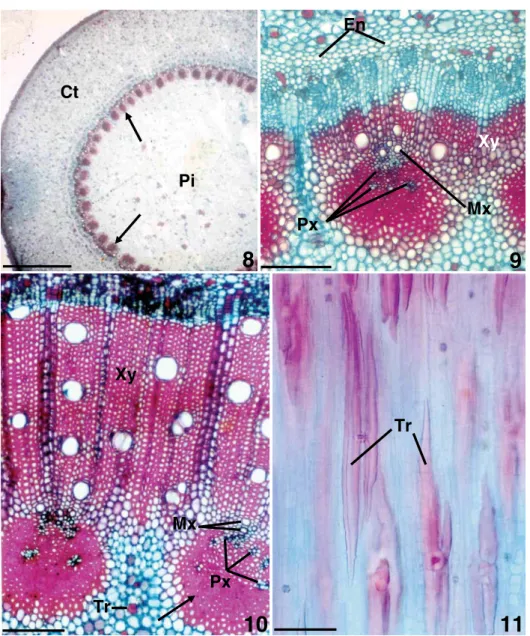
A cross-section of the aerial axis of a secondary rhizophore (Fig. 8–9) shows a wide pith and many bundles, in which the protoxylem is in anendarch
position, surrounded by fiber strands throughout the perimedullary region shown by the arrows in Fig. 8. The metaxylem is external to the pro-toxylem, where cambium, secondary phloem and secondary xylem can also be seen. The endodermis is external to the vascular system. Even when sec-ondary growth has been fully established (Fig. 10), fiber strands can be seen around the primary xylem. There are H-trichosclereids both in the cortex and in the pith, as shown in longitudinal section in Fig. 11. The root apex in longitudinal section (Fig. 12) shows a root cap formed by layers which separate eas-ily, produced by a calyptrogen. In the longitudi-nal section of the apex of the secondary rhizophore (Fig. 13), a phellogen can be seen, which produces a protective periderm. In a submedian longitudinal section of the secondary rhizophore (Fig. 14) pro-cambial strands can be seen, and in cross-section (Fig. 15), appearing inside the endodermis. These procambial strands present protoxylem in their interior at the level of Fig. 16. Closer to the apex (Fig. 17–18) the primary xylem forms collateral bundles with primary phloem strands. The cam-bium is formed in the vascular bundle and inside the interfascicular phloem. The bundles show en-darchdifferentiation of the primary xylem. There
are numerous thickened structures that correspond to H-trichosclereid arms, which are clearly visible in Fig. 11. At the level corresponding to Fig. 19, the cells are already fully lignified around the pri-mary xylem, forming fiber strands.
In the apex of the aerial stem with negative geotropism (Fig. 20–21), a band of primary phloem can be seen, originating from the pericycle, and in-terspersed with bundles containing protoxylem and metaxylem, as well as primary phloem. At the level corresponding to Fig. 21, the presence of primary
xylem, i.e. proto- and metaxylem, can be seen only inside the secondary xylem, formed by the cam-bium of procambial origin.
The roots are adventitious, and have a rela-tively wide pith (Fig. 22) withexarchprotoxylem
(Fig. 23–24). The thickened root cortex (Fig. 22) has brachiform cells with lignified secondary walls (Fig. 25) in certain regions of the cell. In a secon-dary structure (Fig. 24), parenchymatous rays for-med by the cambium of pericyclic origin also can be seen in the root.
DISCUSSION
Although the branching system that supports Rhi-zophora mangle plants in swampy soils has always been referred to as being composed of “aerial roots” or “stilt roots”, its true identity can only be resolved by means of anatomical studies. Pitot (1958) iden-tified an inversion in the vascular tissues of these or-gans inRhizophora racemosaG.F.W. Meyer, which he linked to the position of the protoxylem, typically exarch in roots and endarch in these aerial branches, as in stems. He also found another stem character-istic in this organ, namely, the presence of collateral bundles. However, he identified the existence of phloem strands interspersed between these bundles in a radial position, which led him to identify these structures as roots.
When only one adventitious root is formed at the apex (as shown in Fig. 6 with two roots at the apex), it simulates a hypocotyl-radicle axis, as a re-sult of tissue continuity, unlike subapical adventi-tious roots.
Rh2
1
2
Rh2
Figs. 1–2 –Rhizophora manglein Porto de Galinhas (Pe, Brazil). Fig. 1 – Entire plant with the
secondary rhizophores (Rh2) highlighted, at the base. Fig. 2 – Stem branch with leaves, with the same sympodial branching system as that seen in secondary rhizophores. (Photo Ricardo Sacerdoti)
and transform themselves into roots, upon contact with the swampy soil” (Pitot 1958, p. 1112). Pitot (1958, p. 1118) also states that: “the transformation of an aerial organ into an underground organ is ob-served; from endarch bundle into alternate exarch
Figs. 3–7 –Rhizophora mangle. Fig. 3 – Propagule with well-developed hypocotyl = primary rhizophore (Rh1) still connected to the fruit. Fig. 4 – Two primary rhizophores, partially submerged in the soil of the mangrove (arrows). Fig. 5 – Young branches of secondary rhizophores (Rh2) with apical protection (arrow). Fig. 6. Secondary rhizophore with two adventitious roots (Rt) at the extremity. Fig. 7. Young plant with the adventitious roots at the end of the secondary rhizophore. The bars correspond respectively to: 10 cm, 12 cm, 0.5 cm, 2 cm and 10 cm.
use of hormones. However, as Pitot (1958) demon-strates in his work withRhizophora racemosa, this phenomenon also occurs in nature. The same
8
11
10
Ct
Pi
Xy
Tr
Tr
Px
Mx
Xy
En
9
Px
Mx
Figs. 8–11 – Cross-sections (Fig. 8–10) and longitudinal section (Fig. 11) ofRhizophora manglesecondary rhizophores. Fig. 8 – Rhizophore with wide pith (Pi) and many fibrous strands (arrows). The vascular cylinder is 2.5 times the width of the cortex (Ct). Fig. 9 – Detail from previous figure, in which the protoxylem (Px), metaxylem (Mx) and secondary xylem (Xy) can be distinguished. Fig. 10 – Rhizophore with the well-developed secondary xylem. The arrow indicates the fibers of procambial origin. Fig. 11 – H-trichosclereids in longitudinal section. The bars correspond respectively to: 2 mm, 250µm, 150µm and 60µm.
two adventitious roots at the apex of the rhizophore, resulting from two root primordia.
While in this study, only regions with stem characteristics are considered rhizophore, Pitot (1958) considered the whole structure to be a rhi-zophore (with both stem and root regions), hence,
he referred to it as an “intermediate organ”. How-ever, Pitot did not explain his reasons for labeling the organ a rhizophore.
Ca Ph Pc
Rc
Pd Gm
Pe
12
13
Figs. 12–13 –Rhizophora mangle. Longitudinal sections. Fig. 12 – Root apex, showing the procambium (Pc), ground meristem (Gm), protoderm (Pd) and calyptrogen (Ca), which gives origin to the root cap (Rc). Fig. 13 – Apex of a secondary rhizophore, where the procambial strands (arrow) and a periderm (Pe) originating from the phellogen (Ph) can be distinguished. The bars correspond respectively to: 250µm and 750µm.
but these strands are usually found in young shoots. In the stem of Rhizophora mangle, Behnke and Richter (1990) prove the existence of several pri-mary phloem strands without their corresponding primary xylems, between bundles of the young shoot apex, exactly as shown in this paper. It should be noted, as demonstrated in the present work, that on the inner side of the secondary xylem, in the areas corresponding to the intercalary phloem, there are no protoxylem elements in the adult stem.
Subsequent to Pitot’s studies (1958), Gill and Tomlinson (1969) and Chapman (1976) made a se-ries of important observations on the adventitious origin of these rhizophores, which they refer to as “aerial roots”. In other words, unlike roots (ex-cept for the radicle), they are not endogenous in origin. According to these authors, these branches are clearly adventitious because the primary xylem does not have a vascular connection with the primary xylem of the stem that originated it.
Ac-cording to Chapman (1976), “there are no prior root primordia, neither can continuity with the pri-mary xylem” be observed between the root and its generator axis. Therefore, like the stem, they are exogenous in origin. Gill and Tomlinson (1969) demonstrate that while all roots have a monopodial branching system, the “aerial roots” ofRhizophora have a sympodial branching system (a characteris-tic shared with stems) which is also demonstrated in this work.
Tr
Px
Mx
Mx
Px
C1
C2
14
15
17
18
En
Px
Ph2
Tr
Ph1
16
Figs. 14–18 –Rhizophora mangle. Fig. 14 – Submedian longitudinal section of the secondary rhizophore where procambial strands (arrows) can be seen. Fig. 15–16. Cross-sections, where the arrows indicate the procambial strands and protoxylem (Px) already differentiated. Fig. 17 – Cross-section with protoxylem and metaxylem (Mx) perfectly differentiated. Fig. 18 – Differentiated fascicular cambium (C1) between the fascicular phloem (Ph1) and the metaxylem; interfascicular cambium (C2) and the interfascicular phloem (Ph2) can also be observed. En – endodermis; Tr – trichosclereid. The bars correspond respectively to: 750µm, 750µm,
150µm and 60µm.
to confusion among earlier anatomists, as to whether or not it was a root. The authors conclude their study by emphasizing features which are not found in dicotyledonous roots, and which are considered exceptions in the roots ofRhizophora mangle: pol-yarch stele, wide pith, the collateral position of the vascular tissues, and endarch protoxylem. In a later study, Gill and Tomlinson (1977) also mention that these “aerial roots” originate in the trunk, or in other “aerial roots”, sympodially, but never in under-ground (or submerged) roots.
The results presented in this study indicate that the aerial branch system ofRhizophora mangle,with
19
Ph1
C1
Ph2
Px
Mx
Xy
C2
En
Tr
Mx
Ph2
Px
En
Mx
Px
Xy
20
21
22
Ph1
C2
C1
Mx
Figs. 19–22 –Rhizophora mangle. Fig. 19 – Cross-section of the rhizophore, showing vascular bundle with endarch protoxylem (Px), and elements of the secondary xylem (Xy) already differentiated and the fascicular cambium (C1). Fig. 20 – Fibres (arrows) resulting from the procambial strands represented in Fig. 15–18. The elements of the protoxylem appear obliterated. Fig. 21 – First internode of a stem with negative geotropism in cross-section, showing the presence of an interfascicular phloem (Ph2) between the original bundles with primary xylem. Fig. 22 – Eigth internode of the same stem, without protoxylem inside the secondary xylem formed by the interfascicular cambium (C2). En – endodermis; Mx – metaxylem; Ph1 – fascicular phloem; Tr – trichosclereid. The bars correspond respectively to: 60µm, 150µm, 150µm and 150µm.
is a root cap, formed by the calyptrogen, in the rhizophore, the apical protection is a periderm formed by a phellogen. Above all, attention is drawn to the fact that the root has a subapical meristem similar to all mono- and dicotyledonous roots, while the rhizophore does not present the same type of subapical region. It grows as an ex-tension of the apex, in which vascular tissues are formed from the procambial strands.
I agree almost entirely with the statement of Pitot (1958, p. 1136) that: “This study of the anatomic transformation of the rhizophore leads us to conclude that the internal structure of the rhi-zophore known as the “stilt root” of Rhizophora racemosadoes not correspond to its external
mor-phology, which is that of an aerial root with positive geotropism, and a root cap at the extremity. Due to its anatomical structure, the rhizophore is not a root in the exact sense”. The only point with which I disagree is his affirmation that there is a root cap at the extremity of the rhizophore in fact, a periderm. However, the absence of leaves and nodes, which are characteristics of roots, supports the idea of a rhizophore as an intermediate organ between root and stem (Goebel 1905).
Figs. 23–26 – Cross-sections of the roots ofRhizophora mangle. Fig. 23 – Adventitious root with a well-developed pith (Pi) and cortex (Ct) with a thickness of 3 times the diameter of the vascular cylinder. Fig. 24 – Region of the root in primary structure with exarc protoxylem (Px); white arrow indicates secondary xylem. Fig. 25 – Region of the root in secondary structure. Fig. 26 – Warming cells (W) with a special type of thickness, lignified; the arrows indicate regions rich in plasmodesmata, in the contact between two cells. En – endodermis; Mx – metaxylem; Ph – phloem; R – parenchymatous ray; Xy – secondary xylem. The bars correspond respectively to: 2 mm, 100µm, 150µm and 60µm.
a sympodial branching with leaves and the basal system of rhizophores, also with sympodial branch-ing. Despite the difficulties involved in studying fossilized plants, Stewart (1983) reconstituted these basal organs in Lepidodendron, demonstrat-ing that they also have a cauline structure.
Ac-cording to Stewart (1983), Stigmarian systems are comprised of roots linked to a root-bearing axis, the rhizophores. These rhizophores are known as anchoring systems, and form the absorption system of Lepidodendrales.
TABLE I
Comparison of the anatomical characteristics of the rhizophore with those of the stem
and root ofRhizophora mangle.
Stem Rhizophore Root
Endarch Protoxylem –
Exarch Protoxylem – –
Cortex thickness 1/3 of vascular cylinder –
Cortex thickness 3 x vascular cylinder – –
Collateral bundles –
Exogenous origin –
Endogenous origin – –
Vascular connection with the primary xylem of the shoot absent –
Vascular connection with the primary xylem of the shoot present – –
Method of monopodial branching – –
Method of sympodial branching –
Leaves – –
Nodes – –
H-Trichosclereids present –
Warming cells present – –
Root cap – –
Reconstruction ofLepidodendronsp. (Stewart 1983)
other angiosperm families. When I first observed a second cauline system, with positive geotropism in the Asteraceae genusVernonia(Menezes 1975, Menezes et al. 1979) I assumed it to be a muta-tion and, in an analogy withSelaginella
(Selaginel-laceae), I chose the term rhizophore. In
had been published, that we became aware of Ogura’s study (1938), which contained the same considerations on Dioscoreaceae as ours, i.e., ana-logies with Selaginella and Lepidodendrales, and a reference to Goebel.
I consider the possibility of the rhizophore, by evolution, gives rise to the rhizome, rather than the latter originating from an aerial stem, as is currently assumed. Although the rhizophores inRhizophora are above the surface, as in Lepidodendrales, in other angiosperms this organ is normally found under the ground. Tomlinson (1962, p. 211), in his studies on the phylogeny of Scitamineae, makes an interesting statement. Referring to the species Phenakosper-mum, he writes: “It is one of the dogmas of ele-mentary botany that the rhizome is morphologically equivalent to a stem modified as a horizontal, stor-age and propagating organ. Can this long-accepted idea be challenged? The rhizome, or its equivalent, already exists in primitive monocotyledons. This might suggest that it is an organsui generisand not homologous with the aerial stem. One is tempted to compare the rhizome in the Scitamineae with Stig-marian axis ofLepidodendronand the rhizophores of Selaginella similar organs, the morphology of which is unexplained”.
I propose here thatRhizophora manglehas a rhizophore system. Juncosa and Tomlinson (1988b) state that the genus nameRhizophorameans “root-bearer”. However, I believe thatRhizophorashould mean “one that has rhizophores” and that rhizo-phore is a “root bearing” branch.
At first, I did not believe that Pisone’s rhizo-phore (according to Plumier 1703) bore any relation to the rhizophore I was describing. However, it is the very first rizophore ofRhizophora mangle, hence it is referred to in this paper as the primary rhizo-phore (Rh1), i.e., with well-developed hypocotyl, unlike the secondary rhizophores (Rh2), which ap-pear later inR. manglefrom adventitious buds.
According to Chapman (1976), no primary root appears to develop inRhizophora mangle. In a study which is not yet published, I intend to demonstrate that this is, in fact, true.
ACKNOWLEDGMENTS
The author thanks Vanessa de Aquino Cardoso and Delmira da Costa Silva for the cross and longitu-dinal sections of rhizophores and plate preparation; Antonio Salatino, Mary Gregory and Daniela Zappi for English revision; D. Zappi, Simon Mayo, David John Nicholas Hind, from RBG Kew, and Orbelia Robinson, for access to essential bibliography; Nor-berto Palacios who helped with the text and plates; Fundação de Amparo à Pesquisa do Estado de São Paulo (FAPESP), for the support provided (Process 93/2444-8 and 2005/54439-7) and Conselho Nacio-nal de Desenvolvimento Científico e Tecnológico (CNPq) for research grants.
Dedicated with much admiration to Dr. David F. Cutler, as a homage to him in his retirement as Head of Kew’s Anatomy Section, for his impor-tant contributions to our understanding of Plant Anatomy, and for his really excellent and warm welcome to all of us, including myself, from diff-ent parts of the world, who benefited from his ex-tensive knowledge to widen our own experience of the subject.
RESUMO
Rhizophora mangle L., uma das mais comuns espécies
do mangue, tem um sistema de estruturas aéreas que lhe fornecem estabilidade em solo permanentemente alagado. De fato, essas estruturas, conhecidas por “raízes aéreas” ou “raízes suportes” demonstraram tratar-se de ramos es-peciais com geotropismo positivo, que formam grande número de raízes quando em contato com o solo. Esses órgãos apresentam um sistema de ramificação simpodial, medula ampla, córtex pouco espesso, feixes vasculares colaterais, estelo poliarco e protoxilema endarco, como no caule, e uma periderme produzida por um felogênio no ápice, semelhante a uma coifa. Esses ramos apre-sentam, também, o mesmo tipo de tricoesclereídes que ocorrem no caule com geotropismo negativo, diferente das verdadeiras raízes deRhizophora, que não formam
de raízes, com geotropismo negativo e análogos àque-les encontrados em Lepidodendraàque-les e outras pteridófitas arbóreas do Carbonífero que, usualmente, cresciam em solos alagados.
Palavras-chave:Rhizophora mangleL, rizóforo, “raízes
aéreas”, “raízes suporte”.
REFERENCES
ANDREATARHPANDMENEZESNLDE. 1999. Mor-foanatomia do embrião, desenvolvimento pós-semi-nal e origem do rizóforo deSmilax quinquenervia
Vell. (Smilacaceae). Bol Bot Univ São Paulo 18: 33–37.
BEHNKEHDANDRICHTERK. 1990. Primary phloem development in the shoot apex ofRhizophora mangle
L. (Rhizophoraceae). Bot Acta 103: 296–304. CHAPMANV J. 1976.Mangrove vegetation. Vaduz: J.
Cramer.
ELLMOREGS, LEESCANDNICKERSON NH. 1983. Plasticity expressed by root ground tissues of
Rhizophora mangle L. (Red Mangrove). Rhodora
85: 397–403.
GIFFORDEMANDFOSTERAS. 1988. Morphology and
evolution of vascular plants. W.H. Freeeman Co., New York, 3rded.
GILL AM AND TOMLINSON PB. 1969. Studies of the growth of Red Mangrove (Rhizophora mangle
L.) 1. Habit and general morphology. Biotropica 1: 1–9.
GILL AM AND TOMLINSON PB. 1971a. Studies of
the growth of Red Mangrove (Rhizophora mangle
L.) 2. Growth and differentiation of aerial roots. Biotropica 3: 63–77.
GILL AM AND TOMLINSON PB. 1971b. Studies of the growth of Red Mangrove (Rhizophora mangle
L.) 3. Phenology of the shoot. Biotropica 3: 109– 124.
GILL AM AND TOMLINSON PB. 1977. Studies of
the growth of Red Mangrove (Rhizophora mangle
L.) 4. The adult root system. Biotropica 9: 145– 155.
GOEBEL K. 1905. Morphologische und biologische Bermerkungen. 16. Die Knollen der Dioscoreen und die Wurzelträger der Selaginellen, Organe, welche zwischen Wurzeln und Sprossen stehen. Flora 95: 167–212.
HAASDL, CAROTHERSZBANDROBBINSRR. 1976. Observations on phi-thickenings and casparian strips inPelargoniumroots. Am J Bot 63: 863–867.
HALLÉ F, OLDEMAN RAA AND TOMLINSON PB. 1978. Tropical trees and forests – An Architectural Analysis. Springer-Verlag, Berlin.
HOUD. 1958. Rhizophoraceae. Flora Malesiana ser 1.
5: 429–493.
HUANGGANDHUANGQ. 1990. Studies on the
struc-ture of plant organs and ecological adaptation of Mangrove in China (II). Acta Sci Nat Univ Suny-atseni.
JERNSTEDTJAANDMANSFIELDMA. 1985. Two di-mensional gel electrophoresis of polypetides from stems, roots, leaves and rhizophores ofSelaginella krausiana. Bot Gaz 146: 460–465.
JERNSTEDTJA, CUTTEREGANDLUP. 1994.
Inde-pendence of organogenesis and cell pattern in devel-oping angle shoots ofSelaginella martensi. Ann Bot
74: 343–355.
JUNCOSAAM ANDTOMLINSON PB. 1988a. A his-torical and taxonomic synopsis of Rhizophoraceae and Anisophylleaceae. Ann Missouri Bot Gard 75: 1278–1295.
JUNCOSAAMANDTOMLINSONPB. 1988b. System-atic comparison and some biological characteristics of Rhizophoraceae and Anisophylleaceae. Ann Mis-souri Bot Gard 75: 1296–1318.
KARSTENG. 1891. Über die Mangrove-vegetation in
Malayischen Archipel Bibl Bot 22: 1–71.
MAUSETHJD. 1988. Plant Anatomy. The Benjamim/ Cummings Publishing Company, Inc. California. MENEZESNLDE. 1975. Presença de rizóforo em
espé-cies deVernoniada Serra do Cipó. XXVI Congresso
Nacional de Botânica, Rio de Janeiro, RJ. Temas Livres – Resumos, p. 31.
MENEZESNLDE, MULLERCANDSAJOMG. 1979.
Um novo e peculiar tipo de sistema subterrâneo em espécies deVernoniada Serra do Cipó (Minas Gerais)
Brasil. Bol Bot Univ São Paulo 7: 33–38.
OGURAY. 1938. Problems in morphology (13) Botany and Zoology 6: 139–148.
PITOTA. 1951. Les “Racines-échasses” deRhizophora racemosaG.F.W. Meyer. Bull Inst Fr Afr Noire 13:
PITOTA. 1958. Rhizophores et racines chezRhizophora
sp. Bull Inst Fr Afr Noire 20: 1103–1138.
PLUMIERC. 1703. Nova Plantarum americanarum Gen-era. Paris II.
RAVEN PH, EVERT RF AND EICHHORN SE. 1992. Biology of Plants. Worth Publishers, Inc. New York. ROCHA DCANDMENEZESNLDE. 1997. O sistema subterrâneo em Dioscorea kunthianaUline and R.
Knuth (Dioscoreaceae). Bol Bot Univ São Paulo 16: 1–11.
ROESER KR. 1962. Die Nadel der Schwarzkiefer –
Massenprodukt und Kunstwert der Natur. Mikro-kosmos 61: 33–36.
SPORNEKR. 1974. The Morphology of Angiosperms. Hutchinson and Co. (Publishers) Ltd., London, England.
STEWARTWN. 1983. Paleobotany and the evolution of plants. Cambridge University Press, London, Eng-land.
TOMLINSONPB. 1962. Phylogeny of the Scitamineae
– Morphological and Anatomical Considerations. Evolution 16: 192–213.
TOMLINSONPB. 1986. The botany of Mangroves.
Cam-bridge University Press, CamCam-bridge.