Acta Scientiarum
http://www.uem.br/acta ISSN printed: 1806-2636 ISSN on-line: 1807-8672
Doi: 10.4025/actascianimsci.v37i1.24732
Performance, carcass characteristics and litter moisture in broilers
housed at two densities
Edenilse Gopinger1*, Valdir Silveira de Avila3, Dani Perondi2, Aiane Aparecida da Silva Catalan1, Everton Luis Krabbe3 and Victor Fernando Büttow Roll1
1
Programa de Pós-graduação em Zootecnia, Departamento de Zootecnia, Faculdade de Agronomia Eliseu Maciel, Universidade Federal de Pelotas, Campus Universitário, s/n, 96010-900, Pelotas Rio Grande do Sul, Brazil. 2
Faculdade de Ciências Agrária e Veterinária, Universidade Estadual Paulista "Julio de Mesquita Filho", Jaboticabal, São Paulo, Brazil. 3
Embrapa Suínos e Aves, Concórdia, Santa Catarina, Brazil. *Author for correspondence. E-mail: [email protected]
ABSTRACT. The effect of stocking density in broiler chickens (11.08 and 13.20 birds m-2), between 5
and 45 days of age, was assessed with regard to performance, cut yield, litter moisture and frequency of pododermatitis injuries. Further, 476 one-day chicks Cobb 500® were distributed in a completely
randomized design at two densities (birds m-²), with seven replications per treatment in 14 experimental
units. Birds housed at a lower density (11.08) increased feed intake (p < 0.05), without any effect on weight gain and feed conversion. Retail yields were not influenced (p > 0.05) by treatments. In the case of higher density (3.20)the litter showed higher moisture content (p < 0.05) at 28 and 35 days of age. There was a higher occurrence of pododermatitis in birds housed at a density of 13.20 birds m-2. Results show
that increased housing density from 11.08 to 13.20 birds m-2 does not affect growth performance, carcass
yield and cuts. However, a housing density of 13.20 birds m-2 increased litter moisture and provided a
higher occurrence of grade I pododermatitis.
Keywords: chickens, feed intake, stocking, environment, pododermatitis, welfare.
Desempenho, características de carcaça e umidade da cama em frangos de corte alojados
em duas densidades
RESUMO. Foi realizado um experimento para verificar o impacto da densidade de alojamento em frangos de corte (11,08 e 13,20 aves m-2) sobre o desempenho, rendimento de cortes, umidade da cama e frequência
de lesões por pododermatite no período de cinco a 45 dias de idade. Foram utilizados 476 pintos da linhagem Cobb 500® com um dia de idade, distribuídos em um delineamento experimental inteiramente
casualizado, empregando duas densidades (aves m-2) e sete repetições por tratamento, 14 unidades
experimentais. Observou-se que as aves alojadas em menor densidade (11,08) apresentaram maior consumo de ração (p < 0,05), porém, sem afetar o ganho de peso e a conversão alimentar. O rendimento das partes não foi influenciado pelos tratamentos (p > 0,05). Foi verificado efeito significado (p < 0,05) sobre a umidade da cama na maior densidade (3,20), apresentando maior umidade (p < 0,05) aos 28 e aos 35 dias de idade das aves. Observou-se maior incidência por pododermatite em aves alojadas na maior densidade (3,20). Conclui-se que o aumento da densidade de alojamento de 11,08 para 13,20 aves m-2, não
afeta o desempenho zootécnico, rendimento da carcaça e cortes. Porém, promoveu aumento na umidade na cama, assim como a maior incidência de pododermatite de grau 1 foi observada na densidade de 13,20 aves m-2.
Palavras-chave: aves, consumo de ração, lotação, ambiência, pododermatite, bem-estar.
Introduction
The continuous development of broiler studies on their genetics, nutrition, ambiance and handling triggered a rapid growth of the poultry industry in Brazil since they are the main factors that compose the success of the activity.
Due to extensive broiler-raising, higher densities have been used to increase production, with minimal investment in construction and with optimization of fixed costs (Lana et al., 2001).
According to Mortari et al. (2002) density increase results in a decrease in the individual final broilers’ weight, with an increase in productivity per m² and improvement in high economic returns to the producer.
intake, higher density of animals generates a worsening in performance and reduces litter quality mainly by compaction due to the increase of humidity. The latter intensifies the occurrence of skin lesions, pododermatitis, chest callus and hematomas.
Contact pododermatitis is an erosive skin lesion, predominantly on the plantar surface of the broilers’ leg pad. The etiology presents a skin inflammation caused by a combination of humidity and caustic factors, such as concentration of ammonia and acid pH in the litter, which provokes focal ulcerative dermatitis. Further, the excreta of birds are composed of uric acid, a major agent in the formation of the disease (Hernandes et al., 2002). Pododermatitis in broilers began to be seen as greatly relevant in recent years due to the export of chicken feet to the Asian markets.
Another factor associated with a higher density of birds is the litter’s moisture contents, also correlated with the occurrence and severity of pododermatitis lesions and in the carcass, especially the callus on the chest. Greater adherence of feces, causing lesions, may be observed in more humid litters, besides providing a favorable environment for the development of bacteria that may infect chicken skin (Oliveira & Carvalho, 2002). Current
assay uses densities 11.08 and 13.20 birds m-² in a
conventional aviary to investigate the impact on performance, cut yield, litter moisture and frequency of pododermatitis lesions.
Material and methods
The experiment and laboratory analyses were performed at the laboratory of the National Center for Swine and Poultry Research (EMBRAPA-CNPSA) in Concórdia, Santa Catarina State, Brazil. Prior to the housing of the birds, all boxes received 19.20 kg of new litter made of dry wood shavings (Pinus elliotis). Shavings came from the same vendor and from the same batch for all boxes to maintain similar characteristics. The experimental boxes had
an area of 2.80 m2 (1.60 m wide by 1.75 m long) and
were housed in a conventional shed.
Further, 476 one-day old male Cobb 500® chicks
were distributed in a completely randomized experimental design, composed of two treatments
(densities 11.08 and 13.20 birds m-²) with seven
replications per treatment, totaling 14 experimental units. Feeders and waters were used during the first 10 days of life, which were later replaced by tubular feeders and pendulum waters. The birds were fed on diets based on corn and soybean meal, meeting the requirements recommended by Rostagno et al.
(2005). Three diets were elaborated (Table 1): starting (1-21 days), growth (22-35 days) and finishing (36-45 days). Birds received feed and water
ad libitum.
Evaluations of growth performance at 21, 28, 35 and 45 days of age were performed during the experiment, in which average weight, average weight gain, average feed consumption and feed conversion during 5-45 days of age were measured.
Table 1. Centesimal composition of experimental diets for starting (1-21 days), growth (22-35 days) and finishing (36-45 days) stages.
Ingredients Starting Growth Finishing Corn grain 52.01 56.87 59.47
Soybean meal 38.88 33.39 30.90 Soybean oil 3.93 4.99 5.21 Dicalcium phosphate 2.12 1.87 1.71 Limestone 0.77 0.76 0.71 Common salt 0.50 0.47 0.45
Wheat flour 0.50 0.50 0.50
Choline Chloride (60%) 0.30 0.26 0.23 Dl-Methionine (99%) 0.28 0.23 0.21 HCL-lysine (78%) 0.18 0.16 1.17
L-threonine 0.05 0.03 0.03
Mycosorb 0.20 0.20 0.20 Mineral mixture ¹ 0.10 0.10 0.10 Vitamin mixture ² 0.05 0.05 0.05 Anticoccidial 0.05 0.05 0.00 Antioxidant 0.01 0.01 0.01
Total 100.00 100.00 100.00
¹Roligomix (Roche): Warranty levels kg-1 of product: Mn 16.0 g; Fe - 100.0 g; Zn – 100.0 g; Cu - 20.0 g; Co - 2.0 g; Iodine - 2.0 g; and q. s. p. Vehicle – 1,000 g. ²Rovimix (Roche) - Warranty levels kg-1 of product: Vit. A – 10,000,000 UI; Vit. B6 - 4.0 g Vit. D3 – 2,000,000 UI; Vit. E - 30.000 UI; Vit. B1 - 2.0 g; Pantothenic Acid - 12.0 g; Biotin - 0.10 g; Vit. K3 - 3.0 g; Folic acid - 1.0 g; Nicotinic acid - 50.0 g; Vit. B12 - 15.000 mcg; Se - 0.25 g; and q. s. p. Vehicle - 1.000 g.
Litter samples were collected at 28, 35 and 45 days of age to determine moisture, following methodology described by AOAC (1998). The litter was sampled at five random points of the box forming an ‘x’, following the same collection model during the entire experimental period. A mixture of the points was performed at the end of each collection and a pool of the sample of the box was set up for laboratory analyses.
When the broilers reached 45 days of age, the birds were slaughtered and the yield of the parts was calculated by weighing the cuts (g) of the cooled carcass, calculated in relation to live weight before slaughter, using the following formula: Yield = {(cut Weight/Live Weight)*100} Pododermatitis lesions were also evaluated following methodology by Martrenchar et al. (2002), via a four-point scale in which: Score 0: intact plantar cushion; Score 1: less than 25% of the cushion affected; Score 2: lesion covering 26-50% of the cushion; Score 3: lesions covering over 50% of the cushion.
Stocking density of broilers 37
ij i ij
y =µ+α +ε , where yij = yij-th observation
of level i of the treatment factor; µ= overall mean;
i
α = effect of the i-th treatment; = 1, 2;
ε
ij =random experimental error, independent random
variable and identically distributed,
ε
ij~ N(0, σ2).Treatment averages were compared by F test
(p < 0.05) with SAS® (2002). To evaluate the effect
of stocking density on the frequency of contact pododermatitis, data were analyzed by the
chi-square (χ²) test through the FREQ procedure of
SAS (2004), according to the mathematical model
(
)
(2 1) ( 1)
1 2 1 2 − − = = −
= sj r xs
j , i j , i j , i r i ~ E E O
Q χ ,
where: geral total j coluna da total X i linha da total
Ei,j= , expected
values;
j , i
O , observed values. The Q2 distribution
behaves as a Chi-square model with (r-1) x (s-1)
degrees of freedom, with r and s representing the
number of rows and columns, respectively.
Results and discussion
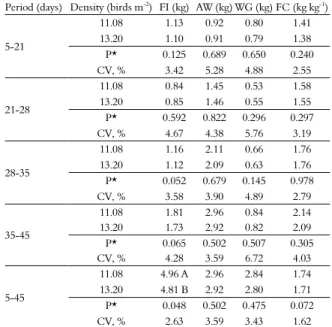
Daily feed intake, daily weight gain and feed conversion were not affected (p > 0.05) by stocking density when each period was analyzed separately (Table 2). However, there was a significant difference (p > 0.05) for daily feed intake during the
whole period. Birds housed at density 11.08 birds m-²
had higher feed intake. Consumption increase may be associated with decrease in density, with an increase of the physical space in the feeders.
Performance results corroborate results by Santos et al. (2005) who investigated different
stocking densities (10, 16, 22 birds m-2) and
observed an increase in feed intake at lower densities. Araújo et al. (2007) tested densities 10 and
12 birds m-2 and observed decrease in feed intake at
density 12 birds m-2. According to the authors, this
reduction in consumption at high densities may be associated to the difficulty of access to feeders, due to the smaller physical space per bird in the shed. On the other hand, the authors reported that density did not affect weight gain.
However, the results of current study differed from those by Lana et al. (2001) who found no significant difference in feed consumption of birds
at 10, 12 and 16 birds m-2 during the entire period of
the lot. Similarly, Moreira et al. (2004) tested the
stocking densities of 10, 13 and 16 birds m-2 and
reported that density failed to affect feed intake, although it reduced the birds’ weight gain. Results may be associated to environmental comfort, quality of the litter and air, which has a direct influence on the ingestion behavior of birds (Lana et al., 2001).
Table 2. Average feed intake (FI), average weight (AW), weight gain (WG) and feed conversion (FC) of Cobb male broilers at two stocking densities.
Period (days) Density (birds m-2) FI (kg) AW (kg) WG (kg) FC (kg kg-1)
5-21
11.08 1.13 0.92 0.80 1.41 13.20 1.10 0.91 0.79 1.38 P* 0.125 0.689 0.650 0.240 CV, % 3.42 5.28 4.88 2.55
21-28
11.08 0.84 1.45 0.53 1.58 13.20 0.85 1.46 0.55 1.55 P* 0.592 0.822 0.296 0.297 CV, % 4.67 4.38 5.76 3.19
28-35
11.08 1.16 2.11 0.66 1.76 13.20 1.12 2.09 0.63 1.76 P* 0.052 0.679 0.145 0.978 CV, % 3.58 3.90 4.89 2.79
35-45
11.08 1.81 2.96 0.84 2.14 13.20 1.73 2.92 0.82 2.09 P* 0.065 0.502 0.507 0.305 CV, % 4.28 3.59 6.72 4.03
5-45
11.08 4.96 A 2.96 2.84 1.74 13.20 4.81 B 2.92 2.80 1.71 P* 0.048 0.502 0.475 0.072 CV, % 2.63 3.59 3.43 1.62
*P – probability by F test (p < 0.05); CV – coefficient of variation.
According to Mortari et al. (2002), density increase causes the birds to have difficulty accessing the feeders, which explains fall in consumption and makes mandatory diets with higher nutrient concentration.
With regard to litter moisture, the effect of
stocking density of 13.20 birds m-2 at 28 and 35 days of
age of the birds (Table 3) was significant (p < 0.05). However, at 45 days of age, litter moisture did not differ statistically between the two densities, in spite of the numerical differences in treatments.
Table 3. Litter moisture (LM-%) at different ages of Cobb 500 male broilers with two stocking densities.
Density (birds m-2)
LM-% (28 days) LM-% (35 days) LM-% (45 days) 11,08 43.88 45.69 51.68 13,20 49.23 51.24 55.04
P* 0.002 0.030 0.250
CV, % 5.54 8.87 9.82
*P – probability by F test (p < 0.05); CV – coefficient of variation.
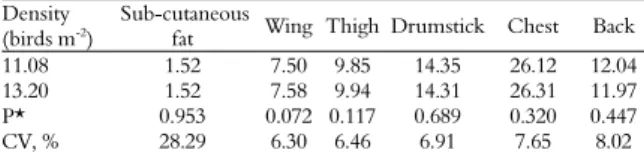
stocking density on carcass and cut yield. The above authors consider that a higher stocking density may impair the yield of carcass or its parts if temperature control is not effective.
The increase of stocking density from 11.08 to
13.20 birds m-2 in current analysis showed that the
yield of cuts was maintained, although there was an
increase in productivity per m2 of the shed.
Another fact observed at 45 days of age was that when the density is increased from 11.08 to 13.20
birds m-2, a significant increase (p < 0.0001) in
animal load occurs, ranging from 32.84 to 38.61 kg
of live weight m-2.
The evaluation of the frequencies of contact pododermatitis lesions (Table 5) demonstrated a difference between the degrees of lesion within the density, in which grade 0 showed the highest
frequency with 11.08 birds m-2. At a density of 13.20
birds m-2, a greater frequency of grade 1 lesion was
reported, differing from the other grades; however, grades 0 and 2 did not differ.
Table 4. Cuts yield (%) of male Cobb 500 broilers at 45 days of age subjected to different densities from 5 to 45 days of age.
Density (birds m-2)
Sub-cutaneous
fat Wing Thigh Drumstick Chest Back
11.08 1.52 7.50 9.85 14.35 26.12 12.04 13.20 1.52 7.58 9.94 14.31 26.31 11.97 P* 0.953 0.072 0.117 0.689 0.320 0.447 CV, % 28.29 6.30 6.46 6.91 7.65 8.02
*p – probability by F test (p < 0.05); CV – coefficient of variation.
When comparing the effect between the densities in each lesion grade, a significant difference was
reported: for grade 0, the density 11.08 birds m-2
showed higher frequency of lesions when compared
with that of density of 13.20 birds m-2. There were
differences between densities in the degrees of
lesion 1, 2, 3. In fact, density 13.20 birds m-2 showed
a higher lesion frequency than that of density of
11.08 birds m-2.
Table 5. Frequencies, percentages and descriptive levels of probability of the Chi-square test for the number of pododermatitis lesions in male broiler chickens stocked at different densities.
Density (Birds m-2)
Lesion degree
p > χ² 0 1 2 3
11.08 A 131 (61.50) a
B 65 (14.16) b
B 13 (2.83) c
B 4 (0.87) d
<0.0001 13.20 B 65
(14.16) b
A 108 (23.53) a
A 46 (10.02) b
A 27 (5.88) c
Averages followed by different lowercase letters in the rows and cTase in the columns differ significantly by the χ² test (p ≤ 0.05).
Probably, the increase in stocking density caused an increase in the amount of ammonia in the litter due to the greater amount of excreta and, consequently, an increase of humidity, which led towards a higher occurrence of pododermatitis
lesions. Bruce et al. (1990) verified that the causes of pododermatitis are linked to a combination of high density, moisture and high concentration of ammonia in the litter. According to Muniz et al. (2006), there is a direct relationship between population density and the percentage of feet cushion calluses, demonstrating that the amount of animals per square meter interferes in the condition of the litter due to the volume of excreta eliminated and negatively interfering in the health and welfare of animals, resulting in carcass disposal.
Conclusion
Increase in stocking density from 11.08 to 13.20
birds m-2 does not affect performance and carcass and
cuts yield. However, litter moisture increases and, consequently, a higher occurrence of grade 1
pododermatitis was observed at density 13.20 birds m-2.
References
AOAC. (1998). Official Methods of Analysis (15th ed.): Assoc. Off. Anal. Chem., Arlington, VA, U.S.A. Araújo, S. J., Oliveira, V. & Braga, G. C. (2007).
Desempenho de frangos de corte criados em diferentes tipos de cama e taxa de lotação. Ciencia Animal Brasileira, 8(1), 59-64.
Bruce, D. W., McIlroy, S. G. & Goodall, E. A. (1990). Epidemiology of a contact dermatitis of broilers. Avian Pathology, 19(3), 523-537.
Hernandes, R., Cazetta, J. O. & Moraes, V. M. B. (2002). Frações nitrogenadas, glicídicas e amônia liberada pela cama de frangos de corte em diferentes densidades e tempos de confinamento. Revista Brasileira de Zootecnia, 31(4), 1795-1802.
Lana, G. R. Q., Silva Junior, R. G. C., Valerio, S. R., Lana, A. M. Q. & Cordeiro, E. C. G. B. (2001). Efeito da densidade e de programas de alimentação sobre o desempenho de frangos de corte. Revista Brasileira de Zootecnia, 30(4), 1258-1265.
Martrenchar, A., Boilletot, E., Huonnic, D. & Pol, F. (2002). Risk factors for foot-pad dermatitis in chicken and turkey broilers in France. Preventive Veterinary Medicine, 52(3), 213-226.
Moreira, J., Mendes, A. A., Garcia, R. G., Nääs, I. A., Miwa, I., Garcia, E. A., Takita, T. S. & Almeida, I. C. L. (2001). Efeito da densidade de criação e do nível de energia da dieta sobre o desempenho e rendimento de carcaça em frangos de corte. Revista Brasileira de Ciência Avícola, 3(Sup.), 39.
Stocking density of broilers 39
Mortari, A. C., Rosa, A. P., Zanella, I., Neto, C. B., Visentini, P. R. & Brites, L. B. P. (2002). Desempenho de frangos de corte criados em diferentes densidades populacionais, no inverno, no sul do Brasil. Ciencia Rural, 32(3).
Muniz, E. C., Fascina, V. B., Pires, P. P., Carrijo, A. S. & Guimarães, E. B. (2006). Histomorphology of bursa of Fabricius: effects of stock densities on commercial broilers. Revista Brasileira de Ciência Avícola, 8(4), 217-220.
Oliveira, M. C. & Carvalho, I. D. (2002). Rendimento e lesões em carcaça de frangos de corte criados em diferentes camas e densidades populacionais. Ciencia e Agrotecnologia, 26(5), 1076-1081.
Rostagno, H. S., Albino, L. F. T., Donzele, J. L., Gomes, P. C., Oliveira, R. d., Lopes, D. C., Ferreira, A. S., Barreto, S. et al. (2005). Composição de alimentos e
exigências nutricionais. In Tabelas brasileiras para aves e suínos (Vol. 2).
Santos, T. M. B., Junior, J. L. & Sakomura, N. K. (2005). Efeitos de densidade populacional e da reutilização da cama sobre o desempenho de frangos de corte e produção de cama. Revista Portuguesa de Ciencias Veterinarias, 100(553-554), 45-52.
SAS. (2004). SAS/STAT User guide, Version 9.1.2. Cary, NC, USA: SAS Institute Inc.
Received on August 19, 2014. Accepted on October 3, 2014.