Glyphosate on digestive enzymes activity in piava (Leporinus obtusidens)
Glifosato sobre a atividade de enzimas digestivas em piavas (
Leporinus obtusidens
)
Joseânia Salbego
IAlexandra Pretto
IIVera Maria Machado da Silva
IIVania Lucia Loro
IIRafael Lazzari
IIICarolina Rosa Gioda
IVBernardo Baldisserotto
I*ISSN 0103-8478
ABSTRACT
The effects of glyphosate, a nonselective herbicide
(1.0 or 5.0mg L-1) on digestive enzymes activity (stomach and
intestine) were evaluated in juveniles of piava (Leporinus
obtusidens) after 90 days of exposure. The activity of acid protease, trypsin, chymotrypsin and amylase increased with the increase of glyphosate concentration. These results indicate that glyphosate affects digestive enzyme activities in this species, and may be an indicator of poor nutrient availability when fi sh survive in herbicide-contaminated water.
Key words: fi sh, herbicide, acid protease, amylase, trypsin.
RESUMO
Os efeitos do glifosato, um herbicida não seletivo
(1,0 ou 5,0mg L-1), sobre a atividade de enzimas digestivas
(estômago e intestino) foram avaliadas em juvenis de piava (Leporinus obtusidens) após 90 dias de exposição. A atividade da protease ácida, tripsina, quimiotripsina e amilase aumentaram com a elevação da concentração de glifosato. Esses resultados indicam que o glifosato afeta a atividade de enzimas digestivas nesta espécie e pode ser indicador da reduzida disponibilidade de nutrientes, quando peixes sobrevivem em água contaminada com este herbicida.
Palavras-chave:peixe, herbicida, protease ácida, amilase, tripsina.
INTRODUCTION
Glyphosate, chemically known as
isopropylamine salt of N - phosphonomethyl glycine,
is a post-emergent herbicide widely used in several
types of cultures (MODESTO & MARTINEZ,
2010a,b) and in South America this herbicide is one
of the most widely used following the introduction
of glyphosate–resistant transgenic soybean (
Glycine
max
) (SOSO et al., 2007). The most known worldwide
commercial name for glyphosate is Roundup
TM(GIESY et al., 2000).
The piava (
Leporinus
obtusidens
) has
great potential for
fi
sh culture due to its omnivorous
feeding habit and ecological and economic importance
to the Uruguay River Basin (REYNALTE-TATAJE
& ZANIBONI FILHO, 2010). Studies demonstrated
that exposure of
fi
sh
to glyphosate leads to oxidative
stress, inhibited brain and muscle acetylcholinesterase
activity, cause metabolic changes and impairs growth
(MODESTO & MARTINEZ, 2010a,b; SALBEGO et
al., 2010; GLUSCZAK et al., 2011). Several studies
indicate that growth rate in
fi
sh can be partially
attributed to digestive capacity (BLIER et al., 2002;
FILIPPOV et al., 2013). Therefore, the aim of this
study was to verify the effect of chronic exposure to
sublethal glyphosate concentrations on the activity of
digestive enzymes of piava juveniles.
MATERIAL AND METHODS
Piava juveniles (mean ± SEM; weight =
8.0±0.5g and length = 5.0±1.0cm) were obtained
IDepartamento de Fisiologia e Farmacologia, Universidade Federal de Santa Maria (UFSM), Av. Roraima, 1000, 97105-900, Santa Maria,
RS, Brasil. E-mail: [email protected]. *Autor para correspondência.
IIDepartamento de Química, UFSM, Santa Maria, RS, Brasil.
IIIDepartamento de Zootecnia e Ciências Biológicas, Centro de Educação Superior Norte (CESNORS), UFSM, Palmeira das Missões, RS,
Brasil.
from the Fish Culture Laboratory at the Universidade
Federal de Santa Maria (UFSM). Fish were acclimated
for ten days in 250L continuously aerated tanks with
a static system and a natural photoperiod (14h light -
10h dark). After the acclimation period,
fi
sh were
placed in 250L continuously aerated tanks (30
fi
sh
per tank) and exposed for 90 days to 0 (control), 1.0
or 5.0mg L
-1Roundup
TM(48% acid equivalent of
the isopropylamine salt of glyphosate, Monsanto
Company, Saint Louis, MO, USA) diluted in water
(two replicates). Roundup concentrations were chosen
considering that the 0.36-2.16mg L
-1range is used
in agriculture and based on the estimated half-life of
glyphosate (RODRIGUES & ALMEIDA, 1998). The
herbicide was reapplied in the tanks at 4-day intervals
to maintain the expected concentration (50% of the
water was renewed at these moments) Glyphosate and
its breakdown product aminomethylphosphonic acid
(AMPA) were monitored according to HIDALGO et
al. (2004) through eight days (Table 1). Throughout
acclimation and experimental period,
fi
sh were fed
once a day to satiety with commercial
fi
sh feed (38%
crude protein, Supra, Brazil). Feces and pellet residues
were removed daily by suction. The water quality
parameters were controlled daily: dissolved oxygen
and temperature were measured with a YSI oxygen
meter (Model Y5512). The pH was determined with a
DMPH-2 pHmeter. Total ammonia nitrogen levels were
measured with the salicylate method (VERDOUW
et al., 1978). Water hardness was analyzed using the
EDTA titrimetric method (EATON et al., 2005). The
nitrite concentration and alkalinity were measured
using the method of BOYD & TUCKER (1992). The
parameters remained within the appropriate levels
for the species (Table 2) (REYNALTE-TATAJE &
ZANIBONI-FILHO, 2010).
At the end of the experimental period (90
days) eight
fi
sh from each replicate were sampled
and killed by section of the spinal cord. Stomach and
intestine were sampled, the content removed and the
tissues placed in liquid nitrogen for posterior analysis
of digestive enzymes activity. In the stomach amylase
and acid protease activities were determined and in the
intestine amylase, trypsin and chymotrypsin activities.
Amylase activity was assayed in 0.2M phosphate-citrate
buffer, pH 7.0, 0.5% NaCl with a starch concentration
of 2.5%. The reaction was stopped by adding Ba
(OH)
20.3N and ZnSO
45%. The experimental protocol
was modi
fi
ed according to BERNFELD (1955). The
determination of starch hydrolysis was done following
PARK & JOHNSON (1949). The absorbance was
recorded at 660nm. One unit of enzyme was de
fi
ned as
1mmol of glucose released from starch per min per mg
of protein. Total acid protease activity was measured
using non-speci
fi
c substrate (casein) according to
HIDALGO et al
.
(1999). The assay was carried out
using 0.2M KCl buffer, pH 2.0. The absorbance of the
enzyme extract was recorded at 280nm. All samples
were assayed in duplicate and readings corrected for
blank solutions. Tyrosine was used as standard, and one
unit of enzyme was de
fi
ned as the amount of enzyme
needed to catalyze the formation of 1.0mg of tyrosine
per min per mg protein, according to HIDALGO et
al
.
(1999). Trypsin activity (E.C.34.21.4) was assayed
with toluenesulphonyl-L-arginine methyl ester
hydrochloride (TAME). Crude extracts were incubated
for 2min (25ºC) in 2mL of Tris/CaCl
2buffer, pH 8.1.
Chymotrypsin activity (E.C.34.21.1) was assayed with
benzoyl tyrosine ethyl ester (BTEE). Crude extracts
were incubated for 2min in 2mL of Tris/CaCl
2buffer,
pH 7.8. Both trypsin and chymotrypsin were assayed
in duplicate and enzyme activities were recorded at
247 and 256nm, respectively, according to HUMMEL
(1959). One unit of enzyme was de
fi
ned as the amount
of enzyme needed to hydrolyze 1
μ
g of substrate (TAME
Table 2 - Overall water quality parameters through 90 days of exposure of piava (Leporinus obtusidens) to different glyphosate levels (control, 1.0 or 5.0mg L-1). Data are reported as the mean ± SEM. There was no significant difference between treatments.
Parameters
Dissolved oxygen ( mg L-1) 7.2 ± 0.2 Temperature (°C) 22 ± 0.5
pH 7.40 ± 0.05
Total ammonia (mg L-1) 0.05 ± 0.001 Hardness (mg CaCO3 L-1) 32.0 ± 1.1 Nitrite (mg L-1) 0.06 ± 0.01 Alkalinity (mg CaCO3 L-1) 39.0 ± 3.2
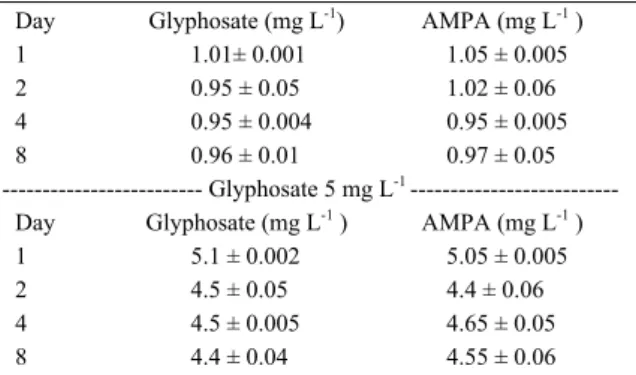
Table 1 - Glyphosate concentration in the water of the experimental tanks through eight days.
---Glyphosate 1 mg L-1
---Day Glyphosate (mg L-1) AMPA (mg L-1 ) 1 1.01± 0.001 1.05 ± 0.005 2 0.95 ± 0.05 1.02 ± 0.06 4 0.95 ± 0.004 0.95 ± 0.005 8 0.96 ± 0.01 0.97 ± 0.05 --- Glyphosate 5 mg L-1
---Day Glyphosate (mg L-1) AMPA (mg L-1 ) 1 5.1 ± 0.002 5.05 ± 0.005
2 4.5 ± 0.05 4.4 ± 0.06
4 4.5 ± 0.005 4.65 ± 0.05
8 4.4 ± 0.04 4.55 ± 0.06
or BTEE) per min per mg protein. Total protein content
of crude extracts was measured following LOWRY et
al. (1951), using bovine serum albumin as a standard.
Data were assessed for normality using a Shapiro–
Wilk test and submitted to one-way ANOVA followed
by Duncan test (
P
<0.05), and values expressed as
mean ± standard error (n=8). All statistics were carried
out using SAS
®(1997) software.
RESULTS AND DISCUSSION
Fish survival was not affected by glyphosate
levels, being 100% in all treatments. Glyphosate in
water of experimental tanks was monitored for eight
days (Table 1) and glyphosate concentration in the
water was adjusted according to treatments.
Digestive enzymes activities in all portions of
the gastrointestinal tract increased signi
fi
cantly in piavas
exposed to both glyphosate concentrations except amylase
in the stomach of those exposed to 1.0mg L
-1(Figure 1).
The higher amylase activity in the intestine than in the
stomach of piavas (Figure 1A and 1B) is expected for
typically omnivorous species (NAMULAWA et al.,
2013). Long-term exposure (90 days) to glyphosate 1.0
or 5.0mg L
-1did not affect feed intake but reduced growth
and caused hematological and metabolic disruption in
piavas (SALBEGO et al., 2010).
The growth and food ef
fi
ciency in
fi
sh
depends on their physiological and biochemical
Figure 1 - Digestive enzymes in the stomach and intestine of piava (Leporinus obtusidens) after 90 days of exposure to different glyphosate levels. Amylase (A) and acid protease (C) activity in the stomach, and amylase (B), trypsin (D) and chymotrypsin (E) activity in the intestine. Where: U= 1mmol of glucose per min per mg protein-1,to amylase;
capacities to digest and transform ingested nutrients
(SWEILUM, 2006; FURNÉ et al., 2008; LAZZARI
et al., 2010). BLIER et al. (2002) suggests that
growth can be determined by some factors: the
activity of digestive enzymes, the availability of
oxygen for metabolism and the protein synthesis. The
herbicides and pesticides in general can affect oxygen
availability for the tissues (ORUÇ & UNER, 1999;
GIMENO et al., 1995; BEGUM, 2004).
Metabolic alterations can also intervene in
the growth process. SALBEGO et al. (2010) attributed
the growth reduction in piavas exposed to glyphosate
to several factors: lower exploitation of the available
nutrients, reduction of the oxygen in tissues con
fi
rmed
by fermentative response in the liver and muscle. These
alterations suggest that for the maintenance of the
fi
sh
in glyphosate-contaminated water, a great demand
of energy is required. The increase in the activity of
digestive enzymes may be an attempt of the organism
to increase the exploitation of the food, compensating
other possible losses caused by the poisoning.
The digestive enzymes activity re
fl
ects in
the capacity of exploitation of the food by the
fi
sh and
that the induction of determined enzymes is directly
related to the type of diet (TORRISSEN & SHEARER,
1992). The obtained results allow concluding that
low growth observed in glyphosate-exposed piavas
by SALBEGO et al. (2010) may be related (at least
partially) to the change in digestive enzymes activity.
CONCLUSION
In conclusion, present study demonstrated
that long-term exposure to Roundup
®increased
digestive enzymes activity in piavas probably as
a compensatory mechanism to obtain nutrients,
indicating Roundup
®toxicity. The piava and
digestive enzymes activity in this
fi
sh may be useful
as biondicator and biomarkers of long-term exposure
to commercial formulations containing glyphosate.
ACKNOWLEDGMENTS
This study was supported by Fundação de Amparo à Pesquisa no Rio Grande do Sul (FAPERGS), process number 040546.0. B. Baldisserotto and V. L. Loro received research fellowships from the Conselho Nacional de Desenvolvimento Científi co e Tecnológico (CNPq) and J. Salbego fellowship from Coordenação de Aperfeiçoamento de Pessoal de Nível Superior (CAPES).
ETHICAL STATEMENT
We declare to whom correspond that we assume any responsibility about any process performed during the development of the research entitled “Effects of glyphosate on digestive enzyme
activity in piava (Leporinus obtusidens)”. Likewise we are available to answer any questions that may be needed.
REFERENCES
BEGUM, G. Carbofuran insec ticide induced biochemical alterations in liver and muscle tissues of the fi sh Clarias batrachus (linn) and recovery response. Aquatic Toxicology, v.66, p.83-92, 2004. Available from: <http://ac.els-cdn.com/ S0166445X03001930/1-s2.0-S0166445X03001930-main.pdf?_ tid=8d7a1ce2-7c6f-11e3-8613-00000aab0f26&acdnat=1389630 610_967be2d5c4a5b3225d7ec406bee0acf6>. Accessed: Jan. 13, 2014. doi:10.1016/j.aquatox.2003.08.002.
BERNFELD, P. Amylases a and b: colorimetric assay methods. In: COLOWICK, S.P.; KAPLAN, N.O. (Eds.). Methods in enzymology. New York: Academic, 1955. p.149-158.
BLIER, P.U.; LEMIEUX, H.; DEVLIN, R.H. Is the growth of fi sh set by digestive enzymes or metabolic capacity of the tissues? Insight from transgenic coho salmon. Aquaculture, v.209, p.379-384, 2002. Available from: <http://ac.els-cdn.com/S0044848601008079/1- s2.0-S0044848601008079-main.pdf?_tid=d3fe7b36-2157-11e3-a904-00000aab0f6b&acdnat=1379614865_2b2383fbfd9c9cfa4ce> bab88d5c09b83. Accessed: Sept. 19, 2013.
BOYD, C.E.; TUCKER, C.S. Water quality and pond soil analyses for aquaculture. Alabama: Alabama Agricultural Experiment Station, Auburn University, 1992. 183p.
EATON, A.D. et al. Standard methods for the examination of water and wastewater. 21.ed. Springfi eld: American Public Health Association, 2005. 1368p.
FILIPPOV, A.A. et al. Effects of organic pollutants on fi sh digestive enzymes: a review. InlandWater Biology, v.6, p.155-160, 2013. Available from: <http://link.springer.com/article/10.11 34%2FS199508291302003X#page-1>. Accessed: Sept. 19, 2013. doi:10.1134/S199508291302003X.
FURNÉ, M. et al. Effect of starvation and refeeding on digestive enzyme activities in sturgeon (Acipenser naccarii) and trout (Oncorhynchus mykiss). Comparative Biochemistry and Physiology (A), v.149, p.420-425, 2008. Available from: <www. ncbi.nlm.nih.gov/pubmed/18328757>. Accessed: Oct. 10, 2013. doi:10.1016/j.cbpa.2008.02.002.
GIESY, J.P. et al. Ecotoxicological risk assessment for roundup herbicide.
Environmental Contamination and Toxicology, v.167, p.35-120, 2000. Available from: <http://link.springer.com/chapter/10.1007/978-1-4612-1156-3_2#page-1>. Accessed: Sept. 19, 2013.
GIMENO, L. et al. Pesticide effects on eel metabolism.
HIDALGO, M.C. et al. Comparative study of digestive enzymes in fi sh with different nutritional habits. Proteolytic and amylase activities.
Aquaculture, v.170, p.267-283, 1999. Available from: <http://ac.els-cdn. com/S004484869800413X/1-s2.0-S004484869800413X-main.pdf?_ tid=cc3f085e-7c72-11e3-8614-00000aab0f26&acdnat=1389632004_81 ce406d86b8e1217d669d5a154 5a634>. Accessed: Jan. 13, 2014. HIDALGO, C. et al. Improved coupled-columm liquid chromatographic method for the determination of glyphosate and aminomethylphosphonic acid residues in environmental waters.
Journal of Chromatography A, v.1035, p.153-157, 2004. Available from: <http://ac.els-cdn.com/S0021967304002511/1- s2.0-S0021967304002511-main.pdf?_tid=3a45de2c-7c73-11e3-897f-00000aab0f02&acdnat=1389632189_d27f0ee44a25a9f2 216b14e9138496d5>. Accessed: Jan. 13, 2014. doi:10.1016/j. chroma.2004.02.044.
HUMMEL, B.C.W. A modifi ed Spectrophotometric determination of chymotrypsin, trypsin and thrombin. Canadian Journal of Biochemistry and Physiology, v.37, p.1393-1399, 1959.
LAZZARI, R. et al. Protein sources and digestive enzyme activities in jundia (Rhamdia quelen). Scientia Agricola, v.67, n.3, p.259-266, 2010. Available from: <http://www.scielo.br/pdf/ sa/v67n 3/a02v67n3.pdf>. Accessed: Jan. 13, 2014.
LOWRY, O.H. et al. Protein measurement with Folin-phenol reagent. Journal of Biological Chemistry, v.193, p.265-275, 1951. Available from: <http://www.jbc.org/content/193/1/265. full.pdf+html>. Accessed: Jan. 13, 2014.
MODESTO, K.A.; MARTINEZ, C.B.R. Roundup causes oxidative stress in liver and inhibits acetylcholinesterase in muscle and brain of the fi sh Prochilodus lineatus. Chemosphere, v.78, p.294-299, 2010a. Available from: <http://ac.els-cdn.com/ S0045653509012739/1-s2.0-S0045653509012739-main.pdf?_ tid=b29040a4-215e-11e3-a2b1-00000aab0f01&acdnat=13796178 15_0e4079ed67307957fcebd3601499bdea>. Accessed: Sept. 19, 2013. doi:10.1016/j.chemosphere.2009.1 0.047.
MODESTO, K.A.; MARTINEZ, C.B.R. Effects of Roundup Transorb on fish: hematology, antioxidant defenses and acetylcholinesterase activity. Chemosphere, v.81, p.781-787, 2010b. Available from: <http://ac.els-cdn.com/ S0045653510007721/1-s2.0-S0045653510007721-main.pdf?_ tid=9bc8ee10-215f-11e3-9482-00000aab0f01&acdnat=13796182 07_1e4c37eedadc820833a8d a37e02fbb80>. Accessed: Sept. 19, 2013. doi:10.1016/j.chemosphere.2010.07.005.
NAMULAWA, V.T. et al. Enzyme activity in the Nile perch gut: implications to Nile perch culture. International Journal of Fisheries and Aquaculture, v.5, p.221-228, 2013. Available from: <http:// www.academicjournals.org/ijfa/PDF/pdf2013/Sep/Namulawa%20 et%20al.pdf>. Accessed: Sept. 19, 2013. doi:10.5897/IJFA13.0349. ORUÇ, E.Ö.; ÜNER, N. Effects of 2,4-Diamin on some parameters of protein and carbohydrate metabolisms in the serum,
muscle and liver of Cyprinus carpio. Environmental Pollution, v.105, p.267-272, 1999. Available from: <http://ac.els-cdn.com/ S0269749198002061/1-s2.0-S0269749198002061-main.pdf?_ tid=961db8b6-7c76-11e3-9f39-00000aab0f02&acdnat=138963363 1_42fadddec358151947f1d81efe2ff82c>. Accessed: Jan. 13, 2014. PARK, J.T.; JOHNSON, M.J. A submicro determination of glucose.
Journal of Biological Chemistry, v. 181, p.149-151, 1949. REYNALTE-TATAJE, D.; ZANIBONI-FILHO, E. Cultivo de piapara, piauçu, piava e piau – gênero Leporinus. In: BALDISSEROTTO, B.; GOMES, L.C. (Eds.). Espécies nativas para piscicultura no Brasil. 2.ed. Santa Maria: UFSM, 2010. p.73-99.
RODRIGUES, B.N.; ALMEIDA, F.S. Guia de herbici das. 4.ed. Londrina: Agris, 1998. 648p.
SALBEGO, J. et al. Herbicide formulation with glyphosate affects growth, acetylcholinesterase activity, and metabolic and hematological parameters in piava (Leporinus obtusidens).
Archives of Environmental Contamination and Toxicology, v.58, p.740-745, 2010. Available from: <http://link.springer.com/ article/10.1007/s00244-009-9464-y#page-1>. Accessed: Sept. 19, 2013. doi: 10.1007/s00244-009-9464-y.
SOSO, A.B. et al. Chronic exposure to sub-lethal concentration of a glyphosate-based herbicide alters hormone profi les and affects reproduction of female jundiá (Rhamdia quelen). Environmental Toxicology and Pharmacology, v.23, p.308-313, 2007. Available from: <http://ac.els-cdn.com/S1382668906001578/1-s2.0-S1382 668906001578-main.pdf?_tid=30dd126c-2163-11e3-8633-00000aacb362&acdnat=1379619745_7dab11677fdd2551d02 5a62ed875c740>. Accessed: Sept. 19, 2013. doi: 10.1016/j. etap.2006.11.008.
SWEILUM, M.A. Effect of sublethal toxicity of some pesticides on growth parameters, haematological properties and total production of Nile tilapia (Oreochromis niloticus L.) and water quality of ponds. Aquaculture Research, v.37, p.1079-1089, 2006. Available from: <http://onlinelibrary.wiley.com/ doi/10.1111/j.1365-2109.2006.01531.x/pdf>. Accessed: Sept. 19, 2013. doi: 10.1111/j.1365-2109.2006.01531.x.
TORRISSEM, K.R.; SHEARER, K.D. Protein digestion, growth and food conversion in Atlantic salmon and Arctic charr with different trypsine-like isozyme patterns. Journal of Fish Biology,
v.41, p.409-415, 1992.