BUSINESS PLAN: ISCTE JUNIOR CONSULTING
Tiago Daniel Moreira Maia Cunha
Project submitted as partial requirement for the conferral of Master of Science in Business Administration
Supervisor: Luís Martins
Glossary
AIESEC: Association Internationale des Etudiants en Sciences Economiques et
Commerciales
EBITDA: Earnings Before Interest, Taxes depreciation and amortization
ISCTE-IUL: Instituto Superior de Ciências do Trabalho e da Empresa – Lisbon University
Institute
IJC: ISCTE Junior Consulting INE: National Institute of Statistics
FJEP: Portuguese junior companies federation MIT: Massachusetts Institute of Technology NPV: Net Present Value
OECD: Organisation for Economic Co-operation and Development SME: Micro, small and medium enterprises
Index 1 Abstract ... 7 2 Introduction ... 9 3 Promoters ... 10 4 Strategic Partners ... 11 5 Literature review ... 12 5.1 Entrepreneurial University ... 12 5.2 Youth Entrepreneurship ... 15 5.3 Junior Enterprise ... 18 6 Reference Board ... 19 7 Market Analysis ... 20
7.1 National context of micro, small and medium enterprises ... 20
7.2 Management consulting services ... 23
7.3 Future of management consulting services ... 24
8 SWOT Analysis ... 25
9 Business Plan Objectives ... 26
10 Mission, Vision and Values ... 26
11 Business Model ... 27
12 Critical Success Factors ... 28
13 Entry and Development Strategy ... 29
14 Implementation policy definition ... 30
14.1 The Offer ... 30
14.1.1 Consulting Services ... 30
14.1.2 Specialties ... 30
14.2 Target Market ... 32
14.3 Potential Market ... 32
14.6 The Customer ... 36
14.7 Pricing Strategy ... 37
14.8 Advertising and Promotion ... 37
14.9 Organizational Structure ... 39
14.10 Job Descriptions ... 40
14.11 Remuneration Policy ... 42
14.12 Reward and Recognition ... 43
15 Implementation Requirements ... 44
15.1 Partnership with IBS ... 44
15.2 Partnership with main sponsor ... 44
16 The Financial Plan ... 45
16.1 Assumptions ... 45
16.2 Investment ... 46
16.3 External Services and Supplies (ESS) ... 47
16.4 Sales and Revenue ... 49
16.5 Investment in Working Capital ... 50
16.6 Operating Cash Flow ... 51
16.7 Income Statement ... 52
16.8 Balance Sheet ... 52
16.9 Project Ratios ... 54
16.9.1 Economic Ratios ... 54
16.9.2 Profitability and Efficiency Ratios ... 55
16.9.3 Finance Leverage and Liquidity Ratios ... 56
16.10 Project Evaluation ... 57
16.11 Members’ perspective ... 58
17 Conclusion ... 59
Figures
5 Literature review
Figure 1 - The triple helix structure ………...13
Figure 2 - The triple helix circulation..……….………...………...13
Figure 3 - Factors that influence Youth Entrepreneurship....……....…………..16
14 Implementation policy definition Figure 4 - Organizational Structure in year 2012...39
Charts 7 Market Analysis Chart 1 - Number of companies by type (%)………...20
Chart 2 - Market Turnover (%)………...…….20
Chart 3 - Percentage of total SMEs turnover………….………...……...21
Chart 4 - SMEs importance in region turnover………21
Tables 7 Market Analysis Table 1 - SMEs importance...21
Table 2 - SMEs importance by region...22
Table 3 - SMEs importance by sector...22
Table 4 - SMEs importance by sector...23
Table 5 - SMEs limitations by sector...24
14 Implementation policy definition Table 6 - Total members evolution...39
1 Abstract
This paper develops a business plan, in which the basic idea is to launch a Junior Enterprise based in ISCTE-IUL.
The current competitiveness of University market challenges the universities to become entrepreneurial, to constantly innovate and introduce new practices. At the same time, there is a growing interest by the young generation in creating their own businesses. They are motivated by the desire for independence and not necessarily for money. The binding of both factors led to the creation of new entities in the Universities, such as the example of Junior Enterprises.
A Junior Enterprise is a non-profit organization entirely managed by students, which provides consulting services. The main goal of this organization is to provide a platform for
practical application of members’ knowledge.
The purpose of ISCTE Junior Consulting is to offer management consulting services to provide start-ups, micro, small and medium enterprises with the required innovation and efficiency within the current market. The offer is focused in four specialties: Marketing Plan, Business Plan, e-Business Development and University Events.
As a non-profit organization, ISCTE Junior Consulting manages its income and outcome according to a remuneration policy that ensures both the sustainability of the organization, and the recognition of volunteers.
Key-words:
_ Junior Enterprise _ Consultancy
_ University Entrepreneurship _ Youth Entrepreneurship
JEL Classification System: M13 - New Firms; Start-ups; L31 – Non-profit Institutions;
Sumário
O presente trabalho desenvolve um plano de negócios, cuja ideia fundamental consiste no lançamento de uma empresa júnior de consultoria de gestão sediada no ISCTE-IUL.
A actual competitividade do mercado universitário obriga a que as Universidades se tornem empreendedoras, inovando e introduzindo constantemente novas práticas. Paralelamente, existe um crescimento de interesse por parte dos jovens na criação dos seus próprios negócios, motivados principalmente pelo desejo de independência e flexibilidade e não necessariamente por dinheiro. A ligação de ambos os factores proporciona a criação de novas entidades nas Universidades, como as empresas júnior.
Uma empresa júnior é uma associação sem fins lucrativos, totalmente gerida por estudantes, que presta serviços de consultoria com o objectivo de possibilitar aos estudantes a aplicação prática dos seus conhecimentos.
O objetivo da ISCTE Junior Consulting consiste em oferecer serviços de consultoria na área de gestão a start-ups, micro, pequenas e médias empresas com foco em quatro serviços: Plano de Marketing; Plano de Negócio; Desenvolvimento de Negócio Online e Realização de eventos na Universidade, garantindo a inovação e eficiência tão necessárias no contexto de mercado actual.
Como organização sem fins lucrativos, a ISCTE Junior Consulting gere os seus rendimentos de acordo com uma política de remunerações que garante a sustentabilidade da organização, a compensação e reconhecimento dos voluntários.
Palavras-chave:
_ Empresa Júnior _ Consultoria
_ Empreendedorismo Universitário _ Empreendedorismo Jovem
JEL Classification System: M13 - New Firms; Start-ups; L31 – Non-profit Institutions;
2 Introduction
The constant need of innovation of Universities and the growing of Youth Entrepreneurship empower the creation of new entities in the Universities, such as Junior Enterprises. A Junior Enterprise is a non-profit organization entirely managed by students, which provides consulting services for micro, small and medium companies. The idea is to offer small companies the possibility to differentiate and innovate at competitive prices.
The purpose of this project is to present the business plan of a Junior Enterprise headquartered in ISCTE-IUL. This organization, ISCTE Junior Consulting will offer management consulting services for start-ups, micro, small and medium enterprises and will try to become a reference through excellence, irreverence and innovation. The organization also aims to be recognized as the best platform for the development of the entrepreneurial spirit in Portugal.
As a non-profit organization, ISCTE Junior Consulting’ goal is to be sustainable and financially independent. The investor ISCTE-IUL will provide in the first year, the required financial support and in the subsequent years the necessary logistical support.
The organization will operate only with volunteers, rewarded according both individual and organizational achievements.
3 Promoters
The promoters of this project are students from ISCTE-IUL – Lisbon University Institute. These students are known by their capacity for multi-task and their willingness to take risks. They have experience in student organizations, such as AIESEC and went abroad as exchange students. They are master students from Management and Marketing degree and two of them are assistant professors of marketing and finance. The promoters are willing to create this organization to provide students the possibility to develop their own skills, while offering a valuable product to the market. They will assume the position of the Board of Directors.
President: Tiago Cunha – Master of Science in Business Administration student
(2010). He was Vice-President of AIESEC Lisboa ISCTE (07/08) and studied in Bratislava, as Erasmus student (08/09).
External Relations Director: João Caetano - Master of Science in Business
Administration student (2010). He was also volunteer during summer holidays in an ONG in India (2009).
Talent Management Director: Diogo Alves - Master of Science in Business
Administration student and Assistant Professor in ISCTE-IUL (2010). Studied in Paris and London as Erasmus student (08/09).
Finance Director: Jorge Cardoso - Master of Science in Business Administration
student and Assistant Professor in ISCTE-IUL (2010).
4 Strategic Partners
ISCTE Business School (IBS), is one of the constituent schools of ISCTE-IUL –
Lisbon University Institute, being recognized as one of the national and international leaders in its field, with a prestigious reputation for teaching excellence and development. ISCTE-IUL currently has around 2.000 undergraduate students and around 1.200 Masters students. In order to provide high-value educational services for the long-term success of University graduates and staff, the University will provide the initial resources and support ISCTE Junior Consulting activities. The initial support is financial and logistic. After starting the activity, the support will be only logistic.
Federação de Júnior Empresas de Portugal (FJEP), aims to spread the movement
of Junior Enterprises in Portugal, providing the necessary tools for sustained growth of the latter. FJEP’s goal is also to develop synergies between Junior Enterprises, foster the entrepreneurial spirit among University students and build a parallel between University and the business sector, to promote personal and professional enrichment of students. ISCTE Junior Consulting will be part of FJEP, which will offer organization knowledge and network.
AUDAX, The non-profit association UNIAUDAX - Centre for Research and Support for
Entrepreneurship and Family Business was established in July 2005, with the aim to study, support and promote entrepreneurship, innovation and sustainable self-employment. AUDAX supports start-up businesses, covering the preparation of business plans, strategic planning and access to funding sources. The organization will have a strategic partnership with AUDAX to share knowledge and networks in order to benefit from economies of scale and anchor ISCTE Junior Consulting brand.
5 Literature review
5.1 Entrepreneurial University
Nowadays, in order to succeed, universities need to interact and manage their relationship with different stakeholders. With the development in information technologies and globalization, the already complex stakeholders became more demanding and their expectations changed. Therefore, there is a need of constant change and adaptation on the value proposition of universities.
The first signal of that change occurred on early 1920s when MIT established a Patent committee of faculty and administrators, changing University-Industry relation from passive to active. It was the first pillar of the concept of Entrepreneurial University (Etzkowitz 2004).
The concept of Entrepreneur University was first introduced in 1998 by the American sociologist Burton R. Clark in his study Creating Entrepreneurial Universities. Organizational Pathways of Transformation, based on studies performed in five different European universities: Warwick (UK), Strathclyde (Scotland), Twente (The Netherlands), Joensuu (Finland), and Chalmers (Sweden). He states that an Entrepreneurial University is consciously introducing new practices and that it is innovational from the organizational, technological and financial point of view. Entrepreneurial Universities are actively trying to innovate in their activity, to operate important changes in their organizational structure, by opening more promising perspectives for the future. They assume the role of an enterprise, being aware of the difficulties of their approach, and trying to develop their competitive advantage.
An Entrepreneurial University requires extension from ideas to practical activity, capitalizing knowledge, organizing new entities, and managing risks (Etzkowitz 2004), according to the demands of a dynamic market, where the competitive spirit is being strongly promoted. They are convinced that the risk of operating structural and profound cultural changes is worth taken in comparison to paying tribute to governmental tight regulations (Constantin Bratianu and Stefan Stanciu 2010).
The mission of the innovative Entrepreneurial University is that of preserving and enriching national and universal culture. Its target is training and forming specialists and its objectives are correct and clear reactions to the requirements of the society it’s part of. The
level. The financial dimension of a University is highly important, but equally important are the material, informational and human resources, the latter contributing to fulfilling the assumed mission.
The relations between Entrepreneurial Universities, Industry and State, can be characterized as a triple helix (Figure1) in which each entity is linked with the other two,
developing an overlay of circulation of communications, networks, and organizations between the helices. (Etzkowitz and Leydesdorff, 2000).
Figure 1 - The triple helix structure - Etzkowitz and Leydesdorff 2000 S – State; U – Universities; O – Industry Organizations
Macro circulations move among the helices while micro circulations take place within a particular helix. The former create collaboration policies, projects and networks, while the latter consists of outputs of individual helices. (Figure 2)
As seen, Entrepreneurial Universities are institutions which embrace flexible structures, minimal hierarchies and risk taking, empowering sustainable cooperation with the external environment, based on high rate of people flow. Such cooperation creates a propitious environment for knowledge-based innovation. Examples of actual interactions between the above-mentioned entities are entrepreneurship education, sharing R&D facilities between entities and also development of consulting projects together to promote industry and to empower the creation of start-ups. The Martin Luther University Halle-Wittenberg and the Humboldt University are good examples of Entrepreneurial Universities, with the development of programs such as Univations, Scidea and Humboldt-Innovation (HI).
Univations:
Activities:
Development of entrepreneurial skills through lectures and workshops Mentoring by 40-odd professors, entrepreneurs
Networking with patent agents, researchers, financing institutions
Achievements: 320 projects supported, including 150 start-ups, of which 28 received financing; currently 14 projects in the application process
Scidea:
Activities:
Coaching and mentoring (business idea development, business plan, financing) Patent valorization
Networking with patent agents, researchers, financing institutions, business support organizations and research organizations
Achievements: 37 innovative R&D projects accompanied, including seven start-ups
Research (scientific services, contract research, research partnerships), Spinoff support (scouting, hatching, coaching)
Help desk and a coaching center for HUB entrepreneurs
Inside HUB, several professors act as “entrepreneurship ambassadors”
Offer entrepreneurs access to University external network which includes business support and advisory service providers, firms, financiers and alumni.
Achievements: More than 20 Spinoff and over 200 research projects supported.
5.2 Youth Entrepreneurship
Youth Entrepreneurship is defined as the practical application of entrepreneurial qualities in youth, such as initiative, innovation, creativity, and risk-taking into the work environment (either in self-employment or employment in small start-up companies), using the appropriate skills for success in that environment and culture (Schnurr and Newing, 1997).
Children have long done odd jobs, such as washing cars or raking leaves for money, but interest in Youth Entrepreneurship seems to be growing. Instead of just earning money from odd jobs here or there, some youth are showing an interest in starting their own businesses. This interest drives young people to start businesses on the internet, such as creating blogs, websites for customers, or even to take advantage of money-making opportunities on online auction websites. (N. Madison, 2011)
Youth entrepreneurs are motivated primarily by the desire for independence and flexibility, and not necessarily money (OECD, 2001); they show enthusiasm, risk-taking, flexibility, energy, resourcefulness and willingness to try new approaches and change (Ghai, 1988).
It is now widely accepted that there are many good reasons to promote entrepreneurship among youth. An obvious, and perhaps significant one, is that it creates employment for the business owner. There may also be a direct effect on employment if new young entrepreneurs hire fellow youths from the ‘dole’ queues (Curtain, 2000). Youth
a new perspective to the market (White and Kenyon, 2001), offering valuable goods and services, which raise the degree of competition in the product market, thereby bringing gains to consumers (Curtain, 2000). Even though, Youth Entrepreneurship has some constraints strongly attached to the age and maturity of the leadership (Curtain, 2000).
Figure 3 - Factors that influence Youth Entrepreneurship - Ulrich Schoof - International Labour Organization 2006
1. Social, Cultural Legimacy and Acceptance: Due to their limited life and work experience, older colleagues or business contacts do often not take young entrepreneurs seriously.
2. Entrepreneurship Education and Training: simply does not exist or has not been sufficiently adopted. Actual training programs are built based on technical aspects, which do not foster the experiential learning. School environments often do not offer tools, resources and information to introduce the concept of entrepreneurship and self-employment as a career option.
financial institutions would look for in assessing creditworthiness. Furthermore, young entrepreneurs are often not aware of all available types of finance, funding forms and special support programs. They often do not understand the concept, benefits, possibilities and drawbacks of the several forms of debt and equity (venture capital) financing.
4. Administrative and regulatory framework: Government regulations and bureaucratic formalities are also seen as one constraint, according to the Euro barometer Survey (2004), 70% of European respondents (67% of respondents aged 15-24 years) stated that administrative complexity is a barrier to setting up one’s business.
5. Business assistance and support: A common obstacle that people find in the implementation of start-ups is Entrepreneurial isolation (not knowing anyone in the business) and the absence (or high entry barriers to) of business networks. Young entrepreneurs are not aware of the variety of public (and private) business support services.
Nowadays, there are programs designed to develop entrepreneur characteristics focused on education, financial support, coaching and technical support:
Shell LiveWIRE: The UK's biggest online community for young entrepreneurs (aged
16-30) who are starting or running their own business.
Junior Achievement: A non-profit association, committed to bringing programs to
schools that develop in children and young people a taste for entrepreneurship.
YOUNG AUDAX - FIRST STEP: develops a training to foster the entrepreneurial spirit
of young people from 13 to 18 years. In a fun way children learn the basics of creating a business.
AIESEC: Present in over 107 countries and territories, and with over 50.000 members,
AIESEC is the world's largest student-run organization. Focused on providing a platform for youth leadership development, AIESEC offers young people the opportunity to be global
5.3 Junior Enterprise
A Junior Enterprise aims to offer specialized consulting services to companies and other entities while their members are complementing their academic education.
The first Junior Enterprise was born in France, in 1967, at the Higher School of Economics and Business. The aim of the organization was to provide the market with knowledge, skills and pro-activity of students. The initiative was a success and currently this Junior Enterprise has a turnover of one and half million euros per year.
Nowadays, the model is implemented around the world. There are around 300 Junior Enterprises in Europe, 700 in Brazil and a few similar initiatives in Africa. Portugal has currently 16 Junior Enterprises from North to South. The first Junior Enterprise appeared in 1991, but the real boom took place from 2005/2006, moment from which were created most of the Junior Enterprises now available (Gonçalves, 2010).
Junior Enterprises business model was revolutionary and had a huge impact on Universities, Students and Local Economy. On the one hand, it connects Universities, Industry and State, supporting change and empowering innovation – Entrepreneurial
University. On the other hand, it offers students a platform full of opportunities for
interaction with the business environment, fostering the development of Youth
6 Reference Board University Industry State University Entrepreneurship Unemployement and Desire of independence Youth Entrepreneurship ISCTE Junior Consulting
7 Market Analysis
7.1 National context of micro, small and medium enterprises
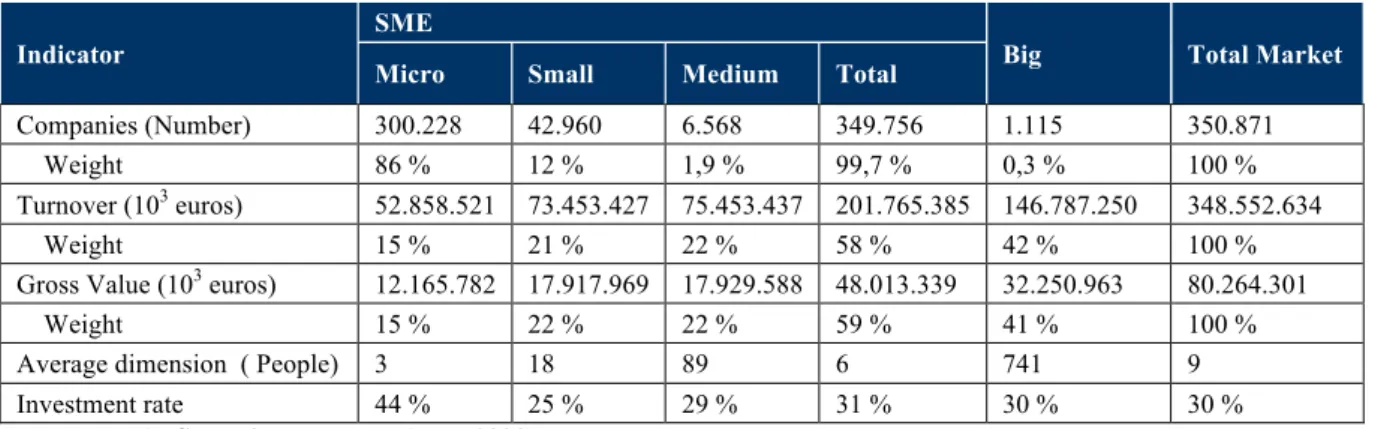
Micro, small and medium enterprises (SMEs) - companies with less than 250 people, whose annual turnover does not exceed 50 million euros or whose annual total assets does not exceed 43 million - are widely recognized as the pillar of national economy. Micro-enterprises predominate, constituting about 86% of total SMEs and being responsible for 57.9% of Turnover and 59.8% of Gross Value
generated in Portugal. (INE, 2008)
Chart 1 - Number of companies by type (%) Chart 2 - Market Turnover (%) (INE, 2008)
In 2008 there were 349.756 SMEs in Portugal, representing 99.7% of non-financial sector companies, contributing to 58% of total market turnover and to 59% of total market gross value.
Micro enterprises - companies with less than 10 employees and an annual turnover (or total assets) not exceeding 2 million euros - have assumed a preponderant role accounting for 85.6% of total companies, and being the segment with the highest investment rate 44 %. (INE, 2008) 0% 10% 20% 30% 40% 50% 60% 70% 80% 90% 100% 85,6% 12,2% 1,9% 0,3% Big Medium Small Micro 0% 10% 20% 30% 40% 50% 60% 70% 80% 90% 100% 15% 21% 22% 42%
Indicator
SME
Big Total Market
Micro Small Medium Total
Companies (Number) 300.228 42.960 6.568 349.756 1.115 350.871
Weight 86 % 12 % 1,9 % 99,7 % 0,3 % 100 %
Turnover (103 euros) 52.858.521 73.453.427 75.453.437 201.765.385 146.787.250 348.552.634
Weight 15 % 21 % 22 % 58 % 42 % 100 %
Gross Value (103 euros) 12.165.782 17.917.969 17.929.588 48.013.339 32.250.963 80.264.301
Weight 15 % 22 % 22 % 59 % 41 % 100 %
Average dimension ( People) 3 18 89 6 741 9
Investment rate 44 % 25 % 29 % 31 % 30 % 30 %
Table 1 - SMEs importance (INE, 2008)
Chart 3 - (%) of total SMEs turnover Chart 4 - SMEs importance in region turnover (INE, 2008)
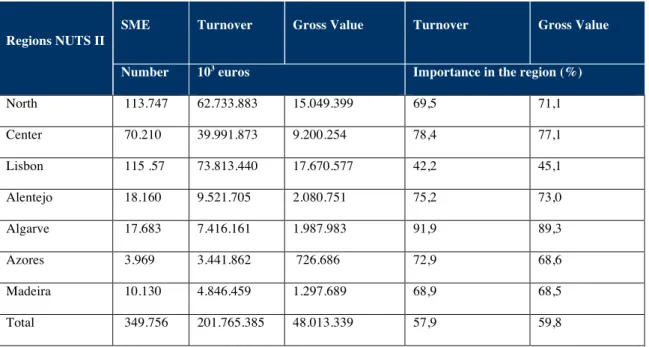
Geographically, SMEs are concentrated in the North of Portugal and in Lisbon representing 65.6% of national companies. Regarding the importance of SMEs for regional economy, we observe that Lisbon is the region where SMEs contribute less to regional
indicators, being below 50% of turnover and gross value.
In contrast, SMEs in Algarve and in the region Center of the country play a leading role with contributions over 75% in turnover and gross value. Nevertheless, Lisbon is the region with the biggest turnover and gross value (INE, 2008).
69,5 78,4 42,2 75,2 91,9 72,9 68,9 0,0 10,0 20,0 30,0 40,0 50,0 60,0 70,0 80,0 90,0 100,0 31,1% 19,8% 36,6% 4,7% 3,7% 1,7% 2,4% North Center Lisboa Alentejo Algarve Açores Madeira
Regions NUTS II
SME Turnover Gross Value Turnover Gross Value
Number 103 euros Importance in the region (%)
North 113.747 62.733.883 15.049.399 69,5 71,1 Center 70.210 39.991.873 9.200.254 78,4 77,1 Lisbon 115 .57 73.813.440 17.670.577 42,2 45,1 Alentejo 18.160 9.521.705 2.080.751 75,2 73,0 Algarve 17.683 7.416.161 1.987.983 91,9 89,3 Azores 3.969 3.441.862 726.686 72,9 68,6 Madeira 10.130 4.846.459 1.297.689 68,9 68,5 Total 349.756 201.765.385 48.013.339 57,9 59,8
Table 2 - SMEs importance by region (INE, 2008)
The consulting activities sector represents 4,5% of total SMEs market turnover and consulting activities contribute to 85% of total sector Gross Value. The sector which aggregates the largest number of SMEs, with 99 486 units, generating the largest turnover 83 864 million euros, 41.6% of total turnover is Trade and the sectors in which SMEs have more impact are Real Estate, Consulting activities and Education. (INE, 2008)
Sector SME Turnover Turnover Gross Value
Number 103 euros Importance in the sector (%)
Trade 99.486 83.863.944 64,8 69,4
Transport 19.686 9.602.742 53,0 43,3
Hotels and restaurants 31.560 6.282.035 81,1 77,6
Information and communication activities 7.249 4.373.905 31,3 28,0
Real estate 23.708 5.362.718 84,7 92,1
Consulting activities 31.499 9.057.797 84,9 85,0
Administrative activities 11.496 6.485.228 64,9 46,0
Education 4.558 947.885 87,9 85,4
7.2 Management consulting services
In Portugal, Management consulting services represent 37% of total consulting services turnover. The most important type of services are Consultancy services in business management, with a turnover of 1.536.366.000 euros and Accounting services - representing 25,8% of service turnover (INE, 2009).
Year Type of Service
Turnover Importance in the service (%) 103 euros 2009 Auditing services 351.801 9,1% Accounting services 1.001.872 25,8% Tax services 90.911 2,3% Receivership services 291 0,01%
Consultancy services in public relations and communication 76.489 2,0% Consultancy services in business management 1.536.366 39,6% Other project management services, except for construction 124.149 3,2%
Other consulting services for business 41.064 1,1%
Trademarks and franchises (franchise) 352.262 9,1%
Other services 309.114 8,0% Total 3.884.319 100% 2008 Auditing services 229.506 5,9% Accounting services 1.273.165 32,6% Tax services 96.264 2,5% Receivership services 7.025 0,2%
Consultancy services in public relations and communication\ 97.846 2,5% Consultancy services in business management 1.269.779 32,5% Other project management services, except for construction 97.524 2,5%
Other consulting services for business 24.290 0,6%
Trademarks and franchises (franchise) 347.337 8,9%
Other services 466.325 11,9%
7.3 Future of management consulting services
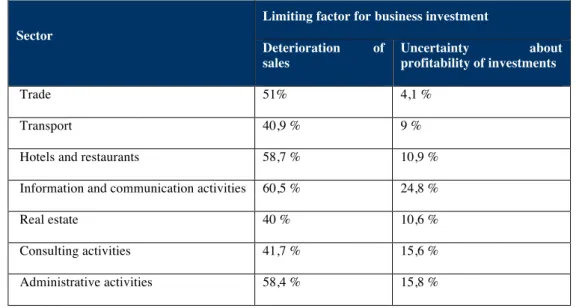
In 2010 the investment in all business activities had a variation of -4.6%, and in 2011 it is expected a decrease in investment of -3.7%. From 2010 to 2011, there has been an increase in weight on investment associated with replacement, rationalization, restructuring, and a reduction in weight on investments oriented to the expansion of productive capacity.
The major limiting factors for business investment are the deterioration of sales and uncertainty about profitability of investments, although the latter factor assumes less importance in 2011, compared with that seen in 2010. This is relevant and has a strong impact given the fact that consulting services depend on customers’ investment capacity. In order to succeed, consulting companies need to focus on rationalization of customers’ resources and in solutions with low implementation investment.
Sector
Limiting factor for business investment Deterioration of sales Uncertainty about profitability of investments Trade 51% 4,1 % Transport 40,9 % 9 %
Hotels and restaurants 58,7 % 10,9 %
Information and communication activities 60,5 % 24,8 %
Real estate 40 % 10,6 %
Consulting activities 41,7 % 15,6 %
Administrative activities 58,4 % 15,8 %
8 SWOT Analysis
SWOT analysis is a tool for auditing an organization and its business environment. It is the first stage of planning and helps to focus on key issues. SWOT stands for strengths, weaknesses, opportunities and threats. Strengths and weaknesses are internal factors. Opportunities and threats are external factors.
Strengths
Youth and irreverence of its members. Price/Quality relationship of its offers. Value-driven approach methodology. Capacity for innovation.
Weaknesses
Few resources.
Time management issues of its members.
Guarantee of continuity and quality of its members (Volunteer job). High dependence on the University (to operate).
Opportunities
Increasing awareness for innovation.
State current incentives for small business and job creation.
Growth of ISCTE-IUL reputation and communication with the market. Low SMEs budgets for investments in consulting services.
Threats
Difficulties to anchor quality – students will always be students. High dependence of the University.
High number of Junior Consulting organizations. Low knowledge and market experience.
9 Business Plan Objectives
The goal consists in the creation of a non profit organization dedicated to consulting services in the fields of Management, Marketing and IT for start-ups, micro, small and medium enterprises willing to innovate their business operations. Headquartered in ISCTE-IUL, ISCTE Junior Consulting will be lead by students and University professors will supervise the consulting projects.
10 Mission, Vision and Values
The vision of ISCTE Junior Consulting consists in achieving a competitive position in the consulting market for micro, small and medium enterprises becoming a reference through excellence, irreverence and innovation.
To reach its goal, ISCTE Junior Consulting’s mission is to constantly exceed the expectations of customers through a portfolio of services based on cutting-edge methodologies ensuring the achievement of the expected results.
The organization aims also to be a platform for the development of the entrepreneurial spirit among its members, providing them with the key-competencies for their future.
Values
Entrepreneurial Culture and Committed professionalism
Social responsibility and Personal development
11 Business Model
ISCTE Junior Consulting operations will follow the normal procedures of a consulting enterprise. It will contact customers to offer services, negotiate, close mutual agreements, assign teams for the project and achieve the expected results!
Project teams will be formed by organization members with different backgrounds and competencies. Besides, a member of the Board of Advisers will be assigned in order to support and enhance project quality. This methodology will ensure the quality of the delivery and the achievement of the expected results.
Organization members will be rewarded according individual and organization performance. If the organization achieves the objectives and the member has a strong contribution to that success, a portion of projects income will be allocated to members’ virtual account. Members will be able to use that money to support activities that will develop their skills. Some examples are Erasmus, summer schools, languages courses, workshops, and conferences… Organization pillars Provide development opportunities to its members Ensure a fair assessment and a clear reward and recognition system Enhance the prestige of ISCTE-IUL, building an image of professionalism Be always proud of projects developed and their results
12 Critical Success Factors
The Portuguese market is mainly composed by micro, small and medium enterprises that often do not have the financial capability to acquire external consultants. The current economic crisis has intensified the financial difficulties, and has increased the need for companies to reassess their position in the market.
These companies may find in ISCTE Junior Consulting an irreverent, youth and innovative offer, three to four times cheaper, to support the need of modernization, to find new solutions and to become more competitive. The connection with the University provides the perfect platform for creation and adoption of innovative working techniques. There is no organization in the world where students use their creativity and irreverence to develop solutions supported by University professors.
On the other hand, ISCTE Junior Consulting aims to be a real application of theoretical knowledge acquired in classes. This application of knowledge enhances the experience of students that wouldn´t have this opportunity, so early, nowhere. When a Student enters the labor market he already knows what is needed to perform consulting projects, to prepare reports, to hold meetings with customers, and to prepare budgets. His personal skills, leadership, creativity, entrepreneurship and public speaking are already well developed.
Real experience – Youth Entrepreneurship. Innovative services - Competitive prices.
13 Entry and Development Strategy
ISCTE Junior Consulting will provide, initially, consulting services to the University communication and services, and then it will approach the emotional part of its market through Alumni and Professors network. After developing a sustainable portfolio, the organization will start approaching the target market.
The development strategies will consist of the following topics:
There is a belief that ISCTE Junior Consulting needs to develop, in a regular basis, new innovative products in order to maintain and strengthen its position in the market. By pursuing this objective it is intended to establish training partnerships with top players in the market in exchange for recruitment privileges.
Be present in the more relevant market activities such as fairs, exhibitions and conferences in order to get public exposure and commercial contacts;
Leveraging the opportunity that ISCTE-IUL and AUDAX provide to help in the promotion of organization services;
It is intended to extend the product offering, gathering all the potential of the University degrees and offering it to the market.
Establishment of strategic partnerships with other companies that indirectly may, in various stages of expansion of ISCTE Junior Consulting be considered allies and, simultaneously, protect the entry of new competitors – example of incubators;
14 Implementation policy definition
14.1 The Offer
ISCTE Junior Consulting will offer consulting services in the fields of Management, Marketing and IT for micro, small and medium enterprises. It will also organize events to connect Students, Universities and Companies, in the framework of talent recruitment and brand awareness for interested companies. The offers are divided in two segments: consulting services and specialties.
The services to be provided are based on the knowledge capitalized in the University and in the nature of its members. The services are based on top methodologies and tools applied by youth and irreverent students (supervised by University teachers).
This operating model will ensure a complete out of the box perspective and a guarantee of innovation, excellence and impact on customers’ business.
The organization has the ambition of constantly launching new services in the same or different business fields, according to market tendencies and customers’ needs.
14.1.1 Consulting Services
Consulting Services are services provided in the management field, based on the analysis of existing organizational problems/challenges/objectives and development of plans for improvement. These services are provided in the fields of Human Resources, Strategy, Finance, Accounting and Marketing.
14.1.2 Specialties
Initially, the organization will focus its marketing efforts in the offer of specialized services.
Marketing Plan: It is a written document containing description and guidelines for an
organization or a product’s marketing strategies, tactics and programs. The marketing plan is structured by:
Current situation analysis.
Internal and External analysis – SWOT Market analysis
Marketing mix development (Product; Price; Place; Promotion; Processes; People; Physical evidence).
Implementation Plan and budget.
Business Plan: It is a document that summarizes the operational and financial objectives of a
business and contains the detailed plans and budgets showing how the objectives are to be achieved. The business plan is structured by:
Executive Summary Market Analysis Objectives
Development Plan Implementation Policy Marketing and Financial Plan
e – Business development: It can be characterized as the support provided by information
and communication technologies to all the business activities. Electronic business methods enable companies to work and interact closely with suppliers, partners and customers increasing stakeholders’ satisfaction. The e-business strategy is structured by:
Current tools and strategies’ analysis. Internal and External analysis – SWOT Strategy development
University Events: This service is different from those that are offered by all other
organizations. ISCTE Junior Consulting will organize events in the University to connect students and companies. The participant companies will interact with University students in order to:
Develop new business or communication ideas. Target and recruit the most talented students.
Increase brand or product reputation in the University market.
14.2 Target Market
ISCTE Junior Consulting target are Portuguese micro, small and medium enterprises of trade and service sector aiming to differentiate and innovate in their offer and way of interaction with customers.
14.3 Potential Market
ISCTE Junior Consulting potential market is represented by the sum of Consultancy Services in public relations and communication, Consultancy services in business management, Trademarks and franchises and Other business consulting services. These types of services represent a turnover of 2.006.181.000 euros contributing to 51,6 % of management consulting market (INE, 2009).
Year Type of Service
Turnover
Importance (%) 103 euros
2009
Consultancy services in public relations and communication 76.489 3,8% Consultancy services in business management 1.536.366 76,6% Other consulting services for business 41.064 2,0% Trademarks and franchises (franchise) 352.262 17,6% Total turnover of type of consulting services provided by
ISCTE Junior Consulting.
2.006.181
Having in consideration that ISCTE Junior Consulting will have a stronger presence in Lisbon and that this region is responsible for 36,5% of total SMEs turnover (Chart 3), and considering also that SMEs are responsible for 84,9% of consulting activities’ turnover, we can calculate a potential market turnover of 622 million euros.
Potential Market Turnover 103 euros
Total turnover of type of consulting services provided by ISCTE Junior Consulting.
2.006.181
Micro, small and medium enterprises importance in consulting activities. (84,9%)
1.703.324
Micro, small and medium enterprises importance Lisbon. (36,5%)
621.685
Potential Market Turnover 621.685
14.4 Porter five forces analysis
Porter's Five Forces is a framework for industry analysis and business strategy development. It helps to determine the competitive intensity, and therefore, the attractiveness of amarket. Porter's five forces include - three forces from 'horizontal' competition: threat of substitute products, the threat of established rivals, and the threat of new entrants; and two forces from 'vertical' competition: the bargaining power of suppliers and the bargaining power of customers (Michael Porter, 2002).
The threat of the entry of new competitors: (High)
Despite the number of Junior Consulting organizations scattered throughout the country, the market continues to register the entry of new organizations. This is due to the low financial investment required and due to the widespread availability of Universities to associate with this type of organizations and to interact with business organizations.
The intensity of competitive rivalry: (High)
The services and prices of Junior Enterprises are similar. The biggest differences are the quality of delivery and innovation. ISCTE Junior Consulting will focus in these two dimensions, offering always top market methodologies and an “out of the box” approach.
The threat of substitute products or services: (medium)
The product of the organization is unique, but the final “format” of the services provided can be developed and delivered by other business organizations. These services would be provided by professionals and the prices would be higher.
The bargaining power of customers: (Medium)
The customer will have some bargaining power at the beginning of operations due to the lack of experience of the organization, but as the organization becomes more experienced, that bargaining power will be mitigated.
The bargaining power of suppliers: (Low)
Regarding the core business of the organization – consulting services for innovation in business operations, a service based in human capital – the power and importance of suppliers is really low.
14.5 Competition
ISCTE Junior Consulting competition can be segmented into two major groups: direct and indirect, distinguished by the type of service provided and the target market.
Direct competition
The main competitors can be also segmented in two groups: Junior Enterprises and Consulting Enterprises whose target market is composed by micro, small and medium enterprises.
Portuguese Junior Enterprises are also seeking for success and market share. They offer a wide range of services in the areas of economics, management, engineering and also design:
Aveiro Smart Business;
Júnior Empresa de Estudantes da Faculdade de Economia da Universidade de Coimbra (JEEFEUC) located in Coimbra;
Instituto Superior de Economia e Gestão (ISEG) Business Consulting, Junimo and Nova consulting located in Lisboa;
Faculdade de Economia do Porto - Junior Consulting (FEP JC) and JuniGest located in Porto;
Utad Solutions Consulting located in Trás-os-montes.
Consulting Enterprises whose target market is formed by micro, small and medium companies are players that act locally and offer services in the fields of accounting and finance, marketing and sales, administration and human resources. Good examples are:
Ativo – micro consultoria, Lisbon Sigma Quadrado, Lisbon
Indirect competition
Indirect competitors are consulting enterprises whose target market is composed by micro, small and medium enterprises, which offer services only in one field. Some examples are accounting enterprises, business administration consulting enterprises or website development enterprises.
14.6 The Customer
ISCTE Junior Consulting customers are micro, small and medium enterprises of trade and service sector aiming to differentiate and innovate in their offer and way of interaction with customers.
The current economic crisis has accentuated the deterioration of sales and the investment restrictions. These difficulties stressed also the need for differentiation and innovation in business operations to increase sales and become more efficient.
Generally micro, small and medium enterprises have scarce resources and often do not have the capability to have employees focused in non-daily activities, such as innovation and business development or budget to acquire external consulting services.
To survive and grow during this time, small and medium enterprises are seeking for focused proposals to achieve measurable results with low investment requirements during design and implementation phase.
Typically SMEs do not search directly for a solution in the market: they become interested in success cases and word of mouth. During the negotiation phase, it is vital to build a solid relationship with the customer, to ensure quality through University support and a portfolio of successful services.
In order to close the deal, the definition of a concrete proposal at an attractive price is the key.
14.7 Pricing Strategy
Initially the organization will use a penetration strategy charging a low price for its services in order to gain market share. Once this is achieved, to preserve the existing customers it will be adopted the captive product pricing by offering complements and upgrades of services provided. For new clients the strategy will be based on the portfolio value and customer satisfaction. The price of services will be set depending on the type/segment of service provided:
Consulting Services
1. Forecast of consultants work in hours. The price is eight euros per hour.
Specialties
Marketing Plan – 1.500 euros (average development time of 180 hours); Business Plan – 1.500 euros (average development time of 180 hours);
e – Business development – 1.300 euros (average development time of 160 hours); University Events – 600 euros (for each participant company).
14.8 Advertising and Promotion
The Promotion will be based on a Pull Strategy; the organization will interact and communicate directly with the final customer. The focus of the promotion mix will be below the line and the main tools will be Public Relations, Web 2.0, Sales Force and Direct Marketing. All the advertising and promotion developments will follow the positioning of the organization – Youth, Irreverence and Top Market Methodologies.
exhibitions to get commercial contact and organize some of those events. It’s also important to organize social events and consulting projects for non-profit organizations.
Web 2.0: To communicate directly with stakeholders. - Advertise products, events, trainings and partners’ activities. The organization web 2.0 strategy combines the following channels:
1. Blog: The organization will create a Blog “online journal” dedicated to entrepreneurship, strategy and marketing. The objective is the promotion of activities, best cases, books, fairs, and conferences about the topics. It is expected to attract students and organizations into the discussions allowing a direct interaction with organization stakeholders.
2. Social networks: It will be created a page in the most relevant social networks like facebook, tweeter and linkedin. The goal is to interact with stakeholders and create brand awareness. This will be combined with the blog.
3. Communities: The organization will also be present in content communities such as youtube, wikipedia and flickr.
Direct Marketing: It will be used to communicate directly with customers. – Advertise products, company developments and market trends. The most important tools will be direct mail and own newsletters. The organization will launch a monthly newsletter for potential clients. It will also be aligned with Web 2.0 strategy.
Sales Force: To establish and maintain a relation with customers and constantly close deals. It’s required to guarantee a sales force trained with the necessary skills to succeed in this market. To achieve this goal, organization members will have sales training. The professors and alumni knowledge will be capitalized to provide these trainings.
14.9 Organizational Structure
The organization will start its activity with 25 volunteer members. A Board of Directors composed by a President and three Executive Directors will be responsible for all organization activities – the project promoters. A Board of Advisers and a Board of Alumni will support the Board of Directors. The organization will have four Product Managers, and all projects will have a team assigned composed by organization members.
Figure 4 - Organizational Structure in year 2012 (1 President, 3 Directors, 4 product managers and 17 members.)
During the development of the project it is expected a growth of members, according to the following table:
2012 2013 2014 2015 2016 2017 Board of Directors 4 4 4 4 4 4 Product Manager 4 4 4 4 4 4 Organization Member 17 27 37 37 37 37 Project Manager 3 7 8 8 12 14 Total Members 25 35 45 45 45 45
Table 6 - Total members evolution Marketing Plan Manager Business Plan Manager e – development Manager University Events Manager Talent Management External Relations Finance President Organization Members
14.10 Job Descriptions Board of Directors
President: The President is the head of the Executive Board. He has the overview of the whole organization, maintains contact with the University representatives, Board of Advisory and Board of Alumni. He is the overall responsible for branding ISCTE Junior Consulting among companies and students. The main responsibilities of the president are:
Strategy Management Brand-Alignment
Insurance of Legal Compliance Elections Management
Talent Management Director: Member of the Executive Board, he is the head of Talent Management area. His role is to organize internal and external workshops to develop members’ skills, organize the recruitment campaign and assure the effectiveness of the reward and recognition system. His main responsibilities are:
Talent Selection (recruiting new members) Talent Education & Training
Talent Coaching
Talent Performance Management – Rewards & Recognition
External Relations: Member of the Executive Board, he is the head of External Relations area. His role is to assure the contact with companies to settle partnerships and sell organization services. He is responsible for the preparation and coordination of major external meetings and key customers. His main responsibilities are:
Maintaining the company database Press and Media management
Promoting services to companies – contacting organizations Getting externals involved
Finance: Member of the Executive Board, he is the head of Financial area. His role is to predict liquidity, to develop a budgeting plan and to process all incoming and outgoing payments. His main responsibilities are:
Budgeting
Bills and expense sheet payment & booking Project budgeting, support and monitoring Preparation for the external and internal audit
Product Manager
Member responsible for a team dedicated to a product. His role is to contact with companies to sell organizations services. He is responsible for the preparation, and coordination of product portfolio and marketing mix:
Approach the market
Development of product marketing mix
Review deliverables prepared by team before passing to customer
Effectively applies organization methodology and enforces project standards
Project Manager
He is the organization member responsible for a project. His role consists in executing work plans, to monitor activities, identify resources needed and assign individual responsibilities. His main responsibilities are:
Manage day-to-day operational aspects and scope of a project Review deliverables prepared by team before passing to customers.
Effectively applies organization methodology and enforces project standards. Minimizes exposure and risk on project.
Organization Members
Organization members are responsible for the day-to-day activities, which are often complex and varied. His role is essentially project-based. Projects can vary in length
depending on the type of consultancy, firm and the demands of the client. They can involve an individual or a large team. His main responsibilities are:
Carrying out research and data collection; Identifying issues and forming hypotheses;
Interviewing customers’ employees, management team and other stakeholders; Formulating and implementing recommendations/solutions;
Preparing business proposals/presentations;
Ensuring that the customer receives the assistance needed to implement the recommendations/solutions;
Board of Advisers
ISCTE Junior Consulting will develop a board of advisers with professors and business professionals. The goal of the board consists in offering support and expertise during the development of company projects. The Board will also have an important role in advising company strategies and developments. An example of board members is:
José Paulo Esperança - President of AUDAX Luís Matos Martins - Director of AUDAX Fábio Rodrigues – CEO of Diferencia
Pedro Crespo – Internal Communication Manager of Novabase
Board of Alumni
ISCTE Junior Consulting will also develop a board of alumni to offer support and expertise for internal management. This board is crucial to ensure the continuity of the organization and to connect members and alumni. Ex- members, who had an important role in the organization, will constitute it.
14.11 Remuneration Policy
As a non-profit organization, ISCTE Junior Consulting will be managed only by volunteer students. The organization objective is to capitalize knowledge and experience
members according to the projects developed and members’ roles. The remuneration policy is the following:
Project Income:
o Project Manager: receives 20 % of project income.
o Project Members: share in equal parts 20 % of Project Income. o Reward and recognition: Retention of 25% of Project Income.
o Organization: Retention of 35% of Project Income to finance organization operations.
14.12 Reward and Recognition
Semiannually the Talent Management Director, with the support of the Board of Directors, will evaluate organization members. This evaluation will be the basis to spread the 25 % of Projects Income retained for reward and recognition. Organization members will be able to use the virtual account money to support activities which will develop their skills.
Initially, the organization will support the following activities:
Erasmus,
Summer schools, Languages courses, Workshops,
Conferences,
15 Implementation Requirements
To implement this project, it’s necessary to establish two partnerships, one with ISCTE Business School (IBS) and one with a main sponsor.
15.1 Partnership with IBS
The partnership with IBS, has the following characteristics:
Support for the beginning of activities – In the year 0 (January 2012) the University will provide:
Office in the University. Necessary furniture.
One phone and two computers. Set up financial support of 5.000 €.
Annual support with automatic renewal (May):
Ability to use University infrastructures (e.g. auditoriums, rooms) when necessary or free.
15.2 Partnership with main sponsor
ISCTE Junior Consulting will have a main sponsor. This sponsor will be a top player in consulting market. The sponsor will provide support in recruitment and selection of organization members and will also finance organization trainings. In exchange, the sponsor will have direct contact with high potential students and with organization Alumni database.
The amount of financial support is 1.500 € per year - dedicated to organization members training and to participate in University events.
16 The Financial Plan
The financial plan is the analysis of the projection of future income and expenses. The length of the project is six years, starting in 2012.
16.1 Assumptions
The assumptions considered were the most accurate and tailored to the sector, by extrapolation and forecasting the market and the economy in order to trace the baseline scenario.
The length of the project is explained by a future period for which it is considered that there will be no major changes in the variables that influence the market and project NPV.
Currency Euros
First year of Activity 2012
Number of months of activity on the first year 12
Receivable Terms (Days) 45
Payable Terms (Days) 45
VAT Tax – Services 23%
VAT Tax – Suppliers 23%
VAT Tax – Investment 23%
Corporate Tax
Level 12,50%; Level 25,00%
Interest Rate for Non.riscky Assets - Rf 2,00% Market Premium of risck - (Rm-Rf)* or pº 6,00% Beta for Equivalent Companies 100,00% Variation of Cash Flows in perpetuity 0,00%
16.2 Investment
Taking into account the budgeted amounts by selected suppliers, the project during the introduction and growth phases needs some investment. The initial investment will be 4.000 €, to be accomplished in the beginning of 2012. It is considered that in year 2016 it should be realized an investment to replace office fixtures & equipment in order to prevent becoming obsolete. After 5 years the website must be totally redesigned.
Investment per Years (unit: euros) 2012 2013 2014 2015 2016 2017
Intangible Assets
Installation Expenses
I&D Expenses
Industrial Property and Other Rights 160
Brands and Trademarks
Other Intangible Assets 500 500
Total Intangible Assets 660 500
Tangible Assets
Land
Buildings and Other Constructions
Basic Equipment 3.100 2.000
Transport Equipment
Tools and Utensils 240
Office Equipment
Returnable Containers
Other Tangible Assets
Total Tangible Assets 3.340 2.000
16.3 External Services and Supplies (ESS)
During the first year, the total supplies and external services cost with taxes is 7.230€. The most significant costs are “travel and accommodation” and “commissions” representing 60% of total ESS. The value of travel and accommodation is related to the annual trainings financed by the annual sponsor with the objective of fostering team building and interaction between organization members. This cost is 100% variable because it depends on the annual partnership agreement. The value of commissions represents 65% of total services revenue due to the remuneration policy (20% to project members; 20% to project manager; 25% to reward and recognition).
From year one to year two is expected an increase, which is related to the rise of the organization activity of 20% in External Services and Supplies costs, and from year two to year three 10%, in all categories except in commissions that depend directly on sales. From year three on, the annual costs increase is related to inflation.
EXTERNAL SERVICES AND SUPPLIES - ESS 2012 2013 2014 2015 2016 2017 ESS - FIXED COSTS 1.110 1.290 1.409 1.430 1.459 1.488
ESS - VARIABLE COSTS 4.990 9.134 11.044 13.366 16.201 19.878
TOTAL ESS 6.100 10.424 12.453 14.797 17.660 21.366 VAT 1.130 2.068 2.498 3.031 3.682 4.527 ESS + VAT 7.230 12.492 14.951 17.828 21.342 25.893
EXTERNAL SERVICES AND SUPPLIES -ESS 2012 2013 2014 2015 2016 2017
Activity - Number of Months 12 12 12 12 12 12
Inflation 0,50% 1,00% 1,50% 2,00% 2,00% VAT % Fixed Cost Variable Cost Euros - Month 2012 2013 2014 2015 2016 2017 Subcontracts 23% 100% 20 240 241 244 247 252 257 Energy 23% 100% Fuel 23% 100% Water 6% 100% Other Fluids 23% 100% Small Tools 23% 100% Books and Technical Documentation 23% 35% 65% 13 150 181 201 204 208 212 Office Material 23% 90% 10% 46 550 663 737 748 763 778 Gifts 23% 100% Rents 23% 100% Representation Costs 23% 30% 70% 13 150 181 201 204 208 212 Communication 23% 40% 60% 21 250 302 335 340 347 354 Insurance 100% Royalties 23% 100% Transport 23% 15% 85% 21 250 302 335 340 347 354 Travel and accommodation 23% 100% 83 1.000 1.206 1.340 1.360 1.387 1.415 Comissions 23% 100% 238 2.860 6.565 8.190 10.470 13.246 16.864 Fees 23% 100% Litigation and Notaries 23% 100% Maintenance 23% 100% Publicity 23% 40% 60% 29 350 422 469 476 486 495 Cleaning 23% 100% Surveillance and security 23% 100% Specialized works 23% 100% Other Services 20% 100% 25 300 362 402 408 416 424 TOTAL EXTERNAL SERVICES AND SUPPLIES 6.100 10.424 12.453 14.797 17.660 21.366
16.4 Sales and Revenue
The revenue forecast was based on several indicators - working capacity, University support, portfolio development time and market receptivity. Therefore, during year one we expect to sell one marketing plan, one business plan, to have one company present in the University event – besides the main sponsor (presence included in sponsor fee) and to sell 100 hours of consulting services. During year two we expect to deliver the first e-Business development service. From year two until year four, the organization will be building a sustainable portfolio, and so, it is expected a contained growth. From year five on, we expect to explore the portfolio and market recognition to ensure market position and sustainable growth.
Services 2012 2013 2014 2015 2016 2017
Marketing Plan 1.500 3.000 3.150 4.866 5.013 6.867
Units Sold 1 2 2 3 3 4
Growth rate of units sold 100% 0% 50% 0% 33%
Unit Price 1500 1500 1575 1622 1671 1721
Business Plan 1.500 3.000 3.150 3.245 5.013 6.867
Units Sold 1 2 2 2 3 4
Growth rate of units sold 100% 0% 0% 50% 33%
Unit Price 1500 1500 1575 1622 1671 1721
e - Business development 0 1.300 2.730 2.812 4.344 4.475
Units Sold 0 1 2 2 3 3
Growth rate of units sold 0% 100% 0% 50% 0%
Unit Price 1300 1300 1365 1406 1448 1492
University events 600 1.200 1.890 2.589 2.667 3.433
Units Sold 1 2 3 4 4 5
Growth rate of units sold 0% 50% 33% 0% 25%
Unit Price 600 600 630 649 668 688
Consulting Services 800 1.600 1.680 2.596 3.342 4.303
Units Sold 100 200 200 300 375 469
Growth rate of units sold 0% 0% 50% 25% 25%
Unit Price 8 8 8 9 9 9