!"#$$%&'(#)*$%&+$,-.(/$$0#1231,%&/#$0#+%434*5$
)"#$/%.#$32$)"#$6(37(&(.)
8%173.$9-(7"#1,#$:(&(;$<3/"%
=%1/">$?@AB
Master’s Dissertation presented to the Faculdade de Ciências Sociais e Humanas of the Universidade Nova de Lisboa in the partial fulfillment of the requirements necessary to obtain the Master’s Degree in Musical Arts carried out under the scientific guidance of the Professor Doctor Isabel Pires.
Dissertação de Mestrado apresentada para a Faculdade de Ciências Sociais e Humanas da Universidade Nova de Lisboa para o cumprimento parcial dos requisitos necessários à obtenção do grau de Mestre em Artes Musicais realizado sob a orientação científica da Professora Doutora Isabel Pires.
This master’s dissertation is dedicated to all my students and colleagues who have suffered from music performance anxiety.
Esta dissertação de mestrado é dedicada a todos os meus alunos e colegas que sofreram ou sofrem da ansiedade da performance musical.
Table of Contents ... Acknowledgments vi ... Agradecimentos vii ... Abstract ix ... Resumo x ... List of tables xi ...
List of figures xii
...
List of abbreviations and acronyms xiv
... Introduction 2 ... 1. Introduction 3 ... 1.1. Research problem 4 ... 1.2. Hypotheses 6 ... 1.3. Research goals 6 ... 1.4. Methodological procedure 7 ...
1.5. Limitations of the study 8
... Methodology 10 ... 2. Methodology 11 ... 2.1. Literature review 11 ... 2.2. Index 12 ...
2.2.1. The Arney Index 15
... 2.3. Q-RIV-MPA 16 ... 2.4. Data processing 18 ... State of Art 22 ... 3. State of art 23 ...
3.1. The pedagogy of violin teaching 24
...
...
3.1.2. Galamian 25
...
3.1.3. Suzuki 26
...
3.1.4. Galpérine and others 27
...
3.2. Music performance anxiety 28
...
3.2.1. Spielberger 29
...
3.2.2. Fishbein and Middlestadt 31
...
3.2.3. Bourgeois 31
...
3.2.4. Antoniazzi, Dell’Aglio and Bandeira 32
...
3.2.5. Duke 33
...
3.2.6. Kenny 34
...
3.2.7. Smith, Smoll and Cumming 35
...
3.2.8. Barbeau 36
...
3.2.9. Bissonnette 37
...
3.2.10. Nicholson, Cody and Beck 38
...
3.3. The psychology of music 39
...
3.3.1. The science and psychology of music performance 39
...
3.3.2. The psychology of music 40
...
3.3.3. Psychology of Music: from sound to significance 40
...
3.4. Music education and technologies 41
...
3.4.1. Freire and Cunha 42
...
3.4.2. Beckstead 42
...
3.4.3. Henrique 42
...
3.4.4. Ruismäki and Juvonen 43
... 3.4.5. ARCO Project. 43 ... Results 44 ... 4. Results 45
...
4.1.1. Quantitative results 45
...
4.1.2. Anxiety and MPA 47
... 4.1.3. Memory 50 ... 4.1.4. Performance 52 ... 4.1.5. Practice 53 ... 4.1.6. Student-teacher relationship 56 ... 4.1.7. Technologies 58 ... 4.1.8. Violin pedagogy 59 ... 4.2. Bibliographic result 61 ... Discussion 63 ... 5. Discussion 64 ...
5.1. Music performance anxiety 64
...
5.2. Student-teacher relationship 67
...
5.3. Individual practice structure 70
...
5.4. Consequences 74
...
5.5. Musical practice agenda (MPAg) 78
... Conclusion 83 ... 6. Conclusion 84 ... 6.1. Implications 85 ... 6.2. Applications 85 ... 6.3. Further Study 86 ... Appendix A 87 ...
English questionnaire version 88
...
French questionnaire version 92
...
Portuguese questionnaire version 96
...
Acknowledgments
This master’s dissertation represents the beginning of a long journey which promises to be my musical and academic life focus for long years. I am sure that the goals in acquiring new knowledge and assisting young musicians in their studies, whether they are my students or not, and increasing violin teachers’ awareness on practice, performance, and anxiety consist of my main inspiration for each day of work, study, and research dedicated to this journey.
Embarking on a project as ambitious as writing a master’s dissertation or a Ph.D. thesis, and thinking about the possibility of extending it for a long period of our lives; it would not be possible without the support and encouragement of the most diverse people. Through, their most diverse gestures and small or big actions. I would like to personally thank all those who contributed and who still contribute to the development of this master’s dissertation, without forgetting the support or collaboration of anyone, but I believe it is difficult. However, it would be awkward not mention nominally, some people who directly contributed to this master’s degree.
First, I want to thank my family for their unconditional support. My father, Carlos; my mother, Fani; my sister, Débora; and my violinist cousin, Fernanda; for not making efforts to support me despite the distance. I would also like to thank Professor Doctor Isabel Pires for her guidance and availability. Many friends, scattered throughout the world, assisted me in the elaboration of this dissertation. In particular, Vinícius, Johann, Julien, Ziyu, Alícia, Maria and Revista DaCapo for sharing my questionnaires, Lilian Seixas (UFAL), my classmates - Musical Arts and Music Sciences - and so many others that I apologize for not mention them here. I want to thank my flatmate, Mariana, for the patience and all long conversations and my English teacher, Vicky Shearn, for all support and dedication. Finally, I would like to thank all my students for the inspiration, to the professors of the Université de Laval; Mr. Dubé and Mrs. Creech, and all my violin teachers; in particular, Max Teppich, Edson Queiroz, and Evelyne Alliaume; for guidance and patience during all these years of learning.
Agradecimentos
Esta dissertação de mestrado representa o início de uma longa jornada que promete ser o foco da minha vida musical e académica por longos anos. Tenho certeza que os objectivos em adquirir novos conhecimentos e auxiliar jovens músicos em início de seus estudos, sejam eles meus alunos ou não, e aumentar a capacidade de consciencialização por partes dos professores de violino sobre a prática, performance e ansiedade consistem em minha inspiração principal para cada dia de trabalho, estudo e pesquisa dedicado nesta jornada.
Embarcar em um projecto tão ambicioso como a redacção de uma dissertação de mestrado ou uma tese de doutoramento e pensar sobre a possibilidade de estendê-lo por um longo período de nossas vidas, não seria possível sem o apoio e incentivo das mais diversas pessoas. Seja través do mais diversos gestos e de pequenas ou grandes acções. Eu gostaria de agradecer pessoalmente a todos que contribuíram e que ainda contribuem para o desenvolvimento desta dissertação de mestrado, sem esquecer o suporte ou a colaboração de ninguém, mas creio que tal tarefa seria descomunal devido a todo auxílio que recebi nestes últimos meses. Contudo, seria deselegante não citar nominalmente, algumas pessoas que contribuíram directamente para a realização deste mestrado.
Primeiramente, eu quero agradecer a minha família pelo apoio incondicional. Meu pai, Carlos; minha mãe, Fani; minha irmã, Débora; e minha prima, Fernanda; por não mediram esforços para apoiar-me apesar da distância. Gostaria igualmente de agradecer a Professora Doutora Isabel Pires pela orientação e disponibilidade. Muitos amigos, dispersos pelo mundo, auxiliaram-me na elaboração desta dissertação. Em especial, é necessário citar Vinícius, Johann, Julien, Ziyu, Alícia, Maria junto à Revista DaCapo pela partilha dos meus questionários, Profª Lilian Seixas (UFAL), meus colegas de classe - Artes Musicais e Ciências Musicais - e tantos outros que eu peço desculpa por não citá-los aqui. Quero agradecer a minha colega de casa, Mariana, pela paciência e longas conversas e a minha professora de inglês, Vicky Shearn, por todo apoio e dedicação. Por último, eu gostaria de agradecer a todos os meus alunos pela inspiração, aos professores da Université de
Laval; Sr. Dubé e Srª. Creech, e a todos os meus professores de violino; em especial, Max Teppich,
Edson Queiroz e Evelyne Alliaume; pela orientação e paciência durante todos estes anos de aprendizado.
Abstract
This master’s dissertation consists of the violin individualized pedagogy and musical performance anxiety (MPA) relationship discussion results. The evidence search related to MPA, violin pedagogy and the student-teacher relationship is literature review main objective. The state of art also allowed index’s elaboration on the violin teaching pedagogues and the Questionnaire on the relationship of individualized violin pedagogy and musical performance anxiety (Q-RIV-MPA). The Q-RIV-MPA was answered by 88 individuals (36 Brazilian, 26 Portuguese, 8 French and 18 other nationalities), 44% of the total interviewees are professional musicians. It is also important to mention that almost half of the participants started their studies between 6 and 10 years. Nevertheless, more than half of the Brazilian participants - 22 individuals - began their studies between 11 and 15 years. Regarding pedagogical issues, 46 individuals believe that the first violin teacher did not adapt the violin teaching methodology according to their individual characteristics and 49 violinists reveal that their teachers did not lead them to reflect on the structure of individual daily practice (metacognition); 85% of the Brazilians interviewed described this problem, against 37,5% of the French and 72% of the Portuguese interviewed. These last data are in agreement with the numbers revealed about time organization during individual practice, whose 56% of the participants answered negatively to this question, they were not oriented in this aspect. As well as, 67% of the individuals answered that no adult or guardian supervised their individual daily practice and 43 musicians revealed their practices consisted in mere repetition. It is also possible to observe an increase in the individual evaluation of MPA. The numbers increased from 54 to 69 individuals. Concerning the control of musical performance anxiety, 46% of the participants had previously used β-blockers (21 Brazilian, 5 French and 19 Portuguese). Finally, 44% of the teachers who answered the Q-RIV-MPA do not use any external pedagogical material in their classes such as books or articles related to the psychology of music as an aid to overcome music performance anxiety (MPA).
Resumo
A presente dissertação de mestrado consiste na discussão dos resultados obtidos referentes à pesquisa sobre a pedagogia individualizada do violino e sua relação com a ansiedade da
performance musical - APM. A busca por evidências relacionadas à ansiedade da performance
musical, à pedagogia de violino e à relação estudante-professor foi o principal objetivo da revisão de literatura. O estado da arte também permitiu elaborar o index sobre os pedagogos do ensino do violino e o questionário - Questionário sobre a relação de pedagogia individualizada do violino e ansiedade da performance musical (Q-RIV-MPA). O Q-RIV-MPA foi respondido por um total de 88 indivíduos (36 brasileiros, 26 portugueses, 8 franceses e 18 indivíduos de outras nacionalidades), 44% do total dos entrevistados revelam ser músicos profissionais. Também é importante mencionar que quase a metade dos participantes iniciaram seus estudos entre 6 e 10 anos. Contudo, mais da metade dos brasileiros participantes - 22 indivíduos - iniciaram seus estudos entre 11 e 15 anos. Sobre as questões pedagógicas, 46 indivíduos acreditam que o primeiro professor de violino não adaptava a metodologia do ensino do violino em função de suas características individuais e 49 violinistas revelam que não foram orientados por seus respectivos professores a refletir sobre a estrutura da prática individual e quotidiana (metacognição); 85% dos brasileiros entrevistados retratam este problema, contra 37,5 % dos franceses e 72% dos portugueses entrevistados. Estes últimos números vão de encontro aos revelados sobre como organizar o tempo durante a prática individual, cujo 56% dos participantes responderam negativamente a esta questão, ou seja, não eram orientados sobre este aspecto. Assim como, 67% dos indivíduos responderam que nenhum adulto ou responsável legal supervisionava a prática diária individual e 43 músicos revelaram que suas práticas consistiam em apenas mera repetição. É possível igualmente observar que um aumento sobre a avaliação individual da APM. Os números aumentaram de 54 para 69 indivíduos. Sobre o controle da ansiedade da performance musical, 46% dos participantes revelaram já ter feito uso de β-bloqueadores (21 brasileiros, 5 franceses e 19 portugueses). Por último, 44% dos professores que responderam o Q-RIV-MPA não empregam nenhum material pedagógico externo em suas aulas como livros ou artigos relacionados à psicologia da música como auxílio para superar a ansiedade da performance musical (APM).
List of tables
Table Page
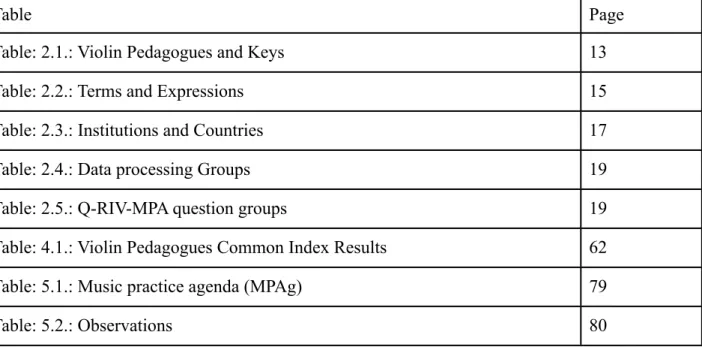
Table: 2.1.: Violin Pedagogues and Keys 13
Table: 2.2.: Terms and Expressions 15
Table: 2.3.: Institutions and Countries 17
Table: 2.4.: Data processing Groups 19
Table: 2.5.: Q-RIV-MPA question groups 19
Table: 4.1.: Violin Pedagogues Common Index Results 62
Table: 5.1.: Music practice agenda (MPAg) 79
Table: 5.2.: Observations 80
List of figures
Figure Page
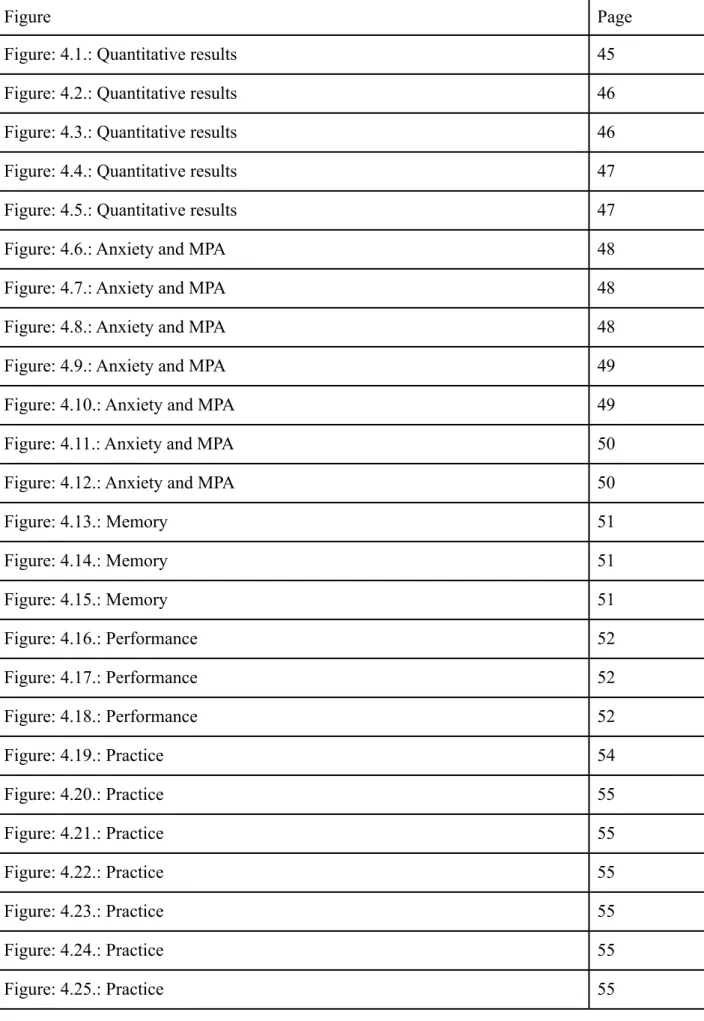
Figure: 4.1.: Quantitative results 45
Figure: 4.2.: Quantitative results 46
Figure: 4.3.: Quantitative results 46
Figure: 4.4.: Quantitative results 47
Figure: 4.5.: Quantitative results 47
Figure: 4.6.: Anxiety and MPA 48
Figure: 4.7.: Anxiety and MPA 48
Figure: 4.8.: Anxiety and MPA 48
Figure: 4.9.: Anxiety and MPA 49
Figure: 4.10.: Anxiety and MPA 49
Figure: 4.11.: Anxiety and MPA 50
Figure: 4.12.: Anxiety and MPA 50
Figure: 4.13.: Memory 51 Figure: 4.14.: Memory 51 Figure: 4.15.: Memory 51 Figure: 4.16.: Performance 52 Figure: 4.17.: Performance 52 Figure: 4.18.: Performance 52 Figure: 4.19.: Practice 54 Figure: 4.20.: Practice 55 Figure: 4.21.: Practice 55 Figure: 4.22.: Practice 55 Figure: 4.23.: Practice 55 Figure: 4.24.: Practice 55 Figure: 4.25.: Practice 55
Figure: 4.26.: Practice 56
Figure: 4.27.: Practice 56
Figure: 4.28.: Practice 56
Figure: 4.29.: Student-teacher relationship 57
Figure: 4.30.: Student-teacher relationship 57
Figure: 4.31.: Student-teacher relationship 58
Figure: 4.32.: Student-teacher relationship 58
Figure: 4.33.: Student-teacher relationship 58
Figure: 4.34.: Technologies 59
Figure: 4.35.: Technologies 59
Figure: 4.36.: Violin pedagogy 60
Figure: 4.37.: Violin pedagogy 60
Figure: 4.38.: Violin pedagogy 60
Figure: 4.39.: Violin pedagogy 60
Figure: 4.40.: Violin pedagogy 61
Figure: 5.1.: Potdar’s Performance Anxiety Cycle structure 66
Figure: 5.2.: Violin pedagogy 69
List of abbreviations and acronyms
AMP: Active Musical Performance
APA: American Psychological Association CNS: Central nervous system
DSM-IV-TR: Manuel Diagnostique et Statistique des Troubles Mentaux - Texte Révisé DSM-V: Manual Diagnóstico e Estatístico de Transtornos Mentais
ICSOM: International Conference of Symphony & Opera Musicians MPA: Music performance anxiety
MPAg: Musical practice agenda PAI: Performance Anxiety Inventory PC: Performance Cues
PRCP: Personal report of Confidence as a Performer OSESP: Orquestra Sinfônica do Estado de São Paulo PVT: Pedagogy of Violin Teaching
Q-RIV-MPA: Questionnaire on the relationship of individualized violin pedagogy and musical performance anxiety
SAD: Social anxiety disorder STR: Student-teacher relationship STAI: State Trait Anxiety Inventory UFAL: Universidade Federal de Alagoas UFMG: Universidade Federal de Minas Gerais WADA: World Anti-Doping Agency
“‘Bach?’ said Lord Edward in a whisper.
Pongileoni’s blowing and the scraping of the anonymous fiddlers had shaken the air in the great hall, had set the glass of the windows looking on to it vibrating; and this in turn had shaken the air in Lord Edward's apartment on the further side. The shaking air rattled Lord Edward’s membrana tympani; the interlocked malleus, incus and stirrup bones were set in motion so as to agitate the membrane of the oval window and raise an infinitesimal storm in the fluid of the labyrinth. The hairy endings of the auditory nerve shuddered like weeds in a rough sea; a vast number of obscure miracles were performed in the brain, and Lord Edward ecstatically whispered ‘Bach!’ He smiled with pleasure, his eyes lit up.”
Introduction
“The right kind of practice is not a matter of hours. Practice should represent the utmost concentration of brain. It is better to play with concentration for two hours than to practice eight without. I should say that four hours would be a good maximum practice time –I never ask more of my pupils–and that during each minute of the time the brain be as active as the fingers.”
1. Introduction
The centuries of western erudite music tradition establish student-teacher relationship (STR) hierarchy. The violin teachers pour their experience out on their students all knowledge necessary for student technical-musical development. They are moral value parameters, influence musical tastes and they are also interpretative model to be followed by their students (Gembris et Davidson, 2002, p. 26). Nevertheless, violin teachers do not interfere of daily student practice except on the amount of time employ for the ultimate goal - public performance - to be achieved. In contrast, violin students absorb teacher’s knowledge they try to reproduce it as effectively as possible. This structure remained intact for many years until different disciplines crossing (Altenmüller, 2009, pp. 106 et 107) began the development of a more specific musical pedagogy adapted to each student. Galamian (1985) describes and establishes this paradigm change:
(...) insistence upon compliance with rigid rules for everyone and everything that has to do with violin playing. The making of rigid rules is a dangerous procedure, since rules as such should be made for the good of the students rather than using the students to glorify the rules. In violin playing, as in any other art, that which can be formulated is not a set of unyielding rules but rather a group of general principles that are broad enough to cover all cases, yet flexible enough to be applied to any particular case. The teacher must realize that every student is an individual with his own personality, his own characteristic physical and mental make-up, his own approach to the instrument and to music. Once the teacher recognizes this, he must treat the student accordingly. Naturalness should be his first guiding principle. “Right” is only what is natural for the particular student, for only what is natural is comfortable and efficient. The efforts of the teacher, therefore, must be devoted to making every student as comfortable as possible with the instrument. In this connection it is distressing to think of the many unnatural theories of technique which have come and gone - and of the new ones which still - that have forced students into a constant keep on coming struggle against nature herself and consequently against a natural approach to the instrument. Such a battle has never yet been won by anybody. (pp. 1-2)
In this stretch, Galamian (1985) summarizes flexible violin teacher discussion concerning individual student needs. These questions would seem resolved and without the urgency of further
issues. Nonetheless, Brazilian violin teaching reveals a distinct reality. It can note a technical-musical poor development and music performance anxiety (MPA) increase. [personal experience, emphasized by the author]. This pedagogical deficiency is not based in just one problem, but with different factors such as the lack of buildings structure, absence of various equipments, problems related to basic and high level education, even, issues related to the local-political-cultural context (Gembris et Davidson, 2002, p. 18). However, it is not our aim discuss on this reality issues origins, but how to help violin teachers, consequently; their students to overcome these adversities within this context. As instance, this assistance it would be useful on the violinist individual daily practice with distinct objectives such as learning a new piece, correcting and strengthening technical skills, shape the best musical work interpretation, memorizing and preparing for a public performance (Barry et Hallam, 2002, p. 155).
All of these purposes can be clear during adults, or even, teenagers individual daily practice. Nevertheless, it would be difficult to believe that children due their technical-musical inexperience in these early violin learning stages, regardless of their individual characteristics, they are able of establishing such goals and organizing their daily individual practice. In most cases, they do not have cognitive and motor skills necessary to develop and elaborate such activities (Chantal, 2007, pp. 33-39). In this situation, teacher’s role on the individual practice becomes relevant. This implies not only teaching at most basic levels and having high mastery over violin technique or on the repertoire appropriate to the individual student stage (Galpérine et Haas, 2012), but also to seek different sources and forms that could overcome individual practice obstacles, performance problems and anxiety issues.
After this brief presentation on the individualized violin pedagogy importance we continue introduction’s development presenting the research’s problem that led to the hypothesis which represent our beliefs, the research’s goals and dissertation’s methodological processes with the purpose of assisting the reader in understanding our objectives. Finally, before proceeding to the next chapter, we discuss on the limitations present in this dissertation.
1.1. Research problem
specialized jury evaluation (Bourgeois, 1991, p. 15). Moreover, playing in orchestra or chamber ensembles also differs from a solo performance (Nicholson et al., 2015, pp. 438, 439 et 445). Work complexity can also influence music performance, as well as, score use when we play in public. Finally, daily practice structure also represents a large part of the results related to the performance both on the technical-musical execution, than on the control or increase of anxiety symptoms.
All these situations and their combinations require a physical, cognitive and emotional musician involvement (Eysenck et al., 2007). They have as possible negative consequences motor automatism coordination disrupt (procedural memory) and student self-confidence breakdown, even, MPA symptoms increase. However, they are not only related to psychological issues (anxiety trait), but they are also associated to the pedagogical learning processes (anxiety trait and anxiety state). Specifically about music performance anxiety, Fishbein and Middlestadt (1987), as cited in Bourgeois (1991, p. 15), report 24% of professional musicians suffer of some MPA symptoms and 16% of young musicians consider that anxiety reduces their performance effectiveness. Among the musicians who suffer most with MPA, Tamborrino (2001), as mentioned in Kenny et al. (2004, p. 761), shows that the highest incidence is between string players and Bissonnette (2013, p. 13) reveals 27% of musicians consume β-blockers against MPA symptoms. Thereby, it seems appropriate to discuss:
1. the consequences of violin pedagogy and MPA for interpreters and their performances;
2. the importance of new technologies such as recording techniques, virtual reality, video class and live stream social medias for violin pedagogy and individual practice and;
3. the relationship between violin pedagogy and the use of β-blockers.
What do we know of professional classical music and students proportion who believe suffer from the MPA effects due to inadequate pedagogy in Brazil, France and Portugal? Is there a relationship between violin pedagogy (first year of study and violin practice) and music performance anxiety?
1.2. Hypotheses
1. Improper musical piece or inadequate violin pedagogy applied may lead to increase performance obstacles. This inadequate teaching may indicate student specific individual pedagogy absence directed to the practice and musical performance.
2. Psychologically, aforementioned point can have negative influences on the student development such as their self-confidence decrease and turn them out unable to perform compatible musical works - or even below, his or her musical-technical level - with his or her technical-musical abilities.
3. Furthermore, self-confidence decreasing may increase MPA symptoms, consequently, lead to increase technical-musical performance difficulties, the search for legal drugs such as β-blockers that help them better manage music performance anxiety symptoms, even, the complete abandonment of violin study by students with relevant musical potential.
4. Finally, we believe violin performance teaching must be built and consolidated through a relationship based on trust among students, violin teachers and students’ parents with individual analysis, especially, as regards technical-musical and anxiety problems resolution.
1.3. Research goals
This research aims to contribute about musical pedagogy deficiency awareness. Its main objectives are:
1. to compare - despite such distinctive realities - Brazilian, French and Portuguese violin teaching and technologies access as pedagogical tool strategy;
2. to understand how the first year of violin teaching influences individual daily practice, consequently, music performance anxiety symptoms increase;
3. to elaborate musical practice agenda (MPAg) to assist teachers, violin students’ parents and violin students. MPAg intend to contribute MPA decrease incidence during practice, and performance;
4. to approach violin teaching (musical pedagogy) and the psychology of music (musical performance) through references, indications and contributions of the existing literature on the two areas.
1.4. Methodological procedure
This master’s dissertation methodology consists of two distinct stages:
1. Gathering data:
1.1. Scientific literature review on musical pedagogy, in particular of violin teaching (practice and performance), MPA and β-blockers, musical psychology (motors and cognitive processes) and music education and technologies.
1.1.1. Index on the following pedagogical works:
. Flesch - The Art of Violin Playing, Book One (2000);
. Galamian - Principles of Violin Playing and Teaching (1985);
. Suzuki - Shinichi Suzuki: His Speeches and Essays (1998), and;
. Galpérine et Reverdito-Haas - A Cursus of Dix Ans à la Class de Violon (2012).
1.1.2. Index structure based on the following terms:
. anxiety or musical performance anxiety; . memory;
. performance; . practice;
. student-teacher relationship; . technologies, and;
. violin pedagogy.
1.2. The Q-RMI-MPA (Questionnaire on the relationship of individualized violin pedagogy and musical performance anxiety) is established through 37 issues. It was available on GoogleDocs platform in two versions12: English and Portuguese version analyzed quantitatively and qualitatively. This survey was addressed to Music Conservatories, Music Faculties and Professional Orchestras with the aim of reporting and evaluating how the first violin lessons influenced their performances, especially regard to the MPA. It is important to emphasize professional musicians or pre-professional music students choice resides on collect their reports about their first violin class, as well as, to analyze the consequences, whether negative or positive, for their music development, music performance and if they consider there is any link between the first violin class and the MPA.
The results’ discussion is based on the literature review, and the Q-RIV-MPA’s data confrontation to reach the previously established objectives and confirm or deny our hypotheses. Analysis process is organized into four parts: MPA, consequences, STR, and individual practice structure. The result of this parallel culminates in the MPAg elaboration and different technological application, including social medias, in the practice and violin teaching against MPA.
1.5. Limitations of the study
Among study limitations factors it needs to mention calendar time available for the research development, book consultation access, questionnaires access and legal questionnaires authorization. Different adversities reside on calendar time available issues. For instance, due to this available time, this research is established on a reduced target population, pedagogy concepts (including violin-teacher relationship) could not be deepened, MPAg development more detailed and methodology data treatment more precise.
As regards bibliography access limitations, The Art of Violin Playing: Artistic Realization and
Instruction (Flesch, 1930) was consulted for a relatively briefed period at the Universidade Federal
of Minas Gerais (UFMG) - Brazil, but due book absence in the Lisbon libraries, it could not be carried a deeper analysis out. To overcome this adversity, master’s dissertations and doctoral’s theses were employed as an aid to better understanding Flesch’s concepts. The access to The
psychology of music performance (Kenny, 2011) was impossible. Kenny (2011)’s book would be
critical for the discussions held and proposed in this dissertation due to the vast author academic knowledge and production.3 Another factor consists of table of contents4 analysis in which different chapters should be important for the relationship among pedagogy, performance, and anxiety understanding.
On methodological issues, State-Trait Anxiety Inventory (STAI), Personal Report of Confidence as a Performer (PRCP) and Performance Anxiety Inventory (PAI) did not apply in the survey due to the fact we did not obtain their legal authorizations for employment in this research. The impossibility of using them, in particular the use of the STAI questionnaire, compromised treatment and evaluation. It is also important to mention we were almost unable to access the Spielberg’s questionnaire - STAI (1971) -, as well as, its French and Portuguese version. This unforeseen provoke an enormous Q-RIV-MPA delay conception.
3. Dianna Kenny (Professor of Psychology and Music, Faculty of Arts, University of Sydney, Australia) within the field
of music psychology.
4. 1. Phenomenology of Music Performance Anxiety; 2. Conceptual framework; 3. The Anxiety Disorders; 4. Defining
Music Performance Anxiety; 5. Epidemiology of Music Performance Anxiety; 6. Theoretical Contributions to Understanding Music Performance Anxiety; 7. Treatment; 8. Severe Music Performance Anxiety: Phenomenology and Theorizing; 9. Common Themes in the lives of performing musicians and 10. Prevention and Pedagogy.
Methodology
“ ‘If I cannot build it, I do not understand it.’ So said Nobel laureate Richard Feynman, and by his metric, we understand a bit about physics, less about chemistry, and almost nothing about biology. When we fully understand a phenomenon, we can specify its entire sequence of events, causes, and effects so completely that it is possible to fully simulate it, with all its internal mechanisms intact. Achieving that level of understanding is rare. It is commensurate with constructing a full design for a machine that could serve as a stand-in for the thing being studied. To understand a phenomenon sufficiently to fully simulate it is to understand it computationally.”
2. Methodology
The evidences search related to music performance anxiety (MPA), violin pedagogy and student-teacher relationship (STR) consist of literature review purpose. As a principal support to this objective, Flesch (2000) and Galamian (1985)’s treatises, Suzuki Methodology (1998) and Galpérine et Reverdito-Haas (2012)’ book form the main axis to understand teacher role on individual daily practice and its possible consequences - regardless of their positive or negative nature - for public performance. Through literature review we developed an index about violin pedagogues’ works and the Questionnaire on the relationship of individualized violin pedagogy and musical performance anxiety. The Q-RIV-MPA aims to evaluate violin first contact experience, as well as, student-teacher relationship established at this moment. The results obtained from the Q-RIV-MPA are added and compared to the data obtained through literature review. These two methodological processes are the basis for the anxiety, pedagogy, practice and performance relationship discussion and master’s dissertation conclusions which include implications, applications and further study. Finally, to ease the reader’s understanding, the master’s dissertation is divided into: introduction, methodology, state of art, results, result’s discussion and conclusion. It is necessary to add the abstracts with preliminary information, the appendix A (English, French and Portuguese questionnaire version), as well as, abbreviations and acronyms list.
2.1. Literature review
The complete literature review is established almost entirely chronological except for topic III. Most of the cited works brings mentioned authors bibliographic data, as well as, books or articles frame (sessions or chapters). Chronology structure’s choice is due to the fact that it is easer to understand analyzed terms’ definition’s evolution in relation to violin pedagogy and music performance anxiety. The literature review is structured in four categories:
1. pedagogy of violin teaching;
2. music performance anxiety;
4. music education and technologies.
Within of the violin pedagogy field, we can observe authors influence on other pedagogues. Another observed aspect is the authors legacy on current violin teaching and performance. The second topic establishes concepts and definitions related to anxiety and MPA. As mentioned, topic III structure is not chronological. This choice is due to the fact that music psychology works frame presents several concepts development in a very similar way. The last topic returns to the chronological structure because technology issues seem to be more ‘tangible’ when analyzed through a continuous time-line. It allows perception of technological advances and its direct and indirect applications
2.2. Index
Specific words search is the index development main objective within the works or chapters consulted in the literature review. In addition, it is also characterized by a analyze for the specific expressions related to the words searched before. However, it is established by author interpretation of these terms, expressions and words that can make reference on the eight subjects selected (see
Table 2.2). Index structure sets through works’ chronological order and words, terms or expressions
in alphabetical sequence. Each author has a specific color: Flesch - yellow; Galamian - red; Suzuki - green, Galpérine et Reverdito-Hass - blue and Term or Expressions not mentioned - cyan. The software employed to create the index is the ‘Pages Index’ and the methodological inspiration is the Arney’s (2006) Master dissertation’s index. Its objective consists of being a useful tool to guide terms analysis addressed in this research, as well as, an extension of the literature review. The index employed is based on the time reduction in the search for terms, words or specific expressions referring to the work(s) of author(s) relevant to the development of analysis and discussion.
Chapters and works are selected specifically in agreement with their themes relevance for the master’s dissertation development. Each chosen work has a clear justification. They are for instance, Flesch (2000)’s conscious practice concept in transforming students from ‘not being able’ to ‘being able’ through sheet music orientation with the objective of diminishing the physical efforts, increase motor automatism and promoting a safe performance without music score. Galamian (1985) emphasizes the importance and necessity that the violin teacher teaches as a
psychologist, diagnosing their students and elaborating the structure of their individual daily practice with the intention of strengthening physical actions.
Suzuki (1998) summarizes the application of his methodology through the contextualization of the ‘Education of Talent’ and the ‘Law of Ability’ in parallel with mother tongue learning. This parallel represents actions’ naturalness, including violin practicing and performing time. It is important to emphasize that Suzuki extensively promotes the use of recordings reference as a tool for violin teaching and practicing. Galpérine and Reverdito-Haas (2012) describe how the application of violin pedagogy should be established, specifically, during the first year of instrument practice and student-teacher relationship development. It is necessary to stress that these same terms or expressions can be present in other works of these same authors. Index terms search (see Table:
2.2)5 6 and their authors and works are (see Table: 2.1):
Table: 2.1.
Violin Pedagogues Keys
Flesch - The Art of Violin Playing, Book One (2000).
1. Practicing in General (pp. 81-83);
2. Practicing as a Tool for Learning (The ‘Hygiene’ Practice) (pp. 147-159);
3. Musical Memory (pp. 160-164).
5. It was considered as ‘motor automatism or procedural memory’, only terms related to gestures, posture and mainly
activities that consist in the cognitive independence of these movements, excluding specific aspects of the violin technique.
6. We consider ‘extra worries’ the individual diagnoses exercised by the violin teacher on the physical and emotional
Galamian - Principles of Violin Playing and Teaching (1985).
1. Chapter four: ‘building time’, ‘interpreting time’, ‘performing time’; and ‘the critical ear’ (p. 93-104);
2. Conclusion - A few words for the teacher (pp. 105-108);
3. Postscript - II. Other Facets of Mr. Galamian’s Teaching (pp. 117-124).
Suzuki - Shinichi Suzuki: His speeches and Essays (1998).
1. Discovery of the Law of Ability and the Principle of Ability Development: Proof that Talent is not inborn. (circa 1980) (pp. 1-17);
2. The Law of Ability and the “Mother Tongue Method” of Education. (1973) (pp. 19-35).
Galpérine and Reverdito-Haas - Un Cursus de Dix Ans à la Classe de Violon (2012).
1. Première année. (pp. 13-31).
Table: 2.2.
Terms and Expressions
.anxiety or musical performance anxiety (all kinds of feelings, thoughts, worries or physical reactions such as arm tremors that can provoke performance damage);
.memory (performance without music score);
.procedural memory (independence and automatism of the movements during the performance);
.performance (performance of a musical work with the presence of one or more individuals, whether in class or in concert);
.practice (self-instruction daily process without violin teacher orientation);
.student-teacher relationship (all kinds of extra worries or influence exerted by the violin teacher on his or her students that can be extended to the parents or legal guardians of each student);
.technologies (all kinds of hardware or software that can enable the violin teaching and assist the violinist against MPA) and;
.violin pedagogy (technical-musical development of the violinist). 2.2.1. The Arney Index
Arney’s (2006) master dissertation’s index is structured in a clear and pragmatic way: authors and topics. Three authors are employed to establish Arney’s index and each of these authors received a specific color7 for better identification. Along with this legend, Arney added ‘No Information in this text’ and ‘Refer to text indexes’. The topics are established in ten parts: philosophy, history, performers, holding the instrument, practice, tone production, teaching, bowing, left hands (doubles stops, ornaments, never, style and psychological) and repertoire 7. Auer - bleu; Flesch, Book One - green; Flesch, Book two - yellow; Galamian - orange; ‘no Information in this text’ -
(composers of concerti and unaccompanied pieces). In addition to the index, Arney adds a table characterizing these three authors through their historical context and their inheritances or pedagogical influences regarding the establishment of schools, styles and students.
2.3. Q-RIV-MPA
A single questionnaire is employed in this master’s dissertation. The Q-RIV-MPA8 objectives are to obtain data and answers on anxiety and individual experiences related to violin learning, practice, performance and anxiety. Its development process is established through three different sources:
1. analysis of three questionnaires - State-Trait Anxiety Inventory (STAI), Personal Report of Confidence as a Performer (PRCP) and Performance Anxiety Inventory (PAI)9 (French version);
2. video and in loco performance observations and;
3. personal experiences shared with different musicians, violin teachers and violinists colleagues on pedagogical development and its application during individual and group classes, performance and music performance anxiety.
The Q-RIV-MPA is filled out anonymously and is intended10 for professional violinists, violin teachers and violin students who are in a pre-professional stage or are enrolled in a regular course at conservatories or universities. Three countries are the main basis for the target population of the questionnaire - Brazil, France and Portugal -, but it does not exclude individuals who started their violin studies outside the countries context established. Although countless research shows that gender issues are highly relevant and women appear to be two to three times more likely to have MPA (Barbeau, 2011, p. 28), gender issues are not applied in this questionnaire due to the fact that we have tried to evaluate experiences during childhood regardless of gender. On the other hand, age
8. The Questionnaire on the relationship of individualized violin pedagogy and musical performance anxiety
(Q-RIV-MPA) was elaborated by the author of this master’s dissertation.
factor has considerable importance for the development of the discussion of the results, even, if we exclude children and adolescents from responding this survey.
The questionnaire consists of 37 questions, a box for comments and is available in two languages, English and Portuguese. Despite its mixed nature, the Q-RIV-MPA is mostly composed of questions ‘yes or no’ answers. Thirty-three questions have this structure which aim to simplify the data analysis. The questions 7, 15, 16 and 31 are divided in part ‘a and b’. Finally, Questions 36 and 37 should be answered only if question 35 has affirmative answer. The Q-RIV-MPA has as main objective to try to better understand the importance of the individualized pedagogy of the violin as a way to combat musical performance anxiety. Thus, the main themes for achieving this goal are the relationship between pedagogical orientation, practice and performance; student-teacher relationship; musical performance anxiety during the first public performance and currently performance and treatments, including beta-blockers. It was sent to forty institutions in six different countries. It was also shared through social medias (Facebook and Twitter) and individually via email, inviting violinists and violists to answer the Q-RIV-MPA. Individuals invited to respond to the questionnaire were also orientated to share it to other musicians and colleagues. The questionnaire was available from 02-31 January 2018 on the online platform docs.google.com11 12. The institutions invited to participate in the survey are:
Table: 2.3.
Institutions Countries
Universidade Estadual de Minas Gerais Universidade Federal de Alagoas Universidade Federal de Minas Gerais Universidade Federal do Rio de Janeiro Universidade Federal de Santa Maria Universidade Federal de São João del Rey Orquestra Filarmônica de Minas Gerais Orquestra Opus
Orquestra Sinfônica do Estado de São Paulo Orquestra Sinfônica de Minas Gerais
Brazil Brazil Brazil Brazil Brazil Brazil Brazil Brazil Brazil Brazil
11. English version: https://goo.gl/forms/ZrwTXmaYvVbkxo5l1 12. Portuguese version: https://goo.gl/forms/p8nF3uyjGQh0SLBi2
Academia de Música de Alcobaça
Academia de Música de Castelo de Paiva Conservatório Regional de Castelo Branco
Escola Artística do Conservatório de Música Calouste Gulbenkian - Aveiro Escola Superior de Música e Artes do Espectáculo
Portugal Portugal Portugal Portugal Portugal Escola Superior de Música de Lisboa
Fundação Calouste Gulbenkian - Gulbenkian Música Orquestra Clássica do Sul
Orquestra de Câmera de Cascais e Oeiras Orquestra do Norte
Orquestra Metropolitana de Lisboa Orquestra Sinfónica do Porto Teatro Nacional de São Carlos Universidade de Aveiro Universidade de Évora Universidade Nova de Lisboa
Portugal Portugal Portugal Portugal Portugal Portugal Portugal Portugal Portugal Portugal Portugal Association Françaises des Orchestres
Conservatoire à Rayonnement Régional de Lille Conservatoire à Rayonnement Régional de Nice Conservatoire à Rayonnement Régional de Paris Conservatoire de Lyon
Conservatoire à Rayonnement Régional de Strasbourg Conservatoire de Paris
Orchestre de Paris
Orchestre National de Lille
Orchestre Philharmonique de Strasbourg
France France France France France France France France France France
Université de Laval Canada
Conservatoire Royal de Bruxelles Belgique
Hochschule für Musik Franz Liszt
Hochschule für Musik Freiburg im Breisgau
Germany Germany
2.4. Data processing
Data processing is established quantitative and qualitatively. The quantitative analysis of the answers is made by the sum of the partial presents in the two questionnaires together with the results presented in the index. The qualitative analysis of the data is established through the association between the terms or expressions of the index and the Q-RIV-MPA results. In order to facilitate the analysis of the data, the Q-RIV-MPA issues are divided into eight groups that are
similar those established in the literature review analysis. However, it is necessary to observe three exceptions:
1. The ‘Quantitative’ group is added. It makes references to the absolute values and the population reached; in relation to the search engines established in index;
2. ‘Motor Automatism’ is excluded and;
3. some issues belong to more than one group.
Table: 2.4.
Data processing Groups
Quantitative A
Anxiety or musical performance anxiety B
Memory C Performance D Practice E Student-teacher Relationship F Technologies G Violin Pedagogy H Table: 2.5.
Q-RIV-MPA question groups
A B C D E F G H
1 2 3 4
5 6 7 8 9 10 11 12 13 14 15 16 17 18 19 20 21 22 23 24 25 26 27 28 29 30 31
32 33 34 35 36 37
State of Art
“Music ability is not an inborn talent but an ability which can be developed. Any child who is properly trained can develop music ability just as all children develop the ability to speak their mother tongue. The potential of every child is unlimited.”
(Suzuki, Nurtured by Love, Alfred Music; 2 edition (1993 June 1) in The Importance of Deliberate Practice)
3. State of art
Three main authors form the basis of literature review and discussion about violin teaching and music performance anxiety. Flesch (1873-1944), Galamian (1903-1981) and Suzuki (1898-1998). As assistance to pedagogues’ thinking understanding, some works such as Un cursus
de dix ans à la classe de violon (Galpérine et Reverdito-Haas, 2012), Chantal (2007)’s PhD thesis,
Arney (2006)’s Master dissertation and Trindade (2010)’s Master dissertation are selected. A wide range of studies, articles, essays, surveys, and encyclopedias have been employed to understand the concepts involving anxiety, social anxiety disorder (SAD) and music performance anxiety (MPA). Different authors or researchers are recurrent during this process, among them: Spielberger et al. (1971); Bourgeois (1991); Kenny (1993); Antoniazzi, Dell’Aglio and Bandeira (1998); Duke (1999), Duke et al. (2009, 2011); Kenny and Osborne (2006); Smith, Smoll and Cumming (2007); Barbeau (2011); Kenny (2011); Bissonnette (2013); Baxter, Scott and Whiteford (2013); DSM-V (Manual Diagnóstico e Estatístico de Transtornos Mentais) (2014); Nicholson et al. (2015); American Psychological Association (APA) (2017); etc.
In the music psychology field, three books have considerable significance for the development of concepts related to both music pedagogy and music performance anxiety. The intention of approaching and reaching both musicians (interpreters and teachers) and music psychologists confirm their importance. Among them, we can highlight: Psychology of Music: from
sound to significance (Tan, Pfordresher et Harré, 2010); The psychology of Music (Deutsch (ed.),
2013) and The science and psychology of music performance (Parncutt et McPherson (ed.), 2012). About (new) technologies, the data discovered during the literature review shows a limited amount of articles or books addressing the use of software, internet, recordings, video lessons, virtual platforms such as Youtube, Instagram etc., within musical education, teaching and violin practice context. Nevertheless, it is possible to understand this loophole because the relationship between these two areas is quite recent. In this section, this theme is approached through five authors - Garcia (2000), Beckstead (2001), Henrique (2002), Cunha (2006) and Ruismäki (2009) - and The Strad Magazine’s article of ARCO Project. Howbeit, this subject is also approached by pedagogues and psychologists such as Suzuki, Seashore and Bissonnette.
3.1. The pedagogy of violin teaching
The pedagogy of violin teaching is a vast field with a strong tradition. It has been established over the years whether via oral or written treatises. We believe they represent a more solid tool for researching the pedagogy of these authors and for making analyze and comparisons. Furthermore, quoting Trindade (2010, p. 12), we would like to emphasize “É importante ressalvar que os violinistas e pedagogos mencionados são aqueles que pelo seu legado exerceram maior influência nas gerações seguintes. Porém, existe um largo espectro de obras, métodos e estudos técnicos omitidos com igual valor e exequibilidade no ensino do violino.”1314 15
3.1.1. Flesch
Carl Flesch (1873-1944), from Hungary, built an extensive career as a violinist, but it is within the field of violin pedagogy that he excelled. His publications, always addressed to the technical and artistic violinists’ development which are still considered reference works and have a great importance in the teaching and violin practicing. Amongst his most important works are: ‘Das
Skalensystem für Violine’ (1926) and ‘Die Kunst des Violin Spiel’ (1923-1928). The last one was
later published in English with the title translated and presented as The Art of Violin Playing (1924-1930), new edition 2000).
The Art of Violin Playing is divided into two volumes. The first book - ‘violin playing as a
craft and as science’ (p. 1) - is dedicated to violin technique and some aspects of pedagogy, violin practice and psychology of performance. The second book - ‘violin playing as an art’ (p. 1), subtitled as The Art of Violin Playing: Artistic Realization and Instruction, is addressed to the artistic development and performance deeper aspects such as physiological and psychological. Both books are devoted to teachers and violin students. The first book is defined by the author himself as the theory of acquisition and use of the technique of violin playing. This concept guides teachers to enable their students ‘to think logically for themselves and to analyze violin-technical problems in
13. Author's translation from the original.
14. “It is important to note that the violinists and pedagogues mentioned are those who by their legacy exerted greater
influence in the following generations. However there is a wide range of works, methods and technical studies omitted with equal value and feasibility in violin teaching” (Trindade, 2010, p.12).
depth’. (Flesch, 2000, p. v). The author also states the book is not addressed to a specific audience of students and any student, independent of their level, can make use of this book and apply it in their study and in their individual daily practice.
The Art of Violin Playing Vol. 1 consists of two major parts: General Technique and Applied Technique. Within this section, three aspects deserve to be highlighted: Practicing in General,
Practicing as a Tool for Learning (The ‘Hygiene’ Practice) and Musical Memory. These three parts consist of an exhaustive description of the musical practice16, described by the pedagogue as a ‘road’, and a ‘tool’ that leads violinists from ‘not being able’ to ‘being able’ to perform in public (2000, p. 81) and achieve the main objective ‘the artistic presentation’ (2000, p. 164). The second book presents itself of great importance on the issues related to the MPA and violin daily practice. It is divided into two large sections. The first section consists of six parts that also contains subdivisions. Within the first part, technical issues are explored in-depth and related to the performance itself. In the first section the fourth chapter discusses about performance, obstacles and hindrances and the sixth chapter addresses violin teaching, pointing out useful information on teacher-student relationship, practicing, anxiety and performance. The second section consists of eleven appendices which Flesch develops the same technical aspects previously addressed through musical examples.
3.1.2. Galamian
Ivan (Alexander) Galamian (1903-1981) was of Armenian descent, born in Tabriz, Persia (now Iran). He is regarded as the most influential theorist and pedagogue on the violin teaching and practicing field. His “approach was analytical and rational, with minute attention to every technical detail” (Grove, 2001, vol. 9, p. 429) aiming to develop students’ individuality and for mental control over the movements to be performed. Among his main works, it is necessary to cite the
Principles of violin playing and teaching (1962) which had a second edition in 1985 and it remains
current and relevant.
The book is structured through four chapters, a conclusion that deserves to be highlighted and the postscript. Among them, Chapter Four contains aspects related to practice and performance
16. Chantal (2007, p. 46) mentions that Flesch was the pedagogue who most wrote about the instruction of violin
(mental alertness in practice; objectives in practice: ‘building time’, ‘interpreting time’, ‘performing time’; and the critical ear). The conclusion - A few words for the teacher - and the postscript - II. Other Facets of Mr. Galamian’s Teaching - are addressed to teachers and how to act in the classroom, how to recognize the strengths and weaknesses, and identify or diagnose the physical and psychological student characteristics.
3.1.3. Suzuki
Shinichi Suzuki (1898-1998) was born in Nagoya, Japan. He is considered one of the greatest pedagogues of the last century within the violin teaching field. His methodology17 crossed the frontier of violin teaching and was extended to other instruments and even if we did not go into detail, it received great influence by the cognitive psychology and developmental psychology elaborated by the Swiss psychologist Jean Piaget (1896-1980) and by Charles Darwin (1804-1882)’s Theory of Evolution. Chantal (2007, p. 58) points Suzuki out was the most dedicated to teaching young children. Its principle is “excellence in auditory memory through listening and repetition” and its philosophy is “to develop as much as possible human skills, through the formation of good habits” (Chantal, 2007, p. 63). It is the principle and the philosophy of the ‘education of the talent’ (Suzuki, 1989, pp. 4-5). These two aspects become evident when, Suzuki, approaches naturalness during the learning process, by adapting violin methodology and pedagogy to the student cognitive maturity level, to the importance of musical learning through memory structure and its reflexes in the continuity of the child’s musical learning.
The book ‘Shinichi Suzuki: His speeches and Essays’ is structured in four parts. It resides on the music education relationship among students, teachers, and students’ parents through attention and the aid of music recordings. The musical education is constant compared to the process of learning of a mother tongue, The law of ability (p. 6), through the valorization and development of personal skills and the understanding of the talent concepts. These concepts are constantly addressed during the development of this book. Within this proposal, the first two chapters (1. Discovery of the law of ability and principle of ability development: Proof that talent is not inborn - about 1980 - and 2. The law of ability and the “Mother Tongue Method” of “Education - 1973) are considered important for the development of this master dissertation, both within the critical aspects
and for the establishment of the issues related to the student-teacher relationship and, consequently; with their parents.
3.1.4. Galpérine and others
Some of the works mentioned previously have been a great contribution to the understanding of the cited authors but also contribute to the methodological and structural development of this master dissertation. Kelley Arney (2006)’s master dissertation - “A comparison
of the violin pedagogy of Auer, Flesch, and Galamian: Improving accessibility and use through characterization and indexing” - compared the pedagogy of the violin between Auer, Flesch and
Galamian. In addition to the pedagogical characteristics of each of the three authors mentioned, we consider it pertinent for this dissertation three aspects: 4.4 Too much practice, 4.6 Teaching: Incompetent Instruction and 4.12 Psychological: Stage Fright. Arney’s index has also proved to be a useful tool for researchers and facilitates in the identification of specific terms within the text and pedagogical strategies proposed by Flesch and Galamian.
Kênia Adriane Pinto Chantal (2007)’s Ph.D. thesis - “O ensino do violino dentro do estágio
pré-operacional: um estudo piloto sobre o estudo técnico, com considerações da psicologia psicognitiva e do desenvolvimento” - considers cognitive and developmental psychology in violin
teaching. An interesting parallel is established between these two areas through the already mentioned pedagogues - among others - and psychologists, including the Swiss researcher Jean Piaget. Also, centered on violin pedagogy, especially on the Suzuki Methodology, Alexandra Sofia Monteiro da Silva Trindade (2010)’s Master dissertation - “A Iniciação em Violino e a Introdução
do Método Suzuki em Portugal” - carries out important considerations about the structure of this
methodology, origins, and influences and its reality in Portugal.
Alexis Galpérine, born in 1955, is a professor at CNSMD in Paris, where he teaches pedagogy. He also teaches at the American Conservatory of Fontainebleau. Ana Reverdito-Haas is a violin teacher at the Strasbourg CRR. “Un cursus de dix ans à la classe de violon” (2012) describes the course of violin learning over fourteen years - even though, book main title refers to ten years of learning - through specific activities, pedagogical advice, and repertoire indications according to students technical-musical level. Our interest is focused on the first part of the book - Première
teacher-student relationship and the pedagogy to be applied. It is interesting to note that in this first chapter, the greatest concern of both authors resides on the presentation of the instrument to the student and how it will be added to his or her daily life, as well as, student’s physical-motor adaptation to a foreign body (violin and bow).
3.2. Music performance anxiety
Anxiety affects a large part of the world’s population. Although, different researches done do not show statistics consensus about affected people they indicate anxiety disorders are the most frequent mental health troubles. According to Kenny (1993) and Baxter, Scott and Whiteford (2013) almost 30% of the adult world population suffers with some type of anxiety disorders, ‘a specific phobia (12,5%) or social phobia (also called social anxiety disorder) (12,1%) over their lifetime’ (Kenny, 1993, p. 5). The American Psychological Association (APA) (2017), in its online version18, defines anxiety disorders as ‘an emotion characterized by feelings of tension or worried thoughts. People with anxiety disorders usually have recurring intrusive thoughts or concerns. They may avoid certain situations out of worry.’
Some somatic issues also characterize anxiety disorders such as cold and wet hands, dry mouth, sweating, nausea or diarrhea and difficulty swallowing, and some symptoms of autonomic hyperactivity as increased heart rate, shortness of breath and dizziness (vertigo). The DSM-IV (Manual Diagnóstico e Estatístico de Transtornos Mentais) (2014) (2014, pp. 189-190) establishes anxiety disorders such as social phobia, depression, stress, post-traumatic stress, mood troubles, panic attack, addiction, or abuse of alcohol or other substances (Manuel Diagnostique et Statistique
des Troubles Mentaux - Texte Révisé (DSM-IV-TR) (2003, p. 546) and performance anxiety. They
can ‘share characteristics of fear, excessive anxiety and behavioral disorders’. These disorders tend to be comorbid, but they can be differentiated through objects or situations which may induce fear and anxiety associated with cognitive construction.
Musical performance anxiety consequences can be countless from the creation of a cycle which can generate a fear of public performance or stage fright to the completely abandoning of music activities. Nicholson et al. (2015, p. 438), quoting Kenny (2011) say: “Music performance anxiety (MPA), commonly known as stage fright, can create effects ranging from slight impairment
to levels that can qualify a diagnosis of social anxiety disorder (SAD) (American Psychiatric Association, 2013). The anxiety may be highly circumscribed to musical performances, or it may occur as part of SAD, in which musical performance is only one of many anxiety-provoking social situations.” They complement with: “MPA appears to be independent of musical training and accomplishment (Kenny, 2011)”.
These latter definitions about anxiety disorders are relevant to understanding more about music performance anxiety, which is identified by Kenny and Osborne (2006, p. 103) as ‘a group of disorders that affect individuals in a range of endeavors, from test-tasking, maths performance, public speaking, sport and performing arts in dance, acting and music’. MPA evidences the most vulnerable instrumentalist somatic aspects. For instance, the violinist may experience tremors in his or her right arm, or the trumpeter may have a specific sensation of dry mouth or dry lips. The motor incapacity of some movements can influence the interpreter until the cognitive level such as remembering and retrieving stored information - melodic, harmonic and rhythmic structure - hindering or impairing music performance.
3.2.1. Spielberger
The article, Development of the spanish edition of the State-Trait Anxiety Inventory,
published in 1971 by the Interamerican Journal of Psychology is signed by Spielberger, Gonzalez-Reigosa and Marinez-Urrutia (Florida State University) and Natalicio and Natalicio (The University of Texas at El Paso). In particular about one of the authors, Charles Spielberger (1927-2013) was president of the American Psychological Association and researcher at the University of South Florida, among other American universities. Directly responsible for the creation of STAI, he signs for more than 460 publications, and he has influenced many researchers and students. The article is divided into: an abstract in English and Spanish, definitions of anxiety dating back to Freud (1936), definitions of trace and state anxiety, translate methodology from English to Spanish and bibliographic references.
Some questionnaires have been widely used to measure anxiety level in individuals daily lives and in specific activities such as musical or sports performance or individual public exposure. Among the most employed anxiety inventories we can mention the State-Trait Anxiety Inventory (STAI), the Personal Report of Confidence as a Performer (PRCP) and the Performance Anxiety