A Work Project presented as part of the requirements for the Award of a Masters Degree in Management
from the NOVA- School of Business and Economics and Warsaw School of Economics.
Use of multi-sensory marketing techniques and its influence on brand
experience in retail and HORECA sector
Agnieszka Machała, #1841
Work Project carried out on the Marketing course under the supervision of: Professor Luis Fructuoso Martinez
Table of Contents
Abstract ... 1 Literature Review ... 2 Relationship Marketing ... 3 Experiential Marketing ... 6 Multi-sensory marketing ... 8 Visual ... 9 Auditory ... 10Visual & auditory ... 11
Olfactory ... 11 Tactile ... 13 Gustative: ... 14 In-store experience ... 14 Method ... 19 Hypotheses ... 19 Research Methodology ... 19 Questionnaires: ... 20 Data Collection ... 20 Participants ... 20 Results ... 20 Discussion ... 22 Main conclusions ... 22 Study Limitations ... 23 Further research ... 23 References: ... 24 Appendixes: ... 27
1
Abstract
Title: Use of multi-sensory marketing techniques and its influence on brand experience in retail and HORECA sector
Author: Agnieszka Weronika Machała
This dissertation aims at providing an analysis of the influence of sensory stimuli on consumer’s decision making process along with product and service perception. It focuses on the multisensory marketing techniques in consumer foodservice and retail sector.
The impact of multisensory marketing techniques is firstly theoretically analyzed regarding advertising and in-store promotion strategies applied by FMCG and HORECA companies. The theoretical basis and conceptualization is supported by examples of successful online and offline marketing campaigns launched in recent years.
The second part of this study is focused specifically on the use of multisensory promotional techniques in the foodservice environment. The real life experiment has been conducted in a local Lisbon restaurant in order to measure the influence of auditory cues on the service perception and overall customer experience. The initial hypotheses were proved by post-purchase survey conducted among patrons of the restaurant.
The result of this study shows that brand, product and service perception can be positively influenced by multisensory marketing techniques. The auditory stimuli proved to be a significant source of customer overall satisfaction and in-store perception, which confirms partly the initial assumptions of the study.
Keywords: multisensory marketing, brand image, in-store experience, product and service perception
2
Literature Review
Nowadays, business environment has become highly competitive, especially in FMCG and HORECA industries. Customers all around Europe generally demonstrate high price sensitivity toward goods and they often search intensively for best price deals.1 Such behavior pertains not only to purchases involving high effort decision making process, such as booking a flight trip or buying a car. Also, while purchasing e.g. convenience good in the supermarket, consumers usually tend to compare prices to obtain the most satisfactory price to value ratio.
The reason for such trend in consumer behavior can be ascribed not only to sluggish growth or even partly decline in disposable income of EU citizens comparing to previous years.2 Also growing number of low - cost suppliers delivering e.g. widespread and easily available private label products has an impact on consumer propensity to make prudent choices. Likewise, buyers are eager to search for the best deals e.g. by using cashback rebates.
This general tendency in consumer behavior is confirmed by research conducted recently in the UK. It had revealed that price is 5 times more significant than any other factor for 75% of consumers while making a purchase decision.3 Hence, its pivotal role cannot be underestimated by companies which aim to succeed in uncertain and harsh economic times. However, even though price proved to be most salient purchase driver, other criteria involved in purchase decision making process, cannot be downplayed. This includes among others: interaction with salesperson, information gained from friends through word of mouth (WOM) or product characteristics presented in commercials.
According to the theory, companies which aim at maximizing efficiency and volume of individual sales through single “point of sale” transaction, adopted transactional marketing strategy. This business strategy is focused around active seller and passive buyer. However, this traditional approach has recently changed in favor of the relationship marketing and sensory marketing as a result of growing meaning of
1
www.plunkettresearch.com/retailing-stores-market-research/industry-and-business-data
2
Well- being and the global financial crisis, OECD, 2013
3
3
customer retention and long-term value co-creation. Hence, the passive and reactive type of relation between customer and company seems to no longer be sufficient4.
Relationship Marketing
The reconceptualization in orientation from transactions to relationships was presented by academics already three decades ago. The growing meaning of emotions in business-to-business (B2B) and in business-to-consumers (B2C) markets was brought up regarding its uncontestable role in creation of customers’ long-term loyalty and higher retention rate. This finding was extended later on by presenting the role of emotions as an important source of information in purchase decision making process (Bagozzi et al., 2000).
The emotional attachment between company and customers gains especially on relevance if there is a periodic or ongoing desire for the product or service. Also, if direct contact with the customer is required, relationship marketing means more than for instance in wholesale sector, where middlemen are involved. Thus, it can be asserted that relationship marketing is not mutually exclusive with transactional marketing, but both types complement each other and should be used as a combined approaches at the managerial level. 5 The influence of the nontraditional marketing techniques, namely the auditory cue, that influence the emotional affiliation with the brand and its perception will be analyzed in the next chapter.
Relationship marketing reflects an ongoing development exchange process between company and its customers. The goal of the firm within this exchange association is to obtain in an unobtrusively way thorough information on customers priorities and needs. According to this concept, the termination of the customer-company relation should be concerned by customer as unattractive from both economic and psychosocial point of view (Dwyer et al., 1992). Relationship marketing aims at improving and managing long-term trust with large groups of customers in a personalized way. In order to succeed, data about customer profile, buying pattern and other specific characteristics are gathered and scrutinized. To track this key information, companies use tools
4
www.searchcrm.techtarget.com/definition/transactional-marketing
5
The Evolution of Relationship Marketing, Jagdish N. Sheth,,Atul Parvatiyar* International Business Review Vo|. 4, No. 4, pp. 397-418, 1995
4
provided by major players in the Customer Relationship Management market such as salesforce.com, SAP AG or Microsoft Dynamics.
In B2C market, such as retail or service industry, companies intend to improve brand awareness and strengthen customers’ loyalty and involvement through diverse sophisticated and innovative techniques and marketing actions. Customers’ engagement is a salient aspect in maintaining sizable and loyal customer base because it ensures iterative purchases and constant revenue stream. For this reason, it is no coincidence that companies turned in last years toward the concept of relationship marketing, which enables to achieve these goals.
The increased profitability stemming from customer retention is one of main reasons for relationship marketing application in business strategy. Through truly engaged customers, company can achieve 1.7 higher profit than through normal customers.6 Set of advantages associated with the use of relationship marketing contains: lower costs associated with one-time cost of acquisition, valuable source of word of mouth (WOM), higher likelihood of purchase ancillary products by long-term customers, probability of selling compatible products (usually more expensive) to existing customers as a cross-selling activity and the economy of scale linked to the account maintenance.7
Marketers use a term of a “relationship ladder of customer loyalty", in which customers are divided according to the level of their loyalty toward the product. In this theory, “prospects” are people, who are likely to become brand users in the future. At the top of this structure are “advocates” and “partners”. Naturally, companies intend to obtain a high number of “partners” in order to ensure one of the most important sources for positive brand image, namely WOM. This kind of activity accounts for more than 50% of purchase decisions because, as the research reveals, more than 90% of customers trust a WOM.8
However, to assure that customers join the highest level of “loyalty ladder”, it is necessary to provide more personalized and experiential product or service at each step of the interaction. It is especially significant because customers are likely to express
6
www.businessjournal.gallup.com/content/104170/when-engaged-employees-meet-engaged-customers.aspx
7Buchanan, R. and Gilles, C. (10990) “Value managed relationship: The key to customer retention and profitability”,
European Management Journal, vol.8, no 4, 1990
8
5
positive opinion, when their initial expectations were not only met, but actually when they were exceeded.
This customer-centric view is key success factor in the service dominant logic. According to this concept, customer is always value co-creator and value is defined by its idiosyncratic and contextual meaning. This concept was also described as “brand as the experience” from the point of view of the customer, resulting in high and ongoing revenues (Prahalad and Ramasvamy, 2004). To obtain such satisfactory outcome reflexive integrated marketing communication needs to be used.
Engaging customers at different levels of touchpoints is one of the strategies to maximize value - co creation. Companies create a diversified set of activities both in online and offline environment to encourage customer’s interaction with the brand and product or service. There are multiple immensely creative strategies used to involve consumers, ranging from guerilla marketing through event marketing to experiential marketing campaigns. Thanks to such innovative and ingenious marketing actions customers’ emotional bonding with the brand is strengthened and consequently higher loyalty can be achieved.
Last but not least issue confirming the importance of relationship marketing is the fact that customers do not always act in a rational way. People intrinsically tend to simplify the decision making process by evaluating information in a selective and biased way. Very often opinions about a product or service are developed on the unconscious level, which in turn may lead to purchase decision. Research has shown, that even up to 90% of purchase decisions are made on subconscious level.9 Even apparently nonrelated issues: peripheral cues such as social proof (for instance: peer pressure) or reciprocation play meaningful role in persuasion and creation of positive attitude toward brand. This peripheral routes rely on emotional involvement, which as mentioned above is significant in influencing consumer behavior10.
One cognitive bias that reflects the irrationality in consumer behavior is known as “Ikea effect” and is linked partly with the endowment effect. In this instance, the emotional
9
www.digitalmarketingnow.com/marketing-to-the-subconscious
10
6
bonding occurs between customer and “do it yourself” product. Even though the end product is often not flawless, it will be valued much higher by the customers, who perceives themselves as ”creators” because of time and effort devoted to self-assembling the product. Moreover, such customer will irrationally believe that also other people would rate this object highly11. This effect is only one among multiple others that proves how irrational and prone to enchantment are consumers nowadays. Regarding aforementioned findings it is crucial from the perspective of a company to create positive brand associations both on conscious and unconscious level in minds of customers. This can be achieved through bolstering the emotional bounding with customers thanks to diverse multisensory marketing techniques, which will be described in next part of this paper.
Experiential Marketing
Use of experiential marketing in advertising and promotional campaigns can be regarded as an implication of the relationship marketing approach toward customer - company relation. Recently, an impressive amount of truly bonding and engaging marketing actions has been launched into the market. Special emphasis has been laid on providing consumers with holistic brand experience. The purpose is to link them with the brand through all possible touchpoints and give them relevant and personal memories.
Experiential marketing has been embraced by marketers because consumers have been exhibiting increased desire for personalization12. This itch for special sensations forged marketers to create extraordinary marketing messages that would remain in consumers’ minds as meaningful and relevant memories.
One good example of such action has been recently introduced by Italian manufacturer Ferrero. To celebrate the 50th anniversary of its flagship product Nutella, company launched an interactive platform - a website where everyone can submit a photo, video or short story and “share the moment of happiness” (Appendix 1).13 The campaign strives to engage customers in real time in social media and to develop high emotional
11
www.danariely.com/tag/ikea-effect/
12
Marketing Management (12th Edition), Kotler, Keller, 2006
13
7
bonding with the popular hazelnut spread. This kind of user - generated content is a powerful source of bolstering brands recall. Through this digital touchpoint of the anniversary website, positive memories are elicited and unique connection with the brand is created. This action reflects the consumer -centric approach to the experiential marketing.14
In the retail-clothing industry the use of relationship marketing has also gained on popularity. Major players, such as H&M or Levi’s have adopted strategies which force customers’ interaction and provides them with both online and offline multi-sensory experience.
In 2012, Levi’s launched in several shopping malls in Hong Kong special telephone booths. So called Levi’s Summer Hotlines (Appendix 2) were connected to a popular radio host. Participants were offered prizes for answering questions or performing stunts. After completing given “tasks”, users received vouchers that could be redeemed for Levi's products. According to PSFK, this marketing campaign increased Levi's sales by 30 percent. Also the brand recognition was reinforced thanks to the considerable number of visitors. During this 3-days campaign over 500,000 people entered the Levi’s Summer Hotline booths, which is a truly impressive result.15
Second example in the retail industry is H&M, which has recently launched an outdoor experiential marketing campaign. The company installed displays imitating frosted glass in various places in the center of Stockholm (Appendix 3). In order to see the advertised apparel on the display, passers-by needed to scan it with the use of their smartphones. Such technologically advanced solution was, however, not the only interesting thing about this campaign. H&M provided additional special catch, which was the possibility to reserve an advertised item while scanning it from the outdoor display. Thanks to this digital touchpoint, interest and arousal were evoked resulting in special passers-by experience. Through this action H&M confirmed its unique brand image associated with innovation and groundbreaking novelty16.
14 www.popsop.com/2014/02/nutella-marks-its-50th-anniversary-with-a-project-full-of-fans-stories/ 15 www.trendhunter.com/trends/levis-summer-hotline 16 www.creativeguerrillamarketing.com/guerrilla-marketing/hmlooknbook-tweet-reveal-exclusive-hm-fashion-posters/
8
Multi-sensory marketing
The concept of multi-sensory marketing is partly connected with the experiential approach to marketing. It is defined as “marketing that engages the consumer’s senses and affects their behavior” (Krishna, 2010). This concept hasn’t been adopted on the worldwide scale, although already few decades ago it was believed that customers strive mainly for novelty, imagery, emotion and fun (Holbrook and Hirschmann, 1982). Therefore rather than through physical products, these needs and wants could be fulfilled by intangible experiences. Multi-sensory marketing activities appeals in this case to customers better, because they target specifically the emotional level of customers’ perception. Through sensory experience gained simultaneously with more than one sense, brand awareness and the affinity with the product or service is bolstered. To confirm this findings, the real life experiment was conducted for the purpose of this work. Its results on the customer perception of the service offering according to auditory sensory stimuli are presented in the following chapter of this paper.
Sensory system is a unique area that marketers should comprehend and entrench in a fully integrated way. For instance, parallel use of auditory and visual cues first activates the reward senders in human mind. Afterwards, it strengthens attention and imagery processing. As a result, person is much more inclined to purchase certain good.
Recently, a shift in the approach to the consumer decision making process has been observed. The concept developed by Daniel Kahneman describes two ways in which people act. First one, known as System, 1 relates to decisions made intuitively, automatically, very quickly and almost at unconscious level. In this case the impulsive reaction is activated by unconscious emotions. System 2 on the other hand involves decisions which are made effortful and require more comprehensive analysis of information. Here decision makers act according to anticipated emotions. This reflexive way enables to measure consciously the probable gains and losses stemming from the decision17.
This theory can be also applied while designing marketing strategies.18 Having the knowledge about System 1 and System 2, companies strive to develop such marketing messages that could facilitate effortless and intuitive purchase decisions. The
17
Kahneman, D. 2011.Thinking, Fast and Slow. New York: Farrar, Straus and Giroux
18
9
application of such concept is possible thanks to the use of sensory cues, which will be described in following part.
Visual
The sense of sight is the most effective one for processing information regarding goods and services. Marketers use wide variety of powerful and specifically selected visual stimuli, such as color, lighting, packaging or decoration to influence consumer’s implicit (unconscious) and explicit (conscious) consumer purchase behavior. Thanks to persuasive attributes of marketing message the aim at capturing customers’ attention can be achieved. Also, through visual cues marketers convey the brand personality and deliver information about the functional benefits and product attributes. One of most important visual cues, which induces diverse associations, is brand logo. Logo proves that visual appearance and design of products are critical factor that affects consumer response and product or service success.19
Visual properties of a product presented in advertisements include frequently remarkable and nonconventional motives. For instance, use of outstanding composition of elements in the printed ad can cause alertness, curiosity or excitement. The visually appealing message doesn’t need to be necessary coherent with the product itself. It may be shocking to draw viewer’s attentiveness. Marketers put a lot of effort to excel among others and therefore they include often controversial motives in marketing messages. As a result, customers are exposed to more than 80 000 visual marketing messages per day20.
The flow of information obtained through visual cues is activated and retained first of all in the sensory memory. However, marketing communication tactics strive to move this initial impressions to short-term and long-term memory. Sensations and perception regarding one product, service or brand cultivated longer in the long term memory are much more valuable from the company’s point of view. Reason for this pursuit is that the visual sensory system facilitates brand recall and brand recognition. The most difficult level to obtain - the top of the mind awareness - can be achieved only with the
19
P.H. Bloch Seeking the ideal form: product design and consumer response
20
10
use of visual stimuli. Therefore sensations attained through visual cues are so immensely important.
Auditory
Auditory cues, such as tempo, volume or style of music contributes to evaluation of the product, service or in-store space. Study developed by Milliman, 1982 proved that slow pace of background music influences time spend in the supermarket and thanks to this the gross sales exhibit higher values. One experiment proved that the daily sales in a store, where slower music was played, outstripped by more than 1/3 the sales of the store where the tempo of ambient music was higher. Further study (Milliman 1986) which analyzed the HORECA sector, proved that customers of a restaurant dined faster when more energetic music was played. Moreover it was confirmed that the volume of music can increase impulsiveness and influence the spending behavior21.
People who are emotionally labile are more sensitive and reactive to noticeable stimuli, such as loud noise (Wilson et al., 2000). One flagship example concerns the upscale retailer Abercrombie and Fitch. In all of its shops the overly loud upbeat music is played, which leads to a permanent party-like atmosphere. Such overstimulation with the sensory cues seems to pay off.
The music described above not only conveys and triggers relevant information, but also impacts a positive mood and feelings, which are involuntarily evoked. Several studies have shown that ambient music affects positively the product choice and product perception regarding the in-store experience. Music elicit attentiveness, boosts long term memory and as a result contributes to positive brand association created in customers’ minds. For instance, it was confirmed by the research that customers of a wine shop who were exposed to a French music cues, where more prone to buy French wine (by more than 75%) while listening to French music than while being exposed to music of different origin.22
According to the PAD emotional state model (Mehrabian, 1996) people respond to environment according to two main factors: arousal and pleasure. In pleasurable 21 www.noteslive.net.au/5-ways-music-business-affects-customer-spending/ 22 www.retailtouchpoints.com/shopper-engagement/1693-how-brands-use-multi-sensory-techniques-to-pique-consumers-interest-
11
environment, where ambient music is present, consumers are more induced to involve in buyer- seller relation and demonstrate in general more “approach behavior”.
This finding is confirmed by a worthwhile partnership developed in 1999 between Starbucks and Hear Music. The partnership involved exclusive deals with renowned musicians. In each coffee shop the playlists of ambient soundtrack are carefully selected, with the background of e.g. bean grinder. But this approach is not only seen in the offline environment23. Also on the website anyone can download for free chill-out music compilation24. Starbucks, as a company truly aware of the power of music, count now to top music-oriented retailers. This acoustic identity enables a holistic perception to a brand identity of Starbucks.
Visual & auditory
A novel phenomenon, which compiles both visual and auditory cues is 3D Projection Mapping. Marketers adopted this tool recently for the purpose of bolstering brand recognition and providing viewers with extraordinary brand experience. Such 3D projects have a tremendous effect on the product or service perception. The application of Augmented Reality in public spaces, such as historical buildings is highly evaluated and described in press as: “mind-blowing”, “visionary“ or “jaw-dropping” .
Recently, there has been several guerilla marketing campaigns launched by companies such as as: Ralph Lauren, Samsung or H&M. This well-known brands aired projected video mapping on modern and historic buildings in the biggest European cities. For instance H&M used spatial augmented reality to inaugurate the opening of its new store in the heart of Amsterdam (Appendix 4). This 3D projection show was full of colors, shades and magical motives was accompanied by surreal music and it transformed a historical building for 3 minutes into a magical fairytale venue.
Olfactory
The influence of scent has not been discussed as broadly as other sensory stimuli, especially the visual or auditory one. It is an overlooked area by bricks-and-mortar retailers, despite the fact, that scent has been proved to impact positively consumer behavior and purchase intentions (Parsons, 2008). Pleasant ambient aroma can conjure
23
www.info.4imprint.com/wp-content/uploads/blue-paper-sensory-marketing.pdf
24
12
good memories not only about the store, but also about the product or service itself. Consequently, this cognitive process of recollection can influence the customers’ willingness to purchase in the future in this specific place, which they associate with a likable scent (Mitchell et al.1995).
Furthermore, smell can trigger vivid reminiscences from the past, which are not necessarily connected with the brand or product itself. This phenomenon, was described in “Remembrance of Things Past” by Marcel Proust. In this novel, the author elaborated on the effect of a charming scent of a madeleine cookie, which triggered a flood of childhood recollections of the main character25. Through this, the smell effect which prompts memories is known as “Proustian effect”.
Such involuntary recollections triggered by smell are fairly common in everyone’s life. Hence, marketers try to take advantage of this attribute of scent. Some researchers asserts that olfactory cues prompts in general more detailed and arousing memories and positive feelings, than for instance, auditory cues. Moreover, even up to 75% of our emotions can be generated by the smell (Bell and Bell 2007). For this reason scent becomes steadily more and more popular, as retailers realize that bolstering customers’ positive emotions plays significant role in purchase decision making process.
Purpose of using aroma is therefore simple: it can evoke a diverse set of feelings and emotions. For instance, according to International Flavors & Fragrances, the scent of vanilla will drive the feeling of comfort whereas smell of melon will be associated with youthfulness. It is confirmed that a specific smell can naturally enhance impressions and wellbeing among both customers and employees, As such, scent can affects customer intentions to visit and return to a store (Chebat and Michon, 2003).
A good example of using the smell is the diffusion of a pleasant coffee aroma in front of a bakery shop. This not only encourages passersby to enter the venue, but also makes them more alert and willing to stay longer in the venue. Naturally, the longer such client stays in the restaurant or cafeteria, the more money he is likely to spend there.
Abovementioned olfactive marketing strategies has been used in hospitality industry for a long time, however, in retailing industry, this concept has not yet gained on
25
Cognition and Sensory Perception: The Impact of Input from Sensory Modalities on Imagery,
13
popularity. Exception in this area is electronics giant Sony, which was hoping to entice more women to purchase their products. For this reason, SonyStyle contracted ScenAir26 to prepare a special smell for the electronics department of Sony. After comprehensive study session with smell contenders, it was revealed that the blend should contain orange and vanilla accords, in order to allure women and a hint of cedarwood, not to discourage men. The subtle mixture was then initially diffused in the 37 Sony departments27. This marketing action received positive comments and afterwards Sony introduced this special blend in all its stores. Currently, thanks to this approach, the spicy and citrusy scent is associated with Sony brand and is part of the brand identity28.
Second example of olfactive stimulation in the non-food industry is the marketing campaign introduced in Portugal at the beginning of 2014 by L’Oréal. In January 2014 the company launched a new permanent Hair Color - Excellence Crème “Chocolate Parisiense”. Marketers used 3D displays places in three metro stations in Lisbon to draw commuters’ attention. The “gourmand concept” was communicated through special 3D shape imitating melting chocolate. On top of that near the displays there was diffused compatible scent of chocolate. Last but not least, L’Oréal set up a partnership with daily free newspaper Journal “Metro”, through which there was distributed hot chocolate for passers-by. This campaign had many different touchpoints and the results cannot be linked exclusively to the sensorial marketing. However, the satisfactory sales level – achievement of record Market Share (>20%) can be definitely partly ascribed to the use of congruent and integrated sensory cues in the Excellence Crème marketing campaign29.
Tactile
Touch is an essential mean of objects identification. It enables acquiring information on texture, hardness, temperature and weight of an object (Klatzky and Lederman 1992). Moreover, haptic perception influences individual’s judgment and evaluation of an
26
a provider of professionally designed ambient scent for retail
27
www.media.muckrack.com.s3.amazonaws.com/portfolio/items/ScentsAndSensibility-page1.pdf
28
www.forbes.com/2007/01/10/women-gadgets-fashion-tech-media-cx_rr_0110ces-sony.html
29
14
item. These findings have been confirmed in recent years by several studies, which elaborate on the impact of the touch on product perception.
For instance, an experiment was conducted by Kahneman, Knetsch, and Thaler in 1990, in which participants were asked to assess the value of a mug. They were divided into two groups based on the time spent on holding the mug prior to price assessment. The compelling finding revealed that the average price of the mug was higher in one group. Participants who were holding a mug for a half of a minute on average evaluated its value higher, than participants, who were only touching this object for 10 seconds. The results were ascribed to the presence of endowment effect. This experiments shows, how extremely important is for companies to enable its customers the haptic experience with the product.
Gustative:
With the use of taste the holistic brand experience can be created. Taste can alter mood and brand perception. Gustative sense can be enhanced by different marketing actions. Food sampling of salad dressing or a wine tasting is a common way of enticing customers to buy the product. This is known as one of the most convincing promotional activities connected with experiential marketing strategies. Also, TV commercials frequently present images which invoke the gustative impressions.
In-store experience
All off the aforementioned sensory cues contribute to creation of an in-store atmosphere and can be designed specifically to manipulate customers purchase behavior. The environment of a retail space has an undeniable impact on the overall customers’ judgment and evaluation of a product or service. Especially now, when the e-commerce has become omnipresent, the potential of this finding should be exploited.
The growing trend of online shopping was confirmed, by a survey conducted for Eurostat. It revealed that over 60% of European customers had purchased good or services for private purposes in 2013 through the internet30. Therefore, bricks and mortar (B&M) companies need to develop specific sensory marketing tactics to stay as
30
15
attractive as online stores and to entice customers to keep shopping in the traditional offline environment.
Term coined by Kotler: “store atmospherics” gained new meaning in regard to the B&M companies. According to the novel and emerging concept of “experience economy” goods are more than tangible items and they should be regarded as a source of valuable memories (Pine & Gilmore, 1999). Therefore, retailers put a lot of effort into design of distinctive venues, which then provide customers with the holistic experience while shopping.
Firstly, the use of sensory cues such as color of the walls, ambient sound or diffused scent draw customer’s attention to the store (Soars, 2009). Secondly, the brick and mortar venue transmits the brand message: its image and personality through certain environmental elements. Thirdly, the store atmosphere is recognized as a means, by which affective stated can be established. As such, environmental characteristics often trigger internal reactions that contribute positively to the likelihood of purchase (Groeppel-Klein, 2001).
According to POPAI study, 76% of purchase decisions are made at point of sales. This First Moment of Truth is essential, because consumers are exposed in real time to the wide range of alternatives31. According to Kaltcheva and Weitz (2006) retailers should therefore provide customers with exciting store environment on three dimensions: arousal, pleasantness and motivation. According to this concept nowadays companies launch technologically driven solutions that are aiming at fulfilling all abovementioned levels.
Use of new technologies as a part of in-store marketing strategies has been intensified during recent years. Among the popular, traditional techniques stimulating multisensory experience are: LED displays (visual stimuli) and promotional jingles (auditory stimuli). Apart from these, there are diverse ground-breaking pilot technologies introduced to the market by retailers last years.
One of the companies, which uses such new technologies, is Makro Cash and Carry. This leading retailer opened in 2010 in Nord Rhine Westphalia in Germany a remodeled
16
convenience “Future Store”, where i.e. RFID technology was installed to boost customer’s experience. Also, there was assembled special ceiling “Directional Sound Shower”, which aired pleasant sounds. This device was attached in the sports department and it enabled customers to hear natural sounds of birds singing. Another device that strengthened multisensory experience was a multi-touch gaming module (haptic stimuli) made available to children (Appendix 5). Lastly, in the fish market department an installation was provided, which facilitated two-sensory experience. It engaged customer’s sense of sigh through the “interactive aquarium floor” in front of the counter and in the same time it boosted attention by airing the ambient of herbal aroma. Finally, the wine tasting station (gustative stimuli) installed in the mall, enabled customers to try the wine before actual purchase32.
However, according to the Commercial Manager of MakroCash and Carry for Portugal, Dr Márcio Sampaio, the new technologies, such as aforementioned Augmented Reality applications, won’t be commonly seen in the retail stores earlier than in 10 years. The flagrant issue pertains to the costs of implementation. Various advanced solutions that would be interesting from the point of view of technologically savvy consumers, wouldn’t pay off on the global scale and will not be absorbed by all retailers soon. Regarding the FMCG goods, Dr. Sampaio asserted that the most important factors that led customers to shop in a certain grocery store are average prices and its location33. Therefore it is important to emphasize that the approach to the multisensory and relationship marketing won’t be efficient without the transactional marketing as basic strategy.
At this point it is necessary to point out significance of the multisensory marketing techniques within the specific kind of stores, namely concept stores. According to Voque Italia, a concept store is a “space, (…), where the buying action has a different meaning that retains a philosophical connotation. On sale there are not only physical objects, but also full-on emotional experiences. This retail format is not just a shopping destination; it has become part of city's cultural environment. (…) Every single store
32
www.slideshare.net/FourDee/metro-group-future-store-initiative-real-future-store-4744317
33
17 has to have its own character.”34
This own character of a premium concept store can be only provided with the multisensory marketing techniques.
For instance, several concept stores are located in LX Factory- an artistic “island” in postindustrial district of Lisbon. One of this stores: “Boox store” is run by a design consulting company. In 2012 “Boox” launched into the market a novel and elegant own branded product- a nonconventional frame for displaying different types of objects on the wall. Even though this product offering is available through online webpage, the founder, Mr. Pedro Albuquerque emphasized the incontestable clout of the offline store, in a single sentence: “All departs from real experience”. That is why the Boox store provide its customers with distinctive in store environment: fresh ambient scent, energizing music and extraordinary spacious interior. All this attributes convey the feelings of exclusivity to its customers.
The same issue pertains to the HORECA industry, where patrons’ subjective impressions and emotions play salient role in the overall experience gained in the venue. One of very successful Spanish restaurant is “El Bosc de les Fades”, which is placed in the ranking at one of the highest places (9 out of 696) at Trip Advisor web platform. Visitors’ reviews include statements such as: “Fairyland in Barcelona” or “Childhood Dream- This little hidden gem is a secret hideaway full of sparkles, spirit,
fairies and imagination!” 35 Only these two senteces highlight the ingenious use of multisensory marketing techniques that this restaurant applied. The unusual interior design resembles the wild forest. Moreover, it empowers customers experience through other visual and auditory cues, such as dimmed lightening and sound effects of a thunderstorm (Appendix 6).
To sum up this part, it needs to be once again explicitly stated that the overall customer experience is shaped not only by product characteristics, but also by the store environment. Regarding this issue, the design of this elements-sensory cues needs to be congruent with the product or service offering and should fit with the segmented target audience (González-Benito, Muñoz-Gallego, & Kopalle, 2005). In the following part of this Work Project, the multisensory approach to the marketing with the use of auditory stimuli will be analyzed through the restaurant example.
34 www.vogue.it/en/people-are-talking-about/obsession-of-the-day/2010/11/concept-stores 35 http://www.tripadvisor.com/ShowUserReviews-g187497-d1008608-r188117561-El_Bosc_de_les_Fades-Barcelona_Catalonia.html#REVIEWS
19
Method
The following chapter is dedicated to the presentation of research methodology of this study. It explains the hypotheses and their validation as well as functionalities for the purpose of this Work Project.
Hypotheses
Consumers’ behavior is influenced by different factors that occur outside of their conscious awareness (Vargas, 2008). More specifically, according to previous research in this field of study, it has been identified that people are willing to spend higher amount of time and money in a retail environment or in restaurant if the appropriate music is played (Radocy and Boyle, 1997). This could be ascribed to the overall more positive experience gained from visiting certain venues where pleasant ambient music is available. This finding serves as the point of departure for the empirical part of this Work Project. After reviewing the literature and analyzing different multisensory techniques applied by companies from the retail and HORECA industry, the following hypotheses connected with the auditory stimuli have been created:
H1: Patrons tend to evaluate higher the interior design of the restaurant if the ambient
music is played.
H2: Patrons tend to evaluate higher the taste of the meal if the ambient music is played. H3: Patrons tend to evaluate higher the overall experience in the restaurant in relation
to price of the meal if they are exposed to the ambient music.
H4: Patrons tend to evaluate higher the positive influence of music after having lunch in
the restaurant where the ambient music is played.
Research Methodology
For the purpose of the hypotheses validation, the experiment has been conducted in the local restaurant based in Santos, Lisbon area. The size of the venue can be described as medium (12 tables). The plain interior design resembles popular Portuguese- style
pastelaria. The restaurant is a one of several venues in this area serving lunch meals and
therefore it was chosen for conducting the experiment. It was assumed that this characteristics: seating capacity and proximity of other restaurants (close competitors), will allow to obtain sufficient number of survey’s respondents (>80) and representative data.
20
Questionnaires:
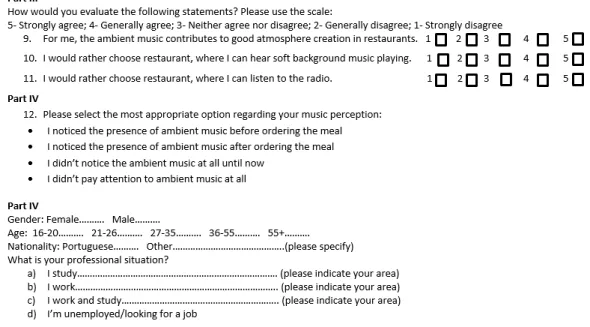
Two separate questionnaires were designed for the purpose of this study. First questionnaire was distributed during the first day to the control group (Appendix 7). Second questionnaire was distributed during the second day to the experiment group (Appendix 8). Both questionnaires comprised demographic part and main part. The main part of the first questionnaire contained 11 questions. The main part of the second questionnaire differed in one additional question regarding the actual recognition of the music. Questionnaires were available both in English and Portuguese language.
Data Collection
The study was conducted during two working days. On the first day the survey was distributed among the control group in non-changed environment under “normal conditions”, which means that neither music nor radio were present in the restaurant. In turn, on the second day, there was ambient music played. The speakers and the CD player were hidden in order not to draw patrons’ attention. The playlist consisted of a mixture of enjoyable, popular songs of international artists, among others Nouvelle Vague, The Baseballs, The Beatles and Alicia Keys. Music was selected specifically according to the tempo (medium) type (popular) and volume (low). Patrons were asked to take part in the study after finishing their meals and settling the payment. This approach was deliberate in order not to obtain distorted data.
Participants
All patrons of the restaurant were eligible to take part in the study and only few of them refused to do so due to the lack of time. Participants consisted of 85 restaurant clients (49 male and 36 female).The data was collected during the lunch time on two working days. During the first day, 44 patrons filled out the questionnaire and during the second day 41 did so. This proportional dispersion (51,8% vs 48,2%) allowed to proceed the analysis. Participant’s demographics is presented in the table 1 in Appendix 9 .
Results
The goal of this study was to validate the hypotheses, which assumed the differences in perception and evaluation of the restaurant offering, prices, interior design and overall experience between two groups of restaurant patrons. The differences were investigated
21
using t-test, computed with the SPSS Statistics. It was assumed that the evaluation of the variables would be higher among the customers who were exposed to auditory cue - popular background music. The differences were partly confirmed, however not all hypotheses turned out to be valid.
Regarding the first hypothesis H1 (Patrons tend to evaluate higher the interior design of
the restaurant if the ambient music is played) and the second hypothesis H2 (Patrons tend to evaluate higher the taste of the meal if the ambient music is played) differences
between control and treatment group were not significant. In both groups the evaluation of the taste of the meal and the interior design of the restaurant was on average the same and no statistical differences between groups were observed. Hence, it can be asserted that presence of ambient music didn’t have a significant influence on the perception of this particular areas (taste and design) while visiting restaurant.
On the other hand, third hypothesis H3 (Patrons tend to evaluate higher the overall
experience in the restaurant in relation to price of the mea, if they are exposed to the ambient music) can be confirmed. The analysis showed that background music was a
factor that influenced perception of the price in relation to the overall experience while dining in the restaurant. In the treatment group, this evaluation was higher than in control group. Hence, it can be stated that ambient music had positive influence on the customers’ perception of experience in relation to the price.
Also, the last hypothesis H4 (Patrons tend to evaluate higher the positive influence of
music after having lunch in the restaurant where the ambient music is played) was
proved. In the treatment group the evaluation of the ambient music as the factor that contributes to positive atmosphere creation has proved to be higher. Also, the treatment group has shown significantly higher willingness to choose restaurant with background music. This allows to infer that the music may be considered as a factor that influences creation of the positive atmosphere in the restaurant environment.
22
Discussion
Main conclusions
To conclude this study, several managerial implications can be provided regarding the sensory cues used in the restaurant and retail environment. The survey results have revealed that patrons from the treatment group were mostly highly aware about the ambient music. More than 60% of the surveyed customers (treatment group) noticed ambient music before and 25% just after ordering the meal. Only less than 10% stated that they didn’t pay attention to music.
This finding confirms that customers are generally sensitive to auditory cues such as background music in the restaurant environment. This empirical study may reflect general trend that customers expect not only tasty meal, but also another, non-gustative pleasant sensations that would perfectly compliment and enrich their dining experience. Therefore music, which positively arouse consumer’s emotional state (Stout & Leckenby, l988), should be a part of each restaurant environment.
While designing restaurant interior, the ambient music style should be congruent with the interior design (color, decoration elements, lightning, etc.). Also, the volume of ambient music should be conscientiously aligned so that it does not disturbs current patrons, but also so that it can be noticed by passers-by. For instance, it would be advisable for the restaurant in Santos to apply cheerful and soothing background music, because it was proven by the survey, that its customers generally was appealed to such kind of auditory cue.
Additionally, all sensory attributes can be considered as a form of boosting brand awareness and brand value. Hence, venues such as restaurant in Santos should apply this findings to provide its customers with unique in-store experience. Visual cues, when combined with another stimuli, e.g. auditory one, have undeniable influence on service perception. Integrated use of auditory stimuli and additional visual or olfactory one would entice clients to visit this venue more frequently, which would derive uncontestable benefits: tangible- in form of higher revenues and intangible- in form of positive word of mouth.
23
Moreover according to the survey, even though the taste of the meal was highly evaluated, the interior decoration was not assessed very favorably. This implies the need for change in the décor for more aesthetically pleasing. Since the restaurant is family based, there is plenty of leeway to redesign the overall interior. Lastly, affordable prices of the meals are definitely a great advantage of the restaurant in comparison to other venues. However, the improvement of the restaurant surrounding by adding background music and redecorating with some pleasing décor might have justify a slight price increase and could result in increased revenues.
To sum up, it is necessary to emphasize once again that product or service is framed by its setting. Because of this, the interpretation- brand and product or service perception evaluation depend integrally on the surrounding and companies in HORECA and retail industry should take advantage of this finding in order to create meaningful relationship with its customers and provide them with special experience.
Study Limitations
The main limitation of this study is that music as a factor influencing customers overall experience can be viewed as only one of several other external parameters for overall service perception and its evaluation.
Further research
As it was proven by past studies, the involvement of five senses influences the consumption pattern and customers’ purchases (Hultén, 2011). The results obtained through this study could be extended in future by measuring other interdependences between other sensory stimuli in order to establish the most efficient combination for creation of the optimal level of customer overall satisfaction by the use of multisensory marketing techniques.
24
References:
Books:
Cialdini, R.1993. Influence. New York: Harper Collins College Publishers.
Kotler,P., Keller, K. 2006 Marketing Management , Prentice Hall, 12th Edition
Kahneman, D. 2011.Thinking, Fast and Slow. New York: Farrar, Straus and Giroux
Radocy, R. E., & Boyle, J. D. 1997. „Psychological foundations of music. Springfield, IL”: Charles C. Thomas Publisher, Ltd.
Hulten. B. 2009 Sensory Marketing, Palgrave Macmillan
Articles:
Bagozzi, Richard; Gopinath, Mahesh; Nyer, Prashanth.1999.”The Role of Emotions in Marketing” Journal of the Academy of Marketing Science, vol. 27 no. 2 184-206 OECD (2013), How’s Life? 2013: Measuring Well-being, OECD Publishing
Jagdish N. Sheth,,Atul Parvatiyar (1995) “The Evolution of Relationship Marketing”,
International Business Review Vo|. 4, No. 4, pp. 397-418,
Bloch, P. 1995. Seeking the Ideal Form: Product Design and Consumer Response. The
Journal of Marketing, Vol. 59, No. 3
Buchanan, R., Gilles, C., 1990, “Value managed relationship: The key to customer retention and profitability”, European Management Journal, vol.8, no 4, 1990
Wood, O. 2012. “How Emotional Tugs Trump Rational Pushes”, Journal of advertising
research, 2012
Krishna, A. 2009. “Cognition and Sensory Perception: The Impact of Input from Sensory Modalities on Imagery, Memory, Information Processing, and Sensory Perception” Advances in Consumer Research;2009, Vol. 36, p127
Dwyer R., Ping. R. (1992) A Preliminary Model of Relationship Termination in Marketing Channels, Advances in Distribution ChannelResearch. Vol. 1.
Prahalad, C.K.; Ramaswamy (2004). The Future of Competition. Harvard Business School Press.
Hultén, B. 2011 "Sensory marketing: the multi-sensory brand-experience concept",
25
Milliman, R. 1982 “Using Background Music to Affect the Behavior of Supermarket Shoppers”. Journal of Marketing,86-91.
Milliman, R. 1986 “The Influence of Background Music on the Behavior of Restaurant Patrons”. Journal of Consumer Research 13,286–289
Mehrabian, A. 1996 “Pleasure-arousal-dominance: A general framework for describing and measuring individual differences in Temperament” Current Psychology, Volume 14, Issue 4, pp 261-292
Parsons, A. 2009 "Use of scent in a naturally odourless store", International Journal of
Retail & Distribution Management, Vol. 37
Bell, S.,C.P. Bell. 2007, “Future Sense: Defining Brands through Scent,” The Journal
of the Marketing Society 38.
Chebat, J. Michon, R. 2003, The Interaction Effect of Background Music and Ambient
Scent on the Perception of Service Quality
Klatzky R., Lederman S.1992. Extracting object properties through haptic exploration,
Acta Psychologica 84, 29-40
Pine, J. and Gilmore, J. 1999, “The Experience Economy”, Harvard Business School Press, Boston, 1999.
Groeppel-Klein, A. 2001 “The role of customers= arousal for retail store - results from an experimental pilot study using electrodermal activity as indicator” Advances in
Consumer Research Vol. 28, 412-419
Velitchka D. Kaltcheva, Barton A. Weitz 2006 “When Should a Retailer Create an Exciting Store Environment?” Journal of Marketing: January 2006, Vol. 70, No. 1, pp. 107-118
González-Benito,O. Muñoz-Gallego, & Kopalle, 2005, "Asymmetric Competition in Retail Store Formats: Evaluating Inter- and Intra-Format Spatial Effects," Journal of
Retailing, 81 (1), 75-95.
Kruger, P. Vargas. P. 2008 “Consumer confusion of percent differences” Journal of
Consumer Psychology 18, 49-61
Stout, P. J. Leckenby, l988 “The Nature of Emotional Response to Advertising: A Further Examination” Journal of Advertising;1988, Vol. 17 Issue 4, p53
26 Web References: www.plunkettresearch.com/retailing-stores-market-research/industry-and-business-data www.searchcrm.techtarget.com/definition/transactional-marketing www.businessjournal.gallup.com/content/104170/when-engaged-employees-meet-engaged-customers.aspx www.digitalmarketingnow.com/marketing-to-the-subconscious www.danariely.com www.nutellastories.com www.popsop.com/2014/02/nutella-marks-its-50th-anniversary-with-a-project-full-of-fans-stories/ www.trendhunter.com/trends/levis-summer-hotline www.creativeguerrillamarketing.com/guerrilla-marketing/hmlooknbook-tweet-reveal-exclusive-hm-fashion-posters/ www.cestrian.co.uk/articles/blogs/2014/make-your-pos-displays-stand-out/ www.noteslive.net.au/5-ways-music-business-affects-customer-spending/ www.retailtouchpoints.com/shopper-engagement/1693-how-brands-use-multi-sensory-techniques-to-pique-consumers-interest- www.info.4imprint.com/wp-content/uploads/blue-paper-sensory-marketing.pdf www.starbucks.com/promo/summermusic www.cestrian.co.uk/articles/blogs/2014/make-your-pos-displays-stand-out/ www.media.muckrack.com.s3.amazonaws.com/portfolio/items/ScentsAndSensibility-page1.pdf www.forbes.com/2007/01/10/women-gadgets-fashion-tech-media-cx_rr_0110ces-sony.html www.epp.eurostat.ec.europa.eu www.slideshare.net/FourDee/metro-group-future-store-initiative-real-future-store-4744317 www.vogue.it/en/people-are-talking-about/obsession-of-the-day/2010/11/concept-stores www.parago.com/uk-shopper-report-2014/ www.mckinsey.com/insights/marketing_sales/a_new_way_to_measure_word-of-mouth_marketing Interviews:
Dr. Márcio Sampaio, MakroCash & Carry Portugal
27
Appendixes:
Appendix1: Nutella anniversary website
Source: www.nutellastories.com
Appendix 2: “Levi’s Summer Hotline”
28 Appendix 3: H&M frosted glass banner
Source:www.creativeguerrillamarketing.com
Appendix 4: 3D Projection Mapping
Source: www.coloribus.com
29
Source:www.slideshare.net/FourDee/metro-group-future-store-initiative-real-future-store-4744317
Appendix 6: Spanish Restaurant “El Bosc de les Fades”
Source: www.baresenbarcelona.com
30 Appendix 8: Survey English Version Treatment Group
31
Appendix 9: Table 1: Respondents Profile Statistics Table Age:
Frequency Percent Cumulative Percent
16-20 6 7,1 7,1 21-26 30 35,3 42,4 27-35 18 21,2 63,5 36-55 27 31,8 95,3 55-... 4 4,7 100,0 Total 85 100,0 Gender:
Frequency Percent Cumulative Percent
man 49 57,6 57,6
woman 36 42,4 100,0
33 Appendix 10. Survey Results
1. Evaluation of overall restaurant design/interior.
Group Statistics
group N Mean Std. Deviation Std. Error Mean
How would you evaluate the overall restaurant design/interior?
control_no_music 44 2,66 ,805 ,121
treatment_with_music 41 2,78 ,852 ,133
Independent Sample Test Levene's Test for Equality
of Variances t-test for Equality of Means
F Sig. t df Sig 2-tailed Mean Difference Std. Error Difference 95% Confidence Interval of the Difference Lower Upper How would you
evaluate the overall restaurant
design/interior?
Equal variances
assumed ,409 ,524 -,675 83 ,501 -,121 ,180 -,479 ,236
Equal variances not
assumed -,674 81,674 ,502 -,121 ,180 -,480 ,237
34 2. Evaluation of the taste of the meal.
Group Statistics
group N Mean Std. Deviation Std. Error Mean
How would you evaluate the taste of the meal?
control_no_music 44 3,93 ,587 ,088
treatment_with_music
41 4,05 ,805 ,126
Independent Sample Test Levene's Test for Equality
of Variances t-test for Equality of Means
F Sig. T df Sig 2-tailed
Mean Difference Std. Error Difference 95% Confidence Interval of the Difference Lower Upper How would you
evaluate the taste of the meal?
Equal variances
assumed 4,479 ,037 -,769 83 ,444 -,117 ,152 -,419 ,185
Equal variances not
assumed -,761 72,811 ,449 -,117 ,154 -,423 ,189
Result: No statistical significant difference between control and treatment group. Sig. 0,037<0,05 , p : 0,449>0,05,
35
3. Evaluation of the price in comparison to overall experience in the restaurant.
Independent Sample Test Levene's Test for Equality
of Variances t-test for Equality of Means
F Sig. t df Sig 2-tailed Mean Difference Std. Error Difference 95% Confidence Interval of the Difference Lower Upper How would you
evaluate the price in
Equal variances
assumed ,065 ,800 -2,435 83 ,017 -,402 ,165 -,730 -,074 group N Mean Std. Deviation Std. Error Mean
How would you evaluate the price in reference to your overall experience at this restaurant?
control_no_music 44 4,16 ,745 ,112
treatment_with_music
36 reference to your
overall experience at this restaurant?
Equal variances not
assumed -2,431 81,973 ,017 -,402 ,165 -,731 -,073
37
4. For me the ambient music contributes to creation of good atmosphere. Group Statistics
group N Mean Std. Deviation Std. Error Mean
For me, the ambient music contributes to good atmosphere creation in restaurants control_no_music 44 3,43 ,925 ,139 treatment_with_music 41 4,00 ,922 ,144
Independent Sample Test Levene's Test for
Equality of Variances t-test for Equality of Means
F Sig. T df Sig 2-tailed Mean Difference Std. Error Difference 95% Confidence Interval of the Difference Lower Upper For me, the ambient
music contributes to good atmosphere creation in restaurants Equal variances assumed 1,492 ,225 -2,834 83 ,006 -,568 ,200 -,967 -,169
Equal variances not
assumed -2,835 82,616 ,006 -,568 ,200 -,967 -,169
38
5. I would rather choose restaurant with the soft background music playing. Group Statistics
group N Mean Std. Deviation
Std. Error Mean I would rather choose
restaurant, where I can hear soft background music playing
control_no_music 44 3,07 1,208 ,182
treatment_with_music
41 4,02 ,935 ,146
Independent Sample Test Levene's Test for
Equality of Variances t-test for Equality of Means
F Sig. T df Sig 2-tailed Mean Difference Std. Error Difference 95% Confidence Interval of the Difference Lower Upper I would rather choose restaurant, where I can hear soft background music playing
Equal variances
assumed 2,568 ,113 -4,059 83 ,000 -,956 ,236 -1,425 -,488
Equal variances not
assumed -4,095 80,351 ,000 -,956 ,233 -1,421 -,492
39 6. Radio in the restaurant.
Group Statistics
group N Mean Std. Deviation Std. Error Mean
I would rather choose restaurant, where I can listen to the radio.
control_no_music 44 2,00 ,863 ,130
treatment_with_music 41 1,61 ,862 ,135
Independent Sample Test Levene's Test for Equality
of Variances t-test for Equality of Means
F Sig. t df Sig 2-tailed Mean Difference Std. Error Difference 95% Confidence Interval of the Difference Lower Upper I would rather choose
restaurant, where I can listen to the radio.
Equal variances
assumed ,089 ,767 2,084 83 ,040 ,390 ,187 ,018 ,763
Equal variances not
assumed 2,084 82,580 ,040 ,390 ,187 ,018 ,763