
Endocrine disrupting pesticides in environmental samples
137
0
0
Texto
(2) © Autorizada a reprodução parcial desta dissertação (condicionada à autorização das editoras das revistas onde os artigos foram publicados) apenas para efeitos de investigação, mediante declaração escrita do interessado, que a tal se compromete. ii.
(3) Tese de Doutoramento Endocrine disrupting pesticides in environmental samples. José Luis Vera. Dissertação para obtenção do Grau de Doutor em Química Sustentável, apresentada à Faculdade de Ciências da Universidade do Porto. Orientação Professor Doutor José Alberto Nunes Ferreira Gomes. Co-Orientação Professora Doutora Cristina Delerue-Matos Professora Doutora Valentina Fernandes Domingues. Porto Janeiro 2014. i.
(4) © Autorizada a reprodução parcial desta dissertação (condicionada à autorização das editoras das revistas onde os artigos foram publicados) apenas para efeitos de investigação, mediante declaração escrita do interessado, que a tal se compromete. ii.
(5) A realizaçao deste trabalho foi possível graças à concessão de uma Bolsa de Doutoramento pelo Programa Erasmus Mundus Ação 2, Vertente 1 – Projeto MUNDUS 17 – lote 17 – Brasil, Paraguai e Uruguai – financiado pela Comissão Europeia através da EACEA (The Education Audiovisual and Culture Executive Agency).. iii.
(6) Os estudos apresentados nesta dissertação foram realizados no Laboratório Grupo de Reaçao e Análise Química (GRAQ) do Instituto Superior de Engenharia do Porto do Instituo Politécnico do Porto.. iv.
(7) Agradecimentos O meu profundo obrigado à família, aos professores, aos amigos, aos colegas, às instituições e aos serviços que contribuíram para que o presente trabalho de doutoramento fosse uma realidade. Agradeço: Aos responsáveis da Facultad de Ciencias Exactas y Naturales (FaCEN) e à Dirección de Relaciones Internacionales da Rectoria da Universidad Nacional de Asunción pela adesão ao projeto MUNDUS 17 (Programa Erasmus Mundus Ação 2, Vertente 1 – Projeto MUNDUS 17 – lote 17 – Brasil, Paraguai e Uruguai – financiado pela Comissão Europeia através da EACEA (The Education Audiovisual and Culture Executive Agency)), para obtenção da bolsa de doutoramento, responsável pelo suporte financeiro deste trabalho de investigação e de uma bolsa do GRAQ/ Instituto Superior de Engenharia do Porto concedida pelo Instituto Politécnico do Porto ao abrigo do programa PAPRE (GRAQ/2013/10) e pelo que estou muitíssimo agradecido pela oportunidade que me concederam e que enriqueceu a minha formação profissional e pessoal. À instituição de acolhimento (Universidade do Porto), principalmente à Marília Cunha, Ana Castro Paiva, Miu Castro Paiva e Dra. Paula Marques da equipa de Gestão com quem estive em contacto desde o começo da mobilidade do Erasmus Mundus 17; elas ajudaram ao esclarecimento das dúvidas relacionadas e da ajuda em toda a gestão administrativa e a resolução das dificuldades que foram surgindo durante o percurso da mobilidade. Ao Professor Doutor José Ferreira Gomes por ter aceitado ser meu orientador e me ter encaminhado para o laboratório de investigação GRAQ, para a realização da minha tese de doutoramento e ainda pela ajuda na resolução de alguns problemas relacionados com a documentação do doutoramento. À Professora Doutora Cristina Delerue Matos, quero manifestar o meu agradecimento, pela oportunidade de me inserir no seu grupo de investigação no Laboratório GRAQ/REQUIMTE. Realço a excelente pessoa que é, a quem admiro pela sua forma de lidar com todas as situações do dia-a-dia, pelas palavras de carinho e de amizade, sempre disposta a fazer o impossível para que todos consigam atingir os seus objetivos. À Professora Doutora Valentina Domingues por me ter orientado e acompanhado ao longo destes três anos, ao qual manifesto o meu profundo agradecimento pela orientação, disponibilidade, apoio, compreensão e carinho. Estando sempre presente em todos os momentos e dificuldades neste trabalho, na ajuda das publicações dos artigos, dos posters, e da presente tese. À Doutora Virgínia Fernandes pelos ensinamentos, ideias, soluções, pela amizade e pelo carinho. O meu agradecimento sincero por a ter conhecido e por fazer parte, sem dúvida alguma, dos melhores momentos desta etapa da minha vida. Ao J. M. Costa e Doutora Catarina Mansilha pela colaboração com o Laboratório Ricardo Jorge, na colheita de amostragem da Ria de Aveiro. Ao Dr. Luís Silva, pela sua disponibilidade e ajuda nos cálculos estatísticos na otimização da metodologia de espectrometria de massa. Aos meus colegas e amigos de trabalho, Paula, Luísa, Isabel, Idalina, Teresa, Marta, António, Ivo, Eng. Isabel, Filipa, Rita, Susana, Alexandra, Laurens, Ruth e a cada um que faz parte do grupo v.
(8) GRAQ que, em maior ou menor medida, tornaram-se parte deste trabalho e do dia-a-dia como uma equipa. Ao Doutor Viswanathan com quem aprendi que o conhecimento é poder, que o trabalho duro tem os seus frutos, e que lutar faz parte da vida. Ao Francisco Wirley, Túlio e Thiago por serem amigos e irmãos na fé e pelos bons momentos que passamos juntos. Às pessoas da minha Igreja, em Portugal e no Paraguai, por estarem presentes nos momentos difíceis e de por me darem tão gratos momentos, dos quais especialmente queria agradecer ao Pastor António Figueira e à sua família por me receberem em Portugal. Ao amigo e professor de inglês Jeffrey Darling, pela imensa ajuda na correção dos textos escritos em inglês e artigos relacionados com a tese. Ao Gigi e sua esposa Rodica, por me terem acolhido na sua casa fazendo-me sentir como parte da família. Um agradecimento com carinho à minha namorada Isabel, sua mãe Manuela e sua irmã Lídia e marido David pela amizade, pela ternura e pelo apoio. À minha família, a quem amo muito, em especial os meus pais Feliciano e Justina, aos meus irmãos Gladys, Leticia, Luis, Manuel e Ulises, ao meu cunhado Victor e à minha avó Maximina. Todos eles têm sido o meu porto seguro em todas as etapas da minha vida. E finalmente, para o Rei dos Reis que é o meu Senhor Jesus, minha esperança e meu refúgio, embora eu seja fraco, com Ele sou forte, foi quem me deu a vida e me ama de tal maneira que entregou a Sua vida por mim; a Ele agradeço por me ter trazido para realizar este doutoramento.. Muito obrigado!. vi.
(9) Resumo Os pesticidas têm sido usados para impedir danos nas culturas. No entanto, são conhecidas as consequências nefastas do uso excessivo destes compostos na agricultura. Em Portugal, o uso de pesticidas na região Norte é intenso, tornando-o vulnerável à contaminação. Destacam-se. as. famílias. de. pesticidas. organoclorados,. triazinas,. piretróides,. organofosforados, etc.. Grande parte destes pesticidas tem vindo a ser considerados como desreguladores endócrinos ou como potenciais desreguladores, sendo por isso alvo de diversos estudos por parte da comunidade científica e técnica no que concerne à sua monitorização e avaliação dos efeitos nocivos para o Homem e ecossistemas. Deste modo, esta tese focou-se principalmente na otimização de métodos de extração (extração em fase sólida (SPE), micro extração em fase sólida (SPME) e QuEChERS) e técnicas cromatográficas para análise de desreguladores endócrinos. O presente trabalho de investigação abrangeu o estudo de trinta e oito pesticidas e seus metabolitos: organoclorados (aldrin, DDT, p,p-DDD, o,p-DDE, HCB, dieldrin, isómeros de HCH, endosulfan, endrin, heptacloro, metoxicloro e metolacloro), triazinas (atrazina, desetil atrazina, terbutilazina, desetil terbutilazina e simazina), piretróides (bifentrina, cipermetrina, ciflutrina, cialotrina, deltametrina, fenvalerato, fenpropatrina e permetrina), organofosforados (diazinão e malatião), dicarboximida (iprodiona e vinclozolina), organofosfato (dimetoato), ácido/éster ariloxialcanoico (éster metílico de 2,4-D), tiocarbamato (EPTC), ureia (linurão), dinitroanilina (pendimetalina) e cloroacetamida (alacloro). Foi utilizada a cromatografia gasosa (CG) com espectrometria de massa (MS) na quantificação, identificação e confirmação da maior parte dos pesticidas em estudo. Na deteção por GC-MS/MS optou-se por uma abordagem estatística de otimização multivariável dos parâmetros instrumentais tendo sido o método aplicado na análise de pesticidas organoclorados, triazinas e piretróides, em águas. Relativamente às técnicas de extração foram utilizados SPE e SPME na extração de pesticidas nas águas de rios e estuários e a metodologia QuEChERS na extração dos pesticidas em sedimentos. Estas metodologias foram aplicadas a amostras de águas de rio e estuarinas recolhidas no período compreendido entre 2010 e 2012, cujos locais de amostragem se situavam na região norte de Portugal: Ria de Aveiro, Rio Douro, Rio Cávado, Rio Lima, Rio Minho, Rio Sousa, Rio Tâmega, Rio Leça, Rio Cabrum, Ribeira Moscoso, Rio Caima e Rio Ave. A metodologia SPME-GC-MS foi usada na monitorização de pesticidas em águas dos rios. Os resultados mostraram níveis de pesticidas mais elevados no Rio Douro com a concentração de 1800 ng / L (γ-HCH) e no Rio Cávado com a concentração de 760 ng / L (HCB). A metodologia SPE-GC-MS foi aplicada a amostras de água recolhidas na Ria de Aveiro, por ser uma zona de intensa agricultura. Foram quantificados catorze compostos, e os valores encontrados oscilaram na gama de vii.
(10) concentrações de 32 a 3446 ng / L. A aplicação da técnica de extração QuEChERS à análise de pesticidas em sedimentos em que a quantificação foi efetuada por GC-MS, os resultados evidenciaram a presença de desethyl atrazina, β-HCH, fenvalerato, com variação das concentrações entre 4.0 a 27.7 ng / g. Termos chave: Pesticidas, Desreguladores endócrinos, GC-MS, GC-ECD, SPE, SPME, QuEChERS, Águas, Sedimentos. viii.
(11) Abstract Humans have always used pesticides to prevent damage to their crops. However, it is not a secret that there are adverse consequences from excessive use of these compounds in agriculture. In Portugal, the use of pesticides in the northern region is frequent, making the region vulnerable to contamination. The most common pesticides come from the families of organochlorine, triazines, pyrethroids, and organophosphates. Most of these pesticides have been considered true endocrine disruptors, or have the potential to become so. Therefore, they are the subject of several studies by the scientific community in regards to monitoring adverse effects on humans and ecosystems. These studies focused primarily on the optimization of extraction methods (SPE, SPME, QuEChERS), and on chromatography for extraction and analysis of endocrine disrupters. This present study includes the analysis of thirty-eight pesticides and metabolites: organochlorine (aldrin, DDT, p,p-DDD, o,p-DDE, HCB, dieldrin, HCH isomers, endosulfan, endrin, heptachlor, methoxychlor, and metolachlor), triazines (atrazine, desethyl atrazine, terbuthylazine, desethyl terbuthylazine, and simazine), pyrethroids (bifenthrin, cypermethrin, cyfluthrin,. cyhalothrin,. deltamethrin,. fenvalerate,. fenpropathrin,. and. permethrin),. organophosphate (malathion and diazinon), dicarboximide (iprodione and vinciozolin), organophosphate (dimethoate), acid ariloxialcanoico ester (methyl ester of 2,4-D), thiocarbamate (EPTC), urea (linuron), dinitroaniline (pendimethalin), and chloroacetamide (alachlor). Gas chromatography (GC) coupled with mass spectrometry (MS) was used for identification, quantification and confirmation of most of the analysed pesticides. Concerning detection using GC-MS/MS, a statistical approach to the multivariable optimisation of instrumental parameters was the method applied in analysis of organochlorine, triazines, and pyrethroids. This analysis was done in water. SPE and SPME were the techniques used to extract pesticides from the waters of rivers and estuaries. The QuEChERS procedure was used for the extraction of pesticides in sediments. These methodologies were applied to samples of river and estuarine waters collected in the period between 2010 and 2012. The sampling sites were located in the northern region of Portugal, and included: Ria de Aveiro, Douro River, Cávado River, Lima River, Minho River, Sousa River, Tâmega River, Leça River, Cabrum River, Ribeira Moscoso, Caima River, and Ave River. The SPME-GC-MS method was used for the monitoring of pesticides in river water. The results showed higher levels of pesticides in the Douro River, with a concentration level of 1800 ng/L (δ-HCH), and in the Cávado River, with a concentration level of 760 ng/L (HCB). The SPE-GC-MS method was applied to water samples collected in the Ria de Aveiro, being a zone of intensive agriculture. Fourteen compounds were quantified, and the values were found varied in the concentration range of 32 to 3446 ng/L. The use of the QuEChERS technique in the analysis ix.
(12) of pesticides in sediments showed the presence of desethyl atrazine, β-HCH, and fenvalerate.. Quantification was performed by using the GC.MS method, and showed. concentration levels between 4.0 to 27.7 ng / g. Keywords: Pesticides, Endocrine Disruptor, GC- MS, SPE, SPME, QuEChERS, Water, Sediment. x.
(13) Resumen Los seres humanos han usado los pesticidas para impedir daños en sus cultivos. Sin embargo, son conocidas las consecuencias nefastas del uso excesivo de estos compuestos en la agricultura. En Portugal, el uso de pesticidas en la región norte es intenso, volviéndolo vulnerable a la contaminación. Se destacan los pesticidas organoclorados, triazinas, piretroides, organofosforados, ect.. Grande parte de estos pesticidas han venido a ser considerados disruptores endocrinos o como potenciales disruptores endocrinos, siendo por eso objetivo de varios estudios por parte de la comunidad científica y técnica en lo que concierne a su monitorización y evaluación de efectos nocivos para el hombre y ecosistemas. De este modo, esta tesis se centro principalmente en la optimización de métodos de extracción (extracción en fase sólida (SPE), micro extracción en fase sólida (SPME), y QuEChERS) y en la técnicas cromatográficas para la extracción y análisis de los disruptores endocrinos. El presente trabajo investigación abarco el estudio de treinta y ocho pesticidas y sus metabolitos: organoclorados (aldrina, DDT, p,p-DDD, o,p-DDE, HCB, dieldrina, isómeros del HCH, endosulfán, endrina, heptacloro metoxicloro y metolachlor), piretroides. (bifentrina,. cipermetrina,. ciflutrina,. cihalotrina,. deltametrina,. fenvalerato,. fenpropatrin y permetrina) organofosforados (malatión y diazinón) dicarboximida (iprodiona y vinclozolina), organofosforados (dimetoato), éster de ácido / ariloxialcanoico (éster metílico de. 2,4-D). tiocarbamato. (EPTC),. urea. (linuron),. dinitroanilina. (pendimetalina). y. cloroacetamida (alaclor). Fue utilizado la cromatografía gaseosa (CG) con espectrometría de masa (MS) en la cuantificación, identificación, y confirmación de la mayor parte de los pesticidas en estudio. En la detección por GC-MS/MS se optó por un abordaje estadístico de optimización multivariable de los parámetros instrumentales siendo el método aplicado en el análisis de pesticidas organoclorados, triazinas y piretroides, en las aguas. Relativamente a las técnicas de extracción, fueron utilizados SPE y SPME en la extracción de pesticidas en las aguas de ríos y estuarios y la metodología QuEChERS en la extracción de pesticidas en sedimentos. Estas metodologías fueron optimizadas y posteriormente aplicadas en las muestras de aguas de rio recogidas en el periodo comprendido entre 2010 y 2012, cuyo locales de muestreo se situan en la región norte de Portugal: Ria de Aveiro, Rio Douro, Rio Cávado, Rio Lima, Rio Minho, Rio Sousa, Rio Tâmega, Rio Leça, Rio Cabrum, Ribeira Moscoso, Rio Caima y Rio Ave. La metodología SPME-GC-MS fue usada en la monitorización de pesticidas en las aguas de ríos. Los resultados muestran los niveles de pesticidas más elevados en el Rio Douro con concentraciones de 1800 ng / L (γ-HCH) y en el Rio Cávado, con una concentración de 760 ng / L (HCB). La metodología SPE-GC-MS fue aplicada para las muestras de aguas recogidas en la Ria de Aveiro, por ser una zona de intensa agricultura. Fueron cuantificados catorce compuestos, y los valores encontrados xi.
(14) oscilan en una gama de concentraciones de 32 a 3446 ng / L. La aplicación de la técnica de extracción QuEChERS, para el análisis de pesticidas en sedimentos fue efectuado por GCMS, los resultados evidencian la presencia de atrazina desetil, β-HCH, fenvalerato, con concentraciones entre 4.0 a 27.7 ng / g. Términos clave: pesticidas, los disruptores endocrinos, GC-MS, GC-ECD, SPE, SPME, QuEChERS, Agua, Sedimentos. xii.
(15) List of Contents AGRADECIMENTOS .............................................................................................................................................. V RESUMO ............................................................................................................................................................ VII ABSTRACT........................................................................................................................................................... IX RESUMEN............................................................................................................................................................ XI LIST OF CONTENTS ........................................................................................................................................... XIII LIST OF FIGURES ............................................................................................................................................. XVII LIST OF TABLES ................................................................................................................................................ XIX LIST OF ABBREVIATIONS................................................................................................................................... XXI ORGANIZATION, AND STRUCTURE OF THE THESIS .......................................................................................... XXIII OBJETIVES ....................................................................................................................................................... XXV CHAPTER 1 INTRODUCTION ..................................................................................................................... 3 1.1 STATE OF THE ART OF ENDOCRINE DISRUPTORS ........................................................................................ 3 1.1.1 Important factors in endocrine disruption ....................................................................................... 7 1.1.2 Police of EDCs in Europe ................................................................................................................. 9 1.1.3 A particular group of endocrine disruptors - Pesticides ............................................................. 12 1.1.4 Portugal and endocrine disrupting pesticides (EDPs) ................................................................ 25 1.2 SAMPLE PREPARATION - ENVIRONMENTAL ............................................................................................... 27 1.2.1 Liquid-Liquid Extraction (LLE) ........................................................................................................ 28 1.2.2 Micro Liquid-Liquid Extraction (MLLE).......................................................................................... 29 1.2.3 Dispersive Liquid-Liquid Microextraction (DLLME)..................................................................... 29 1.2.4 Solid-Phase Extraction (SPE) ........................................................................................................ 29 1.2.5 Micro-solid phase extraction (SPME) ........................................................................................... 31 1.2.6 Stir Bar Sorptive Extraction (SBSE) .............................................................................................. 34 1.2.7 Accelerated Solvent Extraction (ASE) .......................................................................................... 34 1.2.8 Soxhlet Extraction (SXE) ................................................................................................................ 35 1.2.9 Ultrasound-Assisted Extraction (UAE).......................................................................................... 36 1.2.10 Microwave-Assisted Extraction (MAE) ....................................................................................... 36 1.2.11 Supercritical Fluid Extraction (SFE) ............................................................................................ 37 1.2.12 Quick, Easy, Cheap, Effective, Rugged, and Safe (QuEChERS) .......................................... 38 1.3 CHROMATOGRAPHIC DETERMINATION OF PESTICIDES IN ENVIRONMENTAL SAMPLES ............................. 40 1.3.1 Gas chromatography- Electron Capture Detector (GC-ECD) ................................................... 41 1.3.2 Gas chromatography-mass spectrometry (GC-MS) ................................................................... 41 CHAPTER 2 MASS SPECTROMETRY PARAMETERS OPTIMIZATION FOR THE PESTICIDES DETERMINATION IN N-HEXANE WITH GAS CHROMATOGRAPHY ION-TRAP TANDEM MASS SPECTROMETRY *..................................................................................................................................... 47. xiii.
(16) 2.1 INTRODUCTION ........................................................................................................................................... 47 2.2 EXPERIMENTAL PART................................................................................................................................. 48 2.2.1 Chemicals and solvents .................................................................................................................. 48 2.2.2 Standard solutions preparation ...................................................................................................... 48 2.2.3 Apparatus .......................................................................................................................................... 48 2.2.4 Gas Chromatograph Conditions .................................................................................................... 49 2.3 LIMIT OF DETECTION .................................................................................................................................. 49 2.4 MULTIPLE LINEAR REGRESSION ANALYSIS ............................................................................................... 49 2.5 MACRO EDITION IN MICROSOFT EXCEL .................................................................................................... 49 2.6 RESULTS AND DISCUSSION........................................................................................................................ 50 2.6.1 Isolation of Precursor Ion and Product Ions Selection ............................................................... 50 2.6.2 Screening Analysis .......................................................................................................................... 50 2.6.3 Multiple Linear Regression ............................................................................................................. 53 2.6.4 Statistical evaluation........................................................................................................................ 53 2.7 CONCLUSIONS ............................................................................................................................................ 57 CHAPTER 3 OCCURRENCE OF ENDOCRINE DISRUPTING PESTICIDES IN RIVERS, DETERMINATE BY SPME-GC-MS* .......................................................................................................... 61 3.1 INTRODUCTION ..................................................................................................................................... 61 3.2 EXPERIMENTAL........................................................................................................................................... 62 3.2.1 Site selection and sampling ........................................................................................................... 62 3.2.2 Reagents and solutions .................................................................................................................. 63 3.2.3 Equipments ....................................................................................................................................... 64 3.2.4 Conditioning and cleaning procedure ........................................................................................... 64 3.2.5 Extraction Procedure ....................................................................................................................... 65 3.3 RESULTS AND DISCUSSION ........................................................................................................................ 66 3.3.1 Chromatographic analysis .............................................................................................................. 66 3.3.2 Application to a rivers analysis ...................................................................................................... 67 3.4 CONCLUSION .............................................................................................................................................. 72 CHAPTER 4 OCCURRENCE OF PESTICIDES IN RIA DE AVEIRO ESTUARY, PORTUGAL* ......... 75 4.1. INTRODUCTION .......................................................................................................................................... 75 4.2. MATERIALS AND METHODS........................................................................................................................ 76 4.3. RESULTS AND DISCUSSION ....................................................................................................................... 78 4.4. CONCLUSIONS........................................................................................................................................... 83 CHAPTER 5 SIMULTANEOUS DETERMINATION OF 25 ENDOCRINE DISRUPTING PESTICIDES IN SEDIMENTS FROM RIA DE AVEIRO USING QUECHERS BY GAS CHROMATOGRAPHYTANDEM, MASS SPECTROMETRY * ...................................................................................................... 87. xiv.
(17) 5.1. INTRODUCTION .......................................................................................................................................... 87 5.2. MATERIALS AND METHODS........................................................................................................................ 88 5.3. RESULTS AND DISCUSSION ...................................................................................................................... 91 5.3.1 Organic Carbon in sediments............................................................................................................... 91 5.3.2. Method Validation.............................................................................................................................. 91 5.3.3. Sediments samples analysis ............................................................................................................... 94 5.4. CONCLUSION ............................................................................................................................................. 96 CHAPTER 6 CONCLUSIONS AND PROSPECTS ................................................................................ 101 6.1 CONCLUDING REMARKS ........................................................................................................................... 101 6.2 FUTURE PERSPECTIVES .......................................................................................................................... 102 BIBLIOGRAPHY ................................................................................................................................................ 103. xv.
(18) xvi.
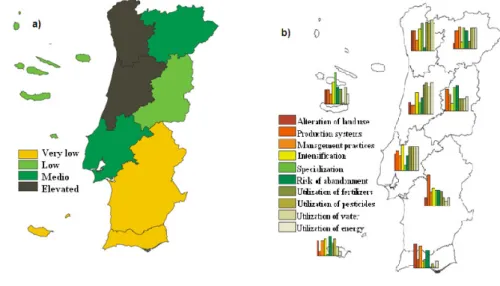
(19) List of Figures Figure 1.1 Male and female endocrine system. Adapted from Diamanti-Kandarakis, et al. and Sharpe 2,3. et al. . ..................................................................................................................................................... 3 Figure 1.2 Functional or receptor-based toxicology. Adapted from LaFleur et al. and McLachlan et al. 6,7. .............................................................................................................................................................. 6. Figure 1.3 Different sources of pollution by endocrine disruptors. .......................................................... 7 Figure 1.4 Route of exposition (dermal, inhalation, oral) of the endocrine disruptors. Adapted from 2. Sharpe et al. and Irvine et al. . ............................................................................................................... 8 Figure 1.5 Overview of the steps of the project made by the European commission. Adapted from Groshart et al.. 13. . ................................................................................................................................... 11. Figure 1.6 The possible bioaccumulation of EDCs by aquatic organisms. ........................................... 12 Figure 1.7 Distribution of pesticides in the environment after it is applied and the various processes 18. involved. Adapted from Zhang et al. . .................................................................................................. 13 Figure 1.8 a) Relative risk to the environment posed by drivers of agriculture, and b) Importance of each indicator "driving forces" the assignment of the relative risk to the environment, by Region in 40. Portugal. Adapted from reported INE 2009 . ...................................................................................... 25 Figure 1.9 Different steps of extraction for SPE. 1) Cartridge is equilibrated or conditioned with a solvent to wet the sorbent, 2) loading solution containing the analyte is percolated through the solid phase, the analytes are retained on the sorbent, 3) sorbent is then washed to remove impurities, and 4) the analyte is collected during this elution step. ................................................................................ 31 Figure 1.10 Coating selectivity’s based on component volatilities and polarities. Adapted from Kataoka 71. et al. . .................................................................................................................................................. 32 Figure 1.11 Time effect for SPME extraction. Adapted from Vas et al. 72. . ............................................. 33. Figure 1.12 Principles of SPME 1) Retract fiber/withdraw needle and device extraction and, desorption of solid-phase microextraction (SPME) procedure; 2) pierce septum on sample container; 3) expose SPME fiber/extract analytes; 4) retract fiber/withdraw needle; 5) pierce septum in GC inlet, and 6) expose fiber/desorb analytes. Adapted from Augusto et al. and Pawliszyn et al.. 69,73. ......................... 34. Figure 1.13 Step in QuEChERS extraction. 1) Sieving, 2) teflon tube with soil sample, 3)addition of the extraction solvent and hand mix, 4) addition of the QuEChERS content, 5) vortex, 6) centrifugation step, 7) aliquot of the supernatant, 8) filtration with a syringe filters, and 9) vial with the extract to analysis. Adapted from Vera et al.. 92. . ................................................................................................... 39 110. Figure 1.14 Inject and detect SIM scan MS. Adapted from Hubschmann. . ....................................... 42. Figure 2.1 Plots of average signal to noise (S/N) versus a) IMW, b) IT, c) EV, and d) ET. .................. 52 Figure 3.1 Average concentration values expressed in µg/L for pesticides detected at extraction temperature is 60 ºC. ............................................................................................................................. 71 -1. Figure 4.1 Distribution map of the pesticides concentration (ng L ) in the surface water of the Ria de Aveiro..................................................................................................................................................... 80 Figure 5.1 Map showing the point of sampling sample in Ria de Aveiro. ............................................. 89 Figure 5.2 Chromatogram and spectra of atrazine desetyl detected in sample 2................................. 95 xvii.
(20) Figure 5.3 Chromatogram and spectra of fenvalerate detected in sample 4. ....................................... 95. xviii.
(21) List of Tables Table 1.1 Summary of some endocrine systems glands and hormones (mainly mammalian) of interest 5. in connection with environmental endocrine modulators. Adapted from Louekari et al. ........................ 4 Table 1.2 List candidate substances-summary of work to date. Adapted from Ch. Groshart et al.. 13. .. 11. Table 1.3 Effects of endocrine disruptor pesticides and their chemical structure. ................................ 15 Table 1.4 Pesticides background detected in different types of samples is Portugal. .......................... 26 Table 2.1 Precursor ions and the products ions (Q1 and Q2) for the selected pesticides. ................... 50 Table 2.2 Coefficient of Determination for First and Second Order and Statistic T Used for Model Discrimination ........................................................................................................................................ 54 Table 2.3 The best MS/MS significant parameter combinations ........................................................... 57 Table 3.1 Rivers, coordinates, date and sampling points. .................................................................... 63 Table 3.2 Optimized GC-MS acquisition method for 20 pesticides. ...................................................... 66 2. Table 3.3 Limited of detection (LOD), Limit of quantification (LOQ) and R for each pesticide at 60 ºC of temperature of extraction................................................................................................................... 67 Table 3.4 The adopted maximum limits of the studied pesticides. Adapted from the EU Water Framework Directive 2008/105/CE (for on environmental quality standards (EQS) in the field of water policy) and Directive 98/83/CE (for drinking water) .............................................................................. 68 Table 4.1 Places of sampling location data ........................................................................................... 76 Table 4.2 Method validation data .......................................................................................................... 81 Table 4.3 Pesticides detected (ng/L) in the samples between winter of 2011 and summer of 2012 .... 84 Table 5.1 Values obtained of OC for sediments samples ..................................................................... 91 Table 5.2 Method validation data. ......................................................................................................... 92 Table 5.3 Concentration of pesticides detected in the sediment from Ria de Aveiro............................ 94 Table 5.4 Pesticide levels (ng/g) found in sediments in different countries. ......................................... 96. xix.
(22) xx.
(23) List of Abbreviations 2,4 D. dichlorophenoxyacetic acid. ASE. Accelerated Solvent Extraction. CG. Gas Crhomatography. DDD. Dichlorodiphenyldichloroethane. DDE. dichlorodiphenyldichloroethylene. DDT. dichlorodiphenyltrichloroethane. DI-SPME. direct immersion solid-phase micro-. DL. Decree law. DLLME. Dispersive Liquid-Liquid Microextraction. DSPE. Dispersive solid phase extraction. EC. European Commission. EDCs. Endocrine Disrupting compounds. EI. Electron Ionization. EPA. Environmental Protection Agency. EPAL. Empresa Portuguesa das Águas Livres. ERSAR. Entidade Reguladora dos Serviços de Águas e Resíduos. ET. Excitation Time. EtAc. Ethyl Acetate. EV. voltage. GC × GC-TOFMS Orthogonal Chromatography-Time-of-the-flight mass analyzer GC-ECD. Gas Crhomatography-Electron capture detector. GC–MS. Gas chromatography–mass spectrometry. GPC. Gel-Permeation Chromatographic. HCB. Hexachlorobenzene. HCH. Hexachlorocyclohexane. HPV. High Production Volume. IMW. Isolation Mass Window (wideband application). INRB. Instituto Nacional de Recursos Biológicos. INE. Instituto Nacional de Estatistica. IT. isolation time. LC. Liquid-Liquid Extraction. LD. Liquid Desorption. LLE. Liquid-Liquid Extraction. LOD. Limit of Detection. LOQ. Limit of Quantitation. MAE. Microwave Assisted Extraction. MeCN. Acetonitrile. MgSO4. Magnesium sulfate xxi.
(24) MRMs. Multiresidue Methods. MLLE. Micro Liquid-Liquid Extraction. Na2SO4. Sodium sulfate. NaCl. Sodium chloride. not pers. non-persistent. OC. Organochlorines. ON. Organonitrogen. OP. Organophosphate. PA. pol(acrylate). PAHs. Polycyclic Aromatic Hydrocarbons. PCBs. Polychlorinated Biphenyls. PDMS. poly (dimethylsiloxane). pers. persistent. pers +. highly persistent. PLE. Pressurized Liquid Extraction. POPs. Persistent organic pollutants. PSA. Primary Secondary Amine. PTV. Programmed-temperature vaporiser. Q. factor Q. QSAR. Quantitative structure–activity relationship. QuEChERS. Quick, Easy, Cheap, Effective, Rugged, and Safe. SBSE. Stir Bar Sorptive Extraction. SFE. Supercritical Fluid Extraction. SIM. Single-Ion Monitoring. SPE. Solid Phase Extraction. SPME. Solid Phase Microextraction. SXE. Soxhlet Extraction. TD. Thermal Desorption. UAE. Ultrasound-Assisted Extraction. TSH. Thyroid-stimulating Hormone. ER. Estrogen Receptor. xxii.
(25) Organization, and structure of the thesis The present thesis includes all the work developed in the scope of the doctoral project inserted in the PhD program in Sustainable Chemistry. The document is divided into six chapters that enclose four scientific articles. One of the chapters includes an adapted version of a published article, and others three include three articles that were submitted to international peer-reviewed journals. The objective of including published and submitted articles was that almost all of the work had already been critically analysed by different international reviewers, experts in the research field in which the work was developed, and selected according to the criteria of the journals in which they were published. For all the articles, their structures were maintained according to the journal guidelines in which they were published or submitted to, including the reference style. However, the table and figure numbers were adapted according to the chapter in which they were inserted. The first chapter corresponds to an introduction in order to contextualize the developed work, followed by the description of the general and specific objectives. This part of the thesis includes a review of the state-of-the-art regarding the analytical methodologies for the identification and quantification of Endocrine Disrupting Pesticides in the environment, focusing on the most recent trends in sample preparation and chromatographic separation. Chapter 2 corresponds to part of the work included in a paper published in the Journal of The American Society for Mass Spectrometry and describes the optimization of the mass spectrometric parameters for the determination of 11 pesticides, belonging to three different families, by gas chromatography (GC) with ion-trap tandem mass spectrometric detection (MS). Chapter 3 describes the development of a Solid Phase Micro Extraction (SPME) technique followed by GC with mass spectrometric (MS) detection. The methodology was used to evaluate twenty pesticides in surface water, in particular twelve rivers located in the north of Portugal. To monitor the presence of thirty five pesticides and/or their metabolites throughout the environment, another approach, based on Solid Phase Extraction (SPE) and GC-MS, is described in Chapter 4. The developed methodologies were applied to the analysis of surface water samples from Ria de Aveiro, near Aveiro. In Chapter 5 another and more recent sample preparation procedure was developed: “Quick, Easy, Cheap, Effective, Rugged and Safe”, referred to as QuEChERS. This method has many advantages for solid samples and was therefore applied to assess the presence of twenty six pesticides and three metabolites in sediments of Ria de Aveiro. Finally, in Chapter 6 the final concluding remarks will be presented. The main conclusions of the developed work were presented along the different chapters, so in the last chapter the highlights are described and the future perspectives are pointed out. The end of this dissertation is not the culmination of a project, but it intends to formulate a set of reflections, prospecting projects and future research activities.. xxiii.
(26) xxiv.
(27) Objetives During recent years the repeated monitoring of endocrine disrupting pesticides (EDPs) in a variety of matrices resulted in several advances related to sample preparation techniques, especially extraction procedures, and their chromatographic separation. Despite the previous studies, it was considered important to explore new analytical methodologies for EDPs control in environmental samples. This required the development of analytical methodsbut also were environmentally less aggressive than traditional methods. In this scope, the present work stems from an investigation that was based on the following general objectives: •. To develop new analytical methodologies for EDPs determination in the environment. using new approaches, emphasizing green processes; •. To assess environmental quality regarding EDPs;. •. To evaluate the influence of agricultural activities on the quality of surface waters with. respect to EDPs; •. To disseminate the results obtained in Portuguese case studies.. To achieve the general objectives, the experimental work was developed to comply with the following specific objectives: •. To develop solventless extraction techniques, such as SPME and SPE, in order to. reduce the solvent volume and sample manipulation as well as the analysis time and, simultaneously, minimize the amount of sample required for each analysis; •. To develop a “Quick Easy Cheap Effective Rugged Safe” (QuEChERS) extraction. method for EDPs quantification in sediments; •. To develop gas chromatographic techniques, with mass spectrometry (MS) detection,. for the environmental control of EDPs; •. To apply the developed methodologies to the analysis of EDPs in environmental. samples, namely surface waters, such as river and estuary waters, and sediments; •. To monitor EDPs in environmental samples from the northern region of Portugal.. xxv.
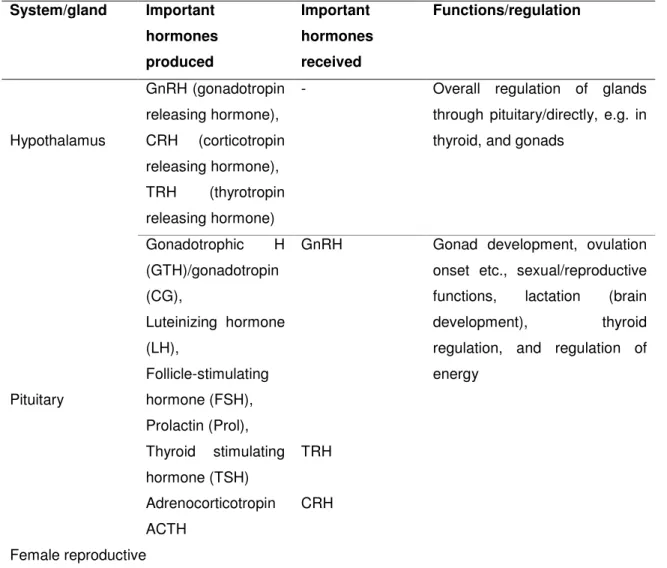
(28) xxvi.
(29) CHAPTER 1. INTRODUCTION. 1.
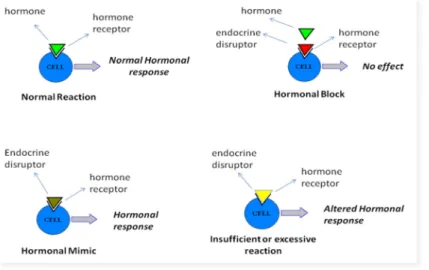
(30) 2.
(31) CHAPTER 1 Introduction 1.1 State of the art of endocrine disruptors Thousands of chemicals (organic and inorganic) of anthropological origin are currently found in the environment. These chemicals cause changes in human physiological functions and, consequently, health problems. One of the subjects that have received tremendous attention from scientific and regulatory communities worldwide is the issue of endocrine disruption. Numerous studies have been carried out concerning the possible harmful consequences of human and wildlife exposure. The endocrine disruptors,. also. called. endocrine-active. compounds,. endocrine. modulators,. environmental hormones, hormone-related toxicants etc., are compounds which exhibit the potential of interfering with the endocrine system of humans and animals. This group of endocrine disruptors is included with a large and still increasing number of natural and anthropogenic agents with diverse chemical structures. Figure 1.1 illustrates the endocrine system formed by a set of glands, such as the thyroid, gonads, adrenal and pituitary glands. Figure 1.1 also shows the hormones they produce, such as thyroxine, oestrogen, testosterone and adrenaline. These hormones regulate the development, growth, reproduction, and behaviour of animals, including human beings 1. . In addition, numerous physiological processes are controlled by these hormones,. which are delivered from their tissues of production to their target organs via the blood stream. Table 1.1 summarizes some relevant endocrine system components and hormones (mainly mammalian) of interest in connection with environmental endocrine modulators.. Figure 1.1 Male and female endocrine system. Adapted from Diamanti-Kandarakis, et al. and Sharpe et al.2,3.. 3.
(32) Hormones are signalling molecules which elicit responses in other parts of the body. An endocrine system is found in most animals, including mammals, non-mammalian vertebrates (such as birds, fish, amphibians, and reptiles), and in the invertebrates (such as snails and insects) 1. By European Commission the endocrine disruptor is defined as “an exogenous substance or mixture that alters function(s) of the endocrine system and consequently causes adverse health effects in an intact organism, or its progeny, or (sub) populations”. According to the Environmental Protection Agency (EPA); Endocrine disruptor is “an exogenous agent that interferes with synthesis, secretion, transport, metabolism, binding action, or elimination of natural blood-borne hormones that are present in the body and are responsible for homeostasis, reproduction, and developmental process” 4.. Table 1.1 Summary of some endocrine systems glands and hormones (mainly mammalian) of interest in connection with environmental endocrine modulators. Adapted from Louekari et al.5.. System/gland. Hypothalamus. Important. Important. hormones. hormones. produced. received. GnRH (gonadotropin. -. Functions/regulation. Overall regulation of glands. releasing hormone),. through pituitary/directly, e.g. in. CRH. thyroid, and gonads. (corticotropin. releasing hormone), TRH. (thyrotropin. releasing hormone) Gonadotrophic. Pituitary. H. GnRH. Gonad development, ovulation. (GTH)/gonadotropin. onset etc., sexual/reproductive. (CG),. functions,. Luteinizing hormone. development),. (LH),. regulation, and regulation of. Follicle-stimulating. energy. hormone (FSH), Prolactin (Prol), Thyroid. stimulating. TRH. hormone (TSH) Adrenocorticotropin. CRH. ACTH Female reproductive. 4. lactation. (brain thyroid.
(33) Ovaries. Estrogen (E2) and. FSH, GTH, LH. Progesterone (Pr). Gonadogenesis/steroidogenesis menses etc. sexual regulation, pregnancy. Uterus. -. Pr,. CG,. &. menses. regulation,. embryo. Lactoferrin (LF). development,. -. Prolactin. lactation. Testis. Testosterone (T). -. Spermatogenesis sex hormone. Prostate. and. Mammary. birth,. and. Male reproductive functions. Dihydrotestrosterone (DHT, 5α-DHT) Thyroid. Thyroxin (T4),. TSH. Metabolism, sexual functions,. triiodothyronine (T3). goiter/hypothyroidosis,. (free/total), Vitamin. epithelial proliferation. and. A (retinol), linked by transthyretin Adrenal gland. Adrenalin,. ACTH. Energy metabolism at stress. (interrenal in. glucocorticoid. combines adrenocorticoid more. invertebrates). Corticosterone. mineralocorticoid functions. (CORT) Cortisol (fish) Pineal. Noradrenaline (NA),. (Photo)biorhythms. melatonin, serotonin. metabolism. Langerhans islets. Insulin. Glucose metabolism. Other systems. Growth H (GH). Growth urophysis. Antidiuretic H (ADH). (xenobiotic metabolism). and. (Hepatocyte enzymes, e.g., MFO*, AHH**) *MFO=mixed-function oxygenase, **AHH=aryl hydrocarbon hydroxylase.. There are several ways in which Endocrine Disrupting Compounds (EDCs) can act upon an organism, including: mimicking the natural hormone, fooling the body to generate excessive response to stimulation, cause the body to respond at inappropriate times, block the effect of a hormone, directly stimulate or inhibit the endocrine system, and cause un-production or overproduction of the hormone. These possible ways of EDCs acting in the endocrine system are shows in Figure 1.2.. 5.
(34) Figure 1.2 Functional or receptor-based toxicology. Adapted from LaFleur et al. and McLachlan et al. 6,7.. Generally organisms are subject to EDCs co-exposure. The results in more or less an additive effect, such as potentiation, synergism, or antagonism, exposure to multiple pesticides may cause changes in the toxicokinetics of the individual compounds, thus modifying the predicted toxicity. Toxicokinetic interactions are the result of one compound altering the absorption, distribution, metabolism or elimination of others and can occur at all dose levels. However, the effects may not be measurable at low doses. The most likely effect of these interactions is the chance in the relationship between the external dose and the corresponding level of pesticide at its target site, leading to an alteration in the threshold 8. EDCs can contribute to a wide range of diseases and disabilities, including obesity, diabetes, testicular cancer, heart disease, and reproductive health problems (genital malformations, infertility, neuro-development and neurodegenerative disorders). In wildlife EDCs can cause fish and frog feminization, malformations in birds and lizards, among other effects 2,9. EDCs contain a wide variety of compounds that can come from domestic, industrial, and agricultural pollution. The EDCs are highly heterogeneous and include synthetic chemicals used as industrial solvents/lubricants and their byproducts [polychlorinated biphenyls (PCBs), polybrominated biphenyls (PBBs), dioxins], plastics [bisphenol A (BPA)],. plasticizers. (phthalates),. pesticides. [methoxychlor,. chlorpyrifos,. dichlorodiphenyltrichloroethane (DDT)], and pharmaceutical agents [diethylstilbestrol (DES)]. Natural chemicals found (e.g., phytoestrogens, including genistein and coumestrol) can also act as endocrine disruptors Figure 1.3 shows the different sources of pollution.. 6. 3,10,11. . The scheme presented in.
(35) Figure 1.3 Different sources of pollution by endocrine disruptors.. 1.1.1 Important factors in endocrine disruption A number of factors have proven to be key to a full understanding of mechanisms of action and consequences of exposure to EDCs. Several of them are listed below 3.. 1.1.1.1 - Age at exposure Exposure of an adult to EDCs may have very different consequences from exposure to a developing fetus or infant. Figure 1.4 shows the different route of exposition to EDCs. In fact, the field of endocrine disruption has embraced the terminology “the fetal basis of adult disease.” This terminology is used to describe observations on how the environment of a developing organism (which includes the maternal environment of eutherian mammals, the eggs of other vertebrates, and the. external environment) interacts with the individual’s genes to determine the propensity of that individual to develop a disease or dysfunction later in life 3.. 7.
(36) Figure 1.4 Route of exposition (dermal, inhalation, oral) of the endocrine disruptors. Adapted from Sharpe et al. and Irvine et al. 2.. 1.1.1.2 - Latency from exposure The developmental basis of adult disease also has implicit in its name the concept that there is a lag between the time of exposure and the manifestation of a disorder. In other words, consequences of developmental exposure may not be immediately apparent early in life but may be manifested in adulthood or during aging 3.. 1.1.1.3 - Importance of mixtures If individuals and populations are exposed to an EDCs, it is likely that other environmental pollutants are involved as contamination of environment is rarely due to a single compound. Furthermore, effects of different classes of EDCs may be additive or even synergistic 3.. 1.1.1.4 - Nontraditional dose-response dynamics There are several properties of EDCs that have caused controversy. Any level of exposure may cause endocrine or reproductive abnormalities, particularly if exposure occurs during a critical developmental window. Surprisingly, low doses may even exert more potent effects than higher doses. EDCs may also exert non-traditional doseresponse curves, such as inverted-U or U-shaped curves 3.. 1.1.1.5 - Transgenerational, epigenetic effects EDCs may affect not only the individual who is exposed but also their children and succeeding generations. Recent evidence suggests that the mechanism of 8.
(37) transmission may in some cases involve the germline and may be nongenomic. Effects may be transmitted not due to mutation of the DNA sequence, but rather through modifications to factors that regulate gene expression such as DNA methylation and histone acetylation 3.. 1.1.2 Police of EDCs in Europe The European Union (EU) is focused on the following: the detection of EDCs in food and environmental samples the impact of these compounds on reproductive health related to the endocrine system, improving assessment methods and tools, and risk management. In this context the EU adopted in December 1999 a strategy to address the problems of EDCs, which produced a list of possible substances with endocrine disrupting activity 4,12. Priority was placed on any evidence of disruptors in humans and animals, and their potential exposure to the chemical. This was done using the basis of its persistence in the environment, and the amount of substance produced. The disruptors were then grouped according to these criteria.. 1.1.2.1 Priority list The priority list (564 chemicals) was established in two phases. The first phase contains an independent review of evidence of endocrine disrupting effects and human/wildlife exposure. The second phase contains a priority-setting exercise that involves consultations with stakeholders and Commission Scientific Committees. The process includes different steps and is described in the text below in Figure 1.5. In step 1, a working list of chemicals was compiled from lists of 'suspected endocrine disruptors' that were published by various organisations. This list was then supplemented by a search of the scientific literature to identify reports describing effects that suggested the existence of endocrine disrupting activity in specific chemicals. To try to ensure that the list was as comprehensive as possible, a draft of the list was discussed at a meeting with key stakeholders. (including. representatives. from. government,. industry. and. non-. governmental organisations (NGOs)). Data on the effects of chemicals in humans and animals possibly due to endocrine disruption was collected and included in a database to facilitate the analysis of findings. Information on each chemical's persistence in the environment and the likelihood that its levels might build up in exposed organisms (i.e. bioaccumulate) was also collected and made available.. 9.
(38) In step 2, the available information was reviewed to identify those chemicals that might be either highly persistent in the environment or are produced by industry as High Product ion Volume (HPV) chemicals, (i.e. more than 1000 tonnes each year). At any rate, it was assumed that both humans and animals would be more likely to be exposed to them and, as a result, be at potentially greater risk to any harmful effects. In step 3, using expert advice, information on the subset of chemicals identified by step 2 (persistent or HPV chemicals) was reviewed to determine the strength of evidence for endocrine disruption. The chemicals were then assigned to one of three categories. In this priority-setting, Commission Scientific Committees and Stakeholders were consulted and a differentiation between both categories is worth noting. : Category 1 evidence of endocrine disrupting activity in at least one species using intact animals; Category 2 - at least some in vitro evidence of biological activity related to endocrine disruption; Category 3 - no evidence of endocrine disrupting activity or no data available. In step 4, regarding the chemicals assigned to Category 1 in Step 3 (i.e. those for which there was evidence of endocrine disrupting activity in at least one intact animal species), the available information was reviewed to decide, if it was possible, that humans or wildlife might actually be exposed. The highest concern was allotted to examples in which humans and/or wildlife were expected to be exposed, medium concern related to examples in which humans were not expected to be exposed but wildlife could be, and lowest concern was given for those where neither humans or wildlife were exposed. The European Commission (EC) has compiled a list containing 564 substances, all of which are categorized in Group I, II or III depending on scientific analysis. 13. . Table 1.2. shows these Groups of chemicals. Of the 564 chemicals suggested as being possible EDCs (by several reputable organizations, published scientific articles/reports), 147 were considered likely to be either persistent in the environment or produced at high volumes (assigned Category 1 using the criteria adopted in the study), and 52 chemicals showed some evidence suggesting potential activity (Category 2).. 10.
(39) Table 1.2 List candidate substances-summary of work to date. Adapted from Ch. Groshart et al. 13. Group. Group I. Number of. Selection criteria Highly persistent and/or HPV. substances High concern in Category 1. term of human and wildlife exposure. 60 (29 chemicals groups). Medium concern Group II. Highly persistent. Category 1. and/or HPV. in term of human and wildlife. 4. exposure Category 2. 51 Low concern in. Highly persistent Group III. Category 1. and/or HPV. term of human and. 2. wildlife exposure Category 3. 18*. Not HPV and not highly persistent. 213. Not HPV and no data on persistence. 205**. * Excluding 11 Substances that have been excluded from the candidate list because of data giving no basis for inclusion in the list (Category 3) ** No Smiles notations were readily available for QSAR estimations on persistence.. In total, 118 substances were categorised in the first exercise as priority examples. Of the 66 chemicals in Category 1, humans were considered likely to be exposed to 60 of them.. Figure 1.5 Overview of the steps of the project made by the European commission. Adapted from Groshart et al. 13.. 11.
(40) The majority of substances registered in the list of chemicals adopted by the EC in 2007 are pesticides. EDCs are considered highly persistent based on related Quantitative Structure–Activity Relationship (QSAR) analysis. This analysis is derived from the combination of two models of biodegradation. When applying the ultimate degradation model, they are considered highly persistent to those with a low probability of degradation (P <0.1). This model was divided into three subgroups: highly persistent substances (pers +), persistent (pers); non-persistent (not pers). An important criterion in risk assessment is the bioaccumulation of chemicals by aquatic organisms (especially Daphnia, mussels and fish). To protect freshwater and marine organisms in their environment, bio-concentration must be considered in context with toxicity, biotic and abiotic degradation, as well as other physical-chemical factors. Furthermore, it is necessary to prevent human exposure from contaminated aquatic food, such as fish, mussels, and oysters 14. Figure 1.6 shows the possible bioaccumulation of EDCs by aquatic organisms.. Figure 1.6 The possible bioaccumulation of EDCs by aquatic organisms.. 1.1.3 A particular group of endocrine disruptors - Pesticides A pesticide is defined as any substance or mixture of substances intended for preventing, destroying, repelling, or mitigating any pest 15.. 12.
(41) Recently, the EU classified endocrine disruption properties as a hazard, therefore any plant protection product containing said properties would be considered for an immediate ban. However, substances showing endocrine disruption properties can be subject to derogation and be approved for maximum of 5 years. This is true only if it can be proven that the substance can be used safely and is necessary to protect plant health 16. . Endocrine disrupting pesticides (EDPs) are the largest group of EDCs numerically in. comparison to other chemical groups17. Pesticides which reach the soil or crops in target areas may disappear by degradation or dispersion. Pesticides may also volatilise into the air, runoff or leach into surface water and groundwater, be taken up by plants or soil organisms or simply stay in the soil. Figure 1.7 shows possible ways that pesticides are distributed in the environment.. Figure 1.7 Distribution of pesticides in the environment after it is applied and the various processes involved. Adapted from Zhang et al.18.. Endocrine disrupting pesticides studied can be found among the families of pyrethroids, organophosphates, imidazoles, triazines and organochlorine. Table 1.3 shows the pesticides studied in this work in which physicochemical properties, chemical structure, and family are categorized according to their possible endocrine disruptor effects, their class and current use are also described. Environmental processes are tremendously complex. The sites of most interest are agricultural fields, forests, lakes, and streams. There are also subtle living ecosystems that are completely, understood and subject to great variability in space and time. The 13.
(42) only way to develop a prediction capability is to develop an understanding of the most basic processes driving pesticide dissipation and degradation between environmental conditions. A current approach to predicting water pollution potential is to estimate each chemical´s inherent tendency to undergo leaching or runoff on the basis of its physical and chemical properties 19.. 14.
(43) Table 1.3 Effects of endocrine disruptor pesticides and their chemical structure.. Pesticides and metabolites alachlor pKa = 0.62 pKOW = 3.09 Vapor Pressure =0.002 Pa (25ºC) Solubility (water) = 170.31 mg/L (pH 7, 20 ºC) Persist = Not pers. 15. aldrin pKa = n.a pKow=5.319 (calculated) Solubility (water) = 0.027 mg/L (27ºC) Vapor Pressure = 0.0086 Pa (20ºC) Persist = Pers+ atrazine pKa =1.6, 4.14, 10.7 logP = −0.97 pKow = 2.5 (25ºC) Vapor Pressure= 3.9 -05 x 10 Pa (25º C) Solubility (water) = 33 mg/L (22ºC, pH 7) Persist = Pers. Chemical structure. O N. Cl O. Endocrine Disruptor Effects. Class and Current use. Synergistic androgenic effects when combined with testosterone In-vitro studies: competitive a ER (estrogenic receptor) and aPR (alligator Progesterone receptor) binding Animal studies: no reproductive effects in adult rats Group: I (High, exposure concern). Chloroacetamide Herbicide. Competitive binding to androgen receptors Antagonises the action of androgens by binding competitively to their receptors and inhibiting the genetic transcription they induce. Group: II. Cyclodiene, organochlorine Non-systemic insecticide. Ref.. 1,20-23. MW = 269.8 g/mol. Cl Cl Cl. Cl. Cl. Cl. 1,20,21,23. MW= 364.9 g/mol. Cl N NH. N N. NH. MW = 215.7 g/mol. Androgen inhibition, weak estrogenic effect. Disruption of the hypothalamic control. Adrenal glands damages and reduction of steroid hormone metabolism In-vitro studies: weak estrogen, weak anti-androgen, Animal studies: damage to adrenal glands, Impairment of steroid, hormone metabolism Group: I (High, exposure concern). Triazine Herbicide. 1,20-23.
(44) Cl. atrazine desethyl pKa =1.3, 1.65 pKow = 1,504 (calculated) Solubility (water) = 3200 mg/L (22ºC) Persist =-. N. Triazine metabolite of atrazine, cyprazine, and propazine). N NH2. N. NH. 21. MW = 187.6 g/mol. 16. bifenthrin pKa = Non ionised pKow = 6.6 (20 ºC, pH 5) Vapor pressure = -05 1.78 x 10 Pa (20 ºC) Henry’s constant = -3 3 7.2 x 10 atm·m /mol Solubility (water) = 0.001 mg/L (20ºC) Soil Sorption Coefficient (Koc) = 5 1.31 x 10 – 3.02 x 5 10 Persist = Pers cypermethrin pKa = Non-ionised pKow = 5.3-5.6 (25ºC) Vapour pressure = -07 2.3 x 10 Pa (20 ºC) Solubility (water) = 0.009 mg/L Persist = Not pers β-cyfluthrin pKa = Non-ionised pKow=5.9 (22ºC) Solubility (water) = 0.0012 mg/L (20ºC). Interferes with the action of the female sex hormones, causing reductions in ovary weight and lack of oestrus. Decreases the level of thyroid hormones present in the blood. Group: III. Cl O. F F. O. F. MW = 422.9 g/mol. Pyrethroid Insecticide, acaricide. 1,21,23,24. Cl Cl. O. O. O N. MW = 416.3 g/mol. N. Cl O. O. Cl F. MW= 434.3 g/mol. Estrogenic effect Androgen receptor may be involved in the adverse effects of βcypermethrin on the reproductive system of male rats. Mimics the action of oestrogen. Metabolites also have oestrogenic effects. Group: III. Pyrethroid Insecticide. Antiandrogenic effects in vitro and in vivo.. Pyrethroid Insecticide. 1,20,21,23,25. 21,26.
(45) Vapor pressure = -08 8.5x10 Pa (20ºC) Persist = λ-cyhalothrin pKa = Non-ionised Solubility (water) =0.005 mg/L (20ºC, pH 6.5) pKow= 7 (20 ºC) Vapour pressure = -07 2x10 Pa (20ºC) Persist = Not pers. 17. DDT pKa = n.a pKow = 6.91 Solubility (water) = Virt. Not soluble Vapour pressure = -05 2.5x10 Pa (25ºC) Persist= Pers. F. O. F. O. O. Cl. Decreases the secretion of thyroid hormones. Group: III. Pyrethroid Insecticide, acaricide. 1,21. MW = 449.9 g/mol. Cl Cl. Cl. Cl. Cl. MW = 354.5 g/mol. o,p-DDT and p,pDDT pKow = 5.923 (calculated) o,p-DDD pKow = 5.389 (calculated) p,p-DDD M(g/Mol) = 320.05 Solubility (water) = 0.05 mg/L (20 ºC) Not soluble pKow = 5.389 (calculated) Persist= Pers. N. F. Cl. Cl. Organochlorine Insecticide. 1,20-23. Organochlorine metabolite of DDT. Cl. MW = 320.05 g/mol. Competitive binding to androgen receptors, activation of androgensensitive cells proliferation. In-vitro studies: estrogen, anti-androgen Animal studies: estrogenic effects thyroid inhibition Stimulation of estrogen receptor production, estrogen receptor agonist and PR antagonist Group: I (technical), III (chemo). Cl.
(46) Cl. o,p-DDE pKow = 6.223 (calculated). ER is sensitive to DDE. Cl. Organochlorine. 27. p,p-DDE pKow = 6.369 (calculated) Persist= Pers deltamethrin pKa = Non-ionised pKow = 4.6 (25ºC) Solubility (water) = 0.0002 mg/L (25 ºC) Vapor pressure = -08 1.24x10 Pa (25ºC) Persist = Not pers. 18. diazinon pKa = 2.6 pKow = 3.69 (24ºC) Solubility (water) = 60 mg/L (22 ºC) Vapour pressure = 0.01197 Pa (25ºC) Persist = Not pers dieldrin pKa = n.a pKow = 4.879 (calculated) Solubility (water) = 0.186 mg/L (20 ºC) Vapour pressure = 0.0004 Pa (20ºC) Persist= Pers+ dimethoate pKa = Non-ionised pKow = 0.704 (pH 7) Solubility (water). Cl. Cl. MW = 318.03 g/mol Weak estrogenic activity. Group: III. Br Br. O O. O. Pyrethroid Insecticide. N. MW = 505.2 g/mol. N. 1,20,21,23. Estrogenic effect Mimics the action of oestrogen. Group: II. S. N. P O. Organophosphorous Insecticide, acaricide. O. 20,21,23. O. MW = 304.4 g/mol. Cl Cl Cl Cl O. Cl. Cl. Competitive binding to androgen receptors, estrogenic effect, stimulation of estrogen receptor production In-vitro studies: weak estrogen, weal anti-androgen Animal studies: no reproductive effects Group: II. Cyclodiene, organochlorine Insecticide and (Metabolite of aldrin). Disruption of thyroid hormones action. Increase of insulin blood concentration, decrease of luteinizing hormone blood concentration Human studies: reduced fecundability Group: II. Organophosphorous Insecticide. 1,20-23. MW = 380.9 g/mol. S NH. P S. O. O. O. 1,20-23.
(47) =39800 mg/L (25 ºC, pH 7) Vapour pressure = 0.00025 Pa (20ºC) Persist = Not pers. MW = 229.3 g/mol. O. 2,4-D pKa = 2.73 logP = 2.81. Synergistic androgenic effects when combined with testosterone. O. Aryloxyalkanoic acid/ester. OH Cl. 21. Cl. MW = 221 g/mol. 19. (α and β) endosulfan pKa = n.a pKow = (α) 4.74 and (β) 4.79 Solubility (water) = (α) 0.32 and (β) 0.33 mg/L (22 ºC) Persist = Pers+ endrin pKa= Non-ionised pKow = 4.879 (calculated) Solubility (water) = Virtually not soluble Vapour pressure = -08 2x10 Pa (20ºC) Persist= Pers+ EPTC pKa= n.a pKow = 3.2 Solubility (water) = 375 mg/L Vapour pressure = 10 Pa (25ºC). O S. Cl Cl Cl. O. Cl. O Cl Cl MW = 406.9 g/mol. Cl Cl Cl. Cl O. Cl. Antagonises the action of androgens via binding competitively to their receptors and inhibiting the genetic transcription they induce. Mimics the actions of oestrogens in directly by stimulating the production of their receptors. Weak aromatase inhibitor. Competitive binding to androgen receptors In-vitro studies: Weak estrogen. Competitive aER and aPR binding. Impaired steroid synthesis in Leydig cells Animal studies: Damage to seminiferous tubules in male rats and reproductive organs in female mice Group: II Antagonises the action of androgens via binding competitively to their receptors and inhibiting the genetic transcription they induce Group: II. Organochlorine Insecticide, acaricide. 1,20-23. Organochlorine Foliar insecticide. Cl. 1,20,21,23. MW = 380.9 g/mol. O S. EDCs disrupt ER-α signaling. N. MW = 189.3 g/mol. Thiocarbamate Herbicide 21,28.
(48) Persist = fenvalerate pKa = n.a pKow = 5.01 Persist = Not pers fenpropathrin pKa= Non-ionised pKow = 6 (20ºC) Solubility (water)= 0.014 mg/L (25ºC) Vapour pressure = 0.00073 Pa (20ºC) Persist:-. 20. HCB pKa = n.a pKow= 5.66 Vapour pressure= 0.00145 Pa (20ºC) Persist= Pers. O O O. Cl. N. MW = 419.9 g/mol O. Pyrethroid Insecticide, acaricide. Pyrethroid Insecticide, acaricide. N. 21,29. MW= 349.4 g/mol. Cl Cl Cl. Cl Cl. Severely disruption of thyroid hormone production. Enhancement of androgen action at low doses, but inhibition at high ones. Animal studies: reduced fertility Human studies: Changes in the levels of sex hormones. Group: I. Organochlorine Fungicide, insecticide. Severely disrupts thyroid hormone production. Enhances androgen action at low doses, but inhibits it at high ones. Reduction of oestrous cycles and luteal progesterone concentrations. Increase of insulin and estradiol concentrations, decrease thyroxine concentrations. Competitive binding to AR(androgen receptor), ER and PR In-vitro studies: weak anti-androgen, no estrogen effect, impired steroid synthesis in Leydig cells Animal studies: Testitular atrophy decreased sperm production and testosterone levels in rats and mink. Group: I. Organochlorine Insecticide. 1,20-23. Cl. Cl. Cl Cl. 1,20,21,23. O. O. MW = 284.8 g/mol HCH (lindane) pKa= Non-ionised pKow = 3.5 Solubility (water) = 8.52 mg/L (25ºC) Vapour pressure = 0.0044 Pa (24ºC) Persist = Pers. Inhibition of estrogen-sensitive cells proliferation, antagonist of the progesterone action. Inhibits the proliferation of oestrogen-sensitive cells, antagonizes the action of progesterone. Group: III In vitro: Weak estrogenic and antiandrogenic activity observed. Cl Cl Cl. MW = 290.8 g/mol. 1,20-23.
(49) α-HCH pKa= Non-ionised pKow = 3.99 (calculated) Persist =Pers Insecticide. Cl. In-vitro studies: Weak anti-androgen. Cl. Cl. 21,22. Cl. Cl. Cl. MW = 290.8 g/mol β-HCH pKa= Non-ionised pKow = 3.99 (calculated) Persist = Pers. Cl. Cl. Animal studies: Weak estrogen-like effects in mice and rats. Group: III. Cl Cl Cl. MW= 290.8 g/mol. 21. iprodione pKa = Non-ionised pKow =3 (pH 3, pH 5) Solubility (water) = 12.2 mg/L (20ºC, pH 7) Vapour pressure = 5 -07 x 10 Pa (25ºC) Persist = Not pers. Organochlorine Insecticide 1,21,22. Cl heptachlor pKa = Non-ionised pKow =4.4-5.5 Solubility (water)= 0.056 mg/L (25-29ºC) Vapour pressure = 0.053 Pa (25ºC) Persist = Pers+. Organochlorine Insecticide. Cl. Cl. Binding to cellular estrogen and androgen receptors. Group: II. Cl Cl Cl. Cl. Cyclodiene, organochlorine Non-systemic insecticide. 1,20,21,23. Cl. MW= 373.3 g/mol Cl. Increase weakly aromatase activity, and estrogen production Group: II. O Cl. Dicarboximide Fungicide. N O. N HN. MW = 330.2 g/mol. 1,20,21,23. O.
Imagem


+7





Documentos relacionados
Neste trabalho o objetivo central foi a ampliação e adequação do procedimento e programa computacional baseado no programa comercial MSC.PATRAN, para a geração automática de modelos
Este artigo discute o filme Voar é com os pássaros (1971) do diretor norte-americano Robert Altman fazendo uma reflexão sobre as confluências entre as inovações da geração de
Para determinar o teor em água, a fonte emite neutrões, quer a partir da superfície do terreno (“transmissão indireta”), quer a partir do interior do mesmo
Concentração de cobre dissolvido em função do tempo durante biolixiviação de rejeito Finos Tratado 40% m/v pelo consórcio ABL em meio 9K pH 2 com adição de 2g/L de Fe2+ no tempo
Os modelos desenvolvidos por Kable & Jeffcry (19RO), Skilakakis (1981) c Milgroom & Fry (19RR), ('onfirmam o resultado obtido, visto que, quanto maior a cfiráda do
É nesta mudança, abruptamente solicitada e muitas das vezes legislada, que nos vão impondo, neste contexto de sociedades sem emprego; a ordem para a flexibilização como
As etapas de criação e expressão dos modelos e analogias proporcionaram à professora, às pesquisadoras e aos pares acesso às ideias que embasavam o entendimento dos estudantes sobre
Os princípios constitucionais gerais, embora não integrem o núcleo das decisões políticas que conformam o Estado, são importantes especificações
