A Work Project, presented as part of the requirements for the Award of a Master Degree in Management from NOVA – School of Business and Economics
CONNECT TO SUCCESS MASTERS CONSULTING PROGRAM
RENASCIMENTO – GESTÃO E RECICLAGEM DE RESÍDUOS, LDA.
Bernardo Carvalho, #18563 Rita Maia, #20614 Sofia Lamego, #20702
A project carried out on the Masters in Management Program, under the supervision of: PhD. Carlos Alberto Marques
1
Executive Summary
The present project was developed by a group of three students, currently pursuing the Masters in Management programme at Nova SBE, under the supervision of PhD. Carlos Alberto Marques. The project was conducted with the intent of providing a clear marketing analysis for Renascimento, with a special emphasis on repositioning Renascimento’s brand, while increasing brand awareness around the several business areas, aligned with a reinforcement of the company’s image around current and potential customers.
Renascimento - Gestão e Reciclagem de Resíduos, Lda, is a global waste management company, established in the waste management industry, for twenty years now. In order to develop a Marketing Analysis, the “5 Cs”, “PESTLE” and “SWOT” models were used, complemented by a Qualitative Research, to get some insights on companies’ waste management practices. By segmenting the market, four main industries were considered as the most attractive to be targeted by Renascimento - Manufacturing, Construction & Demolition, Agriculture & Livestock and Services (Retail and Distribution). On this note, a Marketing Mix analysis was conducted, explaining the broad range of solutions Renascimento offers and how they are made available to its customers. In addition, a pricing strategy was set and as a latest point, a communication plan for the year of 2017 was developed, through which a communication strategy and message for the target audience were conceived. On this note, several KPIs were identified and the largest amount of the media budget (53,5%) was allocated to Outreach activities (mainly events). In order to understand the viability of these campaigns, the NPV was calculated based on the estimated incremental cash flows. Since for each scenario, the NPV was positive, the proposed campaigns should be undertaken. As a conclusion, additional recommendations were proposed and a contingency plan to measure the riskiness of the campaigns was developed.
2
Glossary
BL: Brand Loyal
C2S: Connect to Success
DGAV: Direção Geral da Alimentação e Veterinária
EBITDA: Earnings Before Interests, Taxes, Depreciation and Amortization ELV: End-Of-Life Vehicles
EU: European Union EV: Enterprise Value
GDP: Growth Domestic Product KPI: Key Performance Indicator KSF: Key Success Factor
NCU: New Category User
QES: Quality, Environment and Safety QMS: Quality Management System
RCDW: Recycled Construction and Demolition Waste RDF: Refuse Derived Fuel
SME: Small and Medium Enterprises
WEEE: Waste of Electric and Electrical Equipment OBL: Other Brand Loyal
OBS: Other Brand Switcher
ONGA: Organização Não Governamental de Ambiente P&L: Profit and Loss
STP: Segmentation, Targeting and Positioning
Keywords: AutoRenascimento, Awareness, Business Areas, Business Units, Communication,
Customers, Demolition, Environment, Recycling, Renascimento, Sustainability, Vehicles, Waste.
“Marketing is still an art, and the marketing manager, as head chef, must creatively marshal all his marketing activities to advance the short and long term interests of his firm.”
3
Table of Contents
Executive Summary ... 1
Glossary ... 2
1. Introduction ... 4
1.1. The First Challenge ... 4
1.2. The New Challenge ... 5
2. Theoretical Framework ... 5 2.1. Methodology ... 6 3. Marketing Analysis ... 7 3.1. The 5 C’s ... 7 3.1.1. Context ... 8 PESTEL Analysis ... 8
Key Success Factors Analysis ... 10
3.1.2. Company ... 11 3.1.2.1 Mission ... 14 3.1.2.2. Vision ... 14 3.1.2.3. Values ... 14 SWOT Analysis ... 15 3.1.3. Customers ... 16 3.1.4. Collaborators ... 17 3.1.5. Competitors ... 18 Qualitative Research ... 21 4. Marketing Strategy ... 22 4.1. Segmentation ... 22 4.2. Targeting ... 26 4.3. Positioning ... 28
5. Marketing Mix (4 P’s or SAVE) ... 29
5.1. Product (Solution)... 30 5.1.2. AutoRenascimento ... 32 5.2. Place (Access) ... 33 5.3. Price (Value) ... 35 5.4. Promotion (Education) ... 37 5.4.1. Communication Plan ... 38
5.4.1.1. Marketing objectives & Budget ... 38
5.4.1.2. Target audience selection and Action objectives ... 40
5.4.1.3. Communication Objectives and Positioning Statement ... 42
5.4.1.4. Integrated Marketing Communication (IMC) Strategy ... 46
5.4.1.5. Campaign Tracking and Evaluation ... 67
6. Financials ... 69
7. Contingency Plan and Additional Recommendations ... 71
4
1. Introduction
Founded in 1995, Renascimento - Gestão e Reciclagem de Resíduos, Lda, is a recognized family-owned waste management and recycling company. Its founders, Elsa Nascimento and Paulo Nascimento, rely on a young, qualified and mature team of about 200 employees and partners who unceasingly participate in job-training services in the areas of waste and quality management, environmental concerns, health, hygiene and safety at work in order to ensure the effectiveness and efficiency of the company’s services.
The Co-founder Elsa Nascimento and the Marketing Responsible, Ana Monteiro, signed up to C2S initiative by September 2016. This a program supported by the American Embassy, originally developed by Kim Sawyer, the American Ambassadress in Portugal, to support entrepreneurial women in the development and growth of their businesses. By joining this program, two major challenges arose, described below.
1.1.The First Challenge
Many different business areas and companies, from several industries, are part of Renascimento’s operating, logistic, and strategic sets. By following its mantra, i.e. “Doing more, better and profitably”, the company foresees the best and most efficient environmental and business opportunities. On this note, a new business challenge, in the field of by-products of animal origin, has risen in the last decade. The initial aim of this project was, then, to address the short-term viability, long-term potential and profitability of this business area. To do so, a thorough analysis on best practices, in both Portugal and Spain, was conducted. It was simple to understand that this is a very specific market, where statistical and financial information is not available for public consultation. By the time the group was prompted to look for quantities and business volumes, a decision to begin the research in DGAV’s website was taken, under the supervision of Renascimento’s marketing and financial teams. Within this website, the group looked for companies that had a license to legally manage by-products from category M3. It is important to mention that there are three different categories of by-products according
5 to the level of risk they portray to humans. By-products of category M3 are the ones with the lowest risk and thus, lowest probability of spreading diseases. After an exhaustive and extensive research in DGAV’s website, a consolidated database with around 200 companies was built. Two filters were applied throughout the research, i.e. only companies with a capital structure of at least €100,000 and with a contact, either mobile, skype or e-mail, were considered. During the month of October, other industries up during the research, increasing the sample size to 300 companies. Although it was easy to understand how some parts of the business work, the potential in this business area was not that clear. Apart from the fact that no statistical nor financial information was available, no positive feedback was given from the companies contacted, either because they simply had never heard of this business area or because they were not the actual producers but rather importers.
1.2.The New Challenge
Given all restraints faced, Renascimento suggested a different approach and a different problem they needed to see solved. In spite of its twenty years of activity, the company never had a Marketing Plan. Goals and strategies are planned, but everything is built and defined as time and necessity strike. Therefore, a new challenge, to create a Marketing Plan for Renascimento, with a specific emphasis on the development of a Communication Plan, arose. The point here is to reposition the perceived image of the largest business areas, and at the same time to create brand awareness around the ones with less exposure. The company desires potential and current customers to be aware that it is offering a diversity of services in many different areas, thus being a versatile and differentiated company in the global waste management and recycling sectors.
2. Theoretical Framework
Companies may have excellent products and services, but if they do not communicate it right, they will not be successful in the long run (Tennessee Small Business Development Centers, 2011). Having said this, considering the competitive and intricate environment in which we live
6 in, having a concise plan of all marketing activities to follow is crucial to every business organization, as “marketing is the process of planning and executing the conception, pricing,
promotion, and distribution of ideas, goods, and services to create exchanges that satisfy individual and organizational goals” (Fisher, 2009). When developing a Marketing Plan, an
analysis on both internal and external issues must be conducted, followed by an analysis on the company’s position on the market. This is of crucial importance, as companies need to understand the market in which they operate, against whom they are competing, and finally, how they can benefit from their PODs, thereby overcoming weaknesses and threats. “At the
strategic marketing plan level, marketers are scanning the environment, pondering what is happening and looking for emerging or robust market segments which they could consider as target markets” (Fisher, 2009). Additionally, a Marketing Mix was developed, to describe not
only the current portfolio of offerings of the company but also its pricing and placement strategies. On this note, a Communication Plan was designed, within the Promotional component of the Marketing Mix, whereby a communication strategy and several campaigns were proposed with the overall objective of repositioning Renascimento in customers’ minds as the solution for any type of waste management needs. “A communication plan is the planning
and execution of all types of advertising-like and promotion-like messages selected for a brand, service, or company, in order to meet a common set of communication objectives and to support a single positioning” (Percy, 2008).
2.1. Methodology
In order to develop the project, several tools and models were used and analyzed. On a first stage, in order to develop a Marketing Analysis, the “5 Cs”, “PESTLE” and “SWOT” models were used, complemented by a Qualitative Research. By resorting to the first three models, a complete firm and industry analysis were made. Moreover, by resorting to a Qualitative Research, several insights and behaviors on waste management practices were obtained. These were essential to conduct a detailed analysis to improve Renascimento’s brand awareness and
7 image. On a second stage, to reach and interpret conclusions on this analysis, an STP (Segmentation, Targeting and Positioning) strategy was pursued, complemented by a Marketing Mix (Product, Place, Price and Promotion) model. Finally, to develop the Communication Plan, several branding concepts and models (Rossiter-Percy Grid and IMC 360º approach (Rossiter & Percy, 1997)) were used. The main branding concepts portrayed were brand awareness, image, interest, preference, purchase, and loyalty.
3. Marketing Analysis
Due to the interactive era in which we live in, marketing operates in a complex and changing environment and not in a vacuum (Kotler, Wong, Saunders, & Armstrong, 2005). This being
said, to implement effective marketing strategies and to create customer value and satisfaction, Renascimento must understand not only how and where it shall operate but also the environmental context in which it operates. Having an internal analysis will allow the company to get a deeper knowledge about itself, thereby creating a well-established image of the current offer (which products and services are new on the market and the ones that are more mature), as well as understand the relationship built with the various intervenients on the processes. In this sense, the purpose behind this approach is to find out which are the main strengths and weaknesses of the company in order to accurately plan actions to address market necessities and thereby exploit existing competitive advantages. Moreover, there are forces and trends on the external environment which were worth to consider and analyse, taking into consideration the impact they may have on the company’s operations, on both the short and long run.
3.1. The 5 C’s
In order to define a suitable marketing strategy for the company to harvest the market and to support effective decision making strategies, a deep analysis on the 5 C’s should be conducted. The main goal of this analysis is to understand what are the existing needs on the market, and how prepared the company is to satisfy them, always taking into account the external factors that can affect the flow to meet customers’ expectations (Dolan, 2000).
8
3.1.1. Context
There is no material in this world, which is not useful in one-way or the other. Also there is no material which is created out of nothing. Throughout most of history, the amount of waste generated by humans was insignificant due to both a low population density and to low societal levels of the exploitation of natural resources. Common waste produced during pre-modern times was mainly ashes and human biodegradable waste, and these were released back into the ground locally, with minimum environmental impact (Crowell, 2014). To this day, it is still hard
not to find landscapes, streets, and the quality of life in general damaged by the huge amounts of waste left out and neglected by human beings. On this note, two main concepts of waste management arose in the modern era. On the one hand, Resource Efficiency, which reflects the understanding that current economic growth and development, cannot be sustained with current production and consumption patterns. Globally, we are extracting more resources to produce goods than the planet can replenish. (United Nations Enrironment Programme, 2013). On the other hand, Integrated Solid Waste Management, which is a set of methodologies envisioned to reduce not only the generation and disposal of waste, but also to prompt a better monitoring throughout their production cycle. Moreover, it aims to reduce the generation of waste at its source, and to manage the production of waste in order to achieve a balance between the necessity for waste generation and its environmental impact. It is a transversal and holistic management of the entire production cycle (European Comission, 2006). Taking into account the growth potential of the waste management sector, the societal impacts it comprises and all the directives companies must comply with, a PESTEL Analysis was conducted.
PESTEL Analysis
Political and Legal Forces
The constant scrutiny and tight legal control under which the company is, can indeed constitute a threat to the development of new products and penetration of new markets. Furthermore, EU regulatory constraints and legislations dictate operations and control within the waste management sector (Ministério do Ambiente e Ordenamento do Território, 2011). That is,
9 companies operating within this sector must comply with several legislations and directives and own certificates in accordance with the type of waste and residues in question. Having all this notions in mind, Renascimento unceasingly takes into account all the bureaucracy involved in all services and processes, regulations for competition as well as the protection of intellectual property rights. Furthermore, the company basis all operations in accordance to those directives and legislations and owns several certificates and environmental standards (please refer to appendix I).
Economic Forces
Portugal recorded a Government Debt to GDP of 129% in 2015, which combined with a high unemployment rate (12.2% as of 2016) presents a limitation to the government’s ability to invest in this sector (Eurostat, 2016). Moreover, by resorting once again to this statistical database, it was possible to analyse that the percentage of special/selective collection of urban waste activities has increased from 3,3% to 13,6%, from the year of 2000 to the year of 2014, respectively. The percentage of recycled urban waste has also increased from 4,6%, as of 2002, to 16,2%, as of 2014, nonetheless, as it can be seen from the graphical illustration in appendix II, the collection of urban waste per habitant has not been matching such increment, which proves that there is still room for improvement concerning environmental awareness. Furthermore, the average number of associates per ONGA has also increased from the year of 2000 to the year of 2015, attaining values of 1,1512.8 and 1,937.2, respectively. In conclusion, autarchy and municipality expenditures on waste management have also increased between the year of 2000 and 2015, attaining values of €248.148 and €433.914 respectively (Eurostat, 2016).
Social and Environmental Forces
A critical component in any waste management program is public awareness and participation, in addition to appropriate legislation, strong technical support, and adequate funding. W. Watch,
10
recycling, 1999NOP Research Group LondonStudies is a study conducted based on
population’s attitude concerning waste management practices. The following conclusions were retrieved. 89% of participants considered recycling as an acceptable method for disposing of their waste and 57% agreed with the idea of waste collection being charged per bin to encourage recycling. Only 34% recycled some waste weekly and 9% recycled four times a year or less.
Technological Forces
Adapting brands, products and services to technological advancements and a changing environment, so as to sustain the company’s current efficiency in the market, is a key factor these days. For instance, Trade Association PlasticsEurope has created a new Plastics Packaging Circular Economy Group which will be working across the value chain to maximise the potential of plastics in delivering superior resource efficiency (PlasticcsEurope). According to the organisation, society adds significant value in containing, protecting and preserving a wide range of products. However, more can be done. To this end, PlasticsEurope stated that it is important to further strengthen the engagement with all actors within the supply chain and work in a more holistic way. Additionally, in the Caribbean, the Saint Lucia Solid Waste Management Authority is using small scale funding Assistance from UNEP to develop a strategy for solid waste management.
Key Success Factors Analysis
Key success factors are defined as the basic planning, design, and implementation of how products and services will be presented for consumers and result in successful sales (Lake,
2016). The Key Success Factors for any organization are directly related to what an organization is, and how it operates in the world. However, it is not just the existence of these
factors that enables success -it’s what you do with them. (Lawrimore, 2011). Having said this,
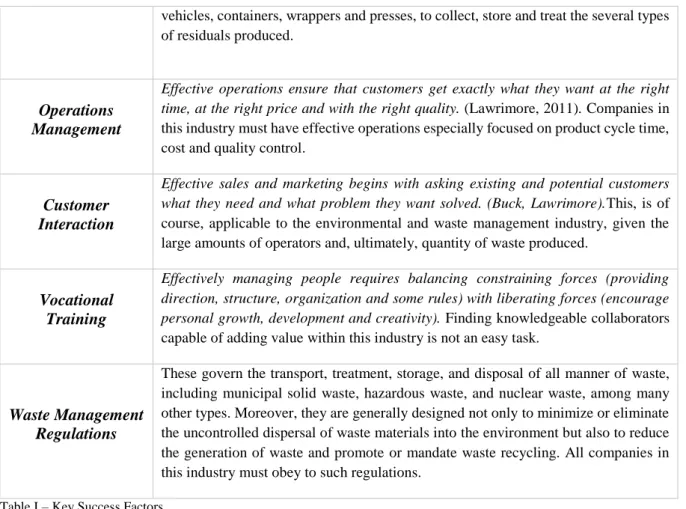
Table I, below, describes the five main KSFs of the waste management sector.
Physical Resources (Logistics)
Finances, facilities and equipment are the big three physical resources. And one of the biggest expenses is providing adequate facilities and equipment for people to work in and with. (Lawrimore, 2011).Companies in this industry must have the appropriate
11 vehicles, containers, wrappers and presses, to collect, store and treat the several types of residuals produced.
Operations Management
Effective operations ensure that customers get exactly what they want at the right time, at the right price and with the right quality. (Lawrimore, 2011). Companies in this industry must have effective operations especially focused on product cycle time, cost and quality control.
Customer Interaction
Effective sales and marketing begins with asking existing and potential customers what they need and what problem they want solved. (Buck, Lawrimore).This, is of course, applicable to the environmental and waste management industry, given the large amounts of operators and, ultimately, quantity of waste produced.
Vocational Training
Effectively managing people requires balancing constraining forces (providing direction, structure, organization and some rules) with liberating forces (encourage personal growth, development and creativity). Finding knowledgeable collaborators capable of adding value within this industry is not an easy task.
Waste Management Regulations
These govern the transport, treatment, storage, and disposal of all manner of waste, including municipal solid waste, hazardous waste, and nuclear waste, among many other types. Moreover, they are generally designed not only to minimize or eliminate the uncontrolled dispersal of waste materials into the environment but also to reduce the generation of waste and promote or mandate waste recycling. All companies in this industry must obey to such regulations.
Table I – Key Success Factors
3.1.2. Company
Being positioned next to the most diverse national industries and services, Renascimento’s core business is based on aspects of global waste management. Since day one, the company’s founders envisioned themselves reinvesting the earnings, not distributed as dividends, in the company’s growth, aiming to improve its equity ratio, i.e. the proportion of the total assets that are financed by stockholders. As a consequence, Renascimento has been witnessing stupendous growth rates in the several business areas in which the company operates, has been working with suppliers and clients from numerous segments and it has been awarded with the following recognitions: PME excellence (2010-2012), PME leader (2013-2016), Entrepreneurial Merit Award for the years of 2013 (granted by Loures autarchy) and 2016 and finally, best centre for the demolition of ELVs (2007 - 2011). Currently, the company has three operating units in Portugal, one in Lisbon (Loures), a 70,000m2 area, with approximately 160 employees, one in Faro (Silves), a 8000m2 area, with 15 employees and finally, one in Porto (Santa Maria da
12 Feira), a 15,000m2 area, with approximately 25 employees. In order to support its packaging services, collection and transportation of waste, the company owns a fleet of 50 vehicles (22 light and 28 heavy), three different types of machines to support its activities, 1500 containers ranging from sizes 6m3, 15m3, 25m3 up to 36m3, presses and big bags to carry trash and rubble (please refer to appendix III). Finally, according to the P&L account presented in appendix IV, the company’s business volume, as of August 2016, is of €12,068,063, in contrast to €12,019,399, as of 2015. This represents a growth rate of approximately 0,4%. Moreover, the EBITDA, as of August 2016, is of €2,351,276, in contrast to €2,503,864, as of 2015. This represents a decrease of approximately 6,1%. Finally, the contribution margin, as of August 2016, is of €6,545,219, in contrast to €6,458,527, as of 2015. This represents a decrease of approximately 1,3%.
Organizational structure
Renascimento has a very well structured organization for its collaborators, to assure that all business departments have someone allocated to them, with all functions and duties very well split. The Direction team is composed by the two administrators and founders of the company, Elsa Nascimento and Paulo Nascimento. Aligned with the direction team, and influencing all the other departments, are the management advisory team and the legal department to assure that all procedures are made in accordance to legislation and aligned with the certifications the company owns. The next institutional layer is composed of four crucial departments and the correspondent professionals of each area, i.e. the QES, Financial, Commercial, Marketing & Development and finally, the Operations departments (please refer to appendix V for a more detailed explanation and respective organizational chart). On the other two business units, Porto and Silves, there is a clients’ assistance unit with the responsibility of dealing with all the clients comprising that specific business unit.
13
Business Units (Porto and Silves)
Porto’s unit was built in the year of 2009 and is located in Santa Maria da Feira. The potential, scope of action and success of this unit can be seen in both a qualitative and quantitative matter. Within a period of five years, the unit grew immensely as quantities received duplicated, the number of collaborators and infrastructures (e.g. equipment, vehicles and facilities) triplicated and revenues attained a value of €1.5M. The unit’s portfolio of clients is already large, including companies such as Jerónimo Martins, Parfois and Mota-Engil, and the main challenge has been to get and keep clients from SME’s, such as Mofitex, Cartonex and Panrico. This is due to the number of competitors around the districts of Porto and Aveiro, and to some unfair price competitive practices, e.g. illegal discounts, delivery of residues in unlicensed fields or in forbidden locations such as sanitation networks. Under the positive scenario that this unit is, producing almost at full capacity and with positive returns, giving up profit margins in order to practice lower prices to match competition, is not a priority. Since most competitors are present in this market for a longer period of time, they already possess the exact equipment and facilities needed to address the needs of a broader range of clients. As this unit only started to grow in 2012, it still needs to acquire new equipment and merchandise to provide proper solutions to clients and that is why, sometimes, monthly rents of €250 arise, in opposition to a large competitor’s €100 rent. In conclusion, this unit’s value proposition is aligned with the headquarters strategy.
Faro’s unit was built in the year of 2009 and is located in Silves. The collection and receipt of scrap waste provided by private companies is the main source of revenue of this business unit. Moreover, just like Porto’s unit, the main challenge of Faro’s unit has been to get and keep clients from SME’s due to client's’ resistance to change, due to the number of competitors around the district of Faro, and to some unfair price competitive practices by companies such as Algar and Europontal. Algar (multi-municipal system), places and distributes equipment and collects waste without any associated cost, whereas Europontal places and distributes
14 containers in construction sites at a negligible cost. Silves’s unit faces a specific challenge, that the other two units do not, i.e. seasonality. On the one hand, during the summer season, the tourism sector is the one keeping the unit running, as hotels and hostels are on huge demand, and as a consequence, more waste is produced. On the other hand, during the winter season, the construction industry is the one keeping this unit running. In order to overcome all of these challenges, Faro’s unit shall present an appealing offer so that customers incur in low switching costs and feel attracted to the company.
3.1.2.1 Mission
The core mission of Renascimento is to ensure on a regular, continuous and efficient manner, the global management of waste, in particular, the receipt, collection, transportation, sorting, processing, recycling and treatment of waste from both customers and partners. By doing so, it aims to maximize the value created from the invested capital to not only the company itself but also to customers, shareholders and society in general.
3.1.2.2. Vision
The company’s ambition is to become a national leader in the waste management sector, whether in services or products provided. Renascimento’s vision guidelines and the growth strategy has undergone a major evolution in the environmental context in the past decade, somehow anticipating the future Portuguese environmental legislation and gaining the recognition of a sustainable company.
3.1.2.3. Values
Renascimento is a leading company in providing and implementing resources and means in the environmental area with added value and competitive conditions for its customers and partners. Having said this, four fundamental pillars comprise Renascimento’s marketing strategy and positioning. These pillars can be seen in Table II, below.
Pillar Description
Customers At the core of the company’s success are its customers. Thus, Renascimento strives to create,
15 relationships and diversify the supply of goods and services. All in all, it aims to improve customer satisfaction, awareness and loyalty, by staying true to its roots and never over promising.
Business
Renascimento’s financial mantra is as follows - “Doing more, better and profitably”. Having said this, the company seeks to reduce costs in an efficient manner by negotiating and re-educating customers to meet payment terms.
Team
Preserving the motivation, passion and ambition of all collaborators and directors and hold them accountable for all successes and failures is crucial to create a healthy environment where everyone feels at home. Furthermore, the company rewards its employees, on a performance evaluation criterion, to sustain their motivation and eagerness to be the best.
Excellence
All employees of the company must work with an everlasting aspiration to achieve excellence in the global waste management market and to strengthen a culture of "Sustainability and continuous improvement". Besides, all employees must comply with all the rules and laws applicable to the company’s business and maintain the certification of Renascimento’s integrated management system. On this note, finding employees knowledgeable of the market and capable of adding value to it and protecting the business has been more of a challenge than expected.
Table II – Four Pillars
SWOT Analysis
A SWOT analysis is, in essence, a distillation of the findings of the internal and external analysis, in terms of the company’s strengths and weaknesses, i.e. an organizational analysis and the company’s opportunities and threats, i.e. an environmental analysis. (Kotler, Wong, Saunders, & Armstrong, 2005). This analysis can be seen in Table III, below.
Strengths
Market establishment: The company is in the market for 20 years now with three business units, allowing it to develop new business areas that work as a complement to the core business area;
Know-how and Expertise: All employees have a coherent and deep understanding of the waste management market and capability to adapt their business to its necessities (Learning Curve);
Recognition: Renascimento was granted with several awards and recognitions from competent bodies proving the excellence of the services provided (as previously mentioned);
Environmental concerns: Very well-built QES department, counting on specialized technicians who constantly keep up with environmental practices and directives, which require specific and constant control; Proactivity and customer-centricity: Renascimento strives to keep up and adapt to foreseen market trends always having in mind customers’ needs and potential
Weaknesses
Low exposure of some business areas: Leads to a low awareness around the market and potential customers, especially because some of them are based on punctual activites;
Low exposure of the company’s versatility: Although the company offers a large number of services and activities, customers are still not aware of how diverse and versatile the company is;
Higher rental prices than competition: Because it simply does not have the necessary quantities of equipment and machinery to sustain lower prices or even have them free of charge.
16 markets that can be profitable for the company in the
long run;
Financial Autonomy: Allows the company to invest some of its returns on the growth of its infrastructures and facilities, by building and also acquiring new equipment and machinery.
Opportunities
Environmental awareness: Population is increasingly conscious about the environment and look for greener alternatives of waste management;
Increasing quantities of waste production: Especially within the demolition, construction and transformation industries;
Value recreation opportunities: Due to the distinctive and extensive offerings of the company, several opportunities for value recreation arise, such as in the case of electrical equipment (e.g. copper and other valuable materials from fridges and ovens);
Value capture opportunities: From existing national customers, from one business unit to the other ones, whenever customer activities match the geographical area of those units.
Threats
Heavy legislations concerning the waste management market and its sustainability;
Unfair competition practices: Such as illegal discounts, delivery of residues in unlicensed fields or in forbidden locations, like sanitation networks; Higher business know-how, of competitors, in some business areas: This situation happens simply because these areas are their core business and so pose a threat to Renascimento due to their deeper business know-how and market position in those areas.
Table III – SWOT Analysis
3.1.3. Customers
Renascimento’s business model is so complex that the commonly defined notion of customers and suppliers goes beyond its common understanding. On this note, some companies like Jerónimo Martins are both a customer and supplier of waste. That is, Renascimento pays the company for materials like plastic and cardboard (supplier perspective) and then, after treatment, cleaning and processing activities, these materials can be resold to the company (customer perspective). The key idea here is that there are indeed some materials worth of revalorization, and thus, of resale, e.g. copper. Given the diverse portfolio of activities and offerings of the company, there are customers from different sectors operating with the company. Due to the strategic location of the three business units, the company has two types of customers, i.e. local customers, which are those located next to each of the three business units, and national customers, which are those acting in a national scale and therefore, present in more than one business unit. In many cases, companies initiate their relationship with
17 Renascimento in a given business unit and due to geographical opportunities may expand to other units. Actually, as it will be explained later in the STP strategy, Renascimento has customers from the three sectors of economic activity and correspondent industries. It is important to mention that companies can have different needs, and thus, associating industries to business areas won’t be feasible. The solution found was to analyse each customer, individually, and understand which business areas match each customers’ needs. Since waste management is indeed a competitive sector and services are customized, price, location and distance play a major role in the customers’ decision making process.
3.1.4. Collaborators
This component of the 5C’s analysis stands for “who should we enlist to help us and how do
we motivate them" (Dolan, 2000). It is important to address this concept because, as Peter
Drucker explains on the article (Shuman & Twombly, 2010) as organizations start engaging
with stakeholders and communities, they tend to specialize and develop relationships with other organizations that complement and extend their core expertise, and thus provide a more valuable and complete solution to the customers. The collaborative network in which
Renascimento is acting has a dynamic fit that has the ability to connect the procedures and partners, called collaborators, who relate to one another either on operations or legal processes. This has been found by organizations to position themselves on the market, to leverage on existing resources, and to create new value together with collaborators. Each industry and more specifically, each business area, may need different collaborators and approaches to address each set of needs and that is why the company distinguishes the different collaborators with whom it works with. This perceived ability to adapt the operations internally, assemble and manage collaborators, gives Renascimento a competitive advantage and a good position on the waste management ecosystem.
The collaboration per se, ultimately depends on the origin and typology of the waste material. Additionally, synergies might result from such collaborations as customers will be exposed to
18 more than one service at once. Having said this, Renascimento formed collaborations with the following waste management entities (Entidades Gestoras de Resíduos): Valorcar, a collaborator in the area of management of ELVs; SPV (Sociedade Ponto Verde); Valorpneu, a collaborator for the management of tires; Amb3e, an Integrated Waste Management system of Electrical and Electronic Equipment; Erp Portugal, Fimet; Sogilub and Ecopilhas; GVB (Gestão e Valorização de Baterias, Lda.).
3.1.5. Competitors
Since Renascimento is a global, industrial waste management company with three units strategically positioned on the country, the competition analysis was done taking into account direct and indirect competitors. The direct competitors are those companies that competitively supply services in the same geographical areas of Renascimento’s three business units; that have a clear expertise in waste management practices and possess strong characteristics in one or more business areas that might influence and even change the strategic set of Renascimento. Two different groups of companies were identified to describe indirect competition. On the one hand, there are some waste management companies which lay on the geographical area between the three business units of Renascimento, and that, due to transportation and logistics procedures, can more accurately address the customers located on that territory. On the other hand, there are other companies that are not exactly on the waste management industry, but that dedicate their activity to one specific business area that do not affect Renascimento’s activities so deeply. The next section will be devoted, on a first stage, to describe who these competitors are, and on a second stage, to compare them with Renascimento on several aspects.
Direct Competitors
EGEO: This company was built in the year of 1949 as a small office, starting its activity in the industrial waste management in 1987. The company collects, transports, stores and treats industrial waste materials (non-hazardous and hazardous) and maritime waste. Moreover, it also offers industrial cleaning services, recover and regeneration of material and additional
19 public services, like cleaning the streets and lakes or collecting waste door-to-door. The company’s business covers all of the Portuguese area, with a total of 658 employees working within the 9 business units the company owns in the Continent and with partnerships in Azores and Madeira. Moreover, it offers innovative skills, business know-how and a customized service. Therefore, and based on all the information provided, one can argue that EGEO is Renascimento’s main competitor, with a total of €51 361 590 in business volume, and with three strong business units acting in the same geographical areas as Renascimento.
Correia & Correia: This is a waste management company with 20 years of experience. It started its activity with the collection of used oils, exclusively, but during the last decade, the company diversified its portfolio of services, by focusing its activities in the management of industrial waste by collecting, managing and offering services to its customers. The company has its main unit in Sertã, with three units for the treatment and storage of waste and a laboratory, and two small units in Venda do Pinheiro and Vila do Conde, which allows them to be present in the same territory of action of Renascimento.
Lumiresíduos: This company has been present on the waste market for more than 20 years and it is located in Póvoa de Varzim, Porto. Currently, the core business of the company encompasses the management of industrial and hazardous waste and manufacturing and demolition of vehicles and correspondent waste. Just like Renascimento, the company is prepared to collect, transport, store and process industrial waste, which in turn is sent to proper entities responsible for its recycling. Moreover, the company offers complementary services to its customers such as machinery cleaning and rental, and transportation of containers. Lumiresíduos can be seen as a competitor of Renascimento, especially within Porto’s unit, as they are better positioned in the ELV business area, with exquisite facilities readily prepared for this activity.
20
Ecodeal: This company, founded in 2008, is dedicated to waste management practices,
providing services such as full management of hazardous and non-hazardous waste, treatment of contaminated soils and management of environmental liabilities. The company holds the operating license of the integrated centre for the recovery and disposal of hazardous waste – Ecodeal Cirver, located in the municipality of Chamusca. Today, the total investment amounts to €25 million, with a waste treatment capacity of about 200,000 ton/year.
Baluarte: This is a portuguese company with a market experience of more than 30 years, owned by two European Groups with reference on the area of production of paper and cardboard, the Saica Group (Spain) and the Holmen Paper Group (Sweden), being competitive in prices on these specific areas. Notwithstanding, in terms of global waste management it is not perceived as a threat. The company works within all the national territory (with business units in Alcochete, Sintra and Maia), having specialized teams for the industrial, logistics and maintenance.
Ambitrena: This company is part of the Group Ambigroup, SGPS, offering several services on the waste management sector, covering all of the national territory. Ambitrena is able to set more appealing prices than Renascimento on the RCDW sector, however in terms of servicing quality Renascimento is one step ahead.
In order to assess the pros and cons of Renascimento relative to competition, Table IV below, was built. As it can be seen from this table, EGEO is indeed Renascimento’s fearest competitor, with a higher business volume, number of employees and fleet of vehicles.
Criteria Renascimento EGEO Baluarte Ecodeal Ambitrena Business Volume (as of 2015) € 17,481,233 € 53,136,685 € 26,503,063 €13,410,234 € 21,203,948 Profit (as of 2015) €411,188 €162,612 €134,384 €1,549,165 €490,045 # Employees 200 658 64 31 82 Fleet of vehicles (Light & Heavy) Light: 28 Heavy: 22 (50 in Total) Light 33 Heavy: 39 (72 in Total) Light: 20 Heavy: 4 (24 in Total) No Information available No Information available
21
Financial
Autonomy 36.40% 34.80% 64.10% 16.60% 30.80%
Recognition High High High-Medium Medium Medium Table IV – Competition Analysis
Indirect Competitors
As previously stated, two different groups were considered to describe indirect competition. On the one hand, there are waste management companies that offer the same services of Renascimento, but whose major target is not on the same geographical area, such as Valnor. These companies are, usually, smaller, with less units, and act on a local level. On the other hand, there are companies that do not have their core activity in the waste management industry, but do offer similar services to some business areas of Renascimento. This being said, industrial cleaning companies and scraps are places that can receive car components for reutilization, resale or even destruction, and thus, can be seen as Renascimento’s competitors.
Qualitative Research
In order to illustrate how Portuguese companies look for waste management solutions, and to depict what are their main necessities and drivers on the topic, a qualitative research was conducted. This research was extremely helpful to understand the key characteristics of the waste management market and as a consequence, to analyse the current positioning and image of Renascimento, which in turn will assure a sustained starting point in order to develop recommendations for campaigns adjusted to the company and the market in which it is inserted. This qualitative research was conducted through a questionnaire (please refer to appendix VI) handled through face-to-face interviews and by e-mail, whenever it was not possible for companies to schedule a personal meeting. The following issues and insights were addressed with this research: type and quantities of waste materials produced/sold by the companies in study, their waste management operator, what are the services that fit the best their necessities and, finally, what they value the most during the waste management process. Although the questionnaire was sent to 15 companies, from different sectors of activity,
22 (Telecommunications, FMCG, Construction, Metalworking, Manufacturing, among others), only 7 replied in time to be subject of an analysis. Notwithstanding, a pattern was found, and the main conclusions are present in Table V, below.
Q1. Description of waste management
process.
Depending on their size and on the amount of residuals produced, companies either have different waste management operators for each type of residuals (storing them on specific containers and on strategic locations until collection takes place) or have the same waste management operator for all types of waste residuals, separating them on small specific containers, nearby each unit. The following materials were most frequently mentioned: oil, batteries, textile, filters, iron, wood residuals, cardboard, styrofoam, paint cans, paint varnish, general and undifferentiated waste
Q2. Current waste management operator
José Maria & Filhos; Oliveira & Pires; Fábrica Papel de Torres Novas; Recolha e Valorização de Residuos, SA; Industria e Comercio Madeiras, SA ; Ambipombal; Tratolixo; Rentokyl; Taxa e Sousa, Lda; Renascimento – Gestão e Reciclagem de Resíduos, Lda.; Valorlis – Valorização e Tratamento de Resíduos Sólidos, Lda; Valorsines – Valorização e Gestão de Recicláveis, Lda.
Q3. Main factors that would make the company change its
current waste management operator
Price reduction; broader offer of services and location (closer to headquarters).
Q4. Ranking of added value services (1 – 5)
1. Price; 2. Transportation; 3. Distance; 4. Collection frequency; 5. Collection schedule flexibility
Q5. Additional services that could add value
for the company
Collection of electrical equipment; having different containers for each residual material; regular presence of a local technician to do the evaluation of the produced waste materials before sending them to the collection service.
Q6. Communication channel
E-mail and telephone
Q7. Opinion about social media presence
Essential to empower positive word-of-mouth and to create awareness. Web presence is very important when searching, however not that much for communication because a personal relationship is always preferred.
Q8. Additional services that could add value for the company and make it willing to
switch operators (from a given list)
List of options: Cleaning and conditioning; consulting and re-structuring the operations area dedicated to waste management; Collection of WEEE materials; Environmental equipment (example: containers); Management of by-products of animal origin.
Answers: Additional services are always welcome, especially if punctual necessities arise. Thus, Consulting and re-structuring the operations area dedicated for the waste management, collection of WEEE materials and environmental equipment are the services selected as the ones with higher potential to add value to the company. On the other hand, all of them mentioned they don't need nor value the management of by-products of animal origin.
Table V – Questionnaire Main Insights
4. Marketing Strategy
4.1. SegmentationThe imperative to divide the market into different segments in order to offer products that match different needs is at the very heart of both B2B and B2C marketing and is called market segmentation (Wright, 2004). The key point around this topic is that if all customers in all segments reacted in the same way to the same marketing mix, there would be no need for
23 segmentation. Thus, segmentation improves marketing efficiency and effectiveness as the company gets to know each segment’s customers, provide a portfolio of services specifically designed in accordance to their wants and needs, build and/or maintain a competitive advantage and finally, identify new business opportunities. For the purpose of this project, a B2B marketing segmentation was conducted, keeping in mind that segments must be attainable, measurable, substantial, differentiable and finally, unique (Kotler, Wong, Saunders, & Armstrong, 2005). In fact, a Macro-Segmentation, i.e. one that uses factors that distinguish one sector from another, one industry and one type of organisation from another, was developed (Fill & Fill, 2005). Nonetheless, since needs cannot really be seen per se, one must use descriptors, which are observable characteristics of business customers in a given segment (Kotler, Wong, Saunders, & Armstrong, 2005). Within this approach, two segment descriptors were used, i.e. economic sector of activity and respective industries whose necessities for efficient waste management practices have been increasing. Having said this, modern economy can be divided into three sectors that reflect the economic development of society. Moreover, as an economy develops, improved technology enables less labour to be needed in the primary sector and allows more workers to produce manufactured goods and further development enables the growth of the service sector and leisure activities.
Primary Sector
This sector involves the extraction of raw materials from the Earth, which in turn results in raw materials and basic foods, such as coal, wood, iron and corn. In Portugal, as in most other modern world countries, there has been a decline in the proportion of the population that works in the primary sector. Within this sector, the agricultural and livestock industries are responsible for the largest share of revenues and sales and also for the largest amounts of waste. Agricultural waste, which includes both natural (organic) and non-natural wastes, is a general term used to describe waste produced on a farm through various farming activities, such as dairy farming, livestock breeding and grazing land. Agricultural and food industry residues, refuse and wastes
24
constitute a significant proportion of worldwide agricultural productivity. It has variously been estimated that these wastes can account for over 30% of worldwide agricultural productivity
(Ashworth & Azevedo, 2006). Given that agricultural waste is not restricted to a particular location, but rather widely distributed, their effect on natural resources such as surface and ground waters, soil and crops, as well as human health, are of a huge dimension.
Secondary Sector
This sector involves the transformation of raw materials into goods (industrialization). This sector generally takes the output of the primary sector and manufactures finished goods or where they are suitable for use by other businesses, for export, or sale to domestic consumers. Only so much can be done in the primary sector before there is a natural limit on how much can be extracted. That is, when an economy moves into the secondary sector, new farm techniques are used, and industrialization changed how goods can be transformed, distributed and sold. These industries produce waste materials and waste heat that may cause environmental problems or cause pollution. Within this sector, the construction and manufacturing/transformation industries are responsible for the largest share of revenues and sales and also for the largest amounts of waste produced. Construction waste consists of unwanted material produced directly or incidentally by the construction or industries. This includes building materials such as insulation, nails, electrical wiring and bricks, as well as waste originating from site preparation such as dredging materials, tree stumps, and rubble. As it can be seen from the study “Waste Prevention on Site. Mitchell Publishing, London”: Observational research has shown that wood, bricks and electrical wiring wastes can be as high as 10 to 15% of the materials that go into a building, a much higher percentage than the 2.5-5% usually assumed by quantity surveyors and the construction industry (Skoyles ER. Skoyles JR,1987). Demolition waste is waste and scraps from destruction of a building, where
the remains vary from insulation, electrical wiring, wood, bricks, among others. There is a large potential to recycle many elements of demolition waste, for instance rubble can be crushed and
25 reused in construction projects. It is important to mention that some hazardous materials may not be moved, or demolition begun, before authorities have ascertained that safety guidelines and restrictions have been followed.
Tertiary Sector
This sector involves the intangible aspect of offering services to consumers and businesses. That is, the basic characteristic of this sector is the production of services instead of end products. Services may involve the transport, distribution and sale of goods from producer to a consumer, as it may happen in wholesaling and retailing, or may involve the provision of a service, such as in waste management. For the last 100 years, there has been a substantial shift
from the primary and secondary sectors to the tertiary sector in industrialised countries. This shift is called tertiarisation (Eurofound, 2014). The tertiary sector is now the largest sector of the economy in the Western world, and is also the fastest-growing sector, due to improved labour productivity and higher disposable income. Within this sector, the commerce, transportation, communication and financial service industries are responsible for the largest share of revenues and sales. Moreover, services like urban cleaning and recycling activities, terrestrial transportation of electric and nonelectric equipment, repair of vehicles, shredding services and tax write-offs are extremely necessary given the large amounts of waste produced by companies within this sector. The universal nature of cardboard packaging makes cardboard a commonly recycled waste product by companies that deal heavily in packaged goods, like retail stores, warehouses and distributors of goods. In fact, the focus of many recycling programs done by waste management companies is the cost–effectiveness and sales potential of recycling. Glass, lumber, wood pulp and paper manufacturers all deal directly in commonly recycled materials, however, old rubber tires may be collected and recycled by independent tire dealers for a profit. Actually, the construction industry recycles concrete and old road surface pavement, selling their waste materials for profit. Especially during the digital era in which we
26 live in, recycling and collection services for electrical equipment are on constant demand. Companies, factories and retailers all over the world, deal with huge amounts of this type of equipment, from microwaves up to laptops. The WEEE Directive is the European Community directive 2012/19/EU on WEEE sets the collection, recycling and recovery targets for all types of electrical goods (Parlamento Europeu e o Concelho da União Europeia, 2012). As one can see from appendix VII, the tertiary economic sector has been the one employing more population throughout the years. Actually, both the primary and secondary sectors have been employing a lower number of people since 2010, reaching a number of 1,1M and 342,000 employees in 2015, in the secondary and primary sectors respectively. These values show a larger necessity of assistance for industries within these two sectors. Considering the growth potential of this industries, the next section will be devoted to understand which benefits can be accrued by Renascimento if it were to target such industries.
4.2. Targeting
After setting the basis of the segmentation process, concerning the market, corresponding industries’ necessities for waste management practices and potential customers, all necessary information to start defining Renascimento’s target was gathered. Targeting involves evaluating each segment attractiveness and then choosing the one to address by designing offerings in line with those needs (Kotler, Wong, Saunders, & Armstrong, 2005). Given the complex alignment between the proposed segments and the extensive number of offerings of the company, targeting more than one segment was considered to be the most feasible to be pursued. These targets were then prioritized, according to their size (measured by sales potential) and profitability. By prioritizing the targets, Renascimento can on a first basis, pursue those that will accrue an immediate return on investment (ROIC), that can be further applied in brand awareness and image in order to attract the remaining targets. Table VI below, summarizes the information. It is important to mention that all information was extracted from (Eurostat, 2016); Tons (T) is the unit of measure and the data is of 2014. Moreover, the manufacturing segment
27 comprises wood, plastic, electrical equipment, textiles, paper and chemical products, all of which will be discriminated individually later on.
Criteria / Segments Manufacturing Construction & Demolition Agriculture & Livestock Services Segment Size 1,494,555 T of recyclable waste 1,650 T of discarded vehicles 945T of batteries and accumulators waste 105,829T of sorting residues 148,916 of Combustion wastes 105,829T of animal and vegetable waste 95,442 T of Recyclable waste 757T of discarded vehicles 298T of batteries and accumulators waste 3,928 T of sorting residues 4,987T of combustion waste 4,419T of animal and vegetable waste 50,751T of recyclable waste 686T of discarded vehicles 61T of batteries and accumulation waste - 1,931T of combustion waste 444,613 T of animal and vegetable waste 389,658 T of recyclable waste - 9,086T of batteries and accumulation waste 9,252T of residues 35T of combustion waste - Segment
Profitability High High Medium Medium
Company Resources
As a result of the screening, manufacturing and processing activities, the company receives a
wide range of waste products prepared for the
recycling industry and subject of revalorization. The company is licensed for storage, sorting, recovery and recycling of waste from construction and demolition and has 3 units for their
treatment and processing. The company possesses the necessary machinery (i.e. monoblocks and fridges) and business know-how to receive, store, process and treat waste of animal and vegetable
origin.
In each of its three units (Lisboa, Porto
and Silves), the company offers to its customers a service of cleaning, receipt and destruction of archives, documents and materials Main Competition EGEO, Baluarte, Ecodeal
EGEO, Ecodeal SAVINOR, ETSA EGEO, Lumiresíduos Table VI – Segment Attractiveness
As it can be seen from the large quantities of recyclable waste, discarded vehicles, batteries and accumulation waste, from Table VI, all segments are indeed worthy of being targeted by Renascimento. Nonetheless, given the alignment between the company’s resources and the segments’ profitability and size, Renascimento should prioritize the segments by targeting on a first scale, the manufacturing, construction and demolition industries (higher profitability and sales potential), and then, on a second scale, the agriculture & livestock and services industries. It is important to mention that within the manufacturing segment, the 1,494,555 T of recyclable
28 waste are originated from textiles, leather and wearing apparel (68,325T); Wood, cork and plaiting materials (113,394T); Paper, printing and recording media (656,208T); Chemical, rubber and plastic (56,016T); Fabricated metal products (212,775T) and finally, Electrical and optical equipments (267,193T). With these quantities at hand, one can easily see that producers of paper, printing and recording media are the targets providing the largest amounts of recyclable waste. Furthermore, as it was previously stated, electronical and optical equipments are indeed on huge demand for waste management practices, amounting to 267,193T of recyclable waste in 2014, whereby the WEEE unit of Renascimento provides the necessary logistics and services to support such demand. The company’s expertise in operations and logistics, which are present in each of the twelve business areas of the company, make any target feasible to be addressed. This being said, a given manufacturing (or any other) company may request from Renascimento a cleaning, processing, sorting or recycling service, but the composition of the materials per se may be of different natures. For instance, a print shop may deliver plastic, cardboard, fibres and ink-related materials, among others, at Renascimento, but given the different nature and composition of these materials, they will obey to different types of treatment, screening and processing from Renascimento. In conclusion, due to the extensive portfolio of services, the company has the capability to design offerings in line with its target needs.
4.3. Positioning
“Positioning is the act of designing the company’s offering and image to occupy a distinctive place in the minds of the target market” (Kotler & Keller, 2012). It is not easy to state an exact
positioning statement for a company working with as many business units as Renascimento, especially because since the growth and the maturity of each of them is different, the perception of its target market in each of them will be as well different. Nonetheless, there are several common practices to each business area favouring Renascimento’s positioning on the market,
29 i.e. the company’s historical background, customer relationship policies, logistics and the reputation it was able to develop through its operating years on the market. The fact, is that as years pass by, Renascimento has been showing signs of customer loyalty and satisfaction, by investing on innovation and on new strategies aligned with its customers’ needs. In this sense, a clear positioning statement for Renascimento can be described as follows: “Renascimento is a global industry waste management company. A national leader in providing resources and services in the environmental area with added value and competitive conditions for its customers and partners. These entities can rely on a customer-centric company that guarantees a customized service in order to fulfil every need. Renascimento’s supply of services and products is of no match, due to the company’s exquisite logistics, customer-oriented and diverse portfolio of activities, all with a common objective, i.e. the promotion of a clean production, reducing risks to both humans and the environment, thereby reducing and even eliminating the production of hazardous substances” (Please refer to appendix VIII for a perceptual map).
5. Marketing Mix (4 P’s or SAVE)
In this section, the action plan will take place, whereby strategies for each one of the four points in the Marketing Mix shall be defined. Neil H. Borden called the marketing managers a “Mixer
of ingredients”, as they would be the ones adapting the various components on the marketing
sphere that will be part of the strategy the company wants to develop (Borden), putting into action the marketing strategic plan (Dolan, 2000). With the Product, Placement and Promotion components, the company is creating value to customers, as these “Ps” are connected with solutions to problems, how such solutions can be assessed and all the communication involved. Through the Price component, the company is able to capture part of the value created, to itself (Dolan, 2000). New studies started to be developed regarding B2B marketing mix, always having in mind the creation of a relationship between the company and all intervenients around it (customers, suppliers and competitors). On this note, the SAVE model was developed, as an improvement of the traditional 4Ps for B2B companies, to convey the message that companies
30 should see their offers as something that will be valuable and relevant to their customers, since they are looking for solutions to their needs (Ettenson, Conrado, & Knowles, 2013). Having said this, this model was considered to fit Renascimento’s vision because the company is, in fact, offering a range of different solutions that will satisfy customers’ needs in a broad and valuable manner.
5.1. Product (Solution)
This topic of the Marketing Mix is related with the range of offerings that the company is able to provide to its customers. Traditionally, in consumer market products, companies believed that the features of the product were the most important part to communicate. However, customers do not care that much about the features, if the product or service does not solve the problem they need to see solved (Wani, 2013). Thus, more and more often, companies try to customize their products and services, to better meet individual desires and to be able to differentiate their offers from those of competition (Fill & Fill, 2005). For this reason, companies in B2B markets are not offering a Product; they are offering a Solution that will satisfy the individual needs of their customers (other companies). According to the new 4P’s model, SAVE, one should “define offerings by the needs they meet, not by their features,
functions, or technological superiority” (Ettenson, Conrado, & Knowles, 2013). Renascimento can be classified as a full service company. The company offers a diverse portfolio of products and services, developed throughout the years, allowing it to be highly competitive in the market. Moreover, 120,000 Tons of waste are managed on a yearly basis. The company is offering, this way, a wide range of different solutions that complement each other and that are adaptable to each type of customer need. These solutions are described on Table VII, below.