When Policy Innovation Fails: Factor Analyses of the Lisbon Real Estate
Market re. Strategic Public Policy, Unintended Consequences, and the
Future Macroprudential Agenda.
Guilherme Marques da Cunha
Dissertation written under the supervision of Prof. Peter V. Rajsingh
Dissertation submitted in partial fulfilment of the requirements for the degree of MSc in Business Administration at Católica-Lisbon School of Business & Economics
2
Acknowledgments
I would like to express my deepest gratitude to Prof. Peter V. Rajsingh for the guidance, expert knowledge, and time invested in this dissertation. His continuous support and dedication were critical for the final outcome.
I am thankful to all the experts who willingly gave up their valuable time to be interviewed. They provided their experience and knowledge, which added decisive insights to this thesis. Thank you, Dr. Paulo Neves, Dr. Luís Marques Mendes, André Monteiro, and those who preferred to remain anonymous.
I extend my gratitude to people who have been influential in my journey, both as a student and a person. There’s a piece of all of them in this project.
To João, Ricardo, and Rui, for lifelong friendship and being a second family for the past six years. Thank you.
To Laura, for unconditional friendship, support, motivation, and love. Thank you.
To my parents, Benedita and Rui, for their caring, comprehension, selflessness, and love. I am eternally grateful for the way they are role models of what one should aim for in life. Thank you.
3
Abstract
Title: When Policy Innovation Fails: Factor Analyses of the Lisbon Real Estate Market re. Strategic Public Policy, Unintended Consequences, and the Future Macroprudential Agenda. Lisbon residents currently face a habitational crisis inadvertently caused by innovative governmental actions. Policies aimed at attracting foreign investment and spurring urban rehabilitation, coupled with a favourable macroeconomic environment, transformed Lisbon into the most unaffordable city in Europe. This thesis researches the causal factors of the Lisbon housing crisis drawing upon academic literature, review of historical and legal phenomena, and empirical data collection. We inquire into the main variables that contributed to a real estate (RE) bubble in Lisbon and uncover the consequences thereof. We used a hybrid methodological approach, including surveys that enabled correlational analysis, and semi-structured interviews which added granularity to the real-world context. We identified tourism, increased construction costs and Golden Visa demand as the major drivers of a top-to-bottom market dislocation that caused a bubble in the lower residential market segments. Moral hazard also played a role. We found that economic displacement is systematically occurring for young adults who do not own their homes. We also found that education does not bear a significant correlation with higher income levels for the young-adult segment. We frame a potential solution to the crisis in terms of macroprudential policy and governmental intervention. Finally, we highlight the urgency of addressing the Lisbon housing bubble by discussing its impact upon national demographics.
Keywords: Lisbon Real Estate Market; Habitational crisis; Macroprudential Policy; Public Policy Innovation.
Author: Guilherme Marques da Cunha
Resumo
Título: Quando a Inovação Política Falha: Análises Fatorais do Mercado Imobiliário de Lisboa relativamente a Política Pública Estratégica, Consequências Involuntárias e Futura Agenda Macro prudencial.
Os Lisboetas enfrentam atualmente uma crise habitacional causada inadvertidamente por ações governamentais inovadoras. Políticas destinadas a atrair investimento estrangeiro e a estimular a reabilitação urbana, aliadas a um ambiente macroeconómico favorável, transformaram Lisboa na cidade mais inacessível da Europa. Esta tese investiga os factores causais da crise habitacional de Lisboa com base em literatura académica, na revisão dos fenómenos históricos e legislativos e na recolha de dados empíricos. Inquirimos sobre as principais variáveis que contribuíram para a bolha imobiliária em Lisboa e descobrimos as suas consequências. Utilizámos uma abordagem metodológica híbrida, incluindo inquéritos que permitiram uma análise correlacional, e entrevistas semiestruturadas que acrescentaram a granularidade necessária ao contexto do mundo real. Identificámos o turismo, o aumento dos custos de construção e a procura derivada de investidores Golden Visa como os principais fatores causais de um deslocamento de mercado de cima para baixo que provocou uma bolha nos segmentos mais baixos do mercado residencial. Os riscos morais também desempenharam um papel importante. Verificámos que a deslocação económica está a ocorrer sistematicamente no segmento dos jovens-adultos que não são proprietários das suas casas. Verificámos também que a educação não tem uma correlação significativa com níveis de rendimento mais elevados no segmento dos jovens-adultos. Definimos uma solução potencial para a crise em termos de
4
política macro prudencial e de intervenção governamental. Finalmente, salientamos a urgência de abordar a bolha habitacional de Lisboa, discutindo o seu impacto na demografia nacional. Palavras-Chave: Mercado Imobiliário de Lisboa; Crise Habitacional; Política Macro Prudencial; Inovação de Política Pública.
Table of Contents
Acknowledgments ... 2
Abstract ... 3
Table of Contents ... 4
List of Figures & Tables ... 5
List of Abbreviations ... 7
Glossary ... 7
Executive Summary ... 8
Literature Review ... 10
Introduction ... 10
The Financialization of Housing ... 11
Government Policies ... 12
Macroprudential Strategy ... 13
Short-term rentals (STR) ... 14
Negative Externalities ... 14
Policy & Uncertainty ... 15
Methodology ... 17
Quantitative Analysis: Survey ... 17
Qualitative Analysis: Semi-Structured Interviews ... 18
Conclusion ... 19
Results ... 19
Semi-Structured Interviews Results ... 19
5
Key Findings & Final Discussion ... 41
Conclusion ... 45 Limitations ... 46 Future Research ... 47 Bibliography ... 49 Appendices ... 54 Appendix 1 ... 54 Appendix 2 ... 56
List of Figures & Tables
Figure 1: Legal timeline ... 13Figure 2: Updated legal timeline ... 16
Figure 3: Number of visitants per year (Source: Turismo de Portugal – Travel BI) ... 22
Figure 4: Source: Inside Airbnb (insideairbnb.com) ... 23
Figure 5: Variables whose interactions originated a residential crisis (Framework) ... 24
Figure 6: Interest Rates (Source: Bank of England, Global Financial Data, Homer and Sylla "A History of Interest Rates" (2005)) ... 25
Figure 7: Inflation-adjusted U.S. home prices, Population, Building Costs, and Bond Yields (1890-2005) ... 26
Figure 8: A History of Home Values (Source: "Irrational Exuberance" 2nd Edition, 2006 by Robert Shiller) ... 27
Figure 9: Pre-Golden Visa Market Segmentation Diagram ... 27
Figure 10: Post-Golden Visa Market Segmentation Diagram ... 28
Figure 11: Variables whose interactions originated a residential crisis (Framework 2) ... 31
Figure 12: Young Adults Working Full-Time (1) vs Student Young Adults (2) ... 33
Figure 13: Rent (Graph 1) and Mortgage (Graph 2) Payments vs Age segment average ... 33
Figure 14: Income distributions of young-adults (Graph 1) vs 30-year olds' (Graph 2) ... 34
Figure 15: Primary relocation reasons for young-adults (Graph 1) vs 30-year olds' (Graph 2) ... 35
6
Figure 16: Income distribution and Primary relocation reasons for renters in the young-adult segment ... 35 Figure 17: Income distribution and Primary relocation reasons for renters in the 30-year olds’ segment ... 36 Figure 18: Ownership in the young-adult segment (Graph 1) filtered by master’s degree education level (Graph 2) ... 37 Figure 19: Ownership in the 30-year olds' segment ... 37 Figure 20: Ownership by educational level. Master’s degree (Graph 1), Bachelor’s Degree (Graph2) and High School (Graph3) ... 37 Figure 21: Ownership Percentage and respective education levels in the [0€-1000€] income range ... 38 Figure 22: Ownership Percentage and respective education levels in the [1000€-2000€] income range ... 38 Figure 23: Ownership Percentage and respective education levels in the [2000€-3000€] income range ... 39 Figure 24: Ownership Percentage and respective education levels in the [4000€-5000€] income range ... 39 Figure 25: Mortgages granted (but not pursued) by income level ... 40 Figure 26: Number of relocations of observations in the past five years per age range ... 40 Figure 27: Number of relocations of observations living in domestic partnership per age segment ... 41 Figure 28: Number of relocations of observations not living in a domestic partnership (In a relationship – Graph 1; Single – Graph 2) per age segment ... 41
7
List of Abbreviations
ECB – European Central Bank HH - Household
MP – Macroprudential policy NPL – Non-Performing Loan
NRAU – Novo Regime do Arrendamento Urbano (New Urban Lease Regime) PSI20 – Portuguese Stock Index
RE – Real Estate
STR – Short term rentals US – United States
Glossary
Financialization of housing – the phenomenon occurs when housing is treated as a commodity – a vehicle for wealth and investment rather than a social good.
Economic displacement – a systematic process whereby residents' purchasing power is diminished by soaring rents (Marcuse, 1985).
8
Executive Summary
Two years ago, my landlord increased my rent. It was a 50% increase. As a student sharing housing, I was able to cope with the rise. But I never stop wondering: what if I hadn’t been a student, but were living there with my wife and kids? Could I have sustained that level of price increase if the burden could not be shared with multiple flatmates? Would it be worth paying 50% more for the same accommodation? Or would I have moved out with my family to a cheaper house? This line of reasoning mirrors discussions taking place in many Lisbon households over the past several years as an economic exodus to Lisbon’s periphery became the norm.
Lisbon is experiencing a period of economic boom with hordes of tourists arriving by air and sea (the lull for COVID-19 notwithstanding), who then spend money on glamorous restaurants, cafes and stores. However, we must ask, what is the hidden cost? The corollary in Lisbon has been a rapid housing inflationary trend, whose root causes and consequences this project intends to analyse. Critics widely regard tourism as one of the variables that caused the spike in prices. The first section is the literature review around RE and housing as a knowledge area. We discuss how RE financialization turned homes into speculative assets. We follow with how rent liberalization in Portugal and the Golden Visa program were significant catalysts for multiple market dislocations. We analyse the new trend of short-term rentals (STRs) and the literature about negative externalities associated with housing. Finally, all these nodes of knowledge are collated under the aegis of public policy, effected under conditions of uncertainty, and presenting a strategic governmental challenge.
To build on the existing research presented in the literature review, we used a hybrid approach of quantitative and qualitative method. We rely on statistical methods to quantify phenomena (Bryman, 1988) while adding further granularity through qualitative data. A hybrid methodology also reinforces the conclusions from each source interviewed for this project. The methods deployed were a survey and semi-structured interviews with RE market stakeholders and participants. We condensed interview data into a comprehensive framework that illustrates the historical context, along with variables that bear upon the residential market and the housing crisis in Lisbon.
Interviewees did not agree about the existence of a housing bubble in Lisbon. However, from the data gathered, it is possible to assert the presence of a bubble at least in the low and
mid-9
level segments of the residential market. This bubble is driven by a top-to-bottom market dislocation, given that residents found their purchasing power shrinking in the face of foreign demand. Inadvertently, they inflated prices in housing segments below their original price points when relocating. A component of moral hazard is also present, with agents holding onto assets in the lower market segments, hoping for value appreciation or a better deal in the future. This speculative behaviour concurs with Shiller’s classic definition of a housing bubble. The survey focused on identifying whether economic displacement was happening in Lisbon, and if so, who were the most vulnerable demographic segments.
The survey established that the most affected segments are renters who live with their partners and are between 23 and 28 years old (young-adults), and 30-year-olds. In other words, these are young-adults and adults who live with their partners and do not own their homes. The survey showed that these segments pay higher rents and spend a larger chunk of their household income on habitation. These segments also record dramatically lower levels of ownership, when compared with historical and EU averages. We uncovered that these segments experienced difficulties when applying for a mortgage, particularly as renters whose household income is below 2000€.
The survey also showed that economic displacement is present in both segments, with a considerable number of renters claiming to relocate because of unpalatable price increases. These results directly correlate with income levels. Also, surprisingly, in the young-adult age segment, education does not correlate significantly with higher income, which adds further nuance to the problem.
Our research suggests that in order to safeguard virtuous and necessary investment vehicles (such as Golden Visas or touristic demand), governmental entities should incentivize the RE supply-side and support builders and developers willing to construct for lower market segments. Tax breaks and easing bureaucratic permit processes for affordable housing construction would be a path to follow.
The need for intervention is urgent, as economic losses associated with economic displacement may be more profound than initially envisaged. The demographic consequences, namely delayed household formation and consequently, the birth of the first child, may also exacerbate the current demographic crisis in Portugal.
10
Literature Review
Introduction
A house, traditionally, is thought of as an essential human good. A theme throughout this work is the tension between housing being both a prima facie good associated with leading the good life, and its status as an asset class – a speculative investment vehicle.
One can divide the extensive research on housing into various subject areas. These include the vast corpus of literature about investing in real estate that discusses financing, cap rates, modelling cash flows, RE asset valuation, etc. (Geltner et al., 2011; Gyourko, Keim, 1993). Then, there are works placing real estate within the framework of structured credit (McDermott, Roy, 2007), along with discussions of the role of subprime mortgages in the Global Financial Crisis (Roubini, Mihm, 2010). The economists Karl Case and Robert Shiller famously created an index tracking the US housing market with pricing that goes back to 1890. In Irrational Exuberance, Shiller demonstrates how housing prices in the US, and by extension other parts of the world, bear scant correlation with construction costs, interest rates, median incomes, and demographic factors (Shiller, 2005).
The subject of this thesis – the contemporary housing problem in Lisbon – is analysed through the lens of macroprudential policy (MP). The Banco de Portugal defines MP as designed “to promote the financial system’s resilience in absorbing risks, ensuring adequate levels of financial intermediation and thus contributing to sustainable economic growth” (Banco De Portugal). MP is framed in terms of its causal relationship with the emergence of a secular market trend – RE business models shifting towards short term rentals (STRs), which commenters squarely identify with price inflation.
Price inflation creates negative externalities which we will discuss using Marcuse’s (1985) notion of economic displacement. This phenomenon, a consequence of governmental activity, calls for further mitigating policy efforts, which implicates an extensive body of literature about strategy and policymaking under conditions of risk and uncertainty.
11 The Financialization of Housing
Randy Martin (2003) proposes that an economic shift towards financialization marked the latter part of the 20th century. Whereas industrial wage employment used to be the dominant mode of economic relations, with financialization the nature of economic agency was transformed. Ordinary people gained increasing access to credit, joining the financial economy and thereby becoming risk-takers and holders of assets such as houses, now conceived of as speculative instruments rather than simply as homes.
Indisputably, for most people in Portugal “owning a house is the largest single investment most households will make” (Ribeiro et al., 2017). Some commenters (Lima, 2019) perceive it positively as “forced savings” that help mitigate the effects of economic downturns, especially for low/mid-level income households. An alternative view is that governments skew prices creating economic inefficiencies and market failures by incentivizing homeownership, which ultimately is harmful to economies and society (The Economist, 2020). These contrary positions converge around the notion that RE financialization pressures housing prices, often destabilizing market supply and demand dynamics, and potentially forcing average homeowners into scenarios of economic distress.
Rising housing ownership is a direct consequence of RE financialization that proliferated across Europe during the ’80s, with the housing market absorbing a significant portion of global excess liquidity (Fernandez, Aalbers, 2016; Aalbers, 2017). Neoliberal economic policies rolled back governmental regulations and controls over the housing market and freed up lending with cheap interest rates (ibid). With RE considered a highly credit-worthy tangible asset to lend against, mortgage debt exploded, and private players were incentivized to speculate and extract profits from what used to be homes.
The advent of structured credit and securitization of pools of mortgages made financial intermediaries, banks, the shadow banking sector, pension funds, etc., voracious players in the market (Rolnik, 2013). RE became a significant asset class within fixed income to achieve investment yields, diversify portfolios, and generally serve as a less risky asset class, predicated on the perceived regularity of mortgage principal and interest payments and ability to model default risk (Aalbers, 2016). Soros (2009) recounts how the Global Financial Crisis (GFC), whose epicentre was subprime mortgages, turned securitized mortgage instruments into toxic vehicles that took down the entire global financial system, including many Portuguese banks.
12 Government Policies
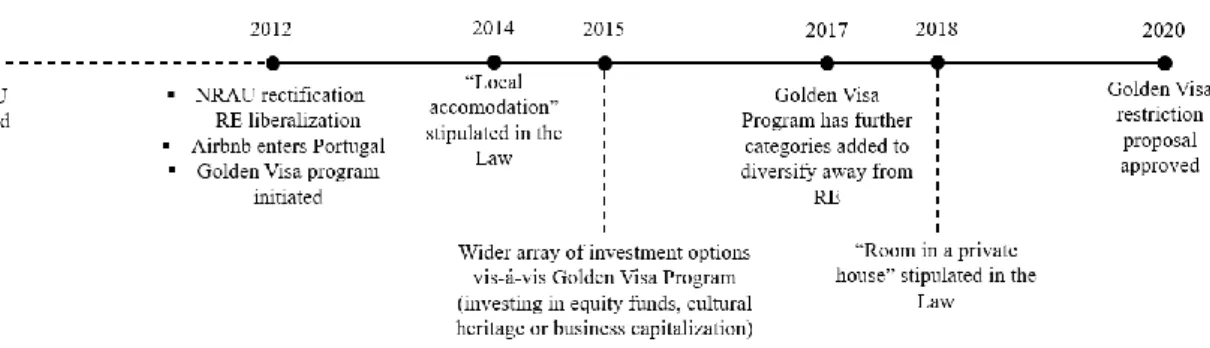
Even though Portugal lagged other countries implementing policies associated with financialization, in August 2012, the rental housing market was liberalized through the promulgation of Law nº31/2012. It rectified Law nº6/2006 (NRAU), which was the first step towards RE liberalization. Rent controls were gradually dissolved, and landlords had increased flexibility to renegotiate agreements and block rental contracts from transferring to family relatives. Property owners gained the power to raise rents and evict tenants as part of an IMF-Governmental plan to make the rental housing market more dynamic and to promote urban rehabilitation.
Simultaneously, a major policy initiative was the Golden Visa program (Law nº29/2012) instituted in October 2012 to attract foreign capital to Portugal and also help banks clean up impaired balance sheets (Lopes, 2016; Gaspar, Haro, 2019). Under the program, a €500,000 real estate purchase (or €350,000 for a rehabilitation project) or a €1,000,000 capital deposit, provides parents and dependent children with a residency permit leading to citizenship after five years.
In 2015, several additional options were added to the program, namely investing in equity funds, cultural heritage, or business capitalization (Law nº63/2015). In 2017, capital requirements for these options were lowered further (Law nº102/2017). Yet, the change did not boost investment into alternative vehicles, with investors still privileging RE as the preferred option. In fact, to date, 90% of issued Golden Visas have occurred via RE (Global Citizen Solutions, 2020; Int. Neves, 2020). This scheme requires applicants to spend just two weeks in Portugal every year, which has led to a proliferation of absentee landlords in Lisbon. This latter phenomenon also poses problems when absentee landlords fail to maintain their properties adequately or are in default of their monthly maintenance payments.
Regarding STR’s, with the entrance of Airbnb into the Portuguese market in 2012, two years later the government enacted legal instruments that stipulated STR’s as “local accommodations”. In 2018, four years later, the “room in a private house” category was added to the legislation, effectively signalling support for the growing concept of the “sharing economy.” One can graph the time-lapse between events that have contributed to the transformation of RE in Lisbon. We can perceive how legal and regulatory regimes adjusted to market dynamics, with inevitable negative consequences:
13
Figure 1: Legal timeline
Speculators, private entities, and foreign investors flooded into Lisbon RE, supported by strategic governmental incentives coupled with a patchwork regime of legislative measures. Clearly, a confluence of policy factors has given rise to the current Lisbon housing bubble. We later discuss what constitutes a bubble referencing Shiller, a leading exponent on the subject. The rapid inflation of house prices has destabilized the RE market, fostering social instability with multiple stakeholders affected. Philipp Hartmann (2015) states that “boom-bust cycles in real estate markets have been major factors in systemic financial crises and therefore need to be at the forefront of macroprudential policy.” He lays out reasons why RE bubbles are events worthy of attention due to their cascade-like economic effects. There are numerous constituencies, stakeholders, and phenomena touched by housing. These include homeowners, the construction industry and its suppliers, individuals’ willingness to undertake household formation and its attendant consumption effects, the “animal spirits” in the economy writ large when housing booms or goes bust, etc. Also, both buyers and developers use leverage to acquire and construct properties, which significantly implicates the banking sector. Hartmann further highlights how RE prices are slow to adjust to supply and demand changes due to structural elements associated with this asset class and market (Hartman, 2015).
Additionally, one must recognize the role of multilateral monetary policy, namely the European Central Bank’s (ECB’s) lower-for-longer interest rate regime (Banco de Portugal, 2019). It potentially nudges investors towards RE as a search-for-yield strategy (Himmelberg, Mayer, Sinai, 2005; Lourenço, Rodrigues, 2017; Banco de Portugal, 2019).
Macroprudential Strategy
Macroprudential strategy pertains to monetary, fiscal, and other policies aimed at reducing risks in markets (Claessens, 2014). The most widely analysed and deployed methods for cooling RE prices commonly target the demand side. These include caps on loan-to-value ratios, hiking
14
interest rates and increasing banks’ reserve ratio requirements. Such restrictions deescalate credit growth by constraining borrowers’ access to capital while improving the credit quality of banks’ portfolios and ultimately, the risk assets on their balance sheets. It also increases opportunity costs associated with RE investment and makes other investment options more attractive (Galati, Moessner, 2012; Claessens, 2014). The authors argue that borrower-based initiatives are effective. However, these policies target and directly affect country-based/resident investors. They do not curb market swings caused by foreign capital inflows insulated from local lending conditions. This hypothesis is congruent with research that points to positive correlations between a growing proportion of foreign investment into local real estate and market imbalances (Borio, Shim, 2007).
It is clear that Portuguese regulators must go beyond generic macroprudential policies if they are to deal effectively with the array of causal factors responsible for Lisbon’s housing bubble – the rapid influx of foreign capital (Lourenço, Rodrigues, 2017) coupled with the effects of a novel real estate paradigm: short-term rentals (STRs) (Cocola-Gant, Gago, 2019).
Short-term rentals (STR)
Housing price inflation due to the STR phenomenon is not exclusive to Lisbon. While it may be favourable for tourism, there is statistically significant research that points to STR-driven real estate bubbles across multiple cities, E.g. in Barcelona (Cocóla-Gant, 2016), Berlin (Bernt, Holm, 2009), Reykjavik (Mermet, 2017) and Sydney (Gurren, Phibbs, 2017). The case of Reykjavik is particularly instructive, having close similarities with Lisbon. Both country's economies became significantly distressed in the late ’00s/early ‘10s and bounced back partly due to RE sector growth. The reason for landlords and investors to adopt this business model is obvious. STRs are more profitable and offer increased asset flexibility as opposed to longer-term rentals (Wachsmuth, Weisler, 2018).
Negative Externalities
All these cities experiencing an explosion of STRs have negative externalities as a common denominator. As supply shifts to a different market demographic – tourists who are short term renters – there is an adverse impact on local people. There is limited literature on RE-based negative externalities, which tend to concentrate in two specific areas: externalities arising from construction, and the different types of economic displacement that occur. The latter is a primary concern for this project.
15
Luís Lima (2019) points out how younger individuals face increasing challenges qualifying for mortgages due to steep price increases, creating conditions for future social instability related to low rates of RE ownership. In addition, interest rates at all-time lows present an ongoing moral hazard for banks that are incentivized to grant mortgages to less creditworthy borrowers, increasing the probability of NPLs while being a further catalyst for property price inflation (Banco de Portugal, 2019).
Alfama, previously a typical working-class neighbourhood, presents a vivid picture of the unintended social consequences of STRs that are proliferating throughout Lisbon. Cocóla-Grant and Gago (2019) discuss in detail the spatial and social changes that Alfama has undergone over the course of the past five years, raising particular concerns about gentrification. Landlords either evict tenants (sometimes illegally) when a rental contract comes up for renewal or raise prices to prohibitive levels, forcing former tenants to relocate. Their goal is to turn what used to be residential dwellings into STR tourist accommodations.
Marcuse (1985) termed this practice economic displacement, a systematic process whereby soaring rents diminish residents' purchasing power. Similar gentrification is present in many other Lisbon neighbourhoods, forcing low/mid-income inhabitants to relocate to more affordable suburbs. At the same time, average salaries fail to grow at levels commensurate with housing estate price appreciation.
Further, the wave of reconstruction and improvement of existing buildings (Lima, 2019) in central Lisbon neighbourhoods exacerbates displacement. The most visible consequence is that this temporarily decreases supply during the renovation period when assets are off the market. Then, prices are hiked up to reflect capital improvements. Authors also discuss an array of negative externalities (Akinbogun, Jones, 2018) which are corollaries of construction activity such as construction debris, large scale crane equipment, noise, traffic congestion, dust, etc., causing residents to relocate to escape these nuisances voluntarily.
Policy & Uncertainty
A macroeconomic paradigm that incentivises RE growth might appear to be promulgating a prima facie economic good. But, as the literature shows, there is a range of unintended consequences that arise. As stated earlier, foreign investment and STR platforms significantly disrupted the Lisbon residential housing market, creating troublesome social effects while compounding complex strategic challenges for policymakers. Portuguese governmental authorities have been mainly ineffectual and reactive. As they attempt to correct one particular
16
problem by policy interventions, they potentially create another series of issues in the market (Almeida, 2019). Recently, and unexpectedly, the government enacted a proposal (article 139.º of the State Budget proposal 2020) that opens the possibility towards restricting RE Golden Visa acquisitions in both Lisbon and Porto, after years of promulgating the opposite approach that enabled market liberalization. We can add another data point to the legal timeline:
Figure 2: Updated legal timeline
The case of the Lisbon housing market helps us interrogate how different economic and social variables interact and influence the RE market (Sequera, Nofre, 2019; Cocola-Gant, Gago, 2019). One sees how extrapolating into the future via policy choices implicates uncertainty. And awareness of uncertainty potentially leads to inaction or policy paralysis. Both of these hinder effective governmental actions or lead to policy mistakes and unintended consequences. Summers (1980) proposes that anticipating rising inflation, people drive up housing prices and, consequently, construction efforts. But, using a land valuation method, Titman (1985) states that if there is uncertainty about the future, policies intended to stimulate construction actually lead to an activity decrease.
Wilson and Gilbert (2005) describe impact bias, whereby people overestimate the intensity and duration of emotional reactions to future events. Behavioural biases in general skew thinking and lead to suboptimal choices as exemplified by prospect theory (Kahneman, Tversky, 1977). This posits how individuals are often not good at predicting future utility for best interest maximization. So, public policy needs to step in to promote general welfare and happiness. It is therefore imperative that the sole entity competent for doing this -- the Portuguese Parliament -- elaborates a RE policy approach for Lisbon that yields sustainable positive results. Such intervention requires grasping the principal rubrics of strategic thinking (Rumelt, 1980; Porter, 1996; Mintzberg, 1979) and adopting appropriate conceptual frameworks to guide action, including learning from past errors. Optimal policy responses need to consider economic interactions as well as social priorities, such as maintaining dignity for citizens in residential
17
housing conditions. It is further paramount that housing policy debates implicate two preponderant concerns: mitigating economic shocks (E.g., macro events such as Brexit, Covid-19, systemic risk from excessive levels of leverage in the financial system, etc.), and tempering the shifting housing market paradigm – from buy-to-use to buy-to-let (Cocóla-Gant, Gago, 2019).
Methodology
Macrosystems, where multiple variables and the behaviour of agents actively influence the system’s dynamics, require a holistic and contextual analytical approach. It is clear that there are various players intervening in the Lisbon RE market, with different incentives and normative conceptions of what the market should entail. Interactions between these various actors and phenomena create significant unintended consequences. Under these conditions, different factors have relative weights concerning causality (Stake, 1995; Yin, 2003) and research needs to be cognizant of this.
This project turns upon two research questions, and any chosen methodology must be sensitive to the peculiarities of the questions (Borrego et al., 2009):
1. First, we seek to uncover the main causal variables giving rise to Lisbon’s housing bubble and potential economic displacement.
2. Next, we will theorize about MP governmental policies that could alleviate negative externalities resulting from these causal variables.
With regard to the economic displacement part of the first question, we need to ascertain which demographic segments are most affected by displacement. Quantitative tests are suitable for this type of study (Queirós, Faria, Almeida, 2017). In discussing ameliorative governmental policies in light of negative externalities, we will aim to target the population for whom the consequences are most grave. Even though we will use quantitative data, qualitative information is best for gaining the necessary granularity and nuance for understanding the multitude of forces at play (ibid).
Quantitative Analysis: Survey
The survey was designed to gain insights into the specific demographics and market challenges of subjects who have recently relocated within Lisbon. In particular, we sought to identify whether there was indeed economic displacement and analyse the nature of the phenomenon in
18
Lisbon. We were interested in determining the demographic cohorts most correlated with being displaced.
Data was gathered partly online, for younger age segments, and offline through telephone questionnaires, to effectively reach older populations. There were two phases of data collection: the first focused on the entire demographic range, and the second, performed after preliminary data analysis, focused on gathering additional observations from younger individuals.
The survey questions were mainly multiple-choice, with two input questions pertaining to residence location and rent/mortgage value. There were three filter questions intended to improve sample representability: the survey inquired about location, the number of years living in Lisbon, and the frequency of relocations within that period. Respondents not residing in Lisbon, who had not lived in Lisbon for at least five years, or who had not relocated in the past five years, were removed, bringing the total sample size to 172. The reason for this data scrubbing was because respondents not satisfying these criteria either had not lived in Lisbon long enough to have experienced the rapid inflationary trends in housing or they had not changed locations. Hence, their rent/mortgage increases were likely to be less substantial. The sample was intended to be a slice of the Lisbon population that has changed residence locations within the city over the last several years, but this obviously is not representative of the city’s entire population. Nevertheless, extrapolating from samples to a general population is a standard mode of conducting social science research (Forbes et al., 2009).
We performed data analysis using Microsoft Power BI, which integrates R statistical analysis tools and performs calculations through data visualizations.
Qualitative Analysis: Semi-Structured Interviews
There were nine semi-structured interviews with relevant players in the real estate sector: real estate agents, builders, lawyers, politicians and a state adviser. The interviews averaged one hour in duration with extensive notes recorded. When interviewees granted permission, we quote them in the following sections.
The guiding scripts allowed discussions to diverge from the predetermined agenda when useful, and questions were adjusted to fit the scope and expertise of each particular interviewee. Nonetheless, there were common questions asked of all respondents (a summary table can be found in Appendix 1). Many were quantifiable and are presented to support or disprove the working hypotheses of this thesis.
19 Conclusion
A mixture of quantitative and qualitative research is appropriate for this case study as this approach adopts scientific methods and established measurement procedures to quantify phenomena (Bryman, 1988) while yielding tangible insights typically associated with qualitative research (ibid). The use of qualitative and quantitative methods reinforces conclusions from each (Gray, Densten, 1998) and facilitates results that are both statistically significant, and also bear upon the real-world situational context.
Results
This section is divided into three segments. Qualitative data gathered through semi-structured interviews is analysed and metabolized into a comprehensive macro framework for gaining insight into the research questions. That data informs the economic paradigm (current and historical) and explicates incentive structures associated with various agents. We further identify the key causal variables of Lisbon’s RE inflationary bubble.
Interpretation of the quantitative data amplifies previously acquired knowledge and serves to substantiate the posited hypotheses about a bubble and economic displacement. We compare demographic data with economic indicators through cross-tabulation, graphical, and correlational analyses. This data enables us to identify the most susceptible and vulnerable demographic segments affected by price increases and is used to corroborate social and geographic change caused by economic displacement.
The last section concludes by weaving results from both sources into a strategic framework that illustrates the key variables and various dimensions of the case study. It lays the groundwork for the concluding section and calls for rethinking governmental strategic MP.
Semi-Structured Interviews Results
Every interview had three elements: the largest segment of the conversation centred upon a description of the current RE market and housing conditions in Lisbon as perceived by the various experts. In this regard, it was interesting to observe how particular contexts contoured perspectives and worldviews. This was followed by discussing negative externalities induced by rising prices. And, finally, the discussion turned to potential mitigation policies that could curb the economic displacement and exodus phenomenon which, in some shape or form, was acknowledged by all interviewees.
20
Two policy variables were identified as causal factors affecting RE. These were the Novo Regime do Arrendamento Urbano (NRAU) rectification through Law nº31/2012, and the Golden Visa program (Law nº29/2012). The majority of the interviewees perceived the two policies as associative and the primary triggers for what was described by Dr. Paulo Neves, a Portuguese parliamentarian, as “one of the biggest revolutions in Portugal” (Int. Neves, 2020). In the 2012 economic recession, Portugal recorded significant declines in foreign investment, rising unemployment (up to 17.3% in December 2012 (Source: Eurostat)), and waning positive investor sentiment (Int. Marques Mendes, 2020). PSI20 dropped 42% between June 2011-2012 (Source: Eurostat). The RE market was already struggling from aftershocks of 2008’s subprime crisis, recording a 20% drop in real house prices (based both on appraisal valuations and transactions) from 2008 to 2013 (Lourenço, Rodrigues, 2017). This economic stress was exacerbated by the rising national debt (from 75.6% of GDP in 2008 to 129% in 2012 (Source: Eurostat)) and the highest balance of payments deficit since 2009 (close to €20 billion in 2010 (Source: Banco de Portugal)).
Governmental authorities were urged to find instruments that could alleviate the crisis and promote economic growth. RE acquisition by foreign investors through a residence program (amongst other options) incentivized by fiscal benefits was one such program. Attracting foreign capital via the real estate sector was a swift, stimulative measure, effectively redressing the fact that national enterprises did not have the capital nor confidence to invest.
To further boost the attractiveness of RE, the government reformed the rental market through NRAU rectifications. It was a reasonable move to increase rental yields. In central historical Lisbon most properties were either vacant and in desperate need of renovation or, if occupied, were mainly inhabited by tenants paying as little as 20€ a month in rent. Landlords did not have the legal power to increase their rental yields which discouraged owners from maintaining their properties (Int. Neves, 2020; Int. Anonymous 5, 2020). Thus, with the 2012 NRAU rectifications, it became easier to evict tenants, renovate properties, and put them up for rental at competitive market prices.
The speed and success of this change were tremendous. It gave rise to a wave of investment and entrepreneurial activity that, over the following years, rehabilitated a considerable percentage of downtown Lisbon (Int. Neves, 2020; Int. Marques Mendes, 2020; Int. Anonymous 5, 2020).
21
Every interviewee was able to describe this exact timeline and its effects. One can summarize the situation as governmental action incentivizing RE acquisition as well as creating foreign demand. Opportunistic global investors recognized Lisbon RE as an attractive asset class in which to deploy capital, focusing on historical neighbourhoods of the city. The first interviewee moment of dissonance revolves around lack of agreement about the exact drivers of urban rehabilitation: was it Golden Visa candidates or other investors and property developers? Five of the interviewees maintained that Golden Visa investors were the critical component of urban rehabilitation, hoping to buy EU residential rights through the purchase of cheap decrepit buildings, which could be renovated and then rented. Three interviewees suggested the opposite – that even though Golden Visas were certainly a trigger, the major wave of investment and reconstruction was performed by other types of investors, namely developers and property owners who saw the potential upside.
Looking at official governmental data from March 2020 courtesy of Dr. Paulo Neves, the total amount of investment through the Golden Visa Program since its origin has been 5.1 billion euros. This amount concentrates in RE investment (4.6 billion euros, or 90% of the total amount). But Golden Visa purchases for rehabilitation amount to only 9.7% of that amount (or 498 million euros). This indicates that urban rehabilitation was and is actually not a priority for Golden Visa applicants, even though the acquisition price threshold is lower for rehabilitation properties. Such a conclusion is relevant for assessing the efficacy of the program which sought to bring about urban renewal. So, while the Golden Visa program was not seen as the primary reason for the wave of urban rehabilitation, interviewees did view it as a trigger for introducing higher levels of trust in the Lisbon real estate market and its future buoyancy. It stimulated additional opportunistic RE investment, beyond the numbers accounted for by the program’s metrics.
It is also possible to extract from this data the broad unpopularity of options added in 2015. Only 5.6% of permits granted resulted from transfers of at least €1 million into Portugal, and a residual 0.2% came through the requisite creation of 10 jobs. To date, cultural heritage investments, business capitalization and fund investments never materialized. Most interviewees were of the opinion that while there are entities willing to invest in cultural heritage, equity funds and in job creation, these are not the types of investors seeking to obtain residence and free movement throughout the Schengen zone. Hence, these other unutilized options are clearly misaligned with the demand criteria of the Golden Visa demographic.
22
Some interviewees proposed that the reason for these options introduction was as a political diversion. Diversification of investment options was merely an attempt to deflect criticism from the RE-centric nature of the program and the market anomalies it was creating.
The abovementioned suggests that the Golden Visa program was not the sole driver of urban rehabilitation and price increases, but was, nevertheless a key catalyst the spurred them. After grasping the historical context that generated initial RE demand, it is now essential to add two further variables, also mentioned by every interviewee, namely short-term rentals and tourism. Following the turmoil of the 2012 bailout, the profile of Portugal has been rising consistently as a leading tourist destination, particularly as a beneficiary of the expanding trend towards budget European travel and foreign cultural immersion. Since 2017, the country has won consecutive World Travel Awards. Tourism demand has strongly focused on Lisbon, Oporto as well as reinforcing the considerable existing volume of tourists in the Algarve. While demand in the Algarve is dispersed across several hotspots located over the entire southern coast, Lisbon has had to absorb a tremendous growth of new visitors. Within nine years, the number of tourists in Lisbon has doubled from 4 million to 8.1 million in 2019. Disregarding seasonality, simple averaging over this timespan shows there are now roughly 11,000 additional tourists per night in Lisbon (an annual percentage growth table can be found in Appendix 2).
Figure 3: Number of visitants per year (Source: Turismo de Portugal – Travel BI)
To accommodate the additional explosive demand, a multitude of RE related businesses scenarios came to the fore. Real estate agents focused on STR properties. Real estate intermediaries, builders, property management companies, restaurants and commercial
23
businesses benefited from the value networks derived from tourism activity, boosting economic growth through capital inflows and increasing levels of currency in circulation (Int. Anonymous 5, 2020).
Airbnb was introduced in Portugal in 2012 and became a significant presence in Lisbon’s touristic lodging sector. Recent data sets the number of Airbnb units at 16,230. These numbers do not account for new hostels, hotels and accommodations rented through other platforms. One of Airbnb’s selling points, and a common claim in support of it, is that it represents the new paradigm of the so-called sharing economy, enabling locals to supplement their incomes by renting an extra room in their houses and turning anyone into an entrepreneur. This view proposes a de minimis impact from Airbnb upon decreasing the RE housing supply. However, this argument does not hold up against the data, which shows a predominance of available entire flats/apartments in European capitals. In Lisbon, 74.8% of the listings pertain to entire units. Analogous scenarios can be seen in Paris (86.8%), Amsterdam (79%), Prague (78.3%), Vienna (73.4%) and Rome (64%), similar tourist hotspots (Source: Inside Airbnb (insideairbnb.com)). This type of STR offering is highly concentrated in central and historical Lisbon, as seen below:
Figure 4: Source: Inside Airbnb (insideairbnb.com)
Due to the rapid growth of tourism, it was necessary to create accommodations for travellers. Therefore, housing rehabilitations targeted the visitor segment (Int. Anonymous 1, 2020; Int. Anonymous 6, 2020). Because STR profits are substantially higher compared to habitational renting, a significant number of landlords also shifted their focus to STR activities. Such dislocation effectively decreased the housing supply in Lisbon, which, coupled with higher demand, caused gradual price hikes.
24
As of 2019, most Lisbon neighbourhoods have an average rental price above 10€/m2, more than twice the national average, which is 4.8€/m2. Taking only central Lisbon into account, the average rental price per m2 is triple the national average (Carregueiro, 2019) (Source: INE). Using Oporto for comparison, a city that is tracking Lisbon in terms of trends that are sources of concern, average rental prices are 7€/m2 (ibid) (Source: INE), a figure still only half of some areas in Lisbon. This price inflation is astronomical when one considers average salaries in Lisbon, which have been close to stagnant for the past decade. In 2011, average wages were € 1117 a month, rising by 4.8% to € 1170 in 2018, which in absolute terms represents a € 62 increase, an inconsequential amount when compared with the higher levels of market rents (Source: PORDATA).
In fact, Lisbon leads all of Europe (and is 6th in the world) in terms of the percentage of income (50.4%) that goes to rent payments (Idealista, 2019). It outpaces cities like Paris (47.9%), Milan (40.5%) or even New York (31.5%) (ibid) (Source: Deutsche Bank).
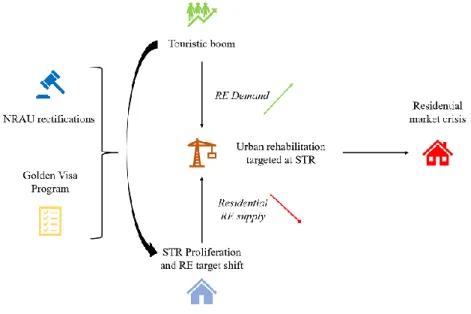
Governmental authorities did not initially envisage rent inflation of this magnitude. Assunção Cristas, a prominent political figure during the NRAU rectification period, responded to critics decrying prices in the Lisbon rental market by admitting that rent liberalization strategies simply had not anticipated market dislocations caused by STR’s and the tourism boom (SOL, 2018). However, there seems to be a lack of consensus amongst regulators, governmental authorities and market participants regarding the existence of a bubble or a housing crisis. We can model the main variables responsible for price increases so as to have a visual framework of causal factors:
25
The most apparent consequence of these variables is rapid price inflation, an unintended consequence which was not initially predicted. As the interviews pointed out, governmental authorities can either be reluctant to intervene or tend towards market activism when faced with scenarios of uncertainty. The propensity towards action or inaction depends on doctrinal, political and economic views. And an anomalous situation can worsen through inaction or inconsistent policy responses.
Interviewees were also divided about the existence of a housing bubble in Lisbon. Uncertainty about this was based on the difficulty of distinguishing between a bubble scenario and natural price increases caused by rising demand with limited supply. The non-bubble view was also linked to market fundamentals improving with interest rates at historically low levels making the cost of capital exceedingly cheap.
Figure 6: Interest Rates (Source: Bank of England, Global Financial Data, Homer and Sylla "A History of Interest Rates" (2005))
At the same time, with local incomes flat, property developers rather than potential local buyers are the beneficiaries of cheap rates for borrowing. Moreover, interest rates and income levels have remained consistently low for years (and expectations are that they will continue to be this way for a while). So, the immediate triggers for the housing bubble are more likely to be found in other factors.
It is useful here to discuss Shiller’s definition of a bubble which is predicated on behavioural factors. Shiller writes that “a bubble is really defined in terms of people's thinking: their expectations about future price increases, their theories about the risk of falling prices (…)” (Shiller, 2005). Interestingly, interviewees who claimed that Lisbon is “definitely” not going through a bubble-like scenario, were all active participants in the RE market, either through being property intermediaries, legal service providers or investment players. Interviewees who were less active market participants were more accepting of the idea of a bubble, with four
26
interviewees agreeing with this view. It is plausible to suggest that there are elements of moral hazard for participants benefiting from current market conditions. They dismiss criticism of prices rising exponentially and claim that this is a natural market dynamic, a type of behaviour that fits with Shiller’s definition.
It is also interesting to note how sophisticated practitioners in the United States and elsewhere also failed to notice the severe housing bubble in the US until it blew up. This was despite spreads between housing and other factors widening significantly and housing prices diverging appreciably from historical trendlines. Two much-cited graphs below from Shiller (2006) illustrate these points. Yet, in the midst of the US housing bubble then Chairman of the Federal Reserve Alan Greenspan told the US Congress that: “Although a ‘bubble’ in home prices for the nation as a whole does not appear likely, there do appear to be, at a minimum, signs of froth in some local markets where home prices seem to have risen to unsustainable levels. The housing market in the United States is quite heterogeneous, and it does not have the capacity to move excesses easily from one area to another. Instead, we have a collection of only loosely connected local markets…the behavior of home prices varies widely across the nation…Although we certainly cannot rule out home price declines, especially in some local markets, these declines, were they to occur, likely would not have substantial macroeconomic implications.” (Source: Testimony before the US Congress Joint Economic Committee (June 9, 2005)).
27
Figure 8: A History of Home Values (Source: "Irrational Exuberance" 2nd Edition, 2006 by Robert Shiller) Regarding the existence of a bubble in Lisbon, it is essential to understand the segmentation of the residential property market. The market is divided into four main property types: Luxury, High-End, Mid-End and Low-End (Int. Anonymous 2, 2020).
During the pre-Golden Visa period, the market was stratified across national income levels. Logically, households with higher incomes could afford better housing. Additionally, they easily qualified for mortgages and could readily pay the initial lump-sum down payment (Int. Monteiro, 2020). Such factors contributed to higher ownership levels at the top segments of the market as opposed to lower ones (a point confirmed in the sample, which we will discuss later). Foreign demand was residual and inconsequential for market pricing dynamics.
This segmentation scheme is visualized in the diagram below:
28
With the advent of the Golden Visa program, a new type of player entered the residential housing market. Foreign investors with higher disposable incomes and purchasing power who started to invest in Luxury and High-End properties. The average RE purchase value through the program (for properties not to be subject to rehabilitation) is € 620.000 (Source: Official Government Data). Certain interviewees pointed out how brokers started to increase prices in the top market segments to capitalize on this new, highly qualified demand. Now, the original top segment began to have to compete with foreign buyers as demand-driven prices increased. International demand forced many Portuguese nationals into a lower market segment through pricing pressures.
This has happened in both the luxury and high-end markets, targeted by Golden Visa demand. However, residents who were pushed out of their original segment (Luxury or High-End) did not lose their competitive advantage when compared to other residents in segments below their original purchasing cohort. Hence, downgrading from their initial segments, these buyers inadvertently pushed prices up in their new, lower, segment, through their higher purchasing power. This aftershock driven by Golden Visa demand at the top market segments has cascaded down to the Low-End bottom segment as a form of a vicious cycle. The diagram below adds to Figure 4 by presenting market dislocations post-Golden Visa demand, driven initially by the later and subsequently by national residents.
Figure 10: Post-Golden Visa Market Segmentation Diagram
Interviewees pointed out aspects of this market dislocation and how there is a geographic movement towards Lisbon’s periphery, where prices are obviously lower than in the city centre. The periphery still has some proximity to central areas, and the type of construction there tends
29
to focus on the Mid- and Low-End segments. However, it was also pointed out by three RE agents that prices in the periphery are also experiencing abnormal increases, not consonant with demand.
Recognizing the demographic shift to the periphery in progress, landlords increased prices there as well, to take advantage of the overall secular inflationary trend. It was also mentioned that owners prefer to keep prices high and hold onto the assets rather than negotiating prices to match actual demand. This situation holds for both sales and rentals based on the perception that because prices are increasing, all purchases and rentals should be making top-dollar in line with the notion of an ever-increasing market. (Int. Anonymous 2, 2020). Such behaviour also reflects Shiller’s definition of a bubble, where agents artificially inflate prices by holding onto price expectations, based on the assumption that profits are unidirectional and impervious to cyclical market forces.
Based on the discussions above, it is plausible to assert that the major iatrogenic effect of governmental strategies is an ongoing RE bubble in Lisbon. It is particularly pronounced in the lower housing market segments, which translates into a significant housing crisis that needs to be addressed. And the middle-class economic squeeze that has been engendered has deeper consequences than immediately apparent from considering economic consequences.
As presented above, people are moving towards Lisbon’s periphery, which means a longer commute to the city centre where the majority of people work. Research shows that workers with longer commute times have lower levels of both life satisfaction and happiness (Nie, Sousa-Poza, 2015). Additionally, the relationship between longer commute times and happiness is mediated mostly through lack of sleep, which means that people sleep less to compensate for the time lost from commuting (ibid). It also translates into workers with longer commute times being less productive (Ommeren, Gutiérrez, 2009).
Consequently, economic loss occurs as both first and second-order effects arising from the burdens associated with housing. Overall, attendant in the housing bubble are a host of negative externalities which are potentially a net liability for the Portuguese economy, a line of enquiry demanding further study. In fact, Nie and Sousa-Poza found that one additional hour of commute time amounts to an annual loss of 10 billion yuan (or roughly 1.3 billion euros) in China. The same is likely true on a smaller scale in Lisbon.
Housing bubbles are a global phenomenon. In the US, where demand for rental housing has grown over the years, outpacing supply and household income adjustments, rent affordability
30
in many locations is at all-time lows (Hoyt, Schuetz, 2020). The authors describe how housing development costs are affected by economic and regulatory conditions. Restrictive land-use policies, increased labour costs, and higher prices along the building supply chain are also identified as ultimately leading to higher housing prices.
With this perspective in mind, the interviews explored what causal RE development factors could also have contributed to price increases in Lisbon. Interviewees mentioned multiple times how prices also relate to available land, particularly in the city centre, where the area for construction is severely limited (Int. Anonymous 2, 2020; Int. Anonymous 6, 2020). Additionally, manpower is increasingly expensive due to demographic factors such as an aging workforce (older workers tend to have higher salaries) and the decreasing supply of qualified workers (Int. Anonymous 6, 2020).
Seeking to preserve Lisbon’s historical integrity and patrimony, the municipality restricts work that can be done on building facades. It was pointed out how these rules increase construction costs substantially (Int. Anonymous 2, 2020). Maintaining facades requires not only additional capital during construction but can also constrain the commercial viability of the future building. Building materials and engineering costs are significantly higher because of the need to engage in historical preservation (Int. Anonymous 6, 2020).
These considerations regarding construction lead to another unintended consequence, which is a shift towards the luxury segment by RE developers (Int. Monteiro, 2020; Int. Anonymous 1, 2020; Int. Anonymous 2, 2020; Int. Anonymous 6, 2020). Because construction costs are increasing and suitable locations are becoming scarcer in the city centre, the focus has been to build for the luxury and high-end segments. These are more profitable and might also potentially attract Golden Visa investors, as well as buyers seeking to take advantage of another governmental scheme – a 10-year tax exemption for non-habitual residents from the Schengen region implemented in 2009.
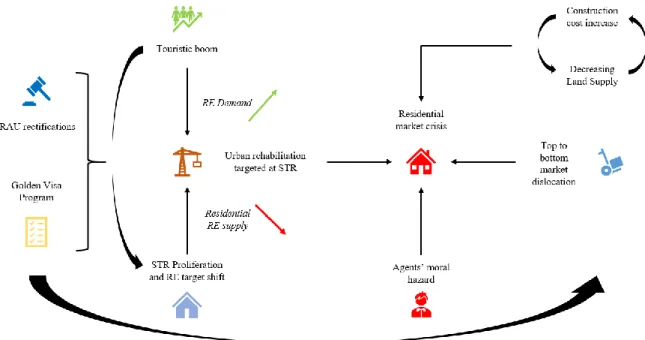
Strategic business repositioning is rational based on evolving market conditions. Notwithstanding this, it exacerbates the already existing housing crisis, causing sluggish adjustment of supply within the lower segments of the market. It is, therefore, possible to edit the framework presented above to account for the impact of increasing costs in construction for the reasons just mentioned:
31
Figure 11: Variables whose interactions originated a residential crisis (Framework 2)
Based on the semi-structured interviews and analytical claims derived from the interviewees, we can plausibly state that there is indeed a pronounced housing crisis in Lisbon. There was broad consensus on this point amongst all the interviewees. However, opinions varied regarding potential solutions to the crisis. There were two central positions: one set of people defended state intervention through stimulating supply and restricting prices. Then some promoted a laissez-faire approach – that the market alone should determine prices and that it is still recovering from years of stagnation and losses. This divergence of opinion was congruent with the respective beliefs regarding whether or not there is a bubble.
In order to propose measures that should be taken, it is vital to identify which demographic segments are most affected. This was the point of the survey. We present the results in the subsequent section. Finally, it is also useful to mention several other unintended consequences that cropped up from the interviews. Even though these points are outside the scope of this dissertation, they are relevant and might provide material for future research.
On the subject of RE price increases, the residential housing market is not the only domain where dislocations are evident. It was pointed out small store owners have experienced substantial squeezes through rent increases while being unable to raise prices to offset increased fixed costs. The reason most articulated was tourism, which brings people with higher purchasing power and an appetite for touristic merchandise, unlike goods catering to the local market.
32
It was also mentioned that any interest rate increase from the ECB might cause an increase in mortgage defaults. Without substantial changes to income levels, higher mortgage costs would further burden total household income. This means that the market is precarious insofar as it is exposed to rising interest rate risk.
Survey Results
Having established that there is a housing crisis in Lisbon and discussed factors which bear upon the housing ecosystem, it is useful to determine the composition of the most vulnerable and affected demographic segments. Understanding this is critical for developing a targeted solution, appropriate to the demographic specificities.
The survey analyses key metrics: levels of rent/mortgage payments, household income, number of relocations, the main reason for relocating, and residential ownership. These variables were selected based on them being significantly mentioned during the interviews and because they are factors generally regarded as meaningful indicators.
During the interviews, six interviewees suggested that the most affected segment potentially is young adults. In this sample, these correspond to the age segment between 23-28 years old. This age group also was bifurcated into two distinct categories of subjects – students, generally enrolled in college-level education, and full-time workers. One consequence is this is there is a large variance in key metrics such as household income and rates of home ownership. Also, students tend to live in shared flats where the number of occupants dilutes the full rent price. Rents for these accommodations are generally higher than for most young-adult households, although monthly per capital outlays are lower (Int. Anonymous 1, 2020).
After preliminary data analysis, another particularity concerning the young adult segment needs to be noted. Young adults who are not in a relationship or do not live with their partner behave similarly to the student sub-segment and tend to live in shared accommodations.
We compared the percentage of full-time workers who do not share housing with their partner (Figure 12, Graph 1) with student observations who pay less than 400€/month (Figure 12, Graph 2). There is an increase in observations who pay less than 400€/month in the student sub-segment, which is congruent with students’ lower monthly household income on average. However, overall Figure 12 clearly shows similarities between both sub-segments.
33
Figure 12: Young Adults Working Full-Time (1) vs Student Young Adults (2)
This distinction is relevant because within-segment disparities such as these skew averages downwards and blur data for future comparisons. Assessing the following age segments ([29-40]; [40-50]; [50-60]), we see that they tend to live with a partner. Therefore, to compare the young-adult segment with older segments, we must point out the observations which are students/live like students, to obtain a representative young-adult segment (for the housing market analysis). This split makes sense because we are focusing on the long-term residential market, while the student sub-segment comprises a short-term segment.
For the subsequent analysis, the young-adult segment encompasses only observations which are living with a partner and working full time, in other words living independently of parental support. The “student” segment was discarded from the analysis and was only added back when appropriate or necessary.
Figure 13: Rent (Graph 1) and Mortgage (Graph 2) Payments vs Age segment average
Figure 13 shows the comparison between rent payments (Graph 1) and mortgage payments (Graph 2) per age segment. The first point that stands out is the fact that every segment, except 50-year olds’, have rents above the average housing price for their age segment (light blue column) in the sample. It preliminarily indicates a rent versus mortgage imbalance, with the
34
market skewed towards higher rents, even though rental outlays of this magnitude grant no ownership, unlike servicing mortgages, nor does paying this amount result in accumulating any equity in the underlying housing asset. It is also apparent that the age segment which faces higher prices is 30-year olds. It’s interesting to notice that young adults are required to pay similar levels of rent as 40-year olds, who will tend to have higher salaries and more stable familial and financial situations.
However, these raw values are not necessary nor sufficient conditions to posit a housing crisis per se without additional referential data points. Therefore, we compared income distributions and the primary reason for relocation for the young adult and 30-year old segments.
Regarding income distribution, 80% of the sample of young adults have a household income below 3000€, with 50% below 2000€. However, 30-year olds presented significant differences with the latter segment, with only 59% earning below 3000€ and 26% below 2000€. Rephrasing this, 40% of the 30-year olds surveyed had a household income above 3000€. Figure 14 illustrates the distributions:
Figure 14: Income distributions of young-adults (Graph 1) vs 30-year olds' (Graph 2)
This income discrepancy is evident when one compares the primary reasons for relocation among both segments. Both segments relocate primarily to move in with their partners (65% for young-adults vs 41% for 30-year olds). However, the second reason is interesting, which was “rent price increased and decided to move” for young-adults (15%) and “housing upgrade” for 30-year olds’ (22%), plainly demonstrating income disparity. While the younger cohort relocated due to price increases, the elder moved to improve housing conditions. This