1Independent geologist consultant. E-mail: [email protected]
2Instituto de Geociências, Universidade de Brasília – UnB, Brasília (DF), Brazil. E-mail: [email protected] 3Independent senior prospector. E-mail: [email protected]
4Independent geophysical consultant. E-mail: [email protected]
*Corresponding author.
Manuscript ID: 20170047. Received on: 04/04/2017. Accepted on: 06/22/2017. ABSTRACT: Magmatism associated with the Alto Paranaíba structural high comprises kimberlites, kamafugites, and alkaline complexes, forming an approximately 400 x 150 km NW‑SE belt in the southern São Francisco Craton. Dating of some intrusions reveals ages between 120 and 75 Ma. Chemical analyses of garnet recovered in alluvium from traditional diamond digging areas indi‑ cate peridotitic garnet windows in Três Ranchos and Coromandel. Six hundred and eighty (680) diamonds acquired or recovered during mineral exploration in the digging areas of Romaria, Estrela do Sul, Três Ranchos and Coromandel show unique characteristics, certain populations indicating young, proximal and primary sources (YPP). Analyses of 201 stones from Santo Antônio do Bonito, Santo Inácio and Douradinho rivers alluvium, Coromandel, present no evidence of transport, characterizing a proximal source. Within these river basins, exposures of the Late Cretaceous Capacete Formation basal conglomerate contain mainly small rounded and/or angular quartzite pebbles and of basic and ultrabasic rocks, as well as kimberlite miner‑ als (garnet, ilmenite, spinel, sometimes diamond). A magnetotelluric proile between the Paraná and Sanfranciscana basins shows that the thick underlying lithosphere in the Coromandel region coincides with the peridotitic garnet window and with a diamond population displaying proximal source characteristics. Diamond‑bearing kim‑ berlite intrusions occur in diferent areas of Alto Paranaíba. KEYWORDS: kimberlite, diamond, conglomerate, mineral chemistry, mineral exploration.
RESUMO: O extenso magmatismo associado ao alto estrutural Alto Pa‑ ranaíba, responsável pela intrusão de kimberlitos, kamafugitos e complexos alcalinos, forma faixa de aproximadamente 400 x 150 km e orientação no‑ roeste‑sudeste na porção sul do Cráton do São Francisco. Datações realizadas em algumas intrusões ao longo da faixa mostram idades entre 120 e 75 Ma. Análises químicas de granada recuperada em amostragem aluvionar na região de Coromandel e adjacências, tradicionalmente produtoras de diamante, mos‑ tram evidências de janelas distintas de granada peridotítica de alto interesse em Três Ranchos e Coromandel. Estudos de 680 diamantes adquiridos ou recuperados durante programas de prospecção nas principais áreas de garimpo em Romaria, Estrela do Sul, Três Ranchos e Coromandel apresentam carac‑ terísticas únicas, distintas entre si, em que determinadas populações indicam procedência de fontes jovens, próximas e primárias (YPP). Especiicamente em Coromandel, análises de 201 pedras provenientes de aluviões dos rios Santo Antônio do Bonito, Santo Inácio e Douradinho não mostram evidências de transporte, caracterizando fonte proximal. Em diferentes pontos das bacias dos rios mencionados, ocorre o conglomerado basal da Formação Capacete, Grupo Mata da Corda, do Cretáceo Superior, contendo principalmente seixos pouco arredondados e/ou angulosos de quartzito e de diferentes tipos de rochas básicas e ultrabásicas. Granada, ilmenita, espinélio e, em casos restritos, diamante são recuperados no conglomerado. Peril magnetotelúrico realizado entre as bacias do Paraná e Sanfranciscana mostra litosfera subjacente espessa na re‑ gião de Coromandel, capaz de preservar diamante, coincidente com a janela de granada peridotítica de alto interesse e com a população de diamante com característica de fonte proximal identiicadas na área. Intrusões de kimberlito diamantífero ocorrem em diferentes pontos do Alto Paranaíba.
PALAVRAS-CHAVE: kimberlito, diamante, conglomerado, química mineral, exploração mineral.
Evidence of young, proximal and primary
(YPP) diamond source occurring in
alluviums in the Santo Antônio do Bonito,
Santo Inácio and Douradinho rivers in
Coromandel region, Minas Gerais
Evidências de fonte jovem, próxima e primária (YPP) do diamante que
ocorre nos aluviões dos rios Santo Antônio do Bonito, Santo Inácio e
Douradinho na região de Coromandel, Minas Gerais
Rogério Silvestre Pereira1, Reinhardt Adolfo Fuck2*,
Osvaldo Soares França3, Anival Antônio Leite4
INTRODUCTION
According to Barbosa (1991), Francisco Machado da Silva found the irst diamond in Brazil in 1714. he stone was recovered in the São Pedro gold mining, in Machado or Pinheiro stream, near the current town of Diamantina. he chronology of the discoveries in other regions of Minas Gerais or the colony is not clear. In many cases, diamonds appeared on the same occasion in diferent places of Minas Gerais or even in other areas of the country. Between 1764 and 1781, diamonds were recovered in the regions of Abaeté and Itacambiruçu Valley, in Grão Mongol. In the nineteenth century, especially between 1830 and 1840, diamond depos‑ its were explored in Chapada Diamantina, Bahia. he region became famous for the production of carbonados, which are porous aggregates of gray or black micro diamonds. he car‑ bonado Sérgio, weighing 3,167 carats, was found in Lençóis in 1895 (Franco 1981; Barbosa 1991). Still in the nineteenth century, deposits were discovered in the Bagagem River, west of Coromandel. It was in the alluvial deposits of this river that the 261.88‑carat South Star diamond was found in 1853, and the 119.5‑carat Dresden diamond was found four years later (Franco 1981; Machado & Figuerôa 1999). Between 1937 and 1943, diamonds over 200 carats were recovered to the east and southeast of Coromandel, more precisely in the allu‑ vial deposits of the Santo Antônio do Bonito, Santo Inácio and Douradinho rivers, including the 726‑carat Presidente Vargas, considered the largest one discovered in Brazil (Fig. 1) (Franco 1981; Barbosa 1991; Machado & Figuerôa 1999).
Most of the diamonds produced in the San Francisco Craton are probably from valley alluvium and terraces asso‑ ciated with the current drainage. Small productions were or are coming from the Mesoproterozoic conglomerates of the Sopa‑Brumadinho Formation, in the Diamantina region, and from the Cretaceous conglomerates in Romaria. In the latter, the contribution of kimberlitic material such as rock fragments, minerals, and diamond is such that the diamond recovery is considered to be characteristic of kimberlite. In the Chapada Diamantina region, the diamonds recov‑ ered in the alluviums are directly associated with the erosion of the diamond‑bearing conglomerates of the Tombador and Morro do Chapéu Formations, similarly to that of the Salobro Formation of the Rio Pardo Group, located about 50 km west of Canavieiras, South Bahia (Pereira 2007).
Although without economic potential, other dia‑ mond‑bearing units in the São Francisco Craton are the Carboniferous Santa Fé Formation (Campos 1992), the Neoproterozoic Jequitaí and Samburá Formations and parts of the Neoproterozoic Ibiá (Gonzaga et al. 1994) and Macaúbas (Karfunkel et al. 2001) groups.
Kimberlite occurs in the northern and southern portions of the São Francisco Craton (Fig. 2) (Pereira 2007). In the northern portion, the intrusions are located in the Serrinha and Gavião blocks. he Braúna 03 kimberlite, classiied as diopside‑phlogopite kimberlite and located in the Braúna province, in the central Serrinha block, has been dated at 682 ± 20 Ma (Rb‑Sr on phlogopite). In the Gavião block, the kimberlites are located near Barra do Mendes, close to the area of inluence of the extensive Barra do Mendes‑João Correa lineament that divides the Chapada Diamantina into east and west structural domains. he Rb‑Sr dating on phlogopite of the Salvador 01 kimberlite provided an age of 1,152 Ma (Williamson & Pereira 1991; Pereira & Fuck 2005). Although sub‑economic, the Salvador 01 kimberlite contains diamond. Recent evaluations of the Braúna 03 kimberlite indicate mine opening in this body (Donatti Filho et al. 2013a, b).
Unlike the Proterozoic kimberlites from the northern portion of the craton with predominant kimberlites over related rocks, the intrusions of the southern portion show Early and Late Cretaceous ages with widely predominant kamafugites over kimberlites.
Chemical analyses of kimberlite minerals recovered from alluvial sampling in the areas afected by Cretaceous magma‑ tism in the southwestern portion of the São Francisco Craton, covering parts of Minas Gerais, São Paulo, and Goiás, allow delimiting peridotitic garnet windows, mainly of G9 lher‑ zolitic‑type, the pressure values of which, at the time of crystal‑ lization, are compatible with those of the diamond formation stability ield, recorded in thick lithosphere. Geochemical data of minerals from the several kimberlite clusters found in the
Figure 2. Diamond, kimberlite and related rocks distribution within the Sanfranciscana plate and São Francisco Craton (Pereira 2007).
10º
15º
20º
10º
15º
20º
50º 45º 40º
50º 45º 40º
Salvador
Distrito Federal
Belo Horizonte
Rio de Janeiro
0 250 500 km
Diamond occurrences
Kimberlite and related rocks intrusions
Paleoproterozoic Sanfranciscana plate limit
São Francisco Craton limit
garnet window outlined in the Coromandel region evidence that the mantle at the time of intrusion presented tempera‑ tures between 960 and 1,200oC and minimum garnet pres‑ sure values between 41 and 50 kbar. Comparison of garnet pressure values with data of clinopyroxene recovered from the kimberlite clusters indicate geothermal gradients of approx‑ imately 37–43 mW/m2 for SCL6 and DDO4 kimberlites (Pereira 2007). he high temperatures recorded in clinopy‑ roxene relect probably local little depleted lherzolitic mantle, suggesting that, aside of Mesozoic mantle fertilization, the possibility of little depleted mantle should also be consid‑ ered in the region. According to Gurney (1984), just 15% of
he objective of this work was to point out and address details observed in the studied region in Minas Gerais, to suggest local/proximal sources for the unique diamond pop‑ ulation found in the alluvial deposits of the Santo Antônio do Bonito, Santo Inácio and Douradinho rivers.
GEOLOGICAL AND
STRUCTURAL SETTING
he evolution of the São Francisco Craton is marked by Paleoproterozoic orogeny, responsible for the amalgam and deformation of diferent Archaean blocks (Barbosa & Sabaté 2002, 2004; Alkmim & Teixeira 2017; Teixeira et al.
2017). he relatively stable geotectonic unit, comprising Paleoproterozoic and Archaean terrains, was partially reworked during the Brasiliano Orogeny in the Neoproterozoic. Polyphasic histories of the terrains are common in the north‑ ern and southern portions of the craton (Pereira 2007).
he crystallization and preservation of diamonds until their capture by kimberlite and/or lamproite require the presence of a thick, relatively cold, refractory, low‑density peridotitic root isolated from heating and tectonic reworking (Haggerty 1986). hese requirements are found in most Archaean terrains little afected by processes such as plumes, volcanism recurrence in extensional regimes, and collisions that destroy the favorable mantle regions under the Archaean‑Paleoproterozoic cratons. he identiication of such terrains is important in the explo‑ ration of diamond‑bearing kimberlite.
Although it is not possible to establish a precise and continuous boundary between the reworked and preserved Archaean terrains in the southern portion of the São Francisco Craton, certain evidence allows to point out the least afected core during the Neoproterozoic Orogeny. his portion of the craton is characterized by the presence of Archaean terrains consisting of partially migmatized orthogneiss and sequences of volcano‑sedimentary rocks developed between 3,200 and 2,700 Ma. Apparently, between 2,160 and 2,000 Ma, the edges of this set of rocks were partially reworked and incor‑ porated in the Mineiro Belt, developed into an arch‑shaped belt around the Archaean core (Alkmim & Marshak 1998) (Fig. 3). Numerous intrusions related to the evolution of the Mineiro Belt aged between 2,200 and 2,000 Ma and occur along the belt. It appears that the reworking inlects northward, under the Bambuí Basin to the Januária region, where the gneiss outcrop is aged 2,710 ± 7 Ma, and non‑de‑ formed granite dated at 2,163 ± 13 Ma (Pereira 2007) is exposed. Paleoproterozoic ages are also recorded further north, in Correntina and São Domingos (Rendon & Kuyunjian 2005). herefore, the data suggest a basement composed of Paleoproterozoic‑Archean terrains in the western portion
of the São Francisco Craton, under the rocks of the Bambuí Basin. he craton boundary to the west corresponds to exten‑ sive thrust faults marking the transition between the fold‑ and thrust belt involving basement and the sub‑horizontal covers inside the craton during the Brasiliano Orogeny in the Neoproterozoic, when the closure of the basins gener‑ ated the marginal Brasília Belt (Dardenne 2000; Fuck et al.
2017). Seer et al. (2001, 2005) stated that the Araxá, Ibiá and Canastra groups, belonging to the southern sector of the Brasília Belt (Fuck 1994; Fuck et al. 2017) represent dis‑ tinct tectonostratigraphic terrains, with no apparent genetic link, originated by tectonic transport of diferent geographic regions. he same authors classiied these groups as tectonic slices formed of three types of terrain:
1. Canastra terrain ‑ fragments of passive continental margin;
2. Ibiá terrain ‑ fragments of a sedimentary portion of the volcanic arc;
3. Araxá terrain ‑ fragments of oceanic crust intruded by collisional granites (Fig. 3).
Apparently, the tectonic sheets formed of these terrains and thrown from west to east against the edge of the cra‑ ton during the Brasiliano compression did not afect the Paleoproterozoic‑Archean basement of the São Francisco Craton, except, perhaps, in the Araxá terrain, where crustal melting took place. his inference is supported by the occur‑ rence of diamond‑bearing intrusions in the region.
he extensive magmatism associated with the develop‑ ment of the Alto Paranaíba structural high occurs along the Brasília Belt, from the Catalão region to the Passos Nappe or the southern end of the Bambuí Basin (Fig. 3) (Pereira 2007).
OBSERVATIONS ON THE
ALTO PARANAÍBA, ASSOCIATED
MAGMATISM, AND DIAMONDS
Figure 3. Distribution of kimberlite-related rock in the southern portion of the São Francisco Craton and Paleoproterozoic Mineiro Mobile Belt (modiied from Pereira 2007).
47°30'
18°30' 18°30'
22°00' 22°00'
44°00'
47°30' 44°00'
Tertiary surface cover or not by unconsolidated sediment and/or laterite
Mata da Corda Formation (Upper Cretaceous): sandstone, tuff and alkaline basaltic lava Areado Formation (Early Cretaceous): sandstone, siltstone, argillite and conglomerate Carbonatite
BRASÍLIA BELT
Araxá Group: micaceous quartzite, mica schist and chlorite schist/amphibolite derived from igneous mafic rock and Neoproterozoic intrusive granite (upper tectonic slice) Ibiá Group: quartzite, phyllite (intermediate tectonic slice) Canastra Group: quartzite, micaceous quartzite, carbonaceous phyllite, chlorite-garnet schist (lower tectonic slice) Espinhaço Supergroup (Meso-Paleoproterozoic)
Minas Supergroup (Paleoproterozoic) Granite (Paleoproterozoic)
Greenstone Belt (Archean partially reworked in the Proterozoic orogenies)
Basement: gneiss-migmatite, granite and granulite (Archean partially reworked in the Paleoproterozoic) Paraná Basin
Bambuí Basin
Reseting during the Brasiliano cycle
Normal fault
Modified from Pereira 1991
Transcurrent fault Thrust fault
Craton border (Alkimin et al. 1993) Limit on the Paleoproterozoic plate Mineiro mobile belt
Circular feature identified in TM image Kimberlite/related rock
Garnet pressure increase
0 10 20 30 40km
he magmatism responsible for the occurrences of kim‑ berlites, kamafugites and alkaline complexes, known as the Alto Paranaíba Igneous Province (Gibson et al. 1995), cov‑ ers an approximate 400 x 150 km northwest‑southeast ori‑ ented band, in the southwest portion of the São Francisco Craton, where kamafugites largely predominate over kim‑ berlites and alkaline complexes.
he quality of the lithospheric mantle in a given region can be monitored by analyzing the recovered minerals in the diferent volcanic pulses associated with the development of the system (O’Reilly & Griin 1996). In the Alto Paranaíba region, the contrasting quality of the mantle sampled by kimberlite, aged between 120 and 90 Ma, compared to the Late Cretaceous kamafugites, aged between 85 and 75 Ma, indicates heating and thinning of the lithosphere in the area afected by the structural high. Pressure‑temperature (P‑T) results obtained on kimberlite‑extracted clinopyroxene recov‑ ered at the headwaters of the Abaeté, São Bento, and Indaiá rivers, near Carmo do Paranaíba and Lagoa Formosa, and in the Coromandel region, indicate sampling in mantle regions between 700 and 950°C, while kamafugite‑source clinopy‑ roxene shows temperatures of 800 and 1,200°C, substantially warmer than that recorded by recovered kimberlite‑clinopy‑ roxene. herefore, in the approximate 5 Ma range, between
90 and 85 Ma, about 250°C heating is observed in these regions (Read et al. 2003) (Figs. 4 and 5). hus, comparisons of the mantle conditions obtained in successive kimberlite generations allow monitoring the evolution of the lithosphere and the diamond potential of a certain region (O’Reilly & Griin 1996). According to Helmstaedt and Gurney (1994), information on lithospheric mantle conditions is also obtained by diamond abundance, garnet with high Cr2O3 and low CaO, and high Cr spinel (Cr> 60% wt%) recovered in the intrusions. As mentioned before, local little depleted lherzolitic mantle in the region should not be discarded. he presence of such a mantle would explain the abundant dissemination of lherzolitic garnet in the Coromandel area.
mantle quality varies visibly as intrusions are placed more and more in the center of the preserved core. For example, analyses of Junco 01 kimberlite from Junco Province, aged 82 ± 5 Ma (U‑Pb in zircon), show 5% spinel of high inter‑ est, 0.5% of subcalcic garnet and is negative for diamond, while the Maravilhas 03 kimberlite from the Maravilhas Province, aged 81 ± 2 Ma (Ar‑Ar in garnet), indicates 30% spinel with high chromium, 6.3% of subcalcic garnet and a diamond content of 13.48 ct/100 t (Pereira 2007).
Mineral exploration programs in the Alto Paranaíba region identiied primary sources of diamond‑bearing alluvium, explored for years as digging areas. his fact is veriied, for example, in the Vargem Bonita diggings in the high course of the São Francisco River, where alluvial sampling in the riverbed and diferent terraces along the diggings provided kimberlite minerals showing practically no signs of transport,
and diamond with proximal source characteristics. Batches of diamonds recovered from alluvium and terraces along the diggings in material that originated from the Canastra 01 kimberlite, located near the upstream Cachoeirinha stream tributary, show octahedron and dodecahedron‑shaped crystallization and stone corrosion characteristics common to the two environments (Pereira 2007). he digging areas of Vargem Bonita stretch for about 35 km along the São Francisco River, starting from the Casca D’Antas waterfall. It is estimated that 500,000 carats were produced between the 1930s and ~2000. Preliminary data indicate an intrusion area of 1.9 hectares, while signiicant grades are restricted to 0.9 hectare. Evaluations indicated about 40 cts/100 t valued at US$ 150/ct. Systematic alluvial sampling per‑ formed in every kilometer of the valley and in the tributar‑ ies of both banks of the São Francisco River shows no new
Figure 4. Kimberlites in the headwaters of the São Bento, Abaeté and Indaiá rivers. Contour lines represent post-Gondwana or before Mata da Corda Formation deposition paleo relief (Pereira 2007).
Planed surface covered or not by unconsolidated sediments and/or laterite, alluvium.
Mata da Corda Formation: sandstone,
conglomerate, alkaline basalt lava, tuff.
Areado Formation: sandstone, siltite, shale, claystone, conglomerate.
Bambuí Group: limestone, slate, siltite, quartzite.
Ibiá Group: quartzite, phyllite.
Canastra Group: quartzite, mica quartzite, carbonaceous phyllite, garnet-chlorite schist.
Kimberlite and related rocks intrusions
Thrust fault
Diggings
Paleo relief contour lines (25 m interval)
Paleo drainage flow direction
only source of the diamond in the Vargem Bonita digging (Figs. 6 and 7) (Pereira & Neves 1996; Pereira 2007).
As in the case of Vargem Bonita, diamond batches recov‑ ered from the São Miguel River show that colored octahedral and dodecahedral‑shaped diamonds, without transport signs, are dominant. A terrestrial magnetometry survey with a 25 x 10 m grid detected the Três Ranchos kimberlites (TRS) 101, 102, 104 near the diggings and about 20 km northeast of the Três Ranchos 04 kimberlite (Fig. 8). A 14 m3 sample from the TRS 101 intrusion yielded 31 diamonds with 0.031‑carat aver‑ age weight, while a 9 m3 sample from the TRS 102 intrusion
Figure 5. Pressure and temperature calculation of 517 garnet grains from the X-270, Regis, Vargem and Santa Rosa 04 kimberlites (modiied ater Read et al. 2003). Graphite and diamond ields are shown.
650 750 850 950 1050 1150 1250 1350
Temperature (°C)
Pressure (kbar)
25
30
35
40
45
50
55
60
Graphite
Diamond
40 mW/m2
Figure 6. Alluvium sampling in digging areas and along São Francisco River tributaries and from the Canastra 01 (CAN 01) kimberlite, primary and single diamond source (modiied from Pereira 2007).
46°30'
46°30' Thrust fault Strike-slip fault Sampling site
Diamond-bearing kimberlite Cartographic sheet
Valley River terrace
Digging area (dig. 1, 2 ...) Drainage
0 1 2 3
N Map
location
km
populations of kimberlite minerals or diamond, indicating that the Canastra 01 kimberlite constitutes the primary and
12 11 10 9 8 7 6 5 4 3 2 1 0 0 2 4 6 8 10 12 14 16 18 20
n = 8164
Pminhi = 50,6 kbar
CaO
Cr2 O3
provided 49 stones with 0.037‑carat average weight. he dia‑ monds recovered from kimberlite are dominantly dodecahedral and octahedral colored stones, very similar to those recovered in the digging. Cubic diamonds represent 10% of the popu‑ lation recovered in TRS 101, and 4% in TRS 102 intrusions. hese kimberlites are considered the primary sources of the diamond diggings in the São Miguel River (Skinner 1996) and are, currently, being economically evaluated.
he diamond‑bearing Três Ranchos 04 kimberlite (Fig. 8), aged 95 Ma, consists of a small intrusion, considered as one of the oldest discoveries in the region. Processing of 296 m3 of rock material provided 371 diamonds. About 50% of the stones are described as gray and black in color and 30% as lighter‑colored cubes, typical samples of mantle regions at the limit of the diamond stability ield, around 44 kb pressure and about 1,000°C temperature. Analyses of recovered garnets indicate pressure values of at least 51 kbar (Pereira 2007).
In 1868, a diamond discovery on the banks of a small aluent stream of the Bagagem River gave origin to the mine and the village known as Água Suja, currently, the town of
Romaria. he discovery site and the small stream are pres‑ ently within the Romaria urban site (Fig. 3).
Svisero et al. (1981) and Fleischer (1998) described the geological features in the area around the mine. he authors refer that diamonds occur in a polymictic conglomer‑ ate containing blocks up to 80 cm in diameter and little rounded pebbles of micaschist, phyllite, quartzite, metaba‑ site, Botucatu sandstone and basalt. Locally, the Tauá con‑ glomerate is deposited on the aeolian Botucatu sandstone, which, in turn, covers discordantly the underlying Araxá Group micaschists and intrusive granites that serve as base‑ ment in the area (Fig. 9). he Tauá conglomerate is cov‑ ered by another polymictic conglomerate called Secondina, which contains less diamond, smaller pebbles and has max‑ imum thickness of 3 m, and which is probably the result of erosion of the Tauá conglomerate and subsequent deposi‑ tion. he conglomerates are covered with a homogeneous succession composed of ine‑ and coarse‑grained greenish sandstones, associated in this region of Minas Gerais with Late Cretaceous volcanic activity. Finally, the entire area is
18º12'58"
18º22'52" 18º22'52"
18º12'58"
47º50'27" 47º36'59"
47º50'27" 47º36'59"
Kimberlite
Diamond-bearing kimberlite N
0 6 12 km
covered with unconsolidated Tertiary material formed of laterite, sandstone pebbles, laterized conglomerate blocks and clays (Pereira 2007).
Exposure of the working front of the Água Suja mine allowed Draper (1911), who already knew kimberlites in South Africa, to describe the geological units in detail. he good local exposure shows that the basal portion is composed of micaschist containing staurolite, garnet, rutile, tourmaline, cut in all directions by pegmatite veins and intrusions of maic rock metamorphosed to amphibolite. According to Draper (1911), the conglomerate or breccia, with a maxi‑ mum thickness of 13 m, rests discordantly on the basement and local intrusions, as well as on the sandstone. he unit is formed of angular or little‑rounded fragments of basic igne‑ ous rock, granite, quartz, shale, and sandstone, cemented by red clay. Layers and masses of opal are observed in the con‑ glomerate. Diamond, pyrope, perovskite, magnetite, ilmen‑ ite, and olivine occur in the clayey material that cement the fragments. According to the author, the conglomerate layer or breccia, as well as the minerals present, is of local origin.
Currently, the GAR Mineração company investigates the area of the former Água Suja mine. With the geologist and company director, Juliano Magalhães Macedo, we examined drill core samples and visited work fronts, where material is extracted for processing and diamond recovery. he high contribution of kimberlite fragments is noted in the material and, according to Juliano Macedo, thin layers, which are char‑ acteristic structures of epiclastic kimberlite, are observed in certain work fronts. he drill core samples represent a typical breccia in which kimberlite fragments examined under mag‑ nifying glass show abundant ilmenite and/or spinel (Fig. 10). Based on the treatment plant recovery, Svisero and Meyer (1989) reported that the diamond content in the con‑ glomerate ranged between 0.04 and 0.12 ct/m3. A studied
batch of 5,317 stones weighed 450 carats, corresponding to 0.084‑carat average weight. he dominant shape is rhom‑ bododecahedron, followed by cube, octahedron and octa‑ hedron‑rhombododecahedron combination. In Romaria, De Beers purchased a batch of 39 diamonds that weighed 3,508 carats, a 0.09‑carat average weight. he diamonds were dominantly rounded dodecahedron and octahedron, while cube‑shaped stones were between 10 and 15% (Robinson 1991; Robinson et al. 1995). According to the authors, the batch can be described as a mixture composed of cubic and dodecahedral stones of gray color, similar to the population from Três Ranchos 04 kimberlite and a distinct population, comprising mainly rounded dodecahedra. Abrasion is not evident, which could suggest either distal sources of dia‑ monds transported under low energy systems (Robinson 1991) or, as indicated by other evidence, a YPP source of diamonds. Systematic sampling and concentrates analyzed in Romaria digging areas indicated garnet with pressure val‑ ues of about 48 kbar and spinel grains typical of inclusions in diamonds (Fig. 11) (Pereira 2007).
he identiication of diamond‑bearing kimberlite in dif‑ ferent areas of Alto Paranaíba makes it clear that kimber‑ lite intrusions, especially of the Early Cretaceous, sampled mantle regions favorable to the crystallization and preser‑ vation of diamond.
he Três Ranchos 04, Três Ranchos 101, 102, 104 kim‑ berlites and the primary source of Água Suja diamond in Romaria, responsible for the cubic diamond populations in the region, intruded into the Araxá Group terrain, where Neoproterozoic intrusions of collisional granites indicate crustal melting. his fact may be an indication that the Paleoproterozoic‑Archaean lithosphere has undergone some alteration at the western edge of the São Francisco Craton, favoring crystallization of cubic diamond (Pereira 2007).
Figure 9. Diamond-bearing conglomerate overlying Botucatu sandstone in the old Água Suja digging, Romaria. Note down-thrown block to the let along a normal fault; such structures are commonly observed in the Alto Paranaíba high (Coelho et al. 2010).
Laterite cover
Diamond-bearing conglomerate
Botucatu sandstone Faulted
to the let
Figure 10. Exploitation of diamond-bearing conglomerate near Romaria. Evaluation of conglomerate and epiclastic kimberlite by GAR Mineração.
BASAL CONGLOMERATE
OF CAPACETE FORMATION,
MATA DA CORDA GROUP
As mentioned above, the development of Alto Paranaíba structural high in the Mesozoic was responsible for magmatic events, comprising kimberlites, kamafugites, carbonatites and related rocks, which constitute hundreds of individual intrusions along an approximately 400‑km‑long north‑ west‑southeast trending belt. he sedimentary‑magmatic sequence occurring along the Brasília Belt and the edges of the Paraná and Sanfranciscana basins is, to some extent, limited by the development of the extensional regime, where horst and graben are characteristic structures in the evolu‑ tion of linear structural highs.
he basal conglomerate of the Capacete Formation (Sgarbi
et al. 2001), or Tauá as it is known in Romaria, is widespread in the Alto Paranaíba. he deposition occurred on a rug‑ ged relief, where paleo channels and lowered blocks along normal faults are recorded in the Araxá Group micaschist and/ or in the Botucatu sandstone that discordantly cov‑ ers the Proterozoic rocks of this group in Romaria (Fig. 9).
Exposures along the work fronts during diamond explo‑ ration in the old Água Suja mine allowed Draper (1911) and Svisero et al. (1981) to observe rocks and their contact relationships in loco. hus, Draper (1911) concluded that the conglomerate or breccia layer, and the minerals present
are of local origin. he author enumerates some facts for this assertion:
■ he Tauá conglomerate, local name for the conglomer‑ ate, is composed of rocks found in situ, underlying por‑ tions of the conglomerate layer itself.
■ Fragments of the rocks that make up the conglomerate are angular, indicating little transport.
■ Occurrence of conglomerate blocks within the Botucatu sandstone, whose deposition extended from the Triassic‑Jurassic to the beginning of the Cretaceous, showing the contemporaneity of the two units in the inal deposition phase of the Botucatu sandstone.
■ he deep weathering observed in every Tauá layer can‑ not be attributed to the iniltration of surface water. Besides the intense decomposition of the layer, the igne‑ ous rocks of the local basement are also totally altered.
he age of the intrusion could not be determined because the kimberlite conduit was not found; however, intrusions in the local stratigraphy indicate an Early Cretaceous age for the hidden body.
On eastern Alto Paranaíba, the western border of the Sanfranciscana Basin, the crater facies of the X‑270 kim‑ berlite, dated at 89.5 ± 3.4 Ma, shows sandstone clasts, and quartz and feldspar grains, conirming the presence of semi‑consolidated sediments from the Early Cretaceous Areado Group (Fig. 4) (Read et al. 2003).
Figure 11. Analyses of heavy mineral concentrates recovered from conglomerates and digging areas in Romaria: (A) garnet, (B) spinel (Pereira 2007). Higher Cr2O3 concentrations in garnet correspond to equilibrium conditions in greater depths within the lithosphere mantle and consequently higher pressures.
12 11 10 9 8 7 6 5 4 3 2 1 0
CaO 20 A
18
16
14
12
10
8
6
4
2
0
Cr2 O3
n = 1,207
Pminhi = 47,8 kbar
0 1 2 3 4 5 6 7 8 9 10 11 12 13 14 15 B
TiO2
75
70
65
60
55
50
45
40
35
30
25
Cr2 O3
he basal conglomerate of the Capacete Formation is exposed in several parts of the structural high, with thick‑ ness varying between 15 and 20 m (Fernandes et al. 2014). In Romaria, the maximum thickness is 13 m, consisting of boulders and angular pebbles of micaschist, phyllite, quartz‑ ite, metabasite, granite and Botucatu sandstone, cemented by clayey material containing diamond, garnet, perovskite, mag‑ netite, ilmenite and olivine (Draper 1911; Svisero et al. 1981; Fleischer 1998). he larger or smaller presence of quartzite, sandstone and siltstone pebbles and other Proterozoic rocks vary according to the bedrock or rocks of the Araxá, Ibiá and Canastra groups underlying the conglomerate. Angular peb‑ bles and/or fragments of volcanic rocks, as well as kimberlite minerals, bordered by alteration or with a keliphitic corona, characteristic of little transport, are frequently found in out‑ crops close to intrusions inferred beneath the conglomerate. he old digging known as Canastrel, between the Santo Antônio do Bonito and Santo Inácio rivers, was developed directly on the conglomerate. he exposed outcrop shows at least a 3‑m‑thick alternation between tuf and conglomerate mate‑ rial. In some cases, the conglomerate grades to coarse‑grained, commonly cross‑laminated sandstone. Clasts of volcanic and Proterozoic rocks, about 20 cm in diameter, are present in the conglomerate layer. As in other outcrops, the top of the suc‑ cession is covered by thick lateritic material. he brown matrix of the conglomerate bears altered feldspar and phlogopite (Karfunkel et al. 2014). Garnet and ilmenite mantled above 50% by alteration material are recovered in the soil along the outcrop, meaning practically no transport. he clasts observed in the conglomerate diggings and in other exposures in the region do not show any sorting as to pebble size increase from the top to the base next to the bedrock (Fig. 12). According to Karfunkel et al. (2014), the last owner recovered 3 stones in the digging, weighing about 2 carats. Analyses of two of the
stones indicated white and yellow colored, gem‑type diamonds weighing 0.750 and 0.497 carats, respectively, and possibly dodecahedral (Karfunkel et al. 2014). As for surface features associated with transport, the authors reported absence of per‑ cussion marks and severe breakage, relecting completely difer‑ ent transport and deposition histories from what is observed, for example, in Diamantina diamonds (Karfunkel et al. 2014). Although analyses of only two stones do not represent statistical data, the results are very similar to those obtained by Robinson
et al. (1995) on 201 diamonds from alluvium of the Santo Antônio do Bonito, Santo Inácio and Douradinho rivers. Also, kimberlite ilmenite and garnet with keliphitic coronae or with almost intact alteration mantles were recovered in the Canastrel digging, indicating absence of transport (Karfunkel et al. 2014).
DIAMOND-BEARING ALLUVIUM
Recovery of diamond with other kimberlite minerals in alluvium does not imply in common primary source. As a rather robust mineral, diamonds resist to transport over large distances, being incorporated into sediments carried along diferent drainages by capture processes and, therefore, in the majority of cases, without any genetic link with the other kim‑ berlite minerals present in the deposit. However, the agreement between certain localities of diamond and kimberlite occur‑ rences in the San Francisco Craton is not random (Fig. 13).
Figure 12. Detail of basal conglomerate of the basal Capacete Formation in the Canastrel digging. Note the lack of pebble sorting from top to base.
07/25/2016
Salvador
DF
BH
0 250 500 km
Diamond Fragile – proximal Non-abraded – non-distal Intrusions Paleoproterozoic continental plate limit
São Francisco Craton limit
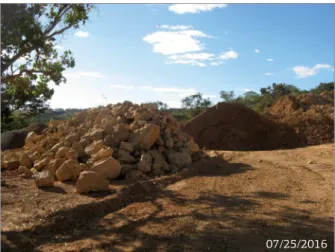
Detailed studies on diamond origin, alluvial deposits and analyses of thousands of kimberlite minerals show that diamonds contained in Cenozoic deposits in certain areas of the southern portion of the craton originate directly from identiied primary sources. he diamonds contained in the Cretaceous Tauá conglomerates in Romaria and in the basal conglomerate of the Capacete Formation, in other areas of the Santo Antônio do Bonito, Santo Inácio and Douradinho river basins, are considered as originating directly from local primary sources, which were not properly located up to now (Pereira 2007).
As emphasized above, diamond‑bearing kimberlites, especially those aged between 120 and 90 Ma, occur in diferent points of Alto Paranaíba, some of them constitut‑ ing the primary sources of diamonds recovered in alluvial deposits associated with the current drainage and exploited as digging areas.
he peridotitic garnet window of high interest inferred in exploration of diamond‑bearing kimberlite corresponds to kimberlite clusters located in the Coromandel region, some of which hidden beneath the conglomerate (Pereira 2007).
he main sources of alluvial diamond deposits in the drain‑ age to the south and southeast of Coromandel, especially in the Santo Antônio do Bonito, Santo Inácio and Douradinho rivers, are the basal conglomerates of the Capacete Formation and rocks of the Araxá, Ibiá and Canastra groups, which serve as bedrock for the conglomerates (Fernandes et al. 2014; Karfunkel et al. 2014). Also, kimberlites of diferent ages, kamafugites and related rocks contributed to the formation of the alluvium associated to the current drainage. In certain diggings, it is possible to recognize fragments or pebbles of kimberlites with marked characteristics. For example, in the diggings of the Vendome Mines company, the small mounds of pebbles and fragments of extremely siliciied kimberlite observed in the yard of the treatment plant, or “osso de boi” (“ox bone”) as called by the diggers, come from the erosion of an extensive strip of siliciied kimberlite, consisting of dikes and blows, that extends for more than 10 km along the roughly north‑south right bank of the Santo Antônio do Bonito River (Figs. 14 and 15). Currently, digging activities in the region are restricted to the river terraces, as it is for‑ bidden to throw tailings in the active bed of the drainage. Among the rivers and tributary streams carrying the same diamond population in the region, the Santo Antônio do Bonito, Santo Inácio and Douradinho rivers are the most important ones. he largest diamonds in the country were found in this area (Fig. 16). he average value of the stones from Coromandel ranges from US$ 200.00 to US$ 300.00/ ct (Pereira 2007).
he batch of 201 diamonds studied shows a unique char‑ acteristic, totally diferent not only from the stones from the
southern portion of the São Francisco Craton but also from other regions in Brazil. Typically, the stones are brown, occa‑ sionally yellow or gray, and usually distorted. he rounded dodecahedron shape is the most common one, with no rem‑ nants of octahedral and cubic faces. Finely spaced lamination lines and zig‑zag patterns are quite common. About 90% of the diamonds do not show evidence of transport, a fact that, added to the 12 stones with fragile shapes or twinning, suggests proximal and primary source. he provenance study of this batch emphasizes that no peculiar diferences were detected in any of the streams that indicated individual pop‑ ulations. In addition, inclusion of silicates or olivine and garnet are rare, while sulide was found only in two stones (Robinson et al. 1995; Pereira 2007).
he peridotitic garnet window of high interest inferred in exploration of diamond‑bearing kimberlite and alluvium is corroborated by the magnetotelluric proile surveyed between the Paraná and Sanfranciscana basins (Bologna et al. 2006).
Figure 14. Kimberlite outcrop at the beginning of the more than 10 km long, grossly north-south siliciied belt along the Santo Antônio do Bonito River right bank.
07/25/2016
Figure 15. Fragments and blocks of siliciied kimberlite at Vendome Mines processing plant.
he proile extends for 180 km in the WSW‑ESE direc‑ tion, and crosses the igneous rocks associated with the Alto Paranaíba high close to Coromandel. In this region, the data show the underlying lithosphere with a thickness of about
150 km (Bologna et al. 2006), coinciding with the peridot‑ itic garnet windows and with the unique diamond popu‑ lation bearing proximal and primary source characteristics (Fig. 17). As it is known, the diamond stability ield in the
Tertiary surface cover or not by unconsolidated sediment and/or laterite.
Mata da Corda Formation Brasília Belt
Araxá Group: mica-schist, quartzite/ amphibolite, granite (upper tectonic slice) Ibiá Group: quartzite, phyllite
(intermediate tectonic slice) Canastra Group: quartzite, phyllite, carbonaceous phyllite (lower tectonic slice)
Bambuí Basin
Drainage and digging areas; size of diamond recovered Kimberlite/related rock
0 - 4 ha 4 - 10 ha 10 - 50 ha 50 - 100 ha > 100 ha
Paleodrainage
Paleosurface contour pre-deposition of the Mata da Corda Formation (Walkings 1974)
Thrust fault
0 2,5 5 7,5 10 km
A
18°30' 18°30'
47°00' 47°00'
B C
0 17,5 km
Diggings along the drainage
Listric or normal fault
Figure 17. Long period magnetotelluric sounding available in a 180 km long WSW-ENE proile across the magmatism associated to the Alto Paranaíba structural high (Bologna et al. 2006); (A) geological map of the region and location of the proile; (B) Três Ranchos-Coromandel garnet windows and localities of distinct diamond population with characteristics of unique young, proximal and primary diamond source (Pereira 2007); (C) occurrence of thick lithosphere (depths larger than 150 km) bellow the garnet window of high interest and localities of unique young primary proximal diamond source in the terrain surface (modiied from Bologna et al. 2006).
48°00'
18°00'
18°30'
19°00'
47°30' 47°00' 46°30'
Tertiary surface cover or not by unconsolidated sediment and/or laterite.
Mata da Corda Formation (Upper
Cretaceous): sandstone, tuff and
alkaline basaltic lava
Carbonatite Complexes
Areado Formation (Early Cretaceous): sandstone, siltstone, argillite and conglomerate
Paraná Basin
Bambuí Basin
BRASÍLIA BELT
Araxá Group: micaceous quartzite, mica-schist and chlorite schist/amphibolite derived from
igneous mafic rock and Neoproterozoic
intrusive granite (upper skin tectonic)
Ibiá Group: quartzite, phyllite (intermediate tectonic slice)
Canastra Group: quartzite, micaceous quartzite, carbonaceous phyllite, chlorite-garnet schist (lower skin tectonic)
Fault
Transcurrent fault Thrust fault Craton border Circular feature
identified in TM image
Kimberlite/related rock
Dike
Long-period magnetolluric sounding
a long WSW-WNW profile
Full MT sites (joint wide-band and long period)
0 10 km
A
48°00'
18°00'
18°30'
19°00
'
18°00'
18°30'
47°30' 47°00' 46°30'
48°00' 47°30' 47°00' 46°30'
Unique young, primary and proximal (YPP) diamond source Garnet windows areas of Três Ranchos and Coromandel
Digging Diamondiferous kimberlite Long-period magnetolluric sounding along WSW-ENE profile Full MT sites (joint wide-band and long period)
B
Distance (km) 100 150 50
0
Mata da Corda Formation
Paraná Basin Brasília Belt São Francisco Craton 78 79 81 74 82 72 76 85 84
ohm-m 5
4
3
2
1
0 Log[ρ] 50
0
100
150
200
WSW ENE
Depth (km)
Archaean lithosphere base shows temperature and pressure ranging approximately between 900 and 1,200°C and 45 to 65 kb, corresponding to depths between 150 and 300 km (Boyd et al. 1985; Haggerty 1986). Despite of the reduced area or extent of thick lithosphere, its presence is important because it indicates that the Archaean‑Paleoproterozoic ter‑ rain of the western border of the São Francisco Craton was characterized by thick lithosphere, capable of crystallizing and preserving diamond.
DISCUSSION
Probably from the Pleistocene to the Holocene, the large lat plateau area observed in the southwestern por‑ tion of the São Francisco Craton that developed during Tertiary peneplanation in Brazil and South America started to undergo erosive processes. In this area, remains of the old surface showing the lateritic cover that character‑ izes the top of the erosion surface can be seen. In some cases, the incision of the current drainage reaches the rocks of the Araxá, Ibiá and Canastra groups. he basal conglomerate of Capacete Formation, in a frank erosion process, is the main source of the diamond‑bearing allu‑ vium of the Santo Antônio do Bonito, Santo Inácio and Douradinho rivers. However, rocks of diferent ages from the magmatism associated with Alto Paranaíba also con‑ tributed to the formation of alluvium. Observations of the diamond‑bearing alluvium indicate only one high terrace level. Apparently, the region underwent little movement or block accommodation after the Tertiary, unlike, for example, the Serra da Canastra region, where the areas upstream of the Vargem Bonita digging, on the São Francisco River, show three distinct terrace levels. he pebble distribution in the alluvium is less chaotic, indicating currents with greater capacity to concentrate the dispersed diamond in the basal conglomerate of the Capacete Formation, considered as the secondary source of the diamond recovered to the south and southeast of Coromandel (Figs. 18 and 19). Despite all indications of source or local primary sources for the diamonds con‑ tained in the conglomerate and concentrated in alluviums, such sources have not yet been located.
Certain factors, or the conjunction of factors, may hin‑ der the location of certain intrusions in the region, espe‑ cially of the potentially diamond‑bearing Early Cretaceous kimberlites. he aeromagnetic survey conducted in the Coromandel region was considered a great success in terms of responses associated with intrusions. housands of anomalies compatible with kimberlite intrusions were selected and hundreds were positive in ield follow‑up,
especially of kamafugites and related rocks intruded in the Late Cretaceous. The Mata da Corda volcanism is extremely magnetic and capable of masking any under‑ lying individual anomaly. For example, analysis of drill core samples from 56 selected anomalies, including the Omega 22 intrusion at the top of the Chapadão, the com‑ mon source area of the Santo Antônio do Bonito, Santo
Figure 19. Erratic pebble distribution in the basal Capacete Formation conglomerate.
07/25/2016 Figure 18. Diamond-bearing alluvial deposit within AMEEX Mineração area, belonging to Mr. Milton Soares França. Note pebble sorting from top to base next to the bedrock.
Inácio and Douradinho rivers, were classiied as related to Late Cretaceous intrusions without potential for diamond. Another factor associated with the high magnetism of Mata da Corda volcanism that could also mask older intrusions would be the emplacement of intrusions in graben zones, where tens of meters of the conglomerate are covered by the volcanic rocks of the Late Cretaceous Mata da Corda Group, and in some cases by Tertiary deposits, resulting in a quite thick coverage over potentially diamond‑bearing intrusions. Finally, a rarer, but not uncommon case, would be either little or non‑magnetic kimberlite emplaced in the described situations (Fig. 20).
At the time of the systematic exploration conducted in the region, a gravimetric survey was considered, however the high cost of gravimetry associated with the size of the area made the project unfeasible.
Some studies should be carried out as an attempt to reduce the area for an eventual gravimetric survey in the southern and southeastern regions of Coromandel, as follows:
1. Surveying all occurrences or outcrops of the basal con‑ glomerate of the Capacete Formation.
2. Analyzing the frequency of angular fragments or peb‑ bles of volcanic rocks, especially kimberlites, and the nature of the more or less sandy or clayey matrix of the outcrops.
3. Collecting at least 500 L of the material, with special care to avoid contamination.
4. Recovering the heavy minerals up to the panning level. 5. Analyzing specially garnet and spinel, and, in the case
of diamond recovery, performing provenance studies.
he set of results could indicate more accurately the proximity to possible primary diamond sources, helping to deine the most appropriate area for the gravimetric survey, or even for drilling, following a convenient grid of bore‑ hole distribution if the reduced surveying area is compati‑ ble with the cost.
CONCLUSION
Geological knowledge is cumulative and continually updated through research and collection of information inserted in a given context of paradigms.
In 1968, SOPEMI – Pesquisa e Exploração de Minérios S.A,, a joint venture between France’s BRGM (Bureau de Recherches Géologiques et Minières) and CAEMI (Antunes Group), discovered the irst kimberlite in the Santo Inácio River, in the São Francisco Craton. In 1974, after the BRGM departure, the De Beers Group, which had joined SOPEMI, took control of the company. Since then, De Beers and other companies invested continuously for more than two decades in diamond prospecting in Brazil and other coun‑ tries in South America, discovering hundreds of kimberlites and related rocks.
he main research focus was the São Francisco Craton, covering the digging areas in the regions of Lençóis, Andaraí, Mucugê in the Chapada Diamantina, in the northern por‑ tion of the craton, but intensive work was also conducted in the traditionally producing areas of southwest Minas Gerais, in the southern portion of the craton.
Among the most used techniques worldwide to explore kimberlite and lamproite are the sampling and recovery of heavy minerals such as garnet, spinel, diopside and ilmen‑ ite, followed by aerial or terrestrial geophysics and remote sensing. he combined data obtained using these techniques become important when searching for favorable targets of kimberlite intrusion. he data include petrology, mineral‑ ogy, geochemistry, geochronology, geophysics, remote sens‑ ing, and, if possible, additional ield work, such as grain size and soil color variations, speciic local anomalies of certain vegetation species and minerals identiied in the waste of anthills or termite mounds.
In the region of Alto Paranaíba, an aeromagnetic sur‑ vey was extremely efective, allowing the direct detection of hundreds of kimberlites and/or related rocks. he cov‑ erage of the Coromandel area, with 8,520 km2, in three stages, allowed selecting 1,184 anomalies, which were
Tertiary deposit
Mata da Corda Formation (Late Cretaceous) Kimberlite/related rock (Late Cretaceous)
Capacete Formation basal conglomerate Diamond-bearing kimberlite (120-90 Ma) Canastra Group Basement Figure out of scale
Chapadão (1,100 meters) 900 – 1,000 meters
classified as grade 1, 2 and 3. Among the 986 tested, 435 intrusions (44%) were proven, of which 120 (27.6%) correspond to already known kimberlites/related rocks (Skinner 1996; Pereira 2007). To reach these results, a lot of work had to be done to deine the anomalies only in this area. Approximately 15,600 km/line, with 50 x 25 m intervals between the lines and stations and 100 x 50 m in the terres‑ trial magnetometry survey, covered the 986 anomalies, clas‑ sifying them as good (485), medium (211) and poor (290). Approximately 33,594 samples were collected, including 22,161 soil, 7,750 alluvium, 3,080 drill cores, and 603 rock samples (Skinner 1996; Pereira 2007).
he São Francisco Craton exploration yielded two import‑ ant results; it identiied a thick lithosphere capable of crys‑ tallizing and preserving diamond in the northern portion, and located diamond‑bearing kimberlites in the southern portion of the craton.
he kimberlites of the Braúna Province, in the north portion of the craton, located in the Archean core of the central portion of the Serrinha Block, are diamondiferous (Pereira & Fuck 2005; Pereira 2007; Donatti et al. 2013a, b). he Salvador 01 kimberlite was also identiied in Chapada Diamantina, Gavião Block, whose outcrops show low‑grade metamorphism, hypabissal facies and phlogopite Rb‑Sr age of 1,152 Ma. he kimberlite was considered at the time as sin deposition of the diamond‑bearing conglomerate of the Tombador Formation. Subsequently, aeromagnetic survey in the region indicated anomalies northwest of Salvador 01 (SVR 01). Drilling detected kimberlitic rocks at 246 and 159 m in two anomalies. Drill cores show crater facies rocks, metamorphosed and placed at the base of the Morro do Chapéu Formation quartzites, therefore intrusive in the rocks that constitute the underlying Tombador and Caboclo formations. he indings indicate a time of intru‑ sions younger than the primary sources that provided dia‑ monds to the known diamondiferous Tombador Formation conglomerates (Pereira 2007).
In the south portion of the craton, the De Beers min‑ eral exploration indicated the location of diamond‑bear‑ ing kimberlites, constituting, in some cases, the primary source of the diamonds extracted from the bed alluvium and terraces of certain streams. In addition to the identii‑ cation of diamond‑bearing kimberlites in Alto Paranaíba, exploration also identiied the conglomerate containing angular pebbles of basic and ultrabasic rocks, quartzites, shales and amphibolites, underlying the Mata da Corda Group. he conglomerate outcrops show distribution of pebbles without any sorting and deposition in rugged relief, where normal faults are common. Sampling of the conglomerate indicates in some places presence of abun‑ dant garnet, spinel and ilmenite of high interest with
keliitic coronae or alteration mantles, comprising more than 50% of the mineral, implying in reduced transport or local origin.
More recent work has contributed signiicantly to the knowledge of the post‑Gondwana stratigraphy in Alto Paranaíba (Sgarbi et al. 2001; Fernandes et al. 2014; Karfunkel et al. 2014). In addition to conirming the presence of diamond in the basal conglomerate of the Capacete Formation, the description of diamonds recov‑ ered in the Canastrel digging, extracted directly from the conglomerate (Karfunkel et al. 2014), sheds light on the fact that the components of this formation constitute the secondary source of diamonds extracted in the allu‑ vium of the Santo Antônio do Bonito, Santo Inácio and Douradinho rivers.
he presence of diamond‑bearing kimberlites at diferent locations in the region and the identiication of thick litho‑ sphere capable of crystallizing and preserving diamond, asso‑ ciated to the recovery of kimberlite minerals extracted directly from the conglomerate with characteristics of local origin, as well as diamonds with little transport, allow to strongly consider the presence of YPP sources, which eroded, fed the basal conglomerate of the Capacete Formation. hese min‑ erals, including diamond, were later reconcentrated in the alluvium of the Santo Antônio do Bonito, Santo Inácio and Douradinho rivers.
ACKNOWLEDGMENTS
Alkmim F.F. & Marshak S. 1998. Transamazonian Orogeny in the southern São Francisco Craton region, Minas Gerais, Brasil: Evidence for Paleoproterozoic collision and collapse in the Quadrilátero Ferrífero. Precambrian Research, 90:29-58.
Alkmim F.F. & Teixeira W. 2017. The Paleoproterozoic Mineiro Belt and the Quadrilátero Ferrífero. In: Heilbron, M., Cordani, U.G.C., Alkmim, F.F. (Org.). São Francisco Craton, Eastern Brazil. Zurich, Springer International, p.71-94.
Barbosa J.S.F. & Sabaté P. 2002. Geological features and the Paleoproterozoic collision of the four Archean crustal segments of the São Francisco Craton, Bahia, Brazil. A synthesis. Anais da Academia Brasileira de Ciências, 74(2):343-359.
Barbosa J.S.F. & Sabaté P. 2004. Archean and Paleoproterozoic crust of the São Francisco Craton, Bahia, Brazil: Geodynamic Features. Precambrian Research, 133:1-27.
Barbosa O. 1991. Diamante no Brasil: histórico, ocorrência, prospecção e lavra. CPRM, Brasília, 136p.
Bologna M.S., Padilha A. L., Vitorello I., Fontes S. L. 2006. Tectonic
insight into a pericratonic subcrustal lithosphere afected by
anorogenic Cretaceous magmatism in central Brazil inferred from long-period Magnetotelluric. Earth and Planetary Science Letters,
241:603-616.
Boyd R.F., Gurney J.J., Richardson S.H. 1985. Evidence for a 150-200 km thick Achaean lithosphere from diamond inclusion thermobarometry. Nature, 325:387-389.
Campos J.E.G. 1992. A glaciação permo-carbonífera nas regiões de Canabrava e Santa Fé de Minas-MG. Dissertação de Mestrado, Instituto de Geociências, Universidade de Brasília, Brasília.
Coelho F.M., Svisero D.P., Filho W.F. 2010. Geologia e Mineralogia da Mina de Diamante de Romaria, Minas Gerais. 5o Simpósio Brasileiro de Geologia do Diamante. Tibagi, Paraná, Brasil, p.50.
Dardenne M.A. 2000. The Brasilia Fold Belt. In: Cordani U.G., Milani E.J., Thomaz Filho A., Campos D.A. (Org.) Tectonic Evolution of South America. Rio de Janeiro: 31st International Geological Congress, p.231-263.
Donatti Filho J.P., Oliveira E.P., McNaughton N.J. 2013a. Provenance
of zircon xenocrysts in the Neoproterozoic Brauna Kimberlite ield,
São Francisco Craton, Brazil: Evidence for a thick Paleoproterozoic lithosphere beneath the Serrinha block. Journal of South American Earth Sciences, 45:83-96.
Donatti Filho J.P., Tappe S., Oliveira E.P., Heaman L. 2013b. Age and origin of the Neoproterozoic Brauna kimberlites: Melt generation within the metasomatized base of the São Francisco craton. Chemical Geology, 353:19-35.
Draper D. 1911. The diamond-bearing deposits of Bagagem and Agua Suja in the state of Minas Gerais, Brazil. Transactions of the Geological Society of South Africa, XIV, 8-23.
Fernandes A.F., Karfunkel J., Hoover D. B., Sgarbi P.B.A., Sgarbi G.N.C., Oliveira G.D., Gomes J.C.S.P., Kambrock K, 2014. The Basal Conglomeration of the Capacete Formation (Mata da Corda Group) and its Relation to Diamond Distributions in Coromandel, Minas Gerais State, Brazil. Brazilian Journal of Geology, 44(1):91-103, March 2014.
Fleischer R. 1998. A rit model for the sedimentary diamond deposits
of Brasil. Mineralium Deposita, 33:238-254.
Franco R.R. 1981. Diamante. Apostila preparada com base nos livros e publicações: Recursos Minerais do Brasil de Sylvio Fróes Abreu, Editora Blucher Ltda. e Editora da Universidade de São Paulo, vol. I
REFERENCES
p.267-294. 1973; Van Nostrand´s Standard Catalogue of Gems de Sinkankas, Editora Van Nostrand Reinhold Company, New York. 1968. Boletim de Preços, Bens Minerais e Produtos Metalúrgicos MME, DNPM, Brasília, DF. 1980.
Fuck R.A. 1994. A Faixa Brasília e a compartimentação tectônica na Província Tocantins. SBG. Simpósio de Geologia do Centro-Oeste, 4. Brasília, Anais, p.184-187.
Fuck R.A., Pimentel M.M., Alvarenga C.J.S., Dantas E.L. 2017. The Northern Brasília Belt. In: Heilbron, M., Cordani, U.G., Alkmim, F.F. (Org.). São Francisco Craton, Eastern Brazil. Zurich: Springer, p.205-220.
Gibson S.A., Thompson R.N., Leonardos O.H., Dickin A.P., Mitchell J.G. 1995. The Late Cretaceous impact of the Trindade mantle
plume‑evidence from large‑volume, maic, potassic magmatism in
SE Brazil. Journal of Petrology, 36:189-229.
Gonzaga G.M., Teixeira N.A., Gaspar J.C. 1994. The origin of diamonds in Western Minas Gerais, Brazil. Mineralium Deposita, 3:414-421.
Gurney J.J. 1984. A correlation between garnets and diamonds in kimberlites. In: Glover J.E., Harris P.G. (eds.) Kimberlite occurrence and origin: A basis for conceptual models in exploration. Geology Department and University Extension, University of Western Australia. Publication 8:143-166.
Haggerty S.E. 1986. Diamond genesis in a multiply constrained model. Nature, 320:34-38.
Helmstaedt H.H. & Gurney, J.J. 1994. Geotectonic controls of primary diamond deposits: Implications of ore selections. In Diamond Exploration: Into the 21st century. Edited by W.L. Griin. Journal of Exploration Geochemistry, 53:125-144.
Kaminsky F.V., Feldman A.A., Varlamov V.A., Boyko A.N., Oloinsky
L.N., Shofman I.L., Vaganov V.I. 1995. Prognostication of primary diamond deposit. Journal of Geochemical Exploration, 53:167-182.
Karfunkel J., Hoover D., Fernandes A.F., Sgarbi G.N.C., Kambrock K., Oliveira G.D. 2014. Diamonds from the Coromandel Area, West Minas Gerais State, Brazil: A update and new data on surface sources and origin. Brazilian Journal of Geology, 44(2):325-338.
Karfunkel J., Martins M.S., Scholz R., McCandless T. 2001. Diamonds from the Macaúbas River Basin (MG, Brazil): Characteristics and possible source. Revista Brasileira de Geociências, 31(4):445-456.
Machado I.F. & Figuerôa S.F.M. 1999. 500 years of mining in Brazil: A brief review. Ciência e Cultura, Journal of the Brazilian Association for Advancement of Science, 51(3/4):287-301.
O’Reilly S.Y. & Griin W.L. 1996. 4‑D Lithosphere mapping:
Methodology and examples. Tectonophysics, 262:3-18.
Pereira R.S. 2007. Cráton do São Francisco Kimberlitos e Diamantes. Tese de Doutorado, Universidade de Brasília, Brasília, Brasil, 200p.
Pereira R.S. & Fuck R.A. 2005. Achaean nucleii and the distribution of kimberlite and related rocks in the São Francisco Craton, Brazil. Revista Brasileira de Geociências 35(3), 297-310.
Pereira R.S. & Neves R.R. 1996. Fotointerpretação estrutural, anomalias e garimpos (delimitação do vale e terraços) no rio São Francisco. Mapa (esc. original 1:50.000). Unidade de Sensoriamento Remoto, De Beers Brasil, Brasília.
Rendón C.A., Kuyumjian R.M. 2005. Mineralizações de ouro do tipo orogênico em arco magmático paleoproterozóico, borda oeste do Cráton do São Francisco, regiões de São Domingos (GO) e Correntina (BA). Revista Brasileira de Geociências, 35(2):187-198.
Robinson D.N. 1991. The characteristics and signiicance of some Brazilian diamond samples examined mainly in the oices of
Sopemi. Internal Report, De Beers Brasil, Brasília.
Robinson D.N., Phillips D., Anderson V.G. 1995. The characteristics and interpretation of Brazilian diamond samples examined in the
Sopemi oice. Internal Report, De Beers Brasil, Brasília.
Seer H.J., Brod J.A., Fuck R.A., Pimentel M.P., Boaventura G.R., Dardenne M.A. 2001. O Grupo Araxá em sua área tipo: Um fragmento de crosta oceânica neoproterozóica na faixa de dobramento Brasília. Revista Brasileira de Geociências, 31:385-396.
Seer H.J., Brod J.A., Valeriano C.M., Fuck R.A. 2005. Leucogranitos intrusivos no Grupo Araxá: Registro de um evento magmático durante colisão neoproterozóica na porção meridional da Faixa Brasília. Revista Brasileira de Geociências, 35:33-42.
Sgarbi G.N.C., Sgarbi P.D.A., Campos J.E.G., Dardenne M.A., Penha U.C. 2001. Bacia Sanfranciscana: O registro fanerozóico da Bacia do São Francisco. In: Pinto C. & Martins-Neto M.A. (eds ). Bacia
do São Francisco, Geologia e Recursos Minerais. Belo Horizonte, SBG/ MG, p. 93-138.
Skinner C. 1996. Prospecting in western Minas Gerais, Brazil. Internal Report, De Beers Brasil, Brasília, 47p.
Svisero D.P., Felitti W., Almeida J.S. 1981. Geologia da mina de diamantes de Romaria, município de Romaria, M.G. Mineração e Metalurgia RJ, 44(425):4:14.
Svisero D.P. & Meyer H.O.A. 1989. Diamonds from Romaria Mine, Minas Gerais, Brazil. Washington, 28th International Geological Congress, p.113-114.
Teixeira W., Oliveira E.P., Marques L. 2017. Nature and evolution of the Archean crust of the São Francisco Craton. In: Heilbron M., Cordani U.G., Alkmim F.F. (Org.). São Francisco Craton, Eastern Brazil. Zurich, Springer International, p.29-56.
Williamson P.A. & Pereira R.S. 1991. The Salvador 01 Kimberlite, Bahia, Brazil: Its regional and local geological setting with comments on the sequence of prospecting activities leading to its discovery. Strategic Services Unit, Internal Report, De Beers Brasil, Brasilia, 27p.