Insights into ecological and reproductive aspects of two cryptogenic peracarid
crustaceans of the Argentinian coast
Peracarid crustaceans belong to the most important agglomerating macrofauna in sedimentary habitats. The amphipod Monocorophium insidiosum CRAWFORD, 1937 and the tanaid Tanais dulongii AUDOUIN, 1926 are listed as invasive species. In the present study, we investigated the ecology of M. insidiosum and T. aff. dulongii from the Argentinian coast. Both crustaceans were breeding under laboratory conditions to study their fecundity and growth. Additionally their behavior and potential interspeciic relations have been investigated in four different laboratory experiments. We evaluated tube building capabilities (experiment 1), and tested gender speciic responses of M. insdiosum to the presence of empty (experiments 2 and 3), and inhabited T. aff. dulongii tubes (experiment 4). Our results showed high fecundity (three generations within four weeks) and growth rates (duplication of body lengths in two weeks) for M. insidiosum. Two tube construction strategies were distinguished: a tube changing behavior for the amphipod M. insidiosum, showing greater construction activity for females, and tube keeping behavior for T. aff. dulongii. Overall, tanaid tubes were frequently claimed by M. insidiosum, demonstrating a close interspeciic relationship and resulting in decreased sediment aggregating activity. In the light of our observations it may be afirmed that these invasive species are probably frequently distributed along the Patagonian Atlantic coast and will still spread in future.
A
bstrAct
Anna Fricke
1,2*, Florencia Biancalana
3, Gina Tonicelli
4, Anabela A. Berasategui
3,
Germán A. Kopprio
3, M. Cecilia Gauna
3, Elisa E. Parodi
3,41 University of Bremen, Department of Marine Botany (Leobener Str. NW2, 28359 Bremen, Germany)
2 EA4228 ECOMERS, Université de Nice-Sophia Antipolis (UNS), Faculté des Sciences (Parc Valrose, 06108 Nice cedex 2, France)
3 Consejo Nacional de Investigaciones Cientíicas y Técnicas (CONICET) - CCT Bahía Blanca - Instituto Argentino de Oceanografía (IADO) (Florida 4750, Bahía Blanca, B8000FWB, Argentina)
4 Universidad Nacional del Sur (UNS), Departamento de Biología, Bioquímica y Farmacia (San Juan 670, Bahía Blanca, B8000FWB, Argentina)
*Corresponding author: [email protected]
Financial Support: This work was supported by a fellowship (AF, D/11/46030) within the Postdoc-programme of the German Academic Exchange Service (DAAD). The Secretary of Science and Technology of the Universidad Nacional del Sur provided funds by grant PGI CSU-24 B/186.
Descriptors: Monocorophium insidiosum, Tanais aff. dulongii, Amphipods, Epibenthos, North Patagonia, algal-crustacean interactions
Crustáceos da superordem Peracarida formam importantes aglomerados em habitats sedimentares. O anfípode Mono-corophium insidiosum (CRAWFORD, 1937) e o tanaidáceo Tanais dulongii (AUDOUIN, 1926) são classiicados como espécies invasoras. No presente estudo, investigamos a eco-logia de M. insidiosum e de T. aff. dulongii na costa argenti-na. Cultivamos ambos os crustáceos para estudar sua fecun-didade e crescimento, e investigamos seu comportamento e
potenciais relações interespecíicas em quatro experimentos
laboratoriais. Avaliamos a capacidade de construção de tu-bos (experimento 1) e testamos a reação de machos e fêmeas de M. insidiosum em construir tubos na presença de tubos vazios (experimentos 2 e 3) e ocupados (experimento 4) de T. aff. dulongii. Nossos resultados mostraram alta fecundida-de (três gerações em quatro semanas) e taxa fecundida-de crescimento (duplicação do comprimento corporal em duas semanas) de M. insidiosum. Duas estratégias de construção de tubos
fo-ram identiicadas: um comportamento de mudança de tubo
para M. insidiosum, em que fêmeas mostraram maior ativi-dade de construção; e um comportamento de manutenção de tubo para T. aff. dulongii. De maneira geral, tubos de tanai-dáceos foram frequentemente reivindicados por M. insidio-sum, demonstrando uma relação interespecíica próxima e resultando numa menor atividade de agregação sedimentar. Segundo nossas observações, é provável que essas espécies invasoras já sejam encontradas ao longo da costa atlântica patagônica, ou que venham a se propagar no futuro.
r
esumo
Descritores:Monocorophium insidiosum, Tanais aff.
INTRODUCTION
The deposition and stabilization of sediments play a crucial role in the coastal ecosystem, affecting the deposit feeding fauna and impacting the physiology of phototrophic organisms due to changes in the underwater light regimes (SCHIEL et al., 2006). Particle budgets of estuary and coastal zones are highly dependent on the degree to which particles passing the benthic boundary layer and to which they are incorporated and stabilized against resuspension and erosion (DYER, 1995). Peracarid crustaceans are the most important sediment agglomerating macrofauna in sedimentary habitats (CONLAN, 1994; and MOURITSEN et al., 1998). Due to their high abundances and extensive building activities, these crustaceans are suspected of altering the sediment properties (e.g. granulometric and hydrodynamic) of their environment (KRASNOW and TAGHON, 1997). Observational studies clearly evidenced selective particle sorting activities of tanaids and amphipods, with a close sorting activities feeding and tube construction activities (MENDOZA, 1982; MILLER, 1984; KRASNOW and TAGHON, 1997). Particles grasped by the chelipeds are sorted in the maxillipeds and either moved to the mouth or to the pereopods, where specialized glands produce a mucuous thread (JOHNSON and ATTRAMADAL, 1982) which is used by the animals to agglomerate their burrows (KRASNOW and TAGHON, 1997; KRONENBERGER et al., 2012a, b). Overall the composition of peracarid burrows (tubes) depends on different factors, such as species identity, animal size, and the presence of particle associated microbes (ULRICH et al., 1995; DIXON and MOORE, 1997; KRASNOW and TAGHON, 1997). Due to their important role in substrate modiication, peracarid crustaceans play a crucial role for benthic-pelagic coupling (NICKEL, 2004). The place of nest construction is vital for peracarid crustaceans and has been shown to be associated with different macroalgae (GUERA-GARCÍA et al., 2009; CERDA et al., 2010). Nest-building peracarid crustaceans are usually in high numbers above macroalgae, forming assemblages of different crustacean species (GUERA-GARCÍA et al., 2009). These assemblages are of interest to a variety of marine predators (JARQUIN-GONZÁLEZ; GARCÍA-MADRIGAL, 2010), including commercially important ish species (YAMAMOTO; TOMINAGA, 2005), shore birds (JAZDZWESKI; KONOPACKA, 1999) and marine mammals (BURNS et al., 1998).
At our study site in San Antonio Bay (40º43’S, 64º56’W), Monocorophium insidiosum (CRAWFORD, 1937) was frequently observed intermixed with the tanaid Tanais aff. dulongii (Audouin, 1926), forming assembla-ges on different macroalgae (Polysiphonia sp., Ulva lac-tuca, Corallina oficinalis, Punctaria sp.). Due to their high tolerance and adaptation potential under changing environmental conditions, these peracarid crustaceans are listed as invasive species worldwide (FOFONOFF et al., 2003). They are known to be disseminated by shipping (MINCHIN, 2007) and aquaculture activities (GROSHOLZ et al., 2012), which have transported them to many coastal systems worldwide (KEVREKIDIS, 2004; WINFIELD et al., 2011). Both species are com-monly found along the Argentinian coast (ADAMI, 2008; ALABANO et al., 2006, 2009; GUTIÈRREZ et al., 2000; VALLARINO et al., 2002; RIVERO et al., 2005; SUEIRO et al., 2011, 2012). M. insidiosum is found to range from Ushuaia (54°48’ S, 68°18’ W) (Schellenberg 1931) to Bahía de Samborom (35°47’S, 57°22’W) (ALONSO DE PINA, 1997) as is T. dulongii from Puerto Madryn (42° 46’ S, 65° 2’ W) (GIAMBIAGI, 1922, 1923) to Mar del Plata (37° 59’S, 57° 34’ W) (RUMBOLD et al., 2012). Despite their ecological importance and observed high abundance little is known about the distribution and ecology of M. insidiosum and T. aff. dulongii on the Argentinian coast.
In order to study crustacean ecology and investigate its potential impact on the coastal system this study: 1) investigated the abundance of these species within a tidal channel system on the North Patagonian coast (San Antonio Bay: 40º43’S, 64º56’W) in relation to autochthonous macroalgal communities; 2) studied crustacean fecundity and growth and 3) tested crustacean behaviour and potential interspeciic relations in vitro, by studying tube building capabilities and gender speciic responses of M. insidiosum to the presence of empty and inhabited T. aff. dulongii tubes.
MATERIAL AND METHODS
S
tudyareaSan Antonio Bay is a semi-enclosed bay of 80 km2 on
sediment substrate, including cobbles, pepples, mussel and snail shells, on which sessile invertebrates, diatoms and macroalgae grow attached.
were transferred to the laboratory and investigated, using stereomicroscope (Nikon SMZ 1500) and microscope (4x to 100x magniication; Nikon Eclipse 80i). Herbar material was remoistened prior to identiication, scanned for crustacean presence and macroalgae were identiied to the lowest possible taxonomic level. Additional formolized crustaceans were transferred to iltrated seawater (5 µm mesh) prior to investigation.
c
ulturingcOnditiOnSIndividuals of Ulva lactuca LINNAEUS (1753) and Polysiphonia sp., identiied as substrate for peracarid crustaceans, were sampled together with their associated fauna in the research area in February and October 2013. Field material was transferred under cooled (approximately 4º C) and aerated conditions to laboratory facilities. In the laboratory mixed material was transferred to an aerated aquarium (10 x 20 x 40 cm) illed with iltrated seawater (< 30 µm) taken from the area (35% salinity) until experimental start. Cultivation conditions were kept constant, at a temperature of 19 ºC, subdued light (~15 μmol m-2 s-1 PAR) and a 12/12 h photoperiod.
F
ecundity and grOwth OFT.
aFF.
dulongii andM.
insidiosuMIn order to study the reproduction and growth of both crustaceans (objective 2), three oviparous females of M. insidiosum and T. aff. dulongii respectively were chosen and isolated in dishes of 200 ml, individually equipped with iltered seawater (iltrated 30 µm), sediment diluted in seawater (transferred with a 2 ml pipette) and algal fragments (see below) taken from the research area. The incubations were performed under aerated conditions, the water was changed (50%) and sediment (2 ml) aggregated weekly, for a period of four weeks. Crustacean juveniles and numbers of tubes were noted and sizes were measured weekly, using a stereomicroscope (Nikon SMZ 1500; 1x - 3x magniication). The experimental lasted a month.
c
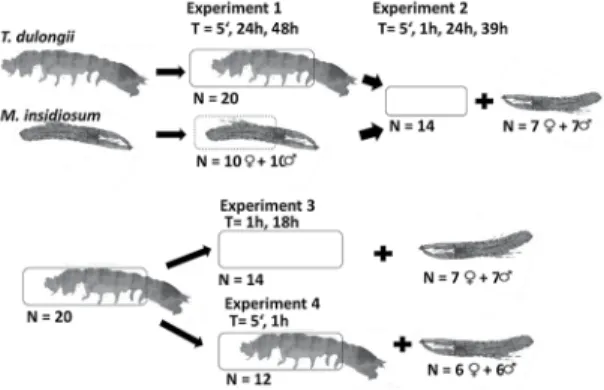
ruStaceanbehaviOurinviTroTo study both tube housing behavior and potential species interactions (objective 3), a series of four different experiments were run during summer 2013 (February ex-periment 1 and 2), and spring 2013 (October exex-periment 3 and 4). The experimental scheme of all the experiments is presented in Figure 2.
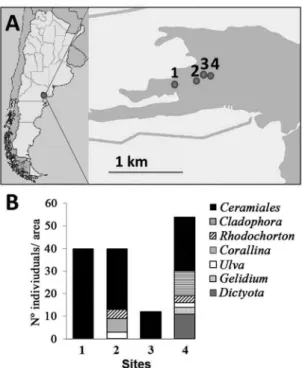
Figure 1. A) Position of sampling sites (1-4) within the Bay of San Antonio (Argentina; S40º43’ W64º56’); B) Variations in macroalgae composition and abundances (individual taxa number number/300 cm2) at the different sampling sites.
M
acrOalgal-
cruStaceanFieldSurveySThe distribution and abundance of M. insidiosum and T. aff. dulongii in relation to different macroalgae (objective 1) had been observed during surveys undertaken in January 2012. We evaluated the abundance of macroalgae in terms of percentage cover, using photo quadrats (50 cm x 50 cm, n = 4) at four different sites along the tidal channel (Figure 1B). From each photo quadrat a picture was taken and analyzed for percentage cover using the CPCe V 4.1 (Coral Point Count with Excel extensions) software program (KOHLER and GILL, 2006), which estimates percentage cover of different taxa applied to a grid of 100 points in the digital photographs (KOHLER and GILL, 2006). At each site an area of 300 cm2 was subsampled for
also: (tube length x tube width)/body length. Petri dishes containing empty tanaid tubes and M. insidiosum were selected and transferred to the following experiment.
e
xperiMent2-4: r
eSpOnSe OFM.
insidiosuM tOeMptyandinhabitedT.
aFF.
dulongiitubeSExperiment 2: Seven males and seven females of M. in-sidiosum, which showed construction activities during ex-periment 1, were randomly selected. They were individually distributed on petri dishes which contained empty tanaid tubes, illed with fresh sea water and additional construction material. A total of 14 petri dishes were observed at four different times: right after the start of the experiment (5’, T0), after 1 hour (T1), after 24 hours (T2), and at the end of the experiment after 39 hours’ exposure (T3). At each observational time the indivi-dual behavior of M. insidiosum was recorded. We distingui-shed following activities: a) passive: individuals showing no construction activity, b) constructing: individuals agglomera-ting material, c) housing: individuals within constructed tubes, d) claiming: individuals in claimed tanaid tubes. Moreover, newly constructed amphipod tube numbers were recorded. In order to investigate details of tube construction a tanaid tube occupied by M. insidiosum was randomly chosen from experi-ment 2 and prepared for scanning electronic microscopy follo-wing the protocol of PARODI and CAO (2003).
Experiment 3: A total of 20 T. aff. dulongii were individually transferred to petri dishes, prepared according to starting conditions. After 20 hours, 15 tanaids had inished their tubes. Constructing tanaids were carefully removed from their tubes and transferred to experiment 4. Petri dishes containing empty tubes were illed with new water and additional construction material. To test the response to the presence of empty tanaid tubes a total of 7 male and 7 female M. insidiosum were added individually to each petri dish. Amphipod behavior was observed after 1 (T1) and 18 hours’ exposure (T2). In addition newly constructed amphipod tubes were recorded.
Experiment 4: Tanaids from experiment 3 were transferred to petri dishes, prepared according to starting conditions. After 20 hours exposure, 12 of the13 petri dishes, containing constructing tanaids, were randomly chosen and illed with fresh seawater to oxygenize them. Six male and six female M. insidiosum were selected from the ield material and were individually distributed to petri dishes containing tanaids within their constructed tubes. Crustacean behavior was observed over the irst 5 minutes (T0) and after 1 hour (T1). In addition newly constructed crustacean tube numbers were noted down.
Figure 2. Overview of four different experiments testing for intraspeciic
interactions between Monocorophium insidusium and Tanais aff. dulongii. Experimental times (T) and replication numbers (N) are given to each experiment.
Prior to each experiment, crustaceans were transferred individually to a prepared petri dish (d = 6 cm). Each petri dish was illed with 10 ml of seawater (iltrated, 30 µm) taken from the area. To provide different material for tube constructions, common macroalgae (1.5 - 2 cm thallus) from the area were added (experiments 1-2: Ulva lactu-ca and Polysiphonia sp., and experiment 3-4: U. lactulactu-ca, Polysiphonia sp. and Punctaria sp.). For each dish, two circles (d = 3 cm) were cut from U. lactuca and Punctaria sp. respectively. One of the two circles was cut into ive stripes and all the material was added to the petri dish. A piece of Polysiphonia thallus (1.5-2 cm length) was added to each dish. In addition, 2 ml of detritus diluted in seawa-ter, transferred with a pipette, was added to each petri dish.
e
xperiMent1: t
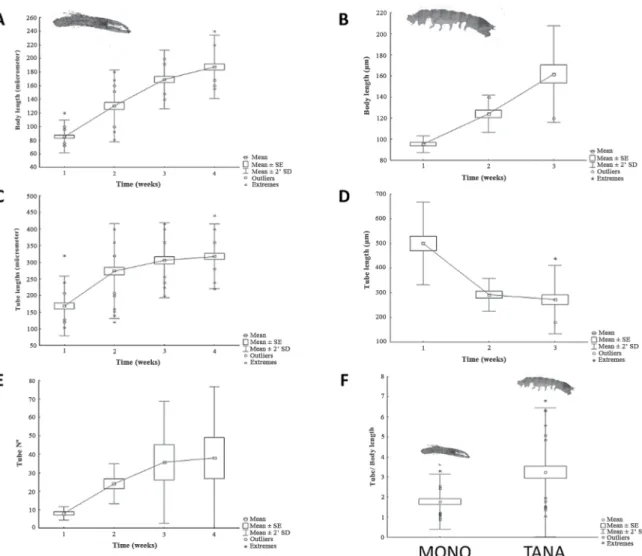
ube building capabilitieS OF aMphipOdSandtanaidSwas oviparous for the third time at the end of the fourth week. Females were kept together with their hatchlings until the end of the observations. First post-marsupial stages of M. insidiosum (85.3 ± 11.9 µm body length) were observed leaving the mother’s tube and starting their tube building activities within the irst 20 hours (168.5 ± 44.9 µm tube length). A slight delay was observed in breeding or in leaving the mother’s tube, as a lower number of juveniles were recognized after one (9.4 ± 4.5 individuals) than after two weeks (13.8 ± 2.7 individuals) of breeding. Juveniles showed rapid growth, duplicating their body lengths over the irst 2 weeks (Table 1, Figure 4A). After ive weeks the irst sexual characteristics were observable. Accordingly to body sizes, also a signiicant growth in tube lengths was observed (Table 1, Figure 4C). The growth in tube sizes was accompanied by frequent rebuilding of tubes (Fig.4E) and a change in construction material from ine mucilaginous detritus to sand grains.
b
) T
anaisaFF.
dulongiiIn contrast to M. insidiosum, individuals of T. aff. dulongii were scarcely observed outside their tubes. The isolated females seemed to be enclosed in their tubes over breeding time. Only one female presented hatching activity during the period of the experiment. Two weeks after isolation 12 post-marsupial stages (95.33 ± 3.93 µm body length) were observed leaving the parental tubes (Fig. 4B) and starting constructing tubes (500 ± 83.68 µm tube lengths). Compared to the adults, the juveniles showed a different type of tube constructions, building long, ine tubes, which seemed to interconnect with each other and agglomerate near the parental tube. Over time these tubes became more condensed (Table 1, Figure 4). No behaviour of tube changing was observed. Material was replaced and tubes were modiied as individuals grew. Furthermore, tube protecting behavior was observed towards the end of the study. Comparing the crustacean tubes built by the different adults of M. insidiosum and T. aff. dulongii, observed in the various experiments a signiicantly higher tube/body length ratio was observed for T. aff. dulongii (Table 1, Figure 4F).
c
ruStaceantubebuildingcapabilitieS(
experiMent1)
For M. insidiosum clear differences were observed in tube constructing behavior as between female and male individuals during the period of the experiment
S
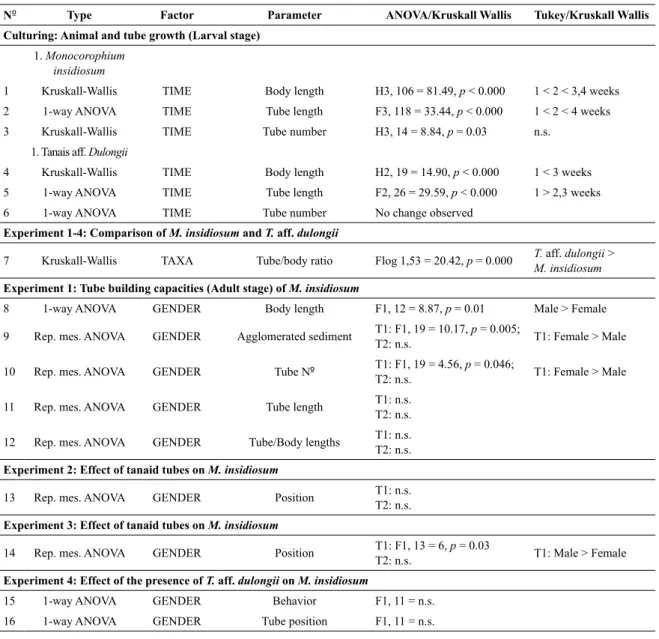
tatiSticalanalySeSSixteen different statistical analyses, 1- factorial analy-ses of variances (ANOVA; 1-way ANOVA) and ANOVAs for repeated measurements (Rep. mes. ANOVA) were ap-plied to test for differences between the different factors: experimental time (TIME), male and female individuals (GENDER) and different species (TAXA). We tested for differences in the parameters: i) body lengths, ii) tube num-bers, iii) tube lengths, iv) tube/body lengths ratios, v) agglo-merated sediments, calculated as tube area (length x width), vi) position of taxa, distinguishing between inside and out-side tanaid tubes, vii) individual behavior, distinguishing between tube construction or non-constructing, viii) tube position: distinguishing between close to (< 1 cm distance) or far from a tanaid tube. An overview of all the statistics is presented in Table 1. Homogeneity of variances was tested with Cochran’s test and, when necessary, data were arcsi-ne-, fourth-root, or log-transformed to meet homogeneity assumptions. In those cases where transformation did not homogenize the variances, we used Mann-Whitney U-tests (e.g. body length comparisons). Tukey’s test of honest sig-niicant difference (HSD) was used for post hoc compari-sons in all cases. Signiicance levels were set at p < 0.05. Statistica 7 software was used for the analyses.
RESULTS
M
acrOalgal-
cruStaceanaSSOciatiOnin theStudyareaThe research area was mainly covered by macroalgae growing as low patchy tufts (< 5 cm height), attached to pebbles buried in the sediment. The composition of these tuft forming algae varied along the channel (Figure 1B), depending on the present substrates, e.g. Dictyota dichotoma was only found attached to bigger stones. Overall the red algal order Ceramiales dominated the area, with Polysiphonia as the most common genus. M. insidiosum and T. aff. dulongii were frequently found in the area, often together in the same macroalgae (Figure 3A), mainly on Ulva lactuca, Polysiphonia sp. and Corallina oficinalis.
F
ecundityandgrOwtha
) M
onocorophiuMinsidiosuMNº Type Factor Parameter ANOVA/Kruskall Wallis Tukey/Kruskall Wallis Culturing: Animal and tube growth (Larval stage)
1. Monocorophium insidiosum
1 Kruskall-Wallis TIME Body length H3, 106 = 81.49, p < 0.000 1 < 2 < 3,4 weeks
2 1-way ANOVA TIME Tube length F3, 118 = 33.44, p < 0.000 1 < 2 < 4 weeks 3 Kruskall-Wallis TIME Tube number H3, 14 = 8.84, p = 0.03 n.s.
1. Tanais aff. Dulongii
4 Kruskall-Wallis TIME Body length H2, 19 = 14.90, p < 0.000 1 < 3 weeks 5 1-way ANOVA TIME Tube length F2, 26 = 29.59, p < 0.000 1 > 2,3 weeks
6 1-way ANOVA TIME Tube number No change observed
Experiment 1-4: Comparison of M. insidiosum and T. aff. dulongii
7 Kruskall-Wallis TAXA Tube/body ratio Flog 1,53 = 20.42, p = 0.000 T. aff. dulongii > M. insidiosum
Experiment 1: Tube building capacities (Adult stage) of M. insidiosum
8 1-way ANOVA GENDER Body length F1, 12 = 8.87, p = 0.01 Male > Female
9 Rep. mes. ANOVA GENDER Agglomerated sediment T1: F1, 19 = 10.17, p = 0.005;
T2: n.s. T1: Female > Male
10 Rep. mes. ANOVA GENDER Tube Nº T1: F1, 19 = 4.56, T2: n.s. p = 0.046; T1: Female > Male
11 Rep. mes. ANOVA GENDER Tube length T1: n.s. T2: n.s.
12 Rep. mes. ANOVA GENDER Tube/Body lengths T1: n.s. T2: n.s.
Experiment 2: Effect of tanaid tubes on M. insidiosum
13 Rep. mes. ANOVA GENDER Position T1: n.s.
T2: n.s.
Experiment 3: Effect of tanaid tubes on M. insidiosum
14 Rep. mes. ANOVA GENDER Position T1: F1, 13 = 6, p = 0.03
T2: n.s. T1: Male > Female
Experiment 4: Effect of the presence of T. aff. dulongii on M. insidiosum
15 1-way ANOVA GENDER Behavior F1, 11 = n.s.
16 1-way ANOVA GENDER Tube position F1, 11 = n.s.
Table 1. Results of different analyses of variances (ANOVA) applied in the various experiments. Results of Tukey’s test are given for each signiicant comparison.
(Table 1). Despite their smaller body size (3 ± 0.6 mm, Table 1), female amphipods showed a significantly greater tube building activity within the first 24 hours, agglomerating 5.8 ± 1.6 mm2 of sediment per mm of
body length (~16 mm2 sediment/day). By contrast
only 78% of male individuals had finished their first tube after 24 hours (T1, Figure 5). Male amphipods started to increase their tube building activities by the end of the experiment, whereas females decreased them. In consequence, no differences were found in agglomerated sediment after 48 hours. No gender specific differences were found for tube lengths or tube/body length ratios. Fourteen tanaid tubes were
DISCUSSION
In our study, both M. insidiosum and T. aff. dulongii were frequently found in the intertidal area of San Antonio Bay, on the northern Argentinian Atlantic coast. In general, both crustaceans are considered as typical epibenthic species, constructing their tubes on different natural and artiicial substrates (CRAWFORD, 1937; NAIR and ANGER, 1979; KEVREKIDIS, 2004). Their observed common association with different macroalgae might be primarily due to the presence of an elevated, sediment free substrate. Furthermore the observed colonized macroalgal species such as the Rhodophyte Polysiphonia sp. hosted a dense epiphytic community composed of diatoms, protozoans and cyanobacteria, which potentially it into the diet of the studied crustaceans (NAIR and ANGER, 1979; POORE; STOREY, 1999).
As the presence of macroalgae strongly depends on substrate availibility (DAVIS, 2009) and shows strong seasonal variations in our research area (MARTINETTO et al., 2010), knowledge of crustacean substrate preferences is crucial to understand the dynamics of crustacean sediment ixation in the area. The observed crustacean-algal interaction might allow us to artiically elevate the sediment agglomeration in the area by providing substrate suitable for algal growth. The observed sediment aggregation activities of the two peracarid crustaceans were considerable. Immediately on leaving their maternal tubes, the post-marsupial stages of M. insidiosum and T. aff. dulongii started constructing tubes, varying in size and materials used (ine detritus to sediment) according to their crustacean body size.
Comparing the two peracarid crustaceans it was pos-sible to distinguish two different tube-inhabiting strate-gies: a tube- changing behavior for M. insidiosum and a tube-keeping behavior for T. aff. dulongii. Constructing and changing its tubes daily, using mainly detritus and se-diment components, the behavior of M. insidiosum was related to a high sediment agglomeration activity (~ 16 mm2 of sediment/day), which consequently led to a high
number of empty tubes within a short time. In contrast, T. aff. dulongii spent more time on a comparatively bigger tube, which it modiies concisely during its growth, using a variety of different construction materials (e.g. detritus, sediment, algal fragments).
These differences in tube housing were accompa-nied by different activity patterns - as T. aff. dulongii Figure 3. A) Both species housing the same red macroalga Corallina
oficinalis (Linnaeus, 1758). Scale bar = 100 µm. B) Amphipod tubes
built by a female Monocorophium insidiosum. Scale bar = 1 mm. C-E) Tanaid tube built by T. aff. dulongii with fragments of the macroalga Ulva lactuca (Linnaeus, 1753). Arrow indicates position of female M. insidiosum housing the tanaid tube during experiment 2. Scale bar = 1 mm. D) Ultrastructure of tanaid tube. Scale bar = 1 mm. Arrow indicates detail of tube wall (E) agglomerated by mucous threat and inhabited by
different ilamentous cyanobacteria (white arrows). Scale bar = 10 µm.
r
eSpOnSeSOFM.
insidiosuMtOeMptytubeSOFT.
aFF.
dulongii(
experiMentS2
and3)
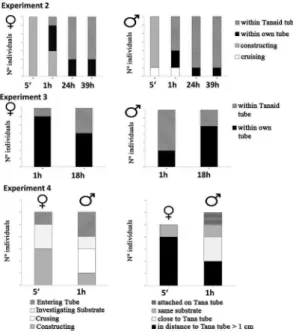
In both experiments, a clear tube-claiming behavior was observed. Amphipods started to investigate and claim empty tanaid tubes within the irst hour of the experiment. Further, gender-speciic differences were registered in ex -periment 3, in which signiicantly more males were found in tanaid tubes after the irst hour (T1) (Table 1, Figure 6). Interestingly, after 18 hours of experiment these differences vanished, as three male amphipods left the claimed tubes and started to construct their own, while parallel to that the number of claiming females increased over time (Figure 6).
r
eSpOnSe OFM.
insidiosuM tO the preSenceOF
T.
aFF.
dulongii(
experiMent4):
Figure 4.M. insidiosum (left) and T. aff. dulongii (right). A+B) Growth of juveniles in body lengths and C+D) Changes in tube lengths of
juveniles constructed over the irst three (T. aff. dulongii) and four weeks (M. insidiosum) after hatching. E) Increase of tube numbers in juvenile M. insidiosum over the irst four weeks. F) Comparisons of tube/body length ratio in adult animals.
Figure 5. Tube numbers and relative agglomerated sediment of male and female Monocorophium insidiosum constructed within 24 hours, measured at two different times (T1 = 24 hours, T2 = 48 hours) in experiment 1.
bacteria and fungi (ALONGI, 1985). In the present study we also observed a high density of microorganisms (e.g. ilamentous cyanobacteria) inhabiting the walls of the tubes constructed by T. aff. dulongii. The crustacean tube’s associated bioilm might play a crucial role for tanaid females which hardly leave their tubes waiting for “cruising males” and where they enclose themselves during hatching period (BOROWSKY, 1983). This microbial ilm, provide a potential food source for the breed after leaving the marsupium (Manca stage), which is observed to remain within the maternal tube for about a week (HAMERS and FRANKA, 2000).
Related to the interaction of both crustaceans, the observed tube-claiming behavior of M. insidiosum may be indicative of the suitability of tanaid tubes in terms of nourishment for peracarids. The observed behavior is interesting as the resulting reduced tube building activities of M. insidiosum might consequently also alter the sediment agglomeration in the adjacent environment. So far it is still unclear under what conditions T. aff. dulongii changes its tubes and how far the tube-claiming of M. insidiosum may alter the tube-construction behavior of M. insidiosum under natural conditions. An alteration in the greater amphipod tube-building activity will not only affect the sedimentary processes but might also have an impact on the associated benthic lora. Macroalgae hosting peracarid crustacean tubes might not only be affected by the presence of sedimentary tubes, but might even proit from the nutrient rich crustacean excretions within the algal thalli. A better knowledge of this and crustacean-algae relations might be crucial for a better understanding of the sedimentation processes in the area.
Overall, due to the observed high fecundity of M. insidiosum, the cryptic behavior of T. aff. dulongii, the observed high abundances of both crustaceans in the ield and frequent records in the recent literature, it is possible that these invasive species are nowadays widely distributed along the Patagonian Atlantic coast. In order to better understand the potential consequences of this for sedimentary habitats along the Patagonian Atlantic coast, further studies on the recent distribution of these potential invaders are urgently required. Our study provides important information on the ecology of the invasive M. insidiosum and T. aff. dulongii on the North Patagonian coast and gives an insight into the behavioral ecology of the sediment agglomerating crustaceans which will help one to understand and evaluate their observed extension along the northern Patagonian Atlantic coast.
Figure 6. Experiment 2 and 3: Behavioral pattern of Monocorophium insidiosum after exposure to empty tanaid tubes over different exposure time (5’ to 39h). Experiment 4: Response of M. insidiosum to housed
tanaid tubes, behavioral observation during irst 5 min of exposure
(left), and position of amphipod tubes after 1h exposure (right).
The tube-claiming behavior does, in fact, seem to be a common feature in M. insidiosum. After the observed clai-ming of foreign tanaid tubes, it is possible that M. insidiosum also claim conspeciic tubes, abandoned by individuals du -ring their growth phase. Such intraspeciic behavior would strongly affect the dynamics of amphipodal populations and also explain the formation of the dense colonies observed.
ACKNOWLEDGMENTS
We wish to thank Prof. Dr. Alan Myers of University College, Cork for his support in the taxonomic identiication of Monocorophium insidiosum and Dr. Jürgen Guerrero-Kommritz for his advice on Tanaidacean taxonomy. This study was supported by a fellowship (AF, D/11/46030) within the Postdoc-programme of the German Academic Exchange Service (DAAD). The Secretary of Science and Technology of the Universidad Nacional del Sur provided funds through grant PGI CSU-24 B/186.
REFERENCES
ADAMI, M. L. Efectos de la herbivoría de la sapa Siphonaria lessoni Blainville, 1824 (Gastropoda) sobre la comunidad aso-ciada a Brachidontes rodriguezii (d’Orbigny, 1846) (Bivalvia). Rev. Mus. Argent. Cienc. Nat., v. 10, n. 2, p. 309-317, 2008. ALBANO, M.; SECO PON, J.; OBENAT, S. Macrozoobentos
asociado a los agregados de Phyllochaetopterus socialis Cla-parède, 1870 en el puerto de Mar del Plata, Argentina. Inves-tig. Mar., v. 34, n, 2, p. 197-203, 2006.
ALBANO, M.; OBENAT, S. Assemblage of benthic macrofauna in the aggregates of the tubiculous worm Phyllochaetopterus socialis in the Mar del Plata harbour, Argentina. J. Mar. Biol. Assoc. UK., v. 89, n. 6, p. 1099-1108, 2009.
ALONGI, D. M. Microbes, meiofauna, and bacterial productivi-ty on tubes constructed by the polychaete Capitella capitata. Mar. Ecol-Prog. Ser., v. 23, p. 207-208, 1985.
ALONSO DE PINA, G. M. Records of intertidal amphipods from the southwest Atlantic, with the description of a new species of Elasmopus. J. Crustacean Biol., v. 17, n. 4, p. 745-757, 1997. BAMBER, R. N.; COSTA, A. C. The Tanaidaceans (Arthropoda:
Peracarida) of Sao Miguel, Azores, with description of two new species, and a new record from Tenerife. Açoreana, v. 6, p. 183-200, 2009.
BOROWSKY, B. Reproductive behavior of three tube-building peracarid crustaceans: the amphipods Jassa falcata and Am-pithoe valida and the tanaid Tanais cavolinii. Mar. Biol., v. 77, n. 3, p. 257-263, 1983.
BOTTO, F.; VALIELA, I.; IRIBARNE, O.; MARTINETTO, P.; AL-BERTI, J. Impact of burrowing crabs on C and N sources, control, and transformations in sediments and food webs of SW Atlantic estuaries. Mar. Ecol. Prog. Ser., v. 293, p. 155-164, 2005. BOUSFIELD, E. L.; HOOVER, P. M. The amphipod superfamily
Corophioidea on the Paciic coast of North America. part V. Family Corophiidae. Corophiinae, new subfamily; systema-tics and distributional ecology. Amphipaciica, v. 2, p. 67-139, 1997.
BURNS, J. M.; TRUMBLE, S. J., CASTELLINI M. A.; TESTA, J. W. The diet of Weddell seals in McMurdo Sound, Antarc-tica as determined from scat collections and stable isotope analysis. Polar. Biol., v. 19, p. 272-282, 1998.
CERDA, O.; HINOJOSA I. A., THIEL, M. Nest-Building Beha-vior by the Amphipod Peramphithoe femorata (Krøyer) on the Kelp Macrocystis pyrifera (Linnaeus) C. Agardh From Northern-Central Chile. Biol. Bull., v. 218, n. 3, p. 248-258, 2010.
CHAPMAN, A. Climate effects on the geography of nonindige-nous peracaridan crustacean introductions in estuaries. In: Pederson J. (ed.). Marine Bioinvasions. Proceedings of the irst national conference. Massachusetts Institute of Techno -logy Sea Grant College Program. Cambridge, 2000. p. 66-80. CONLAN, K. E. Precopulatory behavior and sexual dimorphism
in the amphipod Crustacea. Hydrobiologia, v. 223, n. 1, p. 255-282, 1991.
CONLAN, K. E. Amphipod crustaceans and environmental dis-turbance: a review. J Nat His., v. 28, p. 519-554, 1994. CRAWFORD, G. I. A Review of the Amphipod Genus
Coro-phium, with Notes on the British Species. J. Mar. Biol. Ass. U. K., v. 21, n. 2, p. 589-630, 1937.
DAVIS, A. R. The role of mineral, living and artiicial substrata in the development of subtidal assemblages. In: Wahl M. (ed.). Marine Hard Bottom Communities. Heidelberg, London: New York: Springer Dordrecht, 2009. p. 19-37.
DIXON, I. M. T.; MOORE, P. G. A comparative study on the tubes and feeding behaviour of eight species of corophioid Amphipoda and their bearing on phylogenetic relationships within the Corophioidea. Philos. Trans R. Soc Lond. B Biol. Sci., v. 352, n. 1349, p. 93-112, 1997.
DYER, K. R. Chapter 14 Sediment Transport Processes in Estua-ries. In: PERILLO, G. M. E. (ed.) Developments in Sedimen-tology. Amsterdam; New York: Elsevier, 1995. p. 423-449. FOFONOFF, P.; RUIZ, G., STEVES, B.; CARLTON, J. National
Exotic Marine and Estuarine Species Information System. Available from: < http://invasions.si.edu/nemesis/chesa -peake.html >. Accessed: 04 Jun. 2013.
FORBES, M. R.; J SHERMAN BOATESM, N. L.; MCNEIL, N. L.; BRISON, A.E. Mate searching by males of the intertidal amphipod Corophium volutator (Pallas). Can. J. Zool., v. 74, p. 1479-1484, 1996.
GIAMBIAGI, D. Cuatro nuevos isopodos de la Argentina. Phy-sis, v. 5, n. 20, p. 230-244, 1922.
GIAMBIAGI, D. Una nueva especie de "Tanais". Physis, v. 6, n. 22, p. 248-253, 1923.
GROSHOLZ, E.; CRAFTON R, E.; FONTANA, R. E.; PASARI, J.: WILLIAMS, S.; Zabin, C. Aquatic Invasive Species Vec-tor Risk Assessments: An Analysis of Aquaculture as a VecVec-tor for Introduced Marine and Estuarine Species in California. Davis: University of California at Davis, Bodega Marine La-boratory & Department of Environmental Science and Policy, 2012.
GUERRA-GARCÍA, J. M.; ROS, M.; SÁNCHEZ, J. A. Isopods, tanaids and cumaceans (Crustacea, Peracarida) associated to the seaweed Stypocaulon scoparium in the Iberian Peninsula. Zool baetica., v. 20, p. 35-48, 2009.
GUTIÈRREZ, J.; PALOMO, G.; IRIBARNE, O. Patterns of abundance and seasonality of polychaetes sheltering in sou-thwestern Atlantic estuarine epibenthic shell beds. Bull. Mar. Sci., v. 67, n. 1, p. 165-174, 2000.
HAMERS, C.; FRANKE, H. D. The postmarsupial develop-ment of Tanais dulongii (Audouin, 1826) (Crustacea, Tanai-dacea) in laboratory culture. Sarsaia, v. 85, n. 5/6, p. 403-410, 2000.
JAFFE, B. E.; SMITH, R. E.; FOXGROVER, A. C. Anthro-pogenic influence on sedimentation and intertidal mu-dflat change in San Pablo Bay, California: 1856-1983. Est. Coast. Shelf Sci., v. 73, p. 175-187, 2007.
JARQUÍN-GONZÁLEZ, J.; GARCÍA-MADRIGAL, M. Tanaidáceos (Crustacea: Peracarida) de los litorales de Guerrero y Oaxaca, México. Rev. Mex. Biodiv., v. 81, p. 51-61, 2010.
JAZDZEWSKI, K.; KONOPACKA, A. Necrophagous lysia-nassoid amphipoda in the diet of Antarctic tern at King George Island, Antarctica. Antarct. Sci., v. 11, n. 3, p. 316-321, 1999.
JOHNSON, S. B. ATTRAMADAL, Y. G. A functional-mor-phological model of Tanais cavolinii Milne-Edwards (Crustacea, Tanaidacea) adapted to a tubicolous life-stra-tegy. Sarsia, v. 67, p. 29-42, 1982a.
KAMERMANS, P.; MALTA, E. J.; VERSCHUURE, J.; SCHRI-JVERS, L., LENTZ, L. F.; LIEN, A. T. A. Effect of grazing by isopods and amphipods on growth of Ulva spp. (Chloro-phyta). Aquat. Ecol., v. 36, n. 3, p. 425-433, 2002.
KEVREKIDIS, T. Population dynamics, growth and reproduc-tion of Corophium insidiosum (Crustacea: Amphipoda) at low salinities in Monolimni lagoon (Evros Delta, North Aegean Sea). Hydrobiologia, v. 522, n. 1/3, p. 117-132, 2004.
KOHLER, K. E.; GILL, S. M. Coral Point Count with Excel extensions (CPCe): A Visual Basic program for the deter-mination of coral and substrate coverage using random point count methodology. Comput Geosci, v. 32, n. 9, p. 1259-1269, 2006.
KRASNOW, L. D.; TAGHON, G. L. Rate of tube building and sediment particle size selection during tube construc-tion by the tanaid crustacean, Leptochelia dubia. Estua-ries, v. 20, n. 3, p. 534-546, 1997.
KRONENBERGER, K.; DICKO, C.; VOLLRATH, F. A no-vel marine silk. Naturwissenschaften, v. 99, n. 1, p. 3-10, 2012a.
KRONENBERGER, K.; DICKO, C.; VOLLRATH, F. Spin-ning a marine silk for the purpose of tube-building. J. Crustacean. Biol., 32:191-202, 2012b.
LARSEN, K.I. M. Morphological and molecular investiga-tion of polymorphism and cryptic species in tanaid crus-taceans: implications for tanaid systematics and biodiver-sity estimates. Zool. J. Linn Soc., v. 131, n. 3, p. 353-379. 2001.
MARTINETTO, P.; DALEO, P.; ESCAPA, M.; ALBERTI J.; ISACCH, J. P.; FANJUL, E.; BOTTO, F.; PIRIZ, M. L.; PONCE, G.; CASAS, G; IRIBARNE, O. High abundan-ce and diversity of consumers associated with eutrophic areas in a semi-desert macrotidal coastal ecosystem in Patagonia, Argentina. Estuar. Coast. Shelf Sci., 88:357-364, 2010.
MENDOZA, J. A. Some aspects of the autecology of Lepto-chelia dubia (Kroyer, 1842) (Tanaidacea). Crustaceana, v. 43, n. 3, p. 225-240, 1982.
MILLER, D. C. Mechanical post-capture particle selection by suspension- and deposit-feeding Corophium. J. Exp. Mar. Biol. Ecol., v. 82, n. 1, p. 59-76, 1984.
MINCHIN, D. Rapid coastal survey for targeted alien species associated with floating pontoons in Ireland. Aquatic. In-vas., v. 2, p. 63-70, 2007b.
MOURITSEN, K. N.; MOURITSEN L. T.; JENSEN, K. T. Chan-ge of Topography and Sediment Characteristics on an Inter-tidal Mud-Flat Following Mass-Mortality of the Amphipod Corophium Volutator. J. Mar. Biol. Ass. U. K., v. 78, n. 4, p. 1167-1180, 1998.
NAIR, K. K. C.; ANGER, K. Life cycle of Corophium insidiosum (Crustacea, Amphipoda) in laboratory culture. Helgol Wiss. Meeresunters., v. 32, p. 279-294, 1979.
NICKEL, J. Benthic-pelagic coupling in the Arctic Mellemfjord (West-Greenland) with special focus on benthic peracarida (Malacostrata, Crustacea). Rep. Polar Mar. Res., v. 491, p. 1-135, 2004.
ORENSANZ, J.; SCHWINDT, E.; PASTORINO, G.; BORTU-LOS, A.; CASAS, G. DARRIGRAN, G.; ELÍAS, R.; LÓ-PEZGAPPA, J.; OBENAT, S.; PASCUAL, M. No longer the pristine conines of the world ocean: a survey of exotic mari -ne species in the southwestern Atlantic. Biol. Invas., v. 4, n. 1/2, p. 115-143, 2002.
PARODI, E. R.; CAO, B. D. Benthic microalgal communities in the inner part of the Bahía Blanca estuary (Argentina): a preliminary qualitative study. Oceanol. Acta., v. 25, n. 5, p. 279-284, 2003.
POORE, G. C. B.; STOREY, M. Soft sediment Crustacea of Port Phillip Bay. IN: Marine Biological Invasions of Port Phillip Bay, Victoria. CRIMP. Technical. Report., V. 20, p. 150-170, 1999.
RIVERO, M. S.; ELÌAS, R.; VALLARINO, E. A. First sur-vey of macroinfauna in the Mar del Plata Harbor (Argen-tina), and the use of polychaetes as pollution indicators. Rev. Biol. Mar. Oceanogr., v. 40, n. 2, p. 101-108, 2005. RUMBOLD, C. E.; OBENAT, S. M.; SPIVAK, E. D. Life
history of Tanaisdulongii (Tanaidacea: Tanaidae) in an intertidal flat in the southwestern Atlantic. J. Crustacean. Biol., v. 32, p. 891-898, 2012.
SCHELLENBERG, A. Gammariden and Caprelliden des Mage-llangebietes, Südgeorgiens und der Westantarktis. Further. Zool. Res. Swedish. Antarct. Exped., v. 2, p. 1901-1903, 1931.
SCHIEL, D. R.; WOOD, S. A.; DUNMORE, R. A.; TAYLOR, D. I. Sediment on rocky intertidal reefs: effects on early post-settlement stages of habitat-forming seaweeds. J. Exp. Mar. Biol. Ecol., v. 331, p. 158-172, 2006.
SHOEMAKER, C.R. The amphipod genus Corophium on the east coast of America. Proc. Biol. Soc. Wash., 47:23-32, 1934. SUEIRO, M. C.; BORTOLUS, A.; SCHWINDT, E. Habitat
com-plexity and community composition: relationships between di-fferent ecosystem engineers and the associated macroinverte-brate assemblages. Helgol. Mar. Res., v. 65, p. 467-477, 2011. SUEIRO, M. C.; BORTOLUS, A.; SCHWINDT, E. The role
of the physical structure of Spartinadensiflora Brong. in structuring macroinvertebrate assemblages. Aquatic Eco-logy., v. 46, n. 1, p. 25-36, 2012.
ULRICH, I.; ANGER, K.; SCHLÖTTLER, U. Tube-building in two epifaunal amphipod species, Corophiuminsidio-sum and Jassa falcate Helgol. Meeresunters, v. 49, n. 1/4, p. 393-398, 1995.
WINFIELD, I.; CHÁZARO-OLVERA, S.; ORTIZ, M: PALO-MO-AGUAYO Lista actualizada de las especies de anfípodos (Peracarida: Gammaridea y Corophiidea) marinos invasores en México. Rev. Biol. Mar. Oceanogr., v. 46, n. 3, p. 349-361, 2011.