Sérgio Augusto Morey Ourique(a) César Augusto Galvão Arrais(a) Alessandra Cassoni(a)
Cláudia Ota-Tsuzuki(a) José Augusto Rodrigues(a)
(a) Department of Restorative Dentistry, Guarulhos University – UnG, Guarulhos, SP, Brazil.
Corresponding author: José Augusto Rodrigues E-mail: [email protected]
Received for publication on May 31, 2011 Accepted for publication on Sep 08, 2011
Effects of different concentrations of
carbamide peroxide and bleaching
periods on the roughness of dental
ceramics
Abstract: The wide use of dental bleaching treatment has brought con-cern about the possible effects of hydrogen peroxide on dental tissue and restorative materials. The objective of this study was to evaluate in vitro
the effect of nightguard bleaching on the surface roughness of dental ce-ramics after different periods of bleaching treatment. Fifteen specimens of 5 × 3 × 1 mm were created with three dental ceramics following the manufacturers’ instructions: IPS Classic (Ivoclar-Vivadent); IPS d.Sign (Ivoclar-Vivadent); and VMK-95 (Vita). A proilometer was used to eval-uate baseline surface roughness (Ra values) of all ceramics by ive paral-lel measurements with ive 0.25 mm cut off (λc) at 0.1 mm/s. Afterwards, all specimens were submitted to 6-h daily bleaching treatments with 10% or 16% carbamide peroxide (Whiteness- FGM) for 21 days, while control groups from each ceramic system were stored in artiicial saliva. The surface roughness of all groups was evaluated after 18 h, 42 h, 84 h, and 126 h of bleaching treatment. The surface roughness of each speci-men (n = 5) was based on the mean value of ive parallel measurespeci-ments in each time and all data were submitted to two-way repeated measures ANOVA and Tukey’s post-hoc test (α = 0.05). No signiicant differenc-es in ceramic surface roughndifferenc-ess were observed between untreated and bleached ceramic surfaces, regardless of bleaching intervals or bleaching treatments. This study provided evidence that at-home bleaching systems do not cause detrimental effects on surface roughness of dental ceramics.
Descriptors: Esthetics, Dental; Tooth Bleaching; Hydrogen Peroxide; Surface Properties; Ceramics.
Introduction
In recent years, dental bleaching has become popular and often re-quested by patients wanting to improve their teeth shade. The most useful and effective bleaching technique is the one performed at home, in which bleaching of all the teeth is undertaken over two weeks, with few side effects such as dental sensitivity.1 This technique was irstly described by
Haywood & Heymann in 1989 as nightguard dental bleaching, but to-day this technique may be performed at home from one to eight hours a day, involving the day or nighttime use of a tray with a bleaching agent.1,2
The most commonly used dental bleaching agent is carbamide per-Declaration of Interests: The authors
oxide. The reaction of carbamide peroxide with the teeth releases hydrogen peroxide and free radicals, which are responsible for dental bleaching.3,4
De-spite the wide approval of at-home bleaching tech-niques, the use of peroxides may lead to clinical side effects due to the reactive nature of hydrogen per-oxide, so patients may experience dentin sensitivity and/or gingival irritation.1,3-5 Several microscopic
changes on the enamel surface morphology are also observed, due to enamel mineral loss and surface roughening.6-15
Extremely unstable and reactive H+ free
radi-cals, released by bleaching agents, and low pH are described as the main cause of the side effects of prolonged use of these products.6-14,16-17 Similarly,
bleaching agents may cause structural changes on restorative materials that may compromise their physical properties and lead to premature fail-ure.18-24 Although conventional dental ceramics are
considered the most inert among all dental restor-ative materials, their surfaces can exhibit surface de-terioration in contact with acidulated luoride gels or other solutions.25 In addition, the contact and
possible diffusion of free radicals of H+ or H 3O
+
produced by bleaching agents17 may selectively leach
alkali ions and cause dissolution in ceramic glass networks.25 Thus, prolonged exposure to hydrogen
peroxide through at-home bleaching treatment may potentially affect dental porcelain and may produce alterations on the porcelain’s surface.16 Moreover,
an increase in surface roughness greater than the threshold of Ra = 0.2 µm may result in an increase
in plaque accumulation, thereby increasing the risk of both secondary caries and periodontal inlamma-tion26 or affecting ceramic aesthetics by changing
the ceramic texture.16
The aim of the present study was to evaluate the effect of 10% and 16% carbamide peroxide nightguard bleaching agents on the surface rough-ness of dental ceramics after different time periods of bleaching treatment. Thus, the hypothesis of the present study was that the surface roughness of ceramic might be modiied by exposure to 10% and 16% carbamide peroxide bleaching agents used in at-home treatment for a period of 126 h.
Methodology
The surface roughness of three dental ceramics (Table 1) – one luorapatite glass-ceramic, IPS d.Sign (Ivoclar Vivadent AG - Schaan, Liechtenstein), and two feldspathic ceramics, IPS Classic (Ivoclar Viva-dent AG - Schaan, Liechtenstein), and VMK 95 (Vita Zahnfabrik - Bad Säckingen, Germany) – were evaluated in a research protocol, including a facto-rial design to test the effects of three surface treat-ments: 10% carbamide peroxide (Whiteness FGM, Joinville, Brazil; pH ≅ 6.0); 16% carbamide perox-ide (Whiteness FGM, Joinville, Brazil; pH ≅ 6.0); and no treatment (control group); at ive periods of treatment: 0 h (baseline), 18 h, 42 h, 84 h, and 126 h.
Fifteen specimens with 5 × 3 × 1 mm of each ce-ramic were prepared according to the manufactur-ers’ instructions and their surfaces were sequentially
Ceramic
(Lot number) Type Chemical characterization*
IPS d.Sign (Lot: K33292)
Fluorapatite-leucite glass-ceramic
SiO2; BaO; Al2O3; CaO; CeO2; Na2O; K2O; B2O3; MgO; ZrO2; P2O5; F; Li2O; TiO2; SrO; ZnO; and
pigments
VMK 95
(Lot: 26590) Feldspathic ceramic
Al2O3; BaO; B2O3; CaO; Fe2O3; MgO; SiO2; TiO2; ZrO2; CeO2; Li2O; K2O; Na2O; glycerin; butylene
glycol; tin oxide
IPS Classic
(Lot: K02827) Feldspathic ceramic
SiO2; BaO; Al2O3; CaO; CeO2; Na2O; K2O; B2O3; MgO; ZrO2; P2O5; TiO2; and pigments
* Material Safety Data Sheet; Abbreviations: SiO2: Silicon Oxide; BaO: Barium Oxide; Al2O3: Aluminum
Oxide; CaO: Calcium Oxide; CeO2: Cerium Dioxide; Na2O: Sodium Oxide; K2O: Potassium Oxide; B2O3: Boron Oxide; MgO: Magnesium Oxide; ZrO2: Zirconium Oxide; P2O5: Phosphorus Pentoxide; F: Fluorine;
Li2O: Lithium Oxide; TiO2: Titanium Dioxide; SrO: Strontium Oxide; ZnO: Zinc Oxide; Fe2O3: Iron Oxide.
polished with diamond polishing pastes of 6, 3, 1, and 0.5 µm and polishing cloths with mineral oil lubricant (Top, Gold and Ram, Arotec Ind. Com. Ltda., Cotia, Brazil).
Surface roughness was evaluated by a single blinded evaluator prior to and after all bleaching periods. A proilometer (TR200, Time Group Inc., Beijing, China), with a microneedle, was used to scan the specimen surfaces to determine the param-eter of average surface roughness (Ra). Five points were initially marked to ensure repeatable ments. From these points, ive parallel measure-ments in a longitudinal direction were performed on each specimen surface, with a 0.25 mm cut off (λc) at 0.1 mm/s. Surface roughness was recorded, and mean roughness (Ra expressed in µm) was de-termined for each specimen before and after each treatment period.
Fifteen ceramic specimens were randomly divid-ed into three groups according to surface treatments (n = 5). The respective treatment agent was applied for six hours a day over 21 days, corresponding to 126 hours of treatment. Specimens to be bleached were covered with 0.03 ml of the respective bleach-ing agent, were placed in vacuum-formed custom trays with a drop of artiicial saliva,8,13 and were
stored in a plastic container at 37 °C.6-8 Specimens
from control groups were stored only with artiicial saliva drops in the vacuum-formed custom tray to mimic oral conditions.
After bleaching exposure, specimens were
washed with distilled water to remove residual carb-amide peroxide gel and were stored in a plastic con-tainer for the remaining day period in relative hu-midity at 37 °C.
Surface roughness was measured at 18 h, 42 h, 84 h, and 126 h after the beginning of the experi-ment, after the specimens were washed and dried. Data of each ceramic material were statistically ana-lyzed by two-way repeated measures ANOVA and Tukey’s post-hoc test at a 5 % level of signiicance within each period, using statistical software (SAS 8.0 for Windows; SAS Institute Inc., Cary, USA).
Results
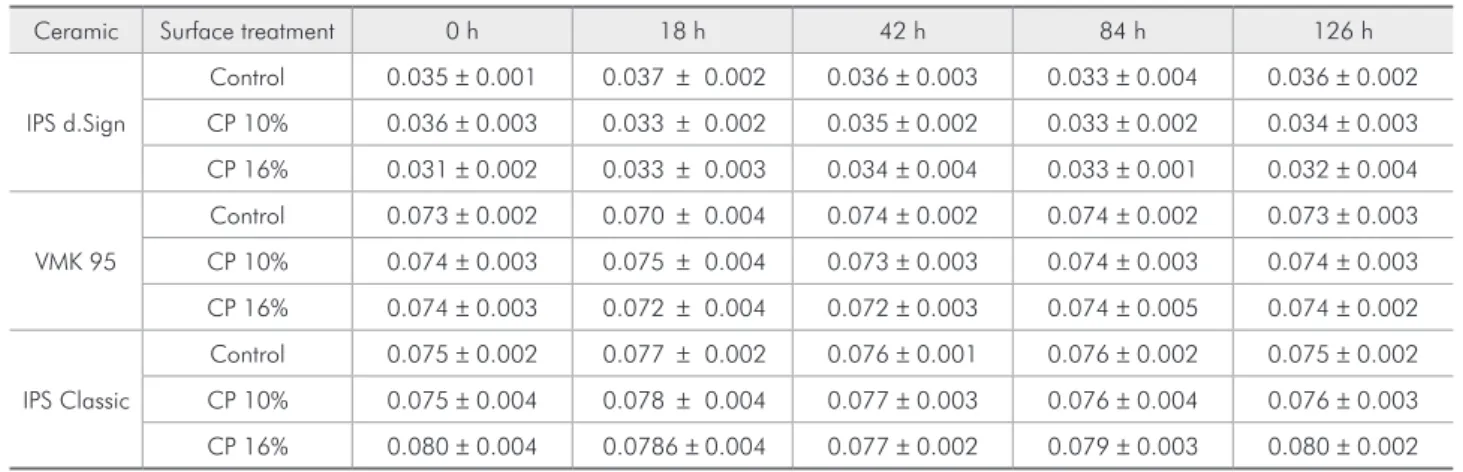
Mean Ra values of each ceramic material before and after treatment, with the respective standard deviations, are shown in Table 2. No signiicant differences in Ra values were observed between the control group and bleached groups, as well as be-tween groups treated with 10% carbamide peroxide and those treated with 16% carbamide peroxide, regardless of time. Moreover, no signiicant differ-ences in Ra were observed among time intervals, regardless of treatment. Figure 1 shows the surface roughness of each ceramic treated with 10% or 16% carbamide peroxide as a function of time.
Discussion
Ceramics are expected to be chemically stable in the mouth, as dental prostheses must withstand deg-radation in the presence of a wide range of solutions
Table 2 - Surface roughness (Ra) of each ceramic and standard deviation (SD) at each evaluation period.
Ceramic Surface treatment 0 h 18 h 42 h 84 h 126 h
IPS d.Sign
Control 0.035 ± 0.001 0.037 ± 0.002 0.036 ± 0.003 0.033 ± 0.004 0.036 ± 0.002
CP 10% 0.036 ± 0.003 0.033 ± 0.002 0.035 ± 0.002 0.033 ± 0.002 0.034 ± 0.003
CP 16% 0.031 ± 0.002 0.033 ± 0.003 0.034 ± 0.004 0.033 ± 0.001 0.032 ± 0.004
VMK 95
Control 0.073 ± 0.002 0.070 ± 0.004 0.074 ± 0.002 0.074 ± 0.002 0.073 ± 0.003
CP 10% 0.074 ± 0.003 0.075 ± 0.004 0.073 ± 0.003 0.074 ± 0.003 0.074 ± 0.003
CP 16% 0.074 ± 0.003 0.072 ± 0.004 0.072 ± 0.003 0.074 ± 0.005 0.074 ± 0.002
IPS Classic
Control 0.075 ± 0.002 0.077 ± 0.002 0.076 ± 0.001 0.076 ± 0.002 0.075 ± 0.002
CP 10% 0.075 ± 0.004 0.078 ± 0.004 0.077 ± 0.003 0.076 ± 0.004 0.076 ± 0.003
CP 16% 0.080 ± 0.004 0.0786 ± 0.004 0.077 ± 0.002 0.079 ± 0.003 0.080 ± 0.002
with variable pH levels.25 Otherwise, ceramics could
release potentially toxic substances and radioactive components and exhibit increased wear, abrasion of opposing dental structures, and increased plaque adhesion after exposure to such intra-oral challeng-es.25
This study tested the effects of dental bleaching agents on the surface roughness of ceramic speci-mens with standardized initial roughness averages less than 0.2 µm, a condition that leads to bacterial accumulation similar to that observed on the least rough surface.26 Therefore, any possible change in
roughness due to in vitro treatment would be de-tected by contact proilometry.11,12,16,26 No
signii-cant differences in ceramic roughness were observed after 126 hours of exposure to 10% or 16% carb-amide peroxide in comparison to the baseline val-ues, demonstrating that all products were inert in vitro to dental bleaching, so the hypothesis of this study was rejected. Our results corroborate those of Zavanelli et al.,27 who found no alterations on
ce-ramic surfaces treated with 10% or 15% carbamide peroxide for 126 h. Therefore, accidental exposure of dental ceramics to bleaching agents does not change their surface roughness to values capable of
increasing the risk for both secondary caries and periodontal inlammation.
The bleaching protocol used in this study was similar to that used in other studies, which aimed to evaluate in vitro the effect of bleaching systems on enamel surface roughness over time.6,8,9,13 Although
an increase in roughness has been observed in com-posite resins or glass ionomers after bleaching treat-ment,18-24,27 no alteration in ceramic surfaces was
observed after bleaching in the current study,23 so
the impact of bleaching agents on surface roughness may be considered material-dependent, as also dem-onstrated by previous studies.16,20-23 In these studies,
the chemical stability of ceramics against bleaching agents was observed after treatment with 15% carb-amide peroxide for 56 h,23 16% carbamide peroxide
for 126 h,17 10% or 15% carbamide peroxide27 and
38% hydrogen peroxide for 30 minutes23 or
45 min-utes, respectively.24
The 126-hour bleaching protocol was chosen to simulate 21-day nightguard bleaching treatment, as most patients achieve the best results within this period.4,5 Although this period may be considered
optimal, bleaching treatment may be extended to longer treatment periods in patients with severe dis-0.026
0.036 0.046 0.056 0.066 0.076 0.086
0 18 42 84 126
Ra
(
µ
m
)
Time periods(h)
IPS d.Sign Control IPS d.Sign CP 10 % IPS d.Sign CP 16 %
VMK 95 Control VMK 95 CP 10 % VMK 95 CP 16 %
IPS Classic Control IPS Classic CP 10 % IPS Classic CP 16 %
coloration. As the detrimental effects of bleaching treatment are time-dependent, more mineral loss is expected on enamel and dentin surfaces in extended treatments.1,6,24 Therefore, despite the lack of
chang-es in ceramic surface roughnchang-ess from the beginning throughout 126 h of bleaching treatment, it is pos-sible that overexposure to bleaching agents for lon-ger than 126 h might lead to some degradation in ceramics due to the interaction between free radicals released from the bleaching gels and the ceramic glass network, which leads to the loss of alkali metal ions from the glass surface. However, only further evaluation, comprising longer exposure to bleach-ing agents, would conirm such speculation. Thus, a time-dependent effect of bleaching treatment on ceramic roughness should not be discarded because only one study observed a statistically signiicant decrease in auto-glazed ceramic roughness after treatment with 35% and 15% carbamide peroxide for 56 h followed by acid luoride gel treatment for 30 h, which was probably due to a mild etching of the ceramic caused by a carbamide peroxide agent with the additive effect of luoride gel.16
Further-more, an energy-dispersive x-ray microanalysis of ceramic surfaces exhibited a decrease in SiO2 con-tent, which is the main matrix component.21 Thus,
its lower content would affect other properties, such as surface microhardness, although the study found no signiicant difference in roughness. In addition, Polydorou et al. (2006)24 showed that the effect of
bleaching on surface texture was material- and time-dependent, as polished ceramic surfaces exposed to 38% hydrogen peroxide for 45 minutes showed slight changes in surface texture evaluated by scan-ning electron microscopy, while no signiicant dif-ference was noted when ceramic surfaces were ex-posed to 15% carbamide peroxide for 56 h.26
However, other authors have demonstrated that bleaching gels affected the surface roughness of den-tal ceramics. A statistically signiicant increase oc-curred in the surface roughness of ceramic material after 21 days of daily application of 10% carbamide
peroxide and a weekly application of 35%, although no alterations in roughness were observed over sev-en and 14 days of bleaching. According to the au-thors, these results were related to the leaching of components from the porcelain matrix as a func-tion of continuing peroxide applicafunc-tion. However, all Ra values were within the clinically acceptable range (Ra values of 0.22 to 0.24), and the changes would most likely be clinically insigniicant. In addi-tion, scanning electron microscopy analyses showed surface changes on ceramic surfaces after bleaching treatment, but the authors described them as clini-cally insigniicant.28-30
The degradation of dental ceramics generally oc-curs because of chemical attacks, mechanical forces or a combination of these effects.25 In the current
study, only a chemical attack of ceramics by 10% or 16% hydrogen peroxide was considered, but differ-ent results might be found if mechanical forces were applied because they could weaken the structure by creating surface cracks and increasing ceramic sus-ceptibility to sequential bleaching attacks. For this reason, further studies are required to evaluate this clinical challenge.
In this regard, the present study showed that ce-ramic dental materials were not affected by 10% or 16% carbamide peroxide treatment, so there is no need for ceramic polishing or replacement in clinical situations in which ceramic restorations are acciden-tally exposed to bleaching gels, provided that shade, shape, and function are clinically acceptable.
Conclusion
Within the study limitations, the surface rough-ness of all evaluated dental ceramics was not affect-ed by treatment with 10% or 16% carbamide perox-ide for 126 hours.
Acknowledgements
References
1. Ritter AV, Leonard RH Jr, St Georges AJ, Caplan DJ, Hay-wood VB. Safety and stability of nightguard vital bleach-ing: 9 to 12 years post-treatment. J Esthet Restor Dent. 2002;14(5):275-85.
2. Haywood VB, Heymann HO. Nightguard vital bleaching. Quintessence Int. 1989 Mar;20(3):173-6.
3. Meireles SS, Heckmann SS, Leida FL, dos Santos I da S, Della Bona A, Demarco FF. Efficacy and safety of 10% and 16% carbamide peroxide tooth-whitening gels: a randomized clini-cal trial. Oper Dent. 2008 Nov-Dec;33(6):606-12.
4. Leonard RH Jr, Garland GE, Eagle JC, Caplan DJ. Safety issues when using a 16% carbamide peroxide whitening solu-tion. J Esthet Restor Dent. 2002;14(6):358-67.
5. Leonard RH Jr, Bentley C, Eagle JC, Garland GE, Knight MC, Phillips C. Nightguard vital bleaching: a long-term study on efficacy, shade retention. side effects, and patients’ percep-tions. J Esthet Restor Dent. 2001;13(6):357-69.
6. Rodrigues JA, Basting RT, Serra MC, Rodrígues Júnior AL. Effects of 10% carbamide peroxide bleaching materials on enamel microhardness. Am J Dent. 2001 Apr;14(2):67-71. 7. Rodrigues JA, Marchi GM, Ambrosano GM, Heymann HO,
Pimenta LA. Microhardness evaluation of in situ vital bleach-ing on human dental enamel usbleach-ing a novel study design. Dent Mater. 2005 Nov;21(11):1059-67.
8. Rodrigues JA, Oliveira GP, Amaral CM. Effect of thickener agents on dental enamel microhardness submitted to at-home bleaching. Braz Oral Res. 2007 Apr-Jun;21(2):170-5. 9. de Oliveira R, Basting RT, Rodrigues JA, Rodrigues AL Jr,
Serra MC. Effects of a carbamide peroxide agent and desensi-tizing dentifrices on enamel microhardness. Am J Dent. 2003 Feb;16(1):42-6.
10. Wandera A, Feigal RJ, Douglas WH, Pintado MR. Home-use tooth bleaching agents: an in vitro study on quantitative effects on enamel, dentin, and cementum. Quintessence Int. 1994 Aug;25(8):541-6.
11. Worschech CC, Rodrigues JA, Martins LR, Ambrosano GM. Brushing effect of abrasive dentifrices during at-home bleach-ing with 10% carbamide peroxide on enamel surface rough-ness. J Contemp Dent Pract. 2006 Feb 15;7(1):25-34. 12. Worschech CC, Rodrigues JA, Martins LR, Ambrosano GM.
In vitro evaluation of human dental enamel surface rough-ness bleached with 35% carbamide peroxide and submitted to abrasive dentifrice brushing. Pesqui Odontol Bras. 2003 Oct-Dec;17(4):342-8.
13. Pinto CF, Oliveira R, Cavalli V, Giannini M. Peroxide bleach-ing agent effects on enamel surface microhardness, roughness and morphology. Braz Oral Res. 2004 Oct-Dec;18(4):306-11. 14. Oltu U, Gürgan S. Effects of three concentrations of carbamide
peroxide on the structure of enamel. J Oral Rehabil. 2000 Apr;27(4):332-40.
15. Soldani P, Amaral CM, Rodrigues JA. Microhardness evalu-ation of in situ vital bleaching and thickening agents on
hu-man dental enamel. Int J Periodontics Restorative Dent. 2010 Apr;30(2):203-11.
16. Zaki AA, Fahmy NZ. The effect of a bleaching system on properties related to different ceramic surface textures. J Prosthodont. 2009 Apr;18(3):223-9.
17. Ourique SA, Magdaleno JP, Arrais CA, Rodrigues JA. Effect of different concentrations of carbamide peroxide on micro-hardness of dental ceramics. Am J Dent. 2011 Feb;24(1):57-9. 18. Cho SD, Bulpakdi P, Matis BA, Platt JA. Effect of bleaching
on fracture toughness of resin composites. Oper Dent. 2009 Nov-Dec;34(6):703-8.
19. Yu H, Li Q, Hussain M, Wang Y. Effects of bleaching gels on the surface microhardness of tooth-colored restorative materials in situ. J Dent. 2008 Apr;36(4):261-7.
20. Türker SB, Biskin T. The effect of bleaching agents on the microhardness of dental aesthetic restorative materials. J Oral Rehabil. 2002 Jul;29(7):657-61.
21. Turker SB, Biskin T. Effect of three bleaching agents on the surface properties of three different esthetic restorative materi-als. J Prosthet Dent. 2003 May;89(5):466-73.
22. Wattanapayungkul P, Yap AU, Chooi KW, Lee MF, Selamat RS, Zhou RD. The effect of home bleaching agents on the surface roughness of tooth-colored restoratives with time. Oper Dent. 2004 Jul-Aug;29(4):398-403.
23. Polydorou O, Hellwig E, Auschill TM. The effect of different bleaching agents on the surface texture of restorative materi-als. Oper Dent. 2006 Jul-Aug;31(4):473-80.
24. Polydorou O, Mönting JS, Hellwig E, Auschill TM. Effect of in-office tooth bleaching on the microhardness of six dental es-thetic restorative materials. Dent Mater. 2007 Feb;23(2):153-8.
25. Anusavice KJ. Degradability of dental ceramics. Adv Dent Res. 1992 Sep;6:82-9.
26. Bollen CM, Lambrechts P, Quirynen M. Comparison of sur-face roughness of oral hard materials to the threshold sursur-face roughness for bacterial plaque retention: a review of the lit-erature. Dent Mater. 1997 Jul;13(4):258-69.
27. Zavanelli AC, Mazaro VQ, Silva CR, Zavanelli RA, Mancuso DN. Surface roughness analysis of four restorative materials exposed to 10% and 15% carbamide peroxide. Int J Prostho-dont. 2011May-Apr;24(2):155-7.
28. Schemehorn B, González-Cabezas C, Joiner A. A SEM evalua-tion of a 6% hydrogen peroxide tooth whitening gel on dental materials in vitro. J Dent. 2004;32 Suppl 1:35-9.
29. Moraes RR, Marimon JL, Schneider LF, Correr Sobrinho L, Camacho GB, Bueno M. Carbamide peroxide bleaching agents: effects on surface roughness of enamel, composite and porcelain. Clin Oral Investig. 2006 Mar;10(1):23-8. 30. Silva MF de A, Davies RM, Stewart B, DeVizio W, Tonholo J,