
Short Report
S
J. Braz. Chem. Soc., Vol. 23, No. 5, 966-969, 2012. Printed in Brazil - ©2012 Sociedade Brasileira de Química 0103 - 5053 $6.00+0.00*e-mail: [email protected]
O
-Iodoxybenzoic Acid in Water: Optimized Green Alternative for Multicomponent
One-Pot Synthesis of 2-Amino-3,5-dicarbonitrile-6-thiopyridines
Santosh Takale,a Jaidas Patil,a Vikas Padalkar,b Rajaram Pisala and Atul Chaskar*,c
aChangu Kana Thakur Research Centre, 410206 Navi Mumbai, India
bInstitute of Chemical Technology, Matunga, 400019 Mumbai, India
cDepartment of Chemistry, National Taiwan University, 10617 Taipei, Taiwan
Uma reação multicomponente do tipo one-pot de aldeído aromático, melanonitrilo e tiofenol na presença de ácido iodoxibenzóico (IBX) em meio aquoso forneceu 2-amino-3,5-dicarbonitrilo-6-tiopiridina em bons a excelentes rendimentos. Eventualmente, um catalisador poderia ser facilmente recuperado e reutilizado sem perda de sua propriedade catalítica.
A multicomponent one-pot reaction of aromatic aldehyde, malononitrile and thiophenol in the presence of iodoxybenzoic acid (IBX) in aqueous media furnished 2-amino-3,5-dicarbonitrile-6-thiopyridine in good to excellent yield. Eventually, a catalyst could be easily recovered and reused without loss of its catalytic property.
Keywords: O-iodoxybenzoic acid, green catalyst, thiopyridines, aqueous media,
multicomponent reactions
Introduction
The nitrogen heterocycles have been intensively investigated in past decades due to their ubiquitous presence in biologically active compounds and multifarious natural products. Pyridine ring system represents the major class of nitrogen heterocycles and its analogues exhibited diverse biological and physiological activities, such as antibacterial, antiviral, anti-inflammatory, antitumoural and antioxidant. These potential therapeutic applications made it as a privileged scaffold.1-3
2-Amino-3,5-dicarbonitrile-6-thiopyridine derivatives are not only used as anti-prion,4,5 anti-hepatitis B virus,6
anti-bacterial7 and anti-cancer8 agents but also are used
as potassium channel openers for the treatment of urinary incontinence.9
Recently, it is being used in treatment of Parkinson’s disease, hypoxia, asthma, kidney disease, epilepsy, cancer10 and creutzfeldt-jacob disease.11 In view of
their high significance, many methodologies have been developed for the construction of the pyridine skeleton. Various basic catalysts like piperidine, Et3N
(N(CH2CH3)3), DABCO (1,4-diazabicyclo[2.2.2]
octane),5,12 morpholine, thiomorpholine, pyrrolidine,
N,N-DIPEA (N,N-diisopropylethylamine), pyridine, 2,4,6-collidine (2,4,6-trimethylpyridine), DMAP (4-dimethylaminopyridine), aniline, N-methylaniline,
N,N-dimethylaniline and N,N-diethylaniline have been employed for this multicomponent reaction.12 In addition,
basic ionic liquids 1-methyl-3-butylimidazolium hydroxide, [bmim]OH,12 DBU
(1,8-diazabicyclo[5.4.0]undec-7-ene)12 and TBAH (tetrabutylammonium hydroxide)12 have
also been used for this reaction. Sridhar et al.13 showed that
this reaction can be carried out using Lewis acid catalyst (ZnCl2), which shows better results than base catalyzed
reactions. Recently, boric acid in combination with cetyl trimethyl ammonium bromide (surfactant) has also been employed for this reaction.14
Takale et al. 967 Vol. 23, No. 5, 2012
compounds,15 simple phenols to ortho-quinones,16
polycyclic aromatic phenols to polycyclic aromatic quinones,17 benzocyclic compounds and amines.18
Besides this, it is also applied for preparation of carbonyl compounds,18N-heterocycles18 and in oxidative cleavage
of dithioacetals and dithioketals.18 IBX also offers
selective deprotection of triethylsilyl ethers along with
tert-butyldimethylsilyl (TBDMS) ethers.19
With all these applications of IBX in mind and its mild, chemo-selective nature and our interest in exploring its catalytic properties20 prompted us to use it in aqueous
medium for the synthesis of 2-amino-3,5-dicarbonitrile-6-thiopyridines. The relevance of this methodology stems from the fact that all the aforementioned protocols encounter disadvantages, such as prolonged reaction time, tedious catalyst preparation and workup, formation of inevitable side or sticky products, exhaustive usage of energy sources and solvents that lead to lower yield of desired product and environmental hazard.
Here, we disclose an efficient and environmental benign method for the synthesis of 2-amino-3,5-dicarbonitrile-6-thiopyridines in presence of IBX as catalyst in good to excellent yield, as shown in Scheme 1.
Results and Discussion
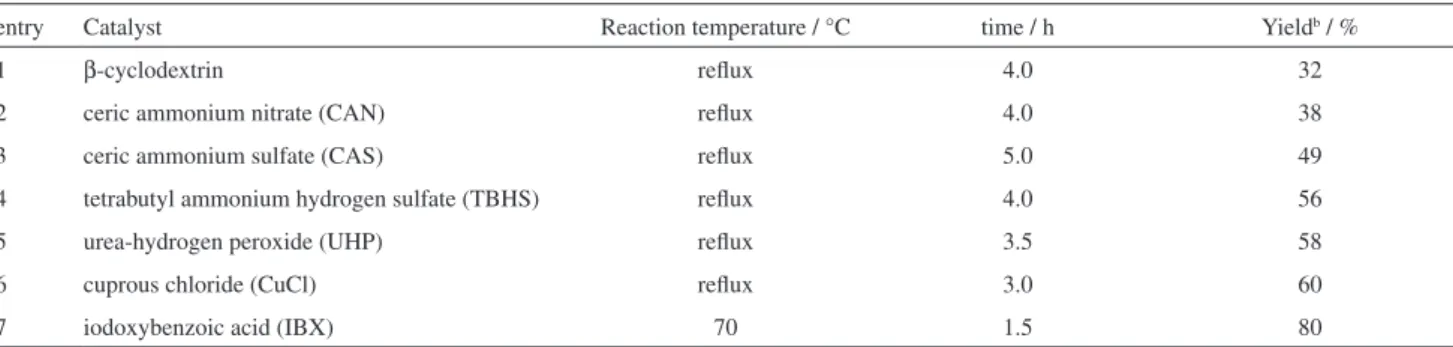
With a view to find optimum reaction conditions for the condensation reaction, preliminary efforts were mainly focused on the evaluation of different catalysts
viz.β-cyclodextrin, ceric ammonium nitrate (CAN), ceric ammonium sulfate (CAS), tetra butyl ammonium hydrogen
sulfate (TBHS), urea-hydrogen peroxide (UHP), cuprous chloride (CuCl) and iodoxybenzoic acid (IBX). Table 1 displays the effect of the catalysts on the reaction rate and product yield.
Fast reaction rate and enhanced product yield were observed in the IBX-mediated reaction presumably due to the ability of hypervalent iodine for a coordination complex, resulting into polarization of carbonyl and nitrile groups which speed up the Knoevenagel condensation and Michael addition (first two steps of the multicomponent condensation).
Since IBX is a selective oxidizing agent at its stoichiometric levels, in order to optimize the catalyst quantity, the model reaction was carried out with different quantities of IBX such as 2, 5, 10 and 15 mol%. 10 mol% of IBX with respect to benzaldehyde was found to be optimal (Table 2).
All the aforementioned results encouraged us to plan the synthesis of several 2-amino-3,5-dicarbonitrile-6-thiopyridines by treating various substituted aromatic aldehydes with malononitrile and thiophenols (Table 3). The products are accomplished in good to excellent yields and their physical and spectral data are in agreement with literature reports.12,14,21 Indeed, the method has the ability to
tolerate functional groups such as methoxy, nitro, halides, etc. The recovery and reusability of the catalyst are crucial in environmental benign large scale protocols and
Scheme 1. Synthesis of 2-amino-3,5-dicarbonitrile-6-thiopyridines.
Ar H
O
2 CN
CN
S H
Ar'
IBX, H2O
70 oC N
Ar CN NC
H2N S
Ar'
1 2 3 4 a-n
Table 1. Screening of the catalystsa
entry Catalyst Reaction temperature / °C time / h Yieldb / %
1 β-cyclodextrin reflux 4.0 32
2 ceric ammonium nitrate (CAN) reflux 4.0 38
3 ceric ammonium sulfate (CAS) reflux 5.0 49
4 tetrabutyl ammonium hydrogen sulfate (TBHS) reflux 4.0 56
5 urea-hydrogen peroxide (UHP) reflux 3.5 58
6 cuprous chloride (CuCl) reflux 3.0 60
7 iodoxybenzoic acid (IBX) 70 1.5 80
aCondition: benzaldehyde (1 mmol), malononitrile (2 mmol), thiophenol (1 mmol), catalyst (10 mol%); bisolated yield.
Table 2. Optimization of iodoxybenzoic acid (IBX) as catalysta
entry Iodoxybenzoic acid / mol% Yieldb / %
1 2 40
2 5 68
3 10 80
4 15 80
O-Iodoxybenzoic Acid in Water J. Braz. Chem. Soc. 968
from the industrial point of view. In this protocol, after completion of the reaction, IBX was recovered by simple filtration, washed with little quantity of water and then dried. IBA, the reduction product of IBX obtained upon completion of reaction, was oxidized back to IBX. Thus, gained IBX has revealed identical chemical and physical characteristics to those of standard IBX. In this manner, it was recovered about 55-60% of IBX and reused for further three successive reaction cycles offering consistent yield of products.
Conclusion
The present work highlights IBX as an inexpensive, non-corrosive and environmentally benign catalyst for the synthesis of 2-amino-3,5-dicarbonitrile-6-thiopyridines. We anticipate that short reaction time, easy catalyst recovery, aqueous reaction medium and high yield of product could make this protocol a good alternative to the existing protocols.
Experimental
All commercial reagents were used as received without purification and all solvents were reagent grade. The reaction was monitored by TLC (thin layer chromatography) using on 0.25 mm E-Merck silica gel 60 F254 precoated plates,
which were visualized with UV light. Melting points (mp) were taken in open capillaries on a Veego apparatus and are uncorrected. Infrared spectra were recorded on a Simadzu
spectrophotometer in a KBr disc, and the absorption bands are expressed in cm-1. 1H NMR (nuclear magnetic
resonance) spectra were recorded on a Varian AS 300 MHz spectrometer in DMSO-d6, chemical shifts (d) are in ppm
(parts per million) relative to TMS (tetramethylsilane).
General procedure for the synthesis of 2-amino-3,5-dicarbonitrile-6-thiopyridines
A solution of aldehyde (1 mmol), malononitrile (2 mmol) and a thiophenol (1 mmol) in water (5 mL) was stirred at 70 °C in the presence of catalytic amount of IBX (10 mol%, 0.28 g). The progress of the reaction was monitored by TLC. After completion of the reaction, the product was extracted with diethyl ether (2 × 5 mL). The combined organic layer was then washed with brine (2 × 5 mL), and dried over MgSO4. The solvent was
evaporated under reduced pressure and the crude product obtained was purified by column chromatography followed by recrystallization from ethanol. The catalyst was recovered from aqueous layer by simple filtration.
Physical and spectral data of the product
2-Amino-4-(4-methoxyphenyl)-6-(phenylthio)pyridine-3,5-dicarbonitrile (4c)
IR (KBr) ν/cm-1 3437, 3327, 3228, 3074, 2926, 2220,
1628, 1529; 1H NMR (DMSO-d
6, 300 MHz) d 3.61 (s,
3H), 7.1 (d, 2H, J 7.8 Hz), 7.18-7.20 (m, 3H), 7.7 (d, 2H,
J 7.8 Hz), 7.45 (d, 2H), 7.78 (s, 2H).
Table 3. Synthesis of 2-amino-3,5-dicarbonitrile-6-thiopyridinesa
entry Compound Ar Ar’ time / h Yieldb / % mpc / oC
1 4a Ph Ph 1.5 80 219-220
2 4b 4-Me-Ph Ph 1.5 72 208-210
3 4c 4-OMe-Ph Ph 2.0 70 242-243
4 4d 3,4-(OMe)2-Ph Ph 2.0 78 229-230
5 4e 4-NO2-Ph Ph 1.5 83 289-291
6 4f 4-NO2-Ph 2-Br-Ph 1.5 82 258-260
7 4g 4-Cl-Ph Ph 1.5 80 222-223
8 4h 2,6-Cl-Ph 2,4,6-Me3-Ph 2.0 75 280-282
9 4i 4-Br-Ph Ph 1.5 82 255-257
10 4j 4-Cl-Ph 2,4,6-Me3-Ph 2.0 73 289-290
11 4k 3,4-(OMe)2-Ph Ph 2.0 69 227-228
12 4l 3,4-Me2-Ph 2-Me-Ph 2.0 71 243-244
13 4m 4-Me-Ph 2-Me-Ph 2.0 70 223-225
14 4n 3,4-(OMe)2-Ph 4-Cl-Ph 2.5 72 273-275
aCondition: benzaldehyde (1 mmol), malononitrile (2 mmol), thiophenol (1 mmol), IBX (10 mol%), H
Takale et al. 969 Vol. 23, No. 5, 2012
Supplementary Information
The spectroscopic 1H NMR and IR data of selected
compoundare available free of charge at http://jbcs.sbq.org.br as a PDF file.
Acknowledgment
We appreciate the generous support from Dr. S. T. Gadade, Changu Kana Thakur College, India.
References
1. Boger, D. L.; Nakahara, S.; J. Org. Chem.1991, 56, 880. 2. Zhang, T. Y.; Stout, J. R.; Keay, J. G.; Scriven, E. F. V.; Toomey,
J. E.; Goe, G. L.; Tetrahedron1995, 51, 13177. 3. Ma, X.; Gang, D. R.; Nat. Prod. Rep.2004, 21, 752.
4. Perrier, V.; Wallace, A. C.; Kaneko, K.; Safar, J.; Prusiner, S. B.; Cohen, F. E.; Proc. Nat. Acad. Sci. U. S. A. 2000, 97, 6073; Anderson, D. R.; Stehle, N. W.; Kolodziej, S. A.; Reinhard, E. J.; PCT Int. Appl. WO 2004055015 A1 20040701, 2004; Nirschl, A. A.; Hamann, L. G.; US Pat. Appl. Publ.2005182105 A1 20050818, 2005.
5. Reddy, T. R. K.; Mutter, R.; Heal, W.; Guo, K.; Gillet, V. J.; Pratt, S.; Chen, B.; J. Med. Chem. 2006, 49, 607; May, B. C. H.; Zorn, J. A.; Witkop, J.; Sherrill, J.; Wallace, A. C.; Legname, G.; Prusiner, S. B.; Cohen, F. E.; J. Med. Chem. 2007, 50, 65. 6. Chen, H.; Zhang, W.; Tam, R.; Raney, A. K.; PCT Int. Appl.
WO 2005058315 A1 20050630, 2005.
7. Levy, S. B.; Alekshun, M. N.; Podlogar, B. L.; Ohemeng, K.; Verma, A. K.; Warchol, T.; Bhatia, B.; Bowser, T.; Grier, M.; US Pat. Appl. 2005124678 A1 20050609, 2005.
8. Anderson, D. R.; Stehle, N. W.; Kolodziej, S. A.; Reinhard, E. J.; PCT Int. Appl. WO 2004055015 A1 20040701, 2004.
9. Harada, H.; Watanuki, S.; Takuwa, T.; Kawaguchi, K.; Okazaki, T.; Hirano, Y.; Saitoh, C.; PCT Int. Appl.WO 2002006237 A1 20020124, 2002.
10. Fredholm, B. B.; Ijzerman, A. P.; Jacobson, K. A.; Klotz, K.-N.; Linden, J.; Pharmacol. Rev. 2001, 53, 527.
11. Guo, K.; Mutter, R.; Heal, W.; Reddy, T. R. K.; Cope, H.; Pratt, S.; Thompson, M. J.; Chen, B.; Eur. J. Med. Chem.
2008, 43, 93.
12. Evdokimov, N. M.; Magedov, I. V.; Kireev, A. S.; Kornienko, A.; Org. Lett. 2006, 8, 899; Evdokimov, N. M.; Kireev, A. S.; Yakovenko, A. A.; Antipin, M. Y.; Magedov, I. V.; Kornienko, A.; J. Org. Chem. 2007, 72, 3443; Ranu, B. C.; Jana, R.; Sowmiah,
S.; J. Org. Chem.2007, 72, 3152; Mamgain, R.; Singh, R.; Rawat, D. S.; J. Heterocycl. Chem. 2009, 46, 69; Guo, K.; Thompson, M. J.; Chen, B.; J.Org. Chem. 2009, 74, 6999. 13. Sridhar, M.; Ramanaiah, B. C.; Narsaiah, C.; Mahesh, B.;
Kumaraswamy, M.; Mallu, K. K. R.; Ankathi, V. M.; Rao, P. S.; Tetrahedron Lett.2009, 50, 3897.
14. Shinde, P. V.; Sonar, S. S.; Shingate, B. B.; Shingare, M. S.; Tetrahedron Lett.2010, 51, 1309.
15. Frigerio, M.; Santagostino, M.; Tetrahedron Lett. 1994, 35, 8019; Duschek, A.; Kirsch, S. F.; Angew. Chem. Int. Ed.2011, 50, 1524; Satam, V.; Harad, A.; Rajule, R.; Pati, H.; Tetrahedron
2010, 66, 7659.
16. Magdziak, D.; Rodriguez, A. A.; Van De Water, R. W.; Pettus, T. R. R.; Org. Lett.2002, 4, 285.
17. Harvey, R. G.; Dai, Q.; Ran, C.; Penning, T. M.; J. Org. Chem.
2004, 69, 2024; Ran, C.; Xu, D.; Dai, Q.; Penning, T. M.;
Blair, I. A.; Harvey, R. G.; Tetrahedron Lett.2008, 49, 4531; Harvey, R. G.; Dai, Q.; Ran, C.; Gopishetty, S. R.; Penning, T. M.; Polycycl. Aromat. Comp.2004, 24, 257.
18. Nicolaou, K. C.; Montagnon, T.; Baran, P. S.; Zhong, Y.-L.; J. Am. Chem. Soc. 2002, 124, 2245; Nicolaou, K. C.; Mathison,
C. J. N.; Montagnon, T.; J. Am. Chem. Soc. 2004, 126, 5192. 19. Wu, Y.; Huang, J.-H.; Hu, Q.; Tang, C.-J.; Li, L.; Org. Lett.
2002, 4, 2141.
20. Takale, S.; Parab, S.; Phatangare, K.; Pisal, R.; Chaskar, A.; Catal. Sci. Technol. 2011, 1, 1128; Shaikh, H.; Padalkar, V.;
Phatangare, K.; Deokar, H.; Chaskar, A.; Green Chem. Lett. Rev.2011, 4, 171.
21. Das, B.; Ravikanth, B.; Kumar, A. S.; Kanth, B. S.; J. Heterocycl. Chem.2009, 46, 1208.
Submitted: December 11, 2011

![Poly(4-vinylpyridine) efficiently catalyzed one-pot four-component synthesis of pyrano[2,3-c]pyrazoles](data:image/gif;base64,R0lGODlhAQABAIAAAP///wAAACH5BAEAAAAALAAAAAABAAEAAAICRAEAOw==)