Article
Printed in Brazil - ©2017 Sociedade Brasileira de Química0103 - 5053 $6.00+0.00
*e-mail: [email protected]; [email protected]
Conformational Analysis, Experimental and GIAO-DFT
13C NMR Chemical Shift
Calculation on 2’-Hydroxy-3,4,5-trimethoxy-chalcone
Fabio Luiz P. Costa,*,a Paulo F. Gomes,b Andressa K. Silvac and Luciano M. Lião*,c
aDepartamento de Química and bDepartamento de Física, Universidade Federal de Goiás, BR 364, km 192, 3800, 75801-615 Jataí-GO, Brazil
cInstituto de Química, Universidade Federal de Goiás, Av. Esperança s/n, Campus Samambaia, 74690-900 Goiânia-GO, Brazil
In this paper we investigated the ability of the GIAO-mPW1PW91/6-31G(d)//mPW1PW91/6-31G(d) level of theory to predict the 13C nuclear magnetic resonance (NMR) chemical shifts of the
2’-hydroxy-3,4,5-trimethoxy-chalcone molecule. Two different approaches were used. First: the absolute shieldings σ for all carbon atoms in each geometrically optimized conformers of the 2’-hydroxy-3,4,5-trimethoxy-chalcone molecule were calculated at the GIAO-mPW1PW91/6-31G(d)// mPW1PW91/6-31G(d) level of theory. This approach is further used to generate weighted average values for each atom considering the previously obtained conformational distribution. Second: only the σ for the lowest energetic conformer will be taken to account. The robustness of the method was evaluated for two other chalcones: (E)-1-(4-hydroxy-3-methoxyphenyl)-3-(3,5-di-tert -butyl-4-hydroxyphenyl)prop-2-en-1-one and (E )-1-(4-aminophenyl)-3-(3,4-dimethoxyphenyl)prop-2-en-1-one, corroborating the ability of the method in chemical shift prevision. Although, both approaches were able to reproduce the chemical shifts of the 2’-hydroxy-3,4,5-trimethoxy-chalcone, significant differences in the calculated values for C-4 and methoxy carbons were observed. The best results were obtained using the second approach (II).
Keywords: chalcone, 2’-hydroxy-3,4,5-trimethoxy-chalcone, GIAO-NMR, scaling factor, NMR spectroscopy
Introduction
Chalcones (1,3-diaryl-2-propen-1-ones) are important intermediates for the synthesis of compounds such as flavonoids, isoflavonoids and their derivatives.1 Besides having a physiological role in plants, flavonoids have also been reported to have a wide variety of biological activities, including antioxidant,2-6 antibacterial,7,8 anticancer,9,10 antiangiogenic ones.11 The growing interest in these compounds and their potential use in medicinal applications is indicated by the increasing number of publications concerning the synthesis and biological evaluation of chalcone analogues.1-11 Their properties are related, among other factors, to its great conformational freedom as well as to the several patterns of substitution of A and B rings.12 Thus, the correct structural determination and the knowledge about three-dimensional (3D) atomic structure of chalcones are crucial to understand their
properties. In this context, the complete assignments of 13C nuclear magnetic resonance (NMR) chemical shifts
for chalcones, even using computation methodology, can help in identifying the chemical structures of new chalcone derivatives. The 2’-hydroxy-3,4,5-trimethoxy-chalcone (Figure 1) has shown in vitro inhibitory effects on PGE2 (prostaglandin E2) production from RAW 264.7 cells induced by LPS (lipopolysaccharide).13 At 10 µM 2’-hydroxychalcones proved strong effect to inhibit the PGE2 production (102.3%). However, these compounds also indicated the effect on cell viability with potential for anti-inflammation and anticancer activity.13
formula in order to achieve great 13C NMR chemical shift experimental data reproduction and prediction. In this context, the goal of this work was to investigate the ability of the scaling factor protocol at the GIAO-mPW1PW91/6-31G(d)//mPW1PW91/6-31G(d) level of theory to predict the 13C NMR chemical shifts (d) of the 2’-hydroxy-3,4,5-trimethoxy-chalcone molecule (Figure 1). Moreover, two different approaches for determining the d of the 2’-hydroxy-3,4,5-trimethoxy-chalcone were compared.
Methodology
Chemicals
The 2’-hydroxy-3,4,5-trimethoxy-chalcone was obtained from Sigma-Aldrich Chemical Co.
NMR system and operating conditions
NMR analyses were acquired on a Bruker Avance III 11.75 Tesla spectrometer at 298 K using a 5 mm triple resonance broadband inverse (TBI) probehead. The spectra were obtained at 125.77 MHz for 13C using CDCl
3 as the solvent. The 13C spectra (Figure S1, Supplementary Information (SI)) were acquired with spectral window of 37,878 Hz, 32,768 digitalized points and accumulation of 3,926 FIDs. The heteronuclear single-quantum correlation (HSQC, Figure S2, SI) and heteronuclear multiple-bond correlation (HMBC, Figure S3, SI) experiments were acquired with a spectral window of 10,000 and 37,731 Hz for 1H and 13C, respectively. The phase and baseline were corrected with the TopSpin software (version 3.2 Bruker BioSpin). NMR assignments are based on 1H, 13C and 1H-13C HSQC/HMBC experiments. 1H NMR (500 MHz,
CDCl3) d 12.85 (s, OH), 7.93 (dd, J 8.1, 1.6 Hz, H-6’), 7.84 (d, J 15.4 Hz, H-β), 7.53 (d, J 15.4 Hz, H-α), 7.50 (ddd,
J 8.4, 7.2, 1.6 Hz, H-4’), 7.03 (dd, J 8.4, 1.2 Hz, H-3’), 6.95 (ddd, J 8.1, 7.2, 1.2 Hz, H-5’), 6.88 (s, H-2/H-6), 3.93 (s, OMe-3/OMe-5), 3.92 (s, OMe-4); HMBC/HSQC crosspeaks: OMe-3/OMe-5 (C-2, C-3, C-5, C-6), OMe-4 (C-4), H-2/H-6 (C-1, C-3, C-4, C-5, C-β), H-β (C-1, C-2, C-6, C-α, C=O), H-α (C-1, C=O), H-3’ (C-1’, C-2’, C-5’,
C=O), H-4’ (C-2’, C-3’, C-5’, C-6’), H-5’ (C-2’, C-3’, C4’, C-6’), H-6’ (C-1’, C-2’, C-4’, C-5’, C=O).
Computational details
The 13C NMR chemical shifts of the three chalcones were calculated with two different approaches. In the first one, the absolute shieldings (σ) of all carbon atoms in each geometrically optimized conformer of molecule were calculated using the GIAO (gauge-independent atomic orbital) approximation at the mPW1PW91/6-31G(d)// mPW1PW91/6-31G(d) (NMR//optimization) level of theory, and further used to generate weighted average values for each atom considering the previously obtained conformational distribution, σaver. In the second one, only the σ for the lowest energetic conformer was taken to account, σlowe. Molecular mechanics calculations were performed using the Spartan’08 modeling software,17 whereas DFT (density functional theory) calculations were performed using the Gaussian 09 W software package.18 Solvent effects were not taken into account in any calculation.
Statistical validation
In order to perform a statistical validation of our results the mean deviation (MD) and the root mean square deviation (RMSD) errors (in ppm) were calculated.
Results and Discussion
A randomized conformational search of the 2’-hydroxy-3,4,5-trimethoxy-chalcone molecule was performed (Figure 2) using the Monte Carlo (MC) method with a search limit of 200 structures. Merck molecular force field (MMFF) as implemented in the Spartan’08 software package, considering an initial energy cutoff of 10 kcal mol-1, was employed.
Figure 1. Structure of the 2’-hydroxy-3,4,5-trimethoxy-chalcone.
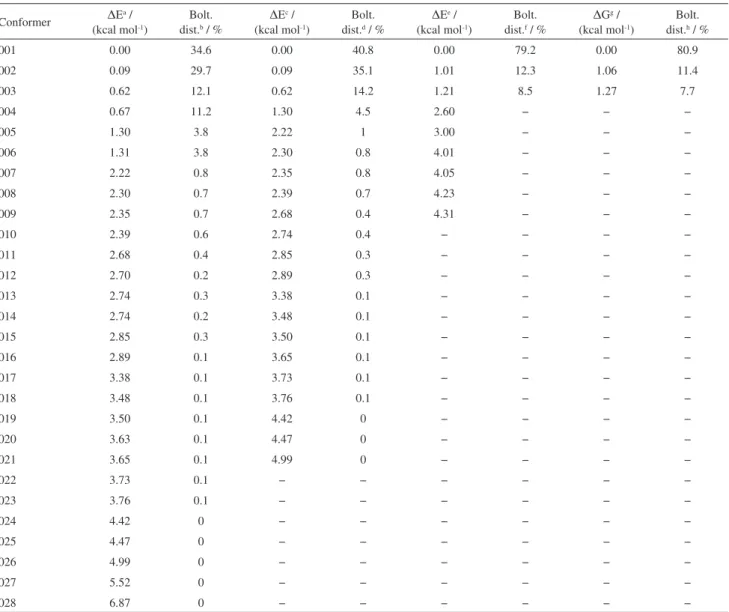
The 28 more significant conformations of 2’-hydroxy-3,4,5-trimethoxy-chalcone molecule were saved, which are responsible for more than 99.99% of the total Boltzmann population in the first 10 kcal mol-1. This was followed by single-point energy calculations at the B3LYP/6-31G(d) and level of theory. The 21 more significant conformations within the range of 0.0-5.0 kcal mol-1 were selected by energy minimization calculations carried out at the mPW1PW91/6-31G(d) level of theory. The relevant results are given in Table 1. Frequency calculations carried out at the mPW1PW91/6-31G(d) level of theory confirmed the optimized geometries to be local minima and delivered values of free energy at 298 K and 1 atm. In this step, the
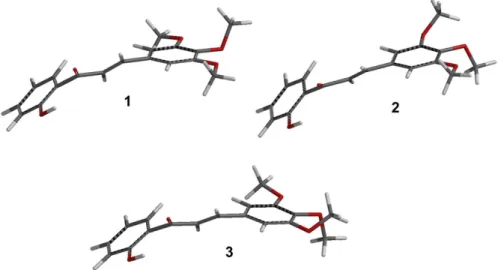
three most significant conformations within the range of 0.0-3.0 kcal mol-1 were selected (Figure 3).
In the approach (I), for each optimized conformer geometry, the 13C atomic chemical shielding tensors (σ) were computed at the mPW1PW91/6-31G(d)//mPW1PW91/6-31G(d) level of theory. Isotropic atomic chemical shifts d
in units of ppm were computed as differences between the atomic isotropic shielding of the solutes and corresponding reference atoms in tetramethylsilane (TMS). Thus, the population-averaged chemical shifts for the selected conformers were computed assuming Boltzmann statistics, according to equation 1, based on mPW1PW91/6-31G(d) free energies. Finally, the 13C NMR chemical shifts were
Table 1. DFT, thermo chemical parameter and DFT population for the 28 more significant conformations of 2’-hydroxy-3,4,5-trimethoxy-chalcone molecule
Conformer DE
a / (kcal mol-1)
Bolt. dist.b / %
DEc / (kcal mol-1)
Bolt. dist.d / %
DEe / (kcal mol-1)
Bolt. dist.f / %
DGg / (kcal mol-1)
Bolt. dist.h / %
001 0.00 34.6 0.00 40.8 0.00 79.2 0.00 80.9
002 0.09 29.7 0.09 35.1 1.01 12.3 1.06 11.4
003 0.62 12.1 0.62 14.2 1.21 8.5 1.27 7.7
004 0.67 11.2 1.30 4.5 2.60 − − −
005 1.30 3.8 2.22 1 3.00 − − −
006 1.31 3.8 2.30 0.8 4.01 − − −
007 2.22 0.8 2.35 0.8 4.05 − − −
008 2.30 0.7 2.39 0.7 4.23 − − −
009 2.35 0.7 2.68 0.4 4.31 − − −
010 2.39 0.6 2.74 0.4 − − − −
011 2.68 0.4 2.85 0.3 − − − −
012 2.70 0.2 2.89 0.3 − − − −
013 2.74 0.3 3.38 0.1 − − − −
014 2.74 0.2 3.48 0.1 − − − −
015 2.85 0.3 3.50 0.1 − − − −
016 2.89 0.1 3.65 0.1 − − − −
017 3.38 0.1 3.73 0.1 − − − −
018 3.48 0.1 3.76 0.1 − − − −
019 3.50 0.1 4.42 0 − − − −
020 3.63 0.1 4.47 0 − − − −
021 3.65 0.1 4.99 0 − − − −
022 3.73 0.1 − − − − − −
023 3.76 0.1 − − − − − −
024 4.42 0 − − − − − −
025 4.47 0 − − − − − −
026 4.99 0 − − − − − −
027 5.52 0 − − − − − −
028 6.87 0 − − − − − −
scaled according to Costa et al. protocols.15
(1)
DEi is the relative energy of the ith conformer to the lowest energy, k is the Boltzmann constant, and the temperature T is set to 298 K. In the approach (II), only the lowest-energetic conformer was used to obtain the scaled chemical shifts.
Figure 3 shows the three most significant conformations conformers of 2’-hydroxy-3,4,5-trimethoxy-chalcone
according to the geometry optimization calculations carried out at the mPW1PW91/6-31G(d) level of theory. The two more significant factors that determine the stability of the 2’-hydroxy-3,4,5-trimethoxy-chalcone conformers are apparently the intramolecular hydrogen bond between the OH and C=O and steric effects of methoxyl groups in the B-ring.
Table 2 shows the calculated (dcalc), scaled (dscal) and experimental (dexp) 13C NMR chemical shifts of the 2’-hydroxy-3,4,5-trimethoxy-chalcone as well as the differences (≠) among them. The data comparison Figure 3. DFT-optimized structures of the three more stable conformers, 1, 2 and 3, respectively, of 2’-hydroxy-3,4,5-trimethoxy-chalcone. For relative energies and abundances of the conformers, see Table 1.
Table 2. Calculated (scaled) and differences between experimental ¹³C NMR chemical shifts (in ppm) in the 2’-hydroxy-3,4,5-trimethoxy-chalcone relative to TMS, for approaches (I) and (II)
Nuclei dexp / ppm
Approach (I) Approach (II)
dcalca (dscal)b / ppm ≠dcalc (dscal) / ppm dcalca (dscal)b / ppm ≠dcalc (dscal) / ppm
C-1 130.07 124.46 (129.46) −5.61 (−0.61) 124.18 (129.17) −5.89 (−0.90)
C-2c 106.03 103.56 (107.52) −2.47 (1.49) 101.93 (105.81) 4.10 (−0.22)
C-3 153.55 148.18 (154.37) −5.37 (0.82) 148.05 (154.23) −5.50 (0.68)
C-4 140.92 137.56 (143.22) −3.36 (2.30) 136.44 (142.04) −4.48 (1.12)
C-5 153.55 148.19 (155.38) −5.41 (0.78) 147.90 (154.08) −5.70 (−0.48)
C-6c 106.03 103.56 (107.52) −2.47 (1.49) 101.93 (105.81) 4.10 (−0.22)
C-α 119.29 143.30 (149.24) −2.34 (3.60) 143.27 (149.21) −2.37 (3.57)
C-β 145.64 111.42 (115.77) −7.88 (−3.53) 111.21 (115.55) −8.09 (−3.75)
C-1’ 120.05 183.25 (191.19) −10.29 (−2.35) 183.22 (191.16) −10.32 (−2.38)
C-2’ 163.60 115.05 (119.58) −4.95 (−0.42) 114.85 (119.37) −5.15 (−0.63)
C-3’ 118.65 159.43 (166.18) −4.17 (2.58) 159.34 (166.08) −4.26 (2.48)
C-4’ 136.35 114.30 (118.79) −4.35 (0.14) 114.09 (118.57) −4.56 (−0.08)
C-5’ 118.81 130.59 (135.90) −5.76 (−0.45) 130.43 (135.73) −5.92 (−0.62)
C-6’ 129.61 111.37 (115.72) −7.44 (−3.09) 111.17 (115.51) −7.64 (−3.30)
C=O 193.54 124.40 (129.40) −5.21 (−0.21) 124.24 (129.23) −5.37 (−0.38)
OMe-3 56.29 54.25 (55.75) −2.46 (−0.99) 52.98 (54.41) −3.32 (−1.89)
OMe-4 61.03 57.26 (58.80) −3.77 (−2.13) 57.42 (59.07) −3.61 (−1.96)
OMe-5 56.29 53.84 (55.31) −2.04 (−0.54) 52.96 (54.39) −3.33 (−1.90)
aCalculated chemical shifts (d
calc = σTMS – σaver or σlowe) obtained by TMS subtraction; bscaled chemical shifts (dscal = 1.05dcalc − 1.22) obtained by the generated universal scaling factor;15cthe d
demonstrated a great agreement between experimental and calculated NMR chemical shifts.
The main differences between experimental and scaled chemical shifts, for both approaches, were observed in carbons C-4, OMe-3, OMe-4 and OMe-5. These differences are consistent with the three selected conformers (Figure 3) to obtain the chemical shifts at the approach (I). The reason is that they have different orientations of the OCH3 group (atoms C-3, C-4 and C-5) with respect to the aromatic ring and their chemical shifts are systematically dependent on the orientation of the methoxyl group.
For evaluating the robustness of the method, the chemical shift for two other chalcones: (E )-1-(4-hydroxy-3-methoxyphenyl)-3-(3,5-di-tert-butyl-4-hydroxyphenyl) p r o p - 2 - e n - 1 - o n e a n d (E) 1 ( 4 a m i n o p h e n y l ) -3-(3,4-dimethoxyphenyl)prop-2-en-1-one (Figure S4, SI), were calculated. The results presented in Table 3 demonstrate an excellent predictive ability of the method. The experimental and theoretical calculation of the NMR data for these two chalcones are presented in the Supplementary Information.
Conclusions
In this work, we investigated the ability of the scaling factor protocol at the GIAO-mPW1PW91/6-31G(d)// mPW1PW91/6-31G(d) level of theory to predict the 13C NMR chemical shifts of the 2’-hydroxy-3,4,5-trimethoxy-chalcone. The robustness of the method was evaluated for two other chalcones: (E )-1-(4-hydroxy-3-methoxyphenyl)-3-(3,5-di-tert-butyl-4-hydroxyphenyl) p r o p - 2 - e n - 1 - o n e a n d (E) 1 ( 4 a m i n o p h e n y l ) -3-(3,4-dimethoxyphenyl)prop-2-en-1-one, corroborating the ability of the method in chemical shift prevision. After using the scale factor, the two approaches were able to correctly reproduce the chemical shifts, despite the differences in the conditions of the experimental measurements and computational predictions. Both approaches had similar performance. These findings
suggest that, in this case, either the approach (I) or the approach (II) could be chosen and that further analysis of the methoxychalcones is therefore justified.
Supplementary Information
Supplementary information is available free of charge at http://jbcs.org.br as PDF file.
Acknowledgments
The authors are grateful to Conselho Nacional de Desenvolvimento Científico e Tecnológico (CNPq), Coordenação de Aperfeiçoamento de Pessoal de Nível Superior (CAPES), Fundação de Amparo à Pesquisa do Estado de Goiás (FAPEG) and Financiadora de Estudos e Projetos (FINEP) for the financial support. The authors also thanks Prof Dr Guilherme Roberto de Oliveira for the chalcone samples.
References
1. Daskiewicz, J.-B.; Depeint, F.; Viornery, L.; Bayet, C.; Comte-Sarrazin, G.; Comte, G.; Gee, J. M.; Johnson, I. T.; Ndjoko, K.; Hostettmann, K.; Barron, D.; J. Med. Chem. 2005, 48, 2790. 2. Stevens, J. F.; Miranda, C. L.; Frei, B.; Buhler, D. R.; Chem.
Res. Toxicol. 2003, 16, 1277.
3. Nishida, J.; Kawabata J.; J. Biosci. Biotechnol. Biochem. 2006, 70, 193.
4. Gacche, R. N.; Dhole, N. A.; Kamble, S. G.; Bandgar, B. P. J.; Enzyme Inhib. Med. Chem. 2007, 23, 28.
5. Vogel, S.; Ohmayer, S.; Brunner, G.; Heilmann, J.; Bioorg. Med. Chem. 2008, 16, 4286.
6. Jung, J.-C.; Jang, S.; Lee, Y.; Min, Y.; Lim, E.; Jung, H.; Oh, M.; Oh, S.; Jung, M.; J. Med. Chem. 2008, 51, 4054.
7. Sugamoto, K.; Kurogi, C.; Matsushita, Y.; Matsui, T.; Tetrahedron Lett. 2008, 49, 6639.
8. Avila, H. P.; Smania, E.; Monache, F. D.; Smania, A.; Bioorg. Med. Chem. 2008, 16, 9790.
Table 3. Statistical data illustrating the performance of two approaches for the GIAO calculation of 13C NMR chemical shifts (d, in ppm) for the 2’-hydroxy -3,4,5-trimethoxy-chalcone (a), (E)-1-(4-hydroxy-3-methoxyphenyl)-3-(3,5-di-tert-butyl-4-hydroxyphenyl)prop-2-en-1-one (b) and (E )-1-(4-aminophenyl)-3-(3,4-dimethoxyphenyl)prop-2-en-1-one (c)
Chalcone Approach (I) Approach (II)
MD (RMSD)a / ppm MD (RMSD)b / ppm MD (RMSD)a / ppm MD (RMSD)b / ppm
a 4.75 (5.20) 0.06 (1.90) 5.21 (5.54) 0.55 (1.89)
b 4.73 (5.75) 0.19 (1.89) 5.54 (6.26) 0.87 (1.56)
c 5.56 (6.63) 0.80 (2.87) 7.17 (7.82) 2.49 (3.54)
aCalculated chemical shifts (d
9. Lawrence, N. J.; Patterson, R. P.; Ooi, L. L.; Cook, D.; Ducki, S.; Bioorg. Med. Chem. Lett. 2006, 16, 5844.
10. Cabrera, M.; Simoens, M.; Falchi, G.; Lavaggi, M. L.; Piro, O. E.; Castellano, E. E.; Vidal, A.; Azqueta, A.; Monge, A.; de Cerain, A. L.; Sagrera, G.; Seoane, G.; Cerecettoand, H.; Gonzalez, M.; Bioorg. Med. Chem. 2007, 15, 3356.
11. Boumendjel, A.; Boccard, J.; Carrupt, P.-A.; Nicolle, E.; Blanc, M.; Geze, A.; Choisnard, L.; Wouessidjewe, D.; Matera, E.-L.; Dumontet, C.; J. Med. Chem. 2008, 51, 2307.
12. Larsen, M.; Kromann, H.; Kharazmi, A.; Nielsen, S. F.; Bioorg. Med. Chem. Lett. 2006, 15, 4858.
13. Tran, T.-D.; Park, H.; Kim, H. P.; Ecker, G. F.; Thai, K.-M.; Bioorg. Med. Chem. 2009, 19, 1650.
14. Costa, F. L. P.; de Albuquerque, A. C. F.; dos Santos Jr., F. M.; de Amorim, M. B.; J. Phys. Org. Chem. 2010, 23, 972. 15. Costa, F. L. P.; de Albuquerque, A. C. F.; Borges, R. M.; dos
Santos Jr., F. M.; de Amorim, M. B.; J. Comput. Theor. Nanosci. 2014, 11, 219.
16. Costa, F. L. P.; de Albuquerque, A. C. F.; dos Santos Jr., F. M.; de Amorim, M. B.; J. Comput. Theor. Nanosci. 2015, 12, 2195. 17. Spartan’08, Wavefunction Inc., Irvine, California, USA, 2010. 18. Frisch, A. E.; Frisch, M. J.; Trucks, G.; Gaussian 09 User’s
Reference, Gaussian Inc., Pittsburgh, USA, 2009.
Submitted: December 26, 2016