Article
Printed in Brazil - ©2016 Sociedade Brasileira de Química0103 - 5053 $6.00+0.00*e-mail: [email protected]
Synthesis of CL-20 from TADB in a One-Pot Method by Zeolite/HNO
3as a New
Nitrolysis System
Yadollah Bayat,*,a Fatemeh Hajighasemalia and Ali Mohajerib
aDepartment of Chemistry, School of Chemistry and Chemical Engineering, Malek-Ashtar University of Technology, Tehran, Iran
bResearch Institute of Petroleum Industry, Tehran, Iran
Hexanitrohexaazaisowurtzitane (CL-20) is the most powerful non-nuclear explosive in the world. Herein, a greener and safer new one-pot method for the synthesis of CL-20 from tetraacetyldibenzylhexaazaisowurtzitane (TADB) has been developed through zeolite/98% HNO3.
The H-ZSM-5 catalyst, with both Brønsted and Lewis acid sites, indicated higher catalytic activity. The reaction using H-ZSM-5 has been optimized with respect to reaction temperature, reaction time, amount of acid and amount of catalyst to substrate ratio.
Keywords: debenzylation, nitrolysis, zeolite, tetraacetyldibenzylhexaazaisowurtzitane, CL-20
Introduction
2 , 4 , 6 , 8 , 1 0 , 1 2 H e x a n i t r o 2 , 4 , 6 , 8 , 1 0 , 1 2 -hexaazaisowurtzitane (HNIW or CL-20), first proposed by Willer1 and synthesized by Nielsen et al.,2 has been subjected to extensive studies.3 It is a well-known caged nitramine with significantly higher density (ε-form),4 higher performance and minimum signature than the other nitramines (HMX, RDX); therefore, CL-20 has found numerous military applications.5 All the processes for CL-20 synthesis are based on the same starting materials.6 In the first step, the hexa substituted hexaazaisowurtzitane derivatives are formed in the condensation reactions (glyoxal and primary amines). Subsequently, CL-20 is prepared by debenzylation and nitration of hexaazaisowurtzitane derivatives.7
According to related literature, there are several methods for the preparation of CL-20, like reductive formylation/nitrolysis, debenzylation/nitrolysis and tetraacetyldibenzylhexaazaisowurtzitane (TADB) nitrosation/nitrolysis methods. In this regard, some nitrolysis systems such as NOBF4/NO2BF4/sulfolane,2 N2O4/HNO3/ H2SO4,7 cerium(IV) ammonium nitrate (CAN)/HNO3/ H2SO4,8 and KMnO4/NaNO2/ammunium nitrate (AN)/ HNO3,9 have been introduced for the synthesis of CL-20 from TADB. The preparation of CL-20 in the final step requires the use of HNO3/H2SO4 which has many disadvantages including
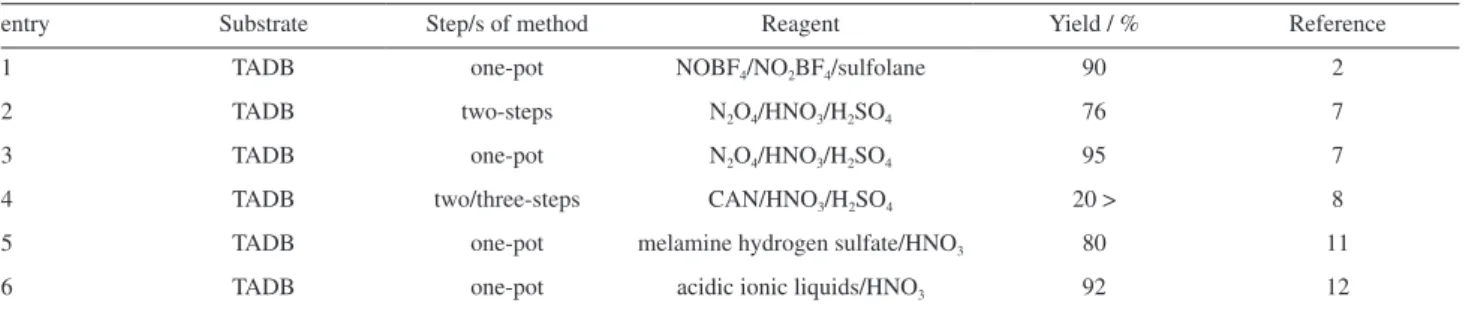
formation of environmentally unfriendly wastes that are expensive to dispose of, strong acidic media, over nitration and safety problems. Presently, the environmental concerns would not allow such means of disposal; thus, there still remains a need to develop commercially valuable process and environment-friendly methods for preparation of CL-20.10 The synthesis of CL-20 from TADB by applying melamine hydrogen sulfate/HNO311 and acidic ionic liquids/HNO312 in the one-pot reactions is reported in the recent studies of these authors. Nevertheless, these methods (Table 1) are affected by the use of stoichiometric quantities of expensive reagents and the high temperature of reaction which is a drawback of industrial scales.
Zeolites, with their unique advantages of high thermal and acid stability and high selectivity (through homogeneous pore shape and size with their defined cages and channels) have been considered at industrial scale.13-15 Zeolite is applied in catalytic cracking, isomerization and alkylation, as well as in the nitration reactions, including nitration of xylene,16 deactivated aromatic compounds,17 phenol18 and stilbene.19 Moreover, selective nitration of the aromatic compounds by zeolite/N2O520,21 and zeolite/nitric acid/acid anhydride systems22 have been published. Nevertheless, the microporous nature of these solid acids imposes diffusion limitations on the reactions involving bulky molecules.23
applied in nitrolysis of the substrate. In this study, the zeolite/HNO3 as a nitrolysis system (nitro-debenzylation, nitro-deacetylation) was applied in order to prepare CL-20 in a one-pot method using TADB. The objective of this study was to pave the way, in order to enhance the yield of CL-20 in a greener method without mixed acid waste.
Experimental
Commercial zeolites (ZSM-5, USY, NaY and LaY) were purchased from Wenzhou Foreign Trade Industrial Product Company. The zeolites were freshly calcined at 550 °C for 2 h prior to use. TADB was synthesized at Maleke-Ashtar University of Technology, Tehran, Iran.24 HNO
3 (98%) and other solvents were purchased from Merck Chemical Company. 1H nuclear magnetic resonance (NMR) spectroscopy was recorded on a Bruker FT-500 MHz instrument. Melting points were determined with an Electrothermal 9100 apparatus. The infrared (IR) spectra were recorded on a Shimadzu FT-IR 8400 spectrophotometer. The X-ray diffraction (XRD) patterns of the catalyst were recorded at room temperature on a Philips analytical PC-APD X-ray diffractometer before and after using. The purity of the products were determined by high performance liquid chromatography (HPLC) method (Waters ODS-25cm × 6mm column, λ = 226 nm,
40:60 water/acetone as mobile phase).
General experimental procedure
A mass of 0.3 g (0.58 mmol) of TADB was added gradually to a magnetically stirred mixture of 5 mL 98% nitric acid and zeolite (0.3 g) at 0 °C in a 10 mL round bottom flask. The flask was equipped with a water condenser fitted with a calcium chloride guard tube. It was heated under vigorous stirring at 85 °C for 24 h. The zeolite was then removed by suction filtration and washed with 2 mL hot 98% HNO3. The reaction mixture was cooled to room temperature; then, gradually poured into 10 g of ice-water
under stirring. Subsequently, a pale yellow precipitate was formed and filtered by sintered glass (4 mesh) and washed with water. The yield of crude products is shown in Table 1. The product was purified by flash chromatography. Finally, CL-20 was obtained as colorless crystals with purity of 99% (HPLC). m.p. 231-238 °C; UV (water/acetone)
λ
max / nm 226; IR (KBr) νmax / cm-1 2980, 1630, 1610, 1540, 1330, 1270 (Figure S1); 1H NMR (500 MHz, DMSO-d
6) d 7.99 (s, 4H, CH), 8.08 (s, 2H, CH) (Figure S2). The CL-20 crystals are mostly in α-form; XRD 2θ / degree
12.52, 13.87, 20.37, 22.46, 28.2 (Figure S3).
In addition, the pale yellow crystals of para-nitrobenzoic acid were identified as the major by-product (flash chromatography). m.p. 236-238 °C; UV (water/acetone)
λ
max / nm 260; 1H NMR (500 MHz, DMSO-d6) d 8.17 (d, 2H, J 8.75 Hz, Ph–H2 and H6,), 8.31 (d, 2H, J 8.75 Hz, Ph–H3 and H5).
Results and Discussion
As part of the present research program in producing CL-20, we have focused on the nitrolysis of TADB in a one-pot method (Scheme 1). TADB was chosen since its preparation takes fewer steps than the other methods.25
The structure of TADB is presented in Figure 1. As observed, there are two kinds of positions for nitrolysis in TADB molecule: benzylamine and acetamide groups. Zeolites are used for the first time as a heterogeneous catalyst in nitrolysis of TADB through HNO3 (as nitrating agent) in the solvent-free condition.
It is proposed that nitration reaction proceed through nitronium ions mechanism. The nitronium ions are generated by the interaction of nitric acid with the Lewis acid sites of the zeolites. It is assumed that in this nitration reaction, the Brønsted and Lewis acid sites on the surface of H-ZSM-5 could be involved; accordingly, the catalytic activity depends on the concentration of the Brønsted and Lewis acid sites. Therefore, by increasing the amount of catalyst, the accessible amount of the Brønsted and Lewis
Table 1. Reagents for the synthesis of CL-20 from TADB
entry Substrate Step/s of method Reagent Yield / % Reference
1 TADB one-pot NOBF4/NO2BF4/sulfolane 90 2
2 TADB two-steps N2O4/HNO3/H2SO4 76 7
3 TADB one-pot N2O4/HNO3/H2SO4 95 7
4 TADB two/three-steps CAN/HNO3/H2SO4 20 > 8
5 TADB one-pot melamine hydrogen sulfate/HNO3 80 11
6 TADB one-pot acidic ionic liquids/HNO3 92 12
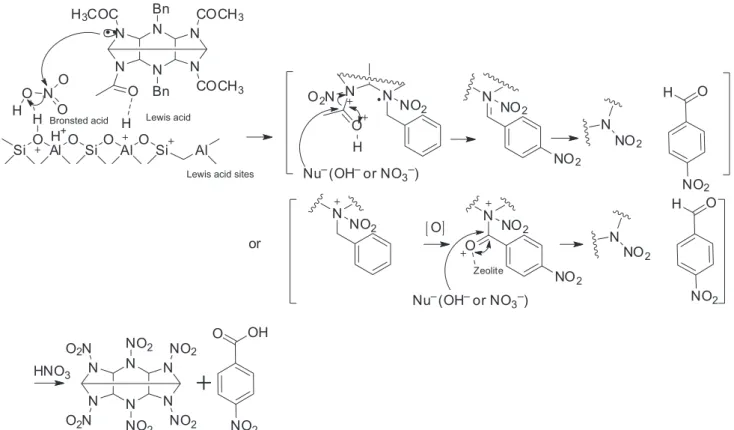
acid sites of H-ZSM-5 will increase, which explains the high conversion for the reactions carried out over more amount of catalyst. The Brønsted acid sites consist of protons adsorbed on the bridged oxygen (the Si–OH groups on the surface) and Lewis acid sites consist of three valence Al atoms (generated after dehydration through calcination).26 The proposed structure for the occurrence of nitrolysis reaction on the surface of H-ZSM-5 is shown in Scheme 2. In the acidic media, the amide activated by H+ is nitrolyzed by NO3
–
or H2O generated in the nitration reaction. The mechanism proposed by Ou et al.27 is presented Scheme 2. However, it is possible that debenzylation-nitration reaction could occur on the N-benzoyl groups (generated from benzyl groups) through nucleophilic substitution reaction of benzamide in the strong acidic media (although it is known as a difficult reaction).28
Considering the large size of TADB and CL-2029-31 and corresponding transition state molecules, the reaction occurred on the external surface of the zeolites.
The reaction yields were lower when LaY and NaY were chosen. This may be attributed to the low acidic sites on the surface of these kinds of zeolites. A maximum reaction yield (86%) was obtained when H-ZSM-5 (with both the Lewis and Brønsted acid catalytic reaction sites) was used as the solid acid catalyst. However, the isolated yield using USY was near the one obtained with H-ZSM-5. It might be due to the large pore size of USY which exposes more active sites to the nitrolysis reaction (Table 2).
The effect of amount of H-ZSM-5 on the reaction yield was investigated. The results indicated that the reaction yield improved with an increase in the amount of catalyst. This could be due to the external surface area with increasing accessible amount of the acid sites of the catalyst. On the contrary, by using a larger amount of catalyst, the yield of the reaction decreased. This may be due to the vaster solid acidic environment as well as a reduction in mobility, and consequently the cage decomposition (Table 3).
The effect of temperature on the isolated yield was studied and the results are shown in Table 4. At 90 °C the yield of reaction was low. The lower yield can be explained by the formation of by-products monitored by thin layer chromatography (TLC). It is possible that high temperature
Figure 1. Tetraacetyldibenzylhexaazaisowurtzitane structure.
cause decomposition of the isowurtzitane cage structure. Consequently, lower temperature is preferable, since the reaction efficiency was promoted at lower temperatures. At the temperature ranging from 50 to 70 °C the reactions were not completed. The optimal temperature was 85 °C.
To optimize the reaction time, five experiments were run. According to Table 5, the optimal reaction time was 24 h. Shorter and longer reaction times could not promote the reaction yield. In the longer reaction times, perhaps the cage decompositions occurred and in the shorter reaction times, the reactions were not completed.
Scheme 2. Proposed mechanism for the synthesis of CL-20 using zeolite/HNO3 system.
Table 3. Optimization of the amount of catalyst
entry Amount of H-ZSM-5 / g Yield of reaction / %
1 0.05 23
2 0.15 50
3 0.3 87
4 0.6 53
5 1 49
Reaction conditions: HNO3 (5 mL), tetraacetyldibenzylhexaazaisowurtzitane (0.58 mmol), temperature (85 °C), time (24 h).
Table 2. Synthesis of hexanitrohexaazaisowurtzitane from tetraacetyl-dibenzylhexaazaisowurtzitane via 98% nitric acid over zeolites
entry Catalyst Yield of reaction / % m.p. / °C
1 H-ZSM-5 87 210-213
2 USY 84 204-206
3 NaY 76 198-202
4 LaY 74 193-198
m.p.: melting point; reaction conditions: zeolite (0.3 g), tetraacetyl-dibenzylhexaazaisowurtzitane (0.58 mmol), HNO3 (5 mL), temperature (85 °C), time (24 h).
Table 4. Optimization of reaction temperature
entry Temperature / °C Yield of reaction / %
1 50 48
2 60 57
3 70 74
4 85 87
5 90 44
Reaction conditions: H-ZSM-5 (0.3 g), HNO3 (5 mL), tetraacetyl-dibenzylhexaazaisowurtzitane (0.58 mmol), time (24 h).
Table 5. Optimization of reaction time
entry Reaction time / h Yield of reaction / %
1 8 31
2 16 65
3 24 87
4 48 50
5 65 49
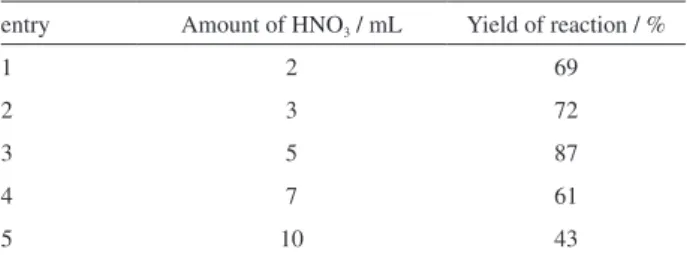
Finally, the amount of 98% HNO3 was optimized. With 5 mL HNO3, the maximum reaction yield was achieved (Table 6). By using less amount of acid, the generated nitronium ions decreased, which affected the yield of reaction. By using more amount of acid, the yield decreased, probably due to the decrease in the number of effective collisions.
The spent catalyst was regenerated by re-calcination under atmospheric condition at 550 °C for about 2 h. The reactivity of regenerated catalyst was examined under comparable conditions. The XRD patterns of H-ZSM-5 before and after first use exhibited reflections at 2θ 23.63
and 45.92°. This may be attributed to the similar structure of the catalyst (H-ZSM-5) after one use (Figure S4). However, the isolated yield of reaction using H-ZSM-5 after the first useshowed a decrease from 87 to 66%.
Finally, the synthesis of CL-20 from TADB was thoroughly examined by acetic anhydride/HNO3 over H-ZSM-5 and USY, as well as by using N2O5/CHCl3/ H-ZSM-5 and USY.20-22,32 These nitrolysis systems showed no CL-20 even at reflux temperature or prolonged reaction times (monitored by TLC).
Conclusions
A facile heterogeneous catalytic methodology was successfully applied for the conversion of TADB to CL-20. The zeolite/HNO3 system was used for the first time as a nitrolysis system which provides an ideal platform for safer condition to the synthesis of CL-20. In this study, the H-ZSM-5, as the solid acid catalyst, has shown the best catalytic activity. The maximum yield of reaction of 87% (crude yield) has been obtained in the optimized condition (24 h, 85 °C, 5 mL 98% HNO3, 0.3 g H-ZSM-5 and 0.3 g TADB).
Supplementary Information
Supplementary information is available free of charge at http://jbcs.sbq.org.br as PDF file.
Acknowledgments
The authors wish to thank the Department of Chemistry, Malek-Ashtar University of Technology, Tehran, Iran for providing financial support.
References
1.Willer, R. L.; New Trends Res. Energ. Mater., Proc. Semin., 16th2013,384.
2. Nielsen, A. T.; Chafin, A. P.; Christian, S. L.; Moore, D. W.; Nadler, M. P.; Nissan, R. A.; Vanderah, D. J.; Gilardi, R. D.; George, C. F.; Flippen-Anderson, J. L.; Tetrahedron 1998, 54, 11793.
3. Nair, U.; Sivabalan, R.; Gore, G.; Geetha, M.; Asthana, S.; Singh, H.; Combust., Explos. Shock Waves2005, 41, 121. 4. Ghosh, M.; Venkatesan, V.; Sikder, A. K.; Sikder, N.; Def. Sci.
J.2012, 62, 390.
5. Yu, L.; Jiang, X.; Guo, X.; Ren, H.; Jiao, Q., J. Therm. Anal. Calorim.2013, 112, 1343.
6. Xubin, G.; Chenghui, S.; Siping, P.; Jing, Z.; Yuchuan, L.; Xinqi, Z.; Chin. J. Org. Chem. 2012, 32, 486.
7. Latypov, N. V.; Wellmar, U.; Goede, P.; Bellamy, A. J.; Org. Process Res. Dev. 2000, 4, 156.
8. Gore, G.; Sivabalan, R.; Nair, U.; Saikia, A.; Venugopalan, S.; Gandhe, B.; Indian J. Chem., Sect. B: Org. Chem. Incl. Med. Chem.2007, 46, 505.
9. Pang, S. P.; Yu, Y. Z.; Zhao, X. Q.; Propellants, Explos., Pyrotech.2005, 30, 442.
10. Sreedhar, I.; Singh, M.; Raghavan, K.; Catal. Sci. Technol.2013,
3, 2499.
11. Bayat, Y.; Zolfigol, M. A.; Khazaei, A.; Mokhlesi, M.; Daraei, M.; Heydari Nezhad Tehrani, A.; Chehardoli, G.;
Propellants, Explos., Pyrotech. 2013, 38, 745.
12. Bayat, Y.; Ahari-Mostafavi, M. M.; Hasani, N.; Propellants, Explos., Pyrotech. 2014, 39. 649.
13. Pande, H.; Parikh, P.; J. Mater. Eng. Perform. 2013, 22, 190.
14. Li, T.; Liu, H.; Fan, Y.; Yuan, P.; Shi, G.; Bi, X. T.; Bao, X.;
Green Chem. 2012, 14, 3255.
15. Guangwei. Q.; Qian, W.; Denghua, X.; Zhaoxiang, Y.; Sci. Technol. Chem. Ind.2013, 3, 7; Daramola, M. O.; Aransiola,
E. F.; Ojumu, T. V.; Materials2012, 5, 2101.
16. Sengupta, S. K.; Schultz, J. A.; Walck, K. R.; Corbin, D. R.; Ritter, J. C.; Top. Catal. 2012, 55, 601.
17. Smith, K.; Gibbins, T.; Millar, R. W.; Claridge, R. P.; J. Chem. Soc., Perkin Trans. 12000, 2753.
18. Arshadi, M.; Ghiaci, M.; Gil, A.; Ind. Eng. Chem. Res.2010,
49, 5504.
19. Xu, J.-H.; Wei, J.-P.; Hao, Z.; Ma, Q.-G.; Peng, X.-H.; Chem. Commun. 2014, 50, 10710.
Table 6. Optimization of amount of acid
entry Amount of HNO3 / mL Yield of reaction / %
1 2 69
2 3 72
3 5 87
4 7 61
5 10 43
20. Ma, X. M.; Li, B. D.; Chen, L.; Lu, M.; Lv, C. X.; Chin. Chem. Lett. 2012, 23, 809.
21. Claridge, R.; Llewellyn Lancaster, N.; Millar, R.; Moodie, R.; Sandall, J. B.; J. Chem. Soc., Perkin Trans. 2 1999, 1815. 22. Smith, K.; Alotaibi, M. H.; El-Hiti, G. A.; ARKIVOC 2014,
4,107.
23. Barone, G.; Casella, G.; Giuffrida, S.; Duca, D.; J. Phys. Chem. C2007, 111, 13033.
24. Bayat, Y.; Ebrahimi, H.; Fotouhi-Far, F.; Org. Process. Res. Dev.2012, 16, 1733.
25 Sysolyatin, S. V.; Lobanova, A. A.; Chernikova, Y. T.; Sakovich, G. V.; Russ. Chem. Rev. 2005, 74, 757.
26. Hölderich, W.; Hesse, M.; Näumann, F.; Angew. Chem., Int. Ed. 1988, 27, 226.
27. Ou, Y.; Jia, H.; Xu, Y.; Chen, B.; Fan, G.; Liu, L.; Wang, C.;
Sci. China, Ser. B: Chem.1999, 42, 217.
28. Pang, S. P.; Yu, Y. Z.; Zhao, X. Q.; Propellants, Explos., Pyrotech.2005, 30, 442.
29. Clawson, J. S.; Anderson, K. L.; Pugmire, R. J.; Grant, D. M.;
J. Phys. Chem. A. 2004, 108, 2638.
30. Kholod, Y.; Okovytyy, S.; Kuramshina, G.; Qasim, M.; Gorb, L.; Leszczynski, J.; J. Mol. Struct. 2007, 843, 14.
31. Tai, Y. F.; Ji, C.; Shi, C. J.; Wang, W.; Peng, X. H.; Bull. Korean Chem. Soc. 2014, 35, 1241.
32. Talawar, M.; Sivabalan, R.; Polke, B.; Nair, U.; Gore, G.; Asthana, S.; J. Hazard. Mater.2005, 124, 153.
Submitted: July 8, 2015