Article
*e-mail: [email protected]
PhSeBr-Catalyzed Selective Addition of Thiols to
α
,
β
-Unsaturated Carbonyl
Compounds: Regioselective Synthesis of Thioacetals
vs
.
β
-Mercapto Ketones
Caroline C. Schneider,a Flávia Manarin,a Rodrigo B. Panatieri,b
Olga S. R. Barrosc and Gilson Zeni*,a
aLaboratório de Síntese, Reatividade, Avaliação Farmacológica e Toxicidade de
Organocalcogênios, CCNE, UFSM, 97105-900 Santa Maria-RS, Brazil
bUniversidade Federal de Uberlândia, Faculdade de Ciências Integradas do
Pontal-Ituiutaba, 38302-000 Ituiutaba-MG, Brazil
cInstituto de Química, Universidade Federal de Góias, 74001-970 Goiania-GO, Brazil
Apresentamos aqui nossos resultados da adição de tióis, catalisada por PhSeBr, a compostos carbonílicos α,β-insaturados sob condições brandas para obter regiosseletivamente β-mercapto cetonas ou tioacetais com altos rendimentos e seletividade. A reação foi principalmente controlada pela temperatura, na qual os produtos de adição 1,4 foram obtidos à temperatura de –20 oC. Inversamente quando a reação foi realizada sob reluxo, tioacetais foram obtidos como único produto. O método admite diversos grupos funcionais, como alquilicos, benzilicos e arilicos com substituintes neutros, deicientes e ricos em elétrons no anel aromático.
We present herein results on the PhSeBr-catalyzed addition of thiols to α,β-unsaturated carbonyl compounds under mild conditions to afford regioselectivily β-mercapto ketones or thioacetals in high yields and selectivity. The reaction was highly controlled by the temperature in which, the 1,4-addition products were obtained when the temperature was –20 °C, conversely when the reaction was carried out at relux, the thioacetals were obtained as a sole product. The developed protocol stands a wide range of functional groups, in which alkyl, benzyl and aryl with neutral, electron deicient and electron rich substituents on the aromatic ring.
Keywords: thioacetals, β-mercapto ketones, chalcogenides
Introduction
Thioacetals are useful intermediates in organic synthesis and are often used as masked carbonyl groups, in particular α-lithiated thioacetals that are synthetic equivalents of carbonyl anions.1,2 Thioacetals and thioketals
are particularly attractive as carbonyl protecting groups in complex molecule synthesis because of their added stability to acidic conditions. In this view, there have been continued improvements in the thioacetal synthesis methods. Usually, these compounds are prepared by protic or Lewis acid-catalyzed condensation of carbonyl compounds with thiols. Lewis acid catalysts such as ZnCl2,3
LnCl3,4 FeCl 3/SiO2,
5 AlCl 3,
6 ZrCl 4/SiO2
7 TeCl 4,
8 SnCl 2,
9
SiCl4,10 TiCl 4,
11 BF 3•OEt2
12 and others methods13-15 have
been used for this purpose. Despite those methods reported
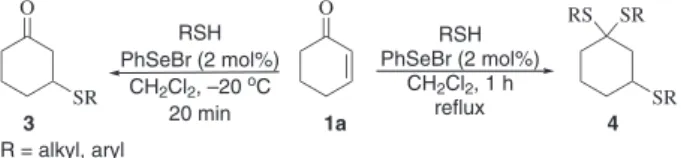
in the literature, some problems were found as, dificulties in work-up, isolation, requirement of inert atmosphere, harsh reaction conditions, expensive and stoichiometric reagents, incompatibility with other protecting groups and failure to protect desactivated and hindered substrates. In contrast, none of the reported methods describe the selective catalytic preparation of β-mercapto ketones or thioacetals from α,β-unsaturated carbonyl compounds with thiols, catalyzed by PhSeBr. Therefore, it would be of interest to deine a method in order to prepare selectively β-mercapto ketones or thioacetals starting from α,β-unsaturated carbonyl compounds and thiols (Scheme 1).
Results and Discussion
Our initial studies have focused on the development of an optimum set of reaction conditions to obtain
Schneider et al. 2089 Vol. 21, No. 11, 2010
this way, cyclohex-2-enone 1a and benzenethiol 2a were used as standard substrates and the variation in the temperature, time, presence or absence of catalyst were investigated. At irst, the reaction was tested under room temperature, using CH2Cl2 as solvent in the presence
of PhSeBr (2 mol%); thus after 10 min the product of 1,4-addition was obtained in 65% yield. However, under this reaction condition traces of the thioacetal were also obtained. In attempt to avoid the thioacetal by-product and to select the β-mercapto ketones, as a sole product, we carried out the reaction at 0 and –20 °C. At 0 °C a mixture of both β-mercapto ketone and thioacetal was yet obtained, but changing the temperature to –20 °C, after 20 min, the desired product in 79% yield was found with no mixture. Regarding the inluence of the catalyst, neither β-mercapto ketones nor thioacetals
Scheme 1. General scheme.
O
RSH PhSeBr (2 mol%)
CH2Cl2, 1 h
reflux
RS
SR SR RSH
PhSeBr (2 mol%) CH2Cl2, –20 oC
20 min O
SR
R = alkyl, aryl
1a
3 4
Table 1. Addition of thiols in the carbonyl group; synthesis of β-mercapto ketones
Entry Ketone Thiol Product Yield
(%)
9 1a O SH
2i
O
S O
3i
84
10 1a O
N SH
2j
no product N.R.
11 1a
SH Cl
2k
O
S(o-Cl)Ph
3k 71 12 O 1b O SH 2i O S O 3l 78 13 1b SH 2a O SPh 3m 62 14 1b SH Cl 2k O
S(o-Cl)Ph
3n 56 15 1b SH OMe 2g O
S(o-OMe)Ph
3o
50
N.R.: no reaction.
Entry Ketone Thiol Product Yield
(%) 1 O 1a SH 2a O SPh 3a 79 2 1a SH 2b O
S(n-Pr)
3b 74 3 1a SH 2c O SBn 3c 63 4 1a SH 2d O S(t-Bu) 3d 74
5 1a C12H25SH2e
O
SC12H25
3e 76 6 1a SH 2f O S(s-Bu) 3f 61 7 1a SH OMe 2g O
S(p-OMe)Ph
3g 95 8 1a SH Cl 2h O
S(p-Cl)Ph
3h
75 O
PhSeBr (2 mol%)
CH2Cl2, –20 oC
were obtained when the reactions was carried out in the absence of PhSeBr. Thus, the analysis of the optimized reaction conditions demonstrated that the optimal ones for this procedure were the addition of cyclohex-2-enone 1a (1 mmol), benzenethiol 2a (1.1 mmol), PhSeBr (2 mol%) and CH2Cl2 (1 mL) as a solvent. After the addition, the reaction was stirred for 20 min at –20 oC
and the product 3a was obtained in 79% yield. These reactions conditions were systematically applied to other substrates to demonstrate the eficiency of this method, and the results are summarized in Table 1.
Inspections of Table 1 show that in general, all of the reactions proceeded smoothly with good yields. Most
importantly, the addition turned out to be general with respect to a diverse array of functional thiol sources. Our experiments showed that the reaction with thiols having aryl and aryl substituted, was sensitive to the electronic nature of functional groups present in the aromatic ring. Electron donating group such as metoxy gave the conjugated addition product in high yield 95%, in contrast to this, electron withdrawing group decrease the yield (Table 1, entries 7, 8 and 11). We also observed that hindered and non-hindered alkyl thiols gave the desired products in good yields (Table 1; entries 2, 4 and 6). As shown in Table 1, bulky carbonyl ketone afforded the 1,4-addition product in moderated yields (Table 1, entries 13-15). A limitation
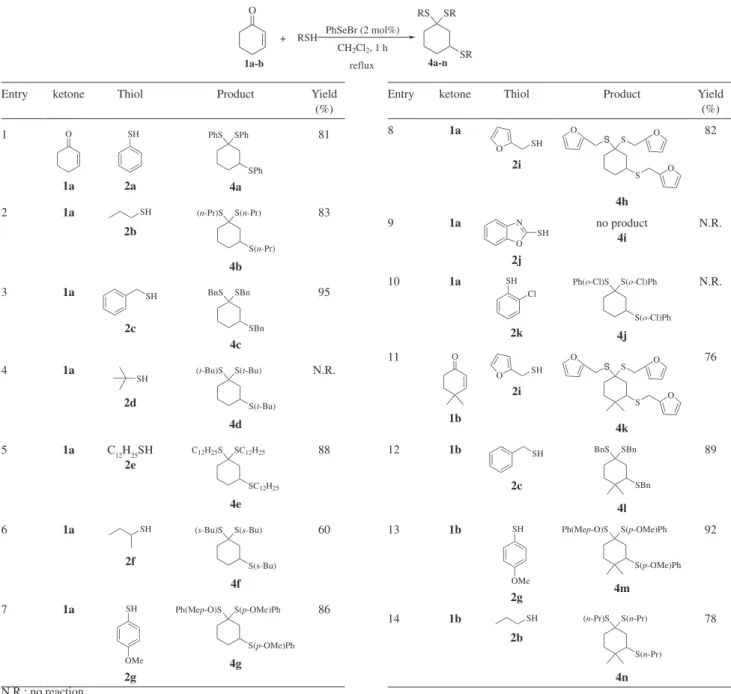
Table 2. Addition of thiols in the carbonyl group; synthesis of thioacetals Aqui corrigir só o 1 h
Entry ketone Thiol Product Yield
(%) 8 1a O SH 2i S S S O O O 4h 82 9 1a O N SH 2j no product 4i N.R.
10 1a SH
Cl
2k
Ph(o-Cl)S
S(o-Cl)Ph S(o-Cl)Ph
4j N.R. 11 O 1b O SH 2i S S S O O O 4k 76
12 1b SH
2c BnS SBn SBn 4l 89
13 1b SH
OMe 2g Ph(Mep-O)S S(p-OMe)Ph S(p-OMe)Ph 4m 92
14 1b SH
2b
(n-Pr)S
S(n-Pr) S(n-Pr)
4n
78
N.R.: no reaction.
Entry ketone Thiol Product Yield
(%) 1 O 1a SH 2a PhS SPh SPh 4a 81
2 1a SH
2b
(n-Pr)S
S(n-Pr) S(n-Pr)
4b
83
3 1a SH
2c BnS SBn SBn 4c 95 4 1a SH 2d
(t-Bu)S
S(t-Bu) S(t-Bu)
4d
N.R.
5 1a C12H25SH
2e
C12H25S
SC12H25
SC12H25
4e
88
6 1a SH
2f
(s-Bu)S
S(s-Bu) S(s-Bu)
4f
60
7 1a SH
OMe 2g Ph(Mep-O)S S(p-OMe)Ph S(p-OMe)Ph 4g 86 O 1a-b RSH
+ PhSeBr (2 mol%) CH2Cl2, 1 h
reflux
RS
SR SR
Schneider et al. 2091 Vol. 21, No. 11, 2010
in this methodology was observed when oxazolethiol derivative 2j was used as thiol source. In this case no product was obtained, even under long reaction time, probably due to steric effects.
It was gratifying to discover the use of cyclohex-2-enone 1a and benzenethiol 2a as standard substrates and the simply changing in the temperature from -20 °C to relux, in the procedure described to obtaine β-mercapto ketones 3, had a dramatic effect. Thus, the reaction of cyclohex-2-enone 1a (1 mmol), benzenethiol 2a (4.0 equiv.) with PhSeBr (2 mol%) in CH2Cl2 (1 mL) at relux, gave thioacetal 4a as the sole product in 85% yield. Using the optimized reaction conditions, a wide variety of thiols containing useful functional groups can be successfully used as substrate (Table 2). The results revealed that the aryl, alkyl and benzyl thiols, gave the product eficiently under these conditions. The exception was the bulky thiols 2d, 2J and 2k, which did not gave the desired product, even changing the reaction conditions.
The fact that the protection of thiols has found widespread applications in the organic transformations16
associated with the simple preparation, low cost and easy handling of PhSeBr, prompted us to study its application on the thiol reaction with dihydropyrane. Thus, the standard reaction condition applied to prepare the β-mercapto ketones 3 was also tested for the reaction of thiols and dihydropyrane. In this way, the reaction of
Table 3 Addition of thiols in dihydropyrane; synthesis of thioethers
PhSeBr (2 mol%)
CH2Cl2, 0 oC
10 min RSH
+
O O SR
1c 5a-f
Entry Thiol Produt Yield (%)
1 SH
2b
O S(n-Pr)5a
75
2 2c
O SBn5b
91
3 SH
OMe2g
O S(p-OMe)Ph5c
87
4
O SH2i
O S O
5d
61
5 SH
Cl
2k
O S(o-Cl)Ph5e
85
6 SH
Cl 2f O S(p-Cl)Bn5f
90
dihydropyrane 1c (1 mmol), benzenethiol 2a (1.1 mmol), PhSeBr (2 mol%) and CH2Cl2 (1 mL) as a solvent, at 0 oC for 10 min gave THP thioether in 75% yield. The
scope and limitations of this protection are summarized in Table 3.
The results showed that the reaction is not sensitive to the electronic effect at aromatic ring in the thiol. For example, both arylthiol bearing electron-donating (OMe) and electron-withdrawing (Cl) group gave the product in good yields. Differentiation in the reactivity between chlorine and sulfur atoms of thiol can also be seen by the reaction of thiols 2k and 2f to provide only the THP thioether products in 85 and 90% yields, respectively, without any side-product observed. In this case, the chlorine substituent was not affected.
Conclusions
We described herein an eficient method for PhSeBr-mediated addition of thiols to α,β-unsaturated carbonyl compounds providing a versatile and regioselective synthesis of 1,4-addition products or thioacetals. The reaction was highly controlled by the temperature in which, the 1,4-addition products were obtained when the temperature was –20 °C; conversely when the reaction was carried out at relux thioacetals were obtained as a sole product. With this protocol, we were also able to prepare THP thioethers under mild conditions in fair to excellent yields demonstrating the versatility of the PhSeBr in this catalytic system. The advantages of this method include, the use of cheap, easy and handle catalyst, non anhydrous reaction conditions, non aqueous work-up and ease of product isolation, besides short reaction times and high yields. This reaction associated with the ease in which the protect group can be removed from thiol, can contribute to an interesting alternative route for preparation of more functionalized organothiols.
Supplementary Information
Experimental details and spectra are available free of charge at http://jbcs.sbq.org.br, as PDF ile.
Acknowledgments
References
1. Greene, T. W.; Wuts, P. G. M.; Protecting Groups in Organic Synthesis, 3rd ed.; John Wiley & Sons: New York, 1999, pp. 297-348.
2. Cordes, E. H.; Bull, H. G.; Chem. Rev. 1974, 74, 581. 3. Truce, W. E.; Roberts, F. E.; J. Org. Chem.1963, 28, 961. 4. Garlaschelli, L.; Vidari, G.; Tetrahedron Lett. 1990, 31, 5815. 5. Patney, H. K.; Tetrahedron Lett. 1991, 32, 2259.
6. Ong, B. S.; Tetrahedron Lett. 1980, 21, 4225.
7. Patney, H. K.; Margan, S.; Tetrahedron Lett. 1996, 37, 4621. 8. Tani, H.; Masumoto, K.; Inamasu, T.; Tetrahedron Lett. 1991,
32, 2039.
9. Das, N. B.; Nayak, A.; Sharma, R. P.; J. Chem. Res. (S)1993, 242. 10. Ku, B.; Oh, D. Y.; Synth. Commun. 1989, 19, 433.
11. Kumar, V.; Dev, S.; Tetrahedron Lett. 1983, 24, 1289. 12. Fieser, L. F.; J. Am. Chem. Soc. 1954, 76, 1945.
13.Khurana, J. M.; Agrawal, A.; Kumar, S.; J. Braz. Chem. Soc.
2009, 20, 1256.
14.Lenardão, E. J.; Trecha, D. O.; Ferreira, P. C.; Jacob, R. G.; Perin, G.; J. Braz. Chem. Soc. 2009, 20,93.
15. Almeida, Q. A. R.; Pereira, M. L. D. O.; Coelho, R. B.; J. Braz. Chem. Soc. 2008, 19, 894
16. Masaki, Y.; Tanaka, N.; Miura, T.; Tetrahedron Lett.1998, 39, 5799.
17. General procedure for b-mercapto ketones formation: To a Schlenck tube, under air atmosphere containing an appropriate
α,β-unsaturated carbonyl compound (0.50 mmol) in CH2Cl2 (2.0 mL), was added the thiol (0.6 mmol). In the resulting solution was added PhSeBr (2 mol%) and the reaction mixture was allowed to stir for 20 min at –20 oC. After that, the mixture
was concentrated under vacuum. The residue was puriied by lash chromatography on silica gel using ethyl acetate/hexane as the eluent. 3-(Phenylthio)cyclohexanone (3a): Yield 0.162 g (79%). 1HNMR (CDCl
3, 400 MHz): d 7.43-7.40 (m, 2H),
7.33-7.25 (m, 3H), 3.46-3.37 (m, 1H), 2.68 (d, J 9.7 Hz, 1H), 2.40-2.25 (m, 3H), 2.17-2.08 (m, 2H), 1.80-1.63 (m, 2H). 13C
NMR (CDCl3, 100 MHz): d 208.63, 133.09, 132.88, 128.95, 127.66, 47.63, 45.98, 40.75, 31.09, 23.90. HRMS calc. for C12H24OS: 206.0765. Found: 206.0769.
18. General procedure for thioacetals formation: To a Schlenck tube, under air atmosphere containing an appropriate
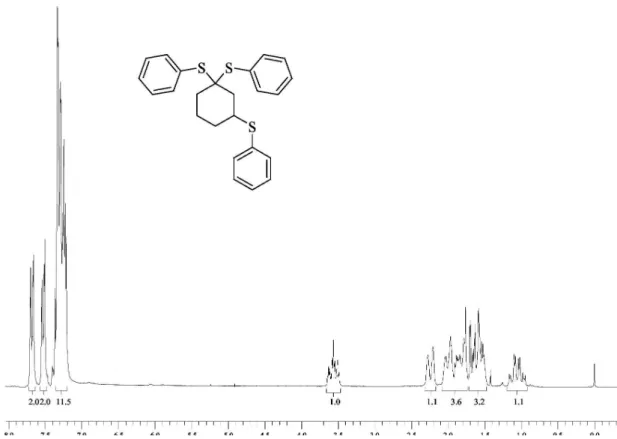
α,β-unsaturated carbonyl compounds (0.50 mmol) in CH2Cl2 (2.0 mL), was added the thiol (2.0 mmol). In the resulting solution was added PhSeBr (2 mol%) and the reaction mixture was allowed to stir for 1 h under relux. After that, the mixture was concentrated under vacuum. The residue was puriied by lash chromatography on silica gel using ethyl acetate/hexane as the eluent. 1,1,3-tris(Phenylthio)cyclohexane (4a): Yield 0.330 g (81%). 1HNMR (CDCl
3, 200 MHz), d: 7.70-7.65
(m, 2H), 7.54-7.50 (m, 2H), 7.35-7.20 (m, 11H), 3.56 (tt, J
12.0/3.5 Hz, 1H), 2.28-2.19 (m, 1H), 2.03-1.75 (m, 3H), 1.69-1.50 (m, 3H), 1.16-0.94 (m, 1H). 13C NMR (CDCl
3, 100 MHz)
d: 137.33, 136.11, 133.67, 132.63, 130.90, 130.72, 129.16, 128.96, 128.77, 128.61, 128.55, 127.08, 65.05, 43.37, 42.73, 36.12, 32.15, 22.66. HRMS calc. for C24H24S3: 408.1040. Found: 408.1043.
19. General procedure for thioethers formation: To a Schlenck tube, under air atmosphere containing an appropriate dihydropyrane (0.50 mmol) in CH2Cl2 (2.0 mL), was added the thiol (0.6 mmol). In the resulting solution was added PhSeBr (2 mol%) and the reaction mixture was allowed to stir for 20 min at 0 oC.
After this, the mixture was concentrated under vacuum. The residue was puriied by lash chromatography on silica gel using ethyl acetate/hexane as the eluent. 2-(Propylthio)-tetrahydro-2H-pyran (5a):Yield 0.120 g (75%). 1HNMR (CDCl
3, 400
MHz) d: 4.16-3.71 (m, 2H), 3.53-3.36 (m, 1H), 2.72-2.49 (m, 2H), 1.92-1.51 (m, 8H), 0.99 (t, J 7.20 Hz, 3H). 13C NMR
(CDCl3, 100 MHz) d: 98.80, 67.26, 62.26, 51.81, 35.98, 29.21, 25.44, 19.59. HRMS calc. for C8H16OS: 160.0921. Found: 160.0918.
Supplementary Information
J. Braz. Chem. Soc., Vol. 00, No. 00, S1-S19, 2010. Printed in Brazil - ©2010 Sociedade Brasileira de Química 0103 - 5053 $6.00+0.00
*e-mail: [email protected]
PhSeBr-Catalyzed Selective Addition of Thiols to
α
,
β
-Unsaturated Carbonyl
Compounds: Regioselective Synthesis of Thioacetals
vs
.
β
-Mercapto Ketones
Caroline C. Schneider,a Flávia Manarin,a Rodrigo B. Panatieri,b Olga S. R. Barrosc and
Gilson Zeni*,a
a Laboratório de Síntese, Reatividade, Avaliação Farmacológica e Toxicidade de
Organocalcogênios, CCNE, UFSM, 97105-900 Santa Maria-RS, Brazil
b Universidade Federal de Uberlândia, Faculdade de Ciências Integradas do Pontal-Ituiutaba,
38302-000 Ituiutaba-MG, Brazil
cInstituto de Química, Universidade Federal de Góias, 74001-970 Goiania-GO, Brazil
Proton nuclear magnetic resonance spectra (1H NMR) were obtained at 200 MHz on a DPX-200 NMR spectrometer or at 400 MHz on DPX-400 NMR spectrometer. Spectra were recorded in CDCl3 solutions. Chemical shifts are reported in ppm, referenced to the solvent peak of CDCl3 or tetramethylsilane (TMS) as the external reference. Data are reported as follows: chemical shift (d), multiplicity, coupling constant (J) in Hertz and integrated intensity. Carbon-13 nuclear magnetic resonance spectra (13C NMR) were obtained either at 50 MHz on a 200 NMR spectrometer or at 100 MHz on a
DPX-400 NMR spectrometer. Spectra were recorded in CDCl3
solutions. Chemical shifts are reported in ppm, referenced to the solvent peak of CDCl3. Abbreviations to denote the multiplicity of a particular signal are s (singlet), d (doublet), t (triplet), q (quartet), quint (quintet), sex (sextet) and m (multiplet). High resolution mass spectra were recorded on a MS50TC double focusing magnetic sector mass spectrometer using EI at 70 eV. Column chromatography was performed using Silica Gel (230-400 mesh) following the methods described by Still (Still, W. C.; Kahn, M.; Mitra, A.; J. Org. Chem. 1978, 43, 2923). Thin layer chromatography (TLC) was performed using Silica Gel GF254, 0.25 mm thickness. For visualization, TLC plates were either placed under ultraviolet light, or stained with iodine vapour, or acidic vanillin. Most reactions were monitored by TLC for disappearance of starting material. Air- and moisture-sensitive reactions were conducted in lame-dried or oven dried glassware equipped with tightly itted rubber septa and under a positive atmosphere of dry argon. Reagents and solvents were handled using standard
syringe techniques. Temperatures above room temperature were maintained by use of a mineral oil bath with an electrically heated coil connected to a Variac controller.
General procedure for b-mercapto ketones
To a Schlenck tube, under air atmosphere containing an appropriate α,β-unsaturated carbonyl compounds (0.50 mmol) in CH2Cl2 (2.0 mL), was added the thiol (0.6 mmol). In the resulting solution was added PhSeBr (2 mol%) and the reaction mixture was allowed to stir for 20 min at −20 oC. After that, the mixture was concentrated under vacuum. The residue was puriied by lash chromatography on silica gel using ethyl acetate/ hexane as the eluent.
3-(Phenylthio)cyclohexanone (3a)
Yield: 0.162 g (79%). 1HNMR (CDCl
3, 400 MHz) d: 7.43-7.40 (m, 2H), 7.33-7.25 (m, 3H), 3.46-3.37 (m, 1H), 2.68 (d, J 9.7 Hz, 1H), 2.40-2.25 (m, 3H), 2.17-2.08 (m, 2H), 1.80-1.63 (m, 2H). 13C NMR (CDCl
3, 100 MHz): d 208.63, 133.09, 132.88, 128.95, 127.66, 47.63, 45.98, 40.75, 31.09, 23.90. HRMS calc. for C12H24OS: 206.0765. Found: 206.0769.
3-(Propylthio)cyclohexanone (3b)
Yield: 0.127 g (74%). 1HNMR (CDCl
3, 400 MHz) d: 3.08-3.01 (m, 1H), 2.70 (d, J 9.5 Hz, 1H), 2.53 (t, J 7.4 Hz, 2H), 2.41-2.31 (m, 3H), 2.18-2.10 (m, 2H), 1.76-1.68 (m, 2H), 1.60 (sex, J 7.3 Hz, 2H), 0.99 (t, J 7.3 Hz, 3H).
13C NMR (CDCl
3-(Benzylthio)cyclohexanone (3c)
Yield: 0.138 g (63%). 1HNMR (CDCl
3, 200 MHz), d: 7.32-7.21 (m, 5H), 3.76 (s, 2H), 3.00-2.86 (m, 1H), 2.67 (dd, J 9.6/4.4 Hz, 1H), 2.40-2.29 (m, 3H), 2.17-2.02
(m, 2H), 1.73-1.61 (m, 2H). 13C NMR (CDCl
3, 100 MHz) d: 208.13, 137.61, 128.39, 128.23, 126.75, 47.39, 41.67, 40.55, 34.55, 30.86, 23.70. MS (relative intensity) m/z: 220 (11), 123 (32), 97 (53), 91 (100). HRMS calc. for C13H16OS: 220.0921. Found: 220.0925.
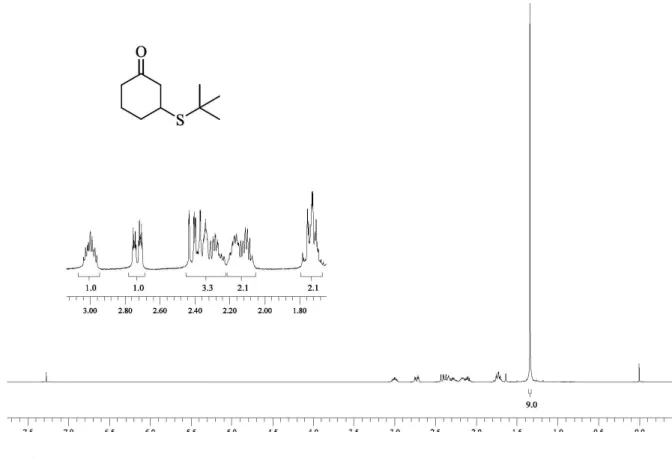
3-(terc-Butylthio)cyclohexanone (3d) Yield: 0.137 g (74%). 1HNMR (CDCl
3, 400 MHz) d: 3.03-2.96 (m, 1H), 2.72 (dd, J 9.3/4.7 Hz, 1H), 2.43-2.22 (m, 3H), 2.20-2.06 (m, 2H), 1.77-1.69 (m, 2H), 1.34 (s,
9H). 13C NMR (CDCl
3, 100 MHz) d: 208.92, 50.66, 43.49, 40.51, 40.46, 34.13, 31.27, 24.46. MS (relative intensity) m/z: 186 (30), 171 (1), 130 (29), 96 (50). HRMS calc. for C10H18OS: 186.1078. Found: 186.1081.
3-(Dodecylthio)cyclohexanone (3e) Yield: 0.226 g (76%). 1HNMR (CDCl
3, 400 MHz) d: 3.09-3.01 (m, 1H), 2.71 (dd, J 9.6/4.3 Hz, 1H), 2.54 (t, J 7.5 Hz, 2H), 2.40-2.31 (m, 3H), 2.17-2.10 (m, 2H), 1.77-1.67 (m, 2H), 1.59-1.53 (m, 3H), 1.40-1.26 (m, 17H), 0.88 (t, J 7.5 Hz, 3H). 13C NMR (CDCl
3, 100 MHz) d: 199.60, 39.05, 37.92, 31.78, 29.50, 29.47, 29.39, 29.22, 29.11, 29.09, 28.39, 25.56, 22.55, 13.98. MS (relative intensity) m/z: 267 (1), 201 (45), 129 (4), 97 (22). HRMS calc. for C18H34OS: 298.2330. Found: 298.2332.
3-(sec-Butylthio)cyclohexanone (3f) Yield: 0.113 g (61%). 1HNMR (CDCl
3, 400 MHz) d: 3.14-3.04 (m, 1H), 2.77 (sex d, J 7.0/2.3 Hz, 1H), 2.69 (dd, J 9.5/4.2, 1H), 2.40-2.31 (m, 3H), 2.18-2.09 (m, 2H), 1.78-1.67 (m, 2H), 1.63-1.45 (m, 2H), 1.25 ( d, J 6.7 Hz, 3H), 0.97 (t, J 7.4 Hz, 3H). 13C NMR (CDCl
3, 100 MHz) d: 208.79, 48.54, 41.34, 40.78, 40.40, 31.89, 29.79, 24.09, 20.98, 11.10. MS (relative intensity) m/z: 186 (30), 171 (1), 157 (20), 143 (1), 129 (21), 97 (100). HRMS calc. for C10H18OS: 186.1078. Found: 186.1083.
3-(4-Methoxyphenylthio)cyclohexanone (3g)
Yield: 0.224 g (95%). 1HNMR (CDCl
3, 400 MHz) d: 7.41-7.37 (m, 2H), 6.86-6.78 (m, 2H), 3.80 (s, 3H), 3.27-3.19 (m, 1H), 2.61 (dd, J 9.6/4.4 Hz, 1H), 2.35-2.26 (m, 3H), 2.16-2.04 (m, 2H), 1.73-1.64 (m, 2H). 13C NMR (CDCl3, 100 MHz) d: 208.61, 159.70, 136.17, 122.70, 114.33, 55.05, 47.45, 46.72, 40.55, 30.91, 23.73. MS (relative intensity) m/z: 236 (70), 207 (1), 140 (100), 97 (19). HRMS calc. for C13H16O2S: 236.0871. Found: 236.0867.
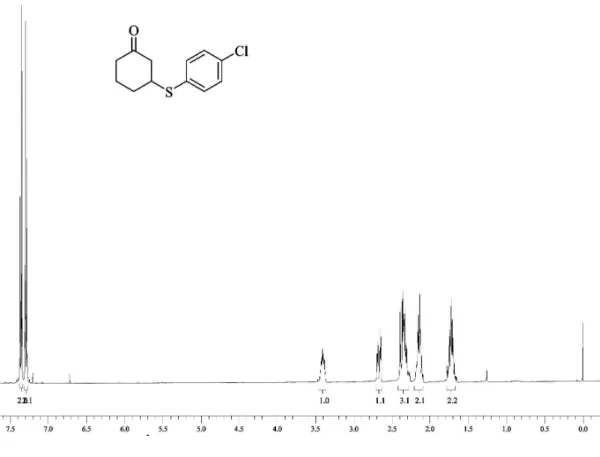
3-(4-Chlorophenylthio)cyclohexanone (3h) Yield: 0.180 g (75%). 1HNMR (CDCl
3, 400 MHz) d: 7.37-7.33 (m, 2H), 7.30-7.26 (m, 2H), 3.43-3.36 (m, 1H), 2.66 (dd, J 9.4/4.5 Hz, 1H), 2.39-2.26 (m, 3H),
2.18-2.09 (m, 2H), 1.77-1.67 (m, 2H). 13C NMR (CDCl
3, 100 MHz) d: 208.28, 134.48, 133.99, 131.45, 129.17, 47.52, 46.27, 40.74, 31.05, 23.87. HRMS calc. for C12H13ClOS: 240.0375. Found: 240.0379.
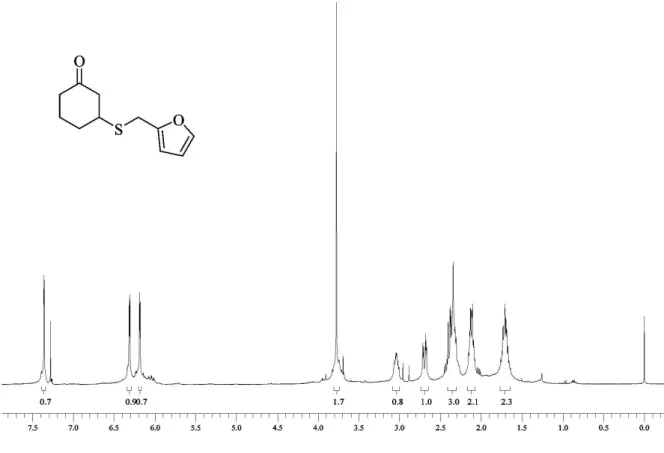
3-(Furan-2-ylmethylthio)cyclohexanone (3i) Yield: 0.176 g (84%). 1HNMR (CDCl
3, 200 MHz) d: 7.35 (dd, J 1.7/0.7 Hz, 1H), 7.30 (dd, J 3.1/1.9 Hz, 1H), 6.18 (dd, J 3.1/0.7 Hz, 1H), 3.77 (s, 2H), 3.08-3.00 (m, 1H), 2.69 (dd, J 9.3/4.2 Hz, 1H), 2.40-2.30 (m, 3H),
2.15-2.08 (m, 2H), 1.76-1.65 (m, 2H). 13C NMR (CDCl
3, 100 MHz) d: 208.61, 151.24, 142.10, 110.42, 107.40, 47.65, 42.32, 40.82, 31.14, 26.94, 24.05. MS (relative intensity) m/z: 210 (6), 114 (20), 97 (12), 81 (100). HRMS calc. for C11H14O2S: 210.0714. Found: 210.0719.
3-(2-Chlorophenylthio)cyclohexanone (3k) Yield: 0.170 g (71%). 1HNMR (CDCl
3, 200 MHz) d: 7.45-7.39 (m, 2H), 7.25-7.18 (m, 2H), 3.69-3.52 (m, 1H), 2.69 (dd, J 9.4/4.4 Hz, 1H), 2.48-2.32 (m, 3H), 2.23-2.07
(m, 2H), 1.87-1.66 (m, 2H). 13C NMR (CDCl
3, 50 MHz) d: 208.19, 136.79, 133.61, 132.41, 130.07, 128.64, 127.13, 47.41, 44.74, 40.80, 30.91, 23.95. MS (relative intensity) m/z: 240 (47), 205 (1), 108 (20), 97 (80). HRMS calc. for C12H13ClOS: 240.0375. Found: 240.0380.
3-(Furan-2-ylmethylthio)-4,4-dimethylcyclohexanone (3l) Yield: 0.185 g (78%). 1HNMR (CDCl
3, 200 MHz) d: 7.35 (d, J 0.9 Hz, 1H), 6.30 (dd, J 3.0/1.8 Hz, 1H), 6.17 (d, J 3.0 Hz, 1H), 3.73 (s, 2H), 2.73-4.49 (m, 3H), 2.44-2.21 (m, 2H), 1.88-1.77 (m, 1H), 1.65-1.49 (m, 1H), 1.10 (s, 6H).
13C NMR (CDCl
3, 100 MHz) d: 209.12, 151.25, 142.15, 110.37, 107.65, 53.22, 45.59, 38.67, 37.78, 34.60, 28.39, 25.21, 20.56. MS (relative intensity) m/z: 238 (10), 125 (23), 97 (3), 81 (100), 69 (14). HRMS calc. for C13H18O2S: 238.1027. Found: 238.1032.
4,4-Dimethyl-3-(phenylthio)cyclohexanone (3m) Yield: 0.145 g (62%). 1HNMR (CDCl
3, 200 MHz) d: 7.41-7.38 (m, 2H), 7.31-7.22 (m, 3H), 3.19-3.15 (m, 1H), 2.66-2.52 (m, 2H), 2.50-2.41 (m, 1H), 2.34-2.27 (m, 1H), 1.93-1.87 (m, 1H), 1.68, 1.59 (m, 1H), 1.28 (s, 3H), 1.22
(s, 3H). 13C NMR (CDCl
Schneider et al. 3 Vol. 00, No. 00, 2010
General procedure for thioacetals formation
To a Schlenck tube, under air atmosphere containing an appropriate α,β-unsaturated carbonyl compounds (0.50 mmol) in CH2Cl2 (2.0 mL), was added the thiol (2.0 mmol). In the resulting solution was added PhSeBr (2 mol%) and the reaction mixture was allowed to stir for 1 h under relux. After that, the mixture was concentrated under vacuum. The residue was puriied by lash chromatography on silica gel using ethyl acetate/hexane as the eluent.
1,1,3-tris(Phenylthio)cyclohexane (4a) Yield: 0.330 g (81%). 1HNMR (CDCl
3, 200 MHz) d: 7.70-7.65 (m, 2H), 7.54-7.50 (m, 2H), 7.35-7.20 (m, 11H), 3.56 (tt, J 12.0/3.5 Hz, 1H), 2.28-2.19 (m, 1H), 2.03-1.75 (m, 3H), 1.69-1.50 (m, 3H), 1.16-0.94 (m, 1H).
13C NMR (CDCl
3, 100 MHz) d: 137.33, 136.11, 133.67, 132.63, 130.90, 130.72, 129.16, 128.96, 128.77, 128.61, 128.55, 127.08, 65.05, 43.37, 42.73, 36.12, 32.15, 22.66. HRMS calc. for C24H24S3: 408.1040. Found: 408.1043.
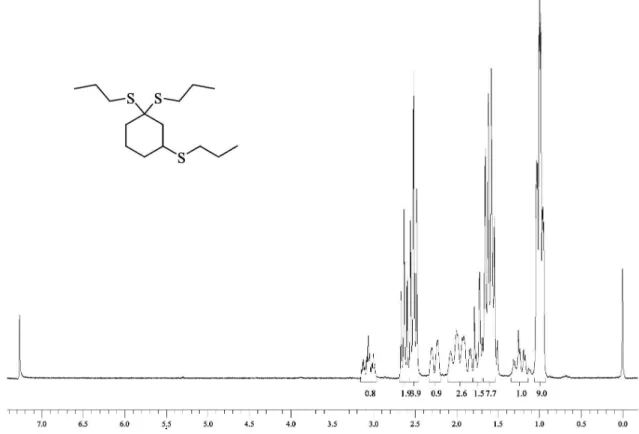
1,1,3-tris(Propylthio)cyclohexane (4b) Yield: 0.253 g (83%). 1HNMR (CDCl
3, 200 MHz) d: 3.06 (tt, J 11.8/3.9 Hz, 1H), 2.63 (t, J 7.0 Hz, 2H), 2.51 (t, J 7.0 Hz, 4H), 2.33-2.19 (m, 1H), 2.09-1.81 (m, 2H), 1.78-1.72 (m, 2H), 1.69-1.50 (m, 8H), 1.31-1.11 (m, 1H), 1.00 (t, J 7.0, 3H), 0.99 (t, J 7.0, 3H), 0.98 (t, J 7.0, 3H).
13C NMR (CDCl
3, 100 MHz) d: 61.14, 44.87, 39.02, 36.94, 33.13, 32.03, 30.56, 30.17, 23.16, 22.65, 22.48, 22.32, 13.73, 13.67, 13.36. MS (relative intensity) m/z: 306 (8), 263 (1), 231 (67), 155 (100). HRMS calc. for C15H30S3: 306.1509. Found: 306.1513.
1,1,3-tris(Benzylthio)cyclohexane (4c) Yield: 0.427 g (95%). 1HNMR (CDCl
3, 200 MHz) d: 7.35-7.23 (m, 15H), 3.88 (s, 2H), 3.71 (d, J 2.5 Hz, 2H), 3.69 (s, 2H), 3.02 (tt, J 12.1/3.9 Hz, 1H), 2.30-2.18 (m, 1H), 2.04-1.90 (m, 2H), 1.81-1.57 (m, 4H), 1.32-1.28 (m, 1H).
13C NMR (CDCl
3, 100 MHz) d: 138.33, 137.68, 137.27, 128.91, 128.50, 128.24, 126.72, 126.65, 62.73, 44.31, 38.98, 36.68, 34.65, 33.39, 33.21, 32.60, 22.34. HRMS calc. for C27H30S3: 450.1509. Found: 450.1505.
1,1,3-tris(Dodecylthio)cyclohexane (4e) Yield: 0.601 g (88%). 1HNMR (CDCl
3, 200 MHz) d: 3.06 (tt, J 12.0/3.3 Hz, 1H), 2.64 (t, J 7.3 Hz, 2H), 2.57-2.46 (m, 4H), 2.30-2.20 (m, 1H), 2.08-1.81 (m, 2H), 1.78-1.66 (m, 3H), 1.64-1.49 (m, 6H), 1.40-1.19 (m, 56H), 0.88 (t, J 6.7 Hz, 9H). 13C NMR (CDCl
3, 100 MHz) d: 61.20, 44.79, 39.04, 38.91, 37.10, 33.99, 33.20, 31.80, 30.00, 29.93, 29.54, 29.45, 29.25, 29.20, 28.99, 28.87,
28.51, 28.28, 28.09, 24.35, 22.54, 13.90. HRMS calc. for C42H84S3: 684.5735. Found: 684.5740.
1,1,3-tris(sec-Butylthio)cyclohexane (4f)
Yield: 0.208 g (60%). 1HNMR (CDCl
3, 400 MHz) d: 3.18-3.08 (m, 1H), 3.03-2.96 (m, 2H), 2.81-2.73 (m, 1H), 2.32-2.23 (m, 1H), 2.05-1.91 (m, 3H), 1.79-1.42 (m, 10H), 1.31-1.21 (m, 9H), 0.96 (t, J 7.3 Hz, 9H). 13C NMR (CDCl3, 100 MHz) d: 62.82, 46.26, 40.02, 39.21, 38.07, 33.65, 33.61, 31.62, 31.47, 31.27, 30.08, 29.95, 22.67, 22.08, 21.43, 11.21, 11.13, 11.01. MS (relative intensity) m/z: 348 (3), 259 (80), 169 (100), 113 (93). HRMS calc. for C18H36S3: 348.1979. Found: 348.1982.
1,1,3-tris(4-Methoxyphenylthio)cyclohexane (4g)
Yield: 0.428 g (86%). 1HNMR (CDCl
3, 400 MHz) d: 7.49 (d, J 9.0 Hz, 2H), 7.39 (d, J 8.5 Hz, 2H), 7.29 (d, J 8.8 Hz, 2H), 6.82-6.77 (m, 6H), 3.78 (s, 9H), 3.36 (tt, J 11.9/3.4 Hz, 1H), 2.07-1.93 (m, 2H), 1.92-1.70 (m, 2H),
1.58-1.49 (m, 3H), 1.04-0.95 (m, 1H). 13C NMR (CDCl
3, 100 MHz) d: 160.40, 160.28, 159.50, 138.83, 137.99, 136.27, 123.39, 121.84, 121.09, 114.19, 113.97, 64.69, 55.08, 43.75, 42.77, 35.72, 31.98, 22.62. MS (relative intensity) m/z: 359 (38), 219 (100), 187 (27), 139 (49), 77 (13). HRMS calc. for C27H30O3S3: 498.1357. Found: 498.1355.
2-((1,3-bis(Furan-2-ylmethylthio)cyclohexylthio)methyl) furan (4h)
Yield: 0.344 g (82%). 1HNMR (CDCl
3, 400 MHz) d: 7.38-7.32 (m, 3H), 6.30-6.29 (m, 3H), 6.20-6.17 (m, 3H), 3.94 (s, 2H), 3.83 (s, 2H), 3.70 (s, 2H), 3.05 (tt, J 12.2/3.8 Hz, 1H), 2.27-2.22 (m, 1H), 2.02-1.92 (m, 2H), 1.82-1.56 (m, 4H), 1.20 (qd, J 8.4/4.0 Hz, 1H). 13C NMR (CDCl
3, 100 MHz) d: 151.64, 151.29, 150.93, 141.75, 141.69, 110.35, 110.28, 107.34, 107.27, 107.04, 62.76, 44.14, 39.23, 36.55, 32.43, 26.74, 25.70, 25.47, 22.32. MS (relative intensity) m/z: 339 (15), 306 (1), 225 (10), 81 (100). HRMS calc. for C21H24O3S3: 420.0887. Found: 420.0890.
2-((1,3-bis(Furan-2-ylmethylthio)-4,4-dimethylcyclo-hexylthio)methyl)furan (4k)
Yield: 0.340 g (76%). 1HNMR (CDCl
3, 400 MHz)
d: 7.35-7.33 (m, 3H), 6.31-6.28 (m, 3H), 6.19-6.18 (m,
3H), 3.92 (s, 2H), 3.82 (d, J 1.7 Hz, 2H), 3.64 (d, J 3.2 Hz, 2H), 2.83 (t, J 8.1 Hz, 1H), 2.04 (d, J 9.3 Hz, 2H), 1.93-1.84 (m, 1H), 1.81-1.73 (m, 2H), 1.29-1.24 (m,
1H), 0.99 (s, 3H), 0.85 (s, 3H). 13C NMR (CDCl
19.74. MS (relative intensity) m/z: 367 (9), 334 (7), 253 (11), 221 (6), 81 (100). HRMS calc. for C23H28O3S3: 448.1200. Found: 448.1205.
1-((5,5-bis(Benzylthio)-2,2-dimethylcyclohexylthio)methyl) benzene (4l)
Yield: 0.425 g (89%). 1HNMR (CDCl
3, 200 MHz) d: 7.35-7.16 (m, 15H), 3.86 (s, 2H), 3.68 (d, J 3.5 Hz, 2H), 3.58 (s, 2H), 2.85-2.76 (m, 1H), 2.08-2.03 (m, 2H), 1.92-1.69 (m, 3H), 1.31-1.22 (m, 1H), 1.00 (s, 1H), 0.86 (s, 3H).
13C NMR (CDCl
3, 100 MHz) d: 138.50, 137.70, 137.42, 129.02, 128.99, 128.78, 128.33, 128.25, 126.80, 126.74, 63.08, 50.61, 41.88, 36.69, 34.45, 33.46, 32.97, 29.93, 19.72. HRMS calc. for C29H34S3: 478.1822. Found: 478.1819.
1-(1,3-bis(4-Methoxyphenylthio)-4,4-dimethylcyclo-hexylthio)-4-methoxybenzene (4m)
Yield: 0.483 g (92%). 1HNMR (CDCl
3, 400 MHz) d: 7.45-7.43 (m, 2H), 7.34-7.30 (m, 4H), 6.86-6.81 (m, 4H), 6.69-6.67 (m, 2H), 3.83 (s, 3H), 3.81 (s, 3H), 3.79 (s, 3H), 3.24-3.20 (m, 1H), 1.96-1.85 (m, 4H), 1.60-1.53 (m, 1H), 1.28-1.25 (m, 1H), 1.21 (s, 3H), 0.67 (s, 3H).
13C NMR (CDCl
3, 100 MHz) d: 160.44, 160.21, 159.30, 138.83, 138.16, 135.79, 132.55, 125.77, 121.02, 114.42, 114.05, 113.94, 64.60, 56.89, 55.19, 55.07, 39.64, 37.33, 34.21, 32.21, 30.47, 19.45. MS (relative intensity) m/z: 416 (1), 387 (34), 247 (100), 139 (49), 107 (50). HRMS calc. for C29H34O3S3: 526.1670. Found: 526.1673.
1,1-Dimethyl-2,4,4-tris(propylthio)cyclohexane (4n)
Yield: 0.260 g (78%). 1HNMR (CDCl
3, 400 MHz) d: 2.81 (dd, J 9.5/4.4 Hz, 1H), 2.64 (t, J 7.4 Hz, 2H), 2.48 (t, J 7.4 Hz, 4H), 2.20-1.72 (m, 5H), 1.60 (sex, J 7.4 Hz, 6H), 1.40-1.20 (m, 1H), 1.11 (s, 3H), 1.00 (t, J 7.4 Hz, 3H), 1.09 (t, J 7.4 Hz, 3H), 0.98 (t, J 7.4 Hz, 3H), 0.88 (s,
3H). 13C NMR (CDCl
3, 100 MHz) d: 61.39, 51.05, 42.46, 36.88, 34.55, 33.25, 30.68, 30.29, 30.19, 23.15, 22.68, 22.38, 19.54, 13.79, 13.74, 13.30. HRMS calc. for C17H34S3: 334.1822. Found: 334.1820.
General procedure for thioethers formation
To a Schlenck tube, under air atmosphere containing an appropriate dihydropyrane (0.50 mmol) in CH2Cl2 (2.0 mL), was added the thiol (0.6 mmol). In the resulting solution was added PhSeBr (2 mol%) and the reaction mixture was allowed to stir for 20 min at 0 oC for thioethers products. After that, the mixture was concentrated under vacuum. The residue was puriied by lash chromatography on silica gel using ethyl acetate/ hexane as the eluent.
2-(Propylthio)-tetrahydro-2H-pyran (5a)
Yield: 0.120 g (75%). 1HNMR (CDCl
3, 400 MHz) d: 4.16-3.71 (m, 2H), 3.53-3.36 (m, 1H), 2.72-2.49 (m, 2H), 1.92-1.51 (m, 8H), 0.99 (t, J 7.20 Hz, 3H). 13C NMR (CDCl3, 100 MHz) d: 98.80, 67.26, 62.26, 51.81, 35.98, 29.21, 25.44, 19.59. HRMS calc. for C8H16OS: 160.0921. Found: 160.0918.
2-(Benzylthio)-tetrahydro-2H-pyran (5b)
Yield: 0.191 g (91%). 1HNMR (CDCl
3, 400 MHz) d: 7.33-7.20 (m, 5H), 4.72-4.69 (m, 1H), 4.14-4.08 (m, 1H), 3.87-3.81 (m, 1H), 3.75-3.70 (m, 1H), 3.53-3.47 (m, 1H),
1.89-1.75 (m, 2H), 1.67-1.49 (m, 4H). 13C NMR (CDCl
3, 100 MHz) d: 128.26, 128.65, 128.09, 126.49, 80.14, 63.80, 34.38, 33.59, 30.49, 25.37, 21.27. HRMS calc. for C12H16OS: 208.0921. Found: 208.0924.
2-(4-Methoxyphenylthio)-tetrahydro-2H-pyran (5c)
Yield: 0.194 g (87%). 1HNMR (CDCl
3, 400 MHz) d: 7.43 (d, J 8.8 Hz, 2H), 6.84 (d, J 8.8 Hz, 2H), 5.04-4.98 (m, 1H), 4.23-4.12 (m, 1H), 3.79 (s, 3H), 3.59-3.48 (m, 1H),
2.04-1.77 (m, 2H), 1.72-1.57 (m, 4H). 13C NMR (CDCl
3, 100 MHz) d: 158.96, 133.94, 124.85, 114.00, 85.82, 64.22, 54.81, 31.15, 25.21, 21.37. HRMS calc. for C12H16O2S: 224.0871. Found: 224.0874.
2-(2-Furan-2-ylmethylthio)-tetrahydro-2H-pyran (5d)
Yield: 0.120 g (61%). 1HNMR (CDCl
3, 400 MHz) d: 7.35 (s, 1H), 6.30-6.29 (m, 1H), 6.17 (d, J 2.6 Hz, 1H), 4.87-4.85 (m, 1H), 4.12-4.06 (m, 1H), 3.91 (d, J 14.6 Hz, 1H), 3.69 (d, J 14.6 Hz, 1H), 3.55-3.49 (m, 1H), 1.94-1.54
(m, 6H). 13C NMR (CDCl
3, 100 MHz) d: 151.68, 141.97, 110.27, 107.28, 80.84, 64.02, 30.64, 25.89, 25.56, 21.39. HRMS calc. for C10H14O2S: 198.0714. Found: 198.0716.
2-(2-Chlorophenylthio)-tetrahydro-2H-pyran (5e)
Yield: 0.194 g (85%). 1HNMR (CDCl
3, 400 MHz) d: 7.59 (dd, J 6.0/1.7 Hz, 1H), 7.36 (dd, J 6.1/1.4 Hz, 1H), 7.26-7.07 (m, 2H), 5.37 (t, J 4.4 Hz, 1H), 4.22-4.11 (m, 1H),
3.67-3.56 (m, 1H), 2.17-1.59 (m, 6H). 13C NMR (CDCl
3, 100 MHz) d: 135.02, 133.27, 129.90, 129.12, 126.91, 126.65, 83.21, 63.67, 31.05, 25.19, 20.96. HRMS calc. for C11H13ClOS: 228.0375. Found: 228.0371.
2-(4-Chlorobenzylthio)-tetrahydro-2H-pyran (5f)
Yield: 0.218 g (90%). 1HNMR (CDCl
3, 400 MHz) d: 7.28-7.15 (m, 4H), 4.69-4.66 (m, 1H), 4.11-4.06 (m, 1H), 3.83-3.75 (m, 1H), 3.69-3.64 (m, 1H), 3.51-3.46 (m, 1H), 1.89-1.46 (m, 6H). 13C NMR (CDCl
Schneider et al. 5 Vol. 00, No. 00, 2010
Figure S1. 1H NMR spectra of compound 3a in CDCl
3 at 200 MHz.
Figure S2. 13C NMR spectra of compound 3a in CDCl
Figure S3. 1H NMR spectra of compound 3c in CDCl
3 at 200 MHz.
Figure S4. 13C NMR spectra of compound 3a in CDCl
Schneider et al. 7 Vol. 00, No. 00, 2010
Figure S5. 1H NMR spectra of compound 3d in CDCl
3 at 200 MHz.
Figure S6. 13C NMR spectra of compound 3d in CDCl
Figure S7. 1H NMR spectra of compound 3h in CDCl
3 at 400 MHz.
Figure S8. 13C NMR spectra of compound 3h in CDCl
Schneider et al. 9 Vol. 00, No. 00, 2010
Figure S9. 1H NMR spectra of compound 3i in CDCl
3 at 200 MHz.
Figure S10. 13C NMR spectra of compound 3i in CDCl
Figure S11. 1H NMR spectra of compound 3k in CDCl
3 at 200 MHz.
Figure S12. 13C NMR spectra of compound 3k in CDCl
Schneider et al. 11 Vol. 00, No. 00, 2010
Figure S13. 1H NMR spectra of compound 4a in CDCl
3 at 200 MHz.
Figure S14. 13C NMR spectra of compound 4a in CDCl
Figure S15. 1H NMR spectra of compound 4b in CDCl
3 at 200 MHz.
Figure S16. 13C NMR spectra of compound 4b in CDCl
Schneider et al. 13 Vol. 00, No. 00, 2010
Figure S17. 1H NMR spectra of compound 4c in CDCl
3 at 200 MHz.
Figure S18. 13C NMR spectra of compound 4c in CDCl
Figure S19. 1H NMR spectra of compound 4g in CDCl
3 at 400 MHz.
Figure S20. 13C NMR spectra of compound 4g in CDCl
Schneider et al. 15 Vol. 00, No. 00, 2010
Figure S21. 1H NMR spectra of compound 4h in CDCl
3 at 400 MHz.
Figure S22. 13C NMR spectra of compound 4h in CDCl
Figure S23. 1H NMR spectra of compound 4m in CDCl
3 at 400 MHz.
Figure S24. 13C NMR spectra of compound 4m in CDCl
Schneider et al. 17 Vol. 00, No. 00, 2010
Figure S25. 1H NMR spectra of compound 5c in CDCl
3 at 400 MHz.
Figure S26. 13C NMR spectra of compound 5c in CDCl
Figure S27. 1H NMR spectra of compound 5d in CDCl
3 at 400 MHz.
Figure S28. 13C NMR spectra of compound 5d in CDCl
Schneider et al. 19 Vol. 00, No. 00, 2010
Figure S29. 1H NMR spectra of compound 5e in CDCl
3 at 400 MHz.
Figure S30. 13C NMR spectra of compound 5e in CDCl