1140 Brazilian Journal of Physics, vol. 35, no. 4B, December, 2005
The Embedding of Spacetime into Cauchy Developments
F. Dahia1 and C. Romero2
1Departamento de F´ısica, UFCG, 58109-970, Campina Grande-PB, Brazil and 2Departamento de F´ısica, UFPB,
Cx. 5008, 58051-970, Jo˜ao Pessoa -PB, Brazil
(Received on 15 October, 2005)
Using the Campbell-Magaard theorem we show that any analytic spacetime can be locally embedded into the Cauchy development of legitimate initial data for the five dimensional vacuum Einstein equations. The embedding presents the domain of dependence property and the Cauchy stability with respect to those initial data.
I. INTRODUCTION
Nowadays the subject of extra dimensions has attracted the attention of physics motivated by the so-called braneworld scenarios [1, 2]. According to these models the ordinary spacetime (the observed spacetime associated to the phe-nomena whose energy is below the scale of TeV) is a four-dimensional submanifold embedded in an ambient space with higher dimension.
It happens that the embedding of a space into another can not be made freely. The embedding demands certain geomet-ric compatibility between the spaces. Hence it is natural to ask whether these models impose some constraints on the geom-etry of the ordinary spacetime we observe. Does every four-dimensional spacetime can be obtained in these scenarios?
Of course this issue only can be properly addressed in the context of embedding theorems. There are well known gen-eral results which guarantee that any manifold can be isomet-rically embedded in some flat space of sufficient high dimen-sions. The dimension of the ambient space depends on the type of the embedding considered. For example, if the em-bedding is local and analytic then n(n+1)/2 is the maxi-mum number of dimensions we would need to embed any n-dimensional manifold [3]. Considering a C∞local embedding this number increases to n(n+3)/2 [4].
Here we are concerned with models which propose ambi-ent spaces with five dimensions, as the Randall-Sundrum (RS) type models [2] and the so-called non-compactified Kaluza-Klein models (NKK)[5]. In these cases, the ambient space has only one extra dimension. However its geometry is not pre-scribed a priori. Instead it is admitted that the ambient space satisfies field equations: Einstein vacuum equations (NKK-models) or Einstein equation with the cosmological constant (RS type models).
The Campbell-Magaard theorem and its variants are of spe-cial relevance for these models[7]. It can be stated in follow-ing way: Given any n-dimensional analytical space (M,g), where g stands for the metric, for any point p∈M there exists a vacuum solution of Einstein equations in(n+1)-dimensions into which a neighborhood of p in M can be embedded.
However showing the existence of the embedding is not enough for physical purposes. It is important to ensure that the embedding possesses the desirable physical properties of sta-bility and domain of dependence. The CM theorem is not ap-propriate to address these issues since it is based on
Cauchy-Kowalewski theorem which demands the analyticity of the functions [8].
In this paper we shall reconsider the embedding from an-other perspective. We have found that for any given analytic spacetime, there correspond initial data sets, legitimate for the problem of Cauchy in General Relativity, in whose Cauchy development for five-dimensional vacuum Einstein equations the spacetime can be locally embedded [9]. In this sense, the embedding of the spacetime might be understood as the result of the physical evolution of the initial data. This formulation have some advantages in comparison with the original CM theorem, since we can establish the stability and domain of dependence properties of the embedding relative to the initial data. For details, the reader is referred to [9].
II. DYNAMICAL APPROACH
The usual procedure adopted to solve the embedding prob-lem concerning the CM theorem is similar to an initial value problem in General Relativity. Schematically we can say that the spacetime (M,g) is taken as part of initial data and it is propagated by the dynamical part of the vacuum Einstein equations along the extra dimension in order to generate the five-dimensional space ³Me,eg´ into which the spacetime is embedded. However this propagation is not a real physical evolution since the direction of evolution is spacelike. Hence, for example, there is no reason why we should expect a causal connection between different slices of the ambient space.
Nevertheless we can show that there exist a 5D neighbor-hoodO of p ine M and a functione φsuch that its gradient∇φ is timelike everywhere inO. Therefore the inverse images ofe
φare acausal spacelike hypersurfaces ofO. Let us considere Σ the hypersurface that contains the point p. Since∇φis time-like then the induced metric in Σby the embedding of this hypersurface in³Oe,ge´is positive definite. Consider now the extrinsic curvature K ofΣrelative to
³ e O,ge
´
. By construction,
Σis a hypersurface of 5D vacuum space, then, it is clear that h e K satisfy the vacuum constraint inΣ. Therefore, the triple (h,K,Σ)constitutes a legitimate initial data set for the Cauchy problem in General Relativity[10].
F. Dahia and C. Romero 1141
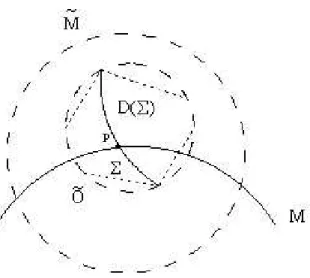
FIG. 1: Sketch of the local embedding of spacetime M into the Cauchy development D(Σ)of initial data given in an acausal space-like four dimensional hypersurfaceΣ.
Σis an acausal hypersurface ofO, then De (Σ)is open inO. Ofe course D(Σ)is a non-empty set, sinceΣ∈D(Σ).The domain of dependence D(Σ)is an open subset ofM. Endowed withe the vacuum metricg, it represents a five-dimensional manifolde (D(Σ),ge)which is a solution of the vacuum Einstein equa-tions. This means that(D(Σ),ge)is a Cauchy development for the Einstein vacuum equations of the initial data(h,K,Σ), that is, it corresponds to the manifold which arises from physical evolution of the initial data.
Now we shall show that there is a region of the spacetime M which is embedded in D(Σ). We know that M and D(Σ)are open and both contain the point p. Then M∩D(Σ)is a
non-empty open set which is a neighborhood of p in M contained in D(Σ). Therefore(M∩D(Σ),g)is embedded in(D(Σ),ge), i.e., in a Cauchy development of (h,K,Σ). In other words the dynamical evolution of the initial data(h,K,Σ)generates a five-dimensional vacuum space into which the spacetime is locally embedded. In this sense, we can say that this local em-bedding is dynamically generated by the physical propagation of those initial data (see figure).
This perspective have some advantages because it allow us to establish the domain of dependence property and the stabil-ity of the embedding relative to the initial data(h,K,Σ). This is a direct consequence of the fact that the spacetime is em-bedded into the Cauchy development of(h,K,Σ)which, as it is well known[10], exhibit these properties.
Indeed if we consider another point q∈M in the future do-main of dependence D+(Σ)it follows that the g(q), the value of the metric at q, depends only on J−
(q)∩Σ, that is, the ini-tial data in the causal past of q. This is the domain of depen-dence property and it guarantees that any perturbation outside J−
(q)∩Σdoes not affect the spacetime at q since the em-bedding is causal connected to the initial data and the signals travel with a finite speed.
Another very interesting property is the Cauchy stability. It means that dependence of the induced metric in M is continu-ous with respect the initial data. Roughly speaking it express the idea that new initial values h′
and K′
sufficiently close to the h and K,in respect to the Sobolev norm (for details, see [9]), give rise to a new metric which will induce a metric in M which is Lorentzian and close to the original spacetime met-ric g.
Acknowledgements
The authors thank CNPq-Fapesq (Pronex) for financial sup-port.
[1] I. Antoniadis, N. Arkani-Hamed, S. Dimopoulos, and G. Dvali, Phys. Lett. B 436, 257 (1998).
[2] L. Randall and R. Sundrum, Phys. Rev. Lett. 83, 4690 (1999). [3] M. Janet, Ann. Soc. Polon. Math. 5, 38 (1926). E. Cartan, Ann.
Soc. Polon. Math. 6, 1 (1927)
[4] R. Greene, Memoirs Amer. Math. Soc. 97, 1 (1970) [5] J. M. Overduin, P. S. Wesson, Phys. Rep. 283, 303 (1997). [6] J. Campbell, A Course of Differential Geometry (Oxford:
Clare-don, 1926). L. Magaard, (PhD Thesis, Kiel, 1963). C. Romero, R. Tavakol, and R. Zalaletdinov, Gen. Rel. Grav. 28, 365 (1996). [7] E. Anderson and J. Lidsey, Class. Quantum Grav. 18, 4831 (2001). F. Dahia and C. Romero, J. Math. Phys., 43, 11, 5804, (2002). F. Dahia and C. Romero, J. Math. Phys. 43, 6, 3097
(2002). E. Anderson, F. Dahia, J. Lidsey, and C. Romero, J. Math. Phys.44, 5108 (2003). S. Seahra and P. Wesson, Class. Quantum Grav. 20, 1321 (2003). N. Katzourakis, math-ph/0407067.
[8] E. Anderson, qc/0409122 E. Anderson and R. Tavakol, gr-qc/0309063 .
[9] F. Dahia and C. Romero, Class. Quant. Grav. 22, 5005, (2005).(gr-qc/0503103).
[10] S. Hawking and G. Ellis, The large scale structure of
space-time, (Cambridge Univ. Press, 1973).