1050 Brazilian Journal of Physics, vol. 35, no. 4B, December, 2005
Nonlinear Resonance in Bouncing Universes
H. P. de Oliveira1, I. Dami˜ao Soares2, and E. V. Tonini3
1Universidade do Estado do Rio de Janeiro
R. S˜ao Francisco Xavier, 524, 20550-013-RJ, Brazil
2Centro Brasileiro de Pesquisas F´ısicas
R. Dr. Xavier Sigaud, 150, 22290-180-RJ, Brazil
3Centro Federal de Educac¸˜ao Tecnol´ogica do Esp´ırito Santo
Avenida Vit´oria, 1729, Vit´oria, 29040-780-ES, Brazil
(Received on 13 October, 2005)
The dynamics of closed LFRW universes with a massive inflaton field is examined where Friedmann equa-tions are corrected by the introduction of a potential term arising from quantum gravity correcequa-tions to cosmo-logical scenarios near the singularity. This extra term implements nonsingular bounces in the early evolution of the universe. For certain windows in the parameter space (labeled by the scalar field mass and the conserved Hamiltonian), phenomena of nonlinear resonance take place. Nonlinear resonance may induce the destruction of KAM tori that trap the inflaton, leading to a rapid growth of the scale factor and consequent escape of the universe into inflation. We make a complete analysis of the nonlinear resonance phenomena and show that
windows of parametric resonance, characterized by an integern≥2, are the ones that strongly favour inflation
in the system. We discuss how generic is this behaviour for inflationary models.
The initial conditions of our present expanding Universe must have been fixed when the early Universe emerged from the semiclassical Planckian regime and started its classical evolution. Evolving back the initial conditions using classi-cal equations of motion, the system is driven towards a neigh-borhood of a singular point, where the classical regime is no longer valid and must be substituted by the quantum regime. Here we consider quantum gravity corrections to cosmolog-ical scenarios in Friedmann equations on the brane, due to the influence of a bulk geometry, that implement nonsingular bounces in the scale factor[1]. We are then led to consider the introduction of an extra potential term in Friedmann’s equa-tions when treating a class of closed FRW models with a con-formally coupled massive scalar fieldφ(the inflaton field) plus radiation. We assume the potentialU(φ) =Λ+m2φ2/2 where the cosmological constant termΛis the vacuum energy of the inflaton field andφits spatially homogeneous expectation val-ues. For perfect fluid cosmologies this correction term may be assumed to be of the form A/aα, whereA is a constant, a the scale factor and the integerα≥2. For simplicity we will fixα=6 in the present paper, but the features of the dy-namics may be substantially different for other choices ofα and deserve a future examination[2]. In the conformal time gauge, the dynamics of the model may then be derived from the Hamiltonian constraint
H=−p
2 ϕ+ϕ2
2 +
p2a
12+V(a)− m2
2 a 2ϕ2−E
0=0, (1) withathe scale factor andE0the total conserved energy of the model. pϕandpaare the momenta canonically conjugated to
ϕ=aφanda, respectively. In the aboveV(a)is the effective potential, given by
V(a) =3a2−Λa4+ A
a2. (2)
The parameter space is labelled by (m,E0), and here we will treat dynamical configurations for which the universe under-goes a series of bounces before the universe enters an infla-tionary regime. The initial conditions for these configurations
n=4 n=3
n=2
m
ϕ 3 3.5 4 4.5 5 5.5 6 6.5 7 7.5 8 8.5 9 9.5
0.3
0.2
0.1
0
–0.1
–0.2
–0.3
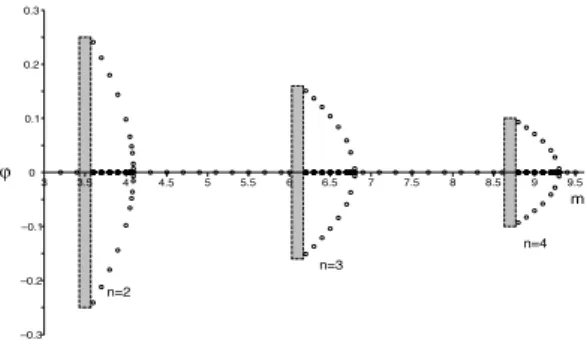
FIG. 1: Diagram(m,ϕ0)of parametric bifurcation of the periodic
orbit at the origin(ϕ=0,pϕ=0), between the resonancesn=2 and
n=4. The shaded regions correspond to values ofmconnected to
disruptive resonances for initial condition values near the invariant
plane(ϕ=0,pϕ=0). On their left is the region of parametric
stabil-ity for the periodic orbit. Further to the left, a value ofmis reached
beyond which the periodic orbit at the origin bifurcates. The stable and unstable branches are shown by white and black dots, respec-tively, marking the parametric domain of the resonance.
will be fixed byresonance windowsin the parameter space since the resonances destroy KAM tori that trap the inflaton about the origin (ϕ=0,pϕ=0). We can show that reso-nance windows are approximated by the curve in parameter spaceR=2/n, wheren≥2 andRis a transcendental func-tion of (m,E0)[3]. The nonlinear resonance of KAM tori pro-duces complex dynamical phenomena, as long time diffusion through Cantori, a phenomena that may have some striking consequences for structure formation [3]. In the following we fixE0=0.8.
In Fig.1 we show a bifurcation diagram connected to the resonancesn=2 ton=4. There it is seen that, in the paramet-ric domain of a resonance, the origin (ϕ=0,pϕ=0) becomes a saddle and allows the inflaton to escape to the DeSitter con-figuration at infinity.
H. P. de Oliveira et. al. 1051
–0.1 –0.05 0 0.05 0.1
Ρϕ
–0.2 –0.1 0 0.1 0.2
ϕ
–0.3 –0.25 –0.2 –0.15 –0.1 –0.05 0 0.05 0.1 0.15 0.2 0.25 0.3
Ρϕ
–0.25 –0.2 –0.15 –0.1 –0.05 0 0.05 0.1 0.15 0.2 0.25
ϕ
FIG. 2: Poincar´e maps with surface of section pa =0 form=
3.80085 in the domain of parametric resonancen=2 (top), and
m=4.29 in the domain of parametric stability between the
reso-nancesn=2 andn=3 (bottom). The origin in the first map (top)
is a saddle with two associated centers, consequence of the bifurca-tion of the periodic orbit due to the resonance. The structure of the stochastic sea differs in each case. The maps were constructed with
τ≃4,000.
system in the parametric domain of anresonance as opposed to the behavior in the region of parametric stability, as shown in Fig. 2. We consider the valuem=3.80085 corresponding to the parametric domain of the resonancen=2, andm=4.29 corresponding to the region of parameter stability between the resonances n=2 andn=3. In the map corresponding to m=3.80085 the two main islands are centered about(ϕ0≃ ±0.18,pϕ0 =0)and the origin is a hyperbolic point. Beyond
the border of the main islands, we note the large region of phase space corresponding to a long time diffusion (before the orbits escape to inflation). The stochastic sea beyond the fuzzy border of the main islands presents the structure of a stochastic web through which diffusion takes place to large
regions of phase space. No islands are seen in this region. This is opposed to the Poincar´e map form=4.29 in the region of parametric stability, where the main island is centered about the origin and the stochastic sea beyond the border of the main island contains several secondary islands. The diffusion of orbits (with initial conditions beyond the border of the main island) in the stochastic sea towards the DeSitter infinity is extremely rapid.
The crucial point for the dynamics of inflation is the insta-bility versus the stainsta-bility of the originϕ=0, pϕ=0. The differences in the two situations will have a bearing in the dy-namics of the spatially homogeneous expectation valuesϕ(τ)
of the inflaton field related to the escape into inflation. In this instance the initial conditions of the expectation values ϕare assumed to be small, and are taken near the invariant plane of the dynamicsϕ=0, pϕ=0 – that corresponds to a neighborhood of the critical point of the map at the origin
(ϕ=0,pϕ=0). Therefore the region of parametric stability of the system will be unfavorable to the physics of inflation since the orbit (a configuration of the early universe) will be trapped in a stable state between two KAM tori near the cen-ter of the main island. However if the system is in the region of parametric resonance, initial conditions near the invariant plane would undergo a long time diffusion to large regions of phase space, and finally escape to the DeSitter configuration at infinity.
The above phenomena are generic for closed inflationary models, as far as bounces are included in the theory. In-deed the minimal ingredients in the inflationary paradigm are a FRW geometry plus a scalar field (the inflaton field) together with well formulated ideas of modern quantum field theory. The basic idea of inflation is that the vacuum energy of the in-flaton field was the dominant component of the energy density of the universe in an early epoch of its evolution. The dynam-ics, ruled by Einstein’s equations, has thus the cosmological constant-type term (connected to the vacuum energy of the in-flaton field) and the two degrees of freedoma(τ)andϕ(τ), respectively the scale factor and the spatially homogeneous expectation value of the inflaton field. In general the result-ing potential forϕhas always a minimum, providing then the condition for nonlinear resonance.
The authors acknowledge partial financial support from CNPQ/Brasil.
[1] A. Campos and C. F. Sopuerta, Phys. Rev. D63, 104012 (2001);
Y. Shtanov and V. Sahni, Phys. Lett. B557, 1 (2003); J. E.
Lid-sey, D. J. Mulryne, N. J. Nunes, and R. Tavakol, Phys. Rev. D
70, 063521 (2004).
[2] We note that the choicen=6 corresponds to bulk-brane
correc-tions in Friedmann’s equacorrec-tions with dust.