Artigo
*e-mail: [email protected]
IN SITU SYNTHESIS OF NANOCLAY FILLED POLYETHYLENE USING POLYMER SUPPORTED METALLOCENE CATALYST SYSTEM
Z. V. P. Murthy* and Parimal A. Parikh
Chemical Engineering Department, Sardar Vallabhbhai National Institute of Technology, Surat 395007, Gujarat, India
Smitha Rajesh
Chemical Engineering Department, Sardar Vallabhbhai National Institute of Technology, Surat 395007, Gujarat / Reliance Technology Group, Hazira Manufacturing Division, Reliance Industries Limited, Surat 394510, Gujarat, India
Recebido em 30/8/10; aceito em 4/3/11; publicado na web em 12/5/11
In situ ethylene polymerizations were performed using bis(cyclopentadiene)titanium dichloride supported on polyethersulfone as catalyst. The bis(cyclopentadiene)titanium dichloride supported on polyethersulfone catalyst activity estimated by ethylene polymerization was 360 kgPE/molTi/h. During polymerization the illers used were montmorillionite nanoclays having surface modiications with 35-45 wt% dimethyl dialkyl(14-18)amine (FA) and 25-30 wt% trimethyl stearyl ammonium (FB). These illers were pretreated with methylaluminoxine (MAO; cocatalyst) for better dispersion onto the polymer matrix. The formation of polyethylene within the whole matrix was conirmed by FTIR studies. It was found that the nature of nanoiller did not have any remarkable effect on the melting characteristics of the polymer. TGA study indicates that nanoclay FB illed polyethylene has higher thermal stability than nanoclay FA illed polyethylene. The melting temperature of the obtained polyethylenes was 142 °C, which corresponds to that synthesized by the polyether sulfone supported catalyst.
Keywords: nanoclay; polymeric support; bis(cyclopentadiene)titanium dichloride.
INTRODUCTION
Polymer nanocomposites have attracted great interest, both in in-dustry and in academy, because they exhibit remarkable improvement in material properties compared to virgin polymer or conventional micro- and macro-composites.1-3 Preparation of desired products from polymer nanocomposites is a challenging area that requires considerable efforts. Polyethylene (PE) is one of the most widely used polyolein but the use is restricted in certain applications because of its low melting point, non-degradability, and the tendency to crack when stressed. Research on reactions like grafting, cross-linking and blending of PE with inorganic illers to mitigate these disadvantages has been extensively investigated for many years.4-6 Introduction of nanoillers onto polyethylene matrix have a strong impact on the macroscopic properties of the polymer even though the iller content is hardly few weight percent. The properties such as heat distortion temperatures, lame resistance, modulus, barrier properties and elec-tronic and optical properties are dramatically enhanced.7-9
Various methodologies of nanoiller illed PE synthesis are avai-lable globally which includes foremost ones like sol–gel reactions, intercalative polymerization, melt processing and polymerization illing technique (PFT). Originated by Howard et al.,10 PFT in which onto the surface of iller, Ziegler–Natta-type catalyst is immobilized where further on olein monomer is polymerized, has been further explored by Jerome et. al.11-13 and Das et. al..14,15 This methodology provides with such nanocomposites which have higher iller content but without sacriicing their enhanced mechanical properties.
The commodity polymers i.e. polyethylenes are synthesized using organometallic coordination catalysts such as heterogeneous Ziegler-Natta catalysts and homogeneous metallocene catalysts.16,17
Metallocene catalysts have created a new area in the polymerization of oleins by providing new polymer structures and resulting properties in comparison to the traditional Ziegler catalysts. These complexes exhibit high catalyst activities and only one type of active site (sin-gle site catalyst). Control of molar mass, narrow molecular weight distributions and structural uniformity related to comonomer content are achieved through precise selection of reaction conditions.18-22
In recent years, special attention has been devoted to the immo-bilization methodology of these catalyst systems either on organic or inorganic materials. Apart from using inorganic supports like magnesium chloride, silica, alumina, TiO2 etc, polymeric support like pentaerythritol trimethacrylate, divinyl benzene, 2-hydroxyethyl methacrylate, styrene etc have been utilized for immobilization of metallocenes.23-29 Beside performing the basic role of the support like exposure of active sites, stabilization of active sites, high activity of catalyst and precise control over polymer properties, polymeric support also eliminates the side effects of inorganic support like reduction in ash content etc.
EXPERIMENTAL
Materials
All the chemicals were procured from Sigma-Aldrich and used as such or otherwise stated. Poly(oxy-1,4-phenylene-sulfonyl-1,4-phenylene; PES), n-hexane (99.9%), toluene (99.9%), nanoclay based on montmorillonite, whose surface has been modiied with 35-45 wt% dimethyl amine (FA) and nanoclay modified with 25-30 wt% trimethyl stearyl ammonium (FB) were used as received. Bis(cyclopentadiene)titanium dichloride (Cp2TiCl2; Strem) was used as such. High purity polymerization grade ethylene gas of 99.9% purity was taken from commercial plant and used with out further puriication. Methylaluminoxane (MAO; 10% v/v in toluene) was used as obtained from Crompton, GmbH.
Synthesis of PES supported Cp2TiCl2 catalyst
For synthesizing the polymeric supported metallocene catalyst, commercially available PES (having Mn = 38000 g mol
-1; melt low index =16 g/10 min) was taken as the support. A 5.0 g of PES was dissolved in the dry dichloromethane by stirring for 45 min. To this solution, 0.2 g of bis(cyclopentadiene)titanium dichloride was added to keep the ratio 0.04 with continuous stirring. The reaction mixture was allowed to stir at ambient temperature for 24 h, washed with dry toluene (100 mL × 5) to remove the excess metalloceneand dried under vacuum. The dried light red catalyst was subjected to titanium estimation, which was 0.80 wt% by calorimetric method using UV-Vis spectroscopy.
Polymerization of ethylene using PES supported Cp2TiCl2
catalyst
All the polymerizations were carried out in 1 L double jacketed glass reactor equipped with a top mounted mechanical stirrer under nitrogen atmosphere. After the addition of toluene (100 mL), it was saturated with ethylene followed by the addition of MAO (3 mL; 10% v/v; Al/Ti mole ratio = 2500). Finally the catalyst (0.25 g) was added to start the polymerization at ambient conditions. Addition of ethylene was continued during the 60 min polymerization. Polymerization was stopped by the addition of suficient amount of acidiied methanol and the precipitated polymer was iltered, washed with methanol and dried under vacuum.
Synthesis of in situ nanoclay illed polyethylene using PES
supported catalyst
In 100 mL toluene, MAO (2.6 mL; 10%, v/v; Al/Ti mole ratio = 2500) was added followed by the nanoclay (0.12, 0.25, 0.50 g) and stirred for 30 min. Then 200 mL toluene was added followed by MAO (3mL, 10% v/v; Al/Ti mole ratio = 2500) and inally the catalyst (0.25 g) was added to start the polymerization, then ethylene addition was continued during the 60 min polymerization. The polymerization was stopped by the addition of suficient amount of acidiied methanol. The precipitated polymer was iltered, washed with methanol and dried under vacuum.
Characterization of PES supported Cp2TiCl2 catalyst
For the determination of titanium content in the catalyst, the catalyst was dissolved in an acidic media. The titanium contained in the catalysts was converted in to Ti4+ by the addition of H
2O2. UV-vis spectra of the resultant solution of peroxotitanium complexes
were recorded on a Perkin-Elmer UV Lambda12 spectrometer.30 The intensity of a peak at 410 nm (ε = 782.7 L-1 mol-1 cm-1) was used to quantify the titanium content. FTIR studies were performed on Perkin-Elmer spectrum GX instrument with 4 cm-1 resolution and 32 scans with KBr pellet for determining the characteristic vibrational modes of the catalyst.31
Characterization of in situ nanoclay illed polyethylene
FTIR studies were performed on Perkin-Elmer spectrum GX instrument with 4 cm-1 resolution and 32 scans with KBr pellet in transmittance mode. The melting points of PEs were measured by differential scanning calorimetry (DSC) with a Perkin-Elmer DSC-7 at a heating rate of 10 °C/min from 50 to 300 °C (with held for 3 min at 300 °C), cooling rate of 10 °C/min from 300 to 50 °C and again heating from 50 to 300 °C. Thermal stability studies were performed using thermogravimetric analysis (TGA) with a TGA V 50 1A Perkin Elmer thermo gravimetric analyzer in the presence of nitrogen in the temperature range of 50-650 °C and at a heating rate of 10 °C/min.31
RESULTS AND DISCUSSION
Synthesis and characterization of PES supported Cp2TiCl2
Bis(cyclopentadiene)titanium dichloride (Cp2TiCl2) was immo-bilized on PES, since PES has potential Lewis base sites in the form of oxygen of sulfonyl group where the coordination of titanium can be expected.32,33 The resulting PES supported Cp
2TiCl2 catalyst had 0.8 wt% of titanium content. The FTIR spectra of pure PES, PES supported Cp2TiCl2 and Cp2TiCl2 is shown in Figure 1. The pure PES shows a strong absorption band at 1486 cm-1 attributed to the stretching vibration of the S=O groups belonging to the sulfone groups.31 After the incorporation of titanium onto the polymer a weak vibration centered at 820 cm-1 corresponding to the complexation of titanium with sulfur group of the polymer was observed.15,33 The room temperature atmospheric polymerization of ethylene was carried out using PES supported Cp2TiCl2 which showed activity of 670 kg PE/ mol Ti/h indicating its potential for polymerization.
Synthesis of in situ nanoclay illed polyethylene
After ensuring the reproducibility of titanium loading on to the support (PES), this supported Cp2TiCl2 was further utilized for prepa-ring in situ nanoclay illed PE. The two illers used for this study are nanoclay based on montmorillonite, whose surface has been modiied with 35-45 wt% dimethyl dialkyl(14-18)amine (FA) and with 25- 30
Figure 1. FTIR spectra of Cp2TiCl2 catalyst; PES supported Cp2TiCl2
wt% trimethyl stearyl ammonium (FB). The whole methodology of synthesizing in situ nanoclay illed PE has been depicted in Scheme 1.
For homogenous dispersion of illers in the polyethylene matrix, the illers were activated in advance with MAO. This pretreatment of illers with MAO minimizes the deactivation effects of their sur-faces on catalyst activity and generates active centres for ethylene polymerization.14
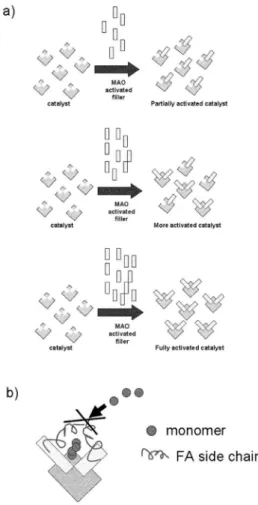
For in situ nanoclay illed PE synthesis, catalyst to MAO treated nanoclay ratio was varied in order to see how the activity of the PES supported Cp2TiCl2 was affected. Table 1 shows the experimental data and the results of the variations carried out. For system where MAO treated FB iller was used, with the introduction of the FB iller, the activity (950 kg PE/mol Ti/h) of PES supported Cp2TiCl2 increased. As the PES supported Cp2TiCl2 catalyst to MAO treated FB iller ratio was increased to 2, activity showed decreasing trend, whereas, when the ratio was changed to 0.5, marked increase in activity was observed. The observed increase in activity with increase in MAO treated iller content may be due to the generation and stabilization of active centers which are formed when enough cocatalyst is present to reduce titanium as depicted in Scheme 2a. At lower supported catalyst to FB ratio, there is not enough cocatalyst to activate the sites for polymerizing ethylene but once the amount of cocatalyst is enough, all the sites are activated to get the polymer.
For system where MAO treated FA iller was used, with introduc-tion of iller, activity was found to be unaffected. This may be due to the bulkiness in the chain length of FB iller. As the PES supported catalyst to MAO treated FA iller ratio was changed to 2, activity got decreased. Even when the ratio was changed to 0.5, one observed decrease in activity. Again this might be assumed that bulkiness of FA iller is decreasing the activity by resisting the chain growth of ethylene monomer as shown in Scheme 2b.
Characterization of in situ nanoclay illed polyethylene
A comparison of FTIR spectra of PE synthesized by Cp2TiCl2; PES supported Cp2TiCl2; in situ FB illed PE and in situ FA illed PE is shown in Figure 2. The strong absorption band at 2856 cm-1 corresponding to υ(C-H) stretching of PE is being observed in Fi-gures 2a,b. This band is also present in nanoclay illed PE (FiFi-gures 2c,d). The occurrence of these IR bands indicates that PE has been formed in the presence of organic support and nanoclay during the polymerization. A strong band at 1474 cm-1 corresponding to
υ(C-H) deformation of tertiary carbon is also present. The 13C{1H} NMR spectrum of PE synthesized by PES supported Cp2TiCl4
ca-Scheme 1. Pictorial representation of methodology of synthesizing in situ nanoclay illed PE
Table 1. Experimental conditions and results for synthesis of in situ iller illed PE using PES supported catalyst (Ti wt% ~ 0.8)
S No. PES supported Cp2TiCl2 (g)
Nanoclay (FB) (g)
Nanoclay (FA) (g)
Supported cat:nanoclay ratio
Yield (PE) (g)
Activity (kg PE/mol Ti/h)
1a 0.00* 0.00 0.00 - 1.5 360
2 0.25 0.12 0.00 2:1 3.6 860
3 0.26 0.25 0.00 1:1 3.9 950
4 0.25 0.50 0.00 1:2 5.4 1290
5b 0.24 0.00 0.00 - 2.8 670
6 0.25 0.00 0.12 2:1 2.1 500
7 0.26 0.00 0.25 1:1 2.5 600
8 0.25 0.00 0.50 1:2 0.5 120
a,bMAO = 6.0 Ml. Al/Ti mole ratio = 2500. * Cp
2TiCl2 = 0.24 g
Table 2. Melting and crystallization temperatures of in situ iller illed PE using PES supported catalysts
Nanoclay Cat:nanoclay ratio
Tm
°C ∆Hm
(J g -1)
Tc
°C
% Crystallinity
FB 2:1 139 145 114 55
1:1 139 192 115 70
1:2 139 231 115 82
FA 2:1 139 183 114 69
1:1 140 209 112 76
1:2 Low productivity
∆Hm= melting enthalpy (J g
-1) of the iller illed polyethylene; T
m= melting
temperature; Tc= crystallization temperature.
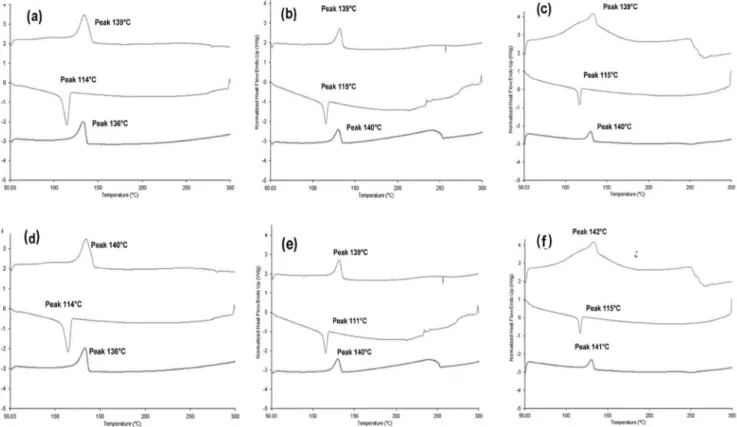
Figure 3. DSC plots of PE synthesized from PES supported Cp2TiCl2 catalyst with in situ FB having: (a) 1:0.5 ratio (b) 1:1 ratio (c) 1:2 ratio and PE synthesized
from PES supported Cp2TiCl2 catalyst with in situ FA having (d) 1:0.5 ratio; (e) 1:1 ratio; (f) 1:2 ratio Figure 2. FTIR spectra: (a) pure PE; (b) PE using Cp2TiCl2 catalyst; (c) PE
synthesized from PES supported Cp2TiCl2 catalyst with in situ FB; (d) PE
synthesized from PES supported Cp2TiCl2 catalyst with in situ FA
talyst where only one strong resonance peak was observed at 29.41 ppm, which is attributed to the main chain methylene carbon.14 Non-existence of other resonance peaks indicates the absence of branching in the homopolymer synthesized using the polymeric supported catalyst.
The DSC analysis (Figure 3) shows the melting and crystallization temperatures of nanoclay illed PE. The melting as well as crystalli-zation temperatures show no remarkable effect by the addition of nanoclays. There is insigniicant change in the crystallization onset temperature indicating that the inclusions induce heterogeneous nucleation. The melt enthalpy observed for FB case increases as the supported catalyst to FB ratio decreases which can be attributed to the difference in molecular weight of PE chain as the productivity is different. The presence of nanoclay shows major inluence on the degree of crystallinity of PE as shown in Table 2.The degree of crystallinity14, 31 of nanoclay illed PEs were measured using the following formula
%
where X = percent crystallinity of the composites; ∆Hm= melting enthalpy (J g-1) of the nanoclay illed PE; ∆H
o= melting enthalpy (293 J g-1) of 100% crystalline PE;14 m
p= mass (g) of PE in the nanoclay illed PE; and mc= mass (g) of the nanoclay illed PE. The high melting point of the polymers (139 °C) indicates the branchless structure of the homopolymer.
with a polymer supported catalyst system. FTIR studies conirmed the formation of polyethylene. DSC study shows that both nanoclay FA and FB illed PE have high melting enthalpies with high crystalli-nity. The high melting point of the polymers indicates the branchless structure of the homopolymer. TGA study indicates that nanoclay FB illed polyethylene has higher thermal stability than nanoclay FA illed polyethylene. Use of Cp2TiCl2 for the anchoring of titanium species on to the surface of polymeric support can be used for catalyst preparation, which may be effectively and eficiently used for in situ polymerization.
REFERENCES
1. Jordan, J.; Jacob, K. I.; Tannenbaum, R.; Sharaf, M. A.; Jasiuk, I.; Mater. Sci. Eng. 2005, A393, 1.
2. Garces, J. M.; Moll, D. J.; Bicerano, J.; Fibiger, R.; McLeod, D. G.; Adv. Mater. 1999, 12, 1835.
3. Koo, J. H.; Polymer Nanocomposites: Processing, Characterization and Application, McGraw-Hill: New York, 2006, p. 61.
4. Heinemann, J.; Reichert, P.; Thomann, R.; Muelhaupt, R.; Macromol. Rapid Commun. 1999, 20, 423.
5. Osman, M. A.; Atallah, A.; Macromol. Chem. Phys. 2007, 208, 87. 6. Chen, Y. X.; Rausch, M. D.; Chien, J. C. W.; J. Polym. Sci. Part A:
Polym. Chem. 1995, 33, 2039.
7. Xu, B.; Song, Y.; ShangGuan, Y.; Zheng, Q.; Chin. J. Polym. Sci. 2006, 24, 299.
8. Fang, Z.; Ma, G. ; Xu, Y.; Tong, L.; Chin. J. Polym. Sci. 2006, 24, 147. 9. Wang, Z.; Pinnavaia, T. J.; Chem. Mater. 1998, 10, 3769.
10. Howard, E.G. Jr.; U. S. Pat. 4187210 1980.
11. Dubosis, P.; Alexander, M.; Jerome, R.; Macromol. Symp. 2003, 194, 13. 12. Alexander, M.; Dubosis, P.; Sun ,T.; Garces, J. M.; Jerome, R.; Polymer
2002, 43, 2123.
13. Alexander, M.; Pluta, M.; Dubosis, P.; Jerome, R.; Macromol. Chem. Phys. 2001, 202, 2239.
after 500 °C temperature. At 600 °C, 12 wt% of material was obtained. Similar was the case when the catalyst-to-clay ratio was maintained as 1:1 and 1:2 and 1:3 indicating there is no much change in the weight reduction during heating due to the incorporation of clay to the PE.
For FA illed PE, the weight loss was observed to be ~20% on reaching 400 °C (Figures 4d-f), followed by reduction in weight (~64%) from 400 to 500 °C. At temperature above 550 °C no signi-icant weight loss was observed, indicating that ~19 wt% clay has been associated with PE. The gradual weight loss was observed in all the cases where nanoclay-FA was incorporated with PE.
The weight percentages of the illers, as elucidated by ash content, are also in close agreement as shown in Table 3. These data indicate that highest residual weight percent is for FB illed at a ratio of 1:2 PE which is also supported by the high activity observed for this system for polymerizing ethylene.
CONCLUSIONS
In situ polymerization of ethylene in the presence of MAO treated nanoclay using polyethersulfone supported Cp2TiCl2 catalyst has been successfully carried out to formulate nanoclay illed polyethylene Table 3. Comparison of thermal gravimetric analysis and ash content with the theoretical values of in situ iller illed PE using PES supported catalysts Nanoclay Cat:nanoclay ratio TGA(g) Ash content (g)
FB 2:1 29 27
1:1 33 34
1:2 63 62
FA 2:1 25 23
1:1 23 21
1:2 -
-Figure 4. TGA plots of PE synthesized from PES supported Cp2TiCl2 catalyst with in situ FB having: (a) 1:0.5 ratio (b) 1:1 ratio (c) 1:2 ratio and PE synthesized
14. Reddy, C. S.; Ratna, D.; Das, C. S.; Polym. Int. 2008, 57, 282. 15. Reddy, C. S.; Das, C. K.; J. Macromol. Sci. A: Pure. Appl. Chem. 2006,
43, 1365.
16. Guo, Z.; Chen, W.; Zhou, J.; Yang, H.; Chin. J. Chem. Eng. 2009, 17, 530.
17. Wolf, C. R.; Forte, M. M. C.; Santos, J. H.; Catal. Today 2005, 107, 451. 18. Motha, K.; Hippi, U.; Hakala, K.; Peltonen, M.; Ojanpera, V.; Lofgren,
B.; Seppala, J.; J. Appl. Polym. Sci. 2004, 94, 1094.
19. Liu, C.; Tang, T.; Huang, B.; J. Polym. Sci., Part A: Polym. Chem. 2001, 39, 2085.
20. Lee, D.; Yoon, K. B.; Noh, S. K.; Macromol. Rapid Commun. 1997, 18, 427.
21. López-Linares, F.; Barrios, A. D.; Ortega, H.; Matos, J. O.; Joskowicz, P.; Agrifoglio, G.; J. Mol. Catal. A: Chem. 2000, 159, 269.
22. Moreira, S. C.; Marques, M. F. V.; Eur. Polym. J. 2001, 2123. 23. Yu, Q.; Chen, H.; Zhang, X. Q.; Huang, B. T.; J. Polym. Sci., Part A:
Polym. Chem. 1996, 34, 2237.
24. Arai, T.; Uozumi, H. T.; Soga, K.; Macromol. Chem. Phys. 1997, 198, 229.
25. Nishida, H.;Uozumi, T.; Arai, T.; Soga, K.; Macromol. Rapid Commun. 1995, 16, 821.
26. Stork, M.; Koch, M.; Klapper, M.; Müllen, K.; Gregorius, H.; Macromol. Rapid Commun. 1999, 20, 210.
27. Mteza, S. B.; Hsu, C. C.; Bacon, D. W.; J. Polym. Sci., Part A: Polym. Chem. 1996, 34, 1693.
28. Meng, F. H.; Yu, G. Q.; Huang, B. T.; J. Polym. Sci., Part A: Polym. Chem. 1999, 37, 37.
29. Musikabhumma, K.; Uozumi, T.; Sano, T.; Soga, K.; Macromol. Rapid Commun. 2000, 21, 675.
30. Kaur, S.; Singh, G.; Gupta, V. K.; J. Polym. Sci., Part A: Polym. Chem. 2008, 46, 7299.
31. Rajesh, S.; Parikh, P. A.; Murthy, Z. V. P.; J. Appl. Polym. Sci. 2011, 119, 2611.
32. Bhaduri, S.; Gupta, V. K.; U.S. Pat., 6969747 2005.