A
rti
g
o
*e-mail: [email protected]
DEVELOPMENT OF AN OPTICAL REDOX CHEMICAL SENSOR FOR NITRITE DETERMINATION
Saadat Rastegarzadeh* and Mehdi Kalantaripour
Department of Chemistry, College of Science, Shahid Chamran University, Ahvaz 6135743135, Iran
Recebido em 18/7/11; aceito em 14/10/11; publicado na web em 20/1/12
An optical chemical sensor for the determination of nitrite based on incorporating methyltrioctylammonium chloride as an anionic exchanger on the triacetylcellulose polymer has been reported. The response of the sensor is based on the redox reaction between nitrite in aqueous solution and iodide adsorbed on sensing membrane using anion exchange phenomena. The sensing membrane reversibly responses to nitrite ion over the range of 6.52×10⁻⁶ – 8.70×10⁻⁵ mol L-1 with a detection limit of 6.05×10⁻⁷ mol L-1 (0.03
µg mL-1) and response time of 6 min. The relative standard deviation for eight replicate measurements of 8.70×10⁻⁶ and 4.34×10⁻⁵
mol L-1 of nitrite was 4.4 and 2.5 %, respectively. The sensor was successfully applied for determination of nitrite in food, saliva and water samples.
Keywords:optical sensor; nitrite; methyltrioctylammonium chloride.
INTRODUCTION
Nitrite has long been recognised as a versatile preservative within meat products through its ability to inhibit microbial growth, which it provide color and taste of meat.1,2 Consumed nitrite
through foods or present nitrite in salivary can react readily with secondary and tertiary amines and amides within the food in the acidic environment of human stomach or other parts of the body to producing toxic and carcinogenic nitrosamines compounds.3 Also,
combination of nitrite with blood pigments reduce the oxygen car-rying capacity of hemoglobin.4,5 Moreover, nitrites can be used in
fertilizers, detergent, wood pulp, dye and synthetic fiber industries which caused serious pollution problems.6 Due to toxic effects
of nitrite, it is important to develop specific, simple and low-cost methods for nitrite determination.
A number of methods have been described in the literature for nitrite determination, which include spectrofluorometry,7,8
chromatog-raphy,9,10 electrochemical detection,11,12 capillary electrophoresis,13,14
flow injection analysis.15,16 Most of these methods are not suitable
for routine determination of nitrite because some of them require expensive instruments or reagents, and others involve difficult and time-consuming separation procedures.
On the other hand, the most of the analytical methods which are being used for environmental problems generate chemical wastes. In some circumstances, the used chemical materials are even more hazardous than the species being monitored. However, it has drawn much attention recently focusing on the development of chemical processes that minimized or eliminate the use of toxic substances in the prevention of environmental pollution and human hazards.17
During the last decade, the development and construction of optical chemical sensors or optodes has increased considerably. They are more interested by analytical chemists because they are extensively employed in routine and research laboratories by the capability to decrease the reagent consumption. Other advantages include simple and low cost preparation, ease of miniaturization, possibility of remote, in situ monitoring and no need for separate reference devices.18,19 These features make optochemical sensors as
a powerful tool for environmental and industrial process monitoring. The present paper reports on the development of an optical
chemical sensor based on immobilization methyltrioctylammonium chloride onto a triacetylcellulose membrane and its application for the determination of nitrite using redox reaction with iodide.
EXPERIMENTAL
Apparatus
A GBC UV-Vis spectrophotometer model Cintra 101 was used for recording the spectra, and the absorbance measurements were made using a Jasco UV-Vis spectrophotometer model 7850. The sensing membrane was placed in a glass cell and all measurements were performed in a batch mode.
Measurement of pH was performed using a Metrohm 632 pH-meter with a combined glass electrode.
Reagents and solutions
All solutions were prepared using reagent grade chemicals and doubly distilled water.
Stock solution of nitrite, 2.17 x 10⁻² mol L−1, was prepared by
dissolving 0.150 g of sodium nitrite (Merck, dried at 105 oC for 2
h before use) in 100 mL water. This nitrite solution was prepared every week and stored in dark. The working solution was prepared freshly by appropriate dilution. A 0.07 mol L-1 of iodide ion solution
was prepared by dissolving 1.162 g of potassium iodide (Merck) in water and diluting to 100 mL in a volumetric flask. This solution was prepared freshly. Sulphuric acid solution was prepared by appropriate dilution of concentrated sulphuric acid (Merck).
Membrane preparation
The general procedure to prepare of sensing membrane was performed according to previously reported work.20 For this purpose,
washing for removing the additional reagent, the optode membrane was stored under water.
Analytical procedure
The prepared membrane was placed in a solution of potassium iodide (0.07 mol L-1) for 70 s, then it was washed and mounted into
a spectrophotometer cell. A few mL of a solution containing nitrite ion and sulfuric acid was transferred to cell, and the absorbance was measured at 363 nm against a blank membrane after 6 min.
Preparation of real samples
Saliva and fresh water samples were collected and filtered through Whatman filter paper, stored at 5 oC and analyzed within 24 h.
Sausage sample was treated according to the method recom-mended by AOAC.21 2.00 g of sample was mixed and homogenized
in a mortar. The thoroughly mixed sample was then taken in a 250 mL beaker and 40 mL of hot water was added and shaken for 5 min. The suspension was incubated for 15 min in a warm water bath at 50 oC.
To precipitate the proteins, 5 mL of 20% zinc acetate was introduced. After cooling, the volume was diluted to 50 mL with water and then filtered through a Whatman filter paper. An aliquot of this solution was used for analytical procedure.
RESULTS AND DISCUSSION
It has been reported that the methyltrioctylammonium chloride (MTA+Cl-) immobilized on triacetylcellulose membrane shows an
excellent tendency toward adsorption of anions.22 Accordingly,
an optical redox sensor was prepared by immobilization of meth-yltrioctylammonium chloride on the triacetylcellulose (TAC) membrane for determination of nitrite. The redox characteristics of membrane are achieved by exchanging the counter ion (Cl-) of
immobilized methyltrioctylammonium chloride with iodide ion. When this membrane was placed in acidic solution of nitrite ions, the colorless membrane changes to yellow. This change is due to oxidation of iodide to I3- by nitrite ions solution acidified with
sulphuric acid.23 Then the formed I
3- adsorbed on membrane by an
anionic exchange mechanism.
The following scheme presents the stages of preparation and response mechanism of proposed optical sensor.
Ethylenediamine
TAC (mem.) + MTA+Cl- —————→ TAC - MTA+Cl-(mem.) (1)
TAC - MTA+Cl
-(mem.)+ I-(aq.) ———→ TAC - MTA+ I-(mem.)+ Cl-(aq.) (2)
H+
TAC-MTA+ I
-(mem.) + NO2-(aq.) –——→ TAC-MTA+ I3-(mem.) + NO (3)
(colorless) (yellow)
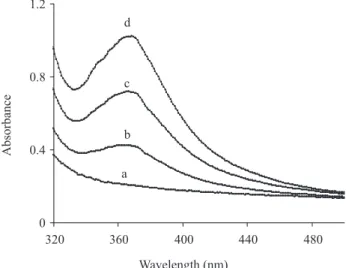
Figure 1 shows the characteristic spectra of the membrane which were obtained in the absence and presence of nitrite ion at different concentrations. An increase in the absorbance at maximum wavelength, 363 nm, appeared as the nitrite concentration increased. Therefore this wavelength was selected for measuring the absorbance of optode.
Study of parameters affecting the response
In order to facilitate the establishment of interaction between the membrane and the sample, a mass transfer of methyltrioc-tylammonium chloride into the triacetylcellulose membrane is required. The results indicated that the effective immobilization of
methyltrioctylammonium chloride into membrane was obtained when using ethylenediamine as solvent. This is due to the hydrolyzed cellulose film in ethylendiamin shaped the porous structure in the polymer, which minimizes barriers of mass transport.24,25
To study the influence of membrane composition, several optodes with different amount of methyltrioctylammonium chloride in the range of 0.05-0.25 g were prepared.
The results denoted that the highest response was obtained when using 0.15 g of methyltrioctylammonium chloride. Also the result-ing data showed that the response increased with preparation time of membrane, but above 15 min the membrane began to become opaque. Finally, a suitable optode with maximum response and higher reproducibility was prepared by treating transparent triacetylcellulose membrane with a solution of 0.15 g methyltrioctylammonium chloride in 10 mL ethylenediamine for 12 min.
The redox reaction of nitrite with iodide ion is affected by the acidity of solution. Thus the influence of sulfuric acid concentration of test solution on the response of the proposed nitrite optical sen-sor was studied. As can be seen from Figure 2, the response of the sensor increased by increasing acid concentration up to 0.07 mol L-1
while beyond this concentration, the optical response decreased. The diminished response could be due to instability of nitrite ion at high concentration of acid.23 Thus a sulfuric acid concentration of 0.07
mol L-1 was selected in further studies.
Figure 1. Absorption spectra of optode (a) in the absence and (b-d) in the presence of 2.17 x 10⁻⁵, 4.34 x 10⁻⁵ and 8.70 x 10⁻⁵ mol L-1 of nitrite, respectively
The effect of iodide concentration over the range of 0.04-0.10 mol L-1 on the absorbance of optical sensor was studied. The results
shown in Figure 3 indicated that the maximum response was obtained at 0.06-0.08 mol L-1 of iodide ions and above this value the optical
response decreased. This is due to saturation of the membrane at higher concentration of iodide resulting in a decrease adsorption of I3- on membrane. Therefore 0.07 mol L-1 of iodide ion was used
throughout the study.
In another experiment, the presence time of membrane in iodide solution was also investigated. The results revealed that the response of the sensor is independent of the presence time of membrane in iodide solution in a range of 60-90 s, and higher than this time range the optical response reduced.
Response time of optode
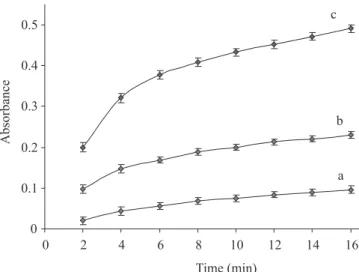
The dynamic response time, which is an important characteristic for any membrane sensor, was studied by plotting absorbance versus time for different concentrations of nitrite in selected experimental conditions. As it is observed from Figure 4 the sensor response in-creased with time and not reached to steady-state response up to 16 min. Therefore in order to select an appropriate time for measuring
the absorbance, the calibration curve for different times was studied. The results indicate that the calibration curve in the range of 6-10 min has the best sensitivity and correlation coefficient. Thus 6 min was selected as response time of optode.
Analytical figures of merit
Under the optimum experimental conditions, a calibration graph for nitrite was constructed by plotting absorbance values of sensing membrane as a function of the nitrite concentration. The calibration graph was linear in the range of 6.52 x 10⁻⁶–8.70 x 10⁻⁵ mol L-1
(0.30-4.00 µg mL-1) of nitrite and the equation using least square linear
regression fit was A = 9.467 x 10³ C (mol L-1) - 0.045 with correlation
coefficient (r) of 0.9994. The detection limit which was estimated as the concentration of nitrite producing an analytical signal equal to three times the standard deviation of the blank signal (n = 10) was found to be 6.05 x 10⁻⁷ mol L-1 (0.03
µg mL-1) . Regeneration and reproducibility of optical sensor
It would be desirable for a sensor to be reproducible. For this purpose the regeneration of optode was investigated using sodium sulfite, sodium thiosulfate and sodium hydroxide. The fully regenera-tion of sensor at a short time was observed by 0.1 mol L-1 sodium
hydroxide less than 30 s.
The reproducibility is important characteristic in determining the suitability of an optical sensor for determination of the species of interest in different test solutions. For evaluating the reproduc-ibility of optical sensor eight replicate measurements for 8.70 x 10⁻⁶
and 4.34 x 10⁻⁵ mol L-1 of nitrite solutions were performed using a
single membrane. The relative standard deviation (RSD) for these determinations was 4.4 and 2.5%, respectively. The results show that the reproducibility is satisfactory and the membrane could be regenerated easily by using sodium hydroxide. The reproducibility between days (n = 4) and between different membranes (n = 4) was assayed by measuring the absorbance under optimum conditions for 4.34 x 10⁻⁵ mol L-1 of nitrite solution. The results showed that RSD
value for these measurements was less than 3.5%.
Short-term stability and life time
In order to study of stability of the sensor the response of the membrane at 363 nm in contact with 4.34 x 10⁻⁵ mol L-1 of nitrite
solution was recorded over a period of 12 h with an interval of 1 h. The mean absorbance value and standard deviation was found to be 0.378 ± 0.005 (n = 12). This indicated that the optode membrane has good short-term stability. Furthermore, the absorbance values of the optode membrane dropped about 5% during the measurement of sample solution over 1 month. However, prepared membranes were kept under water when not in use to prevent them from drying out.
Study of interferences
The effect of interferences on the determination of nitrite was investigated using the optimized optical membrane sensor system. For this purpose, various known amounts of ions were added to a sample containing 2.17 x 10⁻⁵ mol L-1 of nitrite and the general
pro-cedure was applied. The tolerance limit was defined as the maximum concentration of potentially interfering ions causing ± 5% error in the determination of nitrite. The results are shown in Table 1. The results indicate that except S2O32- and SO32- most of the cations and
anions do not interfere in the analysis of nitrite under the experimental conditions.
Figure 3. Effect of iodide ion concentration on the optode response for the solution containing 4.34 x 10⁻⁵ mol L-1 of nitrite and 0.07 mol L-1 sulfuric acid, each point refers to the mean of triplicate measurements
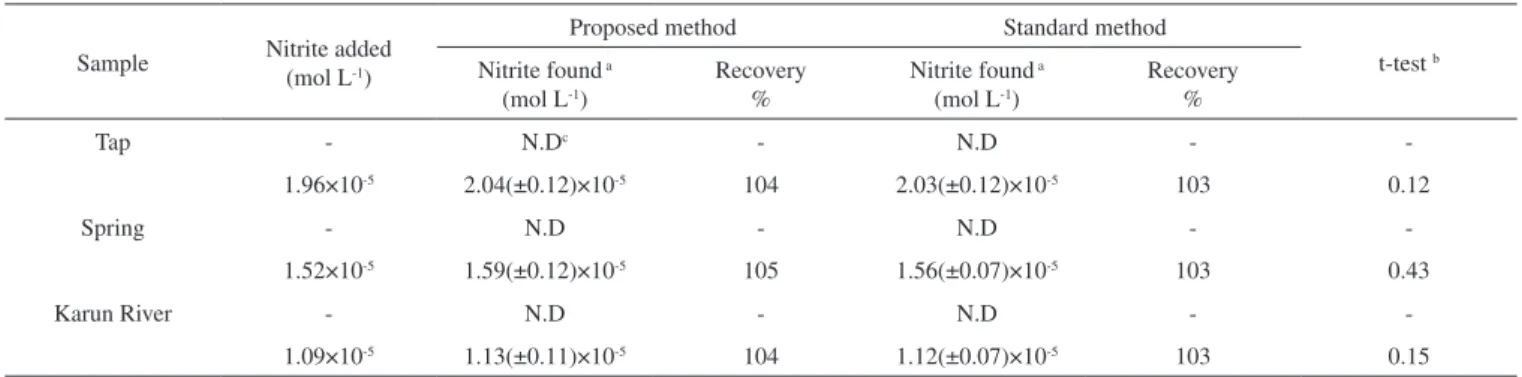
calculated | t | values were less than critical value at 95% confidence level, so there are no significant differences between the accuracy of the suggested method and the standard method.
CONCLUSION
This study has shown that the optode membrane containing methyltrioctylammonium chloride as an anionic exchanger can be used for the determination of nitrite ions contained in different aque-ous matrices. The sensing mechanism is based on formation of I3- by
redox reaction between iodide and nitrite in membrane interface. The optode described in this work shows a high selectivity for nitrite over other common ions except for S2O32- and SO32-. The main advantage of
purposed sensor in comparison with previously reported optodes26-28
(Table 4) is its simple and fast preparation of sensing membrane using low-cost materials. In addition it is fully reversible and has a long lifetime. The recommended method is non-toxic and safer than other methods where organic solvents are used. The obtained results revealed that, the purposed optical sensor is on par with the standard methods currently being used for the determination of nitrite in real samples.
Table 1. Effect of potentially interfering ions on determination of 2.17 x 10⁻⁵ mol L-1 of nitrite
Ions Tolerance ratio ([M]/[NO
2-])
NO3-, Na+ 1000
K+ , PO
43- ,Cl- 500
Mg2+ ,CO
32- 200
Mn2+, Zn2+,Co2+, Ni2+, Ca2+, Cr3+, Fe2+, Fe3+, tartrate 100 Cu2+, Cd2+, Br-, Citrate, Oxalate 50
S2O32- , SO32- 0.5
Table 2. Determination results of nitrite in sausage and saliva samples and comparison with the results obtained by standard method
Sample
Concentration of nitrite found a
(mol L-1) Relative error
%
t-test b Proposed method Standard method
Sausage 8.83(±0.38)×10-6 8.91(±0.27)×10-6 -0.9 0.34 Saliva 5.31(±0.22)×10-5 5.58(±0.18)×10-5 -4.8 1.91 a Mean ± standard deviation (n=4). b Critical value of |t| for P value of 0.05 and six degrees of freedom is 2.45
Table 3. Determination results of nitrite in water samples and comparison with the results obtained by standard method
Sample Nitrite added(mol L-1)
Proposed method Standard method
t-test b Nitrite found a
(mol L-1)
Recovery %
Nitrite found a (mol L-1)
Recovery %
Tap - N.Dc - N.D -
-1.96×10⁻⁵ 2.04(±0.12)×10-5 104 2.03(±0.12)×10-5 103 0.12
Spring - N.D - N.D -
-1.52×10⁻⁵ 1.59(±0.12)×10-5 105 1.56(±0.07)×10-5 103 0.43
Karun River - N.D - N.D -
-1.09×10⁻⁵ 1.13(±0.11)×10-5 104 1.12(±0.07)×10-5 103 0.15 a Mean ± standard deviation (n=4). b Critical value of |t| for P value of 0.05 and six degrees of freedom is 2.45. c Not Detected
Table 4. Comparison of proposed optode with previously reported optodes Reagent Linear range
(µg mL-1)
LOD (µg mL-1)
Technique of sensing film preparation
Estimate of sensor
preparation time Ref.
RBOE a 5-5000 0.5 Entrapment of RBOE into PVC 30 min 26
BCB b 1.7×10⁻⁴ – 2.99 8 ×10⁻⁵ Adsorptionreagent on membrane 4 h 27 SFA & NEDAc 0.05 - 10 0.02 Inserting an optical fiber into a capillary tube not reported 28
Gallocyanine 0.008–1.50 0.001 Binding reagent to a polymer 86 h 29
Safranine O 0.005–2.00 0.001 Binding reagent to a polymer 86 h 30
MTA+Cl- d , I- 0.3-4.0 0.03 Adsorptionreagent on membrane 12 min This work a Rhodamin B octadecyl ester perchlorate (RBOE). b Brilliant cresyl blue (BCB). c Sulfanilamide (SFA) & N-(1-Naphthyl) ethylenediamine dihydrochloride (NEDA). d Methyltrioctylammonium chloride (MTA+Cl-)
Therefore, the present method had good selectivity and could be applied to the direct analysis of samples. The interfering of S2O3
2-and SO32- could be due to these reducing properties which prevent
the formation of I3- and diminished sensor response to nitrite ion.
Application of the method
In order to evaluate the practical utility of the optode, nitrite was determined in several samples including sausage, saliva and water samples. Parallel determination was carried out to validate the recom-mended method with the standard method involving sulphanilamide and N-(1-naphthyl) ethylendiamine dihydrochloride.21 The results
obtained can be seen in Tables 2 and 3. The possibility of apply-ing the present method was tested by determinapply-ing the recovery of known amounts of nitrite ion added to the water samples. The good recoveries obtained showed that nitrite can be analysed in water with different composition.
ACKNOWLEDGEMENT
The authors are grateful to Shahid Chamran University Research Council for financial support of this work (Grant 1390).
REFERENCES
1. Hassan, S. S. M.; Marzouk, S. A. M.; Sayour, H. E. M.; Talanta 2003, 59, 1237.
2. Yilmaz, Ü. T.; Somer, G.; J. Electroanal. Chem. 2008,624, 59. 3. Helaleh, M. I. H.; Korenaga, T.; J. Chromatogr., B: Anal Technol.
Biomed Life Sci. 2000, 744, 433.
4. Santos , W. J. R.; Lima , P. R.; Tanaka, A. A.; Tanaka, S. M. C. N.; Ku-bota, L. T.; Food Chem. 2009, 113, 1206.
5. Nagaraja, P.; Al-Tayar, N. G. S.; Shivakumar, A.; Shrestha, A. K.; Gowda, A. K.; Spectrochim. Acta, Part A 2010,75, 1411.
6. Burakham, R.; Oshima, M.; Grudpan, K.; Motomizu, S.; Talanta 2004, 64, 1259.
7. Huang, K.; Wang, H.; Guo, Y.; Fan, R.; Zhang, H.; Talanta 2006,69, 73. 8. Chen, T.; Tong, A.; Zhou, Y.; Spectrochim. Acta, Part A 2007, 66, 586. 9. Akyüz, M.; Ata, S.; Talanta 2009, 79, 900.
10. Kage, S.; Kudo, K.; Ikeda, N.; J. Chromatogr., B: Anal. Technol. Bio-med. Life Sci. 2000,742, 363.
11. Kalimuthu, P.; John, S. A. ; Electrochem. Commun. 2009,11, 1065. 12. Mori, V.; Bertotti , M.; Talanta 1998,47, 651.
13. Barciela-Alonso, M. C.; Prego, R.; Anal. Chim. Acta 2000,416, 21. 14. Gaspar, A.; Juhasz, P.; Bagyi, K.; J. Chromatogr., A 2005, 1065, 327. 15. Baeza, M.; Bartrol´I, J.; Alonso, J.; Talanta 2005,68, 245.
16. Monser, L.; Sadok , S.; Greenway, G. M. ; Shah, I. ; Uglow, R. F. ; Talanta 2005, 57, 511.
17. Leelasattarathkul, T.; Liawruangrath, S.; Rayanakorn, M.; Liawruan-grath, B.; Oungpipat, W.; Youngvises, N.; Talanta 2007, 72, 126. 18. Kalyan, Y.; Pandey, A. K.; Bhagat, P. R.; Acharya, R.; Natarajan, V.;
Naidu, G. R. K.; Reddy, A. V. R.; J. Hazard. Mater. 2009,166, 377. 19. Safavi, A.; Bagheri, M.; Anal. Chim. Acta 2005,530 , 55.
20. Rastegarzadeh, S.; Moradpour, Z.; Instrum. Sci. Technol. 2007,35, 637. 21. AOAC; Official Methods of Analysis, Method 36.1.21, 16th ed., 1995. 22. Rastegarzadeh, S.; Pourreza, N.; Saeedi, I.; Talanta 2009,77, 1032.
23. Vogel, A. I.; Vogel’s Qualitative Inorganic Analysis, 7th ed., Revised by Svehla, G.; Pearson Education Ltd.,1996.
24. Jones, T. P.; Porter, M. D.; Anal. Chem. 1988,60, 404.
25. Kostov, Y.; Tzonkov, S.; Yotova, L.; Krysteva, M.; Anal. Chim. Acta 1993,280, 15.
26. Mohr, G. J.; Wolfbeis, O. S.; Analyst 1996, 121,1489. 27. Ensafi, A. A.; Amini, M. ; Sens. Actuators B 2010,147, 61.
28. Xiong, Y.; Zhu, D.; Duan, C.; Wang, J.; Guan, Y.; Anal. Bioanal. Chem. 2010, 396, 943.
29. Kazemzadeha, A.; Daghighi, S.; Spectrochim. Acta, Part A 2005,61, 1871.