Leptospirosis presenting as ascending progressive
leg weakness and complicating with acute pancreatitis
Authors
Andre Pacheco Silva1 Luciana Bonnassis Burg2 João Felipe Schadeck Locatelli3
Joice Manes1 Morgana Crispim1
1Resident Physicians in Internal Medicine, Hospital Universitário, Universidade Federal de Santa Catarina (UFSC), SC, Brazil 2Specialistin Clinical Gastroenterology; Postgraduate in Hepatology focused on Hepatic Transplantation; Emergency Physician at Hospital Universitário, UFSC; Preceptor Physician for the Internal Medicine Residency Program at Hospital Universitário, UFSC; Member of the Câmara Técnica de Transplante de Fígado do Estado de Santa Catarina; Physician, Imperial Hospital de Caridade, Florianópolis, SC, Brazil 3Medical Student, UFSC, SC, Brazil
Submitted on: 2/9/2011 Approved on: 4/9/2011
Correspondence to: Andre Pacheco Silva Hospital Universitário Universidade Federal de Santa Catarina Departamento de Clínica Médica
Rua Profª Maria Flora Pausewang, Sn Trindade 88040-900 - Florianopolis, SC, Brazil
We declare no conflict of interest.
©2011 Elsevier Editora Ltda. All rights reserved.
ABSTRACT
Leptospirosis is a spirochetal bacterial infection of great public health importance. It has a broad spectrum of clinical manifestations which goes from subclinical infection and self-limited anicteric febrile illness (80-90% of all cases) to icteric leptospiropirosis known as Weil’s disease. This is a severe disease characterized by hemorrhage, acute renal failure and jaundice. It is uncommon for leptospirosis to present itself as a primary neurological disease. Additionally, acute pancreatitis is an unusual gastrointestinal manifestation. We report a case of leptospirosis presenting as ascending progressive leg weakness and complicating with acute pancreatitis in an adult patient treated at Hospital Universitário, Universidade Federal de Santa Catarina. The diagnosis was confirmed through ELISA-IgM antibody testing positive for leptospirosis. After antibiotic therapy and support treatment for a few weeks, total resolution of severe manifestations was achieved. Rare and unusual presentations of leptospirosis should be kept in mind in relevant epidemiological scenario.
Keywords: leptospirosis; pancreatitis; neurologic manifestations.
limited anicteric febrile illness (80-90% of all cases) to icteric leptospiropirosis known as Weil’s disease, a severe and potentially fatal disease characterized by hemorrhage, acute renal failure and jaundice.2
It is uncommon for leptospirosis to pre- sent as a primary neurological disease. Both central and peripheral neurological manifesta-tions of the disease may be seen, but usually in context of advanced infection, where the diag-nosis has already been established.5 The
com-monest neurological manifestation is aseptic meningitis.6 Peripheral nerve involvement is
rare, but abnormalities reported include tran-sient lower limb weakness, areflexia, paraes-thesiae, neuropathies and the Guillain-Barré syndrome (GBS). There are a few cases of GBS-like presentation during or following infection with Leptospira interrogans documented in the literature.5,7,8
Acute pancreatitis is an uncommon gas-trointestinal manifestation of leptospirosis. There are considerable number of cases doc-umented in literature, but the involvement of the pancreas is not yet well understood in human leptospirosis.8-21 The diagnosis of
INTRODUCTION
Leptospirosis is a worldwide spirochetal bacterial infection of great public health importance in the tropics. The source of infection in humans is usually either direct or indirect contact with the urine of infected animals. These bacteria infect humans by entering through abraded skin, mucous membrane, conjunctivae.1,2 It is
an endemic disease in several regions of Brazil, more often due to bad living conditions and seasonal floodings, seen in the rainy seasons.3
After an incubation period of 1-2 weeks, leptospirosis manifests as a biphasic illness with the leptospiremic phase followed by an immune phase.4
This disease is characterized by the de-velopment of vasculitis, endothelial damage, and inflammatory infiltration. Leptospirosis mostly affects tissues of the liver and kidney. Rarely, other organs such as brain, pancreas, lung, heart, gallbladder, brain, and ophthalmic tissues are involved, mainly due to vasculitis.1,2 Clinically, it shows a broad
spectrum of clinical manifestations which goes from subclinical infection and
self-CASE
acute pancreatitis may be complicated as acute renal fail-ure can increase the serum amylase and lipase levels.10,19,22
We report a case of leptospirosis presenting as ascend-ing progressive leg weakness and complicatascend-ing with acute pancreatitis in an adult patient seen at a tertiary care cen-tre in Florianópolis. Medical records of this patient were retrospectively reviewed in praparation of the case.
CASE REPORT
A 48-year-old black male patient from southeast of Brazil was admitted in the emergency department of our hospital on the October 16th, 2010. At the time, he was working as a
plumber in south of Brazil. He presented with complaints of progressive loss of strength and severe pain in both legs with four-day history. Previously to that, he reported being healthy and did not present any other known diseases. He also complained about a high grade fever and a bilateral headache, mainly occipital, of moderate intensity, in the past three days. One day after the appearance of the fever, he started with diarrhea, without fecal incontinence, abdominal pain, blood or pathological products. Urine alterations or urinary retention were not observed. On the day before being admitted to the hospital, he presented difficulty to stand up due to severe pain and loss of movement control on both legs. He referred 4-kg weight loss in the last week. He denied contact with jaundiced persons, blood transfusion and drug abuse, except for small amount of alcohol daily intake. He had contact with contaminated water 1-2 weeks before coming to the hospital.
On physical examination, he was in poor condi-tion, dehydrated, oriented, anicteric, pulse rate 108 bpm and temperature of 39.1°C. Blood pressure was 140 x 80 mmHg with no dyspnea and with normal car-dio-pulmonar and abdominal auscultation. His abdomen was flat, flaccid, and there was no hepatomegaly. The neurological examination disclosed paraparesis, Muscle Research Council (MRC) grade 2 strength in both legs, and painful skin upon touch. The patellar and ankle re-flexes were absent. Strength was normal in upper limbs, biceps and flexor reflexes were normal. Sensibility was preserved. He did not present nuchal rigidity, exam of cranial nerves was normal and no other abnormalities were noticed. Autonomic dysfunctions, loss of sphincter control or swallowing disorders were not observed.
Laboratory findings on admission revealed Hb: 12.8 g/dL ; Htc: 37.6% ; WBC: 6770/mm3; platelet count:
41,000/mm3 (n: 150 x 10³ – 440 x 10³); creatinine:
1.3 Mg/dL (n: 0.8-1.3); Na: 132 mEq/L (n: 136-145); aspar- tate transaminase: 213 U/L (n: 15-37); alanine transam-inase: 130 U/L (n: 25-64); alkaline phosphatase: 109 U/L (n: 50-136); gamma glutamyltransferase: 106 U/L (n: 15-85); total bilirrubin, serum K, creatine kinase were normal; serology negative for viral hepatitis and HIV.
A lumbar puncture was performed on the fourth day of initial symptoms, and cerebrospinal fluid (CSF) was clear. CSF glucose and protein were normal, latex tests for cryptococcal antigen was negative, and no bacteria were found. B12 vitamin level and thyroid function were nor-mal. Chest X-ray was nornor-mal.
On the admission day, the patient was put on intravenous hydration and received thiamine and medication for symptom relief. One day after being admitted to the hospital jaundice and severe abdominal pain ensued, and the patient remained presenting paraparesis and severe pain in both legs. A neurologic evaluation was requested and performed by a neurologist, who noted loss of strength not only restricted to legs, but also a paresis on upper limbs, MRC grade 4, biceps, triceps and supinator hyporeflexia. GBS was thought to be the main cause.
On the second day in hospital, the urinanalysis showed moderate quantity of bacteria with 160 x 10³ leukocytes. Ceftriaxone was administered on the suspicion of uri-nary tract infection. At that moment, the amylase evalu-ation turned out 478 U/L (n: 25-115); lipase 898 U/L (n: 114-286) and creatinine: 4.9. Acute pancreatitis was diagnosed. No hemodialysis was necessary at that moment.
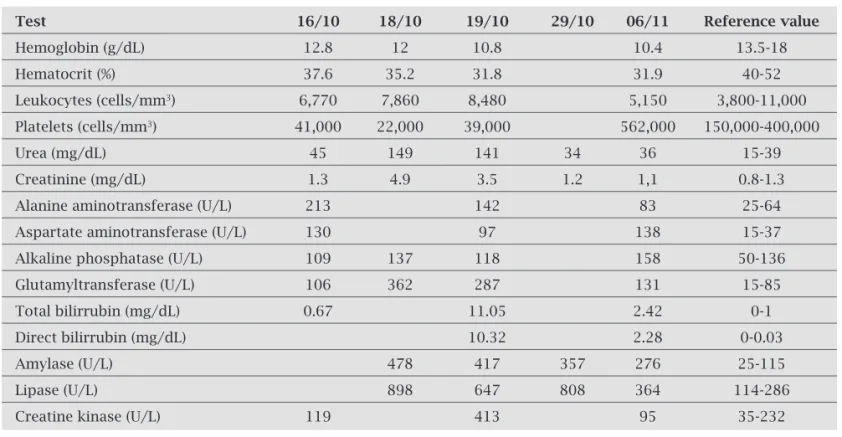
By the third day he continued with high grade fever and the jaundice was more evident. Total bilirrubin increased to 11.05 mg/dL (direct bilirubin: 10.32). Creatine kinase increased to 413 U/L, as shown in Table 1. Uroculture was normal. Ceftriaxone was discontinued and treatment with penicillin G started as leptospirosis infection was the likely diagnosis. The patient’s blood pressure dropped to 80 x 50 mmHg and capillary refill time was decreased. Af-ter rapid hydration he recovered his normal blood pressure with no vasopressors needed.
By the eighth day of initial symptoms, ELISA-IgM anti-body testing for leptospirosis was performed.
An echocardiogram showed mild hypokinesia on left ventricle, ejection fraction of 49% and moderate diastol-ic dysfunction. However, the patient has never presented dyspnea during his clinical evolution. Abdominal ultra-sonography showed free peritoneal fluid and abdomen CT-Scan showed free fluid in the pelvis and bilateral pleu-ral effusion. Nothing was observed at the pancreas site.
The therapy with penicillin was continued. On the following days, the neurological symptoms presented progressive improvement. A mild improvement on la-boratory findings was also noted. From hospital day 6 on the patient did not present fever, headache or diarrhea, although he remained icteric. His creatinine level gradually returned to normal levels.
The neurological findings remained unchanged until the 6th day, when a gradual daily improvement was
the improvement of clinical findings with the introduction of leptospirosis treatment and due to financial constraints.
On hospital day 15 there was a total neurologic recovery and the patient was able to stand up and walk normally. His amylase and lipase were kept high (332 and 706 U/L, respectively) and total bilirubin was 2.49 (direct bilirubin: 2.23), as shown in Table 1. The patient was discharged on the 22nd day after
admis-sion, with a positive result for the immunoenzimatic ELISA-IgM antibody testing for leptospirosis (from Cen-tral Laboratory of Public Health of Santa Catarina). He was asymptomatic but remained with high levels of am-ylase and lipase. Appropriate advice for follow-up after 30 days was given. On November 30th 2010 the patient did
not have any complaints or weaknesses.
DISCUSSION
Leptospirosis has protean manifestations and rare and unu-sual presentations should be kept in mind in relevant epide-miological scenario.23
Neurological involvement in leptospirosis is rare. The neurological manifestations result from the effect of the organism on the central nervous system (CNS) and the host immune reaction to the organism. Following infection, leptospires reach the CNS rapidly. Changes in CSF content are a later manifestation, and it has therefore been suggested that some of the inflammatory neuro-logical manifestations of leptospirosis result not from the
organism itself but from the antibody reaction to it.5,8 The
prognosis after primary neuroleptospirosis is generally good but altered sensorium and seizures herald a worse prognosis.6
The striking feature of this case was initial presentation of leptospirosis with neurological symptoms. In the immune phase of the illness as aseptic meningitis is common, with up to 90% of cases having CSF pleocytosis. About half of these cases have symptoms of meningeal irritation.6,7 However, these features are usually incidental
to an established and generalized illness. Opposite to the reported in this case, the majority of florid neurological features seen usually occur when the diagnosis has already been made and treatment is in progress.5
The present case had a notably symmetric ascending polyneuropathy and arreflexia as initial symptoms, in the absence of sensory loss and sphincter disorders. The probable cause was meningeal and radicular inflammation as a result of antibody production. The neurological picture was progressive and reminiscent of GBS, illness characterized by areflexic motor paralysis with mild sensory involvement and typical acellular rise in CSF total protein.7 No typical albuminocytologic dissociation
was found, probably because of the time of evaluation (4th day after onset of symptoms). In patients with GBS,
normal CSF protein is found in about one-third of patients when tested earlier than one week after symptom onset.24 The diagnosis of GBS is confirmed when there Table 1. Laboratory findings of reported patient during hospitalization, Florianópolis – SC, 2010
Test 16/10 18/10 19/10 29/10 06/11 Reference value
Hemoglobin (g/dL) 12.8 12 10.8 10.4 13.5-18
Hematocrit (%) 37.6 35.2 31.8 31.9 40-52
Leukocytes (cells/mm3) 6,770 7,860 8,480 5,150 3,800-11,000
Platelets (cells/mm3) 41,000 22,000 39,000 562,000 150,000-400,000
Urea (mg/dL) 45 149 141 34 36 15-39
Creatinine (mg/dL) 1.3 4.9 3.5 1.2 1,1 0.8-1.3
Alanine aminotransferase (U/L) 213 142 83 25-64
Aspartate aminotransferase (U/L) 130 97 138 15-37
Alkaline phosphatase (U/L) 109 137 118 158 50-136
Glutamyltransferase (U/L) 106 362 287 131 15-85
Total bilirrubin (mg/dL) 0.67 11.05 2.42 0-1
Direct bilirrubin (mg/dL) 10.32 2.28 0-0.03
Amylase (U/L) 478 417 357 276 25-115
Lipase (U/L) 898 647 808 364 114-286
are compatible clinical features and neurological exam associated with typical CSF and eletrophysiologic studies. MRI is usually helpful in excluding acute myelopathy as a differential diagnosis. Eletrophysiologic tests and MRI were not performed in this patient because improvement of neurological alterations with the treatment for leptospirosis and due to financial constraints.
An epidemiological suspicion, a history of fever, headache, mialgias, low platelet count and acute renal dysfunction were compatible with leptospirosis. The diagnosis was confirmed later by ELISA-IgM antibody testing, which supported the presumption that neuropathy was triggered by an acute leptospiral infection. A total recovery after antibiotic therapy in this patient also confirmed that infection. Elisa-IgM antibody testing is an immunoenzimatic assay with good sensitivity and specificity, mainly after the 7th day of symptom onset.
GBS has been reported as sequelae to several infections including Campylobacter jejuni gastroenteritis, and infections due to Epstein-Barr virus and cytomegalovi-rus. Other cases occur on a background of Hodgkin’s disease, systemic lupus erythematous, and lymphoma. Although its pathogenesis is not clear, GBS may be induced by molecular mimicry, toxin, or immune de-regulation. However, immunological studies delineating the mechanism for neuropathy triggered by Leptospira have not been carried out probably because of the rare association.7
Munford et al.5 also described a dramatic neurological
presentation with a rapidly evolving flaccid paraplegia associated with biochemical evidence of renal and hepatic dysfunction, a fatal case in a 64-year old farm worker. Other authors reported cases of GBS following an infection with Leptospira icterohaemorrhagiae in a 65-year old woman and in a pediatric patient.7,8
A definite relationship between an infection episode and neuropathy is difficult to establish as in most cases it is not possible to isolate the causative organism by the time neuropathy appears. The diagnosis is usually ascertained on the basis of relevant serological tests.5
Pancreatitis is a rare complication of leptospirosis.19
This patient presented epigastric pain and jaundice as the main manifestations of pancreatic involvement, and laboratory diagnosis could be achieved by the eleva-tion of serum lipase levels of more than threefold the normal values and amylase levels more than four times of normal levels. There were no pancreatic morphologic changes detectable by ultrasound and abdominal CT ex-amination revealed only intra-abdominal minimal fluid collection, with bilateral pleural effusion. The history of alcoholism may have mislead the etiology of pancreatitis in this case, but clinical features and leptospirosis serology confirmation weakened the suspicion of alcoholic
pan-creatitis. Other authors have described several cases of leptospirosis and pancreatitis diagnosed by elevated se-rum amylase and lipase, but without morphologic change detectable by pancreatic ultrasound.9-14 Daher et al.17
demonstrated that histopathological pancreatic changes are not well correlated with high level of serum amylase in human leptospirosis. So, the diagnosis of acute pancre-atitis is somewhat controversial in this disease.19 Clinical
symptoms of pancreatitis are not common findings and a true diagnosis of acute pancreatitis is complicated by the fact that acute renal failure, a leptospirosis usual manifes-tation, can increase serum amylase and lipase levels.10 It
is suggested that, apart from the typical clinical features, serum amylase levels higher than twice the normal value could not be explained only by renal failure.25 Therefore,
in the presence of renal failure, Kishor et al.21 suggested
laboratory diagnosis of acute pancreatitis should only be performed with amylase levels higher than 4.4 times the normal value. Sometimes, abdominal CT is essential for a correct diagnosis.
The patient reported here presented a favorable evolution, with total resolution of severe manifestations in a few weeks.
In conclusion, leptospirosis can be presented as a neurological primary disease. It should also be consid-ered in the differential diagnosis of hyperamylasemia and jaundice in endemic areas. Clinicians need to be aware of the possibility of leptospirosis, even if the illness presents with unusual features, because early diagnosis and appropriate treatment is essential for life saving.
ACKNOWLEDGEMENTS
We thank the professionals of Emergency Department of Hospital Universitário, Universidade Federal de Santa Catarina, SC, Brazil.
REFERENCES
1. Farr RW. Leptospirosis. Clin Infect Dis 1995; 21:1-6.
2. Levett PN. Leptospirosis. Clin Microbiol Rev 2001; 14:296-326.
3. Reis RB, Ribeiro GS, Felzemburgh RD et al. Impact of envi-ronment and social gradient on Leptospira infection in urban slums. PLoS Negl Trop Dis 2008; 2:228.
4. Ramakrishna P, Sai Naresh VV, Chakrapani B et al. Indian J Nephrol 2008; 18:130-1.
5. Mumford C, Dudley N, Terry H. Leptospirosis presenting as a flaccid paraplegia. Postgrad Med J 1990; 66:218-20.
6. Panicker JN, Mammachan R, Jayakumar RV. Primary neuro-leptospirosis. Postgrad Med J 2001; 77:589-90.
7. Bal AM, Bharadwaj RS, Gita N et al. Guillain-Barré syndrome in a pediatric patient following infection due to Leptospira. Jpn J Infect Dis 2003; 56:29-31.
9. Casella G, Scatena LF. Mild pancreatitis in leptospirosis in-fection. Am J Gastroenterol 2000; 95:1843-4.
10. Edwards CN, Nicholson GD, Hassel TA et al. Leptospirosis in Barbados. W. Indian Med J 1990; 39:27-34.
11. Edwards CN, Evarard COR. Hyperamylasemia and pancrea-titis in leptospirosis. Am J Gastroenterol 1991; 86:1665-8. 12. Mana D, Karantzias J, Bagilet D et al. Leptospiroses e
hiper-amilasemia. Med Intens 2000; 19:16-8.
13. Monno S, Mizushima Y. Leptospirosis with acute acalculous cholecystitis and pancreatitis. J Clin Gastroenterol 1993; 16:52-4.
14. O’Brien MM, Vincent JM, Person DA et al. Leptospirosis and pancreatitis: a report of ten cases. Pediat infect Dis J 1998; 17:436-8.
15. Stolze E, Schaads JDG, Bool PH. Weil’s Disease associated with pancreatic necrosis. Report on a case. Trop Geogr Med 1959; 11:93-5.
16. Vincent JM, Obrien MM, Person DA et al. Leptospirosis and pancreatitis. Pediat Infect Dis J 1999; 18:400.
17. Daher EF, Brunetta DM, Silva Junior GB et al. Pancreatic involvement in fatal human leptospirosis: clinical and his-topathological features. Rev Inst Med Trop S Paulo 2003; 45:307-13.
18. Leblebicioglu H, Sencan I, Sunbul M et al. Weil’s disease: Report of 12 cases. Scand J Infect Dis 1996; 28:637-9. 19. Kaya E, Dervisoglu A, Eroglu C et al. Acute pancreatitis
caused by leptospirosis: Report of two cases. World J Gas-troenterol 2005; 11:4447-9.
20. Pai ND, Adhikari P. Painless pancreatitis: a rare manifesta-tion of leptospirosis. J Assoc Physic Ind 2002; 50:1318-9. 21. Kishor KK, Rao PV, Bhat KR et al. Pancreatitis in Weil’s
dis-ease. Trop Doct 2002; 32:230-1.
22. Rosa RH, Dias A, Pascoa B et al. Leptospirose e pancreatite aguda. J Port Gastrenterol 2004; 11:210-2.
23. Bal AM. Unusual clinical manifestations of leptospirosis. J Postgrad Med 2005; 51:179-83.
24. Ropper AH, Wijdicks EFM, Truax BT. Chapter 6. In: Guil-lain-Barré syndrome, FA Davis, Philadelphia 1991. p.57 25. Levvit MD, Cooperband SR. The renal clearance of amylase