OF THE SAND MORAY Gymnothorax ocellatus (ANGUILLIFORMES,
MURAENIDAE) IN THE SOUTH WESTERN ATLANTIC
Flávia Borges Santos* and Ricardo M. C. Castro**
Abstract
Activity, habitat utilization, feeding behaviour, and diet of the sand moray Gymnothorax ocellatus (Anguilliformes, Muraenidae) in the South western Atlantic.
The sand moray Gymnothoraxocellatus is a nocturnal predator from the western South Atlantic that actively forages on the bottom, preying mostly on crustaceans (mainly shrimps and crabs) and ray-finned fishes, which are located primarily by the sense of smell. The individuals stay stationary during the day, almost always being hidden in individual tunnels dug by animals other than the morays in the muddy sand bottom.
Key words: Muraenidae; Gymnothorax ocellatus; habitat use; feeding behaviour; diet.
Resumo
Atividade, utilização do habitat, comportamento alimentar, e dieta da moréia-de-areia Gymnothorax ocellatus (Anguilliformes, Muraenidae) no Atlântico sudoeste.
A moréia-de-areia Gymnothoraxocellatus é um predador noturno do Atlântico ocidental que forrageia ativamente o fundo, predando principalmente crustáceos (em especial camarões e siris) e peixes actinopterígios, os quais são localizados principalmente pelo olfato. Os indivíduos permanecem inativos durante o dia, quase sempre escondidos em túneis individuais escavados por outros animais, que não moréias, em substrato areno-lodoso.
Palavras-chave: Muraenidae; Gymnothorax ocellatus; utilização do habitat; comportamento alimentar; dieta.
Biota Neotropica v3 (n1) – http://www.biotaneotropica.org.br/v3n1/pt/abstract?article+BN00103012003
Date Received 10/18/2002 Revised 01/13/2003 Accepted 03/07/2003
Departamento de Zoologia, Instituto de Biociências - Universidade de São Paulo,CP 11461, 05422-970 São Paulo, São Paulo, Brazil. (http://www.ib.usp.br)
*Author to whom correspondence should be addressed. Tel:+55-11-3091-7511; fax:+55-19-3232-1745; e-mail: [email protected]
1. INTRODUCTION
Moray-eels of the family Muraenidae are specialized secretive and largely nocturnal reef-dwelling predators, which typically hunt fish and crustaceans deep in rock crev-ices (Lowe-McConnell 1987, Böhlke & Chaplin 1993, Randall 1996). The prey is located primarily by smell, and some mo-ray species are known to use a knotting behavior to break up large prey items (Miller, 1987, 1989). The muraenid genus Gymnothorax has a worldwide distribution and is repre-sented by five species off the southeastern coast of Brazil: G. funebris Ranzani, 1839, G. moringa (Cuvier 1829), G. vicinus (Castelnau 1855), G. conspersus Poey, 1867, and G. ocellatus Agassiz, 1831 (Figueiredo & Menezes 1978, Böhlke et al. 1989). The first three Gymnothorax species are associated with coral or rock reefs,whereas the sand moray G. ocellatus is associated with gravel, sand, or mud sub-strates of open sedimentary bottoms (Figueiredo & Menezes 1978, Carvalho-Filho 1999),and G.conspersus is a poorly known species living below 200 m (Böhlke & Böhlke 1980). The biology of the central and south west Atlantic morays dwelling in clear water reefs is relatively well known (e. g., Bardach et al. 1959, Bardach & Loewenthal 1961, Dubin 1982, Abrams & Schein 1986). However very little is known about the biology of G. ocellatus, an abundant species over mud/sand bottoms (Carvalho-Filho 1999). This lack of
knowl-edge may be due to the flat, turbid water sites occupied by the sand moray, which are unappealing to divers. This ar-ticle provides the first published information on the activity period, spatial distribution, habitat use, feeding behavior and diet of G. ocellatus on a coastal stretch of the State of São Paulo, southeastern Brazil.
2. MATERIAL AND METHODS
2.1. STUDY SITE
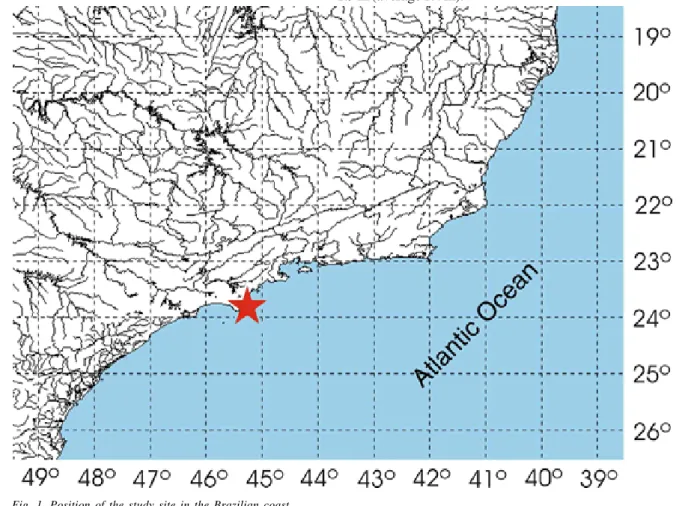
The field observation were carried out monthly from May 1996 to May 1998, in a 12.5 km stretch of the continen-tal margin of the São Sebastião Channel, south-eastern Bra-zil (Fig. 1). Underwater activities were conducted within an approximately pentagonal open bottom area 0.5-5 m deep in front of the 50 m long Cabelo Gordo beach (23º49’30" S, 45º25’18" W). The study area was limited by the surf line, the two bordering rocky shores and three tethered floating markers. This site is characterized by a muddy sand sub-strate (71.7-90.4% sand, 4.3-19.4% silt and 5.3-8.9% clay) and the occurrence of green seagrass Halodule wrightii. During the study period, water temperature at the surface varied 17.4-24.2º C (average 21.5º C) and horizontal trans-parency of water, measured with a Secchi disk, varied 0.85-1.9 m (average 1.4 m).
2.2. PROCEDURE
The 66 examined specimens were collected on muddy sand bottoms shallower than 13 m using hook-and-line baited with sardines (n=64, 97%), a nylon beach seine (n=1, 1.5%) and a handnetduring scuba dives (n=1, 1.5%). The speci-mens were fixed in 10% formalin on capture and latter trans-ferred to ethanol 70%. Voucher specimens (LIRP 2281-2303) were deposited in the fish collection of the Laboratório de Ictiologia de Ribeirão Preto (LIRP), at the FFCLRP-Universidade de São Paulo, São Paulo, Brazil.
A total of 91 hours of underwater observations were made during scuba (85 h) and skin diving (6 h) over bottoms 5 meters deep or shallower. Data on activity period, habitat use, and feeding behavior were obtained during 51 diurnal, 27 nocturnal and 13 crepuscular observation hours, distrib-uted throughout the 24-h cycle (daytime isdefined here as the period between the end of sunrise and beginning of sunset and night as the period between the end of sunset and the beginning of sunrise). During the observational sessions ad libitum and focal animal sampling were used (Altmann 1974, Lehner 1996). During each dive the number of observed G. ocellatus individuals was recorded together with the type of substrate on which they were found and also the type of shelter used during inactivity periods. Ac-tivity was assessed based on food searching behavior, and mobility was categorized as follows: stationary while total or partially hidden, laterally undulating immediately over the bottom, with the body vertical axis perpendicular to the bottom or with the specimen swimming on its side with strong lateral undulations about 0.15 m over the bottom; and searching for prey or taking offered baits. During night and crepuscular dives, an underwater torchlight with a red filter was used to diminish the disturbance caused to white-light sensitive sand morays (cf. Helfman 1992).
To locate the shelters of G. ocellatus within the study site, we used four circular 1-10 m radius concentric transects - derived from the common “search-in-circles” scuba proce-dure (Shreeves et al. 1991) - centered in four 1.3 m high upright PVC cylinders permanently fixed to the bottom. Once located, the shelters were marked with tethered floating markers (Helfman 1992). Three PVC tubes (one straight; one C-shaped; and one U-shaped) 60 cm long and 7 cm wide, were experimentally positioned on the substrate of the study site for about four months to verify the opportunistic shel-ter use by G. ocellatus.
Contents of the whole digestive tracts of 62 speci-mens (43 individuals collected during the day, 14 during the night and five during twilight) of G. ocellatus were ana-lyzed. Collecting was carried out evenly through the year. The ratio of digestive tube length/standard length was cal-culated (LDT: LS index - intestinal ratio - see Knöppel 1970), as well as the frequency of occurrence (Bowen 1992) and the per cent composition (Hynes 1950) for each broad cat-egory of food item.
3. RESULTS
3.1. ACTIVITY PERIOD
Thirty eight (48.7%) sightings of G. ocellatus oc-curred during daytime, when the individuals were hiding within shelters (n=36, 94.7%) (Fig. 1), swimming (n=1, 2.6%) or eating offered baits (n=1, 2.6%). Thirty seven (47.4%) sightings occurred at night, when individuals were hiding within shelters (n=13, 35.1%), swimming (n=6, 16.2%), search-ing for prey (n=2, 5.4%), eatsearch-ing offered baits (n=12, 32.4%), or feeding or trying to feed on live crustaceans and fish (n=4, 10.8%). During the three (3.8%) sightings recorded at twilight, the individuals were swimming between the sunset time and 1 h after it (n=1, 33.3%), and entering shelters be-tween sunrise time and 1 h after it (n=2, 66.6%).
3.2. SPATIAL DISTRIBUTION AND HABITAT USE
All 78 sightings of G. ocellatus were between depths of 1.5-3.5 m on muddy sand open bottom with seagrass, Halodule wrightii, an isolated group of three boulders and a variable number of small patches of debris discarded from recreational and fishing boats. On no occasion G. ocellatus was seen associated with adjacent rocky habitats.
Sand morays were recorded hidden total or partially within shelters during the day (94.7%, n=36) and at night (35.1%, n=13). We recorded three shelter types: 1) individual holes dug in the muddy bottom (n=23, 46.9%) (Fig. 2a); 2) small patches of debris (plastic and ceramic tubes, plank fragments, bottle fragments and pieces of ironwork)
carded from recreational and fishing boats, usually accom-panied by approximately 60 mm young Epinephelus niveatus (Valenciennes, 1828) (n=11, 22.5%); 3) an isolated group of three large boulders (n=2, 4 %) (Fig. 2b).All viduals recorded in shelters were alone except for two indi-viduals found sharing a shelter in the isolated group of boulders and another two within a small patch of debris. On 13 occasions G. ocellatus was found using the U-shaped tube, four (=30.7%) of them at night and nine (=69.2%) dur-ing daytime. Neither the straight tube nor the C-shaped were used as shelter. No excavation activity was recorded throughout the study and the seven individuals seen enter-ing their shelters did so tail first. All individuals recorded outside shelters during the daytime (n=2, 6.9%), nighttime (n=24, 82.7%), or twilight (n=3, 10.3%) were actively search-ing for prey on the bottom and accepted offered dried sar-dine baits.
3.3. FEEDING BEHAVIOUR AND DIET Individuals recorded actively foraging were laterally undulating immediately over the bottom, with the vertical body axis perpendicular to it. When a potential prey was located, the moray stopped for approximately 10-60 s on the
bottom, adopted a distinctly S-shaped body posture and probed the bottom or mats of seagrass with its snout, search-ing for prey. Two actual prey captures were recorded: on one occasion a small (about 20 mm) semi-buried crab was picked up from the substrate and swallowed in a single movement, without chewing (an almost intact true crab Hepatuspudibundus was found in the gut content items of this eel); on another occasion, an approximately 40 mm long silvery bony fish was captured, via a quick grabbing move-ment while trying to escape from the bottom after being disturbed by the moray probing movements.
On two occasions the sand morays were observed trying unsuccessfully to grab and rip off the legs of large Callinectes sp. true crabs (two individuals had large Callinectes claws in their guts, see grasping relatively large prey; Keenleyside 1979). During most nighttime observa-tions, individuals of Lutjanus spp. snappers and Diplectrum spp. sand perchs were observed following individuals of G. ocellatus while these searched for food, presumably to get scraps or capture animals flushed from hiding by the eels prey (followers, see Sazima 1986).
One three occasions, two during the day and one during the night, live fish baits (one 100 mm Harengula
clupeola (Cuvier, 1829) false pilchard; a 70 mm Haemulon steindachneri (Jordan & Gilbert, 1882) latin grunt, and a 50 mm Bathygobius soporator (Valenciennes, 1837) frillfin goby) were offered tethered by a nylon filament to morays hiding in holes in the substrate. On all three cases the mo-rays left their shelters to examine the potential preys but only in the first case was the prey taken and swallowed whole. During two night dives whole dead Sardinella brasiliensis (Steindachner, 1789) sardines and Auxis sp. mackerels were used as bait to attract G. ocellatus. The dead fish were carried underwater tightly sealed inside in-tact transparent plastic bags. While the bags were kept closed, no G. ocellatus specimens were attracted; but ap-proximately 30 seconds after the bags were open and the bloody water inside released into the environment, two to five morays approached from several directions, quickly moving towards the dead fish. If the dead fishes were smaller than about 25% of the moray’s length, they were quickly swallowed whole. If larger, the morays applied the knotting behavior (see Miller 1987, 1989) to bend the fish or remove pieces from it (Fig. 3).
Forty two digestive tracts of the 62 specimens con-tained food, which were in decreasing order of frequency: decapod crustaceans (true crabs and shrimps), bony fishes (mostly non identified fragments, engraulid anchovies, fol-lowed by clupeid herrings, hemiramphid halfbeaks, triglid searobins, syngnathid pipefishes, and diodontid burrfishes, all of approximately equally frequency), followed by uni-dentified crustaceans fragments, and the equally frequent cephalopod molluscs (loliginid squids) and stomatopod crus-taceans (mantis shrimps) (Table I). Approximately 10% of the digestive tracts contained parasitic trematode flukes.
All examined digestive tracts had small amounts of sand, an apparent unintentional by-product of prey ingestion. Food items grouped in broad taxonomic categories and expressed as per cent composition values show that crustaceans (58%) and bony fishes fragments (39%) were the main diet compo-nents, followed by cephalopod mollusks (3%). The average LDT : Ls index for 62 specimens was 0.54 (SD=0.09).
4. DISCUSSION
Our results indicate that G. ocellatus is a crepuscu-lar-nocturnal fish that during daytime remains stationary and hidden mostly inside individual holes in the muddy-sand bottom. During nighttime and twilight about 60% of the recorded individuals leave the shelters and actively for-age over open muddy-sand bottoms. Nonetheless, it was possible to lure sheltered individuals temporarily out of their shelters to feed on offered preys. This tendency previously discussed by Böhlke & Chaplin (1993) for the muraenids as a whole could explain why it was possible for us to collect the majority of the specimens with baited hook-and-line during daytime. The largely crepuscular-nocturnal habits of many moray eel species are relatively well known (e.g. Bardach et al. 1959, Smith & Tyler 1972, Böhlke & Chaplin 1993, Randall 1996, Carvalho-Filho 1999), and G. ocellatus was regarded as an “eel-like nocturnal searching predator of fishes and bottom animals” by Sazima (1986).
All G. ocellatus specimens were found in open muddy-sand flat bottom areas, which is generally in agree-ment withFigueiredo & Menezes (1978) and Carvalho-Filho (1999). Muraenid eels differ from the related ophichthid eels by not having hard pointed tails without an external fin that are utilized to enter the soft bottom substrate tail first (Böhlke & Chaplin 1993, Figueiredo & Menezes 1978). The absence of this excavating tail, the observed opportunistic use of artificial shelters provided by us or by unintentional human activities (throwing trash overboard), as well as the absence of any excavating activity, lead us to believe that all sub-strate holes occupied by G. ocellatus (Fig. 2a and Fig.2b) were product of the activities of some other organisms.
The most frequent food items of G. ocellatus were crustaceans (true crabs and shrimps) and actinopterygian fishes (ray-finned fishes), with stomatopod mantis shrimps and squids being much less frequent (Table I). The crusta-cean and fish-eating benthic feeding habits of G. ocellatus have been already briefly noted by Sazima (1986) and Carvalho-Filho (1999), which agree with our results. The short digestive tract average length of G. ocellatus relative to its average standard length (0.54) also agrees with a car-nivorous feeding habit (Wootton 1994). All crustaceans in-gested were benthic or burrowing species (mantis shrimps). The ingested fish were either benthic (triglid searobins and
syngnathid pipefishes), demersal (diodontid burrfishes), or coastal shallow-water dwelling juveniles of pelagic species (engraulid anchovies, clupeid herrings and hemiramphid halfbeaks) which occur in deeper open waters when adults (Figueiredo & Menezes 1978, Carvalho-Filho 1999, pers. obs.). Loliginid squids were recorded swimming at night-time in groups of 2-5 individuals about half a meter or less over the bottom.
The important role of olfaction and taste in prey loca-tion for muraenid eels and bottom and turbid water dwelling fishes is known and already documented (Bardach et. al. 1959, Bardach & Loewenthal 1961). We believe that this generally also applies to G. ocellatus, since during a very dark moonless night dive, fish baits tightly sealed inside clear plastic bags failed to attract sand morays before opened. The knotting behavior reported here for G. ocellatus was already described by Miller (1987, 1989) for
four other genera and eight species of muraenid eels. We thus regard G. ocellatus as a carcinophagous-piscivorous nocturnal predator feeding on bottom prey, located prima-rily by the sense of smell.
Acknowledgments
We thank F. L. M. Mantelatto and W. E. P. Avelar for the help with crustaceans, trematod flukes and moluscs indentification; F. Z. Gibran and H. F. dos Santos for the valuable suggestions and assistance during the field work; A. C. Ribeiro for the great help with the map figure produc-tion; L. Casatti, J. L. Figueiredo, F. Z. Gibran, I. Sazima and R. P. Vari for the comments and suggestions on the manu-script; CEBIMar-USP and FFCLRP-USP for the logistical support; IBAMA and DPRN for the collecting permits (IBAMA No.10/96); PRONEX-97 (FINEP/CNPq grant No. 661058/1997-2); FAPESP (grant No. 95/9867-7) to F. B. Santos and CNPq (grant No. 301309/91-4) to R. M. C. Castro, for the financial support.
TABLE I. Frequency of occurrence (FO) in percent of food items of Gymnothorax ocellatus (340-580 mm LS, n = 62).
Food items FO (%)
Crustacea 24.4
Decapoda 21.3
Brachyura (true crabs) 11.0 Portunidae: Callinectes spp and C. ornatus 4.3 Calappidae: Hepatuspudibundus 1.2 Majidae: Stenorhynchusseticornis 0.6
Xanthidae 0.6
Unidentified crabs 4.3
Natantia (shrimps) 8.5
Penaeidae 3.0
Unidentified shrimps 5.5
Stomatopoda (unidentified mantis shrimps) 1.2 Unidentified crustacean fragments 1.8
Actinopterygii (ray-finned fishes) 16.5 Engraulidae: Engraulis anchoita Hubbs & Marini, 1935 1.2 Clupeidae: Sardinellabrasiliensis (Steindachner, 1789) 0.6 Diodontidae: Ciclichthysspinosus (L., 1758) 0.6 Hemiramphidae: Hyporhamphus sp. 0.6 Syngnathidae: Syngnathus sp. 0.6 Triglidae: Prionotuspunctatus (Bloch, 1797) 0.6 Unidentified actinopterygian fragments 12.2
Mollusca 1.2
Cephalopoda
References
ABRAMS, R.W. & SCHEIN, M.W. 1986. Individual move-ments and population density estimates for moray eels on a Caribbean coral reef. Coral Reefs 5: 161-163. ALTMANN, J. 1974. Observational study of behaviour:
sam-pling methods. Behaviour 49: 227-265.
BARDACH, J. E.; WINN, H. E. & MENZEL, D. W. (1959). The role of senses in the feeding of the nocturnal reef predators Gymnothorax moringa and Gymnothorax vicinus. Copeia 1959 (2): 133-139.
BARDACH, J. E. & LOEWENTHAL, L. A. 1961. Touch re-ceptors in fishes with special reference to the moray eels (Gymnothorax vicinus and G. moringa). Copeia 1961 (1): 42-46.
BÖHLKE, J. E. & BÖHLKE, E. B. 1980. The identity of moray Gymnotorax conspersus Poey, and description of G. kolpos, n. sp., from the western Atlantic Ocean. Proc. Acad. Nat. Sci. Phila. 132: 218-227.
BÖHLKE, E. B.; MCCOSKER, J. E. & BÖHLKE, J. E. 1989. Family Muraenidae. In Fishes of the Western North At-lantic (E.B. Böhlke, ed.), p.104-206. Sears Found. Mar. Res.1(9).
BÖHLKE, J. E. & CHAPLIN, C. C. G. 1993. Fishes of the Bahamas and Adjacent Tropical Waters. 2 ed. Univer-sity of Texas Press, Austin.
BOWEN, S. H. 1992. Quantitative description of the diet. In Fisheries Techniques(L.A. Nielsen & D.L. Johnson, eds.). American Fisheries Society, Blacksburg, p.325-336. CARVALHO, FILHO. A. 1999. Peixes: Costa Brasileira. 2 ed.
Editora Melro, São Paulo.
DUBIN, R. E. 1982. Behavioural interactions between Carib-bean reef fish and eels (Muraenidae and Ophichthidae). Copeia 1982 (1): 229-232.
FIGUEIREDO, J. L. & MENEZES, N.A. 1978. Manual de peixes marinhos do sudeste do Brasil. II. Teleostei (1). Museu de Zoologia da Universidade de São Paulo, São Paulo. HELFMAN, G. S. 1992. Underwater methods. In Fisheries
Techniques (L.A. Nielsen & D.L. Johnson, eds.). Ameri-can Fisheries Society, Blacksburg, p.349-369.
HYNES, H. B. N. 1950. The food of fresh-water sticklebacks (Gasterosteus aculeatus and Pygosteus pungitius), with a review of methods used in studies of food fishes. J. Anim. Ecol. 19: 36-57.
KEENLEYSIDE, M. H. A. 1979. Diversity and Adaptation in Fish Behaviour. Springer, Berlin.
KNÖPPEL, H. A. 1970. Food of Central Amazonian fishes: contribution to the nutrient-ecology of Amazonian rain forest streams. Amazoniana 2: 257-352.
Title: Activity, habitat utilization, feeding behaviour, and diet of the sand moray Gymnothorax ocellatus
(Anguilliformes, Muraenidae) in the south western Atlantic.
Authors: Flávia Borges Santos e Ricardo M. C. Castro Biota Neotropica, Vol.3 (number 1): 2003
h t t p : / / w w w. b i o t a n e o t r o p i c a . o r g . b r / v 3 n 1 / p t / a b s t r a c t ? a r t i c l e + B N 0 0 1 0 3 0 1 2 0 0 3 ISSN 1676-0611
Date Received 10/18/2002, Revised 01/13/2003 Accepted 03/07/2003
LEHNER, P. N. 1996. Handbook of Ethological Methods. Garland STPM Press, New York.
LOWE-MCCONNELL, R. H. 1987. Ecological studies in tropi-cal fish communities. Cambridge University Press, New York.
MILLER, T. J. 1987. Knotting: a previously undescribed feed-ing behaviour in muraenid eels. Copeia 1987 (4): 1055-1057
MILLER, T. J. 1989. Feeding behaviour of Echidna nebulosa, Enchelycore pardalis, and Gymnomuraena zebra (Teleostei: Muraenidae). Copeia 1989 (3): 662-672. RANDALL, J. E. 1996. Caribbean Reef Fishes. 3 ed. T.F.H.
Publications, Neptune, New Jersey.
SAZIMA, I. 1986. Similarities in feeding behaviour between some marine and freshwater fishes in two tropical com-munities. J. Fish Biol. 29: 53-65.
SMITH, C. L. & TYLER, J. C. 1972. Space resource sharing in a coral reef fish community. Bull. Nat. Hist. Mus. Los Angeles County14: 125-170.
SHREEVES, K.; WOHLERS, B. & SCHUSTER, B. 1991. PADI Adventures in Diving – Advanced Training for Open Water Divers. PADI, Santa Ana, USA.