A
R
T
IG
O
A
R
T
IC
L
E
1 Departamento de Ciências Sociais, Escola Nacional de Saúde Pública Sérgio Arouca, Fundação Oswaldo Cruz. Rua Leopoldo Bulhões 1480/926, Manguinhos. 21045-210 Rio de Janeiro RJ. [email protected] 2 Departamento de Administração e Planejamento em Saúde, Núcleo de Estudos Político-Sociais em Saúde, Escola Nacional de Saúde Pública Sérgio Arouca, Fundação Oswaldo Cruz.
Municipal Health Councils of Brazil: a debate
on the democratization of health in the twenty years of the UHS
Conselhos Municipais de Saúde do Brasil: um debate
sobre a democratização da política de saúde nos vinte anos do SUS
Resumo Em dezessete anos, os Conselhos de Saúde foram criados nos 5.564 municípios do país, arregi-mentando cerca de 72.000 conselheiros. Autores afir-mam que a institucionalização dos Conselhos é im-portante para a democratização da política muni-cipal de saúde, pois amplia os atores que participam de seu processo decisório. Constatam, porém, que isto é insuficiente para tornar tal processo efetiva-mente democratizado. Este cenário é investigado por meio de inédita pesquisa censitária sobre o funcio-namento dos Conselhos Municipais de Saúde (CMS). Para com preendê-lo, utilizam -se três dim ensões analíticas (autonomia, organização e acesso) com-postas por dezoito variáveis. A análise dos resulta-dos mostra que os CMS têm problemas com autono-mia e organização e bom desempenho no acesso. A distribuição por portes populacionais revela que os melhores resultados são os dos CMS de cidades com mais de 250.000 habitantes, e os piores, de popula-ção inferior a 50.000. Os problemas identificados são reações à institucionalização dos CMS. Estas proveem de governantes que consideram as atribui-ções e o caráter deliberativo dos CMS, ameaças a seus interesses. Ocorrem por seu baixo custo, pois as regras do processo decisório não as desestimulam. Busca-se, aqui, compreender reações e regras, apre-sentando-se propostas de superação de problemas.
Palavras-chave Democratização, Participação, Po-lít ica de saú de
Abstract Over 17 years, Health Councils were cre-ated in the 5,564 Brazilian towns, recruiting about 72,000 councilors. Authors affirm that the institu-tionalization of the Council is important for the de-mocratization of municipal health policy, as it in-creases the actors who are participating in its deci-sion-making process. However, they state that this is not enough to make this process fully democratized. This setting is investigated through a new census re-search about the functioning of the Municipal Health Councils. To understand it, we use three analytical dim ensions (autonomy, organization and access) made up of 18 variable. The analysis of results shows that the MHCs have problems with autonomy and organization and good performance in access. Dis-tribution by population size reveals that the best re-sults are in the MHCs of towns with m ore than 250,000 inhabitants, and the worst are those in towns with a population below 50,000. The problems iden-tified are reactions to the institutionalization of the MHCs. These reactions come from governors who consider the attributes and the deliberative charac-ter of the MHCs to be threatening to their incharac-terests. They occur due to their low cost, as the rules of the decision-m aking process do not discourage them . Here, we seek to understand reactions and rules, pre-senting proposals for overcoming problems.
Key words Democratization, Participation, Health policy
Marcelo Rasga Moreira 1
7 9 6
M
o
re
ir
a
M
R
, E
sc
o
re
l S
Introduction
The year 2008 is an important mark for Brazil’s recent democratization: in October, the Federal Constitution declared in 1988, which established health as a right for all and a duty of the state, completed twenty years with no authoritarian in-tervention, a fact that has never occurred before in Brazil. For their part, Laws 80801 and 81422, which organize the workings of the Unified Health Sys-tem (UHS) laid out in the constitution were eigh-teen years old in September and December.
A direct result of the struggles against the mil-itary dictatorship (1964-1985) and the battles for hegemony in conducting the re-democratization process, this set of laws produced important chang-es in the institutional dchang-esign of the Brazilian state, reinvigorating traditional spaces of participation in society and creating new ones.
As they institutionalized the participation of organized society in the social policy decision-mak-ing process, the managdecision-mak-ing councils are the main exam ples of this dem ocratization of the state3. Among them, the Health Councils, created in the 5.564 Brazilian towns, stand out. These represent the broadest initiative for politico-administrative decentralization ever implemented in the country. The importance and complexity of this political process has been highlighted by different authors 4-10 whose analysis, elaborated at different moments and based on conceptual approaches or local and regional case studies, converge on one aspect: the institutionalization of the councils is important for the democratization of municipal health policy, as it broadens and diversifies the number of actors that participate in its decision-making process. However, in itself, it is not enough for the decision-making process to be fully democratized.
This article investigates this setting, relating it to reactions from public power to the institution-alization of the MHCs, especially regarding the at-tributes and the deliberative character of the coun-cils. For this purpose, it analyzes a new census study about the functioning of Brazilian MHCs, seeking to identify how and in what situations these reac-tions interfere with the democratization of munic-ipal health policies.
Democratization and public policies
In contemporary society, few political ideas are as widely accepted as democracy11. This influence, while positive, reflects and nurtures the polysemic nature of democratic conceptions, generating the
need, in order to be fully understood, for adjecti-vation12,13; representative, participatory, delibera-tive, direct, substandelibera-tive, formalist, elitists, plural-ist, etc.
Questions on who takes the decisions that inter-fere in the directions of society; what decisions they can take; and how the decision-making process works are common and central elements of these concep-tions14. Therefore, the scope and the limits of their answers constitute their main divergences.
Postulating as democratic a political regime in which the state is almost entirely responsive to all of its citizens, Dahl15 considers that although there are regimes that seek to be so, none really is. Start-ing with a regime where the state and the decision-making process are controlled by a group – a closed hegemony – he identifies three paths for this search:
(i) increasing the possibilities for participation of new actors (inclusiveness) in a setting where insti-tutions that would allow it do not exist or are not legitimized by the governors, transforming the re-gime into an inclusive hegemony, where new actors participate in the decision-making process, but have little power; (ii) consolidating and broadening the institutions that make public participation and debate possible (liberalization) in a setting of re-stricted inclusiveness, which generates a competi-tive oligarchy, where institutions make possible the expressions of internal contradictions in the oli-garchies that control the state and the power of decision; and (iii) increasing inclusiveness and lib-eralization more or less concomitantly, where new actors can participate effectively in the decision-making process because there are autonomous and organized institutions that work well, no matter who occupies the government.
Considering this last one to be the path to de-mocratization, Dahl states that the regimes which followed it and those that arrived at it through an evolution of the first two have considerably insti-tutionalized and increased the number of citizens whose interests are considered by the state. They have achieved this because they elevated the costs of suppressing participating and of the institutions above the costs of acceptance, restricting the state’s opportunities to act non-responsively. As they have not reached the limit of this process, the author considers them to be not yet democracies, but pol-yarchies.
e C
o
le
tiv
a, 1
4
(3
):7
9
5
-8
0
5
, 2
0
0
9
conflicts of interests. In order for there not to be any steps backwards, the conflicts must be made public and fought in institutions capable of: guar-anteeing the right of different political actors to pursue the satisfaction of their interests; allowing different interests to always be able to dispute their satisfaction; preventing any interest from being sig-nificantly affected during this dispute; not allowing any actor to be certain in advance that their inter-ests will win; and not encouraging any actor to ex-pect to alter, ex post, the result of the dispute.
Dahl’s analysis values actors and institutions in representative democracy, although he recog-nizes the importance of organized society and, in a recent work17, opens space for participatory and deliberative democracy. Przeworski, closer to the Latin-American countries that fought against dic-tatorships in the 1980s-1990s, states that, in au-thoritarian periods, the actors that are able to voice their interests don’t do so through political parties (usually forbidden) but through unions, church-es, local associations and other movements of or-ganized society which, if they are successful, are unlikely to be incorporated by traditional repre-sentative institutions.
This situation locates democratization in two arenas11: that of macrostructures which define the broader and more traditional institutional frame-work of a representative democratic regime; and that of the participation and deliberative spaces that offer to incorporate the new and different ac-tors that wish to participate in the decision-mak-ing process. Recognizdecision-mak-ing that these spaces – insti-tutional innovations – could even risk the existing macrostructural arrangement, Santos & Arvritzer18 con sid er d em ocr atization to n ecessar ily p ass through the most profound articulation between representative democracy and participatory democ-racy [...] recognition by the government that partic-ipatory proceduralism, the public forms of govern-ment monitoring and the public deliberation cesses can substitute part of the representation pro-cess [...] a new political institutionalism that puts back on the democratic agenda the questions of cul-tural plurality and need for social inclusion18.
Manim19, for whom democratization is also the fruit of discursive battles fought in institutions that bring together the different actors, seeks to give concrete forms to this articulation. For him, these institutions should be deliberative, that is, they should allow all political actors to be equally able to defend their interests, explaining the differ-ences in the arguments presented to them and, based on these, moving on to the construction of possible agreements.
Coh en20 stresses th at deliberative practice should not aim to reduce the diversity of interests, but rather to seek collective decisions, for he be-lieves that democratization occurs when the au-thority to exercise state power is granted by the collective decision of those who are governed by this power.
Dem ocratization can , th erefore, in m acro terms, be considered as the historical process in which, in a given political regime, the state/society relation gradually becomes closer and more re-sponsive. This happens as an increasingly large number of citizens have the opportunity to partic-ipate continuously and deliberately in the institu-tional framework in which the decision-making process of public policies takes place. This partici-pation is only possible when institutional rules make the costs of accepting the conflicts of inter-ests lower than those of suppressing them.
However, public policies, as well as sector ones (health, education, social protection...) are subna-tional (formulated in states and towns where po-litical power increases with the federalization of the regim e). This m eans that dem ocratization also occurs in micro terms, where actors, their inter-ests, the decision-making process and the institu-tional framework vary according to the subnainstitu-tional units and the public sector producing the policies. It is in this sense that this article analyzes the de-mocratization of municipal health policies.
Democratization
of Municipal Health Policies in Brazil
The LOS – Organic Health Law (8080/90) deter-mines that the management, the actions and the services of the UHS must follow certain structur-ing principles and be in agreement with the direc-tives set out by the Federal Constitution for health policy. In both cases, society’s participation appears. Regulating LOS, Law 8142/90 defines health coun-cils and conferences as mandatory events that, on national, state and municipal levels, institutional-ize participation.
7 9 8
M
o
re
ir
a
M
R
, E
sc
o
re
l S
health policies, it is necessary to study the path of its institutionalization.
Carvalho22 linked the origins of the health coun-cils, among other factors, to the actions of orga-nized society in the period 1970-1990, emphasizing the struggle against the military dictatorship. Es-corel and Moreira23 updated this reflection to the second half of the 1990s and 2000s, focusing on the transformations of the role it plays in health policy making.
The starting point for these authors is the cov-erage extension programs financed by the interna-tional health agencies that, in the 1970s, encour-aged the serviced communities to participate in the execution of sanitary works. This “community par-ticipation”, disconnected from the discussion of social problems, was advocated as an autonomous for of organization capable of generating social improvements.
For them, the addition of organized society ac-tion and the radicalizaac-tion of political opposiac-tion to the military dictatorship created, still in the 1970s, new directions for participation: the focus started to be “the people”, understand as the part of the population that was excluded or subordinate in the access to goods and services (thus, “popular partic-ipation”); the overcoming of local problems was placed in the context of overcoming national prob-lems; the locus of action went beyond health servic-es, spreading to society as a whole; and the objec-tives started being universal and free access to health services, and control of the state, which represented the interests of the dominant class.
The movement for Sanitary Reform, which saw as inseparable the struggles against dictatorship, in favor of re-democratization and the guarantee of health as a citizen’s right and duty of the state, incorporated popular action and acted through it. The height of this process occurred in 1986, at the 8th National Health Conference (CNS), the Final Report24 of which proposed the creation of a uni-versal, public and free health system, which would have participation as one of its principles. To put it into practice, the Report proposed, among other measures, the creation of municipal councils made up of health users and workers elected by local society to fulfill the role of controlling executive power and the private sector.
This proposal was not incorporated by Law 8142. Through this law, an attribute of the MHCs is participation in the formulation of strategies and control of health policy execution, including in eco-nomic and financial aspects. For this, they should promote, in ordinary and periodical meetings, the debate about health policy, in a deliberative
pro-cess with the participation of sectors the interests of which are affected by health policy: UHS users, represented by civil society entities, who hold 50% of the places; and health workers, service providers and managers who, together, have the other 50%. This indicates the rise of “social participation” which, preferring agreement, articulation and as-sociativism, stops referring only to the people (al-though it considers its importance) to take into account the diversity of interests and projects in society, recognizing the state as an arena for artic-ulation and political struggle between the different interests that dispute space and power. It does not mean, however, that it has become consolidated as predominant, as “popular participation” also re-mained influential in organized society. Besides, the position that society should participate directly in the execution of policies, an essence of community participation, was taken up with the managerial reform of the state promoted by the Union from 1994-2002.
Keeping to certain limits, as the author deals with democratization in a societal scope while this article tackles a sector dimension of the process, it is possible to consider that, in its institutional ex-perimentalism, the MHCs are uniquely inserted in the Dahlsian axes: at the same time that they in-crease the participation of new actors in the deci-sion-making process, they are one of the institu-tions where the interests of these compete with those of other political actors. The results of these com-petitions, at least in theory, become interests of the MHCs, which will dispute their satisfaction with the interests of the other institutions that partici-pate in the decision-making process.
This characteristic represents double participa-tion25: the participation of new political actors in the MHCs and the participation of the MHCs (and, as a result, of the new actors) in the decision-mak-ing process of municipal health policies.
This double participation multiplies the forums where the actors and the interests they represent dispute power. In general terms, it can be said that there are two macro-forums: an internal one, made up of the council chambers during their meetings; and an external one, which is the decision-making process of municipal policies itself, in which the MHCs have to dispute space and power with oth-er institutions to satisfy their intoth-erests.
e C
o
le
tiv
a, 1
4
(3
):7
9
5
-8
0
5
, 2
0
0
9
u n iqu e p oin t : t h e Mu n icip al H ealt h O ffices (MHOs), which represent the executive branch, as well as being the only actors with prerogatives and legal obligations that demand participation in all stages of the decision-making process, they are also responsible for providing adequate conditions for the functioning of the MHCs, especially infra-struc-ture and human and financial resources, which indicates a concentration of power similar to what Abricio classifies as “ultrapresidentialism”: [when] executive power [...] is the main agent in all stages of the government process, relegating the legislative as-sembly to a secondary plane [...] the mechanisms of control of public power [...] [are] not very effective, turning the political system into a presidentialism without checks and balances26 .
Although the author refers to the state deci-sion-making process, here this reality is consid-ered to be reproduced at a municipal level since Brazilian towns experienced more restricted dem-ocratic processes than those of the Union and the federal units. It is enough to remember that, in different historical moments and political situa-tions, mayors were nominated by state interven-ers, governors and even by the president of the republic.
Mayors who use ultra-presidentialist practices – because they continue a pre-existing political set-ting or because they adhere to authoritarian, clien-telist and physiological practices – have such in-flated interests that any proposals of change, even if measured, always seem to threaten them.
As this article is not interested in discussing the justice of this position, but rather in understand-ing its repercussions for the democratization of the decision-making process, the analysis of this situation through Przeworski’s proposal demon-strates that the element which most provokes un-certainty in the municipal executive in relation to its interests being respected is the deliberative char-acter of the MHCs.
Although it doesn’t define this deliberative char-acter and say how it works, law 8142/90 establishes and defines that it is up to executive power to au-thorize MHC deliberations within 30 days. For the current practice of councilors, health workers and even academics, a deliberation is a decision made by the MHC chamber, usually by vote, on health policies, indicating that in this aspect “popular par-ticipation” proposals prevail over “social partici-pation” ones.
From the point of view of the other political actors involved in the decision-making process, this process tends to be seen as a problem: in an insti-tution where half of the councilors represents the
same segment, there are concrete possibilities for these, alone or with a low cost of transaction, to be able to unite in order to have their interests met – especially the veto ones – independently of the in-terests of other represented segments.
The trend is exacerbated because the delibera-tions can be made by a reduced quorum of council-ors. Depending on the internal regime of each MHCs, it can happen that most councilors present at a meeting, regardless of how many there are, are au-thorized to approve a deliberation about health care. There is another aggravating factor: as there is no legal definition for the deliberative character of the MH Cs, there are also no rules to hold the MHCs responsible for the results and impacts of their deliberations.
This deliberative practice has negative reper-cussions on ultra-presidentialist managers who, having no guarantee that their interests will be re-spected (which, generally, is also felt by the service providers), start to find the costs of MHC accep-tance to be high.
8 0 0
M
o
re
ir
a
M
R
, E
sc
o
re
l S
This situation reveals how institutions can re-act to other institutions, seeking to shape them and even paralyze them; [...] based on the distribution of financial, organizational and ideological resourc-es, institutions determine in advance the likelihood that certain private interests will be realized [...] this distribution of likelihoods – which is nothing more than political power – is jointly determined by the resources that the [...] [actors] bring to politics and by the specific institutional arrangements16.
In this way, there is a strong elevation of partic-ipation costs, which demands personal investments from councilors (dedication, time and money) to fill institutional gaps. The negative impacts are felt most by representatives of UHS users. Differently from other councilors who, as a rule, participate in the council as part of their paid professional activ-ities, these are mostly militants from entities whose institutional mission is not necessarily linked to the health sector.
Dependency and functional disorganization, as mentioned above, corrode the consolidation of the MHCs as institutions that make deliberative par-ticipation possible for the different actors interest-ed in the decision-making process of municipal health policies. Therefore, they affect the sector’s liberalization, taking over the actors’ power to in-tervene in the directions of social decisions.
The Brazilian democratic process, regarding the health sector at a municipal level, takes on charac-teristics of inclusive hegemony that, in seventeen years, became capable of promoting a vigorous increase in participation, but was still not able to legitimize and consolidate the institutions that are responsible for making the effective participation of new actors viable.
This analytical picture was applied to the data collected by a census research that aimed to study the functioning of the MHCs and the methods and results of which are presented and debated below.
Methodological aspects
Produced within the scope of the research “Moni-toring and Support of UHS Participatory Manage-ment”28, the data was collected via an instrument applied to all the MHCs in the country (5,564) and answered by 5,463 (98%), which constitute the work universe, for the year of 2007.
To analyze it, three dimensions were elaborat-ed: (i) “autonomy”, the capacity for councils to func-tion independently of the political convicfunc-tions of those who occupy the municipal executive. To por-tray the conditions of this functioning, the more
structural aspects of autonomy were worked on, such as the physical part, equipment, human and financial resources; (ii) “organizations”, which re-fers to the existence of internal bodies and to the performance of qualification and meetings; and (iii) “access”, which reflects the possibilities for all councilors to run for the position of MHC presi-dent and for the population to take part of the daily life of the councils.
These dimensions are made up of eighteen vari-ables, presented in Table 1. As sixteen of these are dichotomic, it was decided to work in their way. For purposes of comparison, the remaining two were transformed into dichotomies, based on the following criteria: for “frequency of meetings” fre-quencies equal or lower than “monthly” were found to be adequate, while frequen cies higher than “monthly” were considered inadequate; and for the variable “President’s sector” the segments “users”, “service providers” and “workers” were consid-ered inadequate.
To ensure the research is ethical, it is necessary to explain that the MHCs, municipal executive or-gans, are legally responsible for making accessible a series of information that is in the “public interest”. As the information worked on here fits into that context, it is considered that this publishing, apart from not causing any harm, brings benefits to soci-ety, as it will have access to data which, although it is public, has not been widely worked on. Besides, all those who answered the instrument were informed (and consented) that the data collected would be published, including on a virtual site28.
Municipal Health Councils in Brazil
Table 1 presents the year of creation of the 5,463 MHCs that make up the universe of this article, showing that the period 1991-1997 had the highest number of councils created (76.7%). These years are marked by the initial impact of the rules that create and make MHCs compulsory and by the great quantity of locations that becam e towns, which also explains the fact that, over the follow-ing years, MHCs continued to be created.
e C
o
le
tiv
a, 1
4
(3
):7
9
5
-8
0
5
, 2
0
0
9
sports and culture (4%), patronage (4%), public power (3%) and the users on unspecified services (2%). There are also 5% of representatives who belong to entities so diverse and rarely mentioned that they had to be grouped into a category called “other entities”.
Regarding entities that represent health work-ers, unions and workers associations from diverse UHS categories predominate, with the emphasis on the division between workers who are high school graduates and those who are college gradu-ates. Service providers are mostly linked to hospi-tals and private establishments hired by the UHS. Managers, when not represented by the health sec-retary himself, are nominated by him.
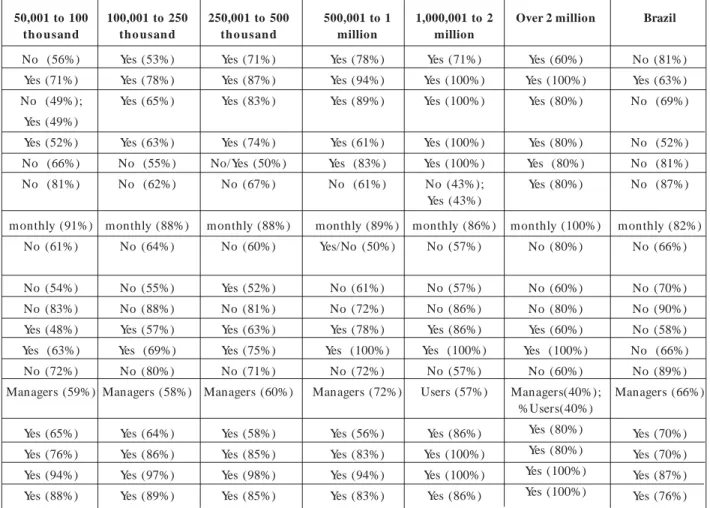
Chart 1 presents and systematizes the MHC functioning conditions according to the size of the population of their respective towns. Analyzing Brazil as a whole, a panorama can be seen in which there are great limitations both in the dimension “autonomy” (especially with respect to
nonexist-ence of headquarters, administrative support staff and own budget allocation) and in “organization” (especially in relation to the non-realization of qual-ification, which represents the worst results of all indicators).
The “autonomy” dimension is the one that pre-sents, in national terms, the worst results, since, with the exception of the “telephone line” variable, all others display negative performance. Among these, it has to be emphasized that “internet access” has the least negative result, overcoming, curious-ly, the one about existence of a computer.
In this dimension, the worst results are the ones that refer to: financial resources – only 265 MHCs studied have their own budget and only in towns of more than 2 million inhabitants can a positive result be seen; human resources – there are ad-ministrative support teams in 940 MHCs and this variable is positive only in towns of more than 500,001 inhabitants; and physical structure – espe-cially the existence of headquarters, positive for only 906 MHCs.
The dimension “organization” also presents bad national results, especially as, out of the 18 vari-ables, it contains those that have the worst perfor-mances: “qualification of councilors”, passable for the year 2003 and terrible for 2004, when 90% of the MHCs present a negative response; and “per-manent commissions”, which are absent from 89% of the MHCs and have a negative performance in all sizes of towns, which does not occur with any of the others.
There are, however, two variables that present positive results on a national scale and in the di-verse population sizes, and which refers to the MHC meetings, which are monthly in 82% of the MHCs and which, in the 12 months preceding the research, were not cancelled for a lack of quorum in 66% of the councils.
For its part, the dimension “access” is the one presenting the best results, once more than 70% of the MHCs elect their presidents and, when they hold their meetings, they directly give voice to any citizen who would wish to participate in it. Only the president’s segment has a result that is consid-ered negative, for only in towns with between 1,000,001 and 2,000,000 inhabitants are the man-agers not the presidents of the MHCs.
The two variables in which the MHCs have the best performance make up this dimension: “popu-lation with a right to a voice at meetings”, with the least positive result reaching 75%, and “meetings open to the population”, which is the best of all, starting from a minimum level of 83% and reach-ing 100% for the two largest population sizes. Table 1. Municipal Health Council - MHC according
to year of creation, Brazil.
Year of creation
Before 1991 1991 1992 1993 1994 1995 1996 1997 1998 1999 2000 2001 2002 2003 2004 2005 2006 2007 Not informed Total
N
312 1351 281 758 477 176 145 1003 196 98 50 233 38 31 27 98 18 13 158 5463
%
5.7 24.7 5.1 13.9 8.7 3.2 2.7 18.4 3.6 1.8 0.9 4.3 0.7 0.6 0.5 1.8 0.3 0.2 2.9 100 MHC created
8 0 2 M o re ir a M R , E sc o re l S
Source: ParticipaNetSus – 2008 (www.ensp.fiocruz.br/participanetsus) - Moreira and Escorel5 Organized by Authors
Table 2. Performance of Municipal Health Council according to selected variables and population size, 2007.
Population size
Up to 5,000 5,001 to 10 thousand 10,001 to 20 thousand 20,001 to 50 thousand 50,001 to 100 thousand 100,001 to 250 thousand 250,001 to 500 thousand 500,001 to 1m illion 1,000,001 to 2 millions Over 2millions Total Classification + + + + ++ ++ +++ +++ +++ +++ +
MHC performance Inhabitants ( % ) ( % )( % ) ( % ) ( % ) 2,7 5,5 11,7 17,1 12,4 13,1 10,7 7,5 5,6 13,9 100 Nº 1349 1281 1364 949 297 141 52 18 7 5 5.463 % 24,7 23,5 25,0 17,4 5,4 2,6 1,0 0,3 0,1 0,1 100 MH C
Variables with positive performance
6 6 6 6 10 11 13 13 14 14 6
20,001 a 50 th o u san d
No (79%)
Yes (64%)
No (65%)
No (51%)
No (76%)
No (88%)
monthly (90%)
No (56%)
No (66%)
No (90%)
No (52%)
No (58%)
No (83%) Managers (70%) Yes (68%) Yes (70%) Yes (90%) Yes (80%) Chart 1. Profile of the Municipal Health Councils - Distribution of indicators per populational dimension and size
of their respective municipalities and Brazil.
Variables /Size
Head Office
Telephone line
Com puter
Access to the Internet
Support team
Own budget
Periodicity
Cancelling of meeting because of lack of quorum
Training 2003
Training 2004
Board of Directors
Executive Office
Perm anent Com .
Chair division
Elections for Chair
Meetings made public
Open meetings
Right to speak
Up to 5.000
No (88%)
Yes (62%)
No (76%)
No (54%)
No (88%)
No (90%)
monthly (72%)
No (78%)
No (75%)
No (91%)
No (64%)
No (79%)
No (94%) Managers (62%) Yes (74%) Yes (69%) Yes (84%) Yes (73%)
5,001 to 10 th o u san d
No (86%)
Yes (59%)
No (75%)
No (53%)
No (85%)
No (88%)
monthly (79%)
No (68%)
No (74%)
No (90%)
No (60%)
No (72%)
No (93%) Managers (65%) Yes (70%) Yes (67%) Yes (83%) Yes (72%)
10,001 to 20 th o u san d
No (84%)
Yes (63%)
No (70%)
No (53%)
No (83%)
No (89%)
monthly (85%)
No (60%)
No (72%)
No (91%)
No (59%)
No (66%)
No (91%) Managers (72%) Yes (69%) Yes (69%) Yes (87%) Yes (76%) Auto no my
e C
o
le
tiv
a, 1
4
(3
):7
9
5
-8
0
5
, 2
0
0
9
Table 2 systematizes the MHCs’ performance according to the 18 variables selected and the size of the population. The functioning of the councils was classified based on the number of variables in which the set of MHCs of each size obtained pos-itive results: pospos-itive performance in up to 3 vari-ables would receive the symbol ‘-’; from 4 to 7, ‘+’; from 8 to 11, ‘++’; 12 to 15, ‘+++’; and from 16 to 18, ‘++++’.
It can be seen that none of the MHCs obtained the worst (‘-’) nor the best (‘++++’) classification and that the national total fits into the classifica-tion ‘+’. As the populaclassifica-tion size grows, there is a trend for improvement in the results, even though specific indicators may show a break in this pat-tern (election of the president, for example) and, at least for towns with up to 50,000 inhabitants, the m ost appropriate way of describing the results
50,001 to 100 th o u san d
No (56%)
Yes (71%)
No (49%);
Yes (49%)
Yes (52%)
No (66%)
No (81%)
monthly (91%)
No (61%)
No (54%)
No (83%)
Yes (48%)
Yes (63%)
No (72%)
Managers (59%)
Yes (65%)
Yes (76%)
Yes (94%)
Yes (88%)
100,001 to 250 th o u san d
Yes (53%)
Yes (78%)
Yes (65%)
Yes (63%)
No (55%)
No (62%)
monthly (88%)
No (64%)
No (55%)
No (88%)
Yes (57%)
Yes (69%)
No (80%)
Managers (58%)
Yes (64%)
Yes (86%)
Yes (97%)
Yes (89%)
250,001 to 500 th o u san d
Yes (71%)
Yes (87%)
Yes (83%)
Yes (74%)
No/Yes (50%)
No (67%)
monthly (88%)
No (60%)
Yes (52%)
No (81%)
Yes (63%)
Yes (75%)
No (71%)
Managers (60%)
Yes (58%)
Yes (85%)
Yes (98%)
Yes (85%)
500,001 to 1 million
Yes (78%)
Yes (94%)
Yes (89%)
Yes (61%)
Yes (83%)
No (61%)
monthly (89%)
Yes/No (50%)
No (61%)
No (72%)
Yes (78%)
Yes (100%)
No (72%)
Managers (72%)
Yes (56%)
Yes (83%)
Yes (94%)
Yes (83%)
1,000,001 to 2 million
Yes (71%)
Yes (100%)
Yes (100%)
Yes (100%)
Yes (100%)
No (43%); Yes (43%)
monthly (86%)
No (57%)
No (57%)
No (86%)
Yes (86%)
Yes (100%)
No (57%)
Users (57%)
Yes (86%)
Yes (100%)
Yes (100%)
Yes (86%)
Over 2 million
Yes (60%)
Yes (100%)
Yes (80%)
Yes (80%)
Yes (80%)
Yes (80%)
monthly (100%)
No (80%)
No (60%)
No (80%)
Yes (60%)
Yes (100%)
No (60%)
Managers(40%); %Users(40%)
Yes (80%)
Yes (80%)
Yes (100%)
Yes (100%)
Brazil
No (81%)
Yes (63%)
No (69%)
No (52%)
No (81%)
No (87%)
monthly (82%)
No (66%)
No (70%)
No (90%)
No (58%)
No (66%)
No (89%)
Managers (66%)
Yes (70%)
Yes (70%)
Yes (87%)
Yes (76%)
Source: ParticipaNetSus – 2008 (www.ensp.fiocruz.br/participanetsus), Moreira and Escorel28.Organized by the authors. Chart 1. continuation
would be to say they are “the least bad”. Adding the number of MHCs in towns that fit the four popu-lation sizes that concentrate the best results, only 82 is reached (2% of the total). However, about 38% of the population studied lives in these loca-tions. On the other hand, the four population sizes where the MHCs have the worst performance con-tain 4,943 towns, that is, 90% of the universe stud-ied, where 37% of the population lives.
Municipal Health Councils: factors that aid and hinder the effective democratization of the decision-making process
of municipal health policies
8 0 4
M
o
re
ir
a
M
R
, E
sc
o
re
l S
in 5,564 towns, bringing together a contingent of around 72,000 titular councilors, 20% more than the approximately 51,000 councilors in Brazil29. Out of the councilors, approximately 36,000 represent UH S users, havin g been n om in ated by alm ost 28,000 civil society entities.
The numbers show the advance of inclusiveness in the health sector at a municipal level. Reinforcing them and giving them new qualities, the positive per-formance of the “access” dimension indicates that the MHCs also open space for the participation of the non-organized population and for councilors of all segments to arrive at the presidency.
In isolation, this setting is positive, for it inserts an increasingly large and more diversified number of interests in the decision-making process of mu-nicipal health policies. However, ultra-presidential-ist managers tend to see the advance of inclusive-ness as an increase in the veto power given to users, which generate reactions that seek to prevent this fear from materializing. The result of these con-flicts is directly linked to the way institutional rules deal with these reactions.
The poor performance of the MHCs in the “au-tonomy” and “organization” dimensions, national keynote, indicates that the existing rules have not been enough to elevate the costs of reactions to the institutionalization of the MHCs. It also shows that increasing the population’s participation as a strat-egy for broadening the MHCs’ social support base has also not been effective for stopping managers’ reactions.
In this way, the MHCs tend to become depen-dent on the political interests that direct Executive power, being prevented form, for example, con-tracting audits, research and consultancies that would increase their capacity and technical knowl-edge; from consolidating agendas with other coun-cils and institutions; and from establishing a daily relationship with the population.
This is the kernel of the problems that prevent an effective democratization of the decision-mak-ing process of political health policies: the rules that regulate the institutional relations in the decision-making process of municipal health policy allow the MHCs to advance on the path of inclusiveness, bu t favor con trary reaction s from th ose wh o consider the increase of social participation a prob-lem, which hinders their path towards liberaliza-tion. For this reason, the MHCs are not in them-selves enough to construct a health sector with polyarchic characteristics.
This is because the “success” demanded from the MHCs does not depend exclusively on them, for their powers cannot be exercised in isolation:
participation in the decision-making process of municipal health only materializes through the in-teraction of actors who are interested in the public problems touched by those policies (UHS, Munic-ipal Legislative Branch, Judiciary Branch, Public Prosecutor’s Office, agents linked to private and market interests). If these actors do not legitimize the MHCs, they are unlikely to be successful.
An analysis of the data shows that even though there are no rules to inhibit the reactions, there are MHCs that have good autonomy and organiza-tion. As these perform slightly better in the access dimension, this fact must be a result of the consis-tent reduction of or the absence of manager reac-tions. This hypothesis is corroborated by the data on the MHCs that have the best functioning con-ditions, the ones in towns of more than 250,000 inhabitants: out of the 82 in this group, 70% are governed by parties that, in some way, place par-ticipation in their program/statute. This index is higher than for the total MHCs in the country (37%) and for towns with the worst results, those with fewer than 50,000 inhabitants (56%)28.
Furthermore, the MHCs that have the best con-ditions of autonom y and organization are also those located in towns with a more mobilized civil society accustomed to negotiation and political articulation. In the health sector, for example, they are the ones who present the highest quantity of local health councils and health unit management councils4.
This confirms that articulation between the dif-ferent actors and institutions involved in the deci-sion-making process is the element capable of lead-ing municipal health policy to democratization. Although it is not the only articulation possible, the combination participatory city hall/negotiat-ing organized society, which would represent the articulation between organizations in representa-tive and participatory democracy, is the most im-portant political element to advance the democra-tization of the decision-making process of munic-ipal health policies, for it is what can give the MHCs legitimacy, clearing the path to liberalization.
Final considerations
e C
o
le
tiv
a, 1
4
(3
):7
9
5
-8
0
5
, 2
0
0
9
contribute to the democratization of health policy. Perfecting the institutional rules and the delib-erative process could potentially reduce the ten-sions arising from the Executive’s concern that its interests will not be met, on the one hand, and raise the costs of negative reactions from sector managers, on the other hand. Examples: elevating the costs of suppressing MHC autonomy; defin-ing the scope of the deliberations, that is, the ques-tions that can be deliberated; denying the possibil-ity that councilors only veto proposals from other councilors; holding the MHCs responsible for their deliberations; forcing m anagers to send to the MHCs the public budget and health actions, pro-grams and policies in their formulation stage, pre-venting councils from appreciating projects that are practically closed, with little possibility for change and committed to certain interests.
In this way, MHC deliberations, because they arise from debates that consider the set of existing
positions and not the attempt by one position to subjugate the others, would be more representa-tive of the set of actors involved, truly becoming an interest of the MHCs.
Agreement on these – and other – rules consti-tutes a challenging proposal that the evidence ana-lyzed here presents to the actors and institutions directly involved in the municipal decision-making processes. However, it is also a challenge for the National Health Council and the Department of Health. With the support of these (which are al-ready developin g im portan t action s with th e MHCs, but which are not as tied to the context explored here), it would be possible to establish a closer relationship between the subnational and national levels, helping the dem ocratization of municipal health policies to spread to other sector policies and, as a result, to positively influence the political macro-structures that define the advance of democratization in Brazil.
References
Brasil. Lei Federal nº 8.080 de 19 de setembro de 1990. Dispõe sobre as condições para a promoção, proteção e recuperação da saúde, a organização e o funciona-mento dos serviços correspondentes e dá outras pro-vidências. Diário Oficial da União 1990; 19 set. Brasil. Lei Federal nº 8142 de 28 de dezembro de 1990. Dispõe sobre a participação da comunidade na gestão do SUS e sobre as transferências intergovernamentais de recursos financeiros na área da saúde e dá outras providências. Diário Oficial da União 1990; 28 dez.
Gohn MG. Conselhos Gestores e Participação
Sociopolí-tica, v. 84. 2ª ed. São Paulo: Cortez; 2003.
Correia MVC. Que controle social? Os Conselhos de
Saú-de como Instrumento. Rio Saú-de Janeiro: Editora Fiocruz; 2000.
Dagn in o E. Dem ocracia, Teoria e Prática: a par tici-pação da sociedade civil. In : Perissin oto RM, Fu ks
M, organ izadores. Dem ocracia: teoria e prática. Rio
de Janeiro: Relum e Dum ará; 2002. p. 141-166. Fu ks M. Dem o cr acia e Par t icip ação n o Co n selh o Municipal de Saúde de Curitiba (1999-2001). In: Fuks
M, Perissin oto RM, Sou za NR, organ izadores.
De-mocracia e Participação: os conselhos gestores no Para-ná. Curitiba: Editora UFPR; 2004. p. 13-44. Pin heiro R. A Din âm ica dos Con selhos Mu n icipais de Saúde do Estado do Rio de Jan eiro: três estudos d e caso: An gr a d os Reis, Resen d e e Bom Jesu s d o
Itabapoana. Racionalidades Médicas e Praticas em
Saú-de 1966; 30(5):62-100. 1.
2.
3.
4.
5.
6.
7.
Labra ME. Conselhos de Saúde: dilemas, avanços e
desa-fios. In: Lima NT, Gerschman S, Edler FC, Suarez JM,.
organizadores. Saúde e democracia. História e
Perspecti-va do SUS. Rio de Janeiro: Editora Fiocruz; 2005.
Van Stralen CJ, Lima AMD, Fonseca Sobrinho D,
Sa-raiva LES, Van Stralen T, Belisario SA. Conselhos de Saúde: efetividade do controle social em m unicípios
d e Goiás e Mato Gr osso d o Su l. Cien Saude Colet
2006; 11(3):621-632.
Coelho VSP. Conselhos de Saúde Enquanto Instituições
Políticas: o que está faltando? In: Coelho VSP, Nobre
M, organ izadores. Participação e deliberação: teoria
democrática e experiências institucionais no Brasil con-temporâneo. São Paulo: Ed. 34; 2004.
Nobre M. Participação e deliberação n a teoria
de-m ocrática: u de-m a in trodu ção. In: Coelho VSP, Nobre
M, organizadores. Participação e deliberação – teoria
democrática e experiências institucionais no Brasil con-temporâneo. São Paulo: Ed. 34; 2004.
Escorel S. Conselhos de Saúde: entre a inovação e a
reprodução da cultura política. Divulgação em Saúde
para Debate 2008; 43(6):23-29.
Lat t m an - Welt t m an F. Dem ocr acia, rep r esen t ação, participação: a aposta do plu ralism o in stitu cion al. Divulgação em Saúde para Debate 2008; 43(6):29-37.
Lima Júnior OB. Instituições políticas democráticas – o
segredo da legitim idade. Rio de Jan eiro: Jorge Zahar Editora; 1997.
8.
9.
10.
11.
12.
13.
8 0 6
M
o
re
ir
a
M
R
, E
sc
o
re
l S
Dahl RA. Poliarquia: participação e oposição. São
Pau-lo: Editora da Universidade de São Paulo; 1997.
Przeworski A. Am a a in certeza e serás dem ocrático.
Novos Estudos CEBRAP 1984; (9):36-46.
Dahl RA. Os sistemas políticos democráticos nos pa-íses avançados: êxitos e desafios. In: Boron AA,
orga-nizador. Nova hegemonia mundial: alternativas de
mu-dança e m ovim entos sociais. Bu en os Aires: Con sejo Latinoam ericano de Ciencias Sociales; 2004. Santos BS, Avritzer LA. Para ampliar o cânone
demo-crático. In : San tos BS, organ izador. Dem ocratizar a
dem ocracia. Os cam inhos da dem ocracia participativa. Rio de Janeiro: Civilização Brasileira; 2002.
Man in B. On Legitim acy an d Political Deliberation.
Political Theory 1987; 15(3):338-368.
Coh en J. Dem ocracia y libertad. In : Elster J, com
-pilador. La dem ocracia deliberativa. Barcelona:
Edito-rial Gedisa; 2001.
Pierson P. Politics in Tim e. History, Institutions, and
Social Analysis. New Jersey: Princeton University Press; 2004.
Carvalho AI. Conselhos de Saúde no Brasil.
Participa-ção cidadã e controle social. Rio de Janeiro: FASE/IBAM; 1995.
Escorel S, Moreira MR. Participação social. In:
Giova-nella L, Escorel S, Lobato LVC, Noronha JC, Carvalho
AI, organizadores. Políticas e Sistemas de Saúde no
Bra-sil. Rio de Janeiro: Editora Fiocruz/CEBES; 2008. Br azil. Min ist ér io d a Saú d e. Relat ór io fin al d a 8ª Con ferên cia Nacion al de Saúde. Brasília: Min istério da Saúde; 1987.
15.
16.
17.
18.
19.
20.
21.
22.
23.
24.
Moreira MR, Fernandes FMB, Sucena LFM, Oliveira NA. Participação nos Conselhos Municipais de Saú-de n os m un icípios brasileiros com m ais Saú-de 100.000
habitan tes. Divulgação em Saúde para Debate 2008;
43(6):48-61.
Abr u cio FL. O u lt r ap r esid en cialism o est ad u al. In :
An drade RC, organ izadores. Processo de Governo no
Município e no Estado. São Paulo: EDUSP; 1998. Avritzer L. A participação social no nordeste. In:
Avrit-zer L, organizadores. A participação social no nordeste.
Belo H orizonte: Editora UFMG; 2007.
Moreira MR, Escorel S. ParticipanetSUS – Estrutura
Virtual de Trabalho e Pesquisa. Escola Nacional de Saúde Pública. Secretaria de Gestão Estratégica e Participativa d o Min istér io d a Saú d e. [ d ocu m en to n a In ter n et] [acessado 2008 dez 14]. Disponível em: http://www. ensp.fiocruz.br/particpanetsus
Tribunal Superior Eleitoral. Estatísticas T SE: Eleições
2008. [documento na Internet] [acessado 2008 dez 14]. Disponível em: http://www.tse.gov.br/internet/eleicoes/ estatistica2008/est_result/resultadoEleicao.htm
Artigo apresentado em 10/11/2008 Aprovado em 10/01/2009
Versão final apresentada em 27/01/2009 25.
26.
27.
28.