Systematic Review
Revisão Sistemática
Marileda Barichello Gubiani1
Karina Carlesso Pagliarin1
Marcia Keske-Soares1
Descritores
Apraxias Fala Criança Teste Diagnóstico Diferencial Keywords
Apraxia Speech
Child Test Diagnosis, Differential
Correspondence to address: Marileda Barichello Gubiani
Rua Senador Cassiano do Nascimento, 85, apartamento 102, Centro, Santa Maria (RS), Brazil, CEP: 97050-680. E-mail: [email protected] Received: 03/22/2015
Study carried out at Universidade Federal de Santa Maria – UFSM – Santa Maria (RS), Brazil. (1) Universidade Federal de Santa Maria – UFSM – Santa Maria (RS), Brazil.
Conlict of interest: nothing to declare.
Tools for the assessment of childhood apraxia of speech
Instrumentos para avaliação de apraxia de fala infantil
ABSTRACT
Purpose: This study systematically reviews the literature on the main tools used to evaluate childhood apraxia of speech (CAS). Research strategy: The search strategy includes Scopus, PubMed, and Embase databases. Selection criteria: Empirical studies that used tools for assessing CAS were selected. Data analysis: Articles were selected by two independent researchers. Results: The search retrieved 695 articles, out of which 12 were included in the study. Five tools were identiied: Verbal Motor Production Assessment for Children, Dynamic Evaluation of Motor Speech Skill, The Orofacial Praxis Test, Kaufman Speech Praxis Test for Children, and Madison Speech Assessment Protocol. There are few instruments available for CAS assessment and most of them are intended to assess praxis and/or orofacial movements, sequences of orofacial movements, articulation of syllables and phonemes, spontaneous speech, and prosody. Conclusion: There are some tests for assessment and diagnosis of CAS. However, few studies on this topic have been conducted at the national level, as well as protocols to assess and assist in an accurate diagnosis.
RESUMO
Objetivo: Revisar sistematicamente na literatura os principais instrumentos utilizados para avaliação da apraxia de fala infantil. Estratégia de pesquisa: Realizou-se busca nas bases Scopus, PubMed e Embase.Critérios de seleção: Foram selecionados estudos empíricos que utilizaram instrumentos de avaliação da apraxia de fala infantil. Análise dos dados: A seleção dos artigos foi realizada por dois pesquisadores independentes. Resultados: Foram encontrados 695 resumos. Após a leitura dos resumos, foram selecionados 12 artigos completos. Foi possível identiicar cinco instrumentos: Verbal Motor Production Assessment for Children, Dynamic Evaluation of Motor Speech Skill, The Orofacial Praxis Test, Kaufman Speech Praxis Test for children
INTRODUCTION
This systematic review addresses a literature overview on the tools for the assessment of childhood apraxia of speech (CAS) and differential diagnosis. CAS is one of the subtypes of childhood speech disorder of unknown origin, being deined as a motor disorder of the sounds that speciically interferes with the planning or execution of orofacial movements during the production of phonemes(1). The characterization of CAS
is widely discussed in literature, but there is much divergence regarding the criteria for its diagnosis(2,3).
The American Speech-Language-Hearing Association (ASHA)(4) deines CAS as a disorder of neurological origin in
which the consistency and accuracy of speech movements are impaired in the absence of neuromuscular deicits. It was char-acterized by inconsistent errors of consonants and vowels in repetitive production of syllables and words; inadequate coar-ticulation of sounds in the transition between sounds and syl-lables; inappropriate prosody, especially in stressed syllables (lexical or phrasal).
According to Shriberg et al.(5), the diagnosis of apraxia
of speech requires segmental and suprasegmental features. Segmental features are articulatory groping, especially in the beginning of speech utterance; substitution errors, mainly charac-terized by metathesis; inconsistent speech exchanges; and more errors in vowels. Suprasegmental features refer to inconsistent stress (syllables) and perception of nasopharyngeal resonance.
Studies(6-8) have used the features pointed by Davis et al.(9)
as diagnostic criteria for apraxia of speech. These character-istics are divided into speciic features of speech production and general characteristics of speech and orofacial movements. Among speciic characteristics of speech production are lim-ited repertoire of consonants and vowels; frequent omissions; high incidence of errors in vowels; inconsistent articulation; changed suprasegmental features (prosody, voice quality, and luency); increase in errors in larger speech units; signiicant dificulties in repeating words and phrases; and predominant use of simple syllabic forms. Among the general characteris-tics of language and orofacial movements, the authors point out impaired voluntary oral movements reduced language expres-sion compared to language understanding, and reduced diado-chokinetic abilities.
However, there are no criteria as to how many features are required for the diagnosis of speech apraxia(8). Some studies
reported more than ive(8,10), others, at least eight(11).
These characteristics tend to remain in the later child’s life with CAS compared with other speech, sound, or language dis-orders. Therefore, it is important to create evaluation protocols that lead to early diagnosis(3). In addition, it is noteworthy that
some CAS features may also be present in the clinical picture of other speech sound disorders, such as severe phonological order disturbances (phonological disorder), where children may get unsystematic exchanges of speech, sounds, and articula-tion groping, which may lead to confusion and misdiagnosis(3).
Thus, the process of CAS evaluation should be quite detailed and requires accurate and valid measures.
A survey conducted in the USA with 75 speech therapists showed more than 40 features currently being used to diagnose apraxia of speech. These results were considered consistent with the literature on the subject; that is, there is a well-deined standard for the diagnosis and interpretation of the subject(2).
From the foregoing, it is clear that the criteria for diagnosis of CAS are often subjective (patient observation) and directed by exclusion of other diseases. Thus, evaluation of CAS is not always made through protocols, since not all of them present norms and psychometric properties for the child population.
In view of the dificulties seen in the literature to estab-lish the diagnosis of CAS, this study sought to identify which instruments have been used to assess children presenting this impairment. With this review, we aimed to answer the follow-ing questions: Which tools have psychometric criteria for the children population? What are the aspects evaluated by assess-ment tools aimed at CAS?
RESEARCH STRATEGY
For this review, we carried out searches in PubMed, Scopus, and Embase databases in the months of October 2013 and February 2014. Abstracts of articles published in the last 11 years (2003–2014), whether or not in open access journals, were included.
Two constructs were used in the searches: evaluation AND apraxia of speech. The evaluation construct was composed of the following combinations of keywords: “Evaluation” OR “Instrument” OR “Test” OR “Battery” OR “Assessment” OR “Task” OR “Screening.” Speech apraxia construct consisted of the associations “Orofacial praxis” OR “Motor speech dis-orders” OR “Speech praxis” OR “Apraxia of speech” OR “Developmental motor speech disorders” OR “Developmental dyspraxia” OR “Verbal developmental apraxia.”
The research was carried out in steps. First, the constructs were searched separately, with their due keywords. From the result of each construct, a new search with the combination of both constructs was performed. The keywords were selected from speciic articles of the area. However, the language (English, Spanish, and Portuguese) and the age of the study population (15 years) were the limitations of this study.
SELECTION CRITERIA
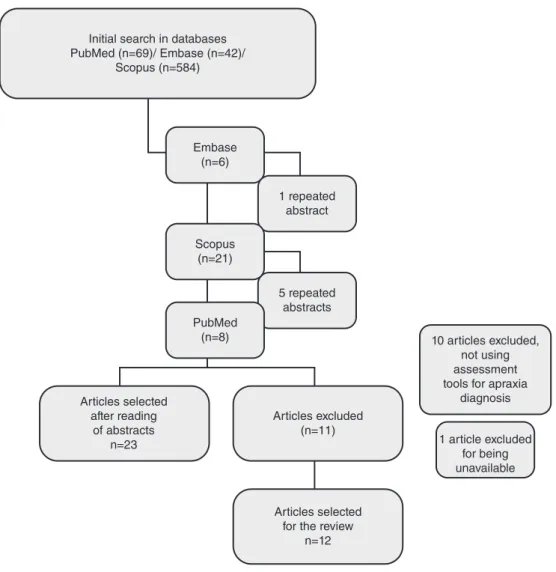
The searches retrieved 695 abstracts, being 42 from Embase, 69 from Pubmed, and 584 from Scopus. Of these, 23 were selected based on the following criteria: being an empirical study and addressing CAS assessment through a tool. Articles that used no formal assessment tool for the diagnosis of apraxia and articles not available online were excluded from the sample.
DATA ANALYSIS
disagreement were submitted to a third evaluator. The low of articles selection is shown in Figure 1.
RESULTS
Based on the number of selected articles, it is clear that there are few studies using formal assessment protocols for CAS diagnosis. The tools found in the studies were Verbal Motor
Production Assessment for Children (VMPAC)(12); Dynamic
Evaluation of Motor Speech Skill (DEMSS)(13), The Orofacial
Praxis Test(1), Kaufman Speech Praxis Test for children (KSPT)(14),
and Madison Speech Assessment Protocol (MSAP)(5). These tools
are used in research to speciically assess apraxia of speech, but other tests are also applied to examine other language functions in children with apraxia, including phonology, expressive, and receptive vocabulary.
Tools mostly evaluate the following characteristics: con-duction of voiced praxis, praxis and/or orofacial movements, sequences of movements, simple phonemes, complex phonemes and syllables, spontaneous speech, articulation accuracy, prosody,
and error consistency. Following, we will briely describe the tools that have been used in the articles selected for this review.
VMPAC assesses motor functions of speech and oral struc-tures (including tasks related to feeding) and aims to assess children aged 3–12 years. It brings contributions to the diag-nosis, treatment planning, and drilling during the therapy of children with CAS. The test presents some evidence of valid-ity (content) and well-deined standards. Furthermore, it uses a 3-point scale (0=incorrect; 1=partially incorrect; 2=correct) to check accuracy and quality of motor movements and allows the identiication of motor speech interruption level(s)(12).
The VMPAC test includes:
1. total motor control (neurophysiological support for speech: control of the head, neck, posture, etc.);
2. oromotor control;
3. sequencing and two complementary areas; 4. connected speech and language; and 5. speech characteristics.
Each subsection can be interpreted independently.
Initial search in databases PubMed (n=69)/ Embase (n=42)/
Scopus (n=584)
1 repeated abstract
5 repeated abstracts
Articles selected after reading
of abstracts
n=23 1 article excluded
for being unavailable 10 articles excluded,
not using assessment tools for apraxia
diagnosis
Articles selected for the review
n=12 Articles excluded
(n=11) PubMed
(n=8) Scopus
(n=21) Embase
(n=6)
The battery is composed of 82 items (20 total motor con-trol, 46 oromotor concon-trol, and 16 sequencing skills). The items related to total motor control assess postural tone and stabil-ity in breathing, phonation, and articulation system, as well as oromotor relexes and vegetative functions. The items related to oromotor control assess the integrity of verbal and nonver-bal movements of the jaw, lips, and tongue. The sequencing items assess nonverbal skills sequencing, sequence of doubled and tripled phonemes.
By analyzing these ive areas, it is possible to identify the following abilities: basic posture, breathing, phonation support for speech production; voluntary control or the jaw, tongue, and lips; ability to perform a nonverbal sequence of verbal speech and verbal movements; changes in the accuracy with increas-ing length and complexity of utterances; breaks in speech; and types of support that help the child.
In a North-American research aimed to identify diagnos-tic markers in children whose speech disorders result from a deicit in speech praxis, Shriberg et al.(15) used VMPAC. In this
study(15), 35 children aged between 3 and 12 years were
evalu-ated, and only one had suspected apraxia of speech. VMPAC was used to screen these children and to assess lexical accent (considered one of the diagnostic markers of CAS). The authors pointed out that the prosodic changes found in children with apraxia (dificulty in lexical accent) were due to the deicit in motor control and speech praxis.
No studies using this tool to assess subjects speaking Brazilian Portuguese were found.
DEM is a new tool that assesses, from imitation, the word and vowel articulation accuracy, prosody and consistency of utterance with 9 subtests, totaling 66 items. The protocol is intended for the evaluation of speech movements of young children (3–6 years and 7 months) or with severe speech dis-orders. During the implementation of this protocol, the child performs the stimuli in two ways: as an initial attempt and after the examiner’s demonstration (articulation hint)(13).
The test assesses words with the following structures: con-sonant-vowel (8 items, e.g., me, hi), vowel-consonant (8 items, e.g., up, eat), duplicate syllables (4 items, e.g., mama, booboo), consonant-vowel-consonant 1 (CVC1) (6 items, e.g., mom, peep, pop), CVC2 (8 items, e.g., mad, bed, hop), dissyllabic 1 (5 items, e.g., baby, puppy), dissyllabic 2 (6 items, e.g., bunny, happy), multisyllabic (6 items, e.g., banana, kangaroo), and productions with extension increased (15 items, e.g., dad, hi dad, hi daddy).
It presents evidence of construct validity and reliability (intra-judges 89%, inter-judges 91%, and test–retest 89%)(13).
In addition, this tool was sensitive for the diagnosis of apraxia of speech in the US population.
DEMSS is not yet available in full (ongoing publishing), but we do know it is currently being adapted for other languages, including Brazilian Portuguese.
The Orofacial PraxisTest allows evaluation of the
dif-iculties in execution of movements (e.g., throw a kiss) and sequencing of movements (e.g., opening and closing the mouth) using orofacial muscles, thus making a distinction between the type of gesture (oroverbal praxis movement,
orofacial praxis movement, sequence of movements, and parallel movements) and application types (verbal and imi-tation requests). It is not restricted to the detection of apraxia of speech; it also helps to identify disorders affecting motor coordination at various levels.
The test consists of 36 tasks, 12 related to voiced praxis, 12 to orofacial praxis, 6 to sequence of movements, and 6 to paral-lel movements. It was irst used in 108 Italian-speaking children aged 4–8 years(1), but does not show evidence of reliability and
validity, bringing only normative data based on the evaluation.
The Orofacial Praxis Test was translated and used in
Brazilian studies(16,17) to compare the performance of children
with typical and atypical speech development. The results of a study(16) aimed to compare orofacial praxis of children with
typical phonological development and phonological disor-ders showed similar performances in both groups. In another study(17), the same protocol was applied to verify the orofacial
praxis of children with typical phonological development, phonological disorders, and phonetic-phonological disorders. The results showed that children with phonetic-phonological disorders had greater dificulty in carrying out the test’s tasks.
KSPT helps to identify and treat CAS. It measures a child’s responses through imitation of the examiner. The test has four parts with levels of increasing dificulty, and the performance of each part depends on the child’s level of functioning. Part 1 has tasks involving extensive oral movements; Part 2 involves simple movements (isolated vowels /a, e/; vowel movement + vowel /ai, ou/, simple consonants /m, p, b, t, d/; CVCV /mama, papa/; VCV /opa/, CV, CVC); Part 3 comprises consonants /k, g, f, s/, complex dissyllabic, complex words; and Part 4 assesses spontaneous speech.
The protocol evaluates children aged 2–5 years and 11 months. KSPT shows evidence of criterion and content validity for the North-American population, being one of the mostly applied tools in international surveys with children(18,19).
This tool was used in a research(18) intended to determine
whether abnormalities in ine motor function could be detected in children with speech sound disorders, and whether there was correlation between imitation of oral motor skills and ine motor function. KSPT was sensitive to evaluate these children.
No studies using this tool on Brazilian Portuguese-speaking subjects were found.
MSAP was developed with the purpose to identify diag-nostic markers for eight subtypes of speech sound disorders of unknown origin(5). The protocol includes 25 tasks and tests,
This protocol was applied to study different age groups(5),
and intended to include, in addition to presenting the protocol, the description of a classiication system for motor speech dis-orders. Another study(20) conducted with MSAP was aimed to
determine the prevalence and phenotype of CAS in individuals with lactose intolerance, due to the high incidence of speech sound disorders in this population, even though the literature lacks this topic. The results showed high prevalence of the dis-order in the sample investigated.
We found no studies using this tool on Brazilian Portuguese-speakers.
All instruments (VMPAC, KSPT, DRESS, The Orofacial Praxis Test, and MSAP) present tasks that assess the oral struc-tures and/or motor function of speech, which is the most inves-tigated ability, which suggests that this is one of the most impaired abilities in apraxia of speech.
It is also believed that prosody is one of the diagnostic markers for children with CAS(9). Among the assessment
tools found in this review, only two (DEMSS and MSAP) evaluate prosody in speciic tasks. VMPAC evaluates con-nected speech, but does not mention prosody as a speciic task. The characteristics of each tool described herein are shown in Chart 1.
The tools found in this review are able to assist in health professionals in CAS diagnosis, but not all of them show evi-dence of validity and reliability. DEMSS was the only tool with a study for validity and reliability(13); two other tools(12,14) had
partial evidence of validity (content and criteria). Empirical studies found tools used only as inclusion criteria (and diag-nosis of speech apraxia), without the proposal of an evaluation protocol, except DEMSS(13) and MSAP(5).
There are other tools such as Apraxia Proile (AP) Preschool and School-Age Versions(21); Oral Speech Mechanism
Screening Examination, Third Edition (OSMSE-3)(22);
Screening Test for Developmental Apraxia of Speech – Second Edition (STDAS-2)(23); the Verbal Dyspraxia Proile
(VDP)(24). However, these were not found in this review,
per-haps because the period of research was limited to the 11 years prior to study, or because of the keywords selected, or for not being used in clinical practice and/or research anymore.
Among tools found so far, none has been adapted and stan-dardized for the Brazilian sociocultural reality. In addition, as far as we know, there are no tools with psychometric properties for the Brazilian Portuguese language intended to assess CAS.
CONCLUSION
After identifying which tools are currently being used to assess children with apraxia of speech, we veriied that there are protocols intended to assess this disorder, but not all of them show psychometric evidence.
The best diagnosis method is combined, that is, clinical assessment (observation of the child’s speech) and formal evaluation (with valid and reliable protocols). In this way, CAS diagnosis can be done more judiciously.
ACKNOWLEDGMENTS
The Fundação de Amparo à Pesquisa do Estado do Rio Grande do Sul (FAPERGS) and Coordenação de Aperfeiçoamento Pessoal de Nível Superior (CAPES), for granting two scholar-ships, one doctoral and one postdoctoral, to the irst and sec-ond authors of this study.
*MBG and KCP were responsible for the study design, searches in databases, and writing of the paper; MKS took part in the writing and review of the paper.
REFERENCES
1. Bearzotti F, Tavano A, Fabbro F. Developmental of orofacial praxis of children from 4 to 8 years of age. Percept Mot Skills. 2007;104(3 Pt 2):1355-66. 2. Forrest K. Diagnostic criteria of developmental apraxia of speech used
by clinical speech-language pathologists. Am J Speech Lang Pathol. 2003;12(3):376-80.
3. Iuzzini J, Forrest K. Evaluation of a combined treatment approach for childhood apraxia of speech. Clin Linguist Phon. 2010;24(4-5):335-45. 4. American Speech-Language-Hearing Association. Childhood apraxia of
speech. 2007. [cited 2015 jun 15]. Disponível em: http://www.asha.org/ policy/PS2007-00277.htm
Chart 1. Characteristics of apraxia tests found in this review
Test Author (year) Age group assessed Evidence of
validity Evidence of liability Abilities assessed
VMPAC Hayden and Square
(1999)(12) 3–12 years Partial No
Oral structures, motor function of speech
DEMSS Strand et al.(2013)(13) 3–6 years and 7
months Yes Yes
Motor function of speech, prosody The Orofacial Praxis
Test
Bearzotti, Tavanno
and Fabbro (2007)(1) 4–8 years No No
Oral movements, voiced and orofacial praxias
KSPT Kaufman (1998)(14) 2–5 years and 11
months Partial No
Oral structures, motor function of speech
MSAP Shriberg et al. (2010)(5)
Preschool, school children, teenagers,
and adults
No No Oral structure, motor function of speech, prosody
Caption: VMPAC = Verbal Motor Protocol Assessment; DEMSS = Dynamic Evaluation Motor Speech Skills; KSPT = Kaufman Speech Test for Children; MSAP = Madison
5. Shriberg LD, Fourakis M, Hall S, Karlsson H, Lohmeier HL, McSweeny JL, et al. Extensions to the Speech Disorders Classiication System (SDCS). Clin Linguist Phon. 2010;24(10):795-824.
6. Betz SK, Stoel-Gammon C. Measuring articulatory error consistency in children with developmental apraxia of speech. Clin Linguist Phon. 2005;19(1):53-66.
7. Aziz AA, Shohdi S, Osman DM, Habib EI. Childhood apraxia of speech and multiple phonological disorders in Cairo-Egyptian Arabic speaking children: language, speech, and oro-motor differences. Int J Pediatr Otorhinolaryngol. 2010;74(6):578-85.
8. Peter B, Stoel-Gammon C. Central timing deicits in subtypes of primary speech disorders. Clin Linguist Phon. 2008;22(3):171-98.
9. Davis BL, Jakielski KJ, Marquardt TP. Developmental apraxia of speech: determiners of differential diagnosis. Clin Linguist Phon. 1998;12(1):25-45. 10. Davis BL, Jacks A, Marquardt TP. Vowel patterns in developmental apraxia of
speech: three longitudinal case studies. Clin Linguist Phon. 2005;19(4):249-74. 11. Peter B., Stoel-Gammon C. Timing errors in two children with suspected
childhood apraxia of speech (sCAS) during speech and music-related tasks. Clin Linguist Phon. 2005;19(2):67-87.
12. Hayden D, Square P. Verbal Motor Production Assessment for Children. San Antonio: The Psychological Corporation; 1999.
13. Strand EA, McCauley RJ, Weigand SD, Stoeckel RE, Baas BA. A motor speech assessment for children with severe speech disorders: reliability and validity evidence. J Speech Lang Hear Res. 2013;56(2):505-20. 14. Kaufman N. Kaufman Speech Praxis Test for Children. Detroit: Wayne
State University Press; 1995.
15. Shriberg LD, Campbell TF, Karlsson HB, Brown RL, Mcsweeny JL, Nadler CJ. A diagnostic marker for childhood apraxia of speech: the lexical stress ratio. Clin Linguist Phon. 2003;17(7):549-74.
16. Marini C. Habilidades práxicas em crianças com desvio fonológico evolutivo e com desenvolvimento fonológico [dissertação]. Santa Maria: Universidade Federal de Santa Maria; 2010.
17. Bertagnolli APC. Habilidades práxicas orofaciais, alterações do sistema estomatognático e tipos de alterações de fala de crianças com desvios fonético e fonológico [dissertação]. Santa Maria: Universidade Federal de Santa Maria; 2012.
18. Newmeyer AJ, Grether S, Grasha C, White J, Akers R, Aylward C, et al. Fine motor function and oral-motor imitation skills in preschool-age children with speech-sound disorders. Clin Pediatr (Phila). 2007;46(7):604-11. 19. McCauley RJ, Strand EA. A review of standardized tests of nonverbal oral
and speech motor performance in children. Am J Speech Lang Pathol. 2008;17(1):81-91.
20. Shriberg LD, Potter NL, Strand EA. Prevalence and phenotype of childhood apraxia of speech in youth with galactosemia. J Speech Lang Hear Res. 2011;54(2):487-519.
21. Hickman L. Apraxia Profile. San Antonio: The Psychological Corporation; 1997.
22. St. Louis KO, Ruscello D. Oral Speech Mechanism Screening Examination. 3rd edition. Austin: Pro-Ed; 2000.
23. Blakeley RW. Screening Test for Developmental Apraxia of Speech. 2nd edition. Austin: Pro-Ed; 2001.