Association between diabetes
and causes of dementia
Evidence from a clinicopathological study
Maria Niures Pimentel dos Santos Matioli1, Claudia Kimie Suemoto2,3, Roberta Diehl Rodriguez1,3, Daniela Souza Farias3, Magnólia Moreira da Silva3,
Renata Elaine Paraizo Leite2,3, Renata Eloah Lucena Ferretti-Rebustini3,4,
Carlos Augusto Pasqualucci3, Wilson Jacob Filho2,3, Lea Tenenholz Grinberg3, Ricardo Nitrini1,3
ABSTRACT. Background: Diabetes mellitus is a risk factor for dementia, especially for vascular dementia (VaD), but there is no consensus on diabetes as a risk factor for Alzheimer’s disease (AD) and other causes of dementia. Objective:
To explore the association between diabetes and the neuropathological etiology of dementia in a large autopsy study.
Methods: Data were collected from the participants of the Brain Bank of the Brazilian Aging Brain Study Group between 2004 and 2015. Diagnosis of diabetes was reported by the deceased’s next-of-kin. Clinical dementia was established when CDR ≥ 1 and IQCODE > 3.41. Dementia etiology was determined by neuropathological examination using immunohistochemistry. The association of diabetes with odds of dementia was investigated using multivariate logistic regression. Results: We included 1,037 subjects and diabetes was present in 279 participants (27%). The prevalence of dementia diagnosis was similar in diabetics (29%) and non-diabetics (27%). We found no association between diabetes and dementia (OR = 1.22; 95%CI = 0.81-1.82; p = 0.34) on the multivariate analysis. AD was the main cause of dementia in both groups, while VaD was the second-most-frequent cause in diabetics. Other mixed dementia was the second-most-common cause of dementia and more frequent among non-diabetics (p = 0.03). Conclusion: Diabetes was not associated with dementia in this large clinicopathological study.
Key words: Alzheimer’s disease, Diabetes mellitus, vascular dementia, neuropathology, clinicopathologic study.
ASSOCIAÇÃO ENTRE DIABETES E CAUSAS DE DEMÊNCIA: EVIDÊNCIA DE UM ESTUDO CLÍNICO-PATOLÓGICO
RESUMO. Introdução: Diabetes mellitus é um fator de risco para a demência, especialmente para a demência vascular (DV), mas ainda não há consenso sobre diabetes como fator de risco para a doença de Alzheimer (DA) e outras causas de demência. Objetivo: Verificar a associação entre diabetes e demência e sua etiologia neuropatológica em um grande estudo de autópsia. Métodos: Os dados foram coletados do Banco de Encéfalos Humanos do Grupo de Estudos em Envelhecimento Cerebral da FMUSP entre 2004 e 2015. O diagnóstico de diabetes foi relatado por pelos parentes do falecido. A demência clínica foi estabelecida quando CDR ≥ 1 e IQCODE > 3,41. A etiologia da demência foi determinada pelo exame neuropatológico com imuno-histoquímica. A associação de diabetes com probabilidades de demência foi investigada usando regressão logística multivariada. Resultados: Foram incluídos 1.037 sujeitos, diabetes esteve presente em 279 participantes (27%). A frequência de diagnóstico de demência foi semelhante entre diabéticos (29%) e não diabéticos (27%). Não encontramos associação entre diabetes e demência (OR = 1,22; IC 95% = 0,81-1,82; p = 0,34) na análise multivariada. DA foi a principal causa de demência em ambos os grupos, DV foi a segunda causa em diabéticos. A frequência de outra demência mista foi a segunda causa de demência e mais frequente entre os não diabéticos (p = 0,03). Conclusão: A diabetes não foi associada à demência neste grande estudo clínico-patológico.
Palavras-chave: doença de Alzheimer, diabetes mellitus, demência vascular, neuropatologia, estudo clinicopatológico.
This study was conducted at the Department of Neurology, University of São Paulo Medical School, São Paulo, SP, Brazil.
1Department of Neurology, University of São Paulo Medical School , São Paulo, SP, Brazil. 2Division of Geriatrics, University of São Paulo Medical School, São Paulo, SP, Brazil. 3Aging Brain Study Group from the University of São Paulo Medical School - LIM/22, São Paulo, SP, Brazil. 4Medical-surgical Nursing Department, Univer-sity of São Paulo School of Nursing, São Paulo, SP, Brazil.
Maria Niures Pimentel dos Santos Matioli. Avenida Doutor Arnaldo 455 / room 1353 – 01246-903 São Paulo SP – Brazil. E-mail: [email protected]
Disclosure: The authors report no conflits of interest.
Received October 11, 2017. Accepted in final form November 16, 2017.
INTRODUCTION
T
he number of people afected by diabetes mellitus has been growing worldwide.1 In 2015, theInter-national Diabetes Federation estimated that 415 mil-lion people aged 20-79 years had diabetes worldwide, and nearly 75% lived in low-to-middle-income coun-tries (LMIC).1 he number of diabetics will continue to
rise with diabetes set to afect 642 million people by 2040, and this will take place especially in regions where economies are transitioning from low-income to middle-income levels.1 he World Alzheimer Report 2015
esti-mated that 46.8 million people worldwide had dementia in 2015, and 58% of these lived in LMIC.2 he
propor-tion of people with dementia living in LMIC will reach 63% in 2030 and 68% in 2050.2 Dementia and type 2
diabetes are more prevalent with aging.1,2
Diabetes is a known risk factor for dementia and vascular dementia (VaD), but the association between diabetes and Alzheimer’s disease (AD) needs to be bet-ter clariied.3 Several longitudinal studies have shown
that diabetes was associated only with VaD, but not with AD.4-9 Meanwhile, some studies have shown that DM is
associated with increased risk of dementia and AD,10-17
while others have found a positive association only in the presence of the apolipoprotein E ε4 allele (APOE
ε4).18,19 However, Akomolafe et al.20 showed diabetes
was a risk factor for AD, especially when three known AD risk factors were absent: elevated plasma homocys-teine level, the APOE ε4 allele, or age 75 years or older. here are fewer autopsy studies than epidemiologi-cal investigations. Despite the positive evidence linking diabetes and cerebrovascular neuropathology,21-27 most
autopsy studies have not supported the same conclu-sion regarding the association between diabetes and AD neuropathology22,24,26-30 and some authors described a
positive association only in individuals carrying the APOE ε4 allele.21,23,31,32 Studies from LMIC regarding the
association between diabetes and dementia are scarce.2
We recently showed that diabetes was not associated with AD-neuropathology in a large sample from Brazil.30
Here, we aimed to expand this inding by examining the association between diabetes and causes of dementia in a large autopsy study.
METHODS
Participants. his cross-sectional study included subjects aged 50 years and older from the Brain Bank of the Brazilian Aging Brain Study Group of the University of São Paulo Medical School (BB-BABSG-FMUSP). Exclu-sion and incluExclu-sion criteria for the BB-BABSG-FMUSP were previously described.33 Initially, 1,083 subjects
were selected from 2004 to 2015, but incomplete interview or neuropathological data were found in 46 deceased. herefore, the inal sample comprised 1,037 deceased. Signed informed consent obtained from the deceased’s next-of-kin (NOK) allowed autopsy and brain donation. he local ethics committee approved this study.
Clinical information. A skilled team of gerontolo-gist nurses applied the structured interview to the deceased’s NOK. he NOK had to have at least weekly contact with the deceased during the six months prior to death. his structured interview provided informa-tion about demographics (age, sex, race, and educa-tion) and socioeconomic status, previous diagnosis of diseases (hypertension, dyslipidemia, heart failure, coronary artery disease, and stroke), lifestyle (alco-holism, smoking, sedentary lifestyle), medication intake, as well as cognitive and functional status.33 A
Brazilian scale classifying subjects into ive socioeco-nomic strata34 was applied. Stratum A is the highest
income and stratum E the lowest, and this scale was grouped into high (stratum A+B), middle (stratum C) and low (stratum D+E) socioeconomic status for statis-tical analysis. Diabetes was deined based on the NOK report of diabetes diagnosis during life or the use of any antidiabetic medication. Cognitive status was evalu-ated by the Clinical Dementia Rating scale (CDR)35 and
the Informant Questionnaire on Cognitive Decline in the Elderly.36 he clinical diagnosis of dementia was
established in the presence of CDR ≥ 1 and IQCODE score > 3.41.37 he cause of dementia was determined
following neuropathological criteria.
dilu-tion 1:2.000; gift of Prof. Peter Davies, NY), β-amyloid (4G8, dilution 1:10.000; Signet Pathology Systems, Dedham, MA), α-synuclein (EQV, 1:10.000, gift of Kenji Ueda, Tokyo, Japan), and transactivation response DNA-binding protein of 43 kDA (TDP-43; 1:500, Proteintech, Chicago, IL).33 Internationally accepted
neuropathological criteria and guidelines were used for diagnosing and staging the causes of dementia.33
AD-type pathology was scored using the Braak and Braak staging system38 and the Consortium to
Estab-lish a Registry for AD (CERAD)39 criteria. Diagnosis of
AD dementia was made in cases that had at least Braak stage III and CERAD moderate score.40
he presence of difuse small-vessel disease in the white matter, of hippocampal sclerosis, and of lacunae, microinfarcts, and infarcts were analyzed semi-quanti-tatively by H&E staining. Cerebral amyloid angiopathy was investigated using anti β-amyloid immunostaining. he diagnosis of VaD was deined in cases with one large chronic infarct (> 1 cm) or three lacunae in strategic areas (thalamus, frontocingular cortex, basal forebrain and caudate, medial temporal area, and angular gyrus).37 AD
plus VaD was considered as mixed dementia only when the criteria for AD and VaD were concomitantly present.
Lewy body disease was diagnosed based on criteria described by McKeith et al.41 To deine dementia
sec-ondary to Parkinson’s disease, a criterion described by Braak et al.42 was applied. he diagnosis of
Frontotem-poral lobar degeneration was established using the cri-teria of Mackenzie et al.43 he diagnosis of argyrophilic
grain disease was established according to Saito et al.44
Undeined cause was deined when there was no agree-ment between the clinical diagnosis of deagree-mentia and the neuropathological indings. Other mixed dementia was considered in presence of two or more neuropathologies of dementia, except when AD + VaD were present.
Statistical analysis. We used the unpaired t-test or
Mann-Whitney test for quantitative variables, and the Chi-square or Fisher’s exact tests for categorical vari-ables, to investigate the association of demographic and clinical variables with dementia stratiied by diabetes status. he association between diabetes and dementia was investigated using multivariate ordinal logistic regression with results adjusted for age, sex, education, hypertension, dyslipidemia, smoking, alcohol use and physical inactivity. We also described the frequency of neuropathological diagnosis by diabetes status among participants with dementia, and compared these frequencies using Chi-square or Fisher’s exact tests. Stata 13.0 (College Station, TX: StataCorp LP) was
employed for statistical analyses. he signiicance level was set at 0.05 in two-tailed tests.
RESULTS
We analyzed data from 1,037 subjects, of which 758 (72%) were non-diabetics and 279 (27%) diabetics. Dementia was determined in 80 diabetics (29%) and 205 (27%) non-diabetics, and no diference was found regarding dementia frequency between these groups (p = 0.24). First, the total sample were strati-ied by diabetes status, and compared for frequency of dementia diagnosis regarding sociodemographic and clinical variables (Table 1). Participants with dementia, with and without diabetes, were mostly female, had lower educational level, and were older compared to non-demented groups. Black and admixed races were more frequent in diabetics with dementia than diabetics without dementia. A higher frequency of stroke and physical inactivity were found in both demented groups. Hypertension and current smoking were more frequent in diabetics without dementia compared to non-diabetics with dementia.
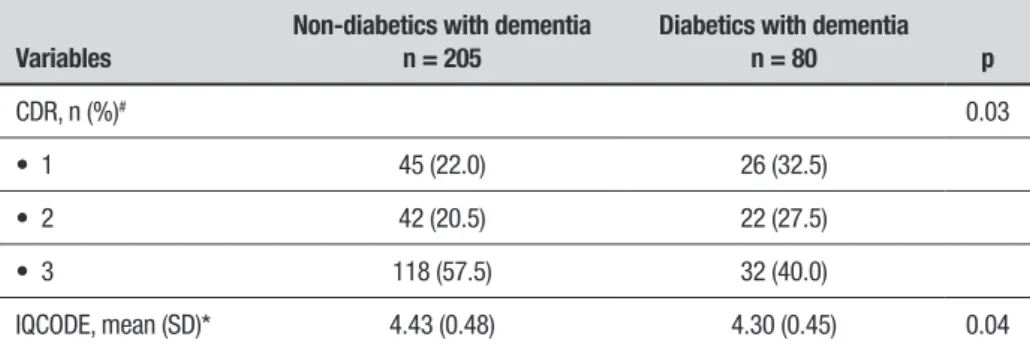
Second, only diabetics and non-diabetics with dementia data were compared. Similar frequencies were found between them regarding age (p = 0.12), sex (p = 0.79), education (p = 0.88), race (p = 0.17), socioeco-nomic status (p = 0.70), coronary artery disease (p = 0.72), stroke (p = 0.52), heart failure (p = 0.83), physical inactivity (p = 0.90), current smoking (p = 0.60), and alcohol use (p = 0.90). Hypertension (p < 0.01) and dys-lipidemia (p < 0.01) were more frequent in demented diabetics than in non-diabetics with dementia. here was a higher frequency of individuals with severe dementia (CDR = 3) among non-diabetics (p = 0.03), and with mild (CDR = 1) and moderate dementia (CDR = 2) among dia-betics. Non-diabetics with dementia died with highest mean IQCODE scores (4.43; SD:0.48; p = 0.04) (Table 2). Diabetes was not associated with dementia (OR:1.22; 95%CI:0.81-1.82; p = 0.34) on multivariate ordinal logis-tic regression adjusted for age, sex, race, education, hypertension, dyslipidemia, smoking, physical inactiv-ity and alcohol use (Table 3).
Table 1. Sociodemographic and clinical data from diabetics and non-diabetics with and without dementia (n=1,037).
Variable
Non-diabetics
P
Diabetics
p Without dementia With dementia Without dementia With dementia
(N = 553) (N = 205) (N = 199) (N = 80)
Female, n (%)* 260 (47.0) 128 (62.4) < 0.01 101 (50.8) 52 (65.0) 0.03
Age (years), mean (SD)† 72.6 (11.8) 80.3 (9.7) < 0.01 71.5 (10.9) 78.5 (9.4) < 0.01
Education (years), mean (SD)£ 4.4 (3.7) 3.2 (3.4) < 0.01 4.6 (3.8) 3.2 (3.4) < 0.01
Race, n (%)# 0.09 0.03
• White 336 (60.8) 120 (58.5) 132 (66.3) 40 (50)
• Black 104 (18.8) 53 (25.9) 33 (16.6) 20 (25.0)
• Admixed 99 (17.9) 30 (14.6) 31 (15.6) 20 (25.0)
• Yellow 14 (2.5) 2 (1.0) 3 (1.5) 0 (0)
Socioeconomic class, n (%)# 0.41 0.22
• High 162 (29.3) 73 (35.6) 57 (28.6) 26 (32.5)
• Middle 260 (47.1) 86 (42.0) 106 (53.3) 38 (47.5)
• Low 130 (23.6) 46 (22.4) 36 (18.1) 16 (20.0)
Hypertension, n (%)* 354 (64.0) 102 (49.8) < 0.01 165 (82.9) 59 (73.8) 0.08
Dyslipidemia, n (%)* 37 (6.7) 6 (2.9) 0.05 41 (20.6) 9 (11.3) 0.06
Coronary artery disease, n (%)* 118 (21.3) 33 (16.1) 0.11 59 (29.6) 15 (18.8) 0.06
Heart failure, n (%)* 94 (17.0) 27 (13.2) 0.20 43 (21.6) 12 (15.0) 0.21
Stroke, n (%)* 57 (10.3) 52 (25.4) < 0.01 34 (17.1) 24 (30.0) 0.02
Physical inactivity, n (%)* 243 (49.4) 136 (82.4) < 0.01 107 (57.8) 53 (88.3) < 0.01
Current smoking, n (%)* 169 (30.6) 39 (19.0) < 0.01 40 (20.1) 18 (22.5) 0.78
Current alcohol use, n (%)* 139 (25.1) 39 (19.0) 0.10 41 (20.6) 14 (17.5) 0.67
*Chi-square test; #Fisher’s exact test †Student´s t-test; £Mann-Whitney Test.
Table 2. CDR and IQCODE in diabetics and non-diabetics with dementia (n = 285).
Variables
Non-diabetics with dementia n = 205
Diabetics with dementia
n = 80 p
CDR, n (%)# 0.03
• 1 45 (22.0) 26 (32.5)
• 2 42 (20.5) 22 (27.5)
• 3 118 (57.5) 32 (40.0)
IQCODE, mean (SD)* 4.43 (0.48) 4.30 (0.45) 0.04
Table 3. Association between clinical dementia and diabetes mellitus status (n = 1,037).
DM
Clinical dementia n (%)
Simple regression OR (95% CI)
Multivariate regression* OR (95% CI)
No Yes
No 553 (73.0) 205 (27.0) 1.00 (reference) 1.00 (reference)
Yes 199 (71.3) 80 (28.7) 1.08 (0.80-1.47) 1.22 (0.81-1.82)
p 0.602 0.340
OR: odds ratio; CI: confidence interval. *Multivariate ordinal logistic regression adjusted for age, sex, race, education, hypertension, dyslipidemia, physical inactivity, smok-ing, and alcohol use.
Table 4. Neuropathological causes of dementia in diabetics and non-diabetics (n = 285).
Neuropathology, n %
Non-diabetics with dementia, n (%) N = 205
Diabetics with dementia, n (%)
N = 80 P
AD** 52 (25.4) 24 (30.0) 0.52
VaD** 22 (10.7) 14 (17.5) 0.65
Mixed dementia (AD +VaD)* 15 (7.3) 03 (3.8) 0.30
Other Mixed NP** 46 (22.4) 09 (11.3) 0.03
Other single NP** 27 (13.2) 11 (13.8) 0.95
Undefined** 43 (21.0) 19 (23.8) 0.73
AD: Alzheimer’s disease; NP: neuropathology; VaD: vascular dementia. **Chi-square test; *Fisher’s exact test.
DISCUSSION
his study did not ind an association between diabetes and dementia in a large sample of subjects submitted to autopsy. All diabetics and non-diabetics with dementia were older, predominantly women, had lower educa-tion, and a higher frequency of stroke and physical inactivity. Older age, low education, female sex, phys-ical inactivity and stroke have been considered risk factors for dementia.2,45-48 Participants with diabetes
died at mild and moderate stages of dementia. hey had more comorbidities, exhibiting more hypertension and dyslipidemia; therefore, they might have died before dementia had reached more advanced clinical stages.
he prevalence of dementia among non-diabetics (27%) and diabetics (29%) was lower in our study com-pared with other reports.22,26,27 Arvanitakis et al.22 found
dementia in 44.2% of non-diabetics and in 50% of dia-betics (p = 0.52). Ahtiluoto et al.26 reported a very high
frequency of dementia, present in 65.9% of non-diabet-ics and 60.0% of diabetnon-diabet-ics (p = 0.381) with mean age of 88 years. Abner et al.27 reported dementia in 38.2%
of non-diabetics and 39.1% of diabetics (p = 0.69), also with a mean sample age of 88.7 years. However, the study by Alafuzof et al.23 found a higher frequency of
dementia in the non-diabetic group (p < 0.01) of 31% in non-diabetics and 21% in diabetics, but with a mean age similar to the present study. Peila et al.21 described an
increased risk for the development of dementia in dia-betics, whereas the study by Ahtiluoto et al.26 reported
double the incidence of dementia in this group.
AD was the main cause of dementia in both groups, showing the importance of this neurodegenerative disease in older people even in the presence of vascu-lar risk factors. VaD was the second-most-common cause only in diabetics. Other mixed neuropathology of dementia was more frequent and the second-most-frequent cause of dementia in non-diabetics. he difer-ence in cause of dementia distribution can probably be explained by diabetics being a group with more vascular risk factors, showing the important role of diabetes in cerebrovascular disease. DM was not associated with increased frequency of any particular type of demen-tia in the present study, unlike cohort studies that have shown an increased risk for AD,10-17,19,49 VaD,5-9,18 AD
and VaD,11,21,26,50 or for mixed AD and VaD11,21 in
to AD remains controversial, where cerebrovascular dis-ease is likely the main mechanism involved and diabetes possibly decreases brain resilience, but does not directly cause AD.3
he present study has several strengths: a) the large sample size from a LMIC with low educational level among subjects, in contrast with other studies; b) autopsy studies allow for the direct measurement of neuropathological lesions, untangling the pure asso-ciation between DM and dementia neuropathology; c) neuropathologists were blinded to clinical information. However, our study has some limitations: a) this is a cross-sectional study and therefore limited in determin-ing causality of diabetes for dementia; b) all clinical data, including diabetes diagnoses, were obtained in NOK; c) the clinical diagnosis of dementia was established only after death based on NOK information. However, the accuracy of our clinical interview was tested previously and showed good reliability.53
In conclusion, we did not ind an association between diabetes and dementia frequency or any neu-ropathological cause in a large sample with low educa-tional level in a LMIC. Further studies are necessary to better clarify these questions, especially longitudinal autopsy studies in LMIC.
Author contribution. Maria Niures Pimentel dos Santos Matioli and Claudia Kimie Suemoto: preparation and statistical calculation of the study. Ricardo Nitrini: study conception, and writing and reviewing the paper. Roberta Diehl Rodriguez and Lea Tenenholz Grinberg: responsible for the neuropathological diagnosis. he other authors contributed to the research and revision of the paper.
Acknowledgements/Funding. he authors are grateful to the families of the brain donors and to the São Paulo City Autopsy Service physicians and staf for their unconditional support, and to the Brazilian Aging Brain Study Group participants.
Study funding. Support for this work was provided by grants the from Fundação de Apoio a Pesquisa do Estado de São Paulo – FAPESP (grant 2009/01934-4 and scholarship to R.E.P.L.), LIM22 of the Department of Pathology of the University of São Paulo Medical School, Albert Einstein Education and Research Insti-tute, São Paulo (grant 240/07), and the Coordenadoria de Apoio ao Pessoal de Nivel Superior – CAPES, Brazil (scholarship to students of the BABSG).
REFERENCES
1. International Diabetes Federation, 2015. IDF Diabetes Atlas seventh edition: www.idf.org.
2. Ali GC, Guerchet M, Wu YT, Prince M, Prina M. World Alzheimer Report 2015: The global prevalence of dementia. Chapter 2. Alzheimer´s Disease Internacional.
3. Prince M, Luchsinger JA, Albanese E. Dementia and Risk Reduction an Analysis of Protective and Modiiable Factors. World Alzheimer Report 2014, Chapter 5: 66-83.
4. Katzman R, Aronson M, Fuld P, Kawas C, Brown T, Morgenstern H, et al. Development of dementia illnesses in an 80-year-old volunteer cohort. Ann Neurol 1989;25:317-24.
5. Luchsinger JA, Tang M-X, Stern Y, Shea S, Mayeux R. Diabetes Mellitus and Risk of Alzheimer’s Disease and Dementia with Stroke in a Multi-ethnic Cohort. Am J Epidemiol 2001;154:635-41.
6. MacKnight C, Rockwood K, Awalt E, McDowell I. Diabetes mellitus and the risk of dementia, Alzheimer’s disease and vascular cognitive impair-ment in the Canadian Study of Health and Aging. Deimpair-ment Geriatr Cogn Disord 2002;14(2):77-83.
7. Hassing LB, Johansson B, Nilson SE, Berg S, Pedersen NL, Gatz M, McClearn G. Diabetes Mellitus is a risk factor for vascular dementia, but not for Alzheimer1s disease: a population-based study of the oldest old. Int Psychogeriatr 2002;14(3):239-48.
8. Raffaitin C, Gin H, Empana JP, Helmer C, Berr C, Tzourio C et al. Meta-bolic Syndrome and Risk for Incident Alzheimer’s Disease or Vascular Dementia. Diabetes Care 2009;32(1):169-74.
9. Xu WL, von Strauss, Qiu CX, Winblad B, Fratiglioni L. Uncontrolled diabetes increses the risk of Alzheimer’s disease: a population-based cohort study. Diabetologia 2009;52:1031-9.
10. Leibson CL, Rocca WA, Hanson VA, Cha R, Kokmen E, O’Brien PC, Palumbo PJ. Risk of dementia amongpersons with diabetes mellitus: a population-based cohort study. Am J Epidemiol 1997; 145:301-8. 11. Ott A, Stolk RP, van Harskamp F, Pols HA, Hofman A, Breteler MM.
Diabetes Mellitus and the risk of dementia: The Rotterdam Study. Neurology 1999;53(9):1937-42.
12. Brayne C, Gill C, Huppert FA, Barkley C, Gehlhaar E, Girling DM et al. Vascular Risks and Incident Dementia: Results from a Cohort Study of the Very Old. Dement Geriatr Disord 1998;9:175-80.
13. Arvanitakis Z, Wilson RS, Bienias JL, Evans DA, Bennett DA. Diabetes Mellitus and Risk of Alzheimer Disease and Decline in Cognitive Function. Arch Neurol 2004;61:661-6.
14. Luchsinger JA, Reitz C, Honig LS, Tang MX, Shea S, Mayeux R. Aggre-gation of Vascular Risk Factors and Risk of Incident Alzheimer’s Disease. Neurology 2005;65(4):545-51.
15. Borenstein AR, Wu Y, Mortimer JA, Schellenberg GD, McCormick WC, Bowen JD, et al. Developmental and vascular risk factors for Alzheimer’s disease. Neurobiol Aging 2005;26:325-34.
16. Cheng D, Noble J, Tang MX, Schupf N, Mayeux R, Luchsinger JA. Type 2 Diabetes and Late-Onset Alzheimer’s Disease. Dement Geriatr Cogn Disord 2011;31:424-30.
17. Wang KC, Woung LC, Tsai MT, Liu CC, Su YH, Li CY. Risk of Alzheimer’s disease in relation to diabetes: a population-based cohort study. Neuro-epidemiology. 2012;38:237-44.
18. Xu WL, Qui CX, Wahlin A, Winblad B, Fratiglioni L. Diabetes Mellitus and risk of dementia in the Kungsholmen project. Neurology 2004;63:1181-6. 19. Irie F, Fitzpatrick AL, Lopez OL, Kuller LH, Peila R, Newman AB,
Launer LJ. Enhanced Risk for Alzheimer Disease in Persons with Type 2 Diabetes and APOE ε4. The Cardiovascular Health Sudy Cognition Study. Arch Neurol 2008;65(1):89-93.
20. Akomolafe A, Beiser A, Meigs JB, Au R, Green RC, Farrer LA, et al. Diabetes Mellitus and Risk of Developing Alzheimer Disease. Arch Neurol 2006; 63(11):1551-4.
22. Arvanitakis Z, Schneider JA, Wilson RS, Li Y, Arnold SE, Wang Z, Bennett DA. Diabetes is related to cerebral infarction but not to AD pathology in older persons. Neurology 2006;67:1960-5.
23. Alafuzoff I, Aho L, Helisalmi S, Mannermaa A, Soininen H. β-Amyloid deposition in brains of subjects with diabetes. Neuropathology Applied Neurobiology 2009;35:60-8.
24. Nelson PT, Smith CD, Abner EA, Schmitt FA, Scheff SW, Davis GJ, et al. Human cerebral neuropathology of type 2 diabetes mellitus. Biochim Biophys Acta 2009;1792:454-69.
25. Sonnen JA, Larson EB, Brickell K, Crane PK, Woltjer R, Montine TJ, Craft S. Different Pattenrs of Cerebral Injury in Dementia with or without Diabetes. Arch Neurol 2009;66(3):315-22.
26. Ahtiluoto S, Polvikoski T, Peltonen M, Solomon A, Tuomilehto J, Winblad B, et al. diabetes, Alzheimer’s disease, and vascular dementia: a popula-tion-based neuropathologic study. Neurology 2010;75:1195-202. 27. Abner EL, Nelson PT, Kryscio RJ, Schmitt FA, Fardo DW, Woltjer RL et
al. Diabetes is associated with cerebrovascular but no Alzheimer neuro-pathology. Alzheimers Dement 2016:1-8.
28. Heitner J, Dickson D. Diabetics do not have increased Alzheimer-type pathology compared with age-matched control subjects. Neurology 1997;49:1306-11.
29. Beeri MS, Silverman JM, Davis KL, Marin D, Grossman HZ, Schmeidler J, et al. Type 2 Diabetes Is Negatively Associated with Alzheimer’s Disease Neuropathology. J Gerontol A Biol Sci Med Sci. 2005;60A(4):471-5. 30. Matioli MNPS, Suemoto CK, Rodriguez RD, Farias DS, da Silva MM,
Leite REP, et al. J Alzheimers Dis 2017;60:1035-43.
31. Matsuzaki T, Sasaki K, Tanizaki Y, Hata J, Fujimi K, Matsui Y, et al. Insulin resistance is associated with the pathology of Alzheimer disease: The Hasayama Study. Neurology 2010;75:764-70.
32. Malek-Ahmadi M, Beach Thomas, Obradov A, Sue L, Belden C, Davis K, et al. Type 2 diabetes is associated with increased Alzheimer’s disease neuropathology in ApoE e4 Carriers. Curr Alzheiner Res 2013; 10(6): 654-9.
33. Grinberg LT. Ferretti RE. Farfel JM. Leite R. Pasqualucci CA. Rosemberg S. et al. Brain bank of the Brazilian aging brain study group - a mile-stone reached and more than 1.600 collected brains. Cell Tissue Bank. 2007;8(2):151-62.
34. Almeida P. Wickerhauser H. O critério ABA/ABIPEME: em busca de uma atualização. Editora da Associação Brasileira dos Institutos de Pesquisa de Mercado. São Paulo. Editora ABA/ABIPEME; 1991.
35. Morris JC. The Clinical Dementia Rating (CDR): current version and scoring rules. Neurology 1993;43:2412-4.
36. Jorm AF. Jacomb PA. The Informant Questionnaire on Cognitive Decline in the Elderly (IQCODE): socio-demographic correlates reliability, validity and some norms. Psychol Med 1989;19:1015-22.
37. Grinberg LT, Nitrini R, Suemoto CK, Ferretti-Rebustini RE, Leite REP, Farfel JM, et al. Clinics 2013;68(8):1140-5.
38. Braak H, Braak E. Neuropathological stageing of Alzheimer-related changes. Acta Neuropathol 1991; 82:239-59.
39. Mirra SS, Heyman A, McKeel D, Sumi SM, Crain BJ, Brownlee LM, et al. (1991) The Consortium to Establish a Registry for Alzheimer’s Disease (CERAD). Part II. Standardization of the neuropathologic assessment of Alzheimer’s disease. Neurology 1991;41:479-86.
40. Matthews FE, Brayne C, Lowe J, McKeith I, Wharton SB, Ince P. Epide-miological pathology of dementia: attributable-risks at death in the Medical Research Council Cognitive Function and Ageing Study. PLoS Med. 2009;6(11):e1000180.
41. McKeith IG, Dickson DW, Lowe J, Emre M, O’Brien JT, Feldman H et al. Consortium on DLB. Diagnosis and management of dementia with Lewy bodies: third report of the DLB Consortium. Neurology. 2005;65:1863-72.
42. Braak H, Del Tredici K, Rub U, de Vos RA, Jansen Steur EN, Braak E. Staging of brain pathology related to sporadic Parkinson’s disease. Neurobiol Aging. 2003;24:197-211.
43. Mackenzie IR, Neumann M, Bigio EH, Cairns NJ, Alafuzoff I, Kril J, et al. Nomenclature and nosology for neuropathologic subtypes of frontotem-poral lobar degeneration: an update. Acta Neuropathol. 2010;119:1-4. 44. Saito Y, Ruberu NN, Sawabe M, Arai T, Tanaka N, Kakuta Y, et al.
Staging of argyrophilic grains: an age-associated tauopathy. J Neuro-pathol Exp Neurol. 2004;63:911-8.
45. Gorelick PB, Scuteri A, Black SE, Decarli C, Greenberg SM, Iadecola C, et al. Vascular contributions to cognitive impairment and dementia: a statement for healthcare professionals from the American Heart Associa-tion/American Stroke Association. Stroke. 2011;42:2672-713. 46. Ferri C, Piovezan RD, Padilla I, Prince M, Albanese E, Prine M. Lyfestile.
World Alzheimer Report 2014, Chapter 4: 9-10.
47. Pender R, Guerchet M, Prince M. Developmental and early-life risk factors. World Alzheimer Report 2014, Chapter 2: 12-24.
48. Chenê G, Beiser A, Au R, Preis SR, Wolf PA, Dufouil C, Seshadri S. Gender and incidence of dementia in the Framingham Heart Study from mid-adult life. Alzheimers Dement 2015;11(3):310-20.
49. Ohara T, Doi Y, Ninomiya T, Hirakawa Y, Hata J, Iwaki T, Kanba S, Kiyo-hara Y. Glucose tolerance status and risk of dementia in community: the Hisayama Study. Neurology. 2011;77:1126-34.
50. Kimm H, Lee PH, Shin YJ, Park KS, Jo J, Lee Y, Kang HC, Jee SH. Mid-life late-life vascular risk factors and dementia in Korean men and women. Arch Gerontol Geriatr. 2011;52:e117-22.
51. Chui HC, Zheng L, Reed BR, Vinters HV, Mack WJ. Vascuar risk factors and Alzheimer’s disease: are these risck factors for plaques and tangles or concomitant vascular pathology that increses the likehood of dementia? An evidenced-based review. Alzheimers Res Ther. 2012;4:1. 52. Richardson K, Stephan BCM, Ince PG, Brayne C, Matthews FE, Esiri MM. The Neuropathology of Vascular Disease in the Medical Research Council Cognitive Function and Aging Study (MRC CFAS). Curr Alzheimer Res. 2012;9:687-96.