WORK ORGANIZATION IN HOSPITAL NURSING: LITERATURE REVIEW
APPROACH
Jorge Lorenzetti1, Julieta Oro2, Eliane Matos3, Francine Lima Gelbcke4
1 Ph.D. in Nursing. Professor of the Department of Nursing at the Universidade Federal de Santa Catarina (UFSC). Florianópolis,
Santa Catarina, Brazil. E-mail: [email protected]
2 M.Sc. in Nursing. Nurse at the UFSC University Hospital. Florianópolis, Santa Catarina, Brazil. E-mail: [email protected] 3 Ph.D. in Nursing. Nursing Director of the UFSC University Hospital. Florianópolis, Santa Catarina, Brazil. E-mail: elianematos@
hotmail.com
4 Ph.D. in Nursing. Professor of the Department of Nursing and at Postgraduate Program in Nursing at the UFSC. Florianópolis,
Santa Catarina, Brazil. E-mail: [email protected]
ABSTRACT: The objective of this study was to analyze aspects of work organization in hospital nursing and its articulations with
care, by means of an integrative review. A total of 25 studies were identiied, from the period between 2000 and 2009. Based on the
understanding of the work organization and its application in nursing, the following analytical categories were structured: conceptual and theoretical aspects, personnel management, care management, technologies, hospital accreditation, planning and material resources management. The literature evidenced the complexity of this work organization theme and the importance of studies on its application in nursing. The analysis of the publications points to the need to rethink work organization in such a way as to build less wearing and quality work alternatives, assuring the safety of both the user and the worker.
DESCRIPTORS: Nursing. Administration. Health management.
ORGANIZAÇÃO DO TRABALHO DA ENFERMAGEM HOSPITALAR:
ABORDAGENS NA LITERATURA
RESUMO: Este estudo, por meio de uma revisão integrativa, teve como objetivo analisar aspectos da organização do trabalho
hospitalar da enfermagem e suas articulações com a assistência. Foram identiicados 25 estudos, no período de 2000 a 2009. A partir da compreensão de organização do trabalho e sua aplicação na enfermagem foram estruturadas as seguintes categorias analíticas:
aspectos teóricos e conceituais, gestão de pessoas, gestão da assistência, tecnologias, acreditação hospitalar, planejamento e gestão de materiais. A literatura evidenciou a complexidade desta temática de organização do trabalho e a importância de estudos sobre a sua aplicação na enfermagem. A análise das publicações aponta para a necessidade de se repensar a organização do trabalho, de modo a construir alternativas de trabalho menos desgastantes e de qualidade, garantindo a segurança do usuário e do trabalhador.
DESCRITORES: Enfermagem. Administração. Gestão em saúde.
ORGANIZACIÓN DEL TRABAJO EN ENFERMERÍA HOSPITALARIA:
ABORDAJES EN LA LITERATURA
RESUMEN: En el presente estudio se realiza una revisión integradora con el objetivo de analizar aspectos de la organización del
trabajo de enfermería y sus relaciones con la atención. Se identiicaron 25 estudios, de 2000 a 2009. A partir de la comprensión de la organización del trabajo y su aplicación en la enfermería, se estructuraron las siguientes categorías de análisis: aspectos teóricos y conceptuales, gestión de personas, gestión de la atención, tecnología, acreditación de hospitales, planiicación y gestión de materiales.
La literatura muestra la complejidad de este tema de la organización del trabajo y la importancia de los estudios sobre su aplicación en
la enfermería. El análisis de las publicaciones muestra la necesidad de repensar la organización del trabajo a in de construir alternativas
para un trabajo menos estresante y de calidad, lo que garantiza la seguridad del usuario y el trabajador. DESCRIPTORES: Enfermería. Administración. Gestión en salud.
INTRODUCTION
Management activities are constitutive of nursing practice, especially for nurses, as of the institutionalization of the profession in the mid-nineteenth century. During these more than 150 years, the organization of the therapeutic environ-ment has been an important part of the nursing work, being grounded on the technical and social division of the work since its conception.1 More recently, there has been a consolidation of the un-derstanding that the professional role of the nurse is identiied by the dimensions of the service in health care, education, research and management, and that these articulated dimensions directly inluence the quality of care.
Several analyses and diagnoses made in Brazil point to relevant weaknesses in the man-agement process of the health sector in the coun-try. The advancement and consolidation of the Brazilian Uniied Health System (SUS, as per its acronym in Portuguese) require confronting the management aspect as one of the highest priorities concomitant to the funding of needs.
In the context of the SUS, performance of nurses in leadership positions at various levels of health institutions stand out, from the direction of basic health units, functions at the central level of municipal, state and federal spheres, as well as the direction of nursing organs in hospitals and the coordination of care units at this level of care. The responsibility of nurses for delivering nursing care to users in all areas of health care requires the application of typical management skills.
Organization is one of the basic functions of management/administration in all institutions, companies or organizations in society, along with planning, coordination, leadership and evalua-tion. The assignment of organizing is a complex activity of formatting the organizational structure, involving the deinition of people, technologies, materials and other resources needed to achieve the objectives of a particular institution, company or organization. It involves the division of labor, responsibilities, levels of authority and the type of management to be adopted. The formatting of organizational structures has its graphical repre-sentation in organizational charts.2
The management of nursing care applies these elements of the organization process for the accomplishment of its mission to ensure safe and quality care in situations of health and illness. Within its scope of action, nursing adopts choices
of managerial design, personnel scaling, the use of materials and technologies, the kind of labor division, hierarchical structure and relationships of power.2 In this sense, the management dimen-sion in nursing encompasses the organization and management of health care and administrative processes that constitute the nurses´core work.3
Considering the relevance of the activity of work organization to manage the care of nursing and administrative processes, the aim of this inte-grative review of studies from 2000 to 2009 was to identify and characterize aspects of the organiza-tion of nursing work in hospital care.
METHODOLOGY
An integrative review was conducted, us-ing a qualitative approach, and with the aim to identify and characterize the aspects addressed in studies related to the organization of nursing work in hospitals.
To guide this study of integrative literature review, a formal and rigid work structure was included, based on a previously developed and validated research protocol.4 The following steps were used in its development: identiication of the topic and deinition of the research question; establishment of inclusion and exclusion criteria of articles for sample selection; approximation of the material in accordance with common characteris-tics; analysis and discussion of results, identiica -tion of differences and conlicts, and presenta-tion of results.
After the deinition of the subject, i.e., the or -ganization of nursing work in the hospital setting, the literature review was carried out to answer the following research question: what aspects are ad-dressed in studies on the organization of nursing work in hospitals?
The Virtual Health Library (VHL) database was used to compose the study, which contains publications from General Health Sciences sourc-es, such as: Latin American Literature in Health Sciences (LILACS), International Literature on Health Sciences (MEDLINE) and Scientiic Elec -tronic Library Online (SCIELO), and also specialist areas such as the Bibliographic Database of the Nursing Area in Brazil.
papers; published in Portuguese, with results available within the selected database, in the period established between 2000-2009, involving the hospital context. Considering the established period, duplicate studies were excluded, those which had no relation to the scope of this research, as well as those that were not complete, thus total-ing 25 articles.
The aspects identiied in the publications dealing with the organization of nursing work in hospitals were organized into the following categories: a) theoretical and conceptual aspects of work organization; b) work organization and personnel management; c) work organization and care management; d) work organization and technology; e) work organization and hospital accreditation; f) work organization and planning; and g) work organization and material resources management.
RESULTS AND DISCUSSION
The organization of work, in general, in health care and nursing, involves multiple and complex dimensions and determinations.
The aim of this study is not to present and relect on this broad theoretical ield. Neverthe -less, it is necessary to note that aspects of work organization express internal choices and external constraints of economic, political, socio-cultural and technological order, among others. These choices and constraints contain an underlying view of the world, and social objectives, within a particular historical moment.
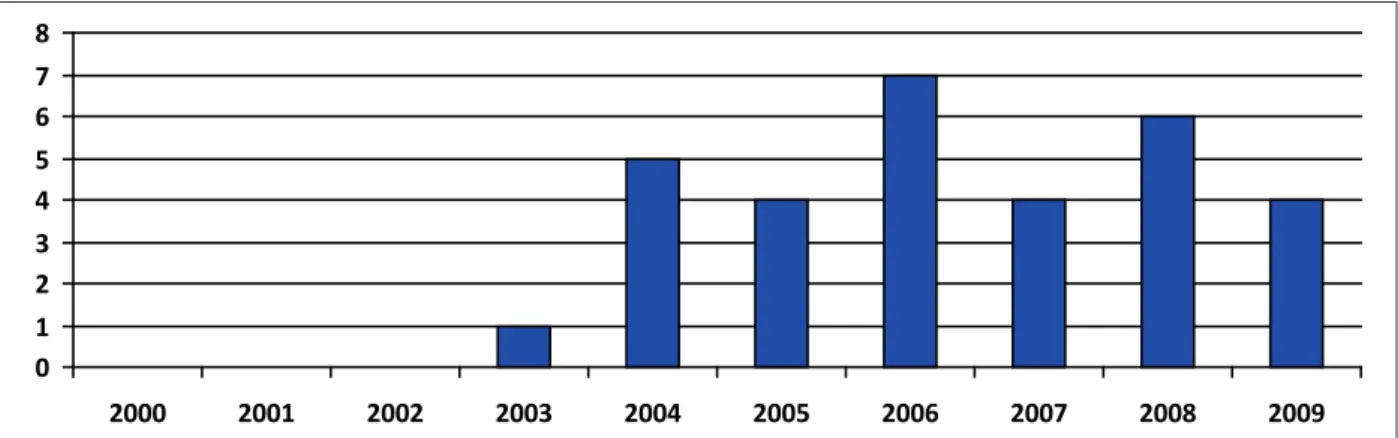
The initial characterization of the 25 selected studies indicates that, chronologically, there was greater interest in the subject from the year 2004 on, as it may be seen in igure 1, which presents the annual distribution of production.
0 1 2 3 4 5 6 7 8
2000 2001 2002 2003 2004 2005 2006 2007 2008 2009
Figure 1 - Selected studies by year of publication, 2000-2009
Aiming to facilitate understanding and anal-ysis, and based on the approaches found in the
se-lected publications, the articles were systematized into categories according to the following table.
Table 1 - Studies by category of analysis
Analytical categories n. of publications
Theoretical and conceptual aspects of work organization 07
Work organization and personnel management 08
Work organization and care management 03
Work organization and technology 03
Work organization and hospital accreditation 02
Work organization and planning 01
Work organization and material resources management 01
1107
-Work organization in hospital nursing: literature review approach
Theoretical and conceptual aspects of work
organization
To analyze the speciicities of work organi -zation, in its institutional focus, it is necessary to understand, initially, how this organization occurs in its general aspects.5-7 In this sense, one must consider that the institutionalization of nursing as a profession, promoted by Florence Nightin-gale in the second half of the nineteenth century, incorporated its own knowledge and practices of administration since the beginning, conigured in the organization of the therapeutic environment in hospitals. It established the division between intellectual work for the nurse and manual labor for other nursing staff members and the hierarchy, where the nurse plays the role of a centralizing knowledge manager who dominates the concep-tion of the work process and delegates partial activities to the other practitioners.6
The concepts of work management and organization, termed as scientiic, classical and bureaucratic, and currently considered as tradi-tional, formulated by Taylor, Fayol and Weber, respectively, were dominant in the production process of goods and services in society for many decades. From the 1950s, these concepts started to suffer criticism and the search for alternatives to meet the new demands of productivity and con-stant changes in the working world were intensi-ied. This process has been accelerating since the 1980s, with a view to overcome this conception, and replace it with management visions and prac-tices, called innovative and participatory.
The authors call attention to the fact that the healthcare sector and nursing in this context are still strongly attached to the traditional concept of management, despite the existence of initiatives and participatory experiences, however, insuf-icient to point out signiicant changes in nursing services.5-7
Management stands out as the possibility of gaining a new professional role for the nurse and the challenge is to become a de facto leader in the health system.5 A strong identity of the authors is perceived, with the need for urgent and substantial changes in the management and organization of nursing work, especially toward the organization of work by the ‘comprehensive care’ model, par-ticipatory management with involvement of the nursing staff and the assisted individuals in care management, education at work and the welfare of the care-giving subjects.9 Furthermore, over-coming poor management practice, linked to the
momentary and urgent aspect that masks the exist-ing disorganization and compromises the quality of the result of the nursing work.6 These aspects are advancing in different areas of nursing action. Regarding general aspects, the organiza-tional structure and culture guide the organization of work that involves all the activities undertaken by workers, hierarchical relationships and labor relationships present in an institution/organiza-tion. Current macro policies in society inluence and affect the organization of work.1
Hospitals and health institutions in general can be considered as “professional bureaucracy” type organizations, according to Mintzberg’s Orga-nizational Theory.8 In these organizations, the “op-erating core” consists of well-educated and trained professionals who hold considerable control over their work and enjoy relative autonomy due to their specialized knowledge and the complexity of the work. There is, in these institutions, a dual system of authority, on the one hand, the administration, involving the hospital staff, with a rigid, authori-tarian and centralized hierarchical scheme and, on the other, the knowledge-power of physicians who may confront the administration and are the only professionals with effective autonomy.9
The centrality of the medical work, prevail-ing in this reality, relected in the care process, and in power relationships. The interdisciplinar-ity which could play a key role in bringing about change, is far from being a concrete practice. Although centered in the medical work, in orga-nization and the management of work and care practice, each professional category holds a certain autonomy in assessment and decision making.1
The nursing service in hospitals is focused on three areas: nursing care to users, the organization of the therapeutic environment and the manage-ment of the nursing staff. The Systematization of Nursing Care (SNC) and the management of inpatient units concentrate the working process of nurses.10
An experience report shows the dificulties of changing the management model in hospitals, from the traditional (biomedical, hierarchical and authoritarian) to an epidemiological model, ori-ented to comprehensive and decentralized care, based on democratic, interdisciplinary participa-tion and co-responsibility. It demonstrates the resistance of nursing and that health profession-als are not prepared for a reorganization and/or restructuring process.11
W o r k o r g a n i z a t i o n a n d p e r s o n n e l
management
Considering personnel management, studies in the literature regarding the sizing of personnel identify workload, quality indicators, subjectivity and ergonomic aspects. It should be stressed that personnel management is one of the most impor-tant dimensions in institutional organization.
In this regard, Brazilian nursing has been devoted in recent years to study and provide input in the area of personnel sizing, also driven by legal support from the resolution 293/2004 of the Federal Nursing Council.12 It is understood that safe and quality nursing care for users requires the antici-pation and provision of an adequate nursing staff, and the profession has developed instruments to determine the quantity and quality of nursing staff needed to provide nursing care to a group of users according to the philosophy and uniqueness of each service.13 This sizing requires the establishment of different variables, which appear in the studies identiied, such as the average daily workload of nursing, a measure that involves the use of Patient Classiication Systems (PCSs), technical safety index and effective working time.14-16
Among the studies, it is worth noting one that addresses the time distribution of nurses in an inpatient medical surgical unit, showing that 50% of their time was spent in indirect care, 22% in direct care, 18% in personal time and 10% in associated activities. Thus, there was an evident need to review work processes, from the perspec-tive of providing more time for the performance of speciic professional activities.14
Another aspect addressed in the studies concerns PCSs, which constitute a way to deter-mine the degree of patient dependency in relation to nursing, allowing to establish the time spent in direct and indirect care. Patient Classiication Systems provide more objective subsidies for the deinition of the nursing workload needed and, therefore, assist in negotiating with and hiring nursing staff, and in quantity and empowerment, inluencing the organization of work.15 Regarding this aspect, a system for patient classiication, pro -posed for the Brazilian reality15, and the Nursing Activities Score (NAS) system are addressed.16
Indicators as care markers for speciic issues with results can be structured in the following categories in personnel management: continuing education, work organization, participation in decision making, proper staff sizing, absenteeism, turnover, titration, scientiic production, accidents at work, occupational diseases, time off, and work satisfaction and dissatisfaction.17
Focusing on work organization and person-nel management, approaches that refer to the subjectivity of nursing also appeared, as well as in-dications of the importance of this relationship.18-19 One study examined identity aspects of nurse managers in a hospital context of strong transfor-mations oriented toward participatory manage-ment practices with decentralization, reduction of hierarchical levels, more lexible communication and the pursuit of professional responsibility as for results.18 Nurses have had increasingly strong participation in management positions in hospitals with an emphasis on people management and inancial, material and technological resources.18 The carrying out of management and care ac-tivities often presents situations of conlict and a blurring of roles that interferes with the nurses’ identity.18 In this case, nurse managers have a professional identity characterized by preserva-tion and the strengthening of the social identity of nurses, “nurse’s soul” with a trajectory of evolu-tion in healthcare practice management with an appreciation for the experience and activities of direct care. In terms of organizational identity, a strong ideological and emotional attachment to the institution appears, a sense of belonging and a driven attitude from the healthcare team to achieve the organizational objectives.18
1109
-Work organization in hospital nursing: literature review approach of nursing work, which is fragmented, hierarchi-cal, authoritarian and lack teamwork, brings the presence of strong dissatisfaction, suffering and an undervalued self-image.19
In one case study, in clinical units of a hospi-tal, the authors analyzed the relationship between occupational accidents and ergonomic risks in the organization of nursing work. In this situation, occupational accidents were considered high, 35% of workers participating in the study had suffered some kind of accident. Of these accidents, 84% oc-curred in the process of carrying out procedures and 65% affected their hands.20 The risk factors identiied were unsatisfactory division of labor, concentration of activities at rush hours (e.g., 10:00 a.m.), concomitant accumulation of tasks and total occupation of workload during the shift.20 Protec-tive factors were: taking regular breaks during work, availability of Personal Protective Equip-ment (PPE), use of PPE, compatibility between the position and the highest level of training, feedback from leaders as regards the performance carried out and professional accomplishment.20
It is important to highlight the importance of the suficiency of human resources and profes -sional satisfaction for the care of appropriate ergo-nomic bases in the organization of nursing work.20
Work organization and care management
Regarding the management of care, the SNC stands out, which constitutes an important tool in the practice of nursing care, since it provides a process of care with planning, implementation and evaluation, indispensable as a basis for safe and quality care. The SNC and its institutionalization in appropriate records are a substantive component in attitude and practice that values the profession, however, it still does not receive due credit from nurses who often act only as facilitators of the work of other healthcare professionals and prioritize ad-ministrative and bureaucratic activities.21
The shift change is a signiicant care man -agement tool, organized and developed by the nursing staff. It is an important activity to ensure the adequate continuity of care, 24 hours a day, as well as team integration; besides being a rich space for communication and collective learning.22
Nurses play multiple roles in hospital ad-ministration. In a general supervisory function during night shifts and weekends, they assume the representation of management throughout the organization, facing and routing the various
problems and issues, such as staff shortages, bed occupancy, conlicts, lack of materials and others.23
Work organization and technology
Another aspect identiied in studies refers to computerization and the use of other technolo-gies that interfere with the organization of work in hospitals, with three articles that show speciic situations regarding the introduction of new tech-nologies, which interfere in the organization of work.24-26
The irst study, upon analyzing the process of computerization in surgical hospital units, with the introduction of electronic health records, describes it as signiicantly interfering with the work of nurses. There was, in this case, resistance from the professionals, who demonstrated disin-terest in this practice and a preference for the old handwritten form. The process of computerization has caused isolation, stress and withdrawal from direct care, despite being seen by sectors of the institution and the administration as positive.24
The second study analyzes the use of mate-rial technologies in the ICU, such as monitors, mechanical ventilators, infusion pumps, deibril -lators, pacemakers, computers and others, called by the authors as hard technologies; part of the idea that there is a strong relationship between the organization of nursing work in ICU and the use of technologies.21 They concluded that the presence of obsolete materials, shortages and insuficient continuous training harm nursing work and cause suffering, dissatisfaction and an intensiication in the work, among other consequences, with the use of technology not replacing the necessary personal interaction between caregivers and as-sisted subjects.25
The third study describes the construction and implementation of a computerized nursing prescription in the ICU, in which the initiative and the process were considered positive and included the broad participation and compliance of the entire nursing staff.26
Work organization and hospital accreditation
weak-nesses of health management in Brazil, there is a strong absence or ledgling culture of evaluation of results of health services. The most widely used instrument is auditing, usually limited to costs and inancial aspects.
In the last decade, this situation has begun to change and part of it is the creation of the Brazil-ian National Accreditation Organization (ONA, as per its acronym in Portuguese), focusing on the hospital. Hospital accreditation is a certiication process that conirms that a hospital organization has implemented and maintains certain standards of quality in the results of their work.
In both studies identiied, the elements in -volved in the hospital accreditation process are addressed,27-28 with the ONA methodology being suggested as reference for nursing actions in an Emergency unit.27 In another study, on the analysis of institutions already certiied by the ONA, the indicators/criteria applied to the performance of nursing services are identiied. Of the 24 criteria/ indicators identiied, 13 are classiied as adminis -trative, six as related to care and ive as regarding teaching and research.28
Work organization and planning
The study on work organization and plan-ning describes the experience of applying the methodology of Situational Strategic Planning (SSP), formulated by Carlos Matus, with the nurs-ing staff of a medical surgical unit and emergency department of a hospital. The SSP was considered an appropriate instrument and shown to enable the practical concept of participatory management in nursing and it positively modiied the process of nursing work with effective relections in improv -ing the work-ing environment and provid-ing more humanized and comprehensive care.29
The application of the participatory planning tool in diverse instances, services and care units, under the coordination of nursing, is a priority and an important initiative for the proper opera-tion and greater visibility and recogniopera-tion of the profession.
Work organization and material resources
management
As regards the management of material resources, this is an important area for the orga-nizational dimension of an institution. Moreover, the adequate management of material resources
directly inluences the performance of the organi -zation in general and, in particular, in the health services that deal with promotion, protection and the recovery of people’s health.30
The World Health Organization believes that the hospital, as an entity for the management of acute and critical events, must make exclusive use of therapeutic possibilities and the technological density compatible with its complexity. 31
Nurses use a variety of tools and materials in performing their work, especially in hospitals, hence the need for a prominent role in the manage-ment of material resources. In this perspective, one study describes an initiative considered as innova-tive in nursing, at a university hospital. The per-formance of nursing in this area is now recognized and institutionalized through the establishment of a Standing Committee on Care Resources. This committee manages about 400 types of materials, involving speciication, standardization, acquisi -tion and quantitative and qualitative control. The results of this experiment have affected the orga-nization of work in the profession.30
FINAL CONSIDERATIONS
The categories drawn from the studies identiied in this integrative review indicate the various dimensions of work organization, from its conception to its inluence in ergonomics, con -solidating what many authors have asserted, i.e., that work organization is still guided mainly by the traditional Taylorism and Fordism, and that hospitals remain as medical institutions where the biomedical model is practiced. New care practices and redeining the mission of health institutions, especially hospitals, from the perspective of an integrated health facility to the service network, are still the objective to be achieved, as well as new forms of work organization, enabling the partici-pation of workers effectively in the management of the institutions and the working process.
ways of organizing the work, so that sharing is a transitive verb, in which the capitalist division of labor, still very strong in the profession, is replaced with an organizational model that coordinates nursing professionals, valuing their knowledge and practice. The concrete practice of management principles adopted by the SUS is needed, such as democratic management, user participation and workforce valuation.
The nursing staff is made of nurses who play a fundamental role in the management of work, especially as it relates to aspects of the manage-ment of people, materials and care. Therefore, it is up to these professionals to encourage team relec -tion on nursing work, because we believe that new forms of work organization will only be possible if nursing workers become actors in the process, from systematic relections on work organization and current implications of how nursing work has been occurring over the years; corroborating what studies show, that the organization and manage-ment of work has also interfered in the wear and tear processes of the workers and in their work satisfaction.
It is possible to state that models of participa-tory organization and the distribution of activities by the comprehensive care model can facilitate the accomplishment of the worker in the work process, as well as meeting the real needs of users. There is, therefore, a need to build on the basis of the information already available new forms of work organization that ensure this practice is carried out safely, with quality, pleasure and satisfaction, considering the actors involved in the process – users and workers.
REFERENCES
1. Pires DEP, Gelbcke FL, Matos E. Organização do trabalho em enfermagem: implicações no fazer e
viver dos trabalhadores de nível médio. Trabalho,
Educ Saúde. 2004 Set; 2(2):311-25.
2. Andrade ROB, Amboni N.Estratégias de gestão: processos e funções do administrador. Rio de Janeiro (RJ): Elsevier; 2010.
3. Peduzzi M, Anselmi ML. O processo de trabalho de enfermagem: a cisão entre planejamento e execução do cuidado. Rev Bras Enferm. 2002
Jul-Ago; 55(4):392-8.
4. Ganong LH. Integrative review of nursing research.
Res Nurs Health. 1987 Feb; 10(1):1-11.
5. Cristovam BP, Santos I. Os desaios da gerência do
enfermeiro no nível central de saúde. Rev Enferm UERJ. 2004 Abr; 12(1):66-70.
6. Matos E, Pires DEP. Teorias administrativas e organização do trabalho: de Taylor aos dias atuais,
inluências no setor saúde e na enfermagem. Texto
Contexto Enferm. 2006 Jul-Set; 15(3):508-14.
7. Svaldi JSD, Lunardi Filho WD, Gomes GC.
Apropriação e uso de conhecimentos de gestão para a mudança de cultura na enfermagem como disciplina. Texto Contexto Enferm. 2006 Jul-Set;
15(3):500-7.
8. Mintzberg H. Criando organizações eficazes.
Estruturas em cinco conigurações. São Paulo (SP):
Atlas; 2006.
9. Lima JC, Binsfeld L. O trabalho do enfermeiro na organização hospitalar: núcleo operacional
autônomo ou assessoria de apoio ao serviço médico? Rev Enferm UERJ. 2003 Jan-Abr; 11(1):98-103.
10. Shimbo AY, Lacerda MR, Labronici LM. Processo de trabalho do enfermeiro em unidade de internação hospitalar: desafios de uma administração contemporânea. Cogitare Enferm. 2008 Jan-Mar;
13(2):296-300.
11. Bernardino E, Felli VEA. A organização da
Enfermagem do HC-UFPR: reletindo sobre seus
determinantes. Rev Bras Enferm. 2006 Mar-Abr;
59(2):148-53.
12. Conselho Federal de Enfermagem – COFEn.
Resolução 293/2004. [acesso 2011 Jun 20] Disponível
em: http://www.portalcofen.gov.br/sitenovo/
node/4329
13. Campos LF, Melo MRAC. Visão de coordenadores de enfermagem sobre dimensionamento de pessoal
de enfermagem: conceito, inalidade e utilização. Rev Latino-Am Enfermagem. 2007 Nov-Dez; 15(6):1099-104.
14. Bordin LC, Fugulin FMT. Distribuição do tempo
das enfermeiras: identiicação e análise em unidade médico-cirúrgica. Rev Esc Enferm USP. 2009 Dez;
43(4):833-40.
15. Fugulin FMT, Gaidzinski RR, Kurcgant P. Sistema
de classiicação de pacientes: identiicação do peril
assistencial dos pacientes das unidades de internação do HU USP. Rev Latino-Am Enfermagem. 2005
jan-Fev; 13(1):72-8.
16. Wolff LDG, Mazur CS, Wiezbicki C, Barros CB, Quadros VAS. Dimensionamento de pessoal de enfermagem na unidade semi-intensiva de um hospital universitário de Curitiba. Cogitare Enferm.
2007 Abr-Jun; 12(2):171-82.
17. Lima AFC, Kurganct P. Indicadores de qualidade no gerenciamento de recursos humanos em
enfermagem. Rev Bras Enferm. 2009 Mar-Abr; 62(2):234-9.
18. Brito MJM, Lara MO, Soares EG, Alves M, Melo MCOL. Traços identitários da enfermeira-gerente em hospitais privados de Belo Horizonte, Brasil.
Correspondence:Jorge Lorenzetti Rua Vitor Lima, 354, Bl A, ap. 204
88040-400 – Trindade, Florianopolis, SC, Brazil E-mail: [email protected]
Received: Mayo 29, 2013
Approved: September 28, 2013 19. Fabbro MRC, Heloani JR. Um outro olhar sobre a
organização do trabalho da enfermagem: o caso de
um centro obstétrico. Acta Paul Enf. 2004 Abr-Jun. 17(2):148-56.
20. Guimarães RM, Chaves MY, Mendes MR, Melo AO, Costa TF. Fatores ergonômicos de risco e de proteção contra acidentes de trabalho: um estudo
caso-controle. Rev Bras Epidemiol. 2005 Set; 8(3):282-94.
21. Pivotto F, Lunardi Filho WD, Lunardi VL. Prescrição de enfermagem: dos motivos da não realização às
possíveis estratégias de implementação. Cogitare Enferm. 2004 Jul-Dez; 9(2):32-42.
22. Portal KM, Magalhães AMM. Passagem de plantão:
um recurso estratégico para a continuidade do
cuidado em enfermagem. Rev Gaúcha Enferm. 2008
jun; 29(2):246-53.
23. Liberali J, Dall’Agnol CM. Supervisão de enfermagem: um instrumento de gestão. Rev
Gaúcha Enferm. 2008 Jun; 29(2):276-8.
24. Fonseca CMBM, Santos ML. Tecnologia da
informação e cuidado hospitalar: relexões sobre o sentido do trabalho. Ciênc Saúde Coletiva. 2007 Maio-Jun;12(3):699-708.
25. Martins JJ, Nascimento ERP. A tecnologia e a organização do trabalho da enfermagem em
UTI. Arquivo Catarinense de Medicina. 2005;
34(4):23-7.
26. Aquino DR, Lunardi Filho WD. Construção da prescrição de enfermagem informatizada em uma
UTI. Cogitare Enferm. 2004 Jan-Jun; 9(1):60-70. 27. Lima SBS, Erdmann AL. A enfermagem no processo
da acreditação hospitalar em um serviço de urgência e emergência. Acta Paul Enferm. 2006 Jul-Ago;
19(3):271-8.
28. Feldman LB, Cunha ICKO. Identificação dos
critérios de avaliação de resultados do serviço
de enfermagem nos serviço de enfermagem nos programas acreditação hospitalar. Rev Latino-Am Enfermagem. 2006 Jul-Ago; 14(4):540-5.
29. Lima SV, Haddad MCL, Sardinha DSS. Planejamento
estratégico elaborado juntamente com a equipe de enfermagem de um hospital de médio porte. Ciên Cuid Saúde. 2008; 7(Supl 1):138-44.
30. Honório MT, Albuquerque GL. A gestão de materiais em enfermagem. Ciên Cuid Saúde. 2005
Set-Dez; 4(3):259-68.
31. Ministério da Saúde (BR). Secretaria de Atenção