Is Pethidine Safe during Labor? Systematic
Review
A petidina é segura durante o trabalho de parto? Revisão
sistemática
Rogevando Rodrigues Nunes
1Paulo Giordano Baima Colares
2Juliana Pinto Montenegro
31Obstetrician, Postgraduate vice-rectory, Health Science Center, MSc
in Medical Sciences, Universidade de Fortaleza (UNIFOR), Fortaleza, CE, Brazil
2Orthopedist/Traumatology, Universidade de Fortaleza (UNIFOR),
Fortaleza, CE, Brazil
3Physiotherapist, Universidade de Fortaleza (UNIFOR), Fortaleza,
CE, Brazil
Rev Bras Ginecol Obstet 2017;39:686–691.
Address for correspondence Rogevando Rodrigues Nunes, Obstretrician, MSc, Universidade de Fortaleza, Fortaleza, CE, 60811-905, Brazil (e-mail: [email protected]).
Introduction
Strictly speaking, all drugs cause changes of different mag-nitudes and with variable duration in the maternal and/or
fetal organism. In order for a drug to be considered safe to be used during labor, it must be unable to cause deleterious changes that could result in any sequel to the mother or her conceptus.
Keywords
►
pethidine
►
safety
►
labor
Abstract
Purpose
To verify if pethidine is safe for the conceptus when used during labor.
Methods
Systematic review in the Capes Periodicals/PubMed and MEDLINE/Virtual
Health Library (BVS, in the Portuguese acronym) databases.
Results
A total of 17 studies published from January 1st, 2000, to September 2nd,
2016, with a total of 1,688 participants involved were included in the present review.
There was no record of conceptus vitality decrease associated with low doses of
pethidine being administered to mothers during labor.
Conclusions
Intramuscular (IM) or intravenous (IV) pethidine at low doses, of up to
50 mg, is safe to administer during labor.
Palavras-chave
►
petidina
►
segurança
►
trabalho de parto
Resumo
Objetivo
Veri
fi
car se a petidina é segura para o concepto quando utilizada durante o
trabalho de parto.
Método
Revisão sistemática nas bases de dados dos Periódicos Capes/PubMed e
MEDLINE/Biblioteca Virtual em Saúde (BVS).
Resultados
Um total de 17 estudos, publicados de 1° de janeiro de 2000 a 2 de
setembro de 2016, totalizando 1.688 participantes envolvidos, foram incluídos nesta
revisão. Não houve registro de depressão na vitalidade dos conceptos com doses baixas
de petidina administradas às mães durante o trabalho de parto.
Conclusão
Petidina intramuscular (IM) ou intravenosa (IV) em baixas doses, de até
50 mg, é segura durante o trabalho de parto.
received
February 23, 2017
accepted
April 19, 2017
published online
June 30, 2017
DOI https://doi.org/ 10.1055/s-0037-1604065.
ISSN 0100-7203.
Copyright © 2017 by Thieme Revinter Publicações Ltda, Rio de Janeiro, Brazil Systematic Review
Labor pain is described as strong in 40 to 70% of cases.1,2 Intense suffering is usual in many parturients. Science has been trying to solve this problem for centuries; however, progress has been slow in achieving this goal. Since the 19th Century, medicine has used systemic analgesics during la-bor3, but, even after nearly 200 years, medicine has not found any potent, safe, easy to use and affordable drug to be administered during this period.
The side effects of the drugs used during pregnancy have always been a medical concern. A drug that is safe for the mother can be harmful to the conceptus because of its immaturity. Therefore, the use of any drug should take into account maternal and fetal safety.4
For the past 50 years, the gold standard in labor analgesia has been continuous epidural anesthesia.5 When it is not available, contraindicated or refused, opioids are the best option.6Pethidine is an opioid derivativefirst synthesized in 1939 in Germany.7Like any drug, it has its potency and its side effects related to the administered dose. During labor, pethidine may be administered intravenously (IV, at doses between 25–50 mg) or intramuscularly (IM, at doses be-tween 50–100 mg).8It has been used for 76 years in labor analgesia, with various dosages and routes of administra-tion.9It is a low-cost and easy to handle analgesic.10 Howev-er, its use has been widely questioned because of the possible side effects on the conceptus, mainly respiratory depres-sion.11,12Traditionally, asphyxia and respiratory depression in newborns are measured by means of clinical and labo-ratorial analyses of the Apgar score, the pH and the blood gases (hypoxemia and hypercapnia).13 This drug has not been correlated with significant negative impacts on the maternal organism when administered in moderate doses during labor.14
After analyzing conflicting studies about the safety of pethidine for the conceptus, many services are decreasing or abolishing its use during labor.
This systematic review aims to compare the results of 17 studies involving pethidine use during labor. The purpose is to verify if pethidine is safe for the conceptus.
Methods
This systematic review was conducted through a search for publications indexed in the Capes Periodicals/PubMed and MEDLINE/Virtual Health Library (BVS, in the Portuguese acronym) databases and published from January 1st, 2000, to September 2nd, 2016. The following keywords were used alone or combined with each other: pethidine in labor. A total of 243 articles were found. The exclusion criteria were: a) repeated articles; b) systematic review articles; c) lack of evaluation of conceptus vitality; d) studies using pethidine associated with promethazine; e) sample size below 25 patients; f) articles whose partic-ipants were not given pethidine IV or IM; g) non-random-ized articles, h) meta-analysis articles; and i) articles of very restricted access.
Systematic reviews and meta-analyses were excluded to avoid duplication in the data analysis; articles with less than
25 patients were not included because they are more prone to erroneous conclusions; non-randomized studies were left out of the review because they have less reliable results, and studies in which promethazine was administered were excluded because promethazine can cause respiratory de-pression in the newborn.15
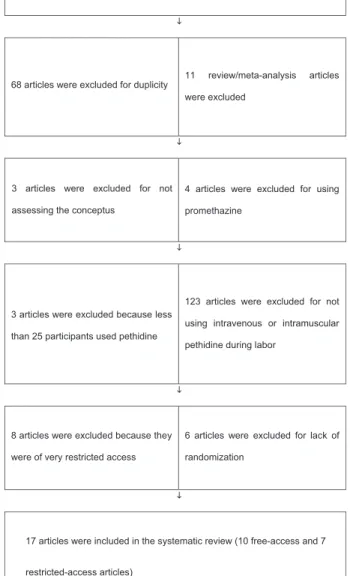
After exclusion of 68 duplicated articles, 175 were selected; of these, 11 were excluded because they were systematic reviews; 3 articles did not assess the conceptus vitality; 4 were excluded because they used promethazine; 3 studies were excluded because they had less than 25 participants; 123 articles were excluded for not using pethidine IV or IM in labor analgesia; 6 articles were non-randomized, and 8 were excluded for being of very restricted access. Finally, 17 articles were analyzed for the present review, being 10 free-access articles and 7 restricted-access articles (►Fig. 1).
243 articles in the Capes/PubMed and MEDLINE/BVS databases from 2000 to
2016
68 articles were excluded for duplicity 11 review/meta-analysis articles were excluded
not for excluded were articles 3
assessing the conceptus
using for excluded were articles 4
promethazine
3 articles were excluded because less
than 25 participants used pethidine
not for excluded were articles 123
intramuscular or
intravenous using
pethidine during labor
8 articles were excluded because they
were of very restricted access
6 articles were excluded for lack of
randomization
17 articles were included in the systematic review (10 free-access and 7
restricted-access articles)
Table 1 Analyzed articles
Author, publishing date Type of study/country
N Dose/route of administration
Neonatal outcomes
El-Refaie et al16 2012
RCT/ Egypt
120 50 mg/IV Pethidine x placebo. There were no differences in Apgar scores (7.47.7), respiratory depression, pH, and arterial blood gases of the NBs.
Khooshideh and Shahriari17 2009
RCT/Iran 80 50 mg/IM Pethidine x tramadol. All Apgar scores at 1 and 5 minutes were>7. There were 3 cases of fetal distress (2 participants had been given pethidine).
Allameh et al18 2015
RCT/ Iran
30 50 mg/IM Pethidine x acupuncture x placebo. The Apgar scores were 8/9 in the 3 groups. There were no differences in the number of NBs who passed meconium.
Yilmaz et al19 2009
RCT/ Turkey
48 50 mg/IV Pethidine x valethamate x placebo. There were no differences in the number of NBs who passed meconium or the number of Apgar scores at 1 or 5 minutes<7.
Sekhavat and Behdad20 2009
RCT/ Iran
75 50–75 mg/IM Pethidine x placebo. There was a decrease in the variability of the fetal heart rate. There were no significant adverse effects on the NBs.
Ng et al21 2011
RCT/ China
34 50–75 mg/IM Pethidine x remifentanil. The Apgar scores were 8/9. No complications were reported.
Elbohoty et al22 2012
RCT/ Egypt
50 50 mg/IV Pethidine x paracetamol. The Apgar scores at 1 minute were lower in the group using pethidine (67). All Apgar scores at 5 minutes were 9. No adverse effects or admissions to the intensive care unit were reported.
Fleet et al23 2015
RCT/ Australia
51 100 mg/IM, every 3 hours
Pethidine x fentanyl. Apgar score at 1 and 5 minutes was 9 for both groups. There was a higher number of NBs admissions to the nursery with pethidine.
Loughnan et al24 2000
RCT/ England
213 100 mg/IM, every 2 hours
Pethidine x epidural. No differences in the number of Apgar scores<9 at 5 minutes.
Keskin et al25 2003
RCT/ Turkey
29 100 mg/IM Pethidine x tramadol. The Apgar scores of both groups were>7/9. There were no differences in Apgar scores number of the respiratory depression. There were 3 cases of respiratory depression in the NBs of the participants who were given pethidine (10.3%).
Wee et al26 2014
RCT/ England
240 150 mg/IM Pethidine x diamorphine. The Apgar at 1 minute was<7 in 15% of the participants who were given pethidine, and there was need for resuscitation in 19% of the participants.
Sosa et al27 2004
RCT/ Uruguay
205 100 mg/IV Pethidine x placebo. There was respiratory depression and acidosis in the NBs whose mothers were given pethidine.
Sharma et al28 2002
RCT/ United States
207 50 mg/IVþ15 mg/IV, every 10 minute, limited to 100 mg every 2 hours
Pethidine x epidural. There were no differences in arterial blood pH between the two groups. In the group that was given pethidine, Apgar scores<7 at 1 minute were more frequent.
Sosa et al29 2006
RCT/ Uruguay
Results
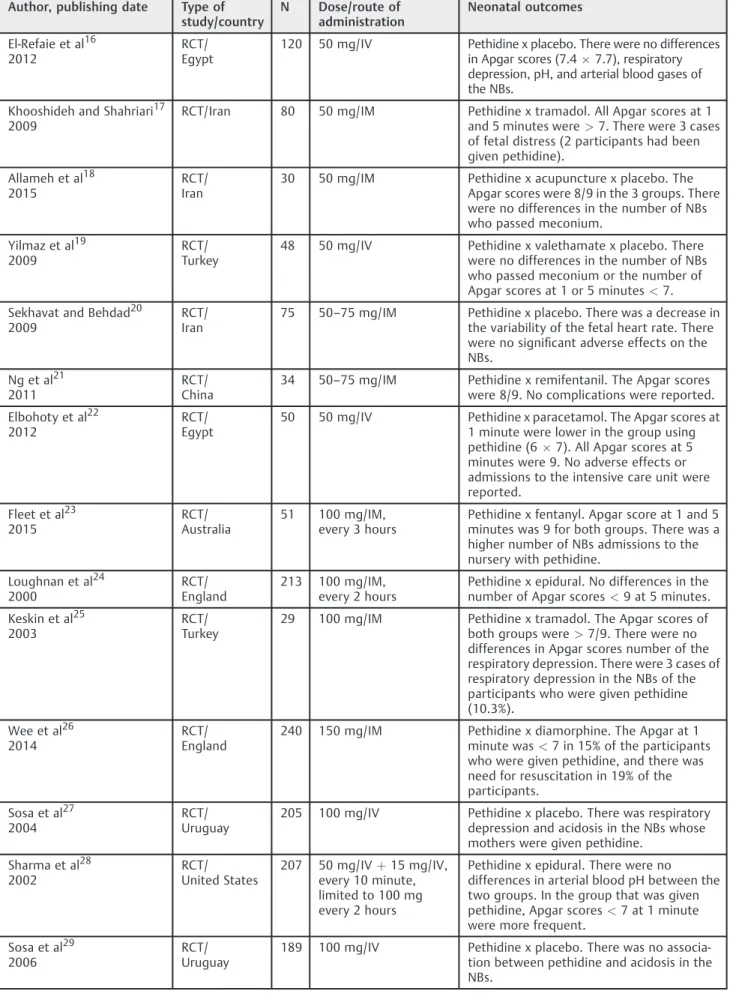
The 17 remaining articles, which included a total of 1,688 participants to whom pethidine was administered during labor, were analyzed (►Table 1). The publications were from countries located in Europe, Asia, South America, North America, Oceania and Africa. They were grouped in order according to the drug dosages administered (from the lowest to the highest dosages) to facilitate the analysis. There was a wide variation in the number of participants in each study, from 25 to 240. Seven articles compared pethidine with placebo (totaling 692 participants), and 10 articles compared pethidine with another analgesic drug (totaling 996 partic-ipants). Even when compared with other drugs, it was possible to analyze the safety of pethidine for the conceptus when it was administered during labor.
Discussion
More than 70% of the 17 studies were concentrated in Asia, Africa and Latin America (Iran: 03; Turkey: 02; Egypt: 02; China: 02; India: 01; and Uruguay: 02). Most studies involv-ing pethidine in labor analgesia are conducted in the devel-oped countries of North America or Europe. Emerging countries are more concerned in seeking options for labor analgesia.
A total of 10 articles were published in the past 7 years. The 7 articles in which pethidine was administered at a dose of 50 mg were published in the past 7 years. The articles show that currently there is a tendency to use lower doses of pethidine.
Several articles provided incomplete data for an optimal analysis. Some articles did not publish the Apgar scores; others articles did not report how many newborns required cardiopulmonary resuscitation, admission to the nursery or
intensive care unit (ICU). An ideal evaluation of newborn vitality should include at the same time: the Apgar score; the need for ventilator assistance; and an analysis of the umbili-cal vein blood, to determine the pH and the blood gases. The analysis of some of these parameters alone or partially combined may not show the correct answer to the harm caused by the use of certain medications.
During the evaluation of neonatal outcomes, the following clinical and/or laboratory criteria were used: presence of respiratory depression; need for resuscitation; Apgar score; pH; hypoxemia; and hypercapnia. Only one study used the neurological and adaptive capacity score (NACS), which is inaccurate and unreliable.33
More than one variable was used in 88% of the articles to analyze the safety of pethidine, and 82% of them used the Apgar score to assess the newborns. Although the Apgar score may have a minor subjective aspect, it is easy to use, and is widely adopted in the evaluation of newborns.
The Apgar score was devised in 1952 by Virginia Apgar, an American anesthesiologist. It consists of 5 parameters, which can receive scores from 0 to 2: pulse rate; respiratory effort; activity; reflex reaction; and skin color.►Table 2shows the parameters of the Apgar score. It is the most widely used assessment of neonatal vitality, as it is quick and easy to perform. The 1-minute Apgar score is related to birth con-ditions, and the 5-minute Apgar score regards the prognosis of the newborn. Ideally, both the 1-minute and 5-minute Apgar score must be>7.34
A study in Egypt, in which 50 mg of IV pethidine was administered to 120 pregnant women in labor, showed that there were no changes in the vitality of the newborns compared with placebo. The Apgar scores were similar, and all above 7; the pH and the arterial blood gases of the newborns were equal, and there was no record of respiratory depression. The results of this study lead us to conclude that Table 1 (Continuation)
Author, publishing date Type of study/country
N Dose/route of administration
Neonatal outcomes
Tsui et al30 2004
RCT/ China
25 100 mg/IM Pethidine x placebo. There were no differences in the pH of the umbilical vein. The number of Apgar scores<7 at 1 and 5 minutes was equal.
Douma et al31 2010
RCT/ Netherlands
53 49,5 mg/IVþ5 mg/IV, every 5 minutes
Pethidine x fentanyl x remifentanil. The Apgar scores with pethidine were 8.6/9.7. Those using pethidine had umbilical cord IV, blood with pH 5/5 minute 7.21 (0.1)-limitary and NACS 36.8 (2.1)-limitary.
Jain et al32 2003
RCT/ India
39 50–75–100 mg/IM Pethidine x epidural x tramadol. There were no differences in the Apgar scores at 1 and 5 minutes among the three groups. Umbilical cord pH was similar in all groups.
Abbreviations: IM, intramuscular; IV, intravenous; N, size of the sample who was given pethidine; NACS, neurological and adaptive capacity score (normal:>35); NBs, newborns; RCT, randomized clinical trial.
pethidine is safe at this dose and with the route of adminis-tration used.
In 6 studies in which pethidine was administered at a dose of 50 mg IV or IM, there were no significant adverse effects on the newborns, and no Apgar scores<7 were found.16–21 Only in a survey using 50 mg of IV pethidine, the Apgar score at 1 minute was 6,22 but without complications for the newborn or admissions to the ICU. Thesefindings demon-strate that pethidine, IM or IV, is safe during labor at this dose.
In studies that used more than 50 mg of pethidine, IM or IV, there was inconsistency in the results: 3 of them (totaling 117 participants) concluded it was safe;30–32and 7 studies (totaling 1,134 participants) found correlations with alter-ations in the newborn, especially respiratory depression, low Apgar scores, or need for resuscitation.23–29
The number of participants who were given 50 mg of pethidine was 437, representing 26% of the total; this reflects the preference for researches employing more than 50 mg of pethidine, especially before 2006. Ideally, we need a study comparing pethidine at 2 doses: 50 mg and>50 mg, with the same number of participants in each group.
Depending on the habits of the population, such as the frequent use of certain drugs, the metabolism of pethidine can be faster among the inhabitants of some countries. As these were multicenter studies, there may be a variation in the side effects of pethidine associated with the observed pharmacological culture in the region.
As a rule, the risk of a drug depends on the route of administration and dose used. There is no harmless drug. The risk/benefit ratio should always be taken into account before administering pethidine.
Some studies used placebo and found lower Apgar scores than others that used pethidine.16,31 This is due to the subjectivity in determining the Apgar scores in the different studies, which leads to some difficulty in comparing them.
Drugs such as pethidine should have a table listing in-creasing doses with the appearance of side effects. Thus, it would be easier to use these drugs, always taking into account their risks and benefits.
Conclusions
The administration during labor of IM or IV pethidine at low doses, of up to 50 mg, is safe for the conceptus. Doses
above>50 mg should be avoided, since they require further studies to obtain definitive evidence.
Note
This study was conducted in partnership with Universi-dade de of Fortaleza (UNIFOR), through the access granted to the digital library of the institution. The authors are part of the MSc Academic Course in Medical Sciences at UNIFOR.
References
1 Ronconi APL, Perdichizzi FS, Pires OC, Constantino E, Lopes VR, Posso IP. Dor e satisfação durante o trabalho de parto em primigestas: visão da parturiente e do obstetra. Rev Dor. 2010;11(04):277–281
2 Nilsen E, Sabatino H, Lopes MHBM. The pain and behavior of women during labor and the different positions for childbirth. Rev Esc Enferm USP 2011;45(03):557–565
3 Chestnut DH, Wong CA, Tsen LC, Kee WDN, Beilin Y, Mhyre J. Anestesia obstétrica: princípios e prática. 5a ed. Rio de Janeiro: Elsevier; 2016
4 Koren G. Medication safety in pregnancy & breastfeeding. New York: McGraw-Hill; 2007
5 Kandel PF, Spoerel WE, Kinch RAH. Continuous epidural analgesia for labour and delivery: review of 1000 cases. Can Med Assoc J 1966;95(19):947–953
6 Shahriari A, Khooshideh M. A randomized controlled trial of intravenous remifentanil compared with intramuscular meper-idine for pain relief in labor. J Med Sci 2007;7(04):635–639
7 Barnes J. Pethidine in labour; results in 500 cases. BMJ 1947; 1(4500):437–442
8 Bismarck JA. Analgesia em obstetrícia. Lisboa: Permanyer Portu-gal; 2002
9 Abu Dayyh W, El Tannir D, Mallah E, et al. Pethidine level in Jordanian women and their newborns during labor after a single intravenous dose. Int J Clin Anesthesiol. 2014;2(03):1–7
10 Freitas JF, Meinberg S. Analgesia de parto: bloqueios locorregio-nais e analgesia sistêmica. Rev Med Minas Gerais. 2009;19(03, Suppl 1):S7–S14
11 Reynolds F. Labour analgesia and the baby: good news is no news. Int J Obstet Anesth 2011;20(01):38–50
12 Minson FP, Ferracini FT, Fernandes Júnior CJ, Sardá Júnior J, Lopes ACB. Redução do uso de Petidina em hospital privado com a implantação de um programa educativo multiprofissional. Rev Dor. 2011;12(01):35–38
13 Dastur AE. Intrapartum fetal distress. J Obstet Gynaecol India 2005;55(02):115–117
14 Yaksh TL, Wallace MS. Opioids, analgesia, and pain management. In: Brunton LL, Chabner BA, Knollmann BC, editors. Goodman and
Table 2 Apgar score
Vital sign 0 1 2
Pulse rate Absent Low (below 100) More than 100
Respiratory effort Absent Slow, irregular Good, crying
Muscle tone Flaccid The presence of any bending of the ends Active movements
Reflex reaction No reaction Grimace Vigorous cry
Color Blue, pale Body pink, blue ends Completely rosy
Gilman’s the pharmacological basis of therapeutics. 12th ed. New York: McGraw-Hill; 2011. p. 481–526
15 Briggs GG, Freeman RK, Yaffe SJ. Drugs in pregnancy and lactation: a reference guide to fetal and neonatal risk. 9thed. Philadelphia: Lippincott Williams & Wilkins; 2011. Promethazine; p. 1219–20
16 El-Refaie TA, El-Said MM, Shoukry AA, Khafagy SM, El-Din AS, Badawy MM. Meperidine for uterine dystocia and its effect on duration of labor and neonatal acid-base status: a randomized clinical trial. J Obstet Gynaecol Res 2012;38(02):383–389
17 Khooshideh M, Shahriari A. A comparison of tramadol and pethidine analgesia on the duration of labour: a randomised clinical trial. Aust N Z J Obstet Gynaecol 2009;49(01):59–63
18 Allameh Z, Tehrani HG, Ghasemi M. Comparing the impact of acupuncture and pethidine on reducing labor pain. Adv Biomed Res 2015;4:46
19 Yilmaz B, Kart C, Kelekci S, et al. Meperidine versus valethamate bromide in shortening the duration of active labor. Int J Gynaecol Obstet 2009;107(02):126–129
20 Sekhavat L, Behdad S. The effects of meperidine analgesia during labor on fetal heart rate. Int J Biomed Sci 2009;5(01):59–62
21 Ng TKT, Cheng BCP, Chan WS, Lam KK, Chan MTV. A double-blind randomised comparison of intravenous patient-controlled remi-fentanil with intramuscular pethidine for labour analgesia. Anaesthesia 2011;66(09):796–801
22 Elbohoty AEH, Abd-Elrazek H, Abd-Gawad M, Salama F, El-Shorbagy M, Abd-El-Maeboud KHI. Intravenous infusion of para-cetamol versus intravenous pethidine as an intrapartum analge-sic in thefirst stage of labor. Int J Gynaecol Obstet 2012;118(01): 7–10
23 Fleet J, Belan I, Jones MJ, Ullah S, Cyna AM. A comparison of fentanyl with pethidine for pain relief during childbirth: a ran-domised controlled trial. BJOG 2015;122(07):983–992
24 Loughnan BA, Carli F, Romney M, Doré CJ, Gordon H. Randomized controlled comparison of epidural bupivacaine versus pethidine for analgesia in labour. Br J Anaesth 2000;84(06):715–719
25 Keskin HL, Keskin EA, Avsar AF, Tabuk M, Caglar GS. Pethidine versus tramadol for pain relief during labor. Int J Gynaecol Obstet 2003;82(01):11–16
26 Wee MYK, Tuckey JP, Thomas PW, Burnard S. A comparison of intramuscular diamorphine and intramuscular pethidine for labour analgesia: a two-centre randomised blinded controlled trial. BJOG 2014;121(04):447–456
27 Sosa CG, Balaguer E, Alonso JG, Panizza R, Laborde A, Berrondo C. Meperidine for dystocia during thefirst stage of labor: A rando-mized controlled trial. Am J Obstet Gynecol 2004;191(04): 1212–1218
28 Sharma SK, Alexander JM, Messick G, et al. Cesarean delivery: a randomized trial of epidural analgesia versus intravenous meper-idine analgesia during labor in nulliparous women. Anesthesiol-ogy 2002;96(03):546–551
29 Sosa CG, Buekens P, Hughes JM, et al. Effect of pethidine adminis-tered during thefirst stage of labor on the acid-base status at birth. Eur J Obstet Gynecol Reprod Biol 2006;129(02):135–139
30 Tsui MHY, Ngan Kee WD, Ng FF, Lau TK. A double blinded randomised placebo-controlled study of intramuscular pethidine for pain relief in thefirst stage of labour. BJOG 2004;111(07): 648–655
31 Douma MR, Verwey RA, Kam-Endtz CE, van der Linden PD, Stienstra R. Obstetric analgesia: a comparison of patient-con-trolled meperidine, remifentanil, and fentanyl in labour. Br J Anaesth 2010;104(02):209–215
32 Jain S, Arya VK, Gopalan S, Jain V. Analgesic efficacy of intramus-cular opioids versus epidural analgesia in labor. Int J Gynaecol Obstet 2003;83(01):19–27
33 Halpern SH, Littleford JA, Brockhurst NJ, Youngs PJ, Malik N, Owen HC. The neurologic and adaptive capacity score is not a reliable method of newborn evaluation. Anesthesiology 2001;94(06): 958–962