João Geraldo Bugarin JúniorI
Volnei GarrafaII
I Programa de Pós-graduação em Ciências da
Saúde. Universidade de Brasília. Brasília, DF, Brasil
I I Cátedra Unesco de Bioética. Universidade
de Brasília. Brasília, DF, Brasil Correspondence:
Cátedra UNESCO de Bioética Universidade de Brasília – UnB Caixa Postal 04451
70904-970 Brasília, DF, Brasil E-mail: [email protected] Received: 24/10/2005 Reviewed: 5/9/2006 Approved: 27/11/2006
Bioethics and biosafety: the
use of biomaterials in dental
practice
ABSTRACT
OBJECTIVE: To analyze the use of biomaterials in surgical procedures carried out by specialist dental surgeons, in light of the Principalist Bioethics Theory and the Individual and Collective Ethics of Responsibility.
METHODS: Dental surgeons (n=95), who were registered as specialists at the Regional Dentistry Council of Brasilia as of 2002, completed questionnaires regarding the use of biomaterials in their work. Data relating to sanitary control were collated, based on these dental surgeons’ responses and research at relevant organizations.
RESULTS: All of the professionals in the survey used biomaterials on a regular basis; 45% believed their use to be risk-free for patients, and 48% did not classify biomaterials as drugs. About 70% of professionals trust the source of the biomaterials even though membranes and bones are the items most commonly bought from individual suppliers. Nonetheless, 96% of interviewees believed that government sanitation agencies should regulate more. More than half of the professionals (51%) pointed to little or no participation by the patient in the process of therapeutic choice. A copy of the informed consent form was provided by 12% of the dental surgeons interviewed produced.
CONCLUSIONS: The results showed that the professionals use biomaterials without knowing about related risks and adverse side effects, contrary to the principle of benefi cence. Government agencies and professional bodies alike do not show evidence of observing public responsibility ethics. Informed consent is not yet integrated fully into professional practice and the doctor-patient relationship in dentistry remains markedly vertical.
KEYWORDS: Bioethics. Biosafety. Biomaterials. Dentistry.
INTRODUCTION
Signifi cant advances in the use of biomaterials in clinical dentistry over the last decade mean that these materials are now used as powerful therapeutic tools in surgical procedures, particularly in the correction of bone defects.3 However,
in spite of these proven benefi ts, the use of biomaterials requires the dental professional to take great care, both clinically and ethically, in analyzing the risks and benefi ts that may come with the use of biomaterials.
Anthropological and archeological studies show that primitive communities were concerned with dental prosthetics. A human jaw bone of Mayan origin dating from the 7th Century AD was found to contain three small fragments of
as a replacement for lost teeth, without knowing the biological consequence. This empirical practice con-tinued throughout the Middle and Modern Ages, when dentistry was considered to be essentially the work of craftsmen, without any scientifi c basis.
However, developments in biotechnology that began in the 1950s and have gathered speed in recent years have given rise to signifi cant advances in dentistry and increased the scope of work of dental surgeons and reinforced the discipline as a science. At the same time, the responsibility of the dental professional has increased and he or she is now required to keep up to date with new areas of research.4
In today’s globalized world, scientifi c discoveries are introduced and swiftly absorbed into clinical practice. In dentistry, new products are launched daily, most of which are used in dental surgery. When these products are used, they come into direct contact with living tissues, such as dentin, pulp, the alveolar bone and periodontal tissue, and sometimes stay in contact for prolonged periods.
Biomaterial is defi ned, in the broader sense, as any pharmacologically inert material that is capable of interacting with a living organism without causing adverse reactions either at the site of the implant or across the whole organism.9 The treatment with dental
biomaterials of gum, mucosal and hard tissues, repre-sents a therapeutic risk that can only be contained if the dental professional has knowledge of the qualities, strengths and properties of the products.
The use of biomaterials without any recognized criteria for biosafety not only causes clinical problems such as therapeutic failure, but also gives rise to ethically con-fl icting situations. This is because the patient may un-dergo treatment without knowing about the subsequent risks, either to himself or to the dental professional.4
Schramm* (1998) defi nes biosafety as “the series of actions aimed at preventing, minimizing or eliminating the risks involved in activities such as research, produc-tion, teaching, technological development and service provision, risks that could jeopardize good health, the environment or the quality of work under development”. Both bioethics and biosafety are concerned with the probability of risks, with negative impacts on the qual-ity of life of individuals and populations and with the adoption of new practices. However biosafety quanti-fi es and measures risks and benequanti-fi ts, while bioethics analyses the rational arguments which justify or fail to justify such risks.
The Principlist theory of bioethics, proffered by Beau-champ & Childress1 (2001) in “Principles of
Biomedi-cal Ethics”, has become the prime theoretiBiomedi-cal basis for the new fi eld of biomedical ethics. It applies a system of principles – autonomy, benefi cence, non-malefi cence and justice – to the area of medical care in everyday situations involving professional-patient relations.
The speed of medical and technological advances means that the work of health care professionals involved in the area of new biomedical discoveries requires more careful ethical consideration.6 It is in this context that
bioethics appears as a new fi eld of study and refl ection in morals and ethics, involving different developments and subjects. Its focus is on the conduct of the health professional, in relation to citizenship and human rights, in contexts of time and space where people fi nd themselves vulnerable, both in terms of their access to and search for health care.
Muñoz & Fortes** (1998) argue that the patient has the moral right to be given explanations about the na-ture and objectives of procedures, be they diagnostic, preventive or therapeutic. In the same way, the patient should be informed about the invasiveness, length of treatment, benefi ts, likely discomfort and potential physical, psychic, economic and social risks that could be involved. The health care professional should offer possible alternatives to treatment, where available. The person needs to be informed about the presumed effectiveness of the proposed course of action, and the probability of any changes in levels of pain, suffering and pathological conditions. In other words, he or she should be clearly supplied with the information required to make informed decisions.
Graham & Harel-Raviv6 (1997) explain that informed
consent is a fundamental instrument in the process of communication between the patient and health profes-sional. With this in mind, the present article sets out to analyze the use of biomaterials in dentistry with respect to criteria such as use, risks, origins, commercializa-tion, sanitary control and participation of the patient in therapeutic choice.
METHODS
The use of biomaterials by dental surgeons was ana-lyzed, in relation to biosafety measures and in light of the Principlist Theory of Bioethics (Beauchamp & Childress1 2001) and the Ethics of Individual and
Col-lective Responsibility (Jonas7 1990; Garrafa5 1995).
* Schramm FR. Bioética e biossegurança. In: Costa SIF, Garrafa V, Oselka G. (orgs.). Iniciação à Bioética, Conselho Federal de Medicina, Brasília, 1998, p.217-230.
The specializations in which biomaterials are most used in professional practice were chosen. It was decided that the study would include all specialists who work in these areas and who have registered as specialists at the Regional Dentistry Council of the Federal District (CRO-DF in the Portuguese) as of 2002.
Once the study group had been determined, criteria for inclusion were established, as follows: participants should be specialists in periodontology, dental implants and buco-maxillofacial surgery and traumatology, and agree to partake independently in the research by sign-ing the terms of informed consent.
Of the original 123 dental surgeons working in the aforementioned specializations and included in the offi cial list provided by CRO-DF, 28 professionals were excluded from the study for one or more of the following reasons: their place of residence was not Brasilia, their current address was not available through the CRO-DF, or they did not agree to participate in the research. Therefore the total number of participants was 95 professionals, which equates to 77.2% of the total study sample.
To gather data, an interview questionnaire was drawn up, containing 13 questions, of which nine were closed and four open.
The aim of the fi rst set of questions was to gather infor-mation on the profi le of the professional involved in the research, with regard to sex, age, length of education, specialization and period of time operating as a regis-tered specialist. Other questions included: information about the patient’s participation in therapeutic planning, by means of use of the terms of consent; notions of risk and biological effects in the use of these materials on patients; and details about the biomaterials most used in their professional practice.
The questionnaire was designed to gather data on the degree of concern displayed by the professional in relation to the origin, quality, regulation and source of the biomaterials. To close, the fi nal question sought to examine once gain the notion of risk in the use of biomaterials, by means of an open question, so that the professional could freely express his or her opinion.
In the fi rst instance, the questionnaire was applied to a pilot sample of ten professionals, chosen at random from the entire sample, in order to analyze the appli-cability, clarity and appropriateness of the proposed objectives. Since no changes to the questionnaire were subsequently necessary, the pilot sample was used in the fi nal study. A group of ten dental students received training and guidance on the use of the questionnaires for the rest of the group under study, with supervision provided by the researcher at all times.
Measures for regulation, standardization or surveillance of the use of biomaterials on the part of governmental authorities or professional-level councils, were evaluated by searching for information in the publications of these organizations and on the web-sites of each institution.
The elements relating to safety and regulation of these materials were evaluated by means of an analysis of the responses given by interviewees in the questionnaire.
The project was submitted to the Committee on Re-search Ethics at the Faculdade de Ciências da Saúde of the Universidade de Brasilia, so as to assess the ethics and the technical and scientifi c content of the research, with approval subsequently being granted. Participants in the study signed informed consent forms.
RESULTS
There was a predominance of male specialists (75%), with the majority aged between 29 and 39, and hold-ing between 11 and 20 years of experience (52%). The largest group was of periodontists (45%), with between 6 and 10 years of experience as specialists (36%).
The majority (51%) of dental surgeons reported using the terms of consent with the patient in their consul-tations. Of these, only 12% produced copies of this document, when asked.
Table 1. Numbers and Proportions of specialists who consider
biomaterials to be a medicine. Federal District, Brazil, 2002.
Response N %
Yes 41 43
No 45 47
Do not know 7 8
Blank 2 2
Total 95 100
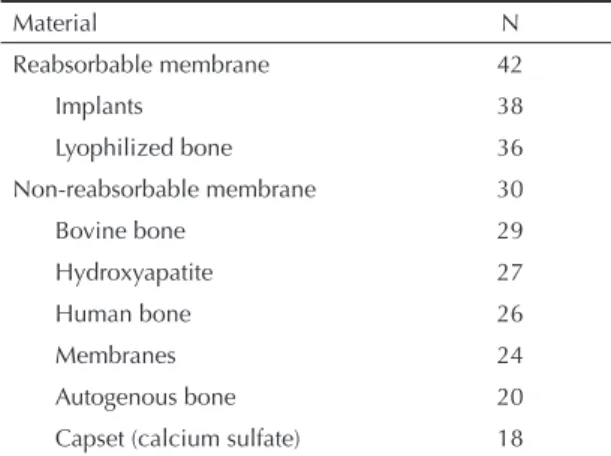
Table 2. List of materials most frequently cited by specialists.
Federal District, Brazil, 2002.
Material N
Reabsorbable membrane 42
Implants 38
Lyophilized bone 36
Non-reabsorbable membrane 30
Bovine bone 29
Hydroxyapatite 27
Human bone 26
Membranes 24
The results show that the professional practice of these specialists is essentially paternalistic: more than half (51%) pointed to little or no participation on the part of the patient in the process of therapeutic choice (Table 4).
In relation to the notion of risk to the patient in the use of these biomaterials, 55% of dental surgeons believed there to be some form of risk to the patient. The most frequently mentioned were: infection, contamination, transmission of disease, rejection, incorrect manipula-tion, allergic reactions, ineffi ciency and manufacturing defects.
DISCUSSION
Analysis of the results allowed for further refl ection about the use of biomaterials by specialists.
The origins of the materials are diverse, primarily due to the fact that a large variety of membranes and lyophilized bone of bovine origin are available on the Brazilian market. Among the animal biomaterials are bone morphogenetic protein and lyophilized bone; among the synthetic biomaterials are hydroxyapatite and calcium sulfate. The use of biomaterials that are of animal and synthetic origin can largely be attributed to the fact that the Brazilian Constitution* forbids the sale and use of materials of human origin. Furthermore, Law 9434 of 4 February, 1997, which relates to the donation of organs and accompanying procedures, establishes penalties and fi nes for any kind of sale of human organs or tissues in Brazil.
For Berlinguer & Garrafa2 (2001), in future there will
be a shift away from the use of human biomaterials towards xenograft, as a result of shortages in the global supply of human bones. However, there remain many doubts about the relationship between cells from dif-ferent species. Much polemic surrounded the proposal to use the organs of animals that had been genetically treated, due to long-term effects, principally in the fi eld of immunology. 2
The biomaterials most commonly referenced by import companies are implants manufactured in other coun-tries and lyophilized human bone. The lack of a bank of human bones for commercial purposes in Brazil, similar to those that already exist in the United States, Singapore, Hong Kong and elsewhere, has meant that there has been a growth in the number of companies importing lyophilized human bone.
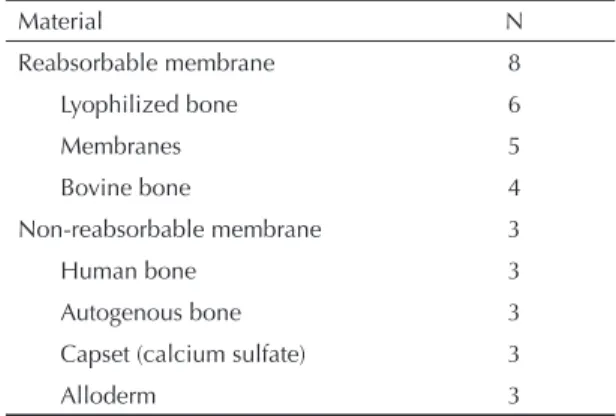
Among the materials that dental surgeons most fre-quently purchase from independent suppliers, are also reabsorbable membranes and lyophilized bone
Table 3. Total number of materials most frequently
purcha-sed from independent suppliers by dental surgeons. Federal District, Brazil, 2002.
Material N Reabsorbable membrane 8
Lyophilized bone 6
Membranes 5
Bovine bone 4
Non-reabsorbable membrane 3
Human bone 3
Autogenous bone 3
Capset (calcium sulfate) 3
Alloderm 3
Table 4. Total numbers and proportion of specialists,
accor-ding to level of patient participation in the choice of materials. Federal District, Brazil, 2002.
Patient participates in choice N %
Always 22 23
Usually 21 22
Occasionally 27 29
Never 21 22
Blank 4 4
Total 95 100
* Federal Constitution of Brazil, Title VIII – on Social Order – Ch.II – section II – on health – article 100 – clause 4. Nearly 47% of those interviewed did not consider
biomaterials to be a form of medication.
The 10 most commonly used materials are presented, in descending order, in Table 2. The most frequently cited were membranes, implants and lyophilized bone graft material.
The materials most frequently purchased by dental practices and bought directly from independent suppli-ers were membranes and bones; those purchased from import companies were implants and bones (Table 3). Implants are the material most commonly purchased directly from the factory, particularly from domestic suppliers; of materials purchased abroad, titanium screws and plates were most commonly mentioned. Seventy percent of professionals said that they trusted the source of these materials.
(Table 4). This fi nding gives cause for concern since of all possible sources, independent suppliers are indeed the least likely to control the quality of the origin of such materials.4 Many of the biomaterials and
equip-ment that have North-American patents are produced in developing countries, such as Taiwan, Korea, Indonesia and others, where a large proportion of the labor force is cheap and unqualifi ed. Outside of the USA, without regulation of the hygiene of their sources, these materi-als are not covered by the strict controls established by the Food and Drugs Administration (FDA).4 The risks
inherent in the use of biomaterials are minimized by means of biological processing during their prepara-tion.9 If the professional uses biomaterials of doubtful
origin or those that are sourced locally without hygiene controls, the biological risks to the patient increase and the procedure risks falling short of the principle of benefi cence. Above all, protection of the patient is the primary objective both of bioethics, through the principles of benefi cence and non-malefi cence, and of biosecurity with a view to prevent and avoid risks. Nonetheless, quality control of materials becomes fundamental.
From the perspective of the Principlist Theory of Bio-ethics, one notes that the principle of patient autonomy is frequently ignored. Most interviewees stated that the patient rarely or never participated in the decision about treatment. The use of terms of informed con-sent has not yet been incorporated into professional practice. The lack of patient participation was also noted in recent research that assessed the records of dental implant specialists in São Paulo and found that 50% of interviewees did not consider it important to pass on information about treatment to their patients.8
These fi ndings show that the patient’s autonomy is not respected, and that the use of informed consent forms has not yet been incorporated into professional practice, suggesting that the professional-patient relationship in dentistry is still excessively vertical.
Findings showed that dental professionals are not aware of the risks and benefi ts of biomaterials, nor of their biological origins, with 45% believing that there was no risk at all for the patient, and 56% do not consider biomaterials to be a medicine. However, even if the biomaterials are thought to be inert, they will come into contact with the oral cavity and be subjected to
the mechanical process of chewing, which may result in biological interactions.
This lack of knowledge on the part of dental surgeons calls for a review of professional conduct. By using materials without appropriate knowledge or by not following the biosafety principles inherent in their use, the dental surgeon goes against the principle of benefi cence. Furthermore, he or she possibly fails to abide by the principle of non-malefi cence (primum non
nocere – above all, do no harm).
For Jonas7 (1990), it is necessary for ethical reasoning to
advance at the same pace as scientifi c and technological progress. The freedom to generate and use new knowl-edge must show a direct relationship with responsibility – both individual and public – in the process of scientifi c discovery and its consequences.
By pointing to a compromise in the ethics of public responsibility, the lack of appropriate controls has been highlighted. This is because the review of the abovementioned biomaterials for the purposes of registration is purely a formality, and does not involve biological tests. In addition, this ethical compromise was not referred to by professional bodies such as the dentistry councils, whose legal role it is to promote, using all available means, the highest technical and moral standards in dentistry. Dental professionals are not provided with any guidance or norms for the use of biomaterials in Brazil.
The results show that 96% of dental surgeons recognize the need for regulation in the use of these materials. This leads to the conclusion that professionals do not feel secure about the control and regulation of these products in Brazil, or that they are unaware of the actions of the Brazilian Ministry of Health, through the Agência Nacional de Vigilância Sanitária (Anvisa – National Agency for Health Surveillance). Although some materials are registered at Anvisa, no measures or guidelines for their use were found within the federal and regional dental councils.
For this reason, the monitoring of their sale, use and scope by professionals, authorities and of all society is fundamental, as is, most importantly, the creation of a robust policy for health surveillance of these products.
1. Beauchamp TL, Childress JF. Principles of biomedical ethics. 5ª ed. New York: Oxford University Press; 2001.
2. Berlinguer G, Garrafa V. O mercado humano: estudo bioético da compra e venda de partes do corpo. 2ª ed. Brasília (DF): UnB; 2001.
3. Garbin CM, Garbin NM. Enxertos ósseos e regeneração tecidual guiada: noções básicas. São Paulo: Pancast; 1994.
4. Garrafa V. Bioética e odontologia. In: Kriger L, organizador. Promoção de saúde bucal. São Paulo: Artes Médicas; 2003. p. 495-504.
5. Garrafa V. Novos paradigmas da saúde - a ética da responsabilidade: individual e pública. Saúde Debate. 1995;48:47-50.
6. Graham EP, Harel-Raviv M. The future of informed consent and patient-dentist communication. J Can Dent Assoc. 1997;63:460-3.
7. Jonas H. Il princípio responsabilitá. Torino: Einaudi; 1990.