O
RIGINAL
A
R
TICLE
Burden on caregivers of elderly victims of
cerebrovascular accident
*SOBRECARGA DOS CUIDADORES DE IDOSOS COM ACIDENTE VASCULAR CEREBRAL
SOBRECARGA DE LOS CUIDADORES DE ANCIANOS CON ACCIDENTE CEREBROVASCULAR
Roberta Amorim Pereira1, Emanuella Barros dos Santos2, Jack Roberto Silva Fhon3,
Sueli Marques4, Rosalina Aparecida Partezani Rodrigues5
* Taken from the course conclusion monograph “Sobrecarga dos cuidadores de idosos com acidente vascular cerebral”, University of São Paulo at Ribeirão Preto College of Nursing, 2011. 1 Undergraduate Nursing Student, University of São Paulo at Ribeirão Preto College of Nursing. Ribeirão Preto, SP, São
Paulo. [email protected] 2 Master’s student in Nursing, University of São Paulo at Ribeirão Preto College of Nursing. Ribeirão Preto, SP,
Brazil. [email protected] 3 M.Sc. in Nursing, University of São Paulo at Ribeirão Preto College of Nursing. Ribeirão Preto, SP, Brazil. beto_unw@hotmail.
com 4 Ph.D. in Nursing. General and Specialized Nursing Department, University of São Paulo at Ribeirão Preto College of Nursing. Ribeirão Preto, SP,
Brazil. [email protected] 5 Full Professor, University of São Paulo at Ribeirão Preto College of Nursing. Ribeirão Preto, SP, Brazil. [email protected] RESUMO
O obje vo deste estudo foi avaliar a sobre-carga dos cuidadores de idosos com aci-dente vascular cerebral (AVC), assim como correlacioná-la com as horas de cuidado, a idade e a independência funcional dos idosos. Trata-se de estudo transversal feito com 62 idosos com AVC e seus cuidadores. O instrumento con nha variáveis sociode-mográfi cas e econômicas, Mini-Exame do Estado Mental, Medida da Independência Funcional (MIF) e a Escala de Zarit. A pos-sível correlação entre os escores da escala de Zarit e as outras variáveis foi avaliada por meio do Coefi ciente de Correlação de Pearson. A maioria dos cuidadores era adultos, fi lhos, casados e do sexo feminino. A média do escore de Zarit foi 34,92 (15,8). A MIF apresentou correlação nega va com a sobrecarga do cuidador, porém, não houve correlação com a idade e as horas de cuidado. A sobrecarga da maioria dos cuidadores variou de moderada a severa e parece estar relacionada ao nível de inde-pendência funcional dos idosos.
DESCRITORES Idoso
Acidente vascular cerebral Cuidadores
Enfermagem geriátrica ABSTRACT
The aim was to assess the burden on care-givers of elderly vic ms of cerebrovascular accident (CVA) and to correlate it with care hours, the elderly people’s age and
onal independence. This cross-sec onal study counted the par cipa on of 62 el-derly individuals with CVA and their care-givers. The instrument used contained so-cio-demographic and economic variables, the Mini-Mental Status Examina on, the Func onal Independence Measure (FIM) and the Zarit Scale. The possible
ons between the Zarit scale scores and the other variables were assessed using Pearson’s Correla on Coeffi cient. Most caregivers were adults, children of the
ms, married, and female. The mean Zarit score was 34.92(15.8). The FIM showed a nega ve correla on with caregiver burden, but no correla on with age and number of care hours. The burden on most of the caregivers ranged from moderate to se-vere and seems to be related to the level of func onal independency of the elderly. DESCRIPTORS
Aged Stroke Caregivers Geriatric nursing
RESUMEN
Se obje vó evaluar la sobrecarga de cui-dadores de ancianos con accidente cere-brovascular (ACV), y correlacionarla con horas de cuidado, edad e independencia funcional de los ancianos. Estudio trans-versal con 62 ancianos con ACV y sus cuidadores. El instrumento contenía va-riables sociodemográfi cas y económicas, Mini-Examen del Estado Mental, Medida de la Independencia Funcional (MIF) y la Escala de Zarit. La posible correlación entre los puntajes de la escala de Zarit y las otras variables fue evaluada por Coefi -ciente de Correlación de Pearson. La ma-yoría de los cuidadores eran adultos, hijos, casados y de sexo femenino. El promedio de puntaje de Zarit fue 34,92 (15,8). La MIF presentó correlación nega va con la sobrecarga del cuidador, sin embargo no hubo correlación con edad y horas de cui-dado. La sobrecarga de la mayoría de los cuidadores varió entre moderada y seve-ra, y parece relacionarse con el nivel de independencia funcional del anciano. DESCRIPTORES
Anciano
Accidente cerebrovascular Cuidadores
INTRODUCTION
Among non-transmissible chronic illnesses, cerebro-vascular accident (CVA) is a frequent neurological syn-drome in adults and the elderly and represents one of the
primary causes of morbidity and mortality in the world(1).
Its incidence levels increase a er the age of 65 years, and the risk rates increase with age and double every decade a er the age of 55 years. CVA is the primary cause of func onal disability, preceded only by cardiovascular
ill-nesses and cancer(2).
Because CVA provokes sequelae and relevant limita ons in survivors, it is the most common cause of func onal
disabil-ity in the Western world(2). Its global prevalence in the general
popula on ranges from 0.5% to 0.7%(2). Approximately 50% of
the CVA popula on survives and requires nursing supervision a er hospital discharge, o en in primary healthcare, which demands orienta on and care to adapt to the new lifestyle that the disease imposes. However, approximately 20% of CVA vic ms die within one month a er the
ac-cident. An addi onal 30% survive and, despite
certain neurological defi cits, they remain able
to live independently(2-3).
Sta s cians es mate that approximately two million people survive CVA and have a disability, 40% of whom need help with daily
ac vi es(4). A er hospitaliza on, elderly CVA
vic ms o en return home with physical, cog-ni ve and behavioral sequelae that compro-mise their func onal abili es, independence and autonomy. These social and economic
limita ons aff ect all aspects of their lives(5).
A er hospitaliza on, 80% of CVA survivors return to the community. However, they con nue to demand special care. The family generally provides this care in Brazil, given
Brazilian culture and socioeconomic condi ons(6).
Changes in the dynamics of these pa ents’ lives can occur as a result of the disabling sequelae of CVA. These changes include restric ons in daily ac vi es such as those related to physical movement, cogni on and decision-making concerning the lives of one’s self and one’s family.
In this context, caregivers emerge as important people with regard to care delivery and pa ent rehabilita on. The caregiver is responsible for performing the tasks that the pa ent injured by CVA is no longer able to do. Moreover, they compensate for the pa ent’s temporary or permanent func onal disability.
Two types of caregivers exist. Formal caregivers are hired by
the elderly, their family or both to give care. These
caregiv-ers establish a job contract. Informal caregivers are family
members or acquaintances (e.g., friends, neighbors or church
members among others) of the elderly who provide care(7).
Most caregivers of elderly CVA vic ms are informal because
the family is historically responsible for caring for itself(7). Due
to the increased number of chronic illnesses in the elderly, this
circumstance is enhanced by a lack of fi nancial resources to
hire a homecare company or a private professional.
The prolonged illness of a family member is a stressful situa on and threatens the normal balance of personal, family and social func oning. Informal caregivers (IC) are subject to problem situa ons due to adverse condi ons and a lack of immediate problem-solving abili es, which can lead to a state of psychosocial disorganiza on that is frequently accompanied by nega ve feelings such as fear, guilt and anxiety. When this state of discomfort and tension occurs over a long period, these individuals tend to adopt new response modes to overcome the crisis, which can lead to an unhealthy adjustment to nega ve emo ons, thereby
causing caregiver burden(8).
IC burden is a disorder that results from coping with the physical dependence and mental disability of the indi-vidual receiving a en on and care. The care process for an elderly or dependent family member, which is con nuous and almost always irreversible,
includes fi ve crisis situa ons: the awareness
of degenera on, unpredictability, me
limi-ta ons, the aff ec ve rela onship between
the caregiver and the target of care and the
lack of alterna ve op ons(9).
Due to increased life expectancy and, consequently, the greater number of dis-abling condi ons (and the omnipresence of caregivers), knowledge of IC burden must guide nursing ac on planning that is focused on the caregivers of elderly pa ents.
Thus, this study assessed the rela onship between the burden of the ICs of elderly CVA vic ms and care hours, pa ent age and func onal independence.
METHODS
This cross-sec onal and quan ta ve study examined elderly CVA vic ms and their ICs. These par cipants (62 elderly adults and their respec ve ICs) were recruited between January and December 2010 at the Emergency
Unit of the Ribeirão Preto Medical School Hospital das
Clínicas (HCFMRP) using the registers of the Medical Filing
Service (SAM). Next, the elderly vic ms were contacted by telephone to schedule interviews at their homes. Nurses collected data at the pa ents’ homes using an interview between January and June 2011.
The inclusion criteria for the elderly par cipants were an age of 60 years or older, a medical diagnosis of (ischemic or hemorrhagic) CVA, a return home a er hospital discharge, residence in Ribeirão Preto, SP and care from an IC. The inclusion criteria for the caregiver were an age of 18 years or older and being the elderly pa ent’s IC.
Due to increased life expectancy and,
consequently, the greater number of disabling conditions (and the omnipresence
of caregivers), knowledge of IC burden must guide nursing action planning
that is focused on the caregivers of elderly
The instrument consisted of four sec ons. The fi rst
on iden fi ed par cipant sociodemographic and economic
variables (i.e., age, gender, family income, marital status and educa on) using a standardized ques onnaire.
The second sec on used the Mini-Mental State Exami-na on (MMSE) to evaluate the pa ent’s cogni ve status. This scale consists of ques ons grouped in seven cogni ve domains, such as me orienta on, spa al orienta on, three-word register, a en on and calcula on, remembering three words and language and visual construc ve capacity.
The cut-off points were based on educa on level, with 12
deno ng illiterate par cipants, 18 represen ng low (1-3 years) and average (4-7 years) educa on levels and 16
de-no ng a high educa on level (8 years or more)(10).
The third sec on used the Func onal Independence Measure (FIM) to assess pa ent func onal independence. This scale measures the level of assistance that the pa ent requires to accomplish daily motor and cogni ve ac vi es. The scale consists of 18 items distributed across the following domains: self-care, sphincter control, transfers, locomo on, communica on and social cogni on. Each item is scored between 1 and 7, where 1 denotes complete dependence, 2 represents maximum dependence, 3 is moderate depen-dence, 4 is minimum dependepen-dence, 5 represents supervision,
6 denotes modifi ed independence (technical help), and 7
denotes complete independence. The total score, which characterizes the pa ent independence level, ranges
be-tween 18 and 126 points(11).
The fi nal sec on of the instrument uses Zarit’s Caregiver
Burden Scale to evaluate the IC’s burden. This scale includes 22 items that assess the health as well as the psychological and socioeconomic wellbeing of the primary caregiver and his or her rela onship with the pa ent. Each item consists
of a statement that is scored according to the frequency of its occurrence: 0 (never), 1 (hardly ever), 2 (some mes), 3 (almost always), and 4 (always). The total score is calculated by adding all the items, and it ranges from 0 to 88. High
scores denote large caregiver burdens(12).
The data collec on procedures began a er the project received approval from the Ethics Commi ee at the Ribeirão Preto Medical School Hospital das Clínicas (HCFMRP) in Au-gust 2010 (process 7735/2010). This approval was in com-pliance with Na onal Health Council Resolu on 196/1996, which sets the guidelines for human subject research.
The data were compiled in an Excel worksheet using double entry to validate the scores and detect inconsis-tencies. Next, the data were imported into the Sta s cal Package for Social Sciences (SPSS) for Windows version 15.0. Descrip ve sta s cs were determined for all variables, including the means and standard devia ons of the ta ve variables. The rela onships among the Zarit scale scores, FIM, pa ent age, care hours per week, and care hours during the weekends were evaluated using Pearson’s
correla on coeffi cient. Signifi cance was set at 5%.
RESULTS
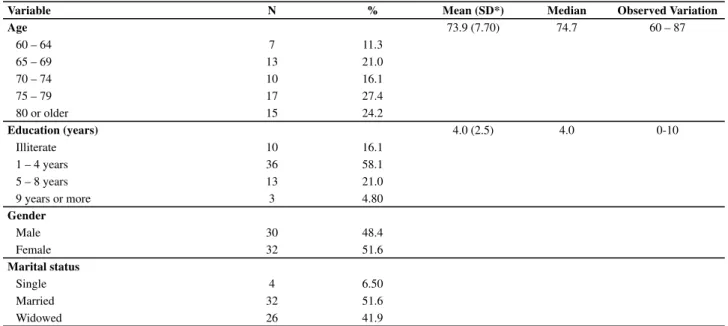
Table 1 presents the pa ent sociodemographic charac-teris cs. Elderly individuals aged 75 years or older (51.6%) predominated. The age of the sample ranged between 60 and 87 years, and the mean age was 73.9 (7.70) years. The majority of pa ents had between 1 and 4 years of educa on, with an overall mean of 3.95 years (2.50). Most pa ents were female and married. Thirty-nine pa ents
(62.9%) presented cogni ve defi cits according to the MMSE
cogni ve status evalua on.
Table 1 - The age, education, gender, marital status and domestic structure of elderly CVA victims who had attend a public hospital - Ribeirão Preto, 2011
Variable N % Mean (SD*) Median Observed Variation
Age 73.9 (7.70) 74.7 60 – 87
60 – 64 7 11.3
65 – 69 13 21.0
70 – 74 10 16.1
75 – 79 17 27.4
80 or older 15 24.2
Education (years) 4.0 (2.5) 4.0 0-10
Illiterate 10 16.1
1 – 4 years 36 58.1
5 – 8 years 13 21.0
9 years or more 3 4.80
Gender
Male 30 48.4
Female 32 51.6
Marital status
Single 4 6.50
Married 32 51.6
Widowed 26 41.9
The social profi le of the ICs is displayed in Table 2. Despite
the predominance of young adult caregivers, it is noteworthy that many caregivers were elderly. The family rela onship
between the caregivers and the pa ents was equally distrib-uted between children and partners, and most caregivers were female. The mean caregiver age was 56.3 (12.5) years.
Table 2 - The age, education, gender, marital status and family relationship of elderly CVA victims at a public hospital - Ribeirão Preto, 2011
Variable N % Mean (SD*) Median Observed Variation
Age (in years) 56.3 (12.5) 57 27 – 79
27 – 59 33 53.2
60 or older 29 46.8
Education (years)
Illiterate 1 1.60
Able to read and write 1 1.60
1 - 4 years 21 33.9
5 - 8 years 19 30.6
9 - 12 years 11 17.7
13 years or older 9 14.5
Gender
Male 10 16.1
Female 52 83.9
Marital status
Never married or lived w/ partner 13 21.0
Married 42 67.7
Separated/divorced 5 8.10
Widowed 2 3.20
Family relationship
Husband/wife 25 40.3
Son/daughter 26 41.9
Sibling 3 4.80
Grandchild 1 1.60
Son-/daughter-in-law 5 8.10
Others 2 3.20
*SD = Standard Deviation Note: (n= 62)
Figure 1 displays the distribu on of Zarit Scale caregiver burden scores, which ranged between 5 and 67 points, with a mean of 34.9 and a standard devia on of 15.8. Approxi-mately 40% of the caregivers scored 44 or higher, which denotes a moderate to high burden.
Table 3 displays the correla ons between caregiver burden and the pa ent variables. The func onal indepen-dence of the pa ents with regard to the motor and cogni ve domains was nega vely correlated with caregiver burden, which suggests that higher levels of burden are associated with elderly pa ents with greater dependence. However, no correla on was observed between caregiver burden and either pa ent age or care hours.
Figure 1 - Box-plot of caregiver´s Zarit Caregiver Burden Scale scores - Ribeirão Preto, 2011
Escore da Escala de Zarit
DISCUSSION
The data collected with regard to the age, gender and marital status of most elderly CVA vic ms in this study are
in line with another study(13) that emphasized that advanced
age is a risk factor for CVA because the incidence of this
morbidity more than doubles over decades and aff ects
more women than men. Being married predicts that the partner will serve as the caregiver to elderly CVA vic ms.
Most of the elderly pa ents in that previous study
were illiterate(13); however, in a diff erent study(5), 45.4%
of the elderly pa ents could read and write. In this study, an educa on level between 1 and 4 years predominated, which characterizes a sample with a low educa on level.
This fi nding, which is associated with socioeconomic and
cultural factors, might contribute to the appearance of the disease because it hampers an awareness of healthcare needs, treatment adherence, the maintenance of a healthy lifestyle and the preven on of risk factors.
In addi on to educa on, cogni ve status is of fundamental importance to the understanding, adherence and self-care abili es of elderly pa ents. The MMSE data revealed that most
elderly pa ents (62.9%) suff ered cogni ve defi cits. This result
is in line with the fi ndings of a study(14) that found a high
preva-lence of cogni ve defi cits in pa ents up to three years a er the
CVA. Hence, the high percentage cogni ve defi cits observed in
this study might derive from CVA sequelae, which commonly involve memory, orienta on, language and a en on. Another
factor that contributes to cogni ve defi cits is advanced age;
in this study, 51.6% of the pa ents were at least 75 years old.
All interviewed caregivers were ICs who usually iden fi ed
themselves as the primary caregivers (i.e., they were respon-sible for the elderly and most of their daily tasks). In general, the IC was a rela ve or friend, which is a common prac ce in 80% to 90% of the situa ons in which the self-care abili es of an elderly pa ent have been compromised. One
cross-sec onal study with a qualita ve approach(6) described the
predominance of these characteris cs in the caregiver profi les.
A signifi cant number of caregivers were elderly (75 years
or older). A similar situa on was observed in another study(6).
Advanced age can be a cause for concern in the care process because these caregivers can experience physical and
onal limita ons due to the advanced aging process.
The majority of caregivers was female, underlining the caregiving role of women in Brazilian culture. Historically, women have been responsible for care, whether for the home or the children, whereas the role of men is to work and provide the family’s income. Despite recent social and
family composi on changes and the new roles that women have assumed (including a greater par cipa on in the job market), women are s ll expected to serve as caregivers. Hence, women commonly take charge of care even when they have another job. This prac ce reduces their free me
and aff ects their social life. In general, men par cipate in care
secondarily through fi nancial help or external tasks such as
transpor ng the pa ent and paying bills(6-7).
Caregiver marital status also requires a en on. The
cur-rent fi ndings revealed that most caregivers, whether they
were the children or partners of the pa ents, were married. This factor can be posi ve and facilitate and support certain caretaking ac vi es, or it can be nega ve when it causes a burden for the caregiver due to an accumula on of roles.
The caregiver educa on level is relevant because they receive informa on and orienta on from the health team and accompany the elderly pa ents to health services. Educa on
level can infl uence caregiver feelings; specifi cally, a low
edu-ca on edu-can hamper an understanding of what is happening to the pa ent. However, caregiver feelings derive from a complex
interac on of factors that extend beyond informa on(6).
In line with the present fi ndings, other authors(16) have
emphasized that the responsibility for care is transferred to the children when the partner passes away or is unable to perform this role. Those authors add that a rela onship of obliga on exists that derives from the values imposed by family culture; that is, caregiving is a moral obliga on. When the caregivers are children, their parents take care of them; thus, when parents become dependent, children should take care of their parents. This feeling con nues across genera ons. When children serve as their parents’ caregivers, a feeling of obliga on is o en
combined with retribu on of care and aff ec on(16).
When partners assume the caregiver role, a rela onship of obliga on is perceived; however, this situa on refers
to the marital obligaƟ on of a common life project that is
assumed through marriage and the commitment to be
together in sickness and in health(15-16).
Thus, disease (especially a chronic condi on) is always a
stressful event that aff ects pa ents and families. When
ex-periencing this crisis, families ini ally experience disequilib-rium in their normal func oning ability, thereby provoking
changes in aff ec on, fi nance and power rela onships that
lead to a family reorganiza on process. Family caregivers then emerge as an important part of the plan to maintain elderly pa ents’ autonomy, integrity and par cipa on in family rela onships and society.
These data also reinforce the need to give con nued attention to family caregivers because the social and
Table 3 - Pearson´s correlation coeffi cients between caregiver burden and age, total FIM score and care hours - Ribeirão Preto, 2011
Patient age Total FIM Motor FIM Cognitive FIM Weekly care hours Care hours at weekends
Zarit - 0.008 -0.466** -0.444** -0.496** 0.216 0.223
economic changes that are transforming the family
struc-tures in Brazilian ci es can aff ect caregivers’ posi ons and
tradi onal roles. Furthermore, the presence of disabled individuals in families can lead to structural, socioeconomic
and emo onal changes and aff ect all family members, who
react by using welcoming strategies and care.
A deep, aff ec ve involvement enhances caregiver
fa-milial bonds with the elderly, thus jus fying the intensity and diversity of responses observed on the Zarit scale. This
result was also found in a study(17) in which the diff erent
feelings and behaviors of caregivers were presented across the development of the disease. That study also considered caregivers’ percep on of the investments they had made in the cure and treatment, their physical and social losses, and the change in their lives as a whole.
Another possible jus fi ca on for the great varia on found
in the Zarit Scale scores relates to the diff erent dependence
levels of the elderly pa ents. Previous studies(7, 18) have found
that caregiver burden is frequently associated with
depen-dence level, and a signifi cant correla on exists between this
burden and the func onal ability of the elderly.
The func onal disability of the elderly is related to not only the CVA and its sequelae but also the natural aging process. Although aging is not an illness, the structural and bodily func onal changes that occur (primarily in the musculoskeletal, bone and nervous systems) reduce the func onal ability of individuals to perform daily
vi es. Hence, aging increases the losses in func onal ability that derive from the CVA and reinforces the need for con nuous care.
Aging can increase caregiver burden not only because it reduces func onal ability but also because it hampers the
percep on of improvements in the elderly(3, 15). The
care-givers a empt to accomplish the ac vi es that are neces-sary to help the pa ent recover and expect actual results in terms of convalescence. When the caregiver does not perceive such improvement, care can become a resome and frustra ng rou ne.
In addi on, caregivers feel anxious, nervous, and ent when the elderly pa ent cannot accomplish certain ac vi es. These feelings also make the caregivers feel red and overburdened.
Caregiver burden not only is related to the func onal dependence of the elderly but also is associated with a
lack of judgment concerning the level of care needed (i.e., complete, maximum, minimum care or mere supervision) when the elderly perform certain ac vi es. The elderly o en have the physical and cogni ve condi ons neces-sary to prac ce ac vi es; however, due to fear, a lack of knowledge, and the feeling of being neglec ul, caregiv-ers do not allow pa ents to perform such tasks, thereby depriving the pa ents of func onal improvements and possible independence.
Judgment concerning when caregivers need to assist or allow the elderly patient to perform an activity de-rives from knowledge regarding the patient’s potential, strategies to facilitate the patient’s performance, and how to perform activities safely. This knowledge is not gained arbitrarily; rather, nurses provide this informa-tion through orientainforma-tions upon discharge or when the patients return to the community, including follow-up visits at health services. Effective nursing orientations that are appropriate to the patient’s potential and the family’s lives are needed.
CONCLUSIONS
Assuming a solo caregiving role for a rela ve is not an easy task because caregivers not only deal with a range of feelings but also add new ac vi es to their daily rou nes. Consequently, taking care of an elderly pa ent with CVA sequelae causes physical, emo onal and social burdens for the caregiver.
The results of this study suggest that caregivers of el-derly CVA vic ms experience a moderate to severe burden that is related to the func onal level of these pa ents. These data emphasize the need to plan and prac ce nursing
ons that provide caregivers with direc ons to accomplish inherent care ac vi es, thus minimizing the burden that caregivers experience.
Due to the present study’s limita ons in terms of sample size and design, addi onal research is needed to enhance knowledge and iden fy other possible factors that trigger or increase caregiver burden. Furthermore, longitudinal studies should iden fy the form that this burden assumes over me.
REFERENCES
1. Giles MF, Rothwell PM. Measuring the prevalence of stroke. Neuroepidemiology. 2008;30(1):205-6.
2. Rodgers H. Risk factors for fi rst-ever stroke in older people in the North East of England: a popula onbased study. Stroke. 2004;35(1):7-11.
3. Andrade LM, Costa MFM, Caetano JA, Soares E, Beserra EP.
The problema c aspects of the family caregiver of people
who suff ered strokes. Rev Esc Enferm USP [Internet]. 2009
[cited 2011 Nov 27];43(1):37-43. Available from: h p://
4. Nicole A, Sofi a V, Giuff rida S, Bartoloni A, Bartalesi F,
Bartolo ML, et al. Prevalence of stroke: a door-to-door survey in rural Bolívia. Stroke. 2000;31(4):882-5.
5. Marques S, Rodrigues RAP, Kusumota L. O idoso após aci-dente vascular cerebral: alterações no relacionamento fami-liar. Rev La no Am Enferm. 2006;14(3):364-71.
6. Fonseca NR, Penna AFG. Perfi l do cuidador familiar do pa-ciente com seqüela de acidente vascular encefálico. Ciênc Saúde Cole va. 2008;13(4):1175-80.
7. Nascimento LC, Moraes ER, Silva JC, Veloso LC, Vale ARMC. Cuidador de idosos; conhecimento disponível na base de dados LILACS. Rev Bras Enferm. 2008;61(4): 514-7.
8. Skinner EA, Edge K, Altman J, Sherwood H. Searching for the structure of coping: a review and cri que of category systems for classifying ways of coping. Psychol Bull. 2003;129(2):216-69.
9. Braithwaite V. Caregiving burden, making the con-cept scien fi cally useful and policy relevant. Res Aging.
1992;14(1):3-27.
10. Bertolucci PHF, Brucki SMD, Campacci SR, JulianoY. O Mini-Exame do Estado Mental em uma população geral. Arq Neuropsiquiatr. 1994;52(1):1-7.
11. Riberto M, Miyazaki MH, Jucá SH, Hatsu S, Po guara P, Pinto N, et al. Validação da versão brasileira da medida de inde-pendência funcional. Acta Fisiatr. 2004;11(2):72-6.
12. Scazufca M. Brazilian version of the Burden Interview scale for the assessment of burden of care in carers of people with mental illnesses. Rev Bras Psiquiatr. 2002; 24(1):12-7.
13. Souza CB, Abreu RNDC, Brit EM, Moreira TMM, Silva LMS, Vasconcelos SMM. O cuidado domiciliar de idosos
dos por acidente vascular cerebral: cuidadores familiares. Rev Enferm UERJ. 2009;17(1):41-5.
14. Patel M, Coshall C, Rudd A, Wolfe CD. Natural history of cogni ve impairment a er stroke and factors associated with its recovery. Clin Rehabil. 2003;17(2):158-66.
15. Elsen I. Cuidado familial: uma proposta inicial de sistema -zação conceitual. In: Elsen I, Marcon SS, Silva MRS, organi-zadores. O viver em família e sua interface com a saúde e a doença. Maringá: UEM; 2002. p.11-24.
16. Ca ani RB, Girardon-Perlini NMO. Cuidar do idoso doen-te no domicílio na voz de cuidadores familiares. Rev Eletr Enferm [Internet]. 2004 [citado 2011 nov. 27];6(2): 254-71. Disponível em: h p://www.revistas.ufg.br/index.php/fen/ ar cle/view/812/929
17. Lavinsky AE, Vieira TT. Processo de cuidar de idosos com aci-dente vascular encefálico: sen mentos dos familiares envol-vido. Acta Sci Health Sci. 2004;26(1):41-5.