Profile of mothers of newborns with
blood glucose control in the first
hours of life
PERFIL DAS MÃES DE NEONATOS COM CONTROLE GLICÊMICO NAS PRIMEIRAS HORAS DE VIDA
PERFIL DE LAS MADRES DE NEONATOS CON CONTROL GLUCÉMICO EN LAS PRIMERAS HORAS DE VIDA
1 Obstetric Nurse. Master in Nursing Science. Lab technician of Maternal-Infant and Psychiatric Nursing Department , School of Nursing University of São Paulo. São Paulo, SP, Brazil. [email protected] 2 Student of Nursing Graduate Course. Scholarship of Scientific Initiation. School of Nursing, University of Sao Paulo, São Paulo, SP, Brazil. [email protected] Obstetric Nurse. PhD, Assistant Professor. Maternal-Infant and Psychiatric Nursing Department, School of
O
RIGINAL
A
R
TICLE
RESUMO
Alguns fatores maternos associados ao qua-dro de hipoglicemia neonatal indicam a monitoração dos níveis glicêmicos nas pri-meiras 24 horas de vida. O estudo objetivou descrever as características sócio-demográ-ficas e obstétricas de mães de neonatos com controle de glicemia capilar nas primeiras 24 horas de vida, internadas em Alojamento Conjunto de um Hospital Amigo da Criança. Estudo descritivo-exploratório que analisou dados de 380 prontuários médicos de mães internadas entre julho e dezembro de 2006, na unidade de Alojamento Conjunto do Hos-pital Universitário da Universidade de São Paulo. Diabetes gestacional foi verificado em 18 (5,6%) mães; nenhuma tratou com hipo-glicemiante oral; 53 (16,2%) tiveram hiper-tensão arterial na gestação, e 17 (32,1%) fi-zeram uso de anti-hipertensivo; 215 (56,6%) receberam soro glicosado, 5% no trabalho de parto e parto. Estudos correlacionais ana-lisando variáveis maternas e ocorrência de hipoglicemia neonatal devem ser realizados, objetivando identificar os fatores preditores desta morbidade neonatal.
DESCRITORES
Recém-nascido. Hipoglicemia. Glicemia.
Enfermagem neonatal.
Patrícia de Freitas1, Caroline Valichelli de Matos2, Amélia Fumiko Kimura3
ABSTRACT
Some maternal factors associated with neo-natal hypoglycemia justify monitoring blood glucose levels in the first 24 hours of life. The objective of this study was to describe the socio-demographic and obstetric character-istics of mothers to newborns undergoing capillary blood glucose control in the first 24 hours of life, hospitalized in a rooming-in maternity ward of a Baby Friendly Hospital. This is a descriptive exploratory study which involved the analysis of data from 380 medi-cal records of mothers hospitalized from July to December, 2006 at the maternity ward of the University of São Paulo Teaching Hospi-tal. It was found that 18 (5.6%) mothers de-veloped gestational diabetes, none of them were treated with oral hypoglycemic agents, 53 (16.2%) had hypertension during preg-nancy and 17 (32.1%) used anti-hyperten-sive medication, 215 (56.6%) received glu-cose 5% continuous infusion during labor and delivery. Correlation studies linking maternal variables and neonatal hypoglyce-mia are needed to identify the predicting factors of this neonatal morbidity.
KEY WORDS
Infant, newborn. Hypoglycemia. Blood glucose. Neonatal nursing
RESUMEN
Algunos factores maternos asociados al cua-dro de hipoglucemia neonatal indican la monitorización de los niveles de glucemia en las primeras 24 horas de vida. El estudio tuvo como objetivo describir las características sociodemográficas y obstétricas de madres de neonatos con control de glucemia capilar en las primeras 24 horas de vida, internadas en Alojamiento Conjunto de un Hospital Amigo de la Niñez. Estudio de tipo descriptivo explo-ratorio que analizó datos de 380 historias clí-nicas de madres internadas entre julio y di-ciembre de 2006 en la Unidad de Alojamien-to ConjunAlojamien-to del Hospital Universitario de la Universidad de San Pablo. Se verificó diabe-tes gestacional en 18 madres (5,6%), ningu-na recibió tratamiento con hipoglucemiantes orales, 53 de ellas (16,2%) tuvieron hiperten-sión arterial durante la gestación y 17 (32,1%) hicieron uso de antihipertensivos; 215 (56,6%) recibieron suero glucosado al 5% durante el trabajo de parto y el parto en sí. Deben ser efectuados estudios correlacionales, analizan-do variables maternas y ocurrencia de hipo-glucemia neonatal, con el objetivo de identi-ficar los factores predictores de esta patolo-gía neonatal.
DESCRIPTORES
Recién nacido. Hipoglicemia. Glucemia.
INTRODUCTION
Glucose is the key substrate for maintaining cells me-tabolism of the neurological system as oxygen is essential for brain functioning. During the pregnancy, 60% to 70% of fetal energy needs is supplied by glucose(1). The full-term
newborn, appropriate for gestational age (AGA) develops homeostatic mechanisms that preserve energy substrates for supplying brain and other vital organs. The maintenance of the thermal stability, as well as the early free demand breastfeeding are key factors for the adaptation of the new-born from the intrauterine to extrauterine environment(2).
Transient hypoglycemia affects the newborn in the first hours of life and is the most prevalent metabolic disorder. In the intrauterine environment, the fetal glucose is pro-vided from maternal blood circulation, through the mater-nal-fetal diffusion that keeps the concentration of fetal glu-cose at, approximately, two thirds of the maternal gluglu-cose concentration. At birth, the maternal glucose supply is in-terrupted with the umbilical cord section. In order to keep the appropriate levels of glucose, the
new-born mobilizes the glycogenolysis process from the hepatic storage, inducing the neoglucogenesis, using nutrients deriving from the diet(1-2).
To analyze family history, prenatal data and neonatal and maternal clinical assess-ment are key eleassess-ments for the identification of maternal and neonatal factors associated to the occurrence of hypoglycemia. Important aspects of the newborn history include ma-ternal diseases like glucose regulation disor-der, the use of oral hypoglycemic agents, in-sulin, ß-agonist tocolysis (terbutaline, propra-nolol), obesity, specific hypertensive disease of pregnancy or essential hypertension,
fam-ily history of hypoglycemia, intravenous infusion of glucose before and during the delivery, previous histories of macrosomic newborns with hypoglycemia or unexplained death of infant in childhood(3-4), gestational age and
infor-mation that indicates the possibility of perinatal hypoxia and/or ischemia. Risk factors related to the physical aspects of the newborn including the determination of the gesta-tional age and its respective classification regarding the child’s weight, facial defects that may compromise the cen-tral nervous system, pituitary disorder and hepatomegaly, besides the clinical manifestations of hypoglycemia that must be considered(5).
These factors indicate the monitoring of the plasma lev-els of neonatal blood glucose, particularly, in the first week of life, since deep organic changes take place in the neona-tal transition, causing a significant metabolic increase with a higher consumption of glucose.
The introduction of the care model that aims to
pro-with the Baby-Friendly Hospital, creates the need to check whether the maternal and neonatal risk factors described in the literature are valid for the population assisted in maternities that adopt the model.
The American Academy of Pediatrics and the World Health Organization recommend that the tests for blood glucose control be reserved to symptomatic newborns or those who are considered to be at risk. These organizations criticize the practice of blood glucose control as a universal measure for term newborns, since they consider it inap-propriate, unnecessary and potentially harmful, even though this is a usual practice in several services, including the Baby-Friendly Hospitals. Blood glucose control must be reserved for risk babies, who include maternal metabolic change, specially, diabetes mellitus and others such as the indiscriminate administration of glucose during labor, moth-ers treated with oral hypoglycemic agents during pregnancy, hypertension during pregnancy, the use of illicit drugs, pre-vious fetal macrosomia, maternal use of b-blockers, with-out mentioning the neonatal risk factors(5-6).
The occurrence of neonatal transient hy-poglycemia in populations assisted by mater-nities that adopt the Baby-Friendly Hospital model is poorly studied, which justifies the present study.
OBJECTIVE
The objective was to describe the socio-demographic and obstetric characteristics of mothers who had newborns undergoing cap-illary blood glucose control in the first 24 hours of life, hospitalized in a rooming-in ma-ternity ward of a Baby-Friendly Hospital.
METHOD
Study Design - a descriptive exploratory study whose
data were collected retrospectively.
Place: the study was carried out at the Rooming-in Ward
of the School Hospital of the University of São Paulo, an institution certified as Baby-Friendly Hospital by the Health Ministry on June, 2006.
Sample - medical records of mothers whose newborns
were undergoing capillary blood glucose control in the first 24 hours of life that remained hospitalized at a rooming-in ward, in the period from July 01 to December 31, 2006, after the institution was certified as a Baby-Friendly Hospi-tal were analysed. According to the eligibility criteria, this study did not include mothers whose newborns had diag-nosis of malformation.
Variables - socio-demographic variables asage,skin
color, marital status, education level, paid work.
Clinical-To analyze family history, prenatal data
and neonatal and maternal clinical assessment are key
elements for the identification of maternal and neonatal
factors associated to the occurrence of
betes diagnosis, use of oral hypoglycemic agents during pregnancy,diagnosis of hypertension during pregnancy, delivery, use of anesthesia, type of labor anesthesia, use of glucose during labor, length of labor.
Data Collection - form dedicated to data registration of
the mother’s medical records, number of the hospital record and socio-demographic and clinical-obstetric data extracted from maternal medical records and their respective newborns.
Operationalization of Data Collection - initially, the
authors identified the newborns undergoing capillary blood glucose in the first 24 hours of life. This information was obtained from the records of occurrences in the rooming-in ward. Based on this identification, the number of the mother’s medical record was obtained from the hospital-ization records of the rooming-in ward. Data were obtained from the medical records of the mothers and newborns at the Service of Medical Archive of the institution, provided with a previous authorization for this search. The following documents were analyzed in the medical record: obstetric form, labor evolution form, medical prescription, birth and evolution form, diagnosis, prescription and nursing notes. These data were registered on a form designed for the study, which presented the identification data and variables that were going to be analyzed.
Data Treatment and Analysis - the collected data were
stored in a database in order to be analyzed using the SPSS package software, 13.0 version. Data were grouped and displayed in tables and presented in absolute and relative frequency.
Ethical Aspects - the research project was approved by
the Ethics Committee of the School Hospital of the Univer-sity of São Paulo (Process CEP HU/USP no. 794/08).
RESULTS
From July 01 to December 31, 2006, 1,585 post-partum women were hospitalized at the rooming-in ward of the institution and 380 of them having their newborns under-going capillary blood glucose control in the first 24 hours of life that composing the casuistic of this study.
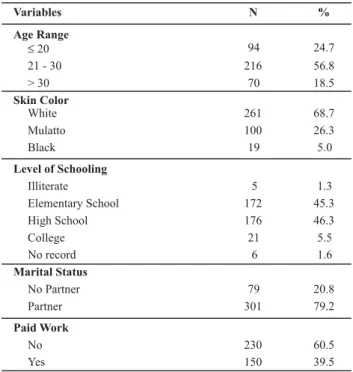
The Table 1 shows that 286 (75.3%) mothers were older than 20 years old and 261 (68.7%) were white-skinned. There was an equitable distribution of mothers who
fin-Table 2 presents the maternal clinical-obstetric charac-teristics. It is worth highlighting that a majority of 368 (99.5%) mothers received prenatal care and 280 (76.1%) went to six or more medical appointments. The use of illicit drugs was identified in 11 (2.9%) women among the stud-ied population. The frequency of mothers with a diagnosis of pregnancy hypertension was 53 (16.2%) and that of dia-betes, 18 (5.6%), but none of them referred treatment with hypoglycemic agents during pregnancy. Most of the women, 215 (56.6%), received continuous intravenous infusion of glucose serum 5% during labor and 270 (71.1%) remained hospitalized and fasting during the period of labor. Table 1 - Socio-demographic characteristics of mothers whose new-borns were submitted to capillary blood glucose control in the first 24 hours of life; July-December 2006, HU/USP - São Paulo - 2008
Variables N %
Age Range
≤20 94 24.7
21 - 30 216 56.8
> 30 70 18.5
Skin Color
White 261 68.7
Mulatto 100 26.3
Black 19 5.0
Level of Schooling
Illiterate 5 1.3
Elementary School 172 45.3
High School 176 46.3
College 21 5.5
No record 6 1.6
Marital Status
No Partner 79 20.8
Partner 301 79.2
Paid Work
No 230 60.5
Yes 150 39.5
Note: (N=380)
ished the elementary school and the high school, and a minority of illiterate women, 5 (1.3%) and those who took a graduation course, 21 (5.5%).
Table 2 - Clinical-obstetrical characteristics of mothers whose new-borns were submitted to capillary blood glucose control in the first 24 hours of life; July-December 2006, HU/USP - São Paulo - 2008
Variables N %
Parity (N=380)
Primipara 199 52.4
Multipara 181 47.6
Prenatal care (N=370)
No 2 0.5
Yes 368 99.5
Prenatal appointments (N=368)
< 6 88 23.9
≥6 280 76.1
Smoking (N=379)
No 296 78.1
Yes 83 21.9
Alcohol consumption (N=376)
No 351 93.4
Yes 25 6.6
Use of illicit drugs (N=379)
No 368 97.1
Yes 11 2.9
Hypertension in pregnancy (N=327)
No 274 83.8
Yes 53 16.2
Diabetes in pregnancy (N=320)
No 302 94.4
Yes 18 5.6
Length of stay in labor at the hospital
< 6 h > 6 h
Infusion of glucose 5% in labor (N=380)
No Yes
Infusion of hypertonic glucose during labor (N=380)
No Yes
Jejum no trabalho de parto (N=380)
No Yes
Type of labor (N=380)
Normal Forceps Cesarean Section
Labor anesthesia (N=380)
No Yes
Type of anesthesia (N=335)
Spinal
Combined spinal and epidural Local
Epidural
200 52.7 180 47.3
165 43.4 215 56.6
274 72.1 106 27.9
110 28.9 270 71.1
185 48.7
65 17.1
130 34.2
45 11.8
335 88.2
181 54.0
84 25.1
62 18.5
8 2.4
Use of hypoglycemic medication
No 18 100
Yes 0 0
DISCUSSION
Studies developed at the same hospitalization unit of the institution of the present study found a prevalence of post-partum women aged between 20 and 29 years old, with the minimum age varying between 13-14 years old and the maximum age from 42-43 years old(7-9), similarly to
the ages found in the present study, in which the mean of the mother’s age was 25 years old, varying between 14 and 41 years old. The findings in literature show that the mother’s age profile has not changed over the last 20 years among the population assisted by this institution.
Most of the mothers had finished the elementary or the high school, 348 (91.6%), agreeing with another study developed in the same institution, in 2001, which found 94.0% of the post-partum women had finished the elemen-tary or the high school(9).
A case-control study with term newborns weighing over 2,500 grams, born from non-diabetic mothers and involv-ing 116 newborns in the group considered case and 232 newborns in the control group, was developed at a North-American hospital in the city of Allentown, Pennsylvania, in order to analyze the factors associated to the neonatal hypoglycemia. The results indicated that the mean of the mother’s age was 27.9 years old, only 15 (4.0%) were not white-skinned, 47 (13.5%) smoked, 5 (2.0%) consumed al-cohol and 12 (4.8%) used illicit drugs. As for the clinical characteristics, 19 (5.5%) had hypertension and 41 (11.8%), asthma. None of the variables previously mentioned pre-sented a statistical significance related to the occurrence of neonatal hypoglycemia. The maternal variables that pre-sented statistical significance (p < 0.01) regarding the oc-currence of hypoglycemia were: type of hospital care re-ceived (public or not public), period of labor, gestational age and maternal fever. The variable type of labor did not show statistical significance towards the occurrence of neo-natal hypoglycemia (10).
Regarding the period of hospitalization in labor, the present study showed that, over half of the women, 200 (52.7%) remained in labor for up to 6 hours.
Some maternal variables are mentioned as risk factors for the occurrence of neonatal hypoglycemia, which are: pre-gestational and pre-gestational diabetes, irregular result in the test of glucose tolerance, pre-eclampsia, specific hyperten-sive disease of pregnancy, systemic arterial hypertension, use of illicit drugs, use of b-blockers and oral hypoglycemic agents, intrapartum administration of glucose(6,11-12).
The results of the present study show that 53 (16.2%) mothers had arterial hypertension during pregnancy.
hypogly-cemia in the first hours of life(13). In the present study, 18
(5.6%) mothers presented gestational diabetes and none of them used hypoglycemic agents.
The data collected for this study show that the continu-ous infusion of glucose serum at 5% was used in most of the mothers during labor or delivery, 215 (56.6%), and 106 (27.9%) mothers received intermittent intravenous hyper-tonic glucose. The data in literature state that the adminis-tration of glucose in labor and delivery constitutes a risk factor for the occurrence of neonatal hypoglycemia(6,14).
Regarding the parturient’s nutrition, the present study showed that only 110 (28.9%) women received some sort of food during labor, unlike what is recommended by the World Health Organization, which states that feeding the low risk parturient is a care practice that must be recom-mended(15).
At the delivery room, the prevalence for the breastfeed-ing practice found in this study was 74.3%. The institution, study field, is certified as a Baby-Friendly Hospital, and the breastfeeding at the first thirty minutes of life constitutes the step 4 of this program, even though this practice does not have the explicit objective of reducing the prevalence of hypoglycemia; however, it is possible to infer that new-borns who are given to feed from them mothers receive the maternal colostrum that contributes to increase their glycemic levels(16).
Free demand breastfeeding is the best way to prevent asymptomatic hypoglycemia, and the continuous support and assessment in breastfeeding are still the best strate-gies to avoid the newborns to develop hypoglycemia(17),
besides the fact that the nursing professional is responsible for all the alternatives for breastfeeding, since she is the one who shares the maternal experience, being with the woman most of the time, specially in the initial moments of breastfeeding(18).
CONCLUSION
The data in literature indicate that obesity, pre-gestational and gestational diabetes, the use of oral hypoglycemic agents, treatment in pregnancy with insulin, specific hypertensive disease of pregnancy and systemic arterial hypertension, use of antihypertensive drugs, history of previous macrosomic child with hypoglycemia, unexplained death of a child in child-hood and intrapartum administration of glucose are factors related to the occurrence of neonatal transitory hypoglyce-mia. The present study outlined the profile of mothers to healthy term newborns who remained hospitalized in a room-ing-in facility, therefore, with low risk to present neonatal morbidities. Nevertheless, 5.6% of the mothers to newborns with capillary blood glucose control in the first 24 hours of life presented gestational diabetes, but none of them had undergone a treatment with hypoglycemic medication and 16.2% had a history of arterial hypertension in pregnancy, 32.1% of them were treated with antihypertensive drugs, 56.6% received continuous intravenous 5% glucose infusion during labor and delivery. The findings of this study point out that more correlational studies, analyzing the maternal variables and the neonatal hypoglycemia, are necessary to validate the maternal risk factors in the population of new-borns hospitalized in maternity hospitals that adopt the Baby-Friendly Hospital.
REFERENCES
1. Wilker RE. Hipoglicemia e hiperglicemia. In: Cloherty JP, Eichenwald EC, Start AR. Manual de neonatologia. 5ª ed. Rio de Janeiro: Guanabara Koogan; 2005. p. 487-96.
2. World Health Organization (WHO). Hypoglycemia of the newborn: review of the literature. Geneva; 1997.
3. Wight NE. Hypoglycemia in breastfed neonates. Breastfeed Med. 2006;1(4):253-62.
4. Cornblath M, Ichord R. Hypoglycemia in the neonate. Semin Perinatol. 2000;24(2):136-49.
5. Rozance PJ, Hay WW. Hypoglycemia in newborn infants: features associated with adverse outcomes. Biol Neonate. 2006;90(7):74-86.
6. Haninger NC, Farley CL. Screening for hypoglycemia in healthy term neonates: effects on breastfeeding. J Midwifery Women’s Health. 2001;46(5):292-301.
7. Barbieri DL. Estudo das intercorrências apresentadas pelo binômio mãe-filho nas primeiras seis horas após o parto nor-mal, como indicadores negativos ou positivos para o sistema alojamento conjunto [tese]. São Paulo: Escola de Enfermagem, Universidade de São Paulo; 1993.
8. Melleiro MM. Consulta de enfermagem pós-alta hospitalar: um instrumento na detecção precocede agravos à saúde do recém-nascido [dissertação]. São Paulo: Escola de Enfermagem, Uni-versidade de São Paulo; 1998.
9. Shimoda GT. Lesão de papila mamária: características, freqüên-cia e fatores presentes na ocorrênfreqüên-cia desta intercorrênfreqüên-cia em um grupo de nutrizes internadas em sistema alojamento con-junto [dissertação]. São Paulo: Escola de Enfermagem, Univer-sidade de São Paulo; 2001.
11. World Health Organization (WHO). UNICEF. Guidance on the development of policies and guidelines for the prevention and management of hypoglycemia of the newborn [text on the Internet]. London; 2008 [cited 2009 Mar 16]. Available from: http://www.babyfriendly.org.uk/pdfs/hypo_policy.pdf
12. Persson B. Neonatal glucose metabolism in offspring of moth-ers with varying degrees of hyperglycemia during pregnancy. Sem Fetal Neonatal Med. 2009;14(2):106-10.
13. Joanna Briggs Institute. Management of asymptomatic hypoglycaemia in healthy term neonates for nurses and mid-wives. Best Pract. 2006;10(1):1-4.
14. Milcic TL. Neonatal glucose homeostasis. Neonatal Netw. 2008;27(3):203-7.
15. Organização Mundial da Saúde (OMS). Assistência ao parto normal: um guia prático. Brasília; 2000.
16. Organização Mundial da Saúde (OMS). Evidências científicas dos Dez Passos para o sucesso do aleitamento materno. Brasília: OPAS; 2001.
17. Jain A, Aggarwal R, Jeevasanker M, Agarwal R, Deorari AK, Paul VK. Hypoglycemia in the newborn. Indian J Pediatr. 2008; 75(1):63-7.