Postoperative pain in children:
a gender approach
O
riginal
a
r
ticle
Dor pós-operatória em crianças: uma aborDagem De gênero
Dolor post-operatorio en niños: un aborDaje De género
1 rn. graduated from centro de graduação em enfermagem, universidade Federal do triângulo mineiro. araxá, mg, brazil. [email protected] 2 ph.D. in public Health, school of public Health, university of são paulo. adjunct professor, community Health nursing and education Department, centro de graduação em enfermagem, universidade Federal do triângulo mineiro. uberaba, mg, brazil. [email protected] 3 b.sc. in statistics, universidade Federal de são carlos. ph.D. student in statistics, universidade Federal de são carlos. assistant professor, community Health nursing and education Department, centro de graduação em enfermagem, universidade Federal do triângulo mineiro. uberaba, mg, brazil. [email protected] 4 ph.D. in Fundamental nursing, university of são paulo at ribeirão preto college of nursing. adjunct professor, school of nursing, universidade Federal de
RESUmo
O objeivo do estudo foi veriicar e descre
-ver, sob o enfoque de gênero, as associa -ções entre o sexo e as variáveis especíicas da dor pós-operatória em pediatria. Corte transversal com 77 crianças, com idades entre seis e 13 anos (M=9 anos; dp=2,2 anos), ASA I e II, 77,9% pertencentes às classes socioeconômicas C e D, 68,8% me
-ninos e 32,8% meninas. Os dados foram coletados no primeiro dia pós-operatório, por meio de entrevista semi-estruturada e quatro escalas de medida. As principais doenças de base foram adenoamigdali
-te e fraturas. A prevalência de dor foi de 91,7% para meninas e 75,5% para meninos (p>0,05). Não houve associação entre in
-tensidade de dor e sexo; as palavras mais uilizadas para descrever a dor foram corta e aperta. A escala preferida foi a Escala de Faces do Cebolinha e da Mônica. O manejo da dor em pediatria ainda é inadequado e o gênero pode inluenciar na resposta dor.
dEScRitoRES Criança
Dor pós-operatória Medição da dor Idenidade de gênero Enfermagem pediátrica AbStRAct
The objecive of this study was to verify and describe, from a gender focus, the associaions between gender and speciic postoperaive pain variables in pediatrics. This is a cross-secional study of 77 chil
-dren between 6 and 13 years of age (M=9 years; sd=2.2 years), ASA I and II, 77.9% from low-income classes, 68.8% boys and 32.8% girls. Data were collected on the irst postoperaive (1st PO) day through semi-structured interviews and four measure
-ment scales. The main baseline diseases were adenotonsilliis and fractures. Preva
-lence of pain on the 1st PO was 91.7% for girls and 75.5% for boys (p>0.05). No asso
-ciaion was found between pain intensity and gender. The most used pain descriptors were it cuts and it squeezes. The preferred scale was the EFMC (with faces from a Bra
-zilian cartoon: Monica’s Gang). Pediatric pain management is sill inadequate and gender may inluence the pain response.
dEScRiPtoRS Child
Pain, postoperaive Pain measurement Gender idenity Pediatric nursing
RESUmEn
El objeivo del estudio fue veriicar y descri
-bir, bajo en enfoque de género, las asocia -ciones entre el sexo y las variables especí
-icas de dolor post-operatorio en pediatría. Corte transversal, con 77 niños con edad entre 6 y 13 años (M=9 años, ds=2,2 años), ASA I y II, 77,9% pertenecientes a clases socioeconómicas C y D, 68.8% varones y 32,8% mujeres. Datos recolectados en pri
-mer día post-operatorio, mediante entre
-vista semiestructurada de cuatro escalas de medida. Las principales enfermedades de base fueron adenoamigdaliis y fractu
-ras. La prevalencia de dolor fue de 91,7% para niñas y 75,5% para niños (p>0,05). No hubo asociación entre intensidad de do
-lor y sexo, las palabras más uilizadas para describir el dolor fueron corto y abierto. La escala preferida fue la Escala de Rostros de Cebollita y Mónica. El manejo del dolor pediátrico es aún inadecuado y el género puede inluir en la respuesta.
dEScRiPtoRES Niño
Dolor postoperatorio Dimensión del dolor Idenidad de género Enfermería pediátrica
intRodUction
Postoperaive pain represents an obstacle for quality of life in pediatrics and adequate management of this ex -perience represents a challenge to be solved in the surgi -cal context. It is undeniable that, in many children, pain is sill insuiciently assessed and treated, despite the ad
-vances achieved in the study of the pain phenomenon(1- 3). Limited improvements have been appointed in pain management in children(2,4), although various instruments have been described to measure and assess pain in child -hood. Obstacles are frequently related to the scales’ un
-proven validity and inadequacy for all age groups. Assessing the way children interpret their illness and the pain simulus is fundamental for efecive pain relief. The many factors to be analyzed for adequate pain man -agement in childhood include the fact that children learn to assess, understand the meaning and the relevance of phenomena, and also to manifest behaviors based on the internalizaion process of gender premises.
Sex and gender are mistakenly used as synonyms(5). Gender, however, comprises the range of cultural meanings atributed to biological diferences. It refers to the at -tributes, funcions and relaions that tran -scend the reproducive biological aspect and which, social and culturally constructed, are atributed to the sexes to jusify difer -ences and relaions of power and oppres -sion between them.
Thus, the aitude of men and women is closely connected with the symbolic rep -resentaions of masculinity and femininity that are historically constructed, changeable and relaional. That is why the gender focus
is associated with social class, race/ethnic origin, general diferences, culture, among others(6).
In men, the hegemonic model’s establishment of the stereotyped view of masculinity represses behaviors that are tradiionally atributed to the female, such as expos -ing feel-ings and emoions and talk-ing about their sexuality with other people(5).
In this context, it is relevant to consider parents’ inlu -ence in their children’s socializaion process, as they react diferently according to age, sex and order of birth. Boys are simulated to repress pain complaints and to develop more acive and independent behaviors, while girls can release their anguish and use passive coping strategies like rest and medicaion use(7).
Thus, gender socializaion is considered a mulidi -mensional construct, which inluences social learning and leads to variaions in behaviors, including the pain - re -sponse(8).
The male gender standard supposedly emphasizes ma-choism, resising pain to evidence a male essence, difer -ently from the female. And the female gender standard is supposed to contain socializaion elements that accept pain as a normal part of life, permiing pain communicaion(9).
In this sense, in a study that involved adults in pain(10), it was observed that women frequently exhibited less pain tolerance than men or communicated greater pain intensity than the later.
Regarding the study of childhood pain, however, in ad -diion to the scarce literature on how gender interferes in the pain measurement process in children, no diferences between boys and girls were observed(11), while hardly consistent diferences were appointed between the sex -es(9,12-13), facts that evidence the need for research to un
-derstand how gender interferes in the pain - response.
objEctiVES
General objecive
• To verify and describe, from a gender focus, associaions between the child/adolescent’s sex and speciic postoperaive pain variables.
Speciic objecives
• To characterize the proile of the children and adolescents under analysis according to age, socioeconomic condiions, baseline dis
-ease and type of surgery;
• To idenify the occurrence of pain on the irst postoperaive day and at the ime of data collecion; pain intensity according to the measurement scales; pain quality; and the measurement scale the children prefer; • To check the associaion between sex and pain occur
-rence, intensity and quality and the child’s preferred scale.
mEtHod
An observaional and cross-secional study was devel -oped at the Pediatric Unit of the Teaching Hospital at Uni-versidade Federal do Triângulo Mineiro (UFTM), Uberaba - MG, in 2006. The convenience sample comprised 77 chil -dren submited to small and medium surgical procedures, male and female, in physical condiion ASA I or II accord
-ing to the criteria of the American Society of Anesthesiol -ogy, and unaware of the category esimaion method.
The variables were: sex; age; socioeconomic situaion; baseline disease, type of surgery; pain occurrence, inten -sity and quality and preferred pain measurement scale.
Postoperaive pain was considered as pain directly related to the surgical site. Four ordinal and one-dimen
-regarding the study of childhood pain, however, in addition to the scarce literature
on how gender interferes in the pain measurement process in children, no
differences between boys and girls were
sional scales were used for subjecive pain intensity mea
-surement: the Smile and Crying Faces Scale (SCFS); the Cebolinha and Mônica Faces Scale (CMFS); the Bear Face Scale (BFS) and the Numerical Scale (NS).
The quality of the pain experience was invesigated through words – the most adequate to describe the pain felt. No instrument was used, the children could freely choose the Portuguese words they knew and used every day.
All children were trained for the measurement task during the preoperaive phase and data were collected on the irst postoperaive (PO) day.
Based on the Microsot Excel database, quanita -ive variables were submited to descrip-ive measures of centrality (mean, median and mode) and dispersion (minimum, maximum and standard deviaion) and, for qualitaive variables, simple frequency distribuion was obtained. The results were organized in tables.
Associaions were explored through the chi-square and Mann-Whitney tests. Signiicance for all tests was set at α=5%. All tests were performed in EpiInfo staisical sotware version 6.04.
The Insituional Review Board at Universidade Federal do Triângulo Mineiro (UFTM) approved the research proj -ect, under protocol CEP No 643/06. All interviewees and responsible persons were previously informed about the research and signed the free and informed consent term.
RESULtS
Seventy-seven children were assessed, 68.8% male and 31.2% female. Ages ranged from 6 to 13 years, in line with the range delimited for the study, with a mean age of 9.0 years and standard deviaion (s.d.) of 2.17 years.
The girls’ mean age (9.4 years±1.9 years) was similar to the boys’ mean age (9.3 years ± 2.3 years) (p=0.854).
Regarding socioeconomic condiion, most children (42.9%) ited in class D of the Classiicaion Key of Socio -economic Classes in Brazil (ABA/ABIPEME), followed by class C (35.1%), class E (18.2%) and class B (3.9%). The com -parison between the socioeconomic situaion of female and male children did not reveal signiicant diferences ei -ther (χ2=1.60; p=0.660), with 0.0%, 33.3%, 45.9%, 20.9% of girls in classes B, C, D, E, respecively; and 5.7%, 35.9%, 41.6%, 17.0% of boys in classes B, C, D, E, respecively, re -vealing that both groups are relaively homogeneous.
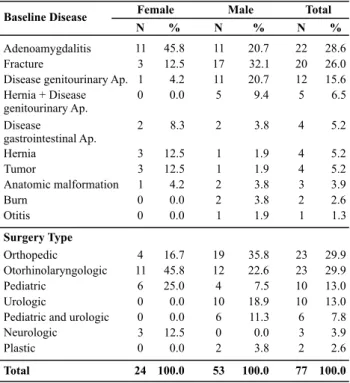
The children presented baseline diseases, mainly ad -enotonsillectomy (28.6%), fracture (26.0%) and disease of the genitourinary apparatus (15.6%) for both sexes.
The distribuion of baseline diseases according to gen -der, in decreasing frequency or-der, corresponded to amyg -daliis (45.8%), and fracture, hernia and tumor (12.5%), re -specively, among girls. Among boys, the highest score was
for adenotonsilliis (28.6%), followed by fracture (26.0%), and disease of the genitourinary apparatus (15.6%).
The most frequent surgery types were: orthopedic cor -responded to 29.9% (F sex – 16.7% and M sex – 35.9%) and otorhinolaryngologic to 29.9% (F sex – 45.8% and M sex – 22.7%), in line with the baseline diseases observed (Table 1). Table 1 - Association between sex and baseline disease and
sur-gery type - Uberaba, MG - 2006
Female Male Total
Baseline Disease
N % N % N %
Adenoamygdalitis 11 45.8 11 20.7 22 28.6
Fracture 3 12.5 17 32.1 20 26.0
Disease genitourinary Ap. 1 4.2 11 20.7 12 15.6
Hernia + Disease genitourinary Ap.
0 0.0 5 9.4 5 6.5
Disease
gastrointestinal Ap.
2 8.3 2 3.8 4 5.2
Hernia 3 12.5 1 1.9 4 5.2
Tumor 3 12.5 1 1.9 4 5.2
Anatomic malformation 1 4.2 2 3.8 3 3.9
Burn 0 0.0 2 3.8 2 2.6
Otitis 0 0.0 1 1.9 1 1.3
Surgery Type
Orthopedic 4 16.7 19 35.8 23 29.9
Otorhinolaryngologic 11 45.8 12 22.6 23 29.9
Pediatric 6 25.0 4 7.5 10 13.0
Urologic 0 0.0 10 18.9 10 13.0
Pediatric and urologic 0 0.0 6 11.3 6 7.8
Neurologic 3 12.5 0 0.0 3 3.9
Plastic 0 0.0 2 3.8 2 2.6
Total 24 100.0 53 100.0 77 100.0
Regarding pain frequency on the irst PO day was 91.7% among girls and 75.5% among boys. Although no staisically signiicant diference was observed (p>0.05), more girls menioned pain.
As for pain intensity, measured through the four mea -surement scales used in this study, in comparison with the children’s sex, no signiicant diference was found (Table 2).
Table 2 - Descriptive measures of NS and BFS, CMFS and SCFS scales regarding sex and result of comparative Mann-Whitney test - Uberaba, MG - 2006
Measurement
Scale N Minimum Median Maximum Man-Whitney P
Numerical Scale 3.82 0.051
F 24 0,000 4,000 10,000
M 53 0,000 4,000 10,000
Cebolinha and Mônica Faces Scale 3.22 0.073
F 24 0,000 2,000 5,000
M 53 0,000 2,000 5,000
Bear Faces Scale 1.26 0.260
F 24 0,000 2,000 4,000
M 53 0,000 2,000 4,000
Smiling and Crying Faces Scale 0.44 0.510
F 24 0,000 4,000 10,000
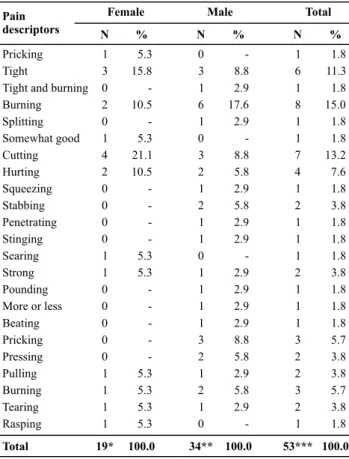
As for the postoperaive pain quality, the words girls most frequently used were: cuts (21.1%), ight (15.8%); and boys: burns (17.6%), followed by ight, cuts and pricks (8.8%) (Table 3). Based on the version of the McGill Pain Quesionnaire translated to Portuguese(14), we observed that most girls (77.8%) and boys (84.9%) described their pain using words that could be grouped as sensiive (Table 4). No reference was made to words that described the afecive pain dimension.
Table 3 - Frequency distribution of Portuguese words children
between 6 and 13 years used to describe postoperative pain - Ube-raba, MG - 2006
Table 5 - Association between sex and scale the child preferred - Uberaba, MG - 2006
Female Male Total
Pain
descriptors N % N % N %
Pricking 1 0 1
Tight 3 3 6
Tight and burning 0 1 1
Burning 2 6 8
Splitting 0 1 1
Somewhat good 1 0 1
Cutting 4 3 7
Hurting 2 2 4
Squeezing 0 1 1
Stabbing 0 2 2
Penetrating 0 1 1
Stinging 0 1 1
Searing 1 0 1
Strong 1 1 2
Pounding 0 1 1
More or less 0 1 1
Beating 0 1 1
Pricking 0 3 3
Pressing 0 2 2
Pulling 1 1 2
Burning 1 2 3
Tearing 1 1 2
Rasping 1 5.3 15.8 -10.5 -5.3 21.1 10.5 -5.3 5.3 -5.3 5.3 5.3
5.3 0 1
1.8 11.3 1.8 15.0 1.8 1.8 13.2 7.6 1.8 3.8 1.8 1.8 1.8 3.8 1.8 1.8 1.8 5.7 3.8 3.8 5.7 3.8 1.8
Total 19* 100.0 34** 100.0 53*** 100.0
-8.8 2.9 17.6 2.9 -8.8 5.8 2.9 5.8 2.9 2.9 -2.9 2.9 2.9 2.9 8.8 5.8 2.9 5.8 2.9
-* Does not know = 3; -*-* Does not know = 6; -*-*-* Does not know = 9
Table 4 - Frequency distribution of Portuguese words children
between 6 and 13 years used to describe postoperative pain, grou-ped based on the Proposed Adaptation of the McGill Pain Ques-tionnaire for Portuguese - Uberaba, MG - 2006
Evaluative 1 1 2
Mixed 3 4 7
Sensitive 14 28 42
Total 18 5.6 16.7 77.8 100.0 33 3.0 12.1 84.9 100.0 51 3.9 13.8 82.3 100.0
Female Male Total
Pain
dimension N % N % N %
(χ2=3.23; p=0.520); 11 words (14.3%) did not correspond to the mcgill Questionnaire groupings.
According to the scales used for pain measurement in children, regarding the scale they liked most criterion,
56.4% of the children chose the Cebolinha and Mônica Faces Scale – CMFS – 59.1% of girls and 55.0% of boys (Table 5), with a posiive and signiicant associaion (χ2=10.58; p=0.032). Next, another 22.6% of the children chose the Smiling and Crying Faces Scale - SCFS -, 36.4% of girls and 15.0% boys.
Numerical Scale
Mônica and Cebolinha Faces Scale
Bear Faces Scale
Smiling and Crying Faces Scale
Total
Female Male Total
Children's
Preferred Scales N % N % N %
0 1 1
13 22 35
1 11 12
8 6 14
22 0.0 59.1 4.5 36.4 100.0 40 2.5 55.0 27.5 15.0 100.0 62* 1.7 56.4 19.3 22.6 100.0
(χ2=10.58; p=0.032); *mentioned not feeling postoperative pain = 15 children.
diScUSSion
The study populaion predominantly included male children, while less than one third was female. The large majority belonged to poorer socioeconomic classes, prob -ably due to the fact that the School Hospital is a teaching hospital that exclusively delivers care through the Uniied Health System (SUS).
Ages and socioeconomic condiions were quite simi -lar between boys and girls, reducing the possibility that these variables would represent a confounding factor in pain responses.
The main baseline diseases the children presented were adenotonsilliis, fracture and disease of the genito -urinary apparatus. Among boys, although no staisically signiicant diference was observed, fractures were more frequent than among girls, probably due to the fact that they involve in more risky and violent aciviies, which can be considered an early sign of what happens with young men. Some tradiional male characterisics, such as strength, virility, compeiiveness and the atempt to comply with the tradiional masculine model turn the male populaion much more vulnerable to violence than the female(15). Also, pain raios in upper and lower limbs among school-age children are related to aciviies like falls from bicycles, falls when running and collisions, caus -ing wounds, fractures or traumas(16).
Brazilian epidemiological mortality data conirm this asserion, as ive imes more men than women die of external causes. This percentage diference is more en -hanced among adolescents and young adults(15).
-yngologic. Tonsillectomy, with or without adenoamygda
-lectomy, was menioned as one of the most common sur -gical procedures in childhood(17).
Most children indicated pain during the irst PO day, most of whom at the ime of data collecion, raising inqui -ries on the adequacy of pain management in this group. The importance of health professionals’ acknowledge
-ment of children’s pain response is highlighted, as well as the prescripion and administraion of analgesics(2,18-19), with a view to avoiding the harmful efects of pain. In ad -diion, these professionals’ percepion of children’s sex/ gender and their gender understanding can inluence ad -equate management of this experience(19).
Regarding sex, higher pain frequencies were found among girls than among boys. These data are similar to the adult populaion, in which women frequently show low pain tolerance levels or communicate high pain lev -els when compared to men(10). Also, girls and women fre
-quently report more pain than boys and men in pain expe -rience research, and more frequently seek help for pain(8).
It should also be appointed, however, that sex difer -ences in pain responses seem to be inconsistent in chil
-dren(9), who showed less coherence between the sexes(13). Besides, epidemiological pain prevalence studies in chil -dren show litle diference between the sexes(12).
Furthermore, it should be taken into account that gender diferences in behavioral pain responses should not be inter
-preted as signs of gender diferences in pain thresholds(11). Thus, even if these results may suggest that women show less pain tolerance or express pain more frequent -ly than men, they approximate childhood pain studies, which appoint litle consistency in terms of diferences be -tween the sexes. The present study sample was relaively small though, entailing the need for further research with larger samples with a view to more consistent results.
Regarding postoperaive pain quality, in adults, stud -ies have appointed that the three dimensions are involved in postoperaive pain descripion(20), although the sensi -ive stands out in acute pain cases, similar to the present study, and the words the children most menioned were: cuing, ight, burning and pricking.
According to the scales used for pain measurement in chil -dren, although most girls and boys chose the CMFS, behaviors in terms of other choices was very diferent, according to the preference distribuion for the other face scales. Studies have
airmed that face scales seem to be the best opion for pain measurement in children over ive years old(3,21-22). Regarding the scale the children declared they liked most, it should be quesioned whether this preference does not derive from the fact that the CMFS is the only scale that permits sexual dis
-incion through the female (Mônica) and male (Cebolinha) characters, enhancing gender ideniicaion.
concLUSion
Pain prevalence levels among children on the irst PO day was high and the fact that most of them reported pain at the ime of data collecion lead to the conclusion that postopera -ive pain management in this group was inadequate.
Girls reported pain more frequently than boys and, although no signiicant associaion was observed among these variables, the results suggest that girls display less pain tolerance or express pain more frequently than boys. Boys and girls judged pain quality and intensity simi -larly through the measurement scales. It is highlighted that the children chose no word from the afecive group, in line with studies that appointed the sensiive pain di -mension as the most present in the postoperaive phase.
Regarding the pain measurement scales used, both girls and boys preferred the CMFS. The second choice was the SCFS, according to studies that appointed Face Scales as the best opion for pain measurement in children older than ive.
As for the children’s preference of the CMFS, it should be taken into account that Mônica and Cebolinha are as -sociated with many Brazilian children’s play universe and widely accepted, but it should be quesioned whether this preference could not derive from the fact that this is the only scale that permits sexual disincion through the male (Cebolinha) and female (Mônica) characters, en -hancing gender ideniicaion.
In view of the above, it is highlighted that care deliv -ery to children with postoperaive pain should consider gender aspects, which can inluence the pain response, paricularly in boys who, concerned with reproducing the tradiional masculine model, could be going through un -necessary sufering.
Hence, in the context of efecive and eicient care for children in pain, care humanizaion is appointed as a right for all, mainly in children, who oten do not manage to communicate what they are feeling.
REFEREncES
1. Mendes TMTG, Miyeko H, Lima RAG. Registros sobre dor pós-operatória em crianças: uma análise retrospeciva de hospitais de Londrina, PR, Brasil. Rev Bras Enferm. 2008;61(3):289-95.
3. Silva FC, Thuler LCS. Tradução e adaptação transcultural de duas escalas para avaliação da dor em crianças e adolescen
-tes. J Pediatr (Rio J). 2008;84(4):344-9.
4. Kain ZN, Cicchei DV, McClain BC. Measurement of pain in chil
-dren: state-of-the-art consideraions.Anesthesiology.2002;96 (3):523-6.
5. Korin D. Novas perspecivas de gênero em saúde. Adolesc Lainoam. 2001;2(2):67-79.
6. Taquete S, Vilhena MM, Paula MC. Doenças sexualmente transmissíveis e gênero: um estudo transversal com adolescen
-tes no Rio de Janeiro. Cad Saude Pública. 2004;20(1):282-90.
7. Okada M, Teixeira MJ, Tengan SK, Bezerra SL, Ramos CA. Dor em pediatria. Rev Med (São Paulo). 2001;80(ed esp Pt 1):135-56.
8. Myers CD, Riley JL 3rd, Robinson ME. Psychosocial contribu
-ions to sex-correlated diferences in pain. Clin J Pain. 2003; 19(4):225-32.
9. Myers CD, Tsao JC, Glover DA, Kim SC, Turk N, Zeltzer LK. Sex, gender, and age: contribuions to laboratory pain responding in children and adolescents. J Pain. 2006;7(8):556-64.
10. Riley JL 3rd, Robinson ME, Wise EA, Myers CD, Fillingim RB. Sex diference in the percepion of noxious experimental simuli: a meta-analysis. Pain. 1998;74(2-3):181-7.
11. Fuller BF. Infant gender diferences regarding acute estab
-lished pain. Clin Nurs Res. 2002;11(2):190-203.
12. Unruh AM, Campbell MA. Gender variaion in children’s pain experiences. In: Mcgrath PJ, Finley GA. Chronic and recurrent pain in children an adolescents: progress in pain research and management. Seatle, WA: IASP; 1999. p. 199-241.
13. Zeltzer LK. The cold pressor pain paradigm in children: feasi -bility of intervenion model (Part II). Pain. 1989;37(3):305-13.
14. Pimenta CAM, Teixeira MJ. Quesionário de dor McGill: pro
-posta de adaptação para a língua portuguesa. Rev Esc En
-ferm USP. 1996;30(3):473-83.
15. Souza ER. Masculinidade e violência no Brasil: contribuições para a relexão no campo da saúde. Ciênc Saúde Coleiva. 2005;10(1):59-70.
16. Claro MT. Escala de faces para avaliação da dor em crianças: etapa preliminar [dissertação]. Ribeirão Preto: Escola de Enfer -magem de Ribeirão Preto, Universidade de São Paulo; 1993.
17. Özköse Z, Akçabay M, Kemaloğlu YK, Sezenler S. Relief of postonsillectomy pain with low-dose tramadol given at in
-ducion of anesthesia in children. Int J Pediatr Otorhinolar
-yngol. 2000;53(3):207-14.
18. Tacla MTGM, Hayashida M, Lima RAG. Registros sobre dor pós-operatória em crianças: uma análise retrospec
-iva de hospitais de Londrina, PR, Brasil. Rev Bras Enferm. 2008;61(3):289-95.
19. Queiroz FC, Nascimento LC, Leite AM, Flória-Santos M, Lima RA, Scochi CG. Manejo da dor pós-operatória na enferma -gem pediátrica: em busca de subsídios para aprimorar o cui -dado. Rev Bras Enferm. 2007;60(1):87-91.
20. Sant’Ana RPM, Pereira LV, Giunini PB, Marquez JO, Sousa FAEF. Esimação de magnitude da linguagem da dor pós-operatória. Rev Dor Pesq Clin Terap. 2003;4(1):42-51.
21. Bieri D, Reeve RA, Champion GD, Addicoat L, Ziegler JB. The FACES Pain Scale for the self-assessment of the severity of pain experienced by children: development, iniial valida
-ion, and preliminary invesigaion for raio scale properies. Pain. 1990;41(2):139-50.
22. Hicks CL, von Baeyer CL, Spaford PA, van Korlaar I, Goode
-nough I. The Faces Pain Scale Revised: toward common met