Rev Odontol UNESP. 2013 May-June; 42(3): 182-187 © 2013 - ISSN 1807-2577 ARTIGO ORIGINAL
Oral condition of critical patients and its correlation with
ventilator-associated pneumonia: a pilot study
Condição oral de pacientes críticos e sua correlação com pneumonia
associada a ventilação mecânica: um estudo piloto
Andrea Carvalho DE MARCO
a,
Camila Galvão CARDOSO
b, Fernando Vinicius Cesar DE MARCO
c,
Antonio Braulino de MELO FILHO
d, Mauro Pedrine SANTAMARIA
a, Maria Aparecida Neves JARDINI
aaDepartment of Diagnosis and Surgery, School of Dentistry, UNESP – Univ Estadual Paulista,
12245-000 São José dos Campos - SP, Brazil
bSchool of Dentistry, UNESP – Univ Estadual Paulista, 12245-000 São José dos Campos - SP, Brazil cHead of Critical Care Unit, Hospital viValle, 12244-380 São José dos Campos - SP, Brazil dDepartment of Social Science and Pediatric Dentistry, School of Dentistry, UNESP – Univ Estadual
Paulista, 12245-000 São José dos Campos - SP, Brazil
Resumo
Introdução: A literatura vem relatando condições inadequadas de higiene oral de pacientes em unidade de terapia intensiva (UTI) e a ocorrência de Pneumonia associada à ventilação mecânica em cerca de 9%-27% de todos os pacientes intubados. Objetivo: O objetivo deste estudo foi avaliar condições orais de pacientes críticos e correlacionar
com a presença de pneumonia associada à ventilação mecânica. Material e método: Vinte e três pacientes foram
categorizados da seguinte maneira: com a doença periodontal e com pneumonia associada à ventilação mecânica, com doença periodontal e sem pneumonia associada à ventilação mecânica, sem doença periodontal e com pneumonia associada à ventilação mecânica e sem doença periodontal e sem pneumonia associada à ventilação mecânica. Foram utilizados na avaliação os índices de placa, de doença periodontal e índice de cariados, perdidos e obturados.
Resultado: Não houve diferença estatisticamente significante na incidência da doença periodontal em relação à pneumonia associada à ventilação mecânica, mas o número de dentes e superfícies com perda de inserção acima
de 4 mm sempre foi maior em pacientes com pneumonia associada à ventilação mecânica. Conclusão: A extensão
da doença periodontal pode contribuir para o aparecimento de pneumonia associada à ventilação mecânica. No entanto, são necessários estudos com uma amostra maior para validar essa relação.
Descritores: Placa dentária; unidade de terapia intensiva; infecção hospitalar; saúde bucal; doenças periodontais.
Abstract
Introduction: Literature has reported inadequate oral hygiene conditions in Intensive Care Unit (ICU) patients and
the occurrence of Ventilator-associated pneumonia in about 9%-27% of all intubated patients. Objective: The aim of
this study was to evaluate ICU patient’s oral conditions and correlate this with the presence of ventilator-associated
pneumonia. Material and method: Twenty-three patients were categorized in the following way: with periodontal
disease and ventilator-associated pneumonia, with periodontal disease and without ventilator-associated pneumonia, without periodontal disease and with ventilator-associated pneumonia, and with neither periodontal disease nor ventilator-associated pneumonia. The periodontal disease index, plaque index, and decay-missing-filled index were
used in the assessment. Result: There was no statistically significant difference in the incidence of periodontal
disease with respect to ventilator-associated pneumonia, but the number of teeth and surfaces with attachment
loss above 4 mm was always greater in patients with ventilator-associated pneumonia. Conclusion: The extent of
periodontal disease may contribute to the onset of ventilator-associated pneumonia. However, studies with a larger sample are needed to validate this relationship.
INTRODUCTION
While infection is a frequent manifestation in intensive care unit (ICU) patients, the risk of oral-cavity infection should also be considered. he mouth is considered an ideal microbial incubator because of its characteristic oxygen tension, pH, and the presence of nutrients. In addition, the hard surfaces in the mouth such as enamel, cementum, restorations, prostheses, and implants, favor the development of microbial deposits leading to the formation of dental bioilm1.
Literature has reported inadequate oral hygiene conditions in ICU patients. Researchers have agreed that oral bioilm could be colonized by respiratory pathogens and that microorganisms associated with nosocomial pneumonia originate from the mouth2,3. Additionally, caries and periodontal disease are infectious
diseases present in the mouth that afect a signiicant number of individuals, with periodontal disease reaching a prevalence of 50% in the Brazilian population4. hus, the presence of these poor oral
conditions can endanger individuals who enter ICUs5,6.
Individuals who are admitted to a hospital environment are oten critical. heir immune response may be compromised; as a result, latent infections intensify. Poor oral hygiene can aggravate a pre-existing oral condition or contribute to the development of fungal or viral opportunistic infections such as oral candidiasis6.
In addition, the use of medicines for these patients may change the amount of saliva produced. his can lead to hyposalivation, which in turn favors the deposition of organic matter and signiicantly increases bioilm deposition around the teeth, back of the tongue, and throughout the mouth. Another important factor is intubation, which causes the patient to remain open-mouthed, a condition that generates greater dehydration of buccal mucosa. his increases the predisposition to ulcerations and facilitates the colonization of respiratory pathogens by bioilm originating from the hospital environment. All of these factors increase the risk of oral infections and may compromise the patient’s prognosis2,3,7.
he relationship between periodontal disease and systemic conditions, including lung infections, has not been thoroughly explored. If periodontal disease does not necessarily lead to an increase in respiratory illnesses, it is believed that it can at least lead to a change in the normal behavior of these diseases. As the presence of periodontal infection causes changes in indigenous bacteria from the oral cavity, one can hypothesize that diseases resulting from oral microaspirations difer, from a microbiological point of view, from the diseases that occur in people with normal oral microbiota6,7.
Nosocomial pneumonia is an infection and inlammation of the lung with consolidation and exudation that pertains to or originates in a hospital8. Ventilator-associated pneumonia (VAP)
is the type that occurs between 48 and 72 h ater intubation and initiation of mechanical ventilation8,9. VAP occurs in about
9%-27% of all intubated patients10.
hus, the aim of this study was to assess the oral condition of patients in an ICU and analyze the data with respect to the presence of VAP.
MATERIAL AND METHOD
his study was submitted and approved by the Committee of Ethics in Research Involving Human Subjects with protocol number 009/2010-PH/CEP.
Twenty-three patients admitted to the ICU of the Hospital viValle, in São José dos Campos, State of São Paulo, Brazil, were assessed from August 2010 to May 2011 (9 months). he patients were categorized into the following groups:
• Individuals with periodontal disease and with ventilator-associated pneumonia (PD + VAP);
• Individuals with periodontal disease and without
ventilator-associated pneumonia (PD + NVAP);
• Individuals without periodontal disease and with
ventilator-associated pneumonia (NPD + VAP);
• Individuals with neither periodontal disease nor
ventilator-associated pneumonia (NPD + NVAP).
To participate in the study, patients had their “free and informed consent” form signed by their legal representative.
Inclusion criteria:
• age between 18 and 75 years;
• patients under mechanical ventilation (intubated or with
endotracheal tube) for more than 48 h.
Exclusion criteria:
• patients with severe maxillofacial trauma that eliminates the
possibility of examination, or edentulous patients;
• immunosuppressed patients;
• patients who have not received authorization from the ICU
medical staf of the Hospital viValle or its legal representative for the oral examination;
• compromised oral examination owing to the presence of the
endotracheal tube.
Antibiotic usage (if applicable) and the time from intubation to examination date were recorded for all patients.
he evaluation of the periodontal condition was assessed by using the periodontal disease index (PDI)11; Turesky et al.’s plaque
index (PI)12; and the decayed, missing, and illed teeth (DMF)
index13.
he examinations were performed by a previously calibrated examiner that obtained an intraclass correlation coeicient (ICC) of 0.8685 (0.8338-0.8959) (P < 0.005).
With respect to the provision of oral care, currently admitted patients in the ICU at Hospital viValle were cared for by teams of nurses and physiotherapists. Oropharyngeal-tract mucus was aspirated twice a day by physiotherapists, and chlorhexidine 2% was topically applied twice a day by the nursing staf.
Ater collection of patient data, patients were categorized according to the dependent variable, VAP (i.e., with or without the presence of VAP). Statistical analyses were performed by chi-square test, Fisher’s exact test, and Mann–Whitney test to compare independent variables for each group, and logistic regression to test the association between the dependent and independent variables.
RESULT
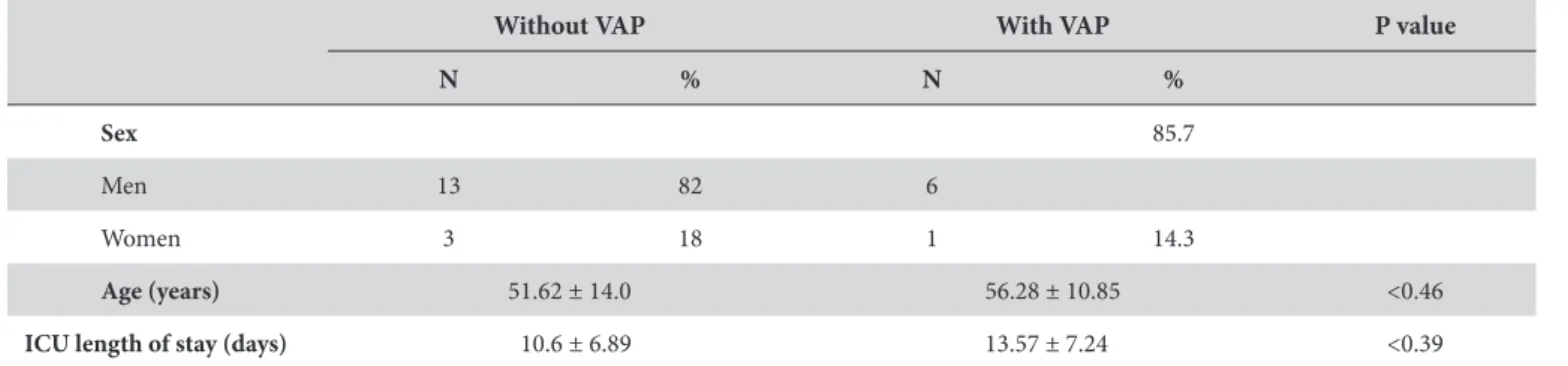
he PDI, PI, and DMF indices were assessed in 23 patients intubated for more than 48 h in our hospital’s ICU. he demographic data of the analyzed patients are presented in Table 1.
Table 2 presents the periodontal condition of patients, categorized according to the dependent variable in the study— the presence of VAP. When the frequency of the presence or absence of periodontal disease was examined in relation to the presence of VAP, there was no statistically signiicant diference. However, the results showed that the extent of the disease could be a factor that may inluence the onset of VAP. he diference between the groups in relation to the frequency of surfaces with attachment loss above 4 mm was 0.06. In addition, the number of teeth and surfaces with attachment loss above 4 mm was always greater in the group of patients with VAP, and the diference is statistically signiicant for both parameters (P = 0.034 and 0.041, respectively).
Table 1. Demographic data of the individuals included in the survey (N = 23)
Without VAP With VAP P value
N % N %
Sex 85.7
Men 13 82 6
Women 3 18 1 14.3
Age (years) 51.62 ± 14.0 56.28 ± 10.85 <0.46
ICU length of stay (days) 10.6 ± 6.89 13.57 ± 7.24 <0.39
Evaluation of normality by Shapiro–Wilk, statistically signiicant diference by t test.
Table 2. Association between periodontal disease and presence of VAP
Respiratory condition
Without VAP With VAP P value OR (95% CI)
N % N %
Periodontal disease <0.9
Yes 12 75 6 85.7
No 4 25 1 14.3
Medium value of PDI 3.67 ± 1.1 3.98 ± 0.84 0.47
Extent of the disease by tooth 0.6
Subjects with more than 4 teeth with attachment loss > 4 mm 3 18 2 28.5
Subjects with less than 4 teeth with attachment loss > 4 mm 13 82 5 71.5
Average of number of teeth with attachment loss > 4 mm 1.43 ± 0.9 2.83 ± 0.89 0.034**
Extent of the disease by surfaces 0.06 0.01–0.98
Subjects with more than 5 surfaces with attachment loss > 4 mm 4 25 5 71.5
Subjects with less than 5 surfaces with attachment loss > 4 mm 12 75 2 28.5
Average of number of surfaces with attachment loss > 4 mm 3.62 ± 2.1 6.33 ± 1.9 0.041**
Medium value of PI 1.77 ± 0.6 2.33 ± 1.2 0.4
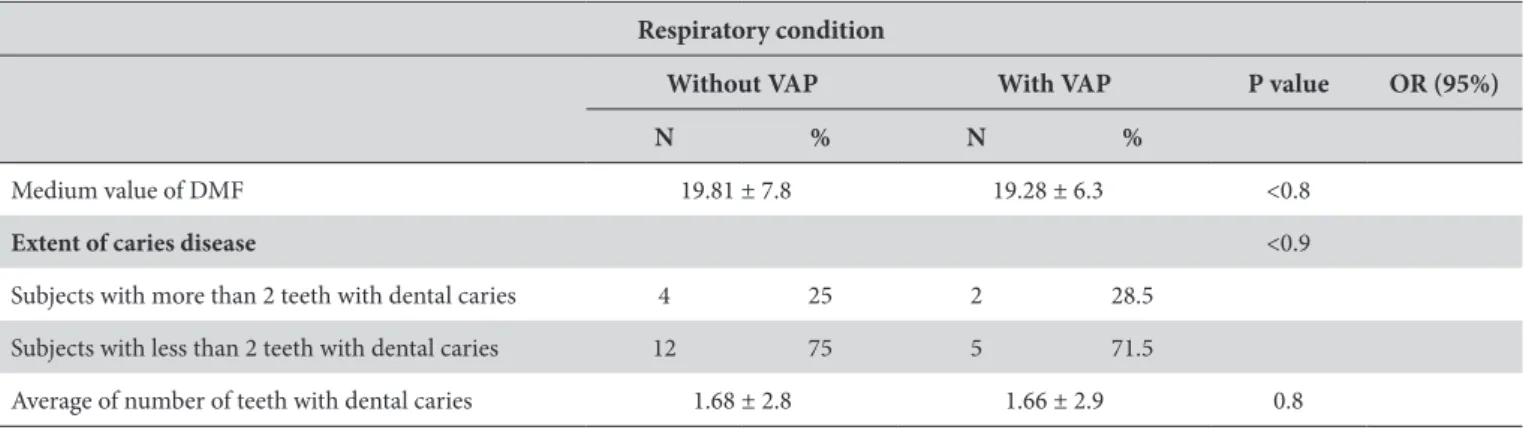
Table 3 presents the condition of dental caries (DMF) in patients, categorized according to the presence of VAP. he average value of the DMF index for patients with VAP was 19.28 ± 6.3 and in patients without VAP was 19.81 ± 7.8 (P > 0.05). In addition, the diference in the frequency of teeth with dental caries was not statistically signiicant; 1.68 ± 2.8 teeth for the group without VAP and 1.66 ± 2.9 for the group with VAP (P > 0.05).
Logistic regression analysis did not detect a positive association or statistically signiicant diference between the various independent variables and the dependent variable (i.e., the presence or absence of VAP).
DISCUSSION
Literature is controversial regarding the association of VAP and periodontal disease. Most of the studies were conducted in populations with a high prevalence of pneumonia, such as hospitalized patients and the elderly in nursing homes.
Scannapieco et al.14 (1998), in an epidemiological study,
found no association between the periodontal status or poor oral hygiene and acute respiratory disease, but reported that there is evidence to support the role of bacteria and/or deicient oral health in the pathogenesis of nosocomial pneumonia. Poor dental health, dental plaque, and bacterial colonization of the oropharynx have been associated with the occurrence of pneumonia in hospitalized patients or in the ICU2,15-19, but a
clear relationship between periodontitis and pneumonia has not always been found20,21.
In our study, we examined 23 individuals who were admitted to the ICU and intubated. When the frequency of the presence or absence of periodontal disease in relation to the presence of VAP was analyzed, we did not ind a statistically signiicant association. However, the presence or absence of periodontal disease is not a rigorously objective criterion, since varying degrees of severity and extent of illness can be found. hus, a further analysis was carried out, looking to assess the degree of disease in the presence or absence of VAP. When we analyzed the extent of the disease, we observed that the frequency of surfaces with attachment loss over 4 mm was greater in the group with VAP (P = 0.06), and
there was a statistically signiicant diference for the 2 parameters (P = 0.034 and 0.041, respectively).
Despite not having observed a statistically signiicant positive association in regression analysis in the present study, these data may suggest that in larger case-control or cohort studies, the association between periodontal disease and VAP can be proven.
hese data corroborate the study by Sharma, Shamsuddin22
(2011), who evaluated patients hospitalized with respiratory disease (test group) and patients who were systemically healthy (control group). hey showed that the greatest probing depths and the greatest values of attachment loss were associated with respiratory disease; speciically, higher degrees of periodontal involvement may increase the risk of pneumonia for hospitalized individuals.
One possible explanation for this is the fact that the patients with the greatest extent of periodontal disease harbor a greater quantity of pathogenic microorganisms. However, these results should be interpreted with caution, since the sample of this study is limited and larger studies and microbiological evaluations should be carried out.
Average values for PDI were 3.98 ± 0.84 for individuals with VAP and 3.67 ± 1.1 for individuals without VAP. hese data seem to relect “moderate periodontitis,” according to the classiication
of the American Academy of Periodontology (AAP) where the
severity of chronic periodontitis corresponds with attachment losses between 3 and 4 mm23. hus, the extent of the disease may
be a factor that inluences the onset of pneumonia.
For the diagnosis of periodontitis, a complete periodontal examination is ideal, using the attachment level associated with a periapical radiographic examination as a parameter. However, the position of the tube, presence of too much secretion in the oral cavity, diiculty in opening the mouth, and reduced time of contact with the patient oten meant more detailed examinations.
In view of these circumstances, the PDI was chosen, as it uses the measure of attachment loss as a parameter of the deinition of periodontitis in these teeth: 16, 21, 24, 36, 41, and 44. Despite being a simpliied index, it is reliable in detecting the presence of attachment loss.
Table 3. Association between DMF index and presence of VAP
Respiratory condition
Without VAP With VAP P value OR (95%)
N % N %
Medium value of DMF 19.81 ± 7.8 19.28 ± 6.3 <0.8
Extent of caries disease <0.9
Subjects with more than 2 teeth with dental caries 4 25 2 28.5
Subjects with less than 2 teeth with dental caries 12 75 5 71.5
Average of number of teeth with dental caries 1.68 ± 2.8 1.66 ± 2.9 0.8
However, recent studies24 showed that partial exams like
the Ramjord index (PDI) tend to underestimate the extent of periodontal disease. herefore, future studies that seek to evaluate the inluence of periodontal diseases on VAP should conduct a whole mouth assessment.
Systematic reviews have shown a link between poor oral health and pneumonia25,26. Aspiration of periodontal pathogens
and bacteria associated with dental caries in dental plaque and saliva has been considered a risk factor for pneumonia in elderly patients in asylums27,28, a fact that supports the use of the DMF
index.
In the present study, the medium value of the DMF index of patients with VAP was 19.28 ± 6.3, and in patients without VAP was 19.81 ± 7.8 (P > 0.05). In addition, the frequency of teeth with dental caries did not have a statistically signiicant association with VAP. he frequency was 1.68 ± 2.8 teeth for the group without VAP and 1.66 ± 2.9 for the group with VAP (P > 0.05). hese values relect an adult population with missing teeth (lost), dental caries, teeth with prosthetic treatment, and several restored teeth.
his index was also used by Fourrier et al.29 (2005) for the
evaluation of dental status, because of its recommendation by the WHO and the International Dental Federation. he authors studied the efect of decontamination with chlorhexidine 0.2% gel in patients with nosocomial infection acquired in an ICU. he study was double blinded. In the study group, the DMF medium was 19.0 ± 8.8, and in the placebo group, it was 20.2 ± 8.6. he data from this study are in agreement and corroborate the results
of Bourgeois et al.30 (1999), who evaluated the dental status of an
adult population in France.
In this study, it was observed that there was no signiicant diference between patients with VAP and without VAP in relation to the PI.
Sharma, Shamsuddin22 (2011) also reported that patients with
respiratory illness had much worse periodontal conditions than did healthy control group patients, when the PI and gingival index were evaluated. he lack of a statistically signiicant diference in the plaque index in the present study is probably because there is an oral hygiene protocol for ICU patients. his may increase the strength of periodontal disease as a risk factor for VAP.
CONCLUSION
Within the limitations of the study, we can conclude that the extent of periodontal disease may be a factor that contributes to the onset of VAP. However, studies with a larger sample are needed to validate this relationship.
ACKNOWLEDGEMENTS
he authors would like to thank the team of doctors, nurses, physiotherapists, nursing auxiliaries, and nutritionists from viValle Hospital’s ICU and Fundação de Amparo à Pesquisa do Estado de São Paulo – FAPESP, for the Scientiic Initiation Fellowship, grant number: 2010/06736-0.
REFERENCES
1. Chandki R, Banthia P, Banthia R. Bioilms: a microbial home. J Indian Soc Periodontol. 2011 Apr; 15(2): 111-4. PMid:21976832 PMCid:3183659. http://dx.doi.org/10.4103/0972-124X.84377
2. Scannapieco FA, Stewart EM, Mylotte JM. Colonization of dental plaque by respiratory pathogens in medical intensive care patients. Crit Care Med. 1992 Jun; 20(6): 740-5. PMid:1597025. http://dx.doi.org/10.1097/00003246-199206000-00007
3. Fields LB. Oral care intervention to reduce incidence of ventilator-associated pneumonia in the neurologic intensive care unit. J Neurosci Nurs. 2008 Oct; 40(5): 291-8. PMid:18856250. http://dx.doi.org/10.1097/01376517-200810000-00007
4. Susin C, Dalla Vecchia CF, Oppermann RV, Haugejorden O, Albandar JM. Periodontal attachment loss in an urban population of brazilian adults: efect of demographic, behavioral, and environmental risk indicators. J Periodontol. 2004 Jul; 75(7): 1033-41. PMid:15341364. http://dx.doi.org/10.1902/jop.2004.75.7.1033
5. Rello J, Koulenti D, Blot S, Sierra R, Diaz E, De Waele JJ, et al. Oral care practices in intensive care units: a survey of 59 European ICUs. Intensive Care Med. 2007 Jun; 33(6): 1066-70. PMid:17384927. http://dx.doi.org/10.1007/s00134-007-0605-3
6. Abidia RF. Oral care in the intensive care unit: a review. J Contemp Dent Pract. 2007 Jan; 8(1): 76-82. PMid:17211508.
7. Berry AM, Davidson PM. Beyond comfort: oral hygiene as a critical nursing activity in the intensive care unit. Intensive Crit Care Nurs. 2006 Dec; 22(6): 318-28. PMid:16806933. http://dx.doi.org/10.1016/j.iccn.2006.04.003
8. Munro CL, Grap MJ, Jones DJ, McClish DK, Sessler CN. Chlorhexidine, toothbrushing and preventing ventilator-associated pneumonia in critically ill adults. Am J Crit Care. 2009 Sep; 18(5): 428-37. PMid:19723863. http://dx.doi.org/10.4037/ajcc2009792
9. Elward AM, Warren DK, Fraser VJ. Ventilator-associated pneumonia in pediatric intensive care unit patients: risk factors and outcomes. Pediatrics. 2002 May; 109(5): 758-64. PMid:11986433. http://dx.doi.org/10.1542/peds.109.5.758
10. Weireter LJ Jr, Collins JN, Britt RC, Reed SF, Novosel TJ, Britt LD. Impact of a monitored program of care on incidence of ventilator– associated pneumonia: results of a longterm performance-improvement project. J Am Coll Surg. 2009 May; 208(5): 700-4. PMid:19476819. http://dx.doi.org/10.1016/j.jamcollsurg.2009.01.041
11. Ramjord SP. Indices for prevalence and incidence of periodontal disease. J Periodontol. 1959; 30: 51-9.
13. Klein H, Palmer CE. Dental caries in American Indian children. Public Health Bull. 1937; 239:1-53.
14. Scannapieco FA, Papandonatos GD, Dunford RG. Associations between oral conditions and respiratory disease in a national sample survey population. Ann Periodontol. 1998 Jul; 3(1): 251-6. PMid:9722708. http://dx.doi.org/10.1902/annals.1998.3.1.251
15. Bonten MJ, Bergmans DC, Ambergen AW, de Leeuw PW, van der Geest S, Stobberingh EE, et al. Risk factors for pneumonia, and colonization of respiratory tract and stomach in mechanically ventilated ICU patients. Am J Respir Crit Care Med. 1996 Nov; 154(5): 1339-46. PMid:8912745. http://dx.doi.org/10.1164/ajrccm.154.5.8912745
16. Garrouste-Orgeas M, Chevret S, Arlet G, Marie O, Rouveau M, Popof N, et al. Oropharyngeal or gastric colonization and nosocomial pneumonia in adult intensive care unit patients. A prospective study based on genomic DNA analysis. Am J Respir Crit Care Med. 1997 Nov; 156(5): 1647-55. PMid:9372689. http://dx.doi.org/10.1164/ajrccm.156.5.96-04076
17. Fourrier F, Duvivier B, Boutigny H, Roussel-Delvallez M, Chopin C. Colonization of dental plaque: a source of nosocomial infections in intensive care unit patients. Crit Care Med. 1998 Feb; 26(2): 301-8. PMid:9468169. http://dx.doi.org/10.1097/00003246-199802000-00032
18. Preston AJ, Gosney MA, Noon S, Martin MV. Oral lora of elderly patients following acute medical admission. Gerontology. 1999 Jan-Feb; 45(1): 49-52. PMid:9852381. http://dx.doi.org/10.1159/000022055
19. El-Solh AA, Pietrantoni C, Bhat A, Okada M, Zambon J, Aquilina A, et al. Colonization of dental plaques: a reservoir of respiratory pathogens for hospital-acquired pneumonia in institutionalized elders. Chest. 2004 Nov; 126(5): 1575-82. PMid:15539730. http://dx.doi. org/10.1378/chest.126.5.1575
20. Chabrand F, Allamand JM, Duroux P, Rabate B, Laudenbach P, Doyon D. Are orodental infectious foci responsible for bacterial pneumopathies? A statistical study. Rev Stomatol Chir Maxillofac. 1986; 87(2): 73-7. PMid:3460159.
21. Treloar DM, Stechmiller JK. Use of a clinical assessment tool for orally intubated patients. Am J Crit Care. 1995 Sep; 4(5): 355-60. PMid:7489038.
22. Sharma N, Shamsuddin H. Association between repiratory disease in hospitalized patients and periodontal disease: a cross-sectional study. J Periodontol. 2011 Aug; 82(8): 1155-60. PMid:21219100. http://dx.doi.org/10.1902/jop.2011.100582
23. Flemmig TF. Periodontitis. Ann Periodontol. 1999 Dec; 4(1): 32-8. PMid:10863373. http://dx.doi.org/10.1902/annals.1999.4.1.32
24. Albandar JM. Underestimation of periodontitis in NHANES surveys. J Periodontol. 2011 Mar; 82(3): 337-41. PMid:21214340. http:// dx.doi.org/10.1902/jop.2011.100638
25. Scannapieco FA, Bush RB, Paju S. Associations between periodontal disease and risk for nosocomial bacterial pneumonia and chronic obstructive pulmonary disease. A systematic review. Ann Periodontol. 2003 Dec; 8(1): 54-69. PMid:14971248. http://dx.doi.org/10.1902/ annals.2003.8.1.54
26. Azarpazhooh A, Leake JL. Systematic review of the association between respiratory diseases and oral health. J Periodontol. 2006 Sep; 77(9): 1465–82. PMid:16945022. http://dx.doi.org/10.1902/jop.2006.060010
27. Langmore SE, Terpenning MS, Schork A, Chen Y, Murray JT, Lopatin D, et al. Predictors of aspiration pneumonia: how important is dysphagia? Dysphagia. 1998 Spring; 13(2): 69–81. PMid:9513300. http://dx.doi.org/10.1007/PL00009559
28. Terpenning MS, Taylor GW, Lopatin DE, Kerr CK, Dominguez BL, Loesche WJ. Aspiration pneumonia: dental and oral risk factors in an older veteran population. J Am Geriatr Soc. 2001 May; 49(5): 557-63. PMid:11380747. http://dx.doi.org/10.1046/j.1532-5415.2001.49113.x
29. Fourrier F, Dubois D, Pronnier P, Herbecq P, Leroy O, Desmettre T, et al. Efect of gingival and dental plaque antiseptic decontamination on nosocomial infections acquired in the intensive care unit: a double-blind placebo-controlled multicenter study. Crit Care Med. 2005 Aug; 33(8): 1728-35. PMid:16096449. http://dx.doi.org/10.1097/01.CCM.0000171537.03493.B0
30. Bourgeois D, Berger P, Hescot P, Leclercq MH, Doury J. Oral health status in 65-74 years old adults in France, 1995. Rev Epidemiol Sante Publique. 1999 Mar; 47(1): 55-9. PMid:10214677.
CONFLICTS OF INTERESTS
he authors declare no conlicts of interest.
CORRESPONDING AUTHOR
Andrea Carvalho De Marco
Departamento de Diagnóstico e Cirurgia / Disciplina de Periodontia
Av. Engenheiro Francisco José Longo, 777, Jardim São Dimas, 12245-000 São José dos Campos - SP, Brazil e-mail: [email protected]