A Risk Score for Predicting Peripheral Arterial Disease in Individuals
75 Years or Older
Marcia Makdisse, Luiz Roberto Ramos, Frederico Moreira, Anderson Oliveira, Otavio Berwanger, Alcione Moscardi,
Virginia Junqueira, Evandro Rodrigues, Antonio Carlos Carvalho
Universidade Federal de São Paulo, Hospital Israelita Albert Einstein - São Paulo, SP - Brazil
Summary
Background: The prevalence of peripheral arterial disease (PAD) in the elderly is high. Most are asymptomatic and the sensitivity of the physical exam is low. In Brazil, little is known in regard to PAD risk factors in the elderly.
Objectives: To identify risk factors for PAD among elderly individuals (≥ 75 years) in the community and to develop a prediction score.
Methods: Cross-sectional, prospective, community-based study nested within a cohort study (“Epidoso”). A total of 176 individuals were assessed. PAD was deined as an ankle-brachial index ≤0.9. Risk factors associated with PAD were entered into a multivariate logistic regression model. Statistical modeling was used to formulate a score according to the likelihood of PAD. A p value <0.05 was signiicant.
Results: PAD was present in 36.4% of participants. Abnormal pedal pulses, hypertension, cigarette smoking, and complain of leg pain/discomfort in either leg on walking were predictors of PAD. Based on the coeicients of the logistic regression, these variables were given scores of 13, 9, 5 and 5, respectively. A cutof point >18 points deined the “high risk” individuals and yielded sensitivity, speciicity, positive predictive value and negative predictive value of 85.9%, 71.4%, 63.2% and 89.9%, respectively. Receiver-operator characteristic analysis yielded area under curve of 85%, indicating excellent discrimination and goodness-of-it statistics indicated excellent calibration (p=0.639).
Conclusion: Because of its good performance, the proposed score can become a simple and useful tool to identify elderly community residents at higher risk of PAD who should be considered for further investigation. (Arq Bras Cardiol 2007;88(6):555-561)
Key words: Arterial occlusive diseases, risk, aged.
Mailing address: Marcia Makdisse •
Rua Dr. Franco da Rocha, 205/51 - 05015-040 - São Paulo, SP - Brazil E-mail: [email protected] / [email protected]
Manuscript received November 4, 2006; revised received December 24, 2006; accepted January 17, 2007.
Introduction
The prevalence of Peripheral Arterial Disease (PAD) increases with age. In the NHANES study, the PAD prevalence for patients over the age of 70 was 14 times higher than for individuals under the age of 501. Among the 3,450 elderly
American men of Japanese descent evaluated in the Honolulu Heart Program, the presence of PAD, deined as an ankle-brachial index (ABI) ≤ 0.90, was a marker of generalized atherosclerotic disease2. The rates of concomitant coronary
artery disease and ischemic stroke with PAD reported for octogenarians are 68% and 42%, respectively3. PAD is
associated with higher cardiovascular morbidity and mortality and functional impairment in the lower limbs regardless of whether the patient is symptomatic or asymptomatic4,5.
Even though the elderly population is a high risk group for PAD, identifying patients with the disease is not always simple. The medical history and clinical examination have limited
value. Most patients, especially the older ones, do not present intermittent claudication, a classic symptom of the disease6. If
the PAD diagnosis were based solely on the presence of typical intermittent claudication, 85 to 90% of the cases would go undetected and if it were based solely on the medical exam half of the cases would go undetected7-8. The ABI is a simple
and cost-efective test for monitoring PAD in clinical practice; however more widespread use of this test is required9.
The aim of the PAD risk score proposed in this study is to identify individuals 75 years or older living in the community, who are at greater risk to develop PAD and should be submitted to more thorough assessments including the ABI measurement.
Methods
Design - Cross-sectional study, nested in a cohort study (Epidoso Study).
of the 55 districts in the city of Sao Paulo, all residents 65 or older were invited to participate in the study. The study area was the catchment area of Federal University of São Paulo Center for the Study of Aging. The original cohort consisted of 1,667 individuals who were recruited in 1991. The methods and preliminary results of the Epidoso Study have been published10-11.
Eligibility -
• Inclusion criteria: Male and female participants of the Epidoso study.
• Exclusion criteria:
- Conditions that impaired ABI measurement: amputation, extensive ulcerations, fractures, pain in lower limbs, severe cognitive impairment, patient refusal;
- ABI > 1.40. These values indicate non-compressible leg arteries and are non-diagnostic of PAD.
Study participants - The Epidoso participants that fulilled the eligibility criteria and signed the consent form were included in the study. The project was approved by the Ethics Committee of the Federal University of São Paulo.
Case deinition -
• Presence of PAD: ABI values of 0.90 or less in either leg. • Absence of PAD: ABI values between 0.91 and 1.40 in the absence of previous lower extremity arterial revascularization procedures.
Definition of intermittent claudication - The presence of intermittent claudication was evaluated using the Brazilian Portuguese Version of the Edinburgh Claudication Questionnaire12.
Deinition of pain/discomfort in either while walking - This is the irst question on the Edinburgh Claudication Questionnaire which was analyzed as an independent variable. A positive response determined the presence of the symptom.
Deinition of abnormal pedal pulses - The pulses were bilaterally palpated on the dorsalis pedis and posterior tibial arteries and classiied as present, absent or asymmetrical. The pulses, even though they were present, were considered asymmetrical when the intensity of the pulse was diferent in the opposite limb.
Data collection - The patient’s clinical data were obtained from the Epidoso databank and included demographics, risk factors, comorbidities, laboratory and imaging tests.
ABI measurement - After 5 minutes of bed rest, ABI was measured in the supine position using a hand-held vascular Doppler (10 Mhz, Medmega, Brazil) and an aneroid blood pressure device. The cuf size was selected according to the participant’s right arm circumference (AC) at the midpoint between the acromion and olecranon. Inlatable cufs in the following lengths were used: AC < 25 cm – 10cm, AC from 25-32 cm – 12cm, AC >32-42 cm – 16cm and AC > 42 cm – 20cm. Systolic blood pressure was measured for the brachial, dorsalis pedis and posterior tibial arteries. Two readings were taken for each artery and the average was calculated. If the diference between the two readings was > 6 mmHg, two more readings were taken. An ABI value was calculated for each lower limb, using the highest systolic pedal pressure
reading divided by the highest brachial pressure reading13.
Laboratory tests - The lipid profile, creatinine and homocysteine levels were obtained from the Epidoso databank.
Statistical analysis - Univariate logistic regression analysis was used to determine the association between risk factors and outcome (presence of PAD). Variables that presented p<0.25, were included in a multivariate logistic regression model with backward stepwise elimination. Variables that attained a level of signiicance (p<0.05) were kept in the model14. The inal
multivariate regression model was obtained using the forward stepwise variable selection method, where variables with p<0.25 were initially included and variables with p<0.05 were kept in the model.
A weighted risk score was constructed using logistic regression coeicients. These coeicients were converted into scores (multiplied by 10 and rounded of to the nearest whole number) that were added up to obtain an aggregated score15.
Two performance indexes were used to estimate the discriminatory power and calibration of the predictive model. The discriminatory power was evaluated using the area under the ROC curve (receiver operating characteristic curve)16 and
the calibration was measured using the Hosmer-Lemeshow goodness-of-it test17. According to Hosmer-Lemeshow, areas
under the curve between 80% and 90% are consistent with excellent discriminatory power and calibration is adequate if the Hosmer-Lemeshow statistics has a p value of > 0.0514.
The optimum cut-off point for the score was determined using the score values plotted on the ROC curve. Signiicance was established as p < 0.05. All statistical analysis were performed using SAS (Statistical Analysis System), version 8.2 (SAS Institute, Cary, NC).
This study was funded by CAPES (Coordenação de Aperfeiçoamento de Pessoal de Nível Superior) and the EPIDOSO Study by FAPESP (Fundação de Amparo à Pesquisa do Estado de São Paulo).
Results
From the 226 patients invited to participate in the study, 178 (78.8%) accepted. Reasons for not participating in the study included severe cognitive impairment, long-term institutional care and change of address. Two of the patients who agreed to participate in the study were excluded as they had an ABI > 1.40 (1.1%) resulting in a inal sample size of 176. The PAD prevalence was 36.4% (n=64). Mean participant age was 82.7 ± 4.04 years (range: 75-94) which, although not statistically signiicant, was slightly higher in the PAD group (83.4 ± 4.2 years and 82.2 ± 4.2 years, p=0.07). Women predominated (68.7%); but PAD prevalence was similar for both genders (33.9% females and 41.8% males, p=0.311).
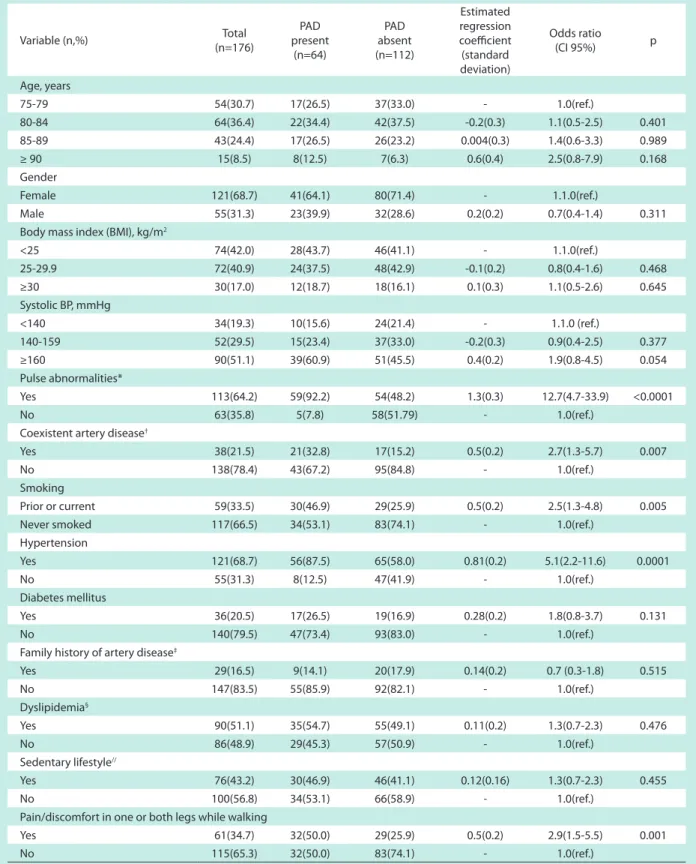
Univariate logistic regression - The results of the univariate analysis are shown in Table 1. Smoking was analyzed as a sum of current and previous smokers due to the small percentage of current smokers in the sample (total of 11 current smokers, 7 with PAD).
Table 1 - Univariate analysis of the clinical parameters of the 176 elderly patients (≥ 75 years) in relation to the presence of peripheral arterial disease (PAD)
Variable (n,%) Total
(n=176)
PAD present
(n=64)
PAD absent (n=112)
Estimated regression coeicient (standard deviation)
Odds ratio
(CI 95%) p
Age, years
75-79 54(30.7) 17(26.5) 37(33.0) - 1.0(ref.)
80-84 64(36.4) 22(34.4) 42(37.5) -0.2(0.3) 1.1(0.5-2.5) 0.401
85-89 43(24.4) 17(26.5) 26(23.2) 0.004(0.3) 1.4(0.6-3.3) 0.989
≥ 90 15(8.5) 8(12.5) 7(6.3) 0.6(0.4) 2.5(0.8-7.9) 0.168
Gender
Female 121(68.7) 41(64.1) 80(71.4) - 1.1.0(ref.)
Male 55(31.3) 23(39.9) 32(28.6) 0.2(0.2) 0.7(0.4-1.4) 0.311
Body mass index (BMI), kg/m2
<25 74(42.0) 28(43.7) 46(41.1) - 1.1.0(ref.)
25-29.9 72(40.9) 24(37.5) 48(42.9) -0.1(0.2) 0.8(0.4-1.6) 0.468
≥30 30(17.0) 12(18.7) 18(16.1) 0.1(0.3) 1.1(0.5-2.6) 0.645
Systolic BP, mmHg
<140 34(19.3) 10(15.6) 24(21.4) - 1.1.0 (ref.)
140-159 52(29.5) 15(23.4) 37(33.0) -0.2(0.3) 0.9(0.4-2.5) 0.377
≥160 90(51.1) 39(60.9) 51(45.5) 0.4(0.2) 1.9(0.8-4.5) 0.054
Pulse abnormalities*
Yes 113(64.2) 59(92.2) 54(48.2) 1.3(0.3) 12.7(4.7-33.9) <0.0001
No 63(35.8) 5(7.8) 58(51.79) - 1.0(ref.)
Coexistent artery disease†
Yes 38(21.5) 21(32.8) 17(15.2) 0.5(0.2) 2.7(1.3-5.7) 0.007
No 138(78.4) 43(67.2) 95(84.8) - 1.0(ref.)
Smoking
Prior or current 59(33.5) 30(46.9) 29(25.9) 0.5(0.2) 2.5(1.3-4.8) 0.005
Never smoked 117(66.5) 34(53.1) 83(74.1) - 1.0(ref.)
Hypertension
Yes 121(68.7) 56(87.5) 65(58.0) 0.81(0.2) 5.1(2.2-11.6) 0.0001
No 55(31.3) 8(12.5) 47(41.9) - 1.0(ref.)
Diabetes mellitus
Yes 36(20.5) 17(26.5) 19(16.9) 0.28(0.2) 1.8(0.8-3.7) 0.131
No 140(79.5) 47(73.4) 93(83.0) - 1.0(ref.)
Family history of artery disease‡
Yes 29(16.5) 9(14.1) 20(17.9) 0.14(0.2) 0.7 (0.3-1.8) 0.515
No 147(83.5) 55(85.9) 92(82.1) - 1.0(ref.)
Dyslipidemia§
Yes 90(51.1) 35(54.7) 55(49.1) 0.11(0.2) 1.3(0.7-2.3) 0.476
No 86(48.9) 29(45.3) 57(50.9) - 1.0(ref.)
Sedentary lifestyle//
Yes 76(43.2) 30(46.9) 46(41.1) 0.12(0.16) 1.3(0.7-2.3) 0.455
No 100(56.8) 34(53.1) 66(58.9) - 1.0(ref.)
Pain/discomfort in one or both legs while walking
Yes 61(34.7) 32(50.0) 29(25.9) 0.5(0.2) 2.9(1.5-5.5) 0.001
No 115(65.3) 32(50.0) 83(74.1) - 1.0(ref.)
legs while walking was more frequent than intermittent claudication (37.7% versus 15.9%). Concomitant leg pain/ discomfort in either leg at rest was the reason for not meeting the claudication criteria for 80% of the elderly patients with PAD. To avoid the efect of various confounding variables, two separate univariate regression models were used, one including pain/discomfort in either leg while walking and another including claudication. The two variables were associated with PAD (p=0.001 and p <0.0001, respectively). Due to the low prevalence of claudication and the independent association between PAD and pain/discomfort in either leg while walking, the latter variable was maintained in the inal logistic regression model.
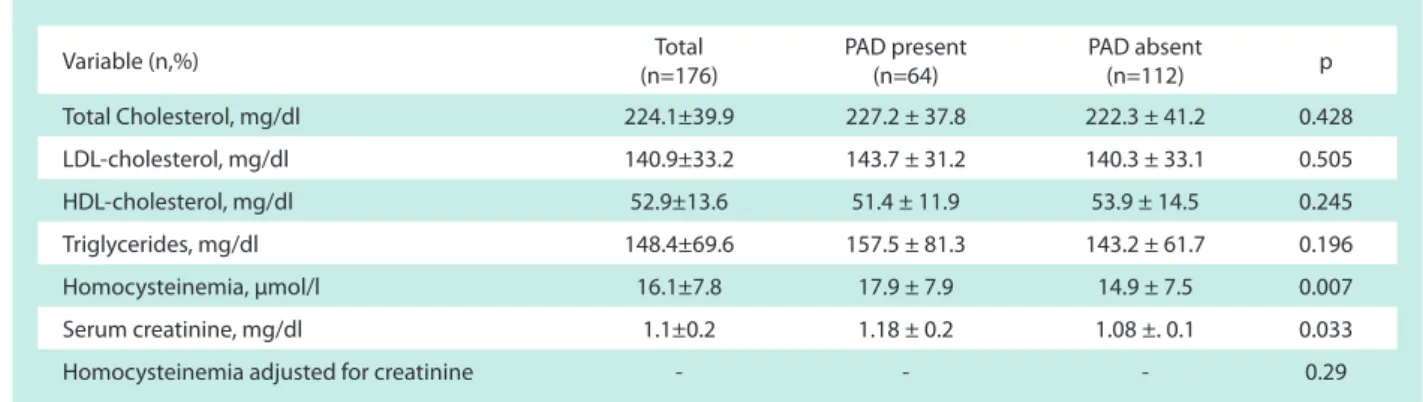
No association was found between PAD and total cholesterol, LDL cholesterol, HDL cholesterol or triglyceride levels. The PAD group presented higher homocysteine and serum creatinine levels. After adjustment for creatinine levels no association was found between homocysteine levels and PAD (Table 2).
Multivariate logistic regression - The independent predictor variables of PAD are shown in Table 3.
Risk score calculation - A numerical score was formulated using logistic regression coeicients. Abnormal pedal pulse palpation, hypertension, current or prior smoking and pain or discomfort in either leg while walking received scores of 13, 9, 5 and 5, respectively. Based on the classiication table, derived from the logistic regression, and ROC curve analysis, the optimal cut-of point for the prediction of PAD resulted from a pre-test probability of 0.34, equivalent to a score >
Table 3 - Logistic regression analysis of the clinical parameters related to peripheral artery disease
Variable
Estimated regression coeicient (standard deviation)
Odds
ratio CI 95% p
Score (points)
Abnormal pedal pulses 1.3(0.3) 14.1 4.9-40.4 <0.0001 13
Hypertension 0.9(0.2) 6.1 2.4-15.8 0.0002 9
Smoking (prior or current) 0.5(0.2) 2.9 1.3-6.6 0.010 5
Pain/discomfort in either leg while walking 0.5(0.2) 2.5 1.1-5.5 0.025 5
Table 2 - Univariate analysis of the laboratory parameters of the 176 elderly patients (≥ 75 years) in relation to the presence of peripheral artery disease (PAD)
Variable (n,%) (n=176)Total PAD present(n=64) PAD absent(n=112) p
Total Cholesterol, mg/dl 224.1±39.9 227.2 ± 37.8 222.3 ± 41.2 0.428
LDL-cholesterol, mg/dl 140.9±33.2 143.7 ± 31.2 140.3 ± 33.1 0.505
HDL-cholesterol, mg/dl 52.9±13.6 51.4 ± 11.9 53.9 ± 14.5 0.245
Triglycerides, mg/dl 148.4±69.6 157.5 ± 81.3 143.2 ± 61.7 0.196
Homocysteinemia, µmol/l 16.1±7.8 17.9 ± 7.9 14.9 ± 7.5 0.007
Serum creatinine, mg/dl 1.1±0.2 1.18 ± 0.2 1.08 ±. 0.1 0.033
Homocysteinemia adjusted for creatinine - - - 0.29
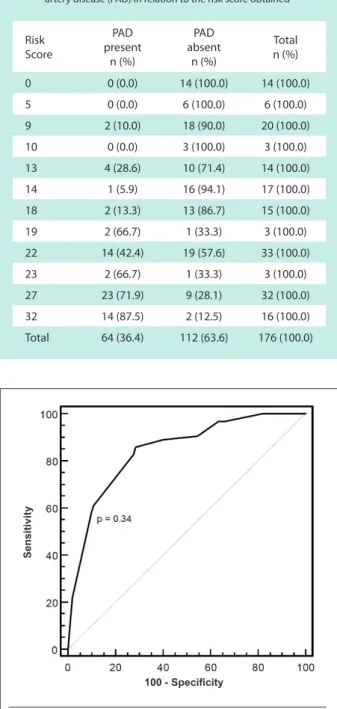
18 points. Sensitivity, speciicity, positive predictive value and negative predictive value were 85.9%, 71.4%, 63.2% and 89.9%, respectively. The equation used to calculate the PAD Risk Score for each patient was: PAD Risk Score = 13 (abnormal pedal pulses) + 9 (hypertension) + 5 (prior or current smoking) + 5 (pain/discomfort in either leg while walking). For each of the items, a value of “1” was assigned if the variable was “present” or “0” if it was “absent”. If the total score was > 18, the individual was classiied as “High risk for PAD”; otherwise, “Low Risk for PAD” (Table 4).
A ROC curve was plotted to test the ability of the score to correctly predict the presence of PAD. The sensitivity and speciicity values for each score were plotted on a two dimensional graph (xy) where the y axis was equal to the sensitivity and the x axis was equal to 100-speciicity. The area under the ROC curve was 85%, indicating excellent model discriminatory power (Figure 1). The goodness-of-it test value was 5.17 with seven degrees of freedom, indicating excellent model calibration for the observed versus the predicted outcome (p=0.639).
Discussion
Table 4 - Distribution of the individuals, with and without peripheral artery disease (PAD) in relation to the risk score obtained
Risk Score
PAD present
n (%)
PAD absent
n (%)
Total n (%)
0 0 (0.0) 14 (100.0) 14 (100.0)
5 0 (0.0) 6 (100.0) 6 (100.0)
9 2 (10.0) 18 (90.0) 20 (100.0)
10 0 (0.0) 3 (100.0) 3 (100.0)
13 4 (28.6) 10 (71.4) 14 (100.0)
14 1 (5.9) 16 (94.1) 17 (100.0)
18 2 (13.3) 13 (86.7) 15 (100.0)
19 2 (66.7) 1 (33.3) 3 (100.0)
22 14 (42.4) 19 (57.6) 33 (100.0)
23 2 (66.7) 1 (33.3) 3 (100.0)
27 23 (71.9) 9 (28.1) 32 (100.0)
32 14 (87.5) 2 (12.5) 16 (100.0)
Total 64 (36.4) 112 (63.6) 176 (100.0)
Fig. 1 - ROC (Receiver operator characteristic) Curve. The area under the curve was 85%, demonstrating the model’s excellent discriminatory power.
100 - Speciicity
Sensitivity
0.90, a high prevalence of PAD (36%) was found which agrees with the indings of other studies evaluating the elderly. In the Rotterdam study, for instance, the prevalence of PAD in those aged 85 years or older approached 60%18.
Pedal pulses abnormalities, hypertension, prior or current smoking and pain/discomfort in either leg while walking were identiied as independent predictors of PAD in the present study. Based on the regression coeicients, a numerical risk score was formulated to assess the individual likelihood of presenting PAD; it enabled the stratiication of individuals
into “high risk” (Total score > 18 points) or “low risk” (Total score ≤ 18 points) for the presence of PAD.
The presence of abnormal pedal pulses was the strongest predictor of PAD in this cohort (odds ratio = 14.1). According to published data, pulse palpation is the single most important part of the physical examination in screening for PAD and abnormal pedal pulses a powerful predictor of the disease, even though the sensitivity and specificity of palpation may vary depending on factors related to the patient and the examiner19-21.
Smoking, hypertension and diabetes mellitus are among the cardiovascular risk factors most consistently linked to PAD in studies that involved elderly cohorts2,3,22. In the present study,
even though most of the diabetics were in the PAD group, no diferences were observed between the groups (26.5% versus 16.9%, p=0.131). This lack of association between diabetes and PAD could have been secondary to the mild diabetes proile presented by the patients (100% with diabetes for less than 10 years, 25% controlled with diet alone and only 17% requiring insulin) that could have reduced the force of association between the two conditions, or sample size was perhaps insuicient to detect the diference, or both.
The lack of association between dyslipidemia and PAD has already been reported. In the Honolulu Heart Program, PAD was associated with high and low cholesterol levels and in the GetABI study no clear association between cholesterol and PAD was observed2,23. These data suggest that in the elderly,
cholesterol is more important as a marker of comorbidity overload than of cardiovascular risk.
No association between a sedentary lifestyle and PAD was observed in our sample. The reduction in physical activity could be a result of functional impairment in the lower limbs provoked by PAD, which causes the patients to reduce physical activity2. The rate of physical inactivity in the present study
was low (43%), considering the deinition adopted (moderate physical activity < 90 minutes per week, regardless of the frequency) and the age proile of the population. In the Estudo Multicêntrico de Idosos (Multicenter Study of the Elderly) the sedentary lifestyle rate, even using the most lenient deinition (physical activity < 15 minutes, 2 times per week) was 74%24.
It is possible that the ten-plus year relationship with the interdisciplinary team of the Epidoso study, stimulated this population to perform physical exercise.
There was no association between BMI and PAD. In literature this association is controversial. Some studies, such as the Honolulu Heart Program, found an association whereas others, such as NHANES, did not9,15. In relation to homocysteine,
the initial difference was eliminated after adjustments for creatinine. In the GetABI study, hyperhomocysteinemia, after adjustments for various factors including creatinine, had a weak association with PAD (odds ratio = 1.4)25.
References
1. Selvin E, Erlinger TP. Prevalence of and risk factors for peripheral arterial disease in the United States: results from the National Health and Nutrition Examination Survey, 1999-2000. Circulation. 2004; 110: 738-43.
2. Curb JD, Masaki K, Rodriguez BL, Abbott RD, Burchfiel CM, Chen R, et al. Peripheral Arterial Disease and Cardiovascular Risk Factors in the Elderly. The Honolulu Heart Program. Arterioscler Thromb Vasc Biol. 1996; 16: 1495-500.
3. Ness J, Aronow WS. Prevalence of coexistence of coronary artery disease, ischemic stroke, and peripheral arterial disease in older persons, mean age 80 years, in an academic Hospital-Based Geriatrics Practice. J Am Geriatr Soc. 1999; 47: 1255-6.
4. Newman AB, Sutton-Tyrrell K, Kuller LH. Mortality over four years in SHEP participants with a low ankle-arm index. J Am Geriatr Soc. 1997; 45: 1472-8.
5. Newman AB, Shemanski L, Manolio TA, Cushman M, Mittelmark M, Polak JF, et al. Ankle-arm index as a predictor of cardiovascular disease and mortality in the Cardiovascular Health Study. Arterioscler Thromb Vasc Biol. 1999; 19: 538-45.
6. McDermott MM, Kerwin DR, Liu K, Martin GJ, O’Brien E, Kaplan H, et al. Prevalence and signiicance of unrecognized lower extremity peripheral arterial disease in general medicine practice. J Gen Intern Med. 2001; 16: 384-90.
7. Hirsch AT, Criqui MH, Treat-Jacobson D, Regensteiner JG, Creager MA, Olin JW, et al. Peripheral arterial disease detection, awareness and treatment in primary care. JAMA. 2001; 286: 1317-24.
8. Criqui MH, Fronek A, Klauber MR, Barrett-Connor E, Gabriel S. The sensitivity, speciicity, and predictive value of traditional clinical evaluation of peripheral arterial disease: results from noninvasive testing in a deined population.
Circulation. 1985; 71: 516-21.
9. Belch JJ, Topol EJ, Agnelli G, Bertrand M, Calif RM, Clement DL, et al. Critical issues in peripheral arterial disease detection and management: a call to action. Arch Intern Med. 2003; 163: 884-92.
10. Ramos LR, Toniolo J, Cendoroglo MS, Garcia JT, Najas MS, Perracini M, et al. Two-year follow-up study of elderly residents in S. Paulo, Brazil: methodology and preliminary results. Rev Saude Publica. 1998; 32: 397-407.
11. Ramos LR, Simoes EJ, Albert MS. Dependence in activities of daily living and cognitive impairment strongly predicted mortality in older urban residents in Brazil: a 2-year follow-up. J Am Geriatr Soc. 2001; 49: 1168-75.
12. Makdisse M, Nascimento Neto R, Chagas ACP, Brasil D, Borges JL, Oliveira A, et al. Cross-cultural adaptation and validation of the Brazilian Portuguese Version of The Edinburgh Claudication Questionnaire. Arq Bras Cardiol. 2007; 88(5): 501-6.
13. Makdisse M. Índice tornozelo-braquial: importância e uso na prática clínica. São Paulo: Editora Segmento Farma; 2004.
14. Hosmer DW, Lemeshow S. Applied logistic regression. 2nd ed. New York: John Wiley & Sons Inc; 2000.
15. Moons KG, Harrell FE, Steyerberg EW. Should scoring rules be based on odds ratios or regression coeicients? J Clin Epidemiol. 2002; 55: 1054-5.
16. Hanley JA, McNeil BJ. The meaning and the use of the area under a receiver operating characteristic (ROC) curve. Radiology. 1982; 143: 29-36.
17. Lemeshow S, Hosmer DW. A review of goodness of it statistics for use in the development of logistic regression models. Am J Epidemiol. 1982; 115: 92-106.
discomfort in the legs at rest in 80% of the patients with PAD that jeopardized the sensitivity of the Edinburgh questionnaire. This decision raised the score’s sensitivity, since the detection of claudication is afected by comorbidities that interfere in patient complaints, particularly the elderly, and reduces the sensitivity of the claudication questionnaires26.
Various interesting points can be raised in favor of the usefulness of this new risk score. In the irst place, this is the irst instrument for predicting PAD directed at the population over 75, and while this is a high risk group very few studies have been conducted on this population segment. The second point is to present a better association between sensitivity and speciicity for the detection of the disease than that presented by pedal pulse palpation or the Edinburgh Claudication Questionnaire that were applied separately in this cohort (proposed score: 86% and 71%, abnormal pedal pulses: 92% and 52%, claudication using the Edinburgh questionnaire: 34% and 94%, respectively).
The third point is its simplicity since there are just four questions, three on the patient’s medical history and one on the physical exam. The combination of these variables was also the basis for other PAD detection scores. Among them, two are precise mathematical models, however they are very complex and complicated to be used during a consultation27-28, and one is derived from the Framingham
Study to detect intermittent claudication; however due to the low prevalence of this symptom, its accuracy is jeopardized, especially in the elderly29.
The fourth point is the excellent performance obtained by the model both in relation to the power to distinguish individuals with and without PAD (area under the ROC curve = 85%), and the calibration demonstrated by the goodness-of-it test (5.2, p = 0.639).
Study limitations - This study has some limitations. Since only the survivors of the original cohort could be included, the sample size was limited and therefore only factors strongly related to PAD were detected. This fact could have, for example, concealed a weak association in this population between PAD and diabetes mellitus. Thus, this score could be a useful tool for screening PAD in non-diabetic elderly patients, that in itself is not a problem, since diabetics over the age of 50 should be evaluated for PAD on a routine basis with the ABI test30. Further prospective validation of this score in diferent
populations is required before it can be recommended for use in clinical practice.
Clinical implications - The intent of the proposed risk score is to provide a simple triage tool to identify elderly individuals with high risk for PAD who should undergo more thorough investigations, especially in primary care facilities where the ankle-brachial index measurement is not widely available, which unfortunately is a reality in the majority of facilities in Brazil as well as in several other countries.
Potential Conlict of Interest
18. Meijer WT, Hoes AW, Rutgers D, Bots ML, Hofman A, Grobbee DE. Peripheral arterial disease in the elderly: the Rotterdam Study. Arterioscler Thromb Vasc Biol. 1998; 18: 185-92.
19. TASC Working Group. Management of peripheral arterial disease; TransAtlantic Inter-Society Consensus (TASC). J Vasc Surg. 2000; 31 (1, Part 2): S1-S288.
20. McGee SR, Boyko EJ. Physical examination and chronic lower-extremity ischemia: a critical review. Arch Intern Med. 1998; 158: 1357-64.
21. Boyko EJ, Ahroni JH, Davignon D, Stensel V, Prigeon RL, Smith DG. Diagnostic utility of the history and physical examination for peripheral vascular disease among patients with diabetes mellitus. J Clin Epidemiol. 1997; 50: 659-68.
22. Newman AB, Siscovick DS, Manolio TA. Polak J, Fried LP, Borhani NO, et al. for the Cardiovascular Health Study Collaborative Research Group. Ankle-arm index as a marker of atherosclerosis in the cardiovascular health study. Circulation. 1993; 88: 837-45.
23. Diehm C, Lange S, Trampisch HJ. Relationship between lipid parameters and the presence of peripheral arterial disease in elderly patients. Curr Med Res Opin. 2004; 20: 1873-5.
24. Taddei CFG, Ramos LR, Moraes JC, Wajngarten M, Libberman A, Santos SC, et al. Estudo multicêntrico de idosos atendidos em ambulatórios de cardiologia e geriatria de instituições brasileiras. Arq Bras Cardiol. 1997;
69: 327-33.
25. Darius H, Pittrow D, Haberl R, Trampisch HJ, Schuster A, Lange S, et al. Are elevated homocysteine plasma levels related to peripheral arterial disease? Results from a cross-sectional study of 6880 primary care patients. Eur J Clin Invest. 2003; 33: 751-7.
26. McDermott MM, Mehta S, Greenland P. Exertional leg symptoms other than intermittent claudication are common in peripheral arterial disease. Arch Intern Med. 1999; 159: 387-92.
27. Boyko EJ, Ahroni JH, Davignon D, Stensel V, Prigeon RL, Smith DG. Diagnostic utility of the history and physical examination for peripheral vascular disease among patients with diabetes mellitus. J Clin Epidemiol. 1997; 50: 659-68.
28. Stofers HEJH, Kester ADM, Saiser V, Rindens PELM, Knottnerus JA. Diagnostic value of signs and symptoms associated with peripheral arterial occlusive disease seen in general practice: a multivariable approach. Med Decis Making. 1997; 17: 61-70.
29. Murabito JM, D’Agostino RB, Silbershatz H, Wilson WF. Intermittent claudication: a risk proile from the Framingham Heart Study. Circulation. 1997; 96 (1): 44-9.