English/Portuguese
EPIDEMIOLOGICAL PROFILE OF INTENSIVE USERS OF A PSYCHOSOCIAL CARE
CENTER
PERFIL EPIDEMIOLÓGICO DE USUÁRIOS INTENSIVOS DE UM CENTRO DE ATENÇÃO
PSICOSSOCIAL
PERFIL EPIDEMIOLÓGICO DE LOS USUARIOS INTENSIVOS DE UN CENTRO DE CUIDADOS PSICOSOCIAL
Rosiana Carvalho Costa1, Marcia Oliveira Coelho2, Edilson Martins Rodrigues Neto3, Lidia Audrey Rocha Valadas Marques4, Mara Assef Leitão Lotif5
ABSTRACT
Objective: evaluating the epidemiological profile of intensive users of a Psychosocial Care Center.
Method: a quantitative descriptive study, of a document basis, in the records of people seen intensively in the period from May to July 2010 in the Psychosocial Assistance Center in Regional Executive Secretary VI in Fortaleza-Ceara. Data were analyzed in IBM SPSS Statistics 20 presented in tables. The research project was approved by the Research Ethics Committee, Opinion nº 10029576-2. Results: there were analyzed 35 medical records of intensive patients, observing that females predominated, with low education and income. Among the complaints of symptoms predominated auditory hallucinations, regarding the diseases predominated mood disorder. Conclusion: the public policies of mental health in Fortaleza should act to meeting the needs of changes in CAPS.
Descriptors: Depression; Affective Disorders; Epidemiology.
RESUMO
Objetivo: avaliar o perfil epidemiológico dos usuários intensivos de um Centro de Atenção Psicossocial. Método: estudo descritivo quantitativo, de base documental, nos prontuários de pessoas atendidas de forma intensiva no período de maio a julho de 2010 no Centro de Assistência Psicossocial da Secretaria Executiva Regional VI do município de Fortaleza-Ceará. Os dados foram analisados no Programa IBM SPSS Statistics 20 apresentados em tabelas. O projeto de pesquisa foi aprovado pelo Comitê de Ética em Pesquisa, Parecer de nº 10029576-2. Resultados: foram analisados 35 prontuários de pacientes intensivos, observou-se que o gênero feminino predominou, principalmente de escolaridade e renda baixas. Entre as queixas de sintomatologia predominaram as alucinações auditivas, quanto às patologias predominou o transtorno de humor. Conclusão: as políticas públicas de saúde mental de Fortaleza devem atuar no sentido de atender as necessidades de mudanças no CAPS. Descritores: Depressão; Transtornos Afetivos; Epidemiologia.
RESUMEN
Objetivo: evaluar el perfil epidemiológico de los usuarios intensivos de un Centro de Atención Psicosocial. Método: un estudio descriptivo cuantitativo, de base de documental, en los registros de personas atendidas intensamente en el período mayo-julio, 2010, en el Centro de Asistencia Psicosocial de la Secretaria Ejecutiva Regional VI en Fortaleza-Ceará. Se analizaron los datos en IBM SPSS Statistics 20 presentados en tablas. El proyecto de investigación fue aprobado por el Comité de Ética en la Investigación, Opinión nº 10029576-2. Resultados: eran analizados 35 prontuarios de pacientes intensivos, se observó que las mujeres predominaban, principalmente de baja educación y bajos ingresos. Entre los síntomas de quejas predominan las alucinaciones auditivas, para las enfermedades predominó el trastorno de humor. Conclusión: las políticas públicas de salud mental de Fortaleza deben actuar para satisfacer las necesidades de cambios en el CAPS. Descriptores:
Depresión; Trastornos Afectivos; Epidemiología.
1Nurse, Specialist in Public Health, State University of Ceara/UECE. Fortaleza (CE), Brazil. Email: r[email protected]; 2Nurse,
Doctoral Student of Public Health, Municipality of Fortaleza/PMF. Fortaleza (CE), Brazil. Email: [email protected]; 3Pharmacist, City
of Fortaleza/PMF, Master of Pharmacology, Federal University of Ceara/UFC. Fortaleza (CE), Brazil. Email: [email protected]; 4Dentist, Specialist in Clinical Pharmacology, Federal University of Ceara/UFC. Fortaleza (CE), Brazil. Email: [email protected]; 5Dentist, Master’s Student of Dentistry, Federal University of Ceara/UFC. Fortaleza (CE), Brazil. Email: [email protected]
The existence of mental disorders is as old as the beginning of human existence, but its recognition as pathology, its concept, are recent events in human history, as well as the form of treatment, in which, through technological advances, has allowed knowledge and further research needs to the patient's body, thus reducing the suffering of mental illness sufferers.
Initially, in the history of medicine, psychiatric disorders were referred to in the literature as malignant manifestations, errors, human weaknesses, where individuals called crazy did not have the control of reason. Only from the eighteenth century, with the emergence of psychiatric hospitals in the developed world is that madness took over the definition of mental illness. 1
On April 6th, 2001, the Brazilian legislation in the parliamentary context welcomed the Law 10.216, which provides the protection and rights of people with mental disorders and redirects the care model in mental health, but does not establish clear mechanisms for the progressive extinction of psychiatric hospitals. Although the Ministry of Health criticizes the Federal Law 10.216, recognizes a breakthrough in the new rhythm she represented for the transformation of the mental health care model and the process of Psychiatric Reform in Brazil.2
Within new care proposals there have emerged in Brazil several health centers based in calling for psychiatric reform, taking place emphasis on community mental health services, the CAPS. These are services with reference to treat patients with mental disorders, particularly severe and persistent disorders whose severity of symptoms, justify their inclusion and assistance intensively, community life and promoter in its territory covered. The Ministry of Health, under Decree 336/GM of February 19th, 2002, states that the Psychosocial Care Centers may constitute the modalities; CAPS I, CAPS II, III CAPS, CAPSi and CAPSad. The adoption of new practices in mental health, with the replacement of hospital-centered model, is to allowing people with mental disorders, their families and communities, new forms of more humane treatment with social inclusion and citizenship rescue.³
In Ceara, the psychiatric reform process occurred even before the adoption of Law 10.216; with implementation of mental health services; being the first in Iguatu city, in 1991. 4
In operation since July 2001, CAPS is an integrated service to the Unified Health System (SUS) and regulated by Ordinance No. 336/GM of February 2002. You can search directly the service or be referred by the health system, offering individual and group sessions. The treatment may be ambulatory, semi-intensive and intensive. As the intensive care that for the individual who is in psychological distress, in crisis or severe difficulties in socialization and family life, needing constant attention. This service can be home if necessary. 3
This indicates that knowledge about the epidemiological profile of the patient is important, because it allows to recognizing the reality in which it is inserted and the treatment offered. Because of this are questions which the demographic and clinical social profile of patients in the intensive psychosocial care center.
● Evaluating the epidemiological profile of
intensive users of a Psychosocial Care Center.
This is a descriptive study with a quantitative approach and evidence base. The research unit was a Psychosocial Assistance Center in Regional Executive Secretary VI in Fortaleza-Ceara. The population consisted of patients seen in the unit. The sample consisted of all people seen intensively in the period May to July 2010.
During data collection, there were used the records of intensive patients, namely: social (gender, age, education, income, marital status, religion, place of origin of the reference to the CAPS) and clinical (major complaints, numbers of psychiatric hospitalizations; associated diseases, diagnosis according to the International Classification of Diseases (ICD-10), use of drugs, treatment plan offered by the CAPS).
Data were organized in Spreadsheet IBM SPSS Statistics 20. This program allowed the elaboration of tables, percentage calculations, and descriptive statistics.
The research project was approved by the Research Ethics Committee of the State University of Ceara, under Opinion No. 10029576-2.
There were analyzed 35 records of patients that attended intensive unit from May to July 2010.
OBJECTIVE
RESULTS AND DISCUSSION
METHOD
English/Portuguese
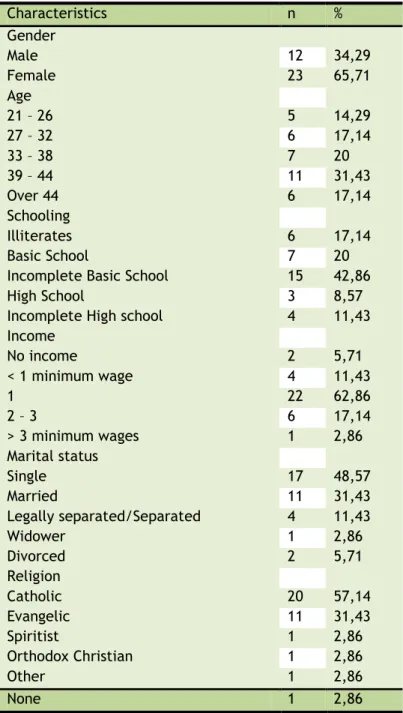
It notes the prevalence of females in 23 patients (65,71%), according to Table1; confirming that psychiatric care practices have particular regard to gender. This concerns both the search for own "relief of suffering by women in health facilities, as the relationship that they have with their peers in their daily lives, in their coexistence and sociability places". 5
This same study states that women seek for health care services to producing new meanings to their experience with mental disorders. This is due to a mental hospital practice that gave them no opportunity to talk about their mental suffering, due to their differences as a genre.
Women are victims of discrimination in almost all spheres of the world of work, home and in society. For the Report on Mental Health in the World, 2001 - Pan American Health Organization/ World Health Organization/United Nations - "women are in a condition of greater risk of developing mental disorders manifesting psychological distress". For the report, this is due to the various roles played by women within the family and professional context. The role of wife, mother, teacher and caregiver, associated in the labor context in the labor market, contributing to the family income, overloads the woman in her physical and mental aspects.
Table 1. Socio-demographic data - Intensive Users of CAPS, Fortaleza-CE, 2011.
Characteristics n %
Gender
Male 12 34,29
Female 23 65,71
Age
21 – 26 5 14,29
27 – 32 6 17,14
33 – 38 7 20
39 – 44 11 31,43
Over 44 6 17,14
Schooling
Illiterates 6 17,14
Basic School 7 20
Incomplete Basic School 15 42,86
High School 3 8,57
Incomplete High school 4 11,43
Income
No income 2 5,71
< 1 minimum wage 4 11,43
1 22 62,86
2 – 3 6 17,14
> 3 minimum wages 1 2,86
Marital status
Single 17 48,57
Married 11 31,43
Legally separated/Separated 4 11,43
Widower 1 2,86
Divorced 2 5,71
Religion
Catholic 20 57,14
Evangelic 11 31,43
Spiritist 1 2,86
Orthodox Christian 1 2,86
Other 1 2,86
None 1 2,86
Women, around 8 patients (34,78%) had a greater number of mental disorders in the age groups 39-44 years old (data not shown in table). It is known that at this stage of life, the female starts showing the first signs of ovarian failure; fall in estrogen and progesterone, or peri-menopausal disorders, from both physical and mental nature. At this age it is common to reporting complaints like
hormone changes that confer vulnerability and predisposition.6
Meanwhile, the male appears more frequently in the range 33-38 years old (33,33%), (Data not shown in table). In this age group, the man entered the labor market, employment and unemployment and the competition in the bureaucratic struggle for positions, leaders and better wages, coming to feel the adverse effects of the capitalist system, occurring probable mental disorders there, so there forwarding the mental health service.
It was observed in the above table that some results were the same. Studies show that every age has its specific pathological possibilities, as each has its own somatic changes and falls in a certain social role. 5
Schooling of intensive patients had varying levels with higher predominance of incomplete primary education, 15 (42,86%). Illiteracy data recorded by 6 (17,14%), significantly contribute to the breakdown of this population with serious mental disorders problems when trying to enter the school benches. Studies show that people with low educational level, below the ninth grade, are more likely to acquire mental dementia than those with high school or more. Thus, the lower the educational level, the greater the chances of developing mental disorders. 7
It is noteworthy that there was no record of college graduates in the study framework, noting that this population generally has private health insurance, because of their higher income, since they are in better educational qualification. For the health professional, it is of great importance the educational level of their patients, so those attending the CAPS with more educated facilitate processing, it is a person claiming rights and follows best guidance on its mental disorder.8
It was also in Table 1, that certain groups of people with low incomes tend to have risk of mental disorders because of their socio-economic situation. It was observed that negative effects of poverty on mental health interact on the individual regardless of age, ethnicity and gender. Those who are in the bottom of the pyramid face more mental health problems than those who are at the top of the pyramid.7
The study of this research, which was held in Fortaleza, find similarities with other Northeast, where most patients would be the first minimum wage range.
The higher the income level, the more likely the individual solve their mental
disorders; and the proportion growing social category, decrease mental disorders.9
With regard to marital status, there was identified in Table 1 to 17 (48,57%) of participants were single. These results can be explained by the break in the curve of life of individuals with some type of mental disorder. Due to own illness or the admissions, many find it difficult to start a married life, not establishing any relationship. Then married represented by 11 participants (31,43%
).
10There is a strong tendency on the part of people emotionally unstable to develop mental disorders when enters a process of separation and/or divorce. When there is a fragmentation caused by mental illness, it is observed that the marital status greatly influences the development of certain manifestations.11
Reinforcing this view, it is demonstrated by studies that "the personal satisfaction of being a parent" and at the same time, social responsibility for a group of people tends to decrease in the person likely to acquire mental illness among married. However, although this placement makes sense, in other cases studied are some variations in the results, as family problems such as low income, unemployment, drugs, being single, can influence the mental disorders. And in the case of persistent cases of mental disorders, there is a greater tendency to occur in misunderstandings because of the emotional wear. In this sense it is important that professionals involved promote lectures, discussions, group activities, in order to using the communication problems between patients be questioned. And with psychotherapies then imposed improves the quality of treatment, giving them a better quality of life.12
Of patients CAPS studied the Catholic religion is the one with the highest frequency 20 (57,14%), coinciding with national research shown by the Brazilian Institute of Geography and Statistics (IBGE), which points this religion as the one with the most number of believers (75,6%).13
English/Portuguese
understanding faith and religious allegiance, intending to make each patient understands the true meaning of religious belief in their life. Some studies explain that the process of this information should be respectful, drawing attention to a significant number of professionals who do not have the ethics of therapy when seeking to impose their religious beliefs or personal anti-religious disregarding the principle of neutrality.14
There is ample majority of studies that show the relationship between religiosity and mental health, search in religion the solution to their health problems. In this approach when individuals engage with religious readings, attendance to cults, to common prayer groups at the same time, considering most religious people, begin to show a greater psychological well-being and social, being less subject to depression, the chemical dependency and less likely to suicidal ideas. However, the mental health therapist must be aware of the religious impact on the diagnosis and outcome of psychiatric mental disorders, ability and professional skill is necessary to addressing and evaluating the use of religious beliefs of the patient, to what extent does well and when you can is hurting the disease.15
Only 6 users (17,14%) entered the service of CAPS via the Family Health Program (FHP). This as SUS primary representation is a gateway service to the CAPS, one of the first resources of the population to enter the health service. However, for the service to work comprehensively, it is necessary that there was information with the poor of psychiatric services on system operation sites, giving at the same time, ease of access both transport as specific geographic locations within the city.
Referrals come from a Public Mental Hospital Ceara for this CAPS was high, cited by 17 people (48,57%), which shows that the traditional model of hospital still prevails when it comes to mental health. It was observed that there was no referral from General Hospital.
In a careful evaluation of research conducted by the Mental Health Court of Account of the Union (TCU) was revealed that in all the states visited the number of psychiatric units in general hospitals is still low, explaining that difficulties were lack of specialized personnel, saturated stocking with other clinical and the lack of adequate physical infrastructure service.16
It is known that there is still controversy as to health care in general hospitals; however, it was observed that the municipalities that have general hospital that are seeing patients with mental disorders, there is a long, articulated with the network outside the hospital, have managed to reduce considerably the number of psychiatric hospitalizations, reaching some cases to zero the number of hospital admissions. The beds designated psychiatric units of general hospitals represent a major replacement network in social control practices assists as psychiatric reform by helping to reduce the social stigma against mental patients, giving them right to citizenship experience.17
The Mental Health Public Policies recognize its commitments with the needs of the population, following the ideas of the Psychiatric Reform, advocated in several national conferences of health and mental health.
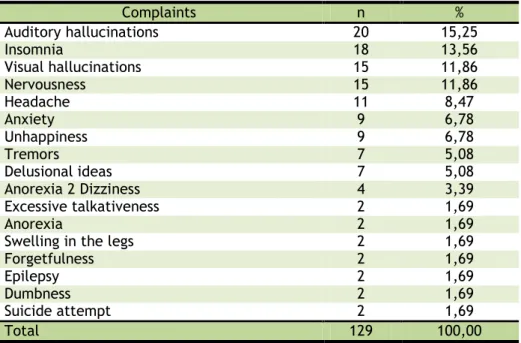
Table 2. Distribution of Complaints by Intensive Users of CAPS, Fortaleza-CE, 2011.
Complaints n %
Auditory hallucinations 20 15,25
Insomnia 18 13,56
Visual hallucinations 15 11,86
Nervousness 15 11,86
Headache 11 8,47
Anxiety 9 6,78
Unhappiness 9 6,78
Tremors 7 5,08
Delusional ideas 7 5,08
Anorexia 2 Dizziness 4 3,39
Excessive talkativeness 2 1,69
Anorexia 2 1,69
Swelling in the legs 2 1,69
Forgetfulness 2 1,69
Epilepsy 2 1,69
Dumbness 2 1,69
Suicide attempt 2 1,69
The study of table 2 shows that among the complaints of intensive users of CAPS, the auditory hallucinations had a higher prevalence (15,25%), which was expected, since it is patients starting crisis or symptoms of control.
Another disorder that deserves attention is the nervousness; in the literature it was found that 49% who reported nervousness, 22% considered themselves to be suffering from depression, and 24,7% said they had insomnia. There the difficulty of expressing their feelings and reporting them as nervousness. 18
Psychiatric hospitalizations, from three to seven times, represent 17,16%, not befitting the goals of psychiatric reform, because it calls for the replacement of psychiatric beds for beds in clinical hospitals. However, cases of never admitted are of the order of 26.65%, of the 35 cases studied. No data also represent 26.65% of the study sample, showing that there was negligence on the part of professionals when the information necessary for planning the therapeutic plan.
Regarding comorbidities, 7 of the patients (20,02%) had no diseases associated with his case of mental disorder. But 5 of them (14,30%) were associated with diabetes. In this case, the probable diabetes treating disorders diets, readiness in feeding and
recommendations may interfere with their psychosis. Again we observe data without information on 19 of them (54,34%).
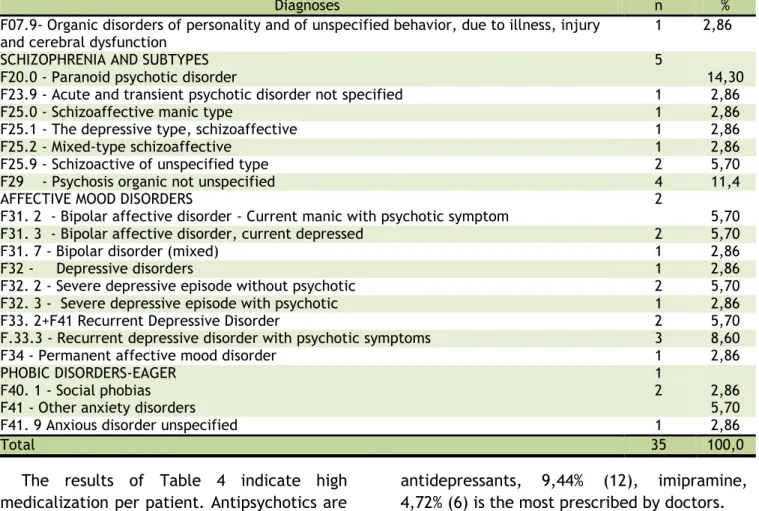
Commenting on the table 3, it is important clarifying that the research in the records found in some patients the registration of various diagnoses at each visit, sometimes more than a diagnostic indication, therefore the existence of more diseases, considered the current episode in the classification of ICD-10.
Many psychiatric disorders are observed. Mood disorders are psychiatric diagnoses most frequently found in 14 patients (40%). There is a variety of work that shows the prevalence of this disorder, with a higher prevalence depression. That has a negative impact on patient's life, in family life and work. The need to invest in mental health programs, with primary care which is the gateway to the health system is justified, as proposed by the WHO. Putting mental health among priority in the Family Health Program (FHP) appears to be fundamental; it includes strategies for prevention and treatment, as is done for diabetic and hypertensive patients.19
In this sense we must understand that mental health is a specific aspect, but inseparable from general health, it is undeniable the attendance at the FHP.
Table 3. Distribution of Diagnoses according to the International Classification of Diseases (CID-10), Fortaleza, 2011
Diagnoses n %
F07.9- Organic disorders of personality and of unspecified behavior, due to illness, injury and cerebral dysfunction
1 2,86
SCHIZOPHRENIA AND SUBTYPES F20.0 - Paranoid psychotic disorder
5
14,30
F23.9 - Acute and transient psychotic disorder not specified 1 2,86
F25.0 - Schizoaffective manic type 1 2,86
F25.1 - The depressive type, schizoaffective 1 2,86
F25.2 - Mixed-type schizoaffective 1 2,86
F25.9 - Schizoactive of unspecified type 2 5,70
F29 - Psychosis organic not unspecified 4 11,4
AFFECTIVE MOOD DISORDERS
F31. 2 - Bipolar affective disorder - Current manic with psychotic symptom
2
5,70
F31. 3 - Bipolar affective disorder, current depressed 2 5,70
F31. 7 - Bipolar disorder (mixed) 1 2,86
F32 - Depressive disorders 1 2,86
F32. 2 - Severe depressive episode without psychotic 2 5,70
F32. 3 - Severe depressive episode with psychotic 1 2,86
F33. 2+F41 Recurrent Depressive Disorder 2 5,70
F.33.3 - Recurrent depressive disorder with psychotic symptoms 3 8,60
F34 - Permanent affective mood disorder 1 2,86
PHOBIC DISORDERS-EAGER
F40. 1 - Social phobias F41 - Other anxiety disorders
1
2 2,86
5,70
F41. 9 Anxious disorder unspecified 1 2,86
Total 35 100,0
The results of Table 4 indicate high medicalization per patient. Antipsychotics are the medications most administered 44,85% (57), where the chlorpromazine and haloperidol were the most prevalent. Then 17,32% with antihistamines (22),
antidepressants, 9,44% (12), imipramine, 4,72% (6) is the most prescribed by doctors.
English/Portuguese
antipsychotics, carbamazepine and valproate are effective in the treatment of acute mania. The carbamazepine, valproate and olanzapine seem effective in preventing mania, but as lithium, are less effective in preventing depression. For bipolar depression, lithium and olanzapine show less effective than lamotrigine. The combined treatment is an option, because the mania responds well to a drug and depressive symptoms to others. The combined prescription should be made taking into account factors such as drug interaction, toxicity, dosage and therapeutic efficacy. The use of drug therapy reached 100% of survey records. So the 35 intensive users in the study have record of psychotropic medications, showing a prevalence of psychiatric care. 20
It was also observed that less than half participate in group activities offered in the service. All intensive patients must be entered in therapeutic activities, according to their specific needs, because these situations require more emotional attention. In a work also performed in a Psychosocial Care Center in Fortaleza-CE it was reinforced that the group activity is presented as important means of intervention, acting as denaturalization of suffering and potentiation for construction of collective modes of existence that dribble exclusion and the denial of life potential. Thus, the mental health professional should discuss more often the relationship of the use of psychotropic drugs with psychosocial rehabilitation and should be able to detect and question along with the multidisciplinary team the time to use the medicine, relapses, and the possibility of reduction of pharmacotherapy in order to provide patients taking psychotropic a better life.21
The reduced number of home visits was remarkable during the study. In a survey by the Ministry of Health, Brazil (2005) it was found that the real causes of the few home visits would be the lack of professionals in the
face of high demand, the lack of vehicle to transport the team and not to pay for these activities SUS. It is reported also that "The main purpose of this reduced numbers of visits are the distance of the professionals in relation to the patient's family and the continuing stigmatization in the social reintegration process. The family group was not mentioned making this a negative point, since the therapy involving family significantly helps in reducing the symptoms and self-esteem of the patient. 2
There was a constant absence of some records of therapeutic activities; there is therefore a deficiency in relation to social inclusion. All this because of the needs arising from the shortage of staff within the CAPS and the high demand of those who seek psychiatric care and, consequently, medications; however, cases of lack of records of therapeutic activities indicated here are not unique only in Ceara but in most of the states of Brazil, such as São Paulo and also the southern states, IBGE (2005). 13
It was reported in the literature that this type of device requires a clear objectification in its purpose, thus avoiding the trivialization of its occurrence. Talks about the meaning of the group, which needs to be exposed and expressed in a particular way to each of the participants, and not only happen due to the requirement of a routinization of service. 21
Studies indicate a possible forecast that there will be an increase in the number of people suffering from mental disorders, with probably prevail depression. And with that, greater attention on the actions of the mental health team, these actions to combat intentional or accidental injuries that may occur in the care of mental health patients. 22
Table 4. Distribution of medicines used by intensive patients of CAPS, Fortaleza-CE, 2011.
Medicine n %
Chlorpromazine 24 18,9
Haloperidol 22 17,3
Antipsychotics Thioridazine 07 5,51
Levomepromazine 02 1,57
Haloperidol decanoate 02 1,57
57 44,85
Antihistamine Promethazine 22 17,32
Bromazepam 02 1,57
Anti-anxiety Drugs Diazepam 13 10,24
15 11,81
Fluoxetine 02 1,57
Antidepressants Imipramine 06 4,72
Amitriptyline 04 3,15
12 9,44
Phenytoin 02 1,57
Anticonvulsants Carbamazepine 09 7,14
11 8,71
Anticholinergic Biperiden 06 4,72
Mood stabilizer Lithium Carbonate 04 3,15
Total 127 100
It was found that 23 women (65,71%) have more psychological distress, almost double than men. This phenomenon can have relations due to the fact that women are subjected to very difficult situations because of their domestic responsibilities, low wages, discrimination in the labor market and other afflictions of social life. With respect to male, the most significant finding was the way by which men outsource their depressive feelings.
Regarding the conditions above, which were another point rose by the study, the mood disorder prevailed; one need improvement of specific public policies necessary for the promotion and prevention of greater evils.
Although the study has shown deficiencies and limitations, it served to showing the reality of CAPS of Fortaleza. There were advances in mental health in Fortaleza, since 2005; however, there are still great challenges to face. It must qualify the therapeutic groups, extend to the fight for the respect of patients with psychiatric disorders, and improve social inclusion of these in the social and family context.
That public policies on mental health in Fortaleza be implemented in order to meeting the needs of changes in CAPS, considering the results obtained from the study. The public can make their paper stock performer, evaluating the physical conditions of the institution, the quality of the professional and the therapeutic plan offered, so this way the
patient suffering from mental disorder feel welcomed and safe.
1. Foucault M. História da loucura na idade clássica. 6th ed. São Paulo: Perspectiva; 1999. 2. Ministério da Saúde (Brasil). Reforma psiquiátrica e política de saúde mental no Brasil, Conferência Regional de Reforma dos Serviços de Saúde Mental: 15 anos depois de Caracas. Brasília: Ministério da Saúde; 2005. 3. Ministério da Saúde (Brasil). Lei 10.216 de 06 de abril de 2001, Legislação em Saúde Mental, 5ª ed., Brasília: Ministério da Saúde; 2004.
Sampaio JJC, Guimarães JMX, Carneiro C, Garcia Filho C. O trabalho em serviços de saúde mental no contexto da reforma psiquiátrica: um desafio técnico, político e ético. Ciências & Saúde Coletiva [Internet]. 2011 [cited 2013 June 28];16(12):4685-94.
Available from:
http://www.scielo.br/scielo.php?pid=S1413-81232011001300017&script=sci_arttext.
4. Andrade FB, Bezerra AIC, Pontes ALF, Ferreira Filho MO, Vianna RPT, Dias MD, et al. Saúde mental na atenção básica: um estudo epidemiológico baseado no enfoque de risco. Rev Bras Enferm [Internet]. 2009 [cited 2013 June 28];62(5):675-680. Available from:
http://www.scielo.br/scielo.php?script=sci_ar ttext&pid=S0034-71672009000500004.
5. Andrade LSG, Viana MC, Silveira CM. Epidemiologia dos transtornos psiquiátricos na mulher. Rev Psiquiatr Clin [Internet]. 2006 [cited 2013 June 28];33(2):43-54. Available from:
English/Portuguese
http://www.hcnet.usp.br/ipq/revista/vol33/ n2/43.html.
6. Stuart GW, Laraia MT. Enfermagem psiquiátrica: princípios e práticas, 6th ed. Porto Alegre: Editora ARTMED; 2001.
7. Lund C, Breen A, Flisher AJ, Kakuma R, Corrigall J, Joska JA, Swartz L, Patel V. Poverty and common mental disorders in low and middle income countries: A systematic review. Social Science & Medicine [Internet]. 2010 [cited 2013 June 28];71(3):517–528.
Available from:
http://www.ncbi.nlm.nih.gov/pubmed/20621 748
8. Costa JSD. Prevalência de distúrbios psiquiátricos menores na cidade de Pelotas, RS. Rev Bras Epidemiol [Internet]. 2002 [cited 2013 June 28];5(2):164-173. Available from:
http://www.scielo.br/pdf/rbepid/v5n2/04.pd f.
9. Rios KA, Barbosa DA, Belasco AGS. Avaliação de qualidade de vida e depressão de técnicos e auxiliares de enfermagem. Rev Latino-Am Enfermagem [Internet]. 2010 [cited 2013 June 28];18(3):122-130. Available from:
http://www.scielo.br/pdf/rlae/v18n3/pt_17.
pdf.
10. Guerra CS, Herculano MM, Ferreira Filha MO, Dias MD, Cordeiro RC, Araújo VS. Perfil Epidemiológico e Prevalência do Uso de Psicofármacos em uma Unidade Referência para Saúde Mental. Nurs. UFPE on line [Internet]. 2013; 7(6): 4444-51. [cited 2013 June 28]. Available from:
http://www.revista.ufpe.br/revistaenfermage m/index.php/revista/article/download/3437/
6425.
11. Scott KM, Wells JE, Angermeyer M, Brugha TS, Bromet E, Demyttenaere K, et al. Gender and the relationship between marital status and first onset of mood, anxiety and substance use disorders. Psychological Medicine [Internet]. 2010 [cited 2013 June 28];40(9):1495-1505. Available from:
http://www.ncbi.nlm.nih.gov/pubmed/19939
327
12. Instituto Brasileiro de Geografia e Estatística (IBGE). Pesquisa Nacional por amostra em domicílios. Brasília: IBGE; 2005. 13. Peres JFP, Simao MJP, Nasello AG. Espiritualidade, religiosidade e psicoterapia. Rev. Psiquiatr. Clín [Internet]. 2007 [cited 2013 June 28];34:32-8. Available from:
http://www.hcnet.usp.br/ipq/revista/vol34/s 1/136.html.
14. Dalgalarrondo P. Relações entre duas dimensões fundamentais da vida: saúde mental e religião (editorial). Rev Bras Psiquiatr [Internet]. 2006 [cited 2013 June
28];28:177-9. Available from:
http://www.scielo.br/scielo.php?script=sci_ar ttext&pid=S1516-44462006000300006
15. Rocha ALM, Avaliação das Ações de Atenção à Saúde Mental. Programa Atenção à Saúde de Populações Estratégicas e em Situações Especiais de Agravos. Brasília: Tribunal de Contas da União; 2005.
16. Cáceres CC. Hospital Geral: Um novo paradigma em Saúde Mental. Revista Eficaz Científica Online [Internet]. 2010 [cited 2013 June 28];1(1):93-5. Available from:
http://www.abep.nepo.unicamp.br/encontro 2010/docs_pdf/eixo_4/abep2010_2526.pdf.
17. Mendoza-Sassi R, Béria JU, Fiori N, Bortolotto A. Prevalência de sinais e sintomas, fatores sociodemográficos associados e atitude frente aos sintomas em um centro urbano no Sul do Brasil. Rev Panam. Salud Publica [Internet]. 2006 [cited 2013 June 28];20(1):22–8. Available from:
http://www.scielosp.org/pdf/rpsp/v20n1/317 17.pdf.
18. Gonçalves DM, Kapczinski F. Prevalência de transtornos mentais em indivíduos de uma unidade de referência para Programa Saúde da Família em Santa Cruz do Sul, Rio Grande do Sul, Brasil. Cad Saúde Pública [Internet]. 2008 [cited 2013 June 28];24(9):2043-53.
Available from:
http://www.scielo.br/pdf/csp/v24n9/10.pdf.
19. Moreno RA, Moreno DH, Soares MBM, Ratzke R. Anticonvulsivantes e antipsicóticos no tratamento do transtorno bipolar. Rev Bras Psiquiatr [Internet]. 2004 [cited 2013 June 28];26(3):37-43. Available from:
http://www.scielo.br/scielo.php?pid=S1516-44462004000700009&script=sci_arttext
20. Sousa DLM, Pinto AG, Jorge MSB. Tecnologia das relações e o cuidado do outro nas abordagens terapêuticas grupais do centro de atenção psicossocial de Fortaleza- Ceará. Texto contexto - Enferm [Internet]. 2010 [cited 2013 June 28];19(1):147-154. Available from:
http://www.scielo.br/pdf/tce/v19n1/v19n1a 17.
21. Stansfeld SA, Fuhrer R, Head J. Impact of common mental disorders on sickness absence in an occupational cohort study. Occup Environ Med [Internet]. 2010 [cited 2013 June 28];68:408-13. Available from:
Submission: 2013/07/05 Accepted: 2014/12/06 Publishing: 2015/02/15 Corresponding Address
Edilson Martins Rodrigues Neto. Rua Jorge Acurcio 600 / Ap. 206 Bairro Vila União