O
riginal
a
r
ticle
RESUMO
Os prematuros são submeidos a diversas manipulações e procedimentos durante internação em unidades neonatais, com consequências deletérias para a saúde. O objeivo do presente estudo foi descrever a manipulação a que são submeidos os prematuros durante as 24 horas em uma unidade de terapia intensiva neonatal (UTIN). Estudo observacional, descriivo, exploratório, realizado com 20 prematuros, ilmados coninuamente por um período de 24 horas, de setembro de 2008 a março de 2009 numa UTIN. Os prematuros foram submeidos a uma média de 768 manipula
-ções e 1.341 procedimentos. A manipulação durou em média 2 horas e 26 minutos em um período de 24 horas. Cada manipulação agrupou uma média de 2,2 procedimentos, a maioria no turno matuino As manipula
-ções isoladas representaram 65,6% do total de manipulações e a maioria teve duração inferior a um minuto. Conclui-se que nas 24 horas avaliadas, os prematuros foram submeidos a um excesso de manipulações na UTIN.
DESCRITORES
Recém-nascido
Prematuro
Unidades de Terapia Intensiva Neonatal Enfermagem neonatal
ABSTRACT
While hospitalized in neonatal units, pre
-term infants undergo various manipulaions and procedures that have negaive health consequences. The aim of this study was to describe the manipulaions that preterm in
-fants are subjected to over a 24-hour period in a neonatal intensive care unit (NICU). An observaional, descripive, exploratory stu
-dy was conducted with 20 preterm infants who were ilmed coninuously in a NICU over a 24-hour period from September 2008 to March 2009. Preterm infants were subjected to an average of 768 manipula
-ions and 1341 procedures. The average duraion of the manipulaions over the 24-hour period was 2 24-hours and 26 minutes. Each manipulaion included an average of 2.2 procedures, most occurring during the morning shift. Individual manipulations accounted for 65.6% of all manipulaions, and most manipulaions lasted less than a minute. The results of this study show that preterm infants in the NICU underwent an excessive number of manipulaions over the 24-hour period evaluated.
DESCRIPTORS
Infant, newborn Infant, premature
Intensive Care Units, Neonatal Neonatal nursing
RESUMEN
Los prematuros son someidos a diversas manipulaciones y procedimientos durante su internación en unidades neonatales, con consecuencias perjudiciales para su salud. El objeivo del presente estudio fue describir la manipulación a la que los prematuros son someidos durante 24 horas en una Unidad Cuidados Intensivos Neonatales (UCIN). Estudio observacional, descripivo y explo
-ratorio realizado con 20 prematuros, que fueron ilmados de forma coninua durante 24 horas, de sepiembre del 2008 a marzo del 2009 en una UCIN. Los prematuros fueron someidos a un promedio de 768 manipula
-ciones y 1341 procedimientos. La duración promedio de la manipulación en 24 horas fue de 2 horas y 26 minutos. Cada manipulación tuvo un promedio de 2,2 procedimientos, la mayoría en el turno matuino. Las manipula
-ciones individuales representaron el 65,6% del total de manipulaciones y la mayoría de las manipulaciones duró menos de un minuto. Se concluye que, en las 24 horas evaluadas, los prematuros fueron someidos a un exceso de manipulaciones en la UCIN.
DESCRIPTORES
Recién nacido
Prematuro
Unidades de Cuidado Intensivo Neonatal Enfermería neonatal
Handling of preterm infants in a neonatal
intensive care unit
A MANIPULAÇÃO DE PREMATUROS EM UMA UNIDADE DE TERAPIA INTENSIVA NEONATAL
LA MANIPULACIÓN DE PREMATUROS EN UNA UNIDAD DE CUIDADOS INTENSIVOS NEONATALES
Fabíola Lima Pereira1, Fernanda dos Santos Nogueira de Góes2,
Luciana Mara Monti Fonseca3, Carmen Gracinda Silvan Scochi4,
Thaíla Corrêa Castral5, Adriana Moraes Leite6
1 MS, RN, Neonatal Intensive Care Unit in the Clinical, Hospital of the School of Medicine of Ribeirão Preto, University of São Paulo, Ribeirão Preto, SP, Brazil.
[email protected] 2 PhD, RN, Associate Professor, Department of General and Specialty Nursing, Ribeirão Preto College of Nursing, University
of São Paulo, Ribeirão Preto, SP, Brazil. [email protected] 3 PhD, RN, Associate Professor, Maternal-Child and Public Health Nursing Department,
University of São Paulo, Ribeirão Preto, SP, Brazil. [email protected] 4 PhD, RN, Professor, Maternal-Child and Public Health Nursing Department,
University of São Paulo, Ribeirão Preto, SP, Brazil. [email protected] 5 PhD, RN, Adjunct Professor, College of Nursing, Federal University of Goiás,
INTRODUCTION
Technological advances in neonatal intensive care units (NICUs) have contributed to the increased survival of preterm infants (PTIs). However, factors such as the increase in the amount of equipment and number of inva -sive procedures, the constant need for light, the presence of ambient noise and the required excessive manipulaion during care have resulted in a number of adverse efects that trigger changes in the development of neonates, es -pecially in PTIs(1- 2).
A NICU environment is considered very diferent from the womb. In the womb, the infant is surrounded by a heated liquid and is contained by the uterine wall, main -taining a sensaion of comfort and security. However, upon being born prematurely, the PTI is placed in an incubator in a posiion that favors manipulaion, with its arms and legs extended, a fact that does not help in its organizaion. Furthermore, there is frequent contact that is generally intrusive, in which the manipulaion is focused on the physi -ological recovery of the PTI. The few afecionate interven -ions generally come from the parents.
Manipulaion can be deined as physical intervenions intended to provide paient monitoring, therapy and care(3). Some authors deine episodes of manipulaions as any care that results in clinical stress for the infants(4-5). In a study conducted in Brazil, the authors reported that the noise caused by manipulaing the infant results in behavioral modiicaions and stress(5). Thus, considering the developmental care provided to the infant, the concern shown for excess manipulaion of this populaion segment in neonatal units is remarkable.
Several studies have focused on characterizing the reac -ivity of newborns to manipulaion and their responses to intervenion protocols(1, 4-13). In general, some studies have methodological limitaions (e.g., small sample size, use of secondary data, lack of a ilming protocol)(4-7,9,11), but they show that there are excessive manipulaions, reaching 18% of the total study period, especially in PTIs with gestaional ages less than 30 weeks, in whom physiological changes re -suling from the manipulaions have been demonstrated(7). To improve the quality of infant care, it is imperaive that developmental care, as a philosophy for care, be re-examined in terms of the relaionship between the infant, the family and those who provide the care. Among the vari -ous developmental care strategies, grouping care is aimed at providing more rest for the infant by minimizing manipu -laions(12, 14); thus, performing fewer manipulaions should decrease the infants’ energy expenditures and stress(15).
Prematurity predisposes the infant to diiculies in adaping to life outside the uterus due to their anatomical
and physiological immaturity. Due to the high incidence of risks to which children are exposed in the process of growth and development, they require specialized care, which should focus on more comprehensive and humanized care that concentrates on the quality of life of both the PTIs and their families(16).
The proper handling of PTIs in NICUs equipped with many technological advancements has been the focus of many governmental(15) and internaional(17) agencies, which have concentrated on proper development and a balance of the infant’s biological, environmental and familial needs(15).
We ideniied 10 studies that have invesigated infant manipulaion, four of which(1,4-7) measured the nature and frequency of the manipulation and three of which(8-10) evaluated the implementaion of a protocol, such as mini -mal touch, kinestheic simulaion and gentle touch. The remaining three studies(11-13) addressed the pain to which the infant was subjected when manipulated.
Notably, studies that have been published in the last de -cade raise quesions about the developmental care of PTIs as they implement care protocols in search for infant responses to the implemented intervenions. It is believed that the char -acterisics of these studies are jusiied by the changes that have occurred in neonatal care during this period. The care aimed at the biological recovery of the PTI has been transformed to become care to support their development and has also become centered on the family(16).
Despite all eforts to assist these infants and their families based on developmen -tal care, the reality is far from what had been hoped. In clinical pracice, PTI manipulaion is sill occurring at a high frequency in the NICU, and not all of the professionals who work directly or indirectly with these babies pracice grouping of care.
Given the changes in care, it is necessary to evaluate PTI manipulaion to provide grants for the reorganizaion of neonatal care that is aimed at invesigaing strategies that are efecive in reducing PTI manipulaion and that are focused on developmental and humanized care.
The aim of this research is to describe the type, fre -quency and duraion of manipulaions that PTIs receive over a 24-hour period in a NICU.
METHOD
This observaional, descripive and exploratory study was performed from September 2008 to March 2009 on PTIs admited to a NICU at a university hospital in the state of São Paulo, Brazil. This hospital is a teriary reference center for perinatal care and other specialies. In total, 21 ...considering the
developmental care provided to the infant, the concern shown for
excess manipulation of this population segment in neonatal
beds are available in its NICU and 27 beds in its intermedi -ate care unit.
The study included 20 PTIs who met the following inclusion criteria: at least one day old, no neurological impairments, not under contact precauions, not taking opioid and sedaive medicaions, not in immediate pre- or post-operaive preparaions and not in humidiied incuba -tors, aiming for the best ilm quality.
The project was approved by the hospital’s Commitee for Ethics in Research (Leter No. 2247/2008 CEP/SPC), and ater consent was given by the mother or guardian, the infant was ilmed for 24 hours using three mini CD Color VR-3256 NTSC DC12V 120mA digital cameras, with three video channels and one audio channel, which were atached to a Penium 4, 2.0 GHzPC with17’’ Philips monitor and an external video card. A Digital Video Surveillance System® was used to capture images. The cameras were installed in the following posiions: at the head of the PTI, at the feet of the PTI and on a pedestal beside the incubator.
Based on a previous study, a manipulaion was considered any procedure performed on the PTI, which could include therapeuic, care or monitoring procedures(7). The proce -dures were recorded as staring when the PTI’s incubator door was opened and ending when the last procedure was performed and the caregiver closed the incubator door. Thus, the manipulaions could occur as individual manipulaions, i.e., when only one procedure was performed per opening and closing of the door, or grouped manipulaions, when two or more procedures were performed during this process.
The type, frequency and duraion of each manipulaion were measured. The frequencies of manipulaions accord -ing to work shits were also recorded: shit 1 (7:00 to 12:59), shit 2 (13:00 to 18:59), shit 3 (19:00 to 23:59) and shit 4 (24:00 to 6:59). The irst two shits represent, respecively, the shits of the morning and aternoon nursing staf, and the last two shits represent the night nursing staf.
The ilming for each PTI occurred separately over a consecuive 24-hour period, staring at 12:00 on one day and ending at 12:00 on the next day. Images were recorded using the sotware Digital Video Surveillance System at high speed (30 frames per second). First, the images were ob -served by the researcher and the research assistant at this fast speed, and the approximate hour, minute and second of each manipulaion were recorded. Then, following this irst analysis, the avi frame changer opion on the program Avifrate was selected, allowing the researchers to modify
the execuion speed of the image. In general, the images were changed to the rate of 5 frames per second. At the modiied speed, the researchers again analyzed the periods during which these manipulaions occurred at the slower speed to record the exact ime (hour, minute and second) that the procedures started and ended.
A manipulaion could occur as an individual manipu -laion (when a procedure was performed in iso-laion)
or as a group of manipulaions (when various types and categories of procedures were conducted during the manipulaion).
Thus, the ime variable was analyzed by observing the duraions of the individual manipulaions that occurred in isolaion or the duraions of those that occurred as a group. In the later case, each duraion of manipulaion extended from the start of the irst procedure unil the compleion of the last procedure on the infant and the door of the incubator was closed.
After all of the manipulations were identified for each PTI, the procedures performed were ideniied, and whether or not they were individual manipulaions was recorded. To analyze the frequency at which the 51 difer -ent procedures were performed on the PTI, each procedure was coded and numbered sequenially from 1 to 51, as it appeared in the images.
When procedures occurred simultaneously, i.e., by grouping care, all of the codes were recorded in a sequen -ial manner as they occurred during that manipulaion. This procedure atempted to idenify which manipulaions occurred most frequently and to analyze the variability of these procedures and their distribuion in both groupings and ime periods.
Two invesigators independently performed the ilm analysis; the invesigators had an overall concordance of 92%, as calculated using Kendall’s test. The total ime for the loss of image was 5 hours, 19 minutes and 50 seconds for each camera, for a combined 15 hours, 58 minutes and 30 seconds of the 1440 hours, which is equivalent to 1.2% of total image ime. The losses occurred for the following infants: infant 5 had a loss of 12 min and 13 seconds; infant 7 had a loss of 3 minutes and 50 seconds; infant 11 had a loss of 22 minutes and 11 seconds; infant 12 had a loss of 3 hours, 54 minutes and 5 seconds; and infant 14 had a loss of 40 minutes and 54 seconds.
The losses occurred because of a variety of issues, including power loss, the loss of a camera signal that was not immediately repositioned, the detachment of the cables connected to the computer and the instability of the equipment. Because we did not have wireless cameras, it was oten necessary to exchange wires that were dam -aged as the cameras were moved around while ilming the diferent PTIs.
RESULTS
Of the 20 PTIs enrolled in the study, 65% were male, and 75% were delivered via cesarean secions. The average birth weight was 1160.7 g ± 344.8 g (ranging from 645 g to 1,830 g). The average PTI gestaional age was 29 weeks and 6 days ± 13 days (ranging from 28 weeks and 6 days to 33 weeks). The average length of stay in the NICU was 14 days ± 11 days (ranging from 2 days to 43 days).
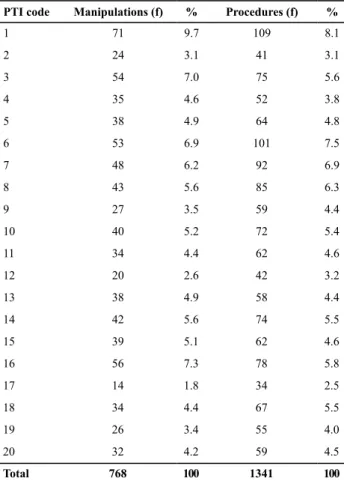
The 20 PTIs underwent a total of 768 manipulaion and 1,341 procedures, and each manipulaion had an average of 2.2 procedures. The overall mean number of manipulaions was 38 (± 13.2), with a median of 38.4 manipulaions. The overall mean number of procedures was 67 procedures per PTI. The frequency of the manipulaions per PTI ranged from 14 (1.8%) to 71 (9.7%) episodes, and the frequency of procedures ranged from 59 (4.55%) to 109 (8.1%) in the 24-hour period. Table 1 shows the frequency and percent -age distribuions of the manipulaions and procedures performed on each PTI in the NICU over the 24-hour period.
minutes and 33 seconds, in which the longest ime was 5 hours, 9 minutes and 9 seconds and the shortest ime was 53 minutes and 15 seconds.
When manipulaions were performed in groups, for 6 PTIs, the minimum interval between manipulaions was zero because the manipulaions were consecuive, whereas the interval between the other manipulaions ranged from 4 to 57 seconds. However, when performed individually, i.e., only 1 procedure was performed during the process of opening and closing incubator door, the maximum interval between end of a manipulaion and the start of the next manipulaion ranged from 30 minutes and 12 seconds to 5 hours, 16 minutes and 18 seconds.
Table 2 shows the frequency of manipulaions according to the diferent ime intervals.
Table 1 – Frequency distribution of the manipulations and
pro-cedures performed on PTIs in the NICU over a 24-hour period.
PTI code Manipulations (f) % Procedures (f) %
1 71 9.7 109 8.1
2 24 3.1 41 3.1
3 54 7.0 75 5.6
4 35 4.6 52 3.8
5 38 4.9 64 4.8
6 53 6.9 101 7.5
7 48 6.2 92 6.9
8 43 5.6 85 6.3
9 27 3.5 59 4.4
10 40 5.2 72 5.4
11 34 4.4 62 4.6
12 20 2.6 42 3.2
13 38 4.9 58 4.4
14 42 5.6 74 5.5
15 39 5.1 62 4.6
16 56 7.3 78 5.8
17 14 1.8 34 2.5
18 34 4.4 67 5.5
19 26 3.4 55 4.0
20 32 4.2 59 4.5
Total 768 100 1341 100
The mean duraion of the total ime for which the PTIs were handled over the 24-hour period was 2 hours, 26
Table 2 – Distribution of the frequencies of the duration of
manipulations of PTIs in the NICU over a 24-hour period.
Interval (minutes) Manipulations (f) Manipulations (%)
<1 321 41.6
≥1≤2 99 12.9
>2≤3 71 9.3
>3≤4 62 8.1
>4≤5 42 5.4
>5≥6 30 3.9
>6≤7 25 3.3
>7≤8 25 3.3
>8≤9 19 2.5
>9≤10 11 1.4
>10≤11 7 0.9
>11≤12 10 1.3
>12≤13 8 1.0
>13≤14 5 0.4
>14≤15 3 0.7
>15 30 3.9
Total 768 100
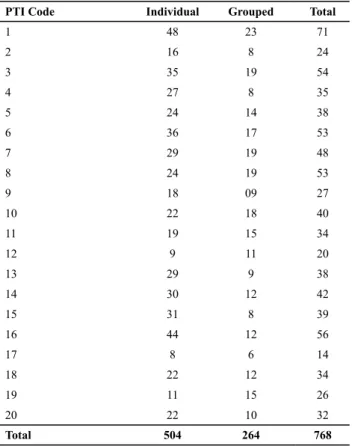
As shown in Table 3, of the 768 manipulaions, 504 (65.6%) were performed as individual manipulaions, i.e., only 1 procedure was performed, and 264 were grouped, i.e., 2 to 10 sequenial procedures were performed. On average, the staf performed 2.2 procedures per manipula -ion. The frequency of the manipulaions decreased as the number of grouped procedures increased.
DISCUSSION
Although the humanizaion of programs designed to care for infants in Brazil have encouraged care strategies that provide for proper development and aim to bal -ance the infant’s biological, environmental and familial needs(14), further studies are sill necessary to evaluate current and future condiions so that such measures are actually implemented.
Few of the current studies have examined manipulaions by themselves, making it diicult to compare data because most of the studies we reviewed were performed outside of Brazil, where the reality of neonatal care is already quite diferent compared to Brazil.
A study conducted in the state of São Paulo with 9 PTIs admited to the NICU evaluated the imes, frequencies and types of manipulaions for 6 hours a day for 17 days. This study reported that the PTIs were handled 45.42 imes in 6 hours, or approximately 181.68 imes over a 24-hour pe -riod(18). Despite the diferences between the ime periods ilmed, in the present study, the PTIs were handled less. However, the number of manipulaions was sill higher than 1 per hour. Perhaps this quanity is due to the fact that minimal PTI manipulaion is one of the strategies that have been widely discussed in the humanizaion courses focused on PTIs that have been ofered in recent years to staf in the unit where this study took place. Because the changes that have been implemented thus far have involved only team awareness, much of this reality sill needs to be changed; however, the protocols have yet to be developed and opimized.
Although the data presented here show that there are diferences between our study and the above-menioned study(18), the manipulaions are sill excessive in quanity compared to the reality seen in centers in foreign countries, in which the measures for developmental care have already been being applied for more than two decades. However, current studies no longer atempt to quanify the number of manipulaions but instead quanify the behavioral re -sponses of PTIs before these protocols were implemented – protocols that include minimal PTI manipulaion as one of their strategies, among many others.
In relaion to the duraions of the manipulaions to which PTIs were exposed, one study reported that 5 PTIs (27 to 35 weeks gestaion) were handled 18% of the ime over a 24-hour period(6). Another study also measured the manipulaions that occurred for 7 PTIs (26 to 31 weeks) over a consecuive 24-hour period via ilming(1). On average, the manipulaions in these studies lasted 72 minutes and 12 seconds and 40 minutes and 36 seconds over 24 hours, respecively. Importantly, both studies measured only the total ime of manipulaion, without reporing the minimum and maximum of each PTI.
The present study highlights the large number of ma -nipulaions that last for less than a minute. This situaion was also ideniied in the previous study that followed 12 PTIs born at less than 32 weeks gestaion(4). The authors noted that there were a large number of manipulaions in a short period of ime and that 1 infant had more than 15 manipulaions within 10 seconds on his/her irst day of life(4).
Unlike most studies on manipulaion that try to achieve homogeneity among individuals, PTIs who were only 1 day old were excluded from the sample. This criterion was included because whether the infant requires a high num -ber of manipulaions, especially during the irst few hours, depends on their clinical condiion. Because of this variable, there would be a risk of some infants having many more manipulaions than other infants.
Table 3 – Distribution of the forms of manipulations performed
on PTIs in the NICU over a 24-hour period.
PTI Code Individual Grouped Total
1 48 23 71
2 16 8 24
3 35 19 54
4 27 8 35
5 24 14 38
6 36 17 53
7 29 19 48
8 24 19 53
9 18 09 27
10 22 18 40
11 19 15 34
12 9 11 20
13 29 9 38
14 30 12 42
15 31 8 39
16 44 12 56
17 8 6 14
18 22 12 34
19 11 15 26
20 22 10 32
Total 504 264 768
Table 4 – Distribution of frequencies of the manipulations performed
on PTIs in the NICU over a 24-hour period according to shift.
Shift Manipulations (f) Manipulations (%)
1 230 29.9
2 204 26.7
3 190 24.7
4 144 18.7
Regarding the forms of manipulaion in this study, the majority were individual manipulaions. There was no rou -ine or established protocol for grouping care in the NICU studied. Moreover, when manipulaions were grouped, the procedures were performed randomly, without any atempts to standardize the care or atempts to meet the needs of the PTI.
Minimal manipulaion refers to a grouping of care in which the infant is seen as the center of care and requires caregiv -ers to act together, prioriizing the needs of the infant(14). This strategy also focuses on the importance of pracicing minimal manipulaion and grouping care and the importance of en -couraging these procedures within the NICU(19).
Through these studies, we have realized that despite the proacive measures to reduce PTI manipulaion, we have not focused on the organizaion of the manipulaions. In -dividual manipulaions for single procedures sill represent the majority of manipulaions, and when care is grouped together, there is no systemaic organizaion for procedures being performed. Although we consider that PTIs should be recognized as unique individuals in that their care must be individualized, we oten do not consider their individuality when adoping care groupings, combining procedures that are highly stressful, painful and unnecessary. As an example of such procedures, changes in the placement of adhesives on the skin and the pulse-oximeter sensor occur simulta -neously. Such procedures are grouped for the purpose of reducing manipulaion in quanitaive terms, but not in terms of the stress caused to the PTI; the authors consider both procedures to be stressful and even painful(7).
Nurse praciioners have ideniied excessive manipu -laion as a causaive agent of pain and stress for infants in intensive care, poining to minimal manipulaion as an important strategy for decreasing PTI stress(20).
According to some authors, minimum manipulaion is efecive in promoing the stability and organizaion of infants, facilitaing the energy conservaion necessary for their growth and development(12,14,20). However, there is sill no evidence from randomized clinical trials on the efeciveness of grouping care based on the responses of infants admited to neonatal units(20).
With respect to the diferent work shits and the fre -quency of manipulaions in both this and previous studies(6), the dayime shits performed more manipulaions than the nighime shits. This observaion is explained by the fact that morning and aternoon shits have more professionals working, especially medical and nursing staf; according to the protocols implemented in the unit, this period is also designated for clinical examinaions and the collecion of samples for tesing.
Regarding the methodology used in previous studies examining manipulaion, there are several diferences in the ime periods observed. Three studies ilmed 3 set pe -riods for 1 hour(8) or 2 hours(9,10). The ilming of infants for
a 24-hour period has also been used in 4 other studies(1,4-7), 1 of which occurred over diferent 24-hours periods over a span of 4 days(6). In another study, the ilming occurred within the irst 3 days of the infant’s life, in which the start ime of the ilming varied(4).
The limitaions of this study include its small sample size; however, recruiing paients in this populaion has also been diicult in previously published studies(1,4-6,8-10) and oten requires mulicenter studies. There were diiculies in selecing paients due to the use of humidiied incuba -tors, the instability of the PTI and the use of sedaives or opioids. Notably, in infants who were in phototherapy, the light oten impeded the analysis at imes because of the posiioning of the cameras, a situaion that could not have been predicted by the researcher.
The short ime in which the PTIs were ilmed is another limitaion of the study, illustraing only a part of the expo -sures they are subjected to during their hospitalizaion in the neonatal unit.
The opion to ilm the PTIs for 24 consecuive hours, as employed in previous studies(1,4-7), was subject to opera -ional issues such as power outages and disconnecion of power cords and communicaion cables from the computer. Thus, we suggest that future researchers use wireless de -vices to prevent interrupions in ilming and to facilitate the installaion of the equipment, as mouning the equipment was very ime consuming due to the need to connect these wires to the computer.
Despite these limitaions, the results allowed us to map the manipulaion paterns for PTIs in the NICU studied, which may assist in the development of protocols for the care of these infants and for conducing future research aimed at reducing manipulaions in this vulnerable populaion.
CONCLUSIONS
The results of this study indicate that premature infants at the locaion studied are subjected to excessive manipula -ion during hospitaliza-ion. This result prompts the need for a criical evaluaion of the care provided to this populaion, speciically with regard to decision making for whether and when to perform procedures and manipulaions for these children during therapy.
These data also highlight the need for studies that examine the quality of the manipulaions performed and the efeciveness of the intervenions included in devel -opmental care, such as the grouping of care, based on the tolerance of the infant.
Studies that explore the behavioral and physiological re -acivity of PTIs to the frequent manipulaions to which they are exposed in neonatal units should also be conducted.
1. Appleton SM. Handle with care: an investigation of the handling received by preterm infants in intensive care. J Neonatal Nurs. 1997;3(3):23-7.
2. Aucot S, Donohue PK, Aikins E, Allen MC. Neurodevelopmental care in the NICU. Ment Retard Dev Disabil Res Rev. 2002;8(4):298-308.
3. Peters KL. Infant handling in the NICU: does developmental care make a diference? An evaluaivo review of the literature. J Perinat Neonatal Nurs. 1999;13(3):83-109.
4. Symon A, Cunningham S. Handling premature neonates: a study using ime-lapse video. Nurs Times. 1995;91(17):35-7.
5. Rodarte MDO, Castral TC, Ferecine GM, Fujinaga CI, Zamberlan NE, Scochi CGS. Reaividade audiiva do prematuro durante o cuidado na unidade neonatal. Rev Latino Am Enferm. 2004,12(3):469-76.
6. Murdoch DR, Darlow BA. Handling during neonatal intensive care. Arch Dis Child. 1984;59(10):957-61.
7. Cignacco E, Hamers JPH, Stefel L, Linger RA, Schutz N, Muller R, et al. Rouine procedures in NICUs: factors inluencing pain assessment and ranking by pain intensity. Swiss Med Wkly. 2008;138(33-34):484-91.
8. Kean S. Efects on oxygen saturaion levels of handling premature infants within the concepts of kinaestheic infant handling: pilot study. Intensive Crit Care Nurs. 1999;15(4):214-25.
9. Slevin M, Farrington N, Dufy G, Daly L, Murphy JFA. Altering the NICU and measuring infants’ responses. Acta Paediatr. 2000;89(5):577-81.
10. Modrcin-Talbot MAM, Harrison LL, Groer MW, Younger MS. The biobehavioral efects of gentle human touch on preterm infants. Nurs Sci Q. 2003;16(1):60-7.
11. Holsi L, Grunau RE, Oberlander TF, Whifield MF. Prior pain induces heightened motor responses during clustered care in preterm infant in the NICU. Early Hum Dev. 2005;81(3):293-302.
12. Ahn Y, Jun Y. Measurement of pain-like response to various NICU stimulants for high-risk infants. Early Hum Dev. 2007;83(4):255-62.
13. Carbajal R, Rousset A, Danan C, Coquery S, Nolent P, Ducrocq S, et al. Epidemiology and treatment of painful procedures in neonates in Intensive Care Units. JAMA. 2008;300(1):60-70.
14. Axelin A, Ojajarvi U, Viitanen J, Lehtonen, L. Promoing shorter duration of ventilator treatment decreases the number of painful procedures in preterm infants. Acta Paediatr. 2009;98(3):1751-5.
15. Brasil. Ministério da Saúde; Secretaria de Políicas de Saúde, Área Técnica de Saúde da Criança. Normas de Atenção Humanizada ao Recém-Nascido de Baixo Peso: método Brasília: MS; 2009.
16. Klock PE, Alacoque LE. Caring for newborns in a NICU: dealing with the fragility of living/surviving in the light of complexity. Rev Esc Enferm USP [Internet]. 2012 [cited 2012 May 17];46(1):45-51. Available from: htp://www.scielo.br/ pdf/reeusp/v46n1/en_v46n1a06.pdf
17. Warnock F. Maternal mood, behavior and stress during maternal kangaroo care for neonatal pain relief. Otawa: Canadian Insitute of Health Research; 2009.
18. Sousa MWCR, Silva WCR, Araújo SAN. Quaniicação das manipulações em recém- nascidos pré-termo em Unidade de Terapia Intensiva Neonatal: uma proposta de elaboração de protocolo. ConScien Saúde. 2008;7(2):269-74.
19. Bellieni CV, Bagnoli F, Perrone S, Nenci A, Cordelli DM, Fusi M, et al. Efect of mulisensory simulaion on analgesia in term neonates: a randomized controlled trial. Acta Pediatr. 2002;51(4):460-3.
20. Badr LK, Abdallah B, Hawari M, Sidani S, Kassar M, Nakad P. Determinants of premature infant pain responses in heel sicks. Pediatr Nurs. 2010;36(3):129-36.
REFERENCES
pracices through the use of efecive strategies to reduce PTI manipulaion, thus contribuing to the quality of care and quality of life of these children and their families.