195
Arq Neuropsiquiatr 2013;71(3):194-197
Takotsubo cardiomyopathy: a rare, but
serious, complication of epileptic seizures
Cardiomiopatia de Takotsubo: uma complicação rara, mas grave, de crises epilépticas
João Rocha1, Elsa Gonçalves2, Catarina Vieira3, Fátima Almeida1, João Pereira1
Study carried out at the Neurology Department of Hospital de Braga, Braga, Portugal. 1Neurology Department of Hospital de Braga, Braga, Portugal;
2Internal Medicine Department of Hospital de Santa Maria Maior, Barcelos, Portugal; 3Cardiology Department of Hospital de Braga, Braga, Portugal.
Correspondence: João Rocha; Neurology Department, Hospital de Braga; Sete Fontes, São Victor; 4710-243 Braga - Portugal; E-mail: [email protected]
Conflict of interest: There is no conflict of interest to declare.
Received 10 June 2012; Received in final form 12 September 2012; Accepted 19 September 2012.
Takotsubo cardiomyopathy (TKC) is a reversible, yet po-tentially fatal, syndrome triggered by stressful conditions, including seizures, with increasing recognition in clinical practice1. We report a TKC in a patient with unexplained sinus tachycardia and troponin elevation after generalized seizures.
CASE REPORT
196 Arq Neuropsiquiatr 2013;71(3):194-197
temporo-occipital infarct with a slight left hemiparesis as a result. She was on acetylsalicylic acid 150 mg/day, clopido-grel 75 mg/day and prophylactic phenytoin 300 mg/day.
Patient was admitted after four inaugural generalized tonic-clonic seizures (GTCS) that occurred in close succes-sion during two hours. Consciousness was impaired between seizures, deeming it a clinical status epilepticus. She was as-sisted during a GTCS, sedated with midazolam perfusion and entubated, having ceased motor activity. After admission, she had no further seizures and regained conscious slowly after stopping midazolam, presenting a grade 4 left hemiparesis. Patient had infratherapeutic levels of phenytoin and start-ed IV phenytoin. Electroencephalography (EEG) revealstart-ed pharmacological beta activity, but no epileptic activity. Brain computed tomography (CT) identiied the right temporo-oc-cipital infarction, overlapping previous exams. Seizures were interpreted as symptomatic due to the cortical lesion and in-fratherapeutic levels of phenytoin.
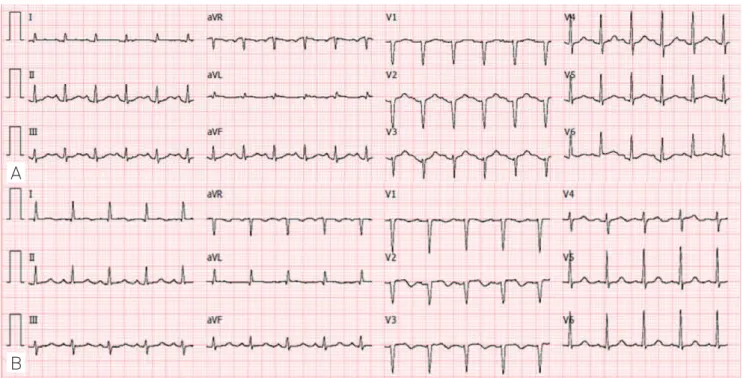
After recovery, she was apyretic, normotensive, but tachy-cardic (110–130 bpm). She had no cardiac or respiratory com-plaints. Electrocardiogram (ECG) showed sinus tachycardia and 12 hours latter T wave inversion in V1–V3 leads (Figs 1A and B). Serum troponin was 6,48 ng/mL. Transthoracic echo-cardiogray demonstrated mild depression of left ventricle systolic function, hypokinesia of apical segments with hyper-contractility of the basal ones. hese kinetic changes were conirmed by left ventriculography (Fig 2). Coronarography was normal, establishing the diagnosis of TKC. She contin-ued treatment with ramipril and double antiplatelet therapy, previously prescribed because of her endovascular interven-tion, with clinical improvement.
DISCUSSION
Takotsubo cardiomyopathy is a reversible dysfunction of the left ventricle in the absence of coronary disease, probably related to excessive catecholamine release due to sympathet-ic hyperactivity induced by stressful factors2.
Patients present signs of ventricular dysfunction or only sinus tachycardia. Chest pain is infrequent in post-epileptic TKC3. Troponin levels are elevated in the absence of coronary disease, and ECG may present with Q waves, ST segment el-evation or T wave inversion2. Treatment is supportive and mortality is as high as 8%3.
Fig 1. Electrocardiogram (ECG). (A) Admission ECG with sinus tachycardia; (B) control ECG with T wave inversion (V1-V3).
A
B
197
Arq Neuropsiquiatr 2013;71(3):194-197 Association between TKC and epileptic seizures ( focal
or generalised) is increasingly reported, and seizures may be the triggering factor of catecholamine release that pro-motes the cardiotoxic response. Focal epileptic activity of the temporal lobe may cause autonomic dysfunction that promotes cardiac damage4. he majority of post-epileptic TKC cases are women, mean age 62.7 years. Epilepsy etiol-ogy may be varied1.
Cardiac complications are one of the main causes of mor-tality in epilepsy5. Incidence of TKC after epileptic seizures is unknown and could be related to cardiac death in epileptic patients1. he authors highlight the importance of suspect-ing TKC in patients with seizures and signs of cardiac dys-function as subtle as sinus tachycardia. Timely recognition of this complication is important to provide adequate sup-portive care.
1. Dupuis M, van Rijckevorsel K, Evrard F, Dubuisson N, Dupuis F, Van Robays P. Takotsubo syndrome (TKS): a possible mechanism of sudden unexplained death in epilepsy (SUDEP). Seizure 2012;21:51-54. 2. Chockalingam A, Mehra A, Dorairajan S, Dellsperger KC. Acute left
ventricular dysfunction in the critically ill. Chest 2010;138:198-207. 3. Stöllberger C, Wegner C, Finsterer J. Seizure-associated Takotsubo
cardiomyopathy. Epilepsia 2011;52:160-167.
4. Naganuma M, Isoda K, Ishizaki M, Ito K, Hirano T, Uchino M. Epilepsy and Takotsubo cardiomyopathy: a case report. Intern Med 2011;50:2397-2399.
5. Rodríguez de Antonio LA, Aguilar-Amat Prior MJ, Iváñez-Mora V, Díez-Tejedor E. Miocardiopatía de Takotsubo como complicación de un estado epiléptico. Rev Neurol 2011;53:673-676.