INTEGRATED ACTIONS OF INFORMATION AND KNOWLEDGE
MANAGEMENT IN THE ACCOUNTING SECTOR
OF A PUBLIC UNIVERSITY
Suzana de Lucena Lira
Master in Information Science
Universidade Federal da Paraíba (UFPB) Brazil
Emeide Nóbrega Duarte
Professor Graduate Program in Information Science
Universidade Federal da Paraíba (UFPB) Brazil
ABSTRACT
It discusses the relevance of information and knowledge management in an institution of public higher education. It focuses on the stimulus, which can be implemented through assertive actions in the creation and maintenance of organizational knowledge, and as a general objective, analyzing the actions of the management of information and the knowledge of the technical coordination of Accounting and Finance of the University. In the methodological aspect, the research is characterized as study of case and field, configured as a study of qualitative and quantitative, exploratory and descriptive nature. It uses as a tool for data collection an individual questionnaire, without identification, which allowed us to recognize the actions of IKM, through the ‘diagnosis of knowledge management’, in the perspective of Bukowitz and Williams, adopted as a parameter. For the organization and analysis of data, the analysis of content was made. The results obtained reveal that the findings of the survey were positive for the shares of IKM, although there is a need for improvement with regard to encouraging the sharing of knowledge in the areas that make the Coordination of Accounting and Finance of the University.
Keywords: Information Management; Knowledge Management; Information Science; Intellectual Capital; Organizational Knowledge.
1 INTRODUCTION
based on the ability to transform information into knowledge and knowledge into decisions and actions. In Brazil, the Higher Education Institutions [Instituições de Ensino Superior (IES)] are gearing up for this new age of knowledge, which emphasizes the role of those who contribute to the enrichment of activities focused on the use of information and knowledge creation. The IES enter the Era of knowledge, with the concern being inserted in the context, not only to offer society a discipline aimed at teaching information and knowledge management (IKM), both in undergraduate and in the post-graduation, but the recognition that information and
the knowledge management rests in its own way of managing. The need for continuous improvement in administrative management encourages their servers in the possibility of developing research on how to manage their intellectual capital for improving the dynamics of information flows and organizational knowledge.
The scenario under study is considered as suitable to the information and knowledge management, not only by the eminently scholarly, in which the object of Information Science is studied – the information itself – this made toward the Accounting and Finance, through people who promote the dynamic flows in formal and informal organizational environment.
Therefore, this study is justified because there are insufficient studies conducted in business sector, through Higher Education Institutions in Brazil, especially in public IES, aiming to highlight the use of information on its activities and managing its intellectual capital to promote organizational knowledge.
Thus, the overall goal is to analyze the actions of information and the knowledge management of the technical staff of the Coordination of Accounting and Finance of UFPB.
2 INFORMATION AND KNOWLEDGE IN INFORMATION SCIENCE
The challenge of proposing a study that focuses on the importance of promoting organizational knowledge through actions that will stimulate the
knowledge are inputs to the organizational actions and are essential for decision making”. In this sense, the author emphasizes that all work performed in the area of Information Science should consider this relationship extremely strong and inseparable. It is divided thereby with the field of Information Science which is defined by Saracevic (1996, p.47):
The Information Science is a field devoted to scientific issues and professional practice focused on the problems of effective communication and knowledge of their records among humans, in the social, institutional or individual of the use and information needs.
According to Bukowitz and Williams (2002, p.18), the intellectual capital or knowledge is, by definition, something that is valued by the organization contained in people, in other words, derived from processes, systems and organizational culture, namely knowledge and individual skills, norms and values, databases, methodologies, software, know-how, licenses, trademarks and trade secrets. The
knowledge is regarded as a key factor, acquired through the search and use of information as well as a mutual learning process, which requires continuous training organizations. It is highlighted by several authors as an intangible; knowledge becomes the major concern of organizations.
Takeuschi and Nonaka (1997) emphasize this concern when they show the importance of people's participation in their definitions of knowledge and when they say that humans are necessary for the creation of knowledge, whereas the foreground always originate in people. In organizations, knowledge usually is embedded in routines, processes, practices and norms organizational activities that can be creators of knowledge, whose place is within human beings and among them.
3 INTEGRATED VISION OF INFORMATION AND KNOWLEDGE MANAGEMENT
The information management and knowledge management are understood as complementary actions, since information management “[…] works directly with flows of formal organization, its focus is the business of the organization and its action is restricted to consolidated information in some kind of medium (print, electronic, digital etc.), i.e. what is explicit”, and knowledge management “[…] works directly with the informal flows of the organization, its focus is the corporate
intellectual capital and its action is restricted to culture and communication corporate, i.e. which is not explicit” (VALENTIM, 2007).
Duarte (2008) believes that the learning process is closely linked to knowledge management. The knowledge is a resource that can and should be managed to improve the performance of organizations. For that to happen, they must discover the ways in which the learning process can be stimulated and to investigate how organizational knowledge can be managed to meet their strategic needs, disseminated and applied by all as a tool for organizational success .
The information management is intrinsically related to knowledge management, given that knowledge, once outsourced by one person, can be transformed into information and that, when internalized by another, turns into knowledge. To Bukowitz and Williams (2002, p.17) “[…] knowledge management is the process by which the organization generates wealth from its knowledge or intellectual capital”.
Silva and Valentim (2008, p.159) recognize that as the knowledge resides in people, the task of knowledge management is to make use of methods, techniques, instruments and tools that help people make explicit the knowledge built in order to share it in the organizational environment and highlight the importance the organization's role as promoting a culture that motivates people to that share.
Bukowitz and Williams (2002, p.211) claim that organizations that rely on knowledge understand that employees are useful for what they know and even more
something that employees are forced to perform in their spare time, these employees tend to offer their knowledge for the good of the organization.
To Barbosa (2008), while information management is closely associated to the electronic document management and information systems, knowledge management relates to the management of intellectual capital and intangible assets, as well as organizational learning. In this case, it is evident the influence of disciplines related to administration, finance, in the case of intellectual capital and organizational behavior, strategic management and, in the case of organizational
learning. On the other hand, the IM has close connection with Information Science, Computer Science, Library Science and Archival Science.
Among the approaches of the various authors on knowledge management, the proposition by Bukowitz and Williams (2002) was chosen as the parameter for being the most suitable to the scenario under consideration, the object and objectives proposed in the research and present information concerning the dimensions and knowledge, as well as indicators to diagnose the actions of Information and Knowledge Management, as can be seen in Table 1 and in the delineation of methodological procedures.
3.1 IM and KM Dimensions Proposed by the Adopted Authors
In order to achieve the research objective of analyzing the actions of information and the knowledge management of the technical staff of the Coordination of Accounting and Finance of UFPB, it was necessary to identify the dimensions of IKM models presented in the literature and listed in Frame 1 containing the list of authors, the dimensions identified and their contents.
Frame 1: Dimensions of information management and knowledge.
Author Dimension Contents
Choo, C. W. - 2003
Creating
significance/meaning; Construction of knowledge; Decision-making.
Information processing; Conversion of information; Interpretation of information.
Davenport, T.; Prusak, L. - 1998
Determination of requirements; Obtaining;
Type of information needed; Source of
Distribution; Usage.
Employment of the information for decision making.
Nonaka, I; Takeuchi, H. - 1997
Ontological dimension - organizational knowledge vs. individual knowledge
Epistemological dimension - tacit knowledge vs. explicit knowledge.
Spiral of knowledge: socialization,
externalization, combination, internalization; 5 conditions: intention, autonomy, fluctuation and chaos, redundancy, varieties and requirements.
Probst , G. ; Raub, S.; Romhardt, K. - 2002
Knowledge goals; Knowledge assessment.
Identification of knowledge, knowledge acquisition, development, sharing and distribution, usage, retention (storage).
Angeloni, M. T. - 1999
Infrastructure; People; Technology.
Holistic vision, culture, management style, structure;
Learning, mental models, shared, intuition, creativity and innovation;
Networks, data warehouse, groupware, workflow, GED/DSE.
Bukowitz, W.; Williams, R. - 2002
Tactics; Strategic.
Get the information, use the information, learn, and contribute;
Evaluate; build / maintain; dispose.
Source: Elaborated by the authors – 2011.
In the description of the model IKM, and its dimensions presented in Table 1, one can identify several similarities. The dimension of meaning creation, where there is information processing, based on the need, the search and the use of the model information of Choo (2003), is in line with the tactical process steps: obtain and use information from the model of Bukowitz and Williams (2002). There are also
similarities with the model of Davenport and Prusak (1998), observed in the size determination of requirements, the type of information required in obtaining
dimension, the source of exploration, sorting and formatting or structuring information.
resemble the tactical dimension in steps ‘learn and contribute knowledge by sharing’ model of Bukowitz and Williams (2002).
The strategic dimension of the model of Bukowitz and Williams (2002) discusses the steps: evaluate information, construct and maintain and dispose, where there is similarity with the objectives and goals of knowledge, the model of Probst, Raub and Romhardt (2002), and with the evaluation of the knowledge dimension, that evaluate intellectual capital, intellectual property and intangible assets. Now, the dimension ‘decision making’ requires interpretation of the information is present in models of Choo (2003) and Davenport and Prusak (1998). There are also steps in the ‘evaluate, build/maintain and dispose’ model of Bukowitz and Williams (2002), aspects of decision making, while in the model of Probst, Raub and Romhardt (2002), there are, in own dimensions, targets and evaluation of knowledge.
4 METHODOLOGICAL PROCEDURES
This research is characterized as study of case and field. To Zanella (2009, p.88), field studies research real situations. Set up as a study of qualitative and quantitative, exploratory and descriptive nature. It was adopted the application of the model proposed by Bukowitz and Williams (2002, p.25) which shows that the process of knowledge management is split into two courses of actions that occur simultaneously in organizations: the tactical and the strategic.
The first course of action, the tactical refers to the use of everyday knowledge to respond to the demands and opportunities of the market and covers the steps: get, use, learn and contribute. Despite being described continuously, the authors claim that each step of the process has a core set of activities sufficiently coherent to distinguish it from the next step. In the second course, the strategy that is
management at the strategic level, requires an ongoing evaluation of existing intellectual capital and a comparison with future needs”.
For practical purposes of the research, the steps have been decoupled of the tactics and strategy parts and now form a single corpus of categories, which enabled us to diagnose the actions carried by IKM along the technical staff of the Coordination of Accounting and Finance of UFPB.
A questionnaire was given without identification, marked with the opinion of each researched the way it identifies each of the ten (10) statements concerning the
process step by checking one of the following: (F) strong, (M) moderate , (Fr) weak. This questionnaire was adapted from the model proposed by Bukowitz and Williams (2002, p.33), with a reduction of twenty (20) to ten (10) statements and suited to the reality of the research institution, mainly because it is a public organization. It has been considered as internal customers themselves technicians who work in the Department of Accounting and Finance, and as external the customers from other areas of the institution.
It was adopted the content analysis proposed by Bardin (2009) from the procedures used and it was analyzed the organizational knowledge based on the diagnostic process of IKM. Regarding the search field, it was chosen the UFPB, which has its hierarchical structure regulated by the Internal Regulations approved by Resolution No. 257/79.
The Coordination of Accounting and Finance, chosen as a sample, is subordinated to Administrative Pro-rector. This Coordination consists of two consultants, a Secretary, three divisions and eight sections, making a total of 35 (thirty five) servers. Among these, 19 (nineteen) are specialists, two are administrators, and the others are accountants. Among the graduates, one is attending Specialization, and two of those experts are in progress to Masters. There are three accountants who are also graduates in Law.
5 ANALYSIS OF RESULTS
questionnaires were answered and received, which is 89% (eighty-nine percent) of the total applied.
In order to calculate the score for each category, the number computed for each of the three alternatives, a total of ten statements, we multiplied the item (F) by three, the item (M) by two, and (Fr) by one, adding all the results. The maximum possible score is thirty, and getting the result in percentage divided by thirty, as shown in Figure 1. The adaptation of the model of the authors Bukowitz and Williams (2002) at this point refers to the maximum possible score would be 60, if the
questionnaires were applied with 20 statements.
Figure 1: Worksheet in the individual score by step of the process of IKM.
Source Adapted: Williams and Bukowitz – 2002 – p.34.
In the last section, the results of the process of Information and Knowledge Management applied in the sector, as shown in Figure 2.
Figure 2: Worksheet in the general score by step of the process of IKM.
After the application of the questionnaires, the scores were computed through the sheets above, yielding the results presented in the following section. In this case, the adaptation consists that the total possible score would be 420, if the questionnaires were applied with 20 statements, becoming 210. According to the questionnaires, the general result of the whole process of diagnosis of IKM, the percentages shown in Graphic 1 were obtained. The results obtained were as follows:
Graphic 1: Steps of the diagnostics process of IKM.
65%
55% 56% 56% 53%
61% 58% 0,00% 10,00% 20,00% 30,00% 40,00% 50,00% 60,00% 70,00% Ge n e ra l S c o re = 3 .7 6 3
obtein use learn contribute evaluate maintain dispose
Source: Elaborated by the authors – 2011.
It can be verified that all steps of the process had percentages above 50%, and the overall percentage score in the accounting industry was 58%, which means that the results were positive for the shares of IKM. Organizations that tested the instrument had an average of 55%, according to Bukowitz and Williams (2002, p.47). It can be observed that the step that presented the best performance was ‘get information’, with 65%. This result indicates that the Coordination of Accounting and Finance, when it needs to get information, it has 65% chance to get it through people, groups, database and online tools, including the Internet.
The step ‘use information’ got 55% as a result. This step of the process
service, which can be increased through unstructured meetings and collaboration with other sectors that comprise the Coordination.
The steps ‘learn together’ and ‘contribute by sharing knowledge’ showed
56% of result. The first is the engagement of the teams inside and outside the organization, so they can work together, exposing experiences and learn from each other. In step ‘contribute by sharing knowledge’, the coordination seeks to promote
the rapprochement of the sectors that make up for that experiences are shared. However, in individual aspects, the physical barriers and systems integration, this
step needs to be well articulated so that knowledge sharing is encouraged.
Step ‘build and maintain the intellectual capital’, with 61%, that means the
Coordination of Accounting and Finance maintains a good level of intellectual capital, be encouraging it on leveraging the knowledge of the group, either in outside activities that contribute to the enrichment of ideas at work. The step ‘evaluate the intellectual capital’ got 53%, representing the lowest percentage of the whole process of diagnosis of IKM. This step in the process presents the issue of intellectual capital measurement of the coordination, of the performance and quality measures, of the management assessment and it still requires further analysis, because it is still a tenuous subject for a public institution.
As for the step ‘dispose through the turnover of people’, it resulted in 58%, in
which the decisions of divestment of knowledge are beyond the control of Coordination with the main focus on the lack of control in maintaining intellectual capital and strategic importance of this capital for the sector.
5.1 Analyses of Categories
5.1.1 Category: Obtain Information
Step 'obtain information' means to search for information - the initial phase of any management process, especially given the challenge of analyzing large amounts
to date the means of learning, training new systems to improve efficiency, requesting information only when necessary, to identify the user in search of information, the importance of specialist information , searching for information, task achievable; variety of applications, databases in which search and the help of specialist in online information and internet, were subjected to evaluative indicators: strong (weight 3), moderate (weight 2) and weak (weight 1), whose results are shown in Graphic 2.
Graphic 2: Results of the category ‘Obtain Information’.
Source: Research data – 2011.
Statements of this step of the process, we highlight that people only ask for information when they really need it, and that is, 70% of respondents attributed it as strong in coordination. In relation to the statements “people provide full explanations when requesting information” and “when people are given the task of researching
information, they are able to perform it”, 63% and 65% of respondents, respectively,
attributed these statements as moderate.
including the Internet”, 42%, 53% and 48% of respondents, respectively, are
assigned as moderate, and 29%, 24% and 24% assigned as weak.
5.1.2 Category: Use Information
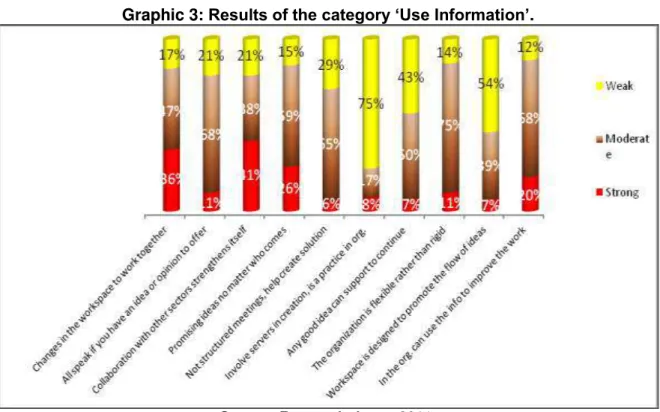
It considers the aspect of creation, experimentation, innovation and strategic use of information. This category is made up of the following subcategories: ‘changes in space to work together’; ‘everybody speaks up they have ideas or opinions to offer’; ‘collaboration with other sectors strengthens their own’; ‘it does not matter from whom promising ideas may come’; ‘unstructured meetings can help creating solutions’; ‘servers involved in the creation is a practice’; ‘any good idea gets support to proceed’; ‘the organization is flexible rather than rigid’; ‘workspace designed to promote the flow of ideas’ and ‘in the Organization, information can be used in order to improve the job’, as shown in Graphic 3.
Graphic 3: Results of the category ‘Use Information’.
Source: Research data – 2011.
variable was also above 50%. The result reveals that the statements ‘everybody speaks up if they have ideas or opinions to offer’; ‘it does not matter from whom promising ideas may come’; ‘unstructured meetings can help creating solutions’; ‘any good idea gets support to proceed’; ‘the organization is flexible rather than rigid’; and ‘in the Organization, information can be used in order to improve the job’ were considerate as moderate in the sector.
We identified two weaknesses in this step, ‘servers involved in the creation is a practice’ with a percentage of 75%, rated as weak and small deficiency detected as the ‘workspace designed to promote the flow of ideas’, which can affect the flow of information. The diagnosis revealed that collaboration with other sectors strengthens the exchange of information to improve processes within the organization.
5.1.3 Category: Learn Together
Graphic 4: Results of the category ‘Learn Together’.
Source: Research data – 2011.
The percentage of 56% obtained for the step 'learn together' is identified by
assertions that influenced the diagnosis of this dimension, in which of the ten statements, seven were evaluated by variable moderate above 50%. It was detected as weak point, with percentage above 60%, the support by the Organization of a group activity that promotes mutual learning, which makes the sharing of organizational knowledge. As a strong point, the diagnosis reveals that tries to ensure for people to have some responsibilities in common, so that it is easier to learn from each other. This demonstrates that the division of responsibilities facilitates organizational learning.
5.1.4 Category: Contribute by Sharing Knowledge
need to inspire contribution is the guide movement of knowledge management because it visualizes how people feel as being a part of the organization.
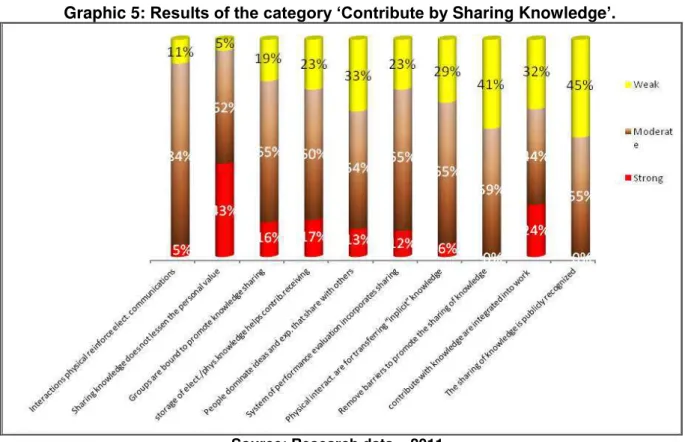
The Graphic 5 below illustrates the results obtained from subcategories formed by the affirmative questions that comprise the data collection instruments used in the organizational environment, with indicators and ratios.
Graphic 5: Results of the category ‘Contribute by Sharing Knowledge’.
Source: Research data – 2011.
The percentage of 56% was also obtained for the step 'Contribute by sharing
knowledge', identified by statements that influenced the diagnosis of this dimension, in which of the ten statements, only one has not been evaluated by the variable moderate above 50%.
transferring ‘implicit knowledge’; ‘The organization seeks to remove barriers in order to promote the sharing of knowledge’ and ‘The sharing of knowledge is publicly recognized’ were considered as moderate in the organization. The only statement that was evaluated as moderate below 50% was ‘The processes that contribute with knowledge in the organization are usually integrated into work activities’ which nonetheless remained as moderately valued at 44%, followed by the variable weak (32%).
5.1.5 Category: Evaluate the Intellectual Capital
On this point, the organization should consider the existing and necessary knowledge in order to achieve its mission and predict the future needs of knowledge for enabling the measurement of intellectual capital development. The Graphic 6 shows the results obtained from subcategories formed by the affirmative questions that comprise the data collection instruments applied.
Graphic 6: Results of the category ‘Evaluate the Intellectual Capital’.
This step had the lowest percentage (53%) of the entire process, which demonstrates that the public institution of higher education, with regard to the Department of Accounting and Finance, namely the business sector through the organization, yet is deficient in evaluating its intellectual capital, resulting in a practice that should be increased. This is a situation that tends to change as it is being introduced in the public sector as a whole, a system of recognition, measurement and disclosure of intangible assets.
5.1.6 Category: Build and Maintain the Intellectual Capital
This step in the process requires the construction of intellectual capital through relationships, which obtains value and maintains the organization in a viable level of development and interweaving of knowledge. In order to illustrate the results, see Graphic 7, from subcategories formed by the affirmative questions that comprise the data collection instruments used in the organizational environment, with indicators and ratios.
Graphic 7: Results of the category ‘Build and Maintain the Intellectual Capital”.
What can be gathered from the questionnaire and the weights assigned to each variable is that in the accounting sector, regarding the construction and maintenance of intellectual capital, experts believe it to be in a moderate way. It appears that no one has assessed as strong the industry subcategory ‘There's a formal policy that shares technology and ideas among the groups’.
The subcategories ‘The organization treats people as sources of value rather than cost’ and ‘There's formal policy that shares technology and ideas among the groups’ were assessed with a percentage above 33% as weak.
As a strong point, the diagnosis reveals that the subcategories ‘It is believed that the KIM is everyone's business’ and ‘IT can be seen as a tool to help doing the work’ were evaluated with percentage above 50% in the variable strong with the latter being a substantial percentage of 72%. This demonstrates that most of the technicians view IT as an ally in the execution of work.
5.1.7 Category: Disposal Through the Turnover of People
This is the last step of the diagnostic process for the Management of Information and Knowledge. This step addresses ways to examine the organization's intellectual capital, both in terms of opportunity costs and alternative sources of value, to keep only what is strategically viable. On this point, the organization is prepared for the turnover to the detachment and the time of divestiture, even if it is of knowledge, because it needs to change.
Graphic 8: Results of the category ‘Disposal through the turnover of people’.
Source: Research data – 2011.
The subcategories “The decision to acquire knowledge is based on how much it can be leveraged”; “When there’s a new opportunity, existing abilities are retooled”; “Divestiture decisions based in intellectual wealth strategic importance”; “The impact on productivity relations is understood before automation”; “Participate in research group to feel the need of new knowledge”; “When discarding a service or group, treat them with dignity and respect”; “People are placed as apprentices in other organizations to acquire new knowledge” and “Before discarding people, try finding abilities that fit elsewhere” reached percentiles above 50% for the moderate variable, that is, the majority of subcategories in this section were evaluated as moderated.
weak and 27% moderate by the technicians at the accounting sector. This indicates that this perception is meaningful regarding people turnover within the Institution.
Facing the challenge of keeping within the Institution an intellectual capital that affords creation, maintenance, evaluation, sharing, use and obtainment of information and knowledge, the organization needs an appropriate culture even for the divestiture of its intellectual capital.
6 CLOSING REMARKS
This paper aimed at the analysis of the actions for managing information and knowledge in the Department of Accounting and Finance of UFPB.
Regarding the management of information, it was found that, when needing information, people request, seek and provide full explanations and are able to perform searches. Furthermore, the exchange of information among sectors is apparent, ideas are encouraged, and unstructured meetings can contribute to the solution of problems and can use the information for improving work.
In knowledge management, it is the process of learning that is the most important one, where disagreements are seen as opportunities to learn, people apply what they learn outside the organization, learn from failures, do not determine guilt and do not believe that sharing knowledge will decrease their value to the institution. This means that, although the notion of knowledge management is not clear, it is identified that the aspect of passing on the experiences to newcomers exist and that, unlike a private institution, there is no retention of knowledge for fear of devaluation of the individual in a public institution.
The diagnosis showed that there is information management in “obtain information and use information”, and in step “to build and maintain intellectual
capital”, although it needs to demonstrate more clearly the informational flows that
It can be concluded that information management refers to formal flows of information, and its management is focused on aspects related to search, use and maintenance of information within the organization. Since knowledge management is focused on informal flows of information, which are contained in the aspects of learning, sharing, evaluation, detachment and rebuilding or new perception of knowledge, both through innovation and the recreation of knowledge.
With the demonstrated analyses and the prospects for implementation of actions aimed at preserving organizational knowledge and improvement in the
accounting industry of GIC, with the possibility of extending to other sectors, this article is disclosed, hoping for the management support in order to achieve this.
REFERENCES
ANGELONI, M. T. Organizações de conhecimento: dos modelos à aplicação prática. Florianópolis: UFSC/Programa de Pós-Graduação de Administração, 1999.
BARBOSA, R. R. A gestão do conhecimento e a ciência da informação: entrevista com o professor efetuada por SILVA, A. K. A. Informação & Sociedade: Estudos, João Pessoa, v.18, n.3, p.187-196, set./dez. 2008.
________. Gestão da informação e do conhecimento: origens, polêmicas e
perspectivas. Informação & Informação, Londrina (PR), v.13, n.esp., p.1-25, 2008.
BUKOWITZ, W.; WILLIAMS, R. Manual de gestão do conhecimento: ferramentas e técnicas que criam valor para a empresa. Porto Alegre: Bookman, 2002.
BARDIN, L. Análise de conteúdo. Lisboa: Edições 70, 2009.
CHOO, W. C. A organização do conhecimento: como as organizações usam a informação para criar significado. São Paulo: SENAC Editora, 2003.
DAVENPORT, T.; PRUSAK, L. Ecologia da informação: por que só a tecnologia não basta para o sucesso na era da informação. São Paulo: Futura, 1998. 316p.
DUARTE, E. N. Aprendizagem organizacional em unidades de informação: do grupo focal à comunidade de prática. Perspectiva em Ciência da Informação. Belo Horizonte, v.13, n.3, set./dez. 2008.
LIRA, W. S. Processo de decisão do uso da informação e a gestão do
NONAKA, I; TAKEUCHI, H. Criação de conhecimento na empresa: como as empresas japonesas geram a dinâmica da inovação. 12.ed. Rio de Janeiro: Elsevier, 1997.
PROBST, G.; RAUB, S.; ROMHARDT, K. Gestão do conhecimento: os elementos construtivos do sucesso. Porto Alegre: Bookman, 2002.
SARACEVIC, T. Ciência da Informação: origem, evolução e relações. Perspectivas em Ciência da Informação, Belo Horizonte, v.1, n.1, p.41-62, 1996.
SILVA, H. M. da; VALENTIM, M. L. P. Modelos de gestão do conhecimento aplicados a ambientes empresariais. In: VALENTIM, M. L. P (Org.). Gestão da informação e do conhecimento no âmbito da Ciência da Informação. São Paulo: Polis: Cultura Acadêmica, 2008. p.12-25
VALENTIM, M. L. P.(Org.). Informação, conhecimento e inteligência organizacional. 2.ed. Marília: FUNDEPE Editora, 2007. 278p.
________. Informação e conhecimento em organizações complexas. In: VALENTIM, M. L. P.(Org.). Gestão da informação e do conhecimento no âmbito da Ciência da Informação. São Paulo: Polis: Cultura Acadêmica, 2008. p.12-25
ZANELLA, L. C. H. Metodologia de estudo e de pesquisa em Administração.
Florianópolis: CAPES/UAB, 2009.
Suzana de Lucena Lira
Master in Information Science
Universidade Federal da Paraíba (UFPB) E-Mail: [email protected]
Brazil
Emeide Nóbrega Duarte
Professor Program Post Graduate in Information Science Universidade Federal da Paraíba (UFPB)