ARTICLE DOI: 10.1590/0004-282X20130055
Codon 129 polymorphism
of prion protein gene in is not a
risk factor for Alzheimer’s disease
Polimorfismo do códon 129 do gene da proteína
priônica não é fator de risco para doença de Alzheimer
Jerusa Smid1, Michele Christine Landemberger2,
Valéria Santoro Bahia1, Vilma Regina Martins2, Ricardo Nitrini1
Human prion diseases are rare neurodegenerative disor-ders that occur sporadically, genetically determined or ac-quired. Sporadic Creutzfeldt-Jakob disease (CJD) is the com-monest prion disease, with annual incidence of one case per one million. he genetic forms of prion diseases follow auto-somal dominant inheritance and are associated with more than 50 mutations in the prion protein gene (PRNP)1,2. he
co-don 129 of PRNP is polymorphic, encoding either methionine
(M) or valine (V). Homozygosity at this codon is associated with a higher risk for sporadic CJD, and variant of CJD occurs exclusively in MM subjects3,4. he PRNP polymorphism at
co-don 129 has been investigated in diferent neurodegenera-tive diseases, including Alzheimer’s disease (AD), Parkinson’s disease and primary progressive aphasia. Its correlation with clinical parameters such as disease onset and cognitive per-formance is contradictory5-8.
Study carried out at Hospital das Clínicas, Universidade de São Paulo (USP); A.C. Camargo Hospital, São Paulo SP, Brazil.
1Cognitive and Behavioral Unit, Department of Neurology, School of Medicine, USP, São Paulo SP, Brazil;
2Molecular and Cellular Biology Group, International Center for Research, A.C. Camargo Cancer Center, São Paulo SP, Brazil. Correspondence: Jerusa Smid; Rua Arruda Alvim 145 / apto 84; 05410-020 São Paulo SP - Brasil; E-mail: [email protected]
Support: Fundação de Amparo à Pesquisa do Estado de São Paulo (FAPESP) Process nº 2009/01427-2, Howard Hughes Medical Institute, National Institute of Translational Neuroscience (INNT) - Conselho Nacional de Desenvolvimento Cientíico e Tecnológico/Ministério da Ciência e Tecnologia (CNPq/MCT) and Ludwig Institute for Cancer Research.
Conflict of interest: There is no conlict of interest to declare.
Received 05 December 2012; Received in inal form 18 December 2012; Accepted 27 December 2012. ABSTRACT
Interaction of prion protein and amyloid-b oligomers has been demonstrated recently. Homozygosity at prion protein gene (PRNP) codon 129 is associated with higher risk for Creutzfeldt-Jakob disease. This polymorphism has been addressed as a possible risk factor in Alzheimer disease (AD). Objective: To describe the association between codon 129 polymorphismsand AD. Methods: We investigated the association of codon 129 polymorphism of PRNP in 99 AD patients and 111 controls, and the association between this polymorphism and cognitive perfor-mance. Other polymorphisms of PRNP and additive effect of apolipoprotein E gene (ApoE) were evaluated. Results: Codon 129 genotype dis-tribution in AD 45.5% methionine (MM), 42.2% methionine valine (MV), 12.1% valine (VV); and 39.6% MM, 50.5% MV, 9.9% VV among controls (p>0.05). There were no differences of cognitive performance concerning codon 129. Stratiication according to ApoE genotype did not reveal difference between groups. Conclusion: Codon 129 polymorphism is not a risk factor for AD in Brazilian patients.
Key words: prion protein gene, Alzheimer’s disease, polymorphism, codon 129, cognitive performance, apolipoprotein E gene.
RESUMO
A interação entre proteína priônica e oligômeros b-amiloide foi demonstrada recentemente. Homozigose no códon 129 do gene da proteína priônica (PRNP) é fator de risco para doença de Creutzfeldt-Jakob. Este polimorismo foi estudado como possível fator de risco para doença de Alzheimer (DA). Objetivo: Estudar uma possível associação entre o polimorismo do códon 129e DA. Métodos: Foram investigados 99 pa-cientes com DA e 111 controles em relação ao polimorismo do códon 129 e sua associação com desempenho cognitivo. Foram pesquisados outros polimorismos do PRNP e efeito aditivo do gene da apolipoproteína E (ApoE). Resultados: Distribuição no códon 129: 45,5% metionina (MM), 42,2% metionina valina (MV), 12,1% valina (VV) nos pacientes com DA; e 39,6% MM, 50,5% MV, 9,9% VV, nos controles (p >0.05). Não houve diferença no desempenho cognitivo em relação ao códon 129. Estratiicação pelo genótipo do ApoE não mostrou diferença entre gru-pos. Conclusão: Polimorismo do códon 129 não é fator de risco para DA em pacientes brasileiros.
AD is a common neurodegenerative disease and the most common cause of dementia in many countries. Some genetic risk factors have been studied in the sporadic cases of AD, the most important one being the genotype of the apolipopro-tein E gene (ApoE)9-11. he codon 129 polymorphism of PRNP
was also addressed as a possible risk factor in AD patients. A few studies have shown that this polymorphism may be a risk factor for AD12-14. Others, however, failed to conirm such
association5,8,15-21. A meta-analysis concluded that codon 129
homozygosity of PRNP is a risk factor for AD in a Caucasian population19. More recently, data from a
pathology-con-irmed AD population failed to support a role of codon 129 polymorphisms as a susceptibility factor for AD5.
AD and prion diseases are both pathogenically associ-ated with the accumulation of misfolded protein fragments: b-amyloid protein and prion protein (PrPC), respectively22,23.
Recently, the interaction of PrPC and amyloid-b oligomers
has been demonstrated24,25. PrPC seems to be a high-ainity
binding site for amyloid-b oligomers mediating neurotoxic-ity24. Although controversies still exist, such indings brought
new interest to the association of AD and PrPC 26.
We investigated the association of codon 129 polymor-phism of PRNP in AD patients and age-matched, cognitively healthy control group. We also evaluated the association be-tween this polymorphism and the cognitive performance of AD and controls. Other polymorphisms of PRNP were also evaluated as well as the potential additive efect of ApoE upon codon 129 polymorphisms in AD and controls.
METHODS
Subjects were enrolled from the Cognitive and Behavioral Unit of the Neurologic Clinic of School of Medicine of
Universidade de São Paulo (USP) and from a previous study11.
he diagnosis of probable AD followed the recommenda-tions of the joint working group of the National Institute
of Neurologic and Communicative disorders and Stroke and the AD and Related Disorders Association (NINCDS-ADRDA). he control group comprised volunteers recruited from community and nonrelated caregivers of the AD pa-tients. Individuals with neurological and psychiatric condi-tions and unstable medical diseases were excluded from the control group. he cognitive evaluation of controls was done with the Folstein Mini-Mental State Exam (MMSE) and se-mantic verbal luency (VF) test.
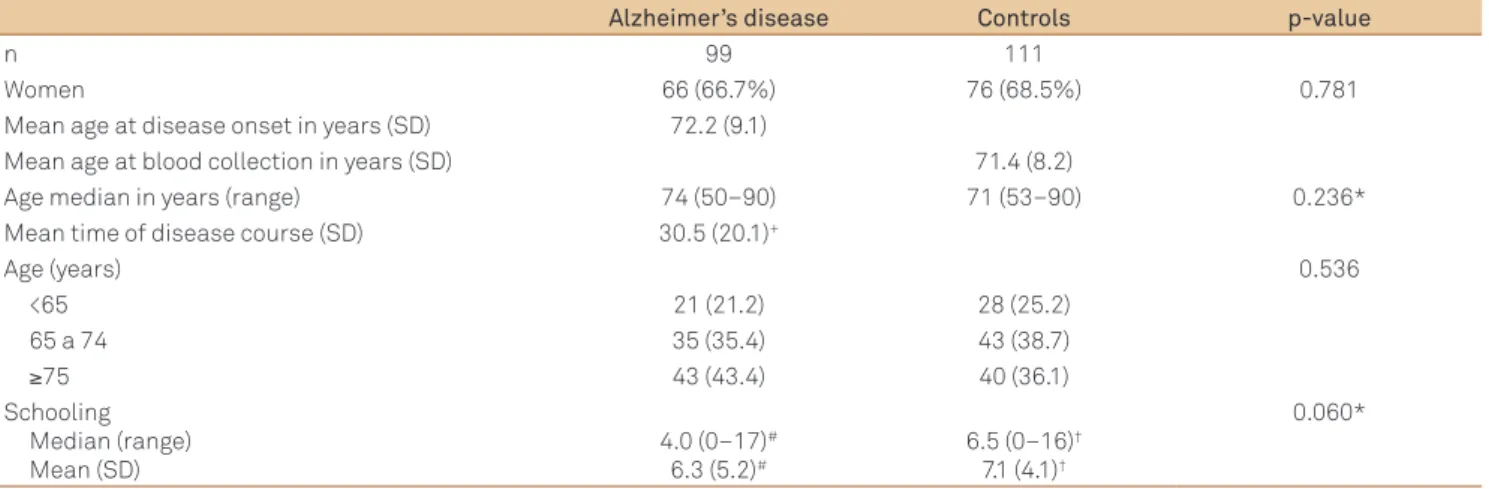
Ninety-nine patients with probable AD and 111 healthy control subjects were enrolled for analysis. he demograph-ic data of groups are shown in Table 1. Diferent subsamples were analyzed: early-onset AD (EOAD; <65 years) and late-onset AD (LOAD; ≥65 years). Control group subsamples were divided according to age at time of blood collection. he dis-ease duration considered was the time between initial symp-toms and the irst cognitive evaluation.
he PRNP polymorphisms at codons 117, 129, 171 and octarepeat domain were analyzed using denaturing high-performance liquid chromatography. Technical details about this procedure as well as ampliication reactions and DNA extraction have been previously described27.
he ApoE polymorphism (ε4+/ε4-) was evaluated in a subsample of 81 AD patients and 94 controls. he ApoE anal-ysis was performed as previously described by Bahia et al.11.
To compare frequencies of genotypes and alleles, we used Pearson χ2 test or Fisher’s exact test when
sam-ple size was small. Sex distribution was compared be-tween patients and controls using Pearson χ2 test. Age
and schooling distribution were compared using Mann-Whitney test. Kruskall-Wallis test was used to compare median between three or more groups. Logistic regression models were used to control for potential confounding ef-fect of sex, age and schooling. Odds ratio (OR) and 95% confidence intervals (CI) were calculated from the logis-tic regression models. Statislogis-tical analyses were done using Stata 11.0 program.
Alzheimer’s disease Controls p-value
n 99 111
Women 66 (66.7%) 76 (68.5%) 0.781
Mean age at disease onset in years (SD) 72.2 (9.1)
Mean age at blood collection in years (SD) 71.4 (8.2)
Age median in years (range) 74 (50–90) 71 (53–90) 0.236*
Mean time of disease course (SD) 30.5 (20.1)+
Age (years) 0.536
<65 21 (21.2) 28 (25.2)
65 a 74 35 (35.4) 43 (38.7)
≥75 43 (43.4) 40 (36.1)
Schooling Median (range) Mean (SD)
4.0 (0–17)#
6.3 (5.2)#
6.5 (0–16)†
7.1 (4.1)†
0.060*
Table 1. Demographic data of Alzheimer’s disease and control groups.
Ethics
his study was approved by the Ethics Committee for anal-ysis of research projects (CAPPesq) of Hospital das Clínicas, School of Medicine, USP. Subjects signed the informed con-sent form. When patient had the diagnosis of moderate or severe dementia, the written informed consent was given by a close relative. he study was conducted in compliance with the Declaration of Helsinki.
RESULTS
The genotype distribution of codon 129 polymor-phisms in the AD group was 45.5% MM, 42.2% MV, and 12.1% VV; and 39.6% MM, 50.5% MV, and 9.9% VV among controls. The genotype distributions were not statistical-ly different between groups. Subgroup anastatistical-lysis according to age at onset revealed no difference of genotype distri-bution between patients with EOAD and LOAD and the respective control groups. The analysis of M and V al-lele frequency, as well as homozygosity and heterozygos-ity distribution did not significantly differ between AD and control groups. These results are displayed in Tab. 2. The genotype distributions were in Hardy–Weinberg equilibrium.
he genotype distribution at codons 117, 171 and octa-peptide domain were not diferent between AD patients and controls (data not shown).
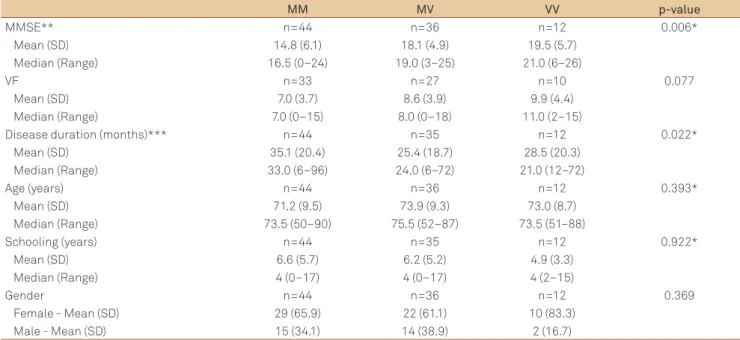
Concerning the cognitive evaluation, MMSE scores were signiicantly higher in AD patients with VV polymorphism and lower in patients with MM genotype (Table 3). he median
time of disease was signiicantly shorter in VV patients and longer in MM patients. Logistic regression model did not con-irm the association of MMSE performance and codon 129 polymorphism in AD group. here were no diferences at VF test performance of AD patients as well as at MMSE and VF test performance of controls concerning the codon 129.
he stratiication according to the ApoE genotype did not reveal any diference in the frequency of codon 129 polymor-phism between AD and control groups (Table 2).
DISCUSSION
The codon 129 polymorphism of PRNP has been asso-ciated with AD and cognitive performance in the elderly population19,28. Although reports show contradictory
re-sults, this polymorphism has been associated with differ-ent phenotypes in prion diseases and other neurodegen-erative diseases3-8.
The homozygosity for V was associated with high-er risk of cognitive impairment in two large population-al studies28,29. On the other hand, the homozygosity for M
was also associated with lower scores on cognitive tests in cognitive normal population30.
he evaluation of AD patients in populations worldwide shows divergent results. In an Italian sample, despite no dif-ference between the frequency of codon 129 polymorphisms in AD patients, the presence of one V allele was related to phenotypic characteristics: earlier disease onset and more aggressive disease16. In another Italian report, only VV
geno-type was associated with a faster rate of cognitive decline19.
n Codon 129 (%) Allele frequency Homozygosity (%)
M/M M/V V/V p-value M V p-value Yes No p-value
Group
Probable AD 99 45 (45.5) 42(42.4) 12 (12.1) 0.50 0.67 0.33 0.70 57 (57.6) 42 (42.4) 0.25
Controls 111 44 (39.6) 56 (50.5) 11 (9.9) 0.65 0.35
<65 years
EOAD 21 12 (57.1) 8 (38.1) 1 (4.8) 0.86 0.76 0.24 0.60 13 (61.9) 8 (38.1) 0.74
Controls 28 14 (50.0) 12 (42.9) 2 (7.1) 0.71 0.29 16 (57.1) 12 (42.9)
≥65 years
LOAD 78 33 (42.3) 34 (43.6) 11 (14.1) 0.48 0.64 0.36 0.79 44 (56.4) 34 (43.6) 0.23
Controls 83 30 (36.1) 44 (53.0) 9 (10.8) 0.63 0.37 39 (47.0) 44 (53.0)
AD
EOAD 21 12 (57.1) 8 (38.1) 1 (4.8) 0.35 0.76 0.24 0.14 13 (61.9) 8 (38.1) 0.65
LOAD 78 33 (42.3) 34 (43.6) 11 (14.1) 0.64 0.36 44 (56.4) 34 (43.6)
ApoE ε4+
AD 41 19 (46.3) 19 (46.3) 3 (7.3) 0.81 0.70 0.30 0.78 22 (53.7) 19 (46.3) 0.57
Control 17 6 (35.3) 10 (58.9) 1 (5.9) 0.65 0.35 7 (41.2) 10 (58.8)
ApoE ε
4-AD 40 17 (42.5) 17 (42.5) 6 (15) 0.57 0.64 0.36 0.89 23 (57.5) 17 (42.5) 0.44
Control 77 29 (37.7) 40 (51.9) 8 (10.4) 0.64 0.36 37 (48.1) 40 (51.9)
Table 2. Genotype, alleles, and homozygosity frequencies in cases and controls.
In a few European studies, codon 129 polymorphisms have been demonstrated to confer higher risk to AD. In a Dutch report, EOAD was more frequent in patients with fam-ily history of AD and codon 129 homozygosity, particularly VV17. he increased risk for EOAD was also demonstrated in
MM patients in Germany13. In a Polish study, MM genotype
was found to be a genetic risk factor only in LOAD14.
In Asian countries, all reported studies failed to demon-strate any association between the PRNP polymorphism at codon 129 and AD18,20,31. Of note, VV genotype is very rare in
the Asian population18,31.
Our results are in line with most of the studies reported to date. We failed to ind any association between the codon 129 polymorphisms of PRNP and AD, even when patients were divided in EOAD and LOAD. he frequency of the genotypes in the studied groups was similar to that previously described in a Brazilian population of blood donors: 45.6% MM, 48.2% MV, and 6.2% VV32.
Our results are also in agreement with the unique neu-ropathologically supported data that refutes the asso-ciation between codon 129 polymorphism and AD8. The
patients described here presenting VV genotype scored
better at MMSE, which is contradictory to other data showing that codon 129 homozygosity is associated with lower cognitive performance28-30. This result could be
ex-plained by the shorter period of disease of VV patients and not by the codon 129 polymorphism. This is particularly reinforced by the logistic regression analysis that refuted the association between MMSE performance and different genotypes at codon 129.
In opposition to some studies, which showed interaction between ApoE and PRNP, our data did not reveal diferences in codon 129 genotypes according to the ApoE status13-21.
his study of PRNP in patients with AD in the Brazilian population has, as its main limitation, the small sample. Additional studies would be necessary to conirm these neg-ative results regarding the relationship between AD and the polymorphism at codon 129 of PRNP.
ACKNOWLEDGMENTS
Authors thank Dr. Marcus Vinícius de Nigro Corpa for lin-guistic editing.
References
Table 3. Cognitive performance in Alzheimer’s disease patients according to prion protein gene codon 129
MM MV VV p-value
MMSE** n=44 n=36 n=12 0.006*
Mean (SD) 14.8 (6.1) 18.1 (4.9) 19.5 (5.7)
Median (Range) 16.5 (0–24) 19.0 (3–25) 21.0 (6–26)
VF n=33 n=27 n=10 0.077
Mean (SD) 7.0 (3.7) 8.6 (3.9) 9.9 (4.4)
Median (Range) 7.0 (0–15) 8.0 (0–18) 11.0 (2–15)
Disease duration (months)*** n=44 n=35 n=12 0.022*
Mean (SD) 35.1 (20.4) 25.4 (18.7) 28.5 (20.3)
Median (Range) 33.0 (6–96) 24.0 (6–72) 21.0 (12–72)
Age (years) n=44 n=36 n=12 0.393*
Mean (SD) 71.2 (9.5) 73.9 (9.3) 73.0 (8.7)
Median (Range) 73.5 (50–90) 75.5 (52–87) 73.5 (51–88)
Schooling (years) n=44 n=35 n=12 0.922*
Mean (SD) 6.6 (5.7) 6.2 (5.2) 4.9 (3.3)
Median (Range) 4 (0–17) 4 (0–17) 4 (2–15)
Gender n=44 n=36 n=12 0.369
Female - Mean (SD) 29 (65.9) 22 (61.1) 10 (83.3)
Male - Mean (SD) 15 (34.1) 14 (38.9) 2 (16.7)
*Kruskal Wallis. M: methionine; V: valine; SD: standard deviation; MM versus MV p<0.001; MV versus VV p<0.001; MM versus VV p<0.001;
1. Glatzel M, Ott PM, Linder T, et al. Human prion diseases: epidemiology and integrated risk assessment. Lancet Neurol 2003;2:757-763.
2. Brandel JP, Delasnerie-Lauprêtre N, Laplanche JL, Hauw JJ, Alpérovitch A. Diagnosis of Creutzfeldt-Jakob disease: effect of clinical criteria on incidence estimates. Neurology 2000;54:1095-1099.
3. Parchi P, Castellani R, Capellari S, et al. Molecular basis of phenotypic variability in sporadic Creutzfeldt-Jakob disease. Ann Neurol 1996;39:767-778.
5. Poleggi A, Bizzarro A, Acciarri A, et al. Codon 129 polymorphism of prion protein gene in sporadic Alzheimer’s disease. Eur J Neurol 2008;15:173-178.
6. Gossrau G, Herting B, Möckel S, et al. Analysis of the polymorphic prion protein gene codon 129 in idiopathic Parkinson’s disease. J Neural Transm 2006;113:331-337.
7. Scholz SW, Xiromerisiou G, Fung HC, et al. The human prion gene M129V polymorphism is not associated with idiopathic Parkinson’s disease in three distinct populations. Neurosci Lett 2006;395:227-229.
8. Li X, Rowland LP, Mitsumoto H, et al. Prion protein codon 129 genotype prevalence is altered in primary progressive aphasia. Ann Neurol 2005;58:858-864.
9. Herrera Jr. E, Caramelli P, Silveira ASB, Nitrini R. Epidemiologic survey of dementia in a community-dwelling Brazilian population. Alzheimer Dis Assoc Disord 2002;16:103-108.
10. Strittmatter WJ, Saunders AM, Schmechel D, et al. Apolipoprotein E: high-avidity binding to b-amyloid and increased frequency of type 4 allele in late-onset familial Alzheimer disease. Proc Natl Acad Sci USA 1993; 90:1977-1981.
11. Bahia VS, Kok F, Marie SN, Shinjo SO, Caramelli P, Nitrini R. Polymorphisms of APOE and LRP genes in Brazilian individuals with Alzheimer disease. Alzheimer Dis Assoc Disord 2008;22:61-65.
12. Golanska E, Hulas-Bigoszewska K, Rutkiewicz E, et al. Polymorphisms within the prion (PrP) and prion-like protein (Doppel) genes in AD. Neurology 2004;62:313-315.
13. Riemenschneider M, Klopp N, Xiang W, et al. Prion protein codon 129 polymorphism and risk of Alzheimer disease. Neurology 2004;63:364-366.
14. Gacia M, Safranow K, Styczyñska M, et al. Prion protein gene M129V allele is a risk factor for Alzheimer’s disease. J Neural Transm 2006;113:1747-1751.
15. Combarros O, Sánchez-Guerra M, Llorca J, et al. Polymorphism at codon 129 of the prion protein gene is not associated with sporadic AD. Neurology 2000;55:593-595.
16. Casadei VM, Ferri C, Calabrese E, et al. Prion protein gene polymorphism and Alzheimer’s disease: one modulatory trait or cognitive decline? J Neurol Neurosurg Psychiatry 2001;71:278-283.
17. Dermaut B, Croes EA, Rademakers R, et al. PRNP Val129 homozygosity increases risk for early-onset Alzheimer’s disease. Ann Neurol 2003;53:409-412.
18. Ohkubo T, Sakasegawa Y, Asada T, Kinoshita T, Goto Y, Kimura H, et al. Absence of association between codon 129/219 polymorphism of the prion protein gene and Alzheimer’s disease in Japan. Ann Neurol 2003;54:553-554.
19. Del Bo R, Scarlato M, Ghezzi S, et al. Is M129V of PRNP gene associated with Alzheimer disease? A case-control study and meta-analysis. Neurobiol Aging 2006;27:770-775.
20. Jeong B-H, Lee K-H, Jeong Y-E, et al. Polymorphisms at codons 129 and 219 of the prion protein gene (PRNP) are not associated with sporadic Alzheimer’s disease in the Korean population. Eur J Neurol 2007;14:621-626.
21. Calero O, Bullido MJ, Clarimón J, et al. Genetic cross-interaction between APOE and PRNP in sporadic Alzheimer’s and Creutzfeldt-Jakob diseases. PLoS One 2011;6:22090.
22. Prusiner SB. Prions. Proc Natl Acad Sci USA 1998;95:13363-11383.
23. Querfurth HW, LaFerla FM. Alzheimer’s disease. N Engl J Med 2010;362:329-344.
24. Laurén J, Gimbel DA, Nygaard HB, Gilbert JW, Strittmatter SM. Cellular prion protein mediates impairment of synaptic plasticity by amyloid-b oligomers. Nature 2009;457:1128-1132.
25. Gimbel DA, Nygaard HB, Coffey EE, et al. Memory impairment in transgenic Alzheimer mice requires cellular prion protein. J Neurosci 2010;30:6367-6374.
26. Calella AM, Farinelli M, Nuvolone M, et al. Prion protein and Ab-related synaptic toxicity impairment. EMBO Mol Med 2010;2: 306-314.
27. Castro RM, Landemberger MC, Walz R, et al. High capacity and low cost detection of prion protein gene variant alleles by denaturing HPLC. J Neurosci Methods 2004;139:263-269.
28. Berr C, Richard F, Dufouil C, et al. Polymorphism of the prion protein is associated with cognitive impairment in the elderly. The EVA study. Neurology 1998;51:734-737.
29. Croes EA, Dermaut B, Houwing-Duistermaat JJ, et al. Early cognitive decline is associated with prion protein codon 129 polymorphism. Ann Neurol 2003;54:275-276.
30. Rujescu D, Hartmann AM, Gonnermann C, Möller H-J, Giegling I. M129V variation in the prion protein may inluence cognitive performance. Mol Psychiatry 2003;8:937-941.
31. Jeong BH, Nam JH, Lee YJ, et al. Polymorphisms of the prion protein gene (PRNP) in a Korean population. J Hum Genet 2004;49: 319-324.