189
https://doi.org/10.1590/0004-282X20170019
HISTORICAL NOTE
Georges Simenon, Inspector Maigret and his
relevance to the practice of Neurology
Georges Simenon, Inspector Maigret e a sua relevância para a prática da Neurologia
Hélio A. G. Teive1, Andrew J. Lees2
he links between neurology and the nineteenth century novel have long been a source of scholarly interest but con
-nections with detective iction have only recently begun to be explored1,2,3. Forensic medicine and neurology both emerged as
distinct specialties in the middle of the nineteenth century and some of the early neurologists like Brouardel in Paris and Ferrier in England held joint appointments between the two disci
-plines3,4. Many authors of crime novels such as Edgar Allan Poe
(detective Auguste Dupin), Agatha Christie (Hercule Poirot), Raymond Chandler (Philip Marlowe), Dashiell Hammett (Sam Spade), Arthur Conan Doyle (Sherlock Holmes) and Georges Simenon (Jules Maigret), are popular reading material for numerous neurologists and some even turned their hand to writing detective iction.3 he Maigret detective novels were
a phenomenal commercial success, but like Sherlock Holmes for Doyle, the ictional creation became a millstone round Simenon’s neck as he strived for serious literary acclaim5,6,7,8,9.
GEORGES SIMENON
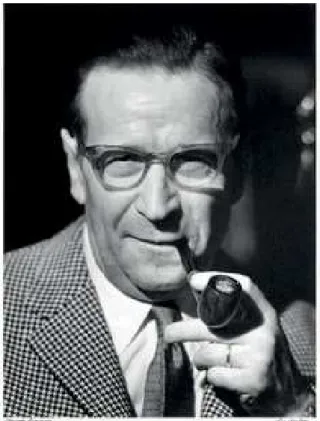
Georges Joseph Christian Simenon (1903-1989) was born in Liège, Belgium (Figure 1) and, while still young, moved to Paris, France5,6,7,8,9.
1Universidade Federal do Paraná, Hospital de Clínicas, Departamento de Medicina Interna, Serviço de Neurologia, Curitiba PR, Brasil; 2University College London, Institute of Neurology, Reta Lila Weston Institute of Neurological Sciences, UK.
Correspondence: Hélio A. G. Teive; Rua General Carneiro, 1103/102; 80060-150Curitiba PR; Brasil; Email: [email protected] Conflict of interest: There is no conflict of interest to declare.
Received 20 February 2016; Accepted 03 March 2016.
ABSTRACT
Georges Simenon’s work, including his famous ‘romans durs’ novels and the forensic investigations carried out by his artistic creation, Inspector Maigret, bear many similarities to some of the diagnostic methods of the founders of Neurology, particularly Jean-Martin Charcot.
Keywords: literature; neurology.
RESUMO
A obra de Georges Simenon, incluíndo os seus famosos “romances duros”, e as investigações criminais realizadas pela sua criação artística, o comissário Maigret, tem muitas similaridades com alguns métodos diagnósticos utilizados pelos fundadores da Neurologia, particularmente Jean-Martin Charcot.
Palavras-chave: literatura; neurologia.
(Extracted from Google Images: www.goodreads.com, February, 13th, 2016).
190 Arq Neuropsiquiatr 2017;75(3):189-191
Simenon’s work can be divided into the ‘romans durs’ novels, in which he explores the daily drama of the lives of ordinary people, and his crime novels featuring his famous creation, Inspector Jules Maigret of the French Judicial Police5,6,7,8,9. Inspector Maigret, the central charac
-ter in 75 of Simenon’s 400 novels and 28 of his short sto
-ries, gained a level of international acclaim comparable to that achieved by Sherlock Holmes and Hercule Poirot, although his star has faded somewhat in recent years. Simenon’s ability to write gripping crime novels and psy
-chological dramas may have stemmed from his family background and his early work as a crime reporter on the
Gazette de Liège, in Belgium. He died at the age of 86 in Lausanne, Switzerland5,6,7,8,9.
INSPECTOR MAIGRET
Commissioner, or Inspector, Jules A. F. Maigret (Figure 2) of the French Police, had a distinctive method for solving crimes that difered considerably from the more scientiic method of deductive reasoning backwards from the crime that characterized Sherlock Holmes’ modus operandi. Maigret’s was far more intuitive and his success depended on a deep understanding of human behaviour (“a dive into the human soul”)5,6,7,8. His approach owed more to psychology,
whereas Holmes embraced pathology and modern scientiic advances such as ingerprinting. Maigret irst soaks up the atmosphere of the
crime scene and analyses, in exhaustive detail, the psy
-chological proiles of the main suspects5,6,7,8. Maigret is
depicted in the novels as a corpulent, sedentary, slothful and bad tempered man of few words, famous for his love of food and drink. He is portrayed on screen with his trademark hat, an overcoat with a velvet collar, sucking on his pipe5,6,7,8. In the
book Memoirs of Maigret, the reader learns that the famous
inspector studied medicine as a young man, only to give it up and start a career in the police8.
Simenon often hints that Maigret’s partial knowledge of medicine helps him to solve some of the crimes he investigated.
SIMENON AND NEUROLOGY
In his book he Bells of Bicêtre, published in 19637, Simenon
details the medical history of Mr. René Maugras, a 55-year-old Parisian magnate who has a stroke during lunch at a famous Parisian restaurant, leaving him paralyzed down the right side and unable to express himself. He then falls into a coma, and is diagnosed with thrombosis of the left middle cerebral artery7. he patient’s clinical course, with severe neurological
deicits, his rehabilitation and the anguish he and his family feel as his condition worsens are described with great atten
-tion to detail and accuracy7.
SIMENON AND PSYCHIATRY
In one of Simenon’s most famous books, Dirty Snow, published in 19486, the main character, 19-year-old Frank
Friedmaier is a pimp, a crook and a thief who lives in France under the Nazi occupation. His mother runs a brothel, which is frequented by German oicers6. Frank’s indiference, his
mendacity and his complete callousness and lack of any feel
-ing of remorse for the crimes he commits, provides a clear description of sociopathy6. Even after he is sent to prison,
Frank remains emotionally detached from his mother, friends and even a supposed admirer6.
DISCUSSION
Simenon describes psychological and psychiatric dis
-orders in a way that clearly shows the “absurdity of human existence” and leads to Simenon being considered “a clinician of the soul”5,6,7,8,9. In his book
My Friend Maigret,5 Simenon
describes in detail the visit of an inspector from Scotland Yard, Mr. Pyke, to the French Judicial Police. he purpose of the visit is for Pyke to learn from how Maigret operates5.
To Pyke’s amazement, Maigret follows no scientiic method of investigation but, literally, enters the inner world of his victim, reconstructing psychological and social proiles. His
(Extracted from Google images: en.wikipedia.org, February, 13th, 2016).
191 Teive HAG, Lees AJ. Simenon, Maigret and neurology
technique involves protracted interviews that eventually end with the perpetrators confession5.
One of Charcot’s great legacies as a clinician was his contribution to the development of systematic neurologi
-cal examination. Charcot attempted to link clini-cal signs to speciic anatomical lesions in the nervous system. He was a visionary who used Gallic intuitiveness and showman
-ship to great efect, in both his clinical demonstrations and
References
1. Iniesta I. [Neurology and literature]. Neurologia. 2010;25(8):507-14. Spanish. https:// doi.org/10.1016/j.nrl.2010.07.013
2. Teive HAG, Munhoz RP, Paola L. Neurological diseases in the Dalton Trevisan’s short stories. Acta Med Port. 2014;27(2):232-5.
3. Kempster PA, Less AJ. Neurology and detective writing. Pract Neurol. 2013;13:372-6. https://doi.org/10.1136/practneurol-2013-000597
4. Lees AJ. The strange case of Dr. William Gowers and Mr. Sherlock Holmes. Brain. 2015;138:2103-8. https://doi.org/10.1093/brain/awv144
5. Simenon G. Meu amigo Maigret. Porto Alegre: LPM; 2013. (LPM Pocket, Vol 1103).
6. Simenon G. A neve estava suja. São Paulo: Companhia das Letras; 2014.
7. Simenon G. The bells of Bicêtre. New York: Harcourt, Brace & World; 1964.
8. Simenon G. Memórias de Maigret. Porto Alegre: LPM; 2006.
9. Simenon G. Pedigree. New York: Review of Books; 2010.
10. Teive HAG, Munhoz RP, Silva GG. Charcot’s skepticism. Arq Neuropsiquiatr. 2012;70(11):897-9. https://doi.org/10.1590/S0004-282X2012001100014
teaching seminars. Maigret’s approach to crime solving reminds us that neurology can never be reduced to a series of guidelines and algorithms and that, although a system
-atic approach may enable a clinician to come to the cor