Case Report
Keywords
Aortic valve stenosis; hemorrhage; gastrointestinal hemorrhage; angiodysplasia; Heyde sindrome.
This study reports the case of Heyde’s syndrome and discusses the pathophysiology bases and potential therapies for this syndrome.
Heyde’s Syndrome: Case Report and Literature Review
Fernando Côrtes Remisio Figuinha, Guilherme Sobreira Spina, Flávio Tarasoutchi
Instituto do Coração - HC-FMUSP, São Paulo, SP - Brazil
Mailing address: Fernando Côrtes Remisio Figuinha•
Rua Teodoro Sampaio, 408 / 24 – Pinheiros - 05406-000 - São Paulo, SP – Brazil E-mail: [email protected], [email protected]
Manuscript received September 10th, 2010; revised manuscript received March 4th ,2010; accepted March 24th ,2010.
Introduction
The association between aortic stenosis and gastrointestinal bleeding — Heyde’s syndrome — has been studied in recent years with major advances in the understanding of its pathophysiological mechanism and therapy. This report presents an illustrative case of Heyde’s syndrome and reviews the literature available to date.
Case Report
Patient A.M., male, 76 years old, sought medical attention complaining of chest tightness, without irradiation, associated with nausea and sweating, usually starting with minor stresses. The patient also presented dyspnea on minimal exertion, orthopnea, paroxysmal nocturnal dyspnea and edema of lower limbs. The patient denied fever. Patient reported episodes of lower gastrointestinal bleeding (LGIB) in small amounts, for six months. He denied other sites of bleeding.
He reported a history of hypertension, type 2 diabetes mellitus, chronic renal failure (CRF) not undergoing dialysis and reported valve problem and exertion fatigue.
On physical examination, he was pale, eupneic. Pulse of 82 bpm, respiratory rate of 20 bpm, blood pressure 140 x 70 mmHg. Cardiovascular examination revealed ejective systolic murmur at aortic focus +++/6+, irradiating to the suprasternal notch. Pulmonary examination with crackling rales at the bases. Peripheral edema ++/4+, and good peripheral perfusion.
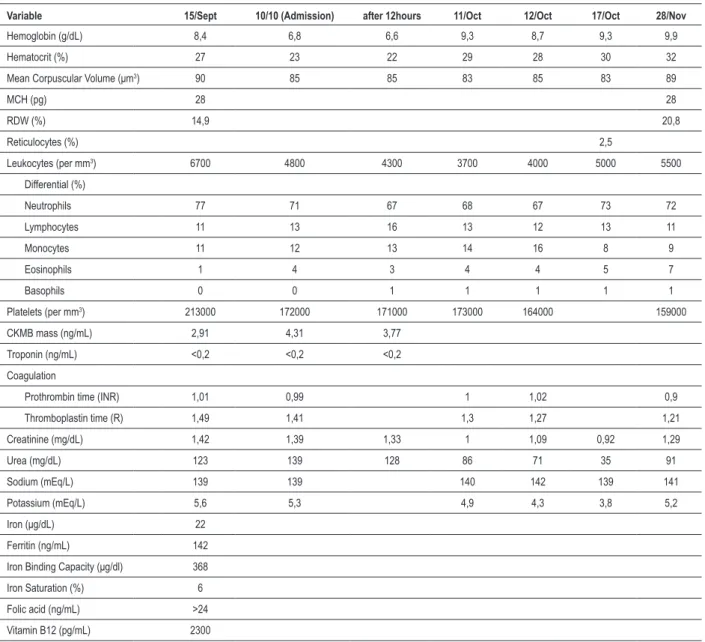
General tests revealed hemoglobin of 6.8 g/dl, hematocrit 23%, creatinine 1.39 mg/dL. The other tests are shown in Table 1. Initially, the picture of anemia was attributed to the
IRC. However, there was improvement in renal function after volume infusion, characterizing renal dysfunction as acute. Because of heart failure and anemia, a blood transfusion was made.
Iron status revealed anemia likely to be due to iron deficiency (Table 1). Electrocardiogram shown in Figure 1.
Transthoracic echocardiography confirmed important aortic stenosis, valve area 0.5 cm2 and a maximum gradient of 85 mmHg and average gradient of 52 mmHg. Ejection fraction 62%. Left ventricle with diastolic diameter of 56 mm and stroke diameter of 37 mm.
Coronary angiography revealed 60% lesion in 1/3 proximal anterior descending artery with no further critical lesions except for some irregularities. LV-Ao gradient of 45 mmHg.
Colonoscopy was performed to investigate the LGIB. It revealed angiodysplasia in proximal ascending colon. The presence of gastrointestinal bleeding for angiodysplasia and aortic stenosis suggested the diagnosis of Heyde’s syndrome.
The patient’s hemoglobin levels remained stable after transfusion performed on admission. After catheterization and with improved cardiac failure symptoms, the patient was discharged and referred to outpatient clinic reassessment for scheduling of surgery for valve replacement.
Two months after discharge, the patient sought the emergency room and was admitted in ICU for decompensated heart failure. Surgery was recommended for aortic valve replacement, but the patient presented clinical worsening because of pulmonary infection, progressing to death from septic shock.
Discussion
Heyde’s syndrome is the association of gastrointestinal bleeding due to angiodysplasia and aortic stenosis (AoS). It was originally described in 19581 by Heyde, and in 1992 Olearchyk2 defined the combination of aortic stenosis and recurrent bleeding due to gastrointestinal angiodysplasia as Heyde’s syndrome.
Vincentelli et al3 showed that 21% of patients with severe aortic stenosis had skin or mucous bleeding in the six months preceding valve surgery.
Several articles have been published in recent years discussing the pathophysiology little known until the end of the last century, and the treatment of this syndrome. It is related to von Willebrand’s type 2A acquired syndrome occuring in these patients — hemorrhagic syndrome that arises due to loss of high molecular weight vWF multimers (HMWM)3.
Case Report
Figuinha et al Heyde’s syndrome
Arq Bras Cardiol 2011;96(3):e42-e45
Table 1 – Serum test results
Variable 15/Sept 10/10 (Admission) after 12hours 11/Oct 12/Oct 17/Oct 28/Nov
Hemoglobin (g/dL) 8,4 6,8 6,6 9,3 8,7 9,3 9,9
Hematocrit (%) 27 23 22 29 28 30 32
Mean Corpuscular Volume (μm3) 90 85 85 83 85 83 89
MCH (pg) 28 28
RDW (%) 14,9 20,8
Reticulocytes (%) 2,5
Leukocytes (per mm3) 6700 4800 4300 3700 4000 5000 5500
Differential (%)
Neutrophils 77 71 67 68 67 73 72
Lymphocytes 11 13 16 13 12 13 11
Monocytes 11 12 13 14 16 8 9
Eosinophils 1 4 3 4 4 5 7
Basophils 0 0 1 1 1 1 1
Platelets (per mm3) 213000 172000 171000 173000 164000 159000
CKMB mass (ng/mL) 2,91 4,31 3,77
Troponin (ng/mL) <0,2 <0,2 <0,2
Coagulation
Prothrombin time (INR) 1,01 0,99 1 1,02 0,9
Thromboplastin time (R) 1,49 1,41 1,3 1,27 1,21
Creatinine (mg/dL) 1,42 1,39 1,33 1 1,09 0,92 1,29
Urea (mg/dL) 123 139 128 86 71 35 91
Sodium (mEq/L) 139 139 140 142 139 141
Potassium (mEq/L) 5,6 5,3 4,9 4,3 3,8 5,2
Iron (μg/dL) 22 Ferritin (ng/mL) 142
Iron Binding Capacity (μg/dl) 368 Iron Saturation (%) 6
Folic acid (ng/mL) >24
Vitamin B12 (pg/mL) 2300
The pathophysiological explanation is that with the passage of vWF through the stenotic valve, occurs proteolysis of these multimers by enzyme ADAMTS13 (A disintegrin And Metalloproteinase with Thrombospondin type 1 moitf, member 13) – a protease that acts preferentially under conditions of high shear stress. These HMWM are very important for a proper haemostasis mediated by platelets3, binding to platelet glycoprotein Ib. The von Willebrand factor is secreted by endothelial cells into the blood, where it contributes to the formation of platelet thrombi and acts as a mediator of platelet adhesion at the vascular injury site. The first description of the loss of HMWM in Heyde’s syndrome was made by Warkentin et al4 in 1992.
The relationship between AoS and platelet function was examined recently3. Almost all patients with severe aortic stenosis had decreased percent HMWM and platelet dysfunction. From
the first day after surgery for valve replacement, all patients had their HMWM levels and platelet function brought to normal conditions, which proves the relationship between valve disease and hematological abnormality.
As for the high prevalence of angiodysplasia in these patients, it was proposed that hemodynamically significant aortic stenosis may be associated with decreased gastrointestinal perfusion, thereby leading to dilation of blood vessels induced by hypoxia, speeding up the development of fixed vasodilatation, genesis of angiodysplasia.
As for treatment, the doubt that arises when dealing with a patient who has a significant aortic stenosis and gastrointestinal bleeding associated is the conduct that must be taken: should we operate the heart first, with aortic valve replacement, or the intestine, with resection of the bleeding segment?
Case Report
Figuinha et al Heyde’s syndrome
Arq Bras Cardiol 2011;96(3):e42-e45
Figure 1 - Resting electrocardiogram showing sinus rhythm, atrioventricular block of 1st degree and left ventricular hypertrophy.
We fear that after the new valve surgery further bleeding may occur. On the other hand, intestinal surgery with AoS is associated with high risk of perioperative cardiovascular complications for valve disease5.
Valve surgery alone may lead to regression of the abnormalities that occur in Heyde’s syndrome. Recurrence of bleeding only occurs when the pathophysiological mechanism is re-established, either by re-aortic stenosis, either by patient-prosthesis mismatch (defined by effective valve area by body surface <0.85 cm2/m2 on echocardiogram)6 — where there are still high postoperative aortic gradients even with normofunctioning valves.
The type of valve prosthesis is the biological one, since it does not require anticoagulation after surgery.
When valve surgery cannot be performed, for high surgical risk, some authors7 suggest to perform colectomy after identification of the bleeding site as an initial treatment option, knowing that recurrence of bleeding could occur at another site. Today, percutaneous prosthesis8 can be performed.
Some authors also suggest octreotide 20 mg once a month7 as an alternative treatment to those whose surgery was not successful in resolving the bleeding.
The supplementation of von Willebrand factor seems to be effective to prevent major bleeding complications
in the perioperative period9, but the long-term treatment of acquired type 2A von Willebrand syndrome for valve lesion does not respond well to desmopressin and repeated transfusions of clotting factors, and thus requires surgical correction of aortic stenosis for final resolution of the hematological abnormality.
Thus, the recommended treatment of choice for Heyde’s syndrome is aortic valve replacement surgery, which should be performed whenever possible to those who have a history of bleeding and severe aortic stenosis.
Potential Conflict of Interest
No potential conflict of interest relevant to this article was reported.
Sources of Funding
There were no external funding sources for this study.
Study Association
This study is not associated with any post-graduation program.
Case Report
Figuinha et al Heyde’s syndrome
Arq Bras Cardiol 2011;96(3):e42-e45
References
1. Heyde EC. Gastrointestinal bleeding in aortic stenosis. N Engl J Med. 1958; 259: 196.
2. Olearchyk AS. Heyde’s syndrome. J Thorac Cardiovasc Surg. 1992; 103 (4): 823-4.
3. Vincentelli A, Susen S, Le Tourneau T, Six I, Fabre O, Juthier F, et al. Acquired von Willebrand syndrome in aortic stenosis. N Engl J Med. 2003; 349 (4): 343-9.
4. Warkentin TE, Moore JC, Morgan DG. Aortic stenosis and bleeding gastrointestinal angiodysplasia: is acquired von Willebrand syndrome the lynk? Lancet. 1992; 240 (8810): 35-7.
5. Christ M, Sharkova Y, Geldner G, Maisch B. Preoperative and perioperative care for patients with suspected or established aortic stenosis facing noncardiac surgery. Chest. 2005; 128 (4): 2944-53.
6. Goldsmith IR, Blann AD, Patel RL, Lip GY. Effect of aortic valve replacement on plasma soluble P-selectine, von Willebrand factor and fibrinogen. Am J Cardiol. 2001; 87 (1): 107-10.
7. De Palma GD, Slavatori F, Masone S, Simeoli I, Rega M, Celiento M, et al. Acute gastrointestinal bleeding following aortic valve replacement in a patient with Heyde’s syndrome. Case report. Minerva Gastroenterol Dietol. 2007; 53 (3): 291-3.
8. Webb JG, Pasupati S, Humphries K, Thompson C, Altweg L, Moss R, et al. Percutaneous transarterial valve replacement in selected high-risk patients with aortic stenosis. Circulation. 2007; 116 (7): 755-63.
9. Morishima A, Marui A, Shimamoto T, Sagi Y, Tambara K, Nishima T, et al. Successful aortic valve replacement for Heyde syndrome with confirmed hematologic recovery. Ann Thorac Surg. 2007; 83 (1): 287-8.