1
The impact of the relief of anginal symptoms, the reduction in the incidence of acute myocardial infarction, and the improvement in survival in some subgroups of patients with impaired ventricular function support the use of coronary artery bypass surgery (CABG) as an effective treatment for ischemic heart disease 1,2. The
obser-vation of the development of intimal hyperplasia, atherosclerosis, and the occurrence of thrombosis and occlusion in the grafts, mainly the venous 3, motivated a progressive increase in the use of arterial
grafts, in an attempt to decrease the indices of occlusion of venous grafts, which ranged from 5% to 15% in the first month, and 15% to 25% in the first year, and reached up to 50% in the first 10 years 4-6. Therefore, based on the Coronary Artery Surgery Study 7,
which was carried out in the 1970s and used the left internal thoracic artery (LITA) as a graft for the anterior interventricular branch (AIVB) 8 in up to 20% of the patients, the arterial graft
became increasingly more used, reaching, at the end of the 1980s and beginning of the 1990s, 37% to 90% of the patients 9-14.
The advance in the techniques of myocardial revascularization in the 1990s stimulated the use of other arterial grafts, such as the double graft of the right and left internal thoracic arteries (RITA and LITA), whose results showed a lower recurrence of anginal symptoms, a decrease in reoperations, and a tendency to longer survival 15,16.
Comparative studies of patients undergoing myocardial revas-cularization through either surgery or angioplasty have not reported statistically significant differences in regard to immediate or late survival rates between the 2 types of treatment. These results did not consider the existence of variations in the samples regarding the number of arteries impaired or the number of arteries effectively treated in each type of intervention. These variations, however, have been observed in recent studies comparing the results of surgery and angioplasty 9, including 45% of patients with
single-vessel disease, while the samples of other studies 14,17 had 60%
of patients with 2-vessel stenoses.
When the number of arteries that effectively underwent inter-vention through the 2 methods is compared, variations are obser-ved in the mean number of arteries treated with angioplasty and those receiving distal anastomoses. In our sample, the mean num-ber of arteries treated with transluminal coronary angioplasty (TCA) was smaller than the number of grafts per patient (2.4 vs 3.1) 14.
Another relevant aspect is the initial number of arteries
con-Original Article
Comparative Study of the Results of Coronary
Artery Bypass Grafting and Angioplasty for
Myocardial Revascularization in Patients with
Equivalent Multivessel Disease
Paulo Roberto Dutra da Silva, Whady Armindo Hueb, Luiz Antônio Machado Cesar,
Sérgio Almeida de Oliveira, José Antônio Franchini Ramires
Rio de Janeiro, RJ / São Paulo, SP - Brazil
InCor - Instituto do Coração do Hospital das Clínicas da FMUSP Mailing address: Paulo Roberto Dutra da Silva - Rua Sorocaba, 464/405 Cep 22271-110 - Rio de Janeiro, RJ, Brazil
E-mail: [email protected] Received for publication: 06/23/2003 Accepted for publication: 07/01/2004 English version by Stela Maris Costalonga
Objective
To investigate the relative efficacy of different therapeutic strategies in patients with symptomatic multivessel coronary ar-tery disease with preserved ventricular function. The primary objectives were defined as a combination of death of cardiac origin, acute myocardial infarction (AMI), and refractory angina that required revascularization, and the secondary objectives were defined as anginal state and exercise-induced ischemia.
Methods
Of the 20,769 patients assessed on cine coronary angiogra-phy at InCor, 210 were chosen for this study and were randomized either for coronary artery bypass grafting (CABG, n=105) or transluminal coronary angioplasty (TCA, n=105).
Results
A mean of 3.2±0.8 vessels received anastomoses and 2.1±0.8 were successfully dilated in the CABG and TCA groups, respectively. In a 5-year follow-up, the rates of events in the CABG and TCA groups were, respectively: mortality, 9.52% and 12.38%; acute myocardial infarction, 2.85% and 8.57% (P = 0.0668); and additional intervention, 2.85% and 24.76% (P < 0.001). The survival rate was 88.39% for CABG and 84.93% for TCA; the respective AMI-free percentages were 84.40% and 77.40%. In the CABG and TCA groups, 62% and 60% of the patients had no angina, respectively. The exercise tests were considered nonischemic in 62.5% and 62.1% of the patients in the CABG and TCA groups, respectively.
Conclusion
In multivessel patients, compared with angioplasty, coronary artery bypass grafting was associated with a lower incidence of long-term events and a reduced need for new interventions (P=0.001).
Key words
2
Volume 84, Nº 3, Março 2005 Volume 84, Nº 3, Março 2005
sidered adequate for TCA and the number of arteries successfully treated and effectively cleared. This condition characterizes an incomplete revascularization, frequent in the major studies 9-14.
Therefore, the final result of myocardial revascularization obtained with TCA is different from that expected in all the studies performed, regardless of whether they were planned to obtain complete ana-tomical revascularization 10, complete or equivalent functional
re-vascularization 9,11, or even the allowed incomplete myocardial
revascularization 12,13.
Therefore, when analyzing the revascularization indices of the 2 types of intervention, greater indices of complete myocardial revascularization have been frequently observed with CABG than with TCA, ie, 88% vs 51% 11, 91% vs 57% 14.
The initial data from the NHLBI-PTCA Registry (1985-86), showing results of long-term follow-up, have contributed to validate incomplete anatomical revascularization as compared with com-plete anatomical revascularization 18.
That report showed no difference between the 2 forms of revascularization regarding the analysis of major cardiac events (death, Q-wave infarction, and recurring angina).
The results of the BARI study regarding the comparative strategy between anatomically incomplete and complete TCA showed no differences in the medium-term survival, confirming the initial studies of the 1980s 19,20. It is worth mentioning that the functional
results of the 2 myocardial revascularization methods (TCA and CABG) are rarely discussed.
On the other hand, few studies are available about the success of patent grafts and corresponding arteries or about the late results of percutaneous transluminal coronary angioplasty.
Therefore, despite all benefits achieved with those 2 thera-peutic methods for myocardial revascularization, several clinical, angiographic, and prognostic conditions of the patients still remain questionable. The randomized and controlled clinical studies in-volving CABG and TCA in patients with multivessel coronary artery disease discussed previously could not establish a consensus re-garding the procedure with better long-term clinical results. Most of those studies have valued the evolution aspects and the clinical events secondary to the procedures, lacking information on the myocardial ischemic load. Because the final objective of both procedures is to improve myocardial ischemia, the analysis of the procedures under that viewpoint is pertinent, and, therefore, our results should be compared with those reported in the major studies 19,20. Perhaps the aimed-for complete myocardial
revascu-larization may have been excessively over-rated compared with the functionally adequate myocardial revascularization.
This study aimed at assessing the efficacy of each intervention in protecting ischemic myocardium and in the long-term survival of patients with chronic obstructive coronary artery disease and at establishing the condition of myocardial ischemia at the end of the study in patients indicated for one of the 2 therapeutic myo-cardial revascularization options.
Methods
This study assessed and followed up a subgroup of 210 patients selected based on 20,769 cine coronary angiographies performed at the Instituto do Coração of the Hospital das Clínicas of the Medical School of the University of São Paulo. This is a
single-center randomized, prospective, multidisciplinary study that com-pares the therapeutic options, CABG and TCA, in patients with multivessel coronary artery disease, stable angina, and preserved ventricular function. The scientific committee on ethics at our institution approved the study.
The study comprised patients with multivessel coronary artery disease and stable angina or exercise-induced myocardial ischemia, or both, diagnosed through cine coronary angiography, which re-vealed significant coronary stenoses (> 70%) in 2 or more vessels, representing the patients with multivessel coronary artery disease treated for angina or myocardial ischemia. The criteria of eligibility were as follows: Canadian Cardiovascular Society FC II or III stable angina 21 or evidence of exercise-induced myocardial ischemia
re-quiring myocardial revascularization. The exercise test was consi-dered positive when the patients developed angina during exercise or when abnormal depressions (horizontal or descending) in the ST segment of 1mm were observed in men and of 2mm in women, analyzed 80 ms from the J point. Multivessel coronary artery disease was angiographically defined as stenosis ≥ 70% in vessels with a diameter > 1.5 mm, affecting one of the major arteries or their branches amenable to treatment through TCA or CABG. For rando-mization, a triple concordance between the clinical cardiologist, interventional cardiologist, and the cardiovascular surgeon was requi-red. The patient’s informed consent was required for randomization. Patients with the following findings were excluded: congenital heart diseases; orovalvular heart diseases; cardiomyopathies; uns-table angina or AMI requiring emergency revascularization; left ventricular aneurysm; previous history of TCA or CABG; single-vessel coronary artery disease; and patients aged < 35 years or > 75 years.
The patients were randomized for CABG or TCA and underwent the respective procedures of revascularization of the ischemic myocardium at an interval, when possible, of up to 4 weeks after randomization.
Therefore, patients were selected in an equivalent and conse-cutive manner, according to the number of arteries involved and the location of the coronary lesions. The indications for both myo-cardial revascularization procedures were similar.
Angina was classified according to the functional classification of the Canadian Cardiovascular Society 21 and was considered
refractory when the triple anti-ischemic therapy (beta-blocker or calcium channel blocker, or both, nitrate, and aspirin) did not succeed.
Acute myocardial infarction was defined as follows: 1) appea-rance of new Q waves in at least 2 contiguous electrocardiographic leads; or 2) symptoms compatible with acute myocardial infarction associated with an elevation in the creatine phosphokinase (CPK) MB fraction greater than 3 times the upper limit of normality. In the TCA group, if that elevation occurred within 96 hours after the revascularization procedure, it was not considered diagnostic of acute myocardial infarction 22,23.
Anatomically complete myocardial revascularization was an-giographically defined as the absence of residual coronary lesion (>70%) in all epicardial branches considered amenable to treatment with TCA, or according to the number of distal anastomoses per-formed in all vessels considered impaired in the same condition18.
3
Clinical assessment was performed every 3 months during the first 5 years after intervention. Functional assessment was performed by use of treadmill exercise testing (ET) according to the modified Bruce protocol at baseline and at the end of every year of follow-up until completing the fifth year after the intervention.
Except when contraindicated, all patients received aspirin, nitrates, HMG-CoA reductase inhibitors, ACE inhibitors, and beta-blockers, or calcium channel beta-blockers, or both. The routine tests included rest electrocardiography, echocardiography, and routine laboratory tests every 6 months.
All patients underwent cine coronary angiography in a Philips device, Integris 3000 model, which included coronary angiography and left ventriculography according to the Sones or Seldinger te-chnique24. At least 4 orthogonal projections were recorded for
assessing the left coronary artery, and 2 projections for the right coronary artery, as well as for assessing the arterial or venous grafts, when present in the CABG group undergoing control cine coronary angiography. The ejection fraction was calculated according to the formula proposed by Dodge et al 25.
Two experienced observers visually quantified the obstructions (those = 50% were considered significant), as well as the presence of collateral circulation. The coronary lesions were classified ac-cording to their location, severity, extension, and angulation 26.
Multivessel coronary atherosclerotic disease was defined as the disease found in more than one coronary artery or its branches, with stenosis ≥ 50%, considering only vessels whose luminal dia-meter was > 1.5mm.
Coronary artery bypass grafting was performed according to the standardized surgical technique using hypothermia and a car-dioplegic solution 27. The cardiovascular surgeon was encouraged
to treat all approachable arteries, including those with stenosis ≤ 50%. Thus, the surgical strategy was determined by the surgeon with the objective of obtaining complete myocardial revasculari-zation, using venous grafts or arterial segments, whenever possible. The patients underwent the procedure after the definition of the therapeutic strategy and were medicated with beta-blockers and antiplatelet drugs, whenever possible, both in the pre- and posto-perative period.
Transluminal coronary angioplasty was performed according to the conventional technique, including the oral administration of aspirin or ticlopidine in the preceding 24 hours 27. Intravenous
heparin (10,000 IU) and nitroglycerin were administered imme-diately before and during the procedure 28.
The interventional cardiologists were encouraged to treat all arteries that could be contributing to myocardial ischemia, or that showed an obstruction ≥ 70%, or both. In addition, all types of techniques based on catheters were available, such as balloon catheter, stent, laser, either directional or rotational atherectomy, or both. The strategy was planned to allow complete functional revascularization, beginning with the treatment of the culprit lesion, followed by the treatment of other vessels. When necessary, TCA was planned and performed in more than one session.
In the case of acute occlusion of the vessel treated during TCA, the interventional and clinical cardiologists could indicate emergency coronary artery bypass grafting.
The result was considered successful when the residual obs-truction was lower than 50% or was reduced by at least 20% of its initial value 22,27.
All variables were analyzed descriptively. The quantitative va-riables were analyzed through observation of the minimum and maximum values and the calculation of the means and standard deviations. The qualitative variables were analyzed through cal-culation of the absolute and relative frequencies.
The hypothesis of the equality of the means of the groups was tested using the Student t test for independent samples 29. The
proportions were compared by using the chi-square test or the Fisher exact test, when expected frequencies below 5 occurred 29.
For assessing the time elapsed until the occurrence of events, Kaplan-Meier curves were adjusted and tested by using the log-rank test. The significance level used in the tests was 5%. The statistical analyses were performed by using the Statistical Analysis System (SAS).
Results
The present study consecutively analyzed the first 105 patients in the TCA group and the first 105 patients in the CABG group, who survived their respective invasive procedures and were dis-charged from the hospital. In the TCA group, 45 (42.9%) patients had stenosis in 2 arteries and 60 (57.1%) in 3 arteries, and were treated with TCA. In the other group, 34 (32.4%) patients had stenosis in 2 arteries and 71 (67.6%) in 3 arteries, and were treated surgically.
The groups were randomized from 06/26/1995 to 12/15/1998, allowing the assessment of cardiac events during a 5-year follow-up in each grofollow-up.
The distribution of the demographic, clinical, and an-giographic characteristics of the patients undergoing TCA and CABG are shown in table I. No significant differences were observed in regard to mean age, sex, dyslipidemia, diabetes mellitus, sys-temic arterial hypertension, smoking, and anginal state. The groups differed regarding previous acute myocardial infarction (P = 0.004); the TCA group had a significantly greater percentage than that in the CABG group (60%).
Concerning the administration of beta-blockers and calcium channel blockers, the CABG group received a significantly greater percentage of those drugs than did the TCA group. However, the percentage of the previous use of aspirin, ACE inhibitors, statins, insulin, and oral antidiabetic drugs was similar in both groups (tab. II).
Concerning cine coronary angiographic characteristics, 3-vessel coronary disease predominated over 2-vessel coronary disease in both groups (P = 0.117). In the TCA group, 60 (57.1%) patients had 3-vessel stenoses, and, in the CABG group, 71 (67.6%) patients did.
In the CABG group, 332 vessels were treated, revealing a mean of 3.16 grafted vessels per patient as follows: 98 (93.33%) received at least one anastomosis using arterial grafting, which resulted in an anatomical revascularization considered complete in 71.4% of the patients. At least one of the internal thoracic arteries (ITA) was used in 71 (67.61%) patients; 2 thoracic arteries and the radial artery were used in 13 (12.38%) patients; and the gastroepiploic artery was used in 3 (2.85%) patients.
4
Volume 84, Nº 3, Março 2005 Volume 84, Nº 3, Março 2005
In the TCA group, 260 vessels were treated. The mean number of vessels treated per patient was 2.47 and the success rate was 85% (221 in 260). Revascularization was considered complete in 53 (50.47%) patients. The percentages of technical resources used to clear the vessels by the interventional cardiologist were: 74 (70%) stents; 65 (61.9%) balloons; 9 (8.57%) interventions using isolated rotational atherectomy; 2 (7.9%) interventions using the association of atherectomy and stent; and only 2 (1.9%) patients underwent the laser technique.
During the 5-year follow-up, 13 (12.38%) deaths of cardiac origin occurred, 9 (8.57%) patients experienced nonfatal AMI, 20 (19.04%) patients required a new coronary angioplasty, and 6 (5.71%) underwent coronary artery bypass grafting.
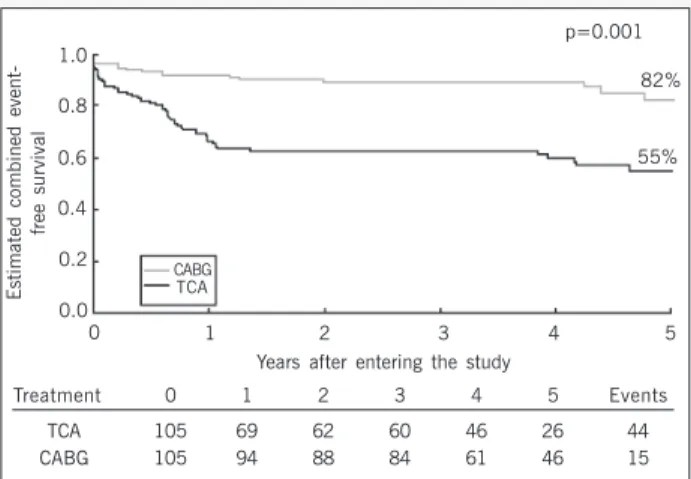
The combined event-free survival rate was significantly different
between the groups studied. Patients in the TCA group had a greater number of combined events, defined as the need for revascularization, AMI or death of cardiac origin, when compared with the patients treated with the surgical therapy – CABG (P<0.001) (fig. 1).
No significant difference in death of cardiac origin was observed in the 2 therapeutic strategies. Thirteen deaths occurred in the TCA group and 10 in the CABG group. The cumulative survival rate in 5 years was 95 (88.39%) and 92 (84.93%) patients in the CABG and TCA groups, respectively (fig. 2).
During the 5-year follow-up, 3 (2.85%) patients in the CABG group and 9 (8.57%) patients in the TCA group had acute myo-cardial infarction (P = 0.0668) (fig. 3).
Only 1 (0.95%) patient in the CABG group and 6 (5.71%) in the TCA group required additional coronary artery bypass grafting (P = 0.0872).
During the same period, 2 (1.90%) patients in the CABG group and 20 (19.04%) in the TCA group required reintervention through coronary angioplasty (P < 0.003).
One important difference between the 2 groups related to the frequency of interventions required during the 5-year follow-up. Three (2.85%) reinterventions were required in the surgical group patients, and 26 (24.76%) additional reinterventions were required in the TCA group (P < 0.001) (fig. 4).
In the 5-year follow-up, a significant difference was found in the presence of angina in the groups studied. Therefore, of the 75 patients in the CABG group who reported anginal symptoms at the beginning of the study, 65 were angina-free at the end of the study (P = 0.001).
In regard to the TCA group, the same tendency was observed as follows: of the 83 patients with anginal symptoms at the be-ginning of the study, 63 were angina-free at the end of the study (P = 0.001).
Regarding the presence of exercise-induced ischemia, statis-tical significance was also found among patients in both groups, who had an exercise test with an ischemic response. In the CABG group, the statistical significance was similar: of the 45 patients who developed exercise-induced ischemia at the beginning of the study, 23 did not reproduce the same test at the end of the study (P = 0.001) (fig. 5).
In the TCA group, of the 35 patients who developed exercise-induced ischemia at the beginning of the study, 17 did not reproduce the same test at the end of the study (P = 0.002) (fig. 6).
Discussion
The present study aimed at comparing the efficacy of myocar-dial revascularization between 2 different methods (CABG and TCA), involving 210 patients who survived for 5 years after their procedures and were discharged from the hospital. The 2 inter-ventions led to significant relief of the anginal symptoms during the follow-up period. However, the 5-year results showed that the proportion of asymptomatic patients with ischemic tests was similar in the 2 types of intervention. Those results were obtained with a significant increase in the need for a new revascularization in the TCA group.
The CASS study showed that, in patients with multivessel coronary disease with normal left ventricular function, stable angina, predominance of 2-vessel (40%) and 3-vessel impairment in a
T TT
TTable I - Demographic, clinical and angiographic characteristics ofable I - Demographic, clinical and angiographic characteristics ofable I - Demographic, clinical and angiographic characteristics ofable I - Demographic, clinical and angiographic characteristics ofable I - Demographic, clinical and angiographic characteristics of patients undergoing TCA and CABG
patients undergoing TCA and CABGpatients undergoing TCA and CABG patients undergoing TCA and CABGpatients undergoing TCA and CABG
Groups
Variable Level TCA CABG P n=105 n=105
Clinical findings Clinical findingsClinical findings Clinical findingsClinical findings
Age (years) 62.12±9.63 60.93±8.91 0.354 Sex Male 69 (65.7%) 73 (69.5%) 0.555 Female 36 (34.3%) 32 (30.5%)
Diabetes 30 (28.6%) 45 (42.9%) 0.153 Smoking 42 (40.0%) 29 (27.6%) 0.067 Hypertension 69 (65.7%) 68 (64.8%) 0.885 AMI 63 (60.0%) 42 (40.0%) 0.004 Stable Angina 97 (92.4%) 91 (86.7%) 0.176 Laboratory
LaboratoryLaboratory
LaboratoryLaboratory Means and standard deviationsMeans and standard deviationsMeans and standard deviationsMeans and standard deviationsMeans and standard deviations (values in mg/dL)
(values in mg/dL)(values in mg/dL) (values in mg/dL)(values in mg/dL)
Cholesterol 229.70±51.26 220.83 ± 48.70 0.204 Triglycerides 195.98 ± 109.12 199.31 ±119.12 0.834 LDL-Cholesterol 151.40 ± 42.94 147.51 ± 42.23 0.529 HDL-Cholesterol 37.74 ± 9.83 36.53 ± 10.34 0.397 Glucose 123.36 ± 54.58 124.70 ± 44.12 0.846
Exercise electrocardiographic test Exercise electrocardiographic test Exercise electrocardiographic test Exercise electrocardiographic test Exercise electrocardiographic test Ischemic 51 (48.57%) 62 (59.04%) NS Nonischemic 13 (12.38%) 13 (12.38%) NS Inconclusive 26 (24.76%) 17 (16.19%) NS
Angiographic data Angiographic data Angiographic data Angiographic data Angiographic data Impaired arteries (n)
2-vessel 45 (42.85%) 34 (32.38%) 0.117 3-vessel 60 (57.15%) 71 (67.62%) 0.117 Ejection fraction 67 ± 7.3 68 ± 7.5 0.329
n - number; AMI - acute myocardial infarction; LDL - low-density lipo-protein; HDL - high-density lipolipo-protein; TCA - transluminal coronary angioplasty; CABG - coronary artery bypass grafting.
T T T T
Table II - Medication used in patients undergoing Table II - Medication used in patients undergoing Table II - Medication used in patients undergoing Table II - Medication used in patients undergoing Table II - Medication used in patients undergoing TCA and CABGCA and CABGCA and CABGCA and CABGCA and CABG
Group
Medication TCA CABG P
n % n %
Beta-blocker 77 73,30 89 84,8 0,042 Calcium channel 48 45,70 63 60,0 0,038 blockers
Aspirin 105 100,00 100 95,2 0,060 ACE inhibitors 37 35,20 32 30,5 0,463 Statins 19 18,10 15 14,3 0,454 Oral antidiabetic agents 21 20,00 15 14,28 0,147 Insulin 9 8,60 30 28,60 0,193
5
smaller percentage (31.5%), the mean annual mortality rate for patients undergoing CABG was 1.1% (0.7%, 1.0%, and 1.4%, respectively, for 1, 2, and 3 vessels), indices similar to the indices for clinical treatment at that time 7.
The CASS study showed no difference between the clinical treatment and CABG in regard to mortality, Q-wave myocardial infarction, or the event-free survival rate in the 5-year follow-up. The benefit of CABG was restricted to the 3-vessel subgroup with ventricular dysfunction, and EF < 50%, whose annual mortality rate with clinical treatment reached 12.5% 30.
At the end of the 1980s and throughout the 1990s, several studies were carried out aiming at comparing the 2 forms of myocardial revascularization, allowing the use of multiple arterial grafts in CABG, and stents and atheroablation devices in TCA.
The profile of the population involved in the present study reflects a sample similar to that of multicenter studies around the world. The groups comprised patients predominantly white and of the male sex, with a mean age of 60 years, with a high prevalence
Estimated combined
event-free survival
1.0 0.8 0.6 0.4 0.2 0.0
0 1 2 3 4 5
p=0.001 82%
55%
CABG TCA
Years after entering the study
Treatment 0 1 2 3 4 5 Events
TCA 105 69 62 60 46 26 44
CABG 105 94 88 84 61 46 15
Fig. 1 - Probability of combined event-free survival in patients in the TCA and CABG groups.
Estimated probability of survival free from death of cardiac origin
1.0 0.8 0.6 0.4 0.2 0.0
0 1 2 3 4 5
p=0.4317 88% 85%
CABG TCA
Years after entering the study
Treatment 0 1 2 3 4 5 Events
ATC 105 92 85 82 64 35 13
RCM 105 96 92 88 65 50 10
Fig. 2 - Probability of survival free from death of cardiac origin in patients in the TCA and CABG groups.
Estimated acute myocardial
infaction-free survival probability
1.0 0.8 0.6 0.4 0.2 0.0
0 1 2 3 4 5
p=0.0668 84%
77%
CABG
TCA
Years after entering the study
Treatment 0 1 2 3 4 5 Events
ATC 105 81 76 73 58 32 22
RCM 105 94 90 86 63 48 13
Fig. 3 - Probability of acute myocardial infarction-free survival in patients in the TCA and CABG groups.
Estimated probability of survival free from any revascularization
1.0 0.8 0.6 0.4 0.2 0.0
0 1 2 3 4 5
p<0.001 86%
58%
CABG TCA
Years after entering the study
Treatment 0 1 2 3 4 5 Events
ATC 105 80 73 71 55 29 39
RCM 105 96 90 86 63 48 12
Fig. 4 - Probability of survival free from any revascularization in patients in the TCA and CABG groups.
6
Exercise test in the CABG group
100%
80%
60%
40%
20%
0%
77.6%
22.4%
37.9%
62.1% p=0.001
Beginning End
Ischemic Nonischemic
Fig. 5 - Exercise-induced ischemia at the beginning and end of the study in the CABG group. CABG = coronary artery bypass grafting.
Exercise test in the CABG group
100%
80%
60%
40%
20%
0%
77.9%
27.1%
37.5%
62.5% p=0.002
Beginning End Ischemic Nonischemic
6
Volume 84, Nº 3, Março 2005 Volume 84, Nº 3, Março 2005
of previous acute myocardial infarction, systemic arterial hyper-tension, dyslipidemia, diabetes mellitus, and smoking. Stable angina and CCS FC II and III prevailed in the clinical studies, ranging from 14% to 65% (RITA 9, GABI 10, ERACI 11, CABRI 12, EAST 17,
BARI14). Therefore, comparisons between the results of the present
study and those reported in the literature could be established. Analyzing the characteristics of myocardial revascularization in the present study, in which 3-vessel patients predominated, complete revascularization was achieved in 72.38% of the CABG group and in 50.48% of TCA group. This difference was explained by the greater freedom of choice and encouragement allowed to the cardiovascular surgeon to perform a greater number of anas-tomoses in vessels with lesions = 50% or occluded vessels.
More recent studies involving incomplete myocardial revascu-larization through TCA have concluded that early coronary rein-tervention was required more (a 2.5-fold greater risk) due to re-curring angina. However, no change was observed in the rate of major cardiac events such as death and nonfatal infarction 18,30-36.
The BARI trial, which compared patients undergoing incom-plete revascularization referred for TCA and CABG and who were followed up for 5 years, showed a longer survival without angina and revascularization in the CABG group patients as compared with those in the TCA group 36. In that same study, when
com-plete revascularization was compared with the incomcom-plete one in the TCA group, survival free from surgical revascularization was significantly longer in the group with complete revascularization. However, no difference was observed in the following events during a 5-year follow-up: death of cardiac origin, acute myocardial in-farction, and unstable angina.
In the present study, the surgical result was better than that of angioplasty in regard to cardiac event-free survival due to the significantly smaller need for reintervention induced by recurring angina (13.7% vs 41.6%) (P < 0.0001). However, no difference in the incidence of death of cardiac origin or acute myocardial infarction was observed between the 2 groups in a follow-up of 5 years at most. This superiority may be explained by the use of multiple arterial grafts, complete revascularization in the CABG group, and elevated indices of symptomatic restenosis, requiring revascularization within the first 12 months in the TCA group.
The studies with an objective similar to that of the present study and a follow-up period ranging from 1 to 5 years, involving 4,130 patients with a predominance of stable coronary artery disease, showed no difference in mortality between the TCA and CABG groups 14,17. A meta-analysis including the CABRI, EAST,
ERACI, GABI, and RITA studies with a total of 2,943 patients assessed, showed no significant differences in regard to the in-cidence of death or acute myocardial infarction in a follow-up period ranging from 1 to 3 years, but showed a longer angina-free survival in the CABG group as compared with that in the TCA group (odds ratio = 1.57, CI = 1.32 to 1.87, P < 0.00001) 36.
More recent studies with clinical follow-up of up to 8 years (EAST and BARI) have shown similar indices of death and acute myocardial infarction between the groups randomized for TCA and CABG. On the other hand, a significant difference was observed in the need for reintervention for angina control (BARI: 72.8% vs 13.8%; P < 0.001; EAST: 65.3% vs 26.5%) 37,38.
More recently with implementation of the use of new devices
for percutaneous coronary intervention, some randomized studies stand out, such as the ARTS study, which analyzed 1,205 patients randomized into 2 groups: TCA-stents or CABG. The primary ob-jective included the occurrence of cardiac event-free survival and stroke in a 1-year follow-up. No significant difference between the 2 groups was evident when the primary objective was achieved, but a difference was observed in the need for more revasculariza-tions in the TCA-stent and CABG groups (16.8% vs 3.5%). Cardiac event-free survival was smaller in the TCA-stent group (73.8%) than in the CABG group (87.8 %) (P < 0.001) 39.
The present study allowed the comparative analysis of symp-tomatic myocardial ischemia and anginal state, as well as of exercise-induced myocardial ischemia at different times between the 2 groups (TCA and CABG).
The analysis of angina in comparative studies between CABG and TCA using a balloon catheter showed a greater prevalence in the TCA group by the end of the first year of follow-up 40. The
RITA study already showed a progressive decrease in the prevalence of angina in the third year of follow-up 41.
At the end of the fifth year of follow-up, 38% of the CABG group and 40% of the TCA group had angina, with a significant improvement in the initial moment, but without any difference between the 2 types of treatment. These results are similar to those of the BARI trial and a meta-analysis of 7,964 patients in 13 randomized studies comparing TCA and CABG up to the year 2001, which allowed the inclusion of studies using stents in the comparative analysis. Those results may be justified by the elevated number of reinterventions in the TCA group and the progression of atherosclerotic disease in the native bed and in the grafts in the medium run in patients with 3-vessel coronary artery disease 41,42.
The results of the exercise test have shown a similar and significant reduction in the exercise-induced ischemic response in the CABG and TCA groups (37.9% and 37.5%, respectively) in 5 years. The BARI trial, in the same follow-up period, reported similar results in the TCA and CABG groups (28% and 31%, respectively); however, in the sample studied here, patients with 3-vessel coronary artery disease predominated, while in the BARI trial, 2-vessel coronary artery disease predominated 43.
Despite the advances in the techniques and in the types of endoprostheses, the rate of restenosis after angioplasty remains elevated, between 20% and 40% in 6 months. At the end of the 1990s, drug-eluting stents appeared, such as the stent coated with rapamycin, a drug capable of inhibiting the neointimal proli-feration of smooth muscle cells 44. A randomized multicenter study
with 238 patients, 50% of whom had unstable angina and whose mean age was 60.7 years, assessed regular stents and the rapa-mycin-coated stent. The need for revascularization was 22.9% in the regular stent group as compared with 0% in the rapamycin-coated stent group (P = 0.001) in a 1-year follow-up 45. However,
the rate of noncritical restenosis was not revealed.
7
An advantage of the percutaneous intervention option is the possibility that cardiologists may review their initial decisions based on the clinical and angiographic results of each lesion considered. The advantage of surgeons is that they may use grafts for the arteries with small degrees of stenosis (<50%), as well as for those with a high degree of stenosis and also chronically occluded. Based on the number of vessels treated, the degree of revascula-rization achieved with surgery certainly seems more anatomically complete than that achieved with angioplasty (P < 0.0001).
In addition, the technological advances achieved with angio-plasty have greatly improved in recent years. The resources of atherectomy, laser, regular stents, and, more recently, the drug-eluting stents may be commonly used for treating coronary stenosis. However, no evidence exists that those resources provide better results regarding death and nonfatal infarction in patients with multivessel coronary artery disease. However, we believe that in the near future, the solution to the problem of restenosis may favorably influence the results.
Finally, the satisfactory results obtained with CABG may be due to the use of arterial grafts as anastomosis, as well as to the normal ventricular function, which, per se, provides a good prognosis in most patients. These results lead to reflection and create ex-pectations and questions about the so-called underuse of the num-ber of grafts 46.
The limitations of this study need to be considered, and there is a consensus that, in the absence of contraindications, all patients should receive complete medicamentous therapy during the
outpa-tient clinic follow-up, independently of the randomized strategy. This study, initiated in 1995, did not contemplate the current diffu-se and beneficial udiffu-se of statins and angiotensin-converting enzyme inhibitors (ACE) in the primary, secondary, and tertiary prevention of coronary artery disease. However, no significant difference existed between the groups studied regarding the proportion of patients receiving statins and ACE inhibitors, although they were used in a small percentage. In addition, the use of anti-ischemic and lipid-lowering drugs is similar to that of the BARI trial.
Another potential limitation was the constant development of the revascularization techniques, both surgical and percutaneous. The appearance of synthetic polymer-eluting stents, which store and slowly release drugs that inhibit neointimal hyperplasia, has contributed to a reduction in restenosis of the treated lesion, and, consequently, to a significant decrease in the need for reintervention in the TCA group. Another inevitable limitation of this study is its long period of follow-up, during which new drugs appeared in clinical practice, such as clopidogrel and IIb/IIIa inhibitor, which were not previously available. Finally, the size of the sample studied did not have the power to test intergroup differences; however, these differences are relevant to the results of the research.
In conclusion, surgical and percutaneous myocardial revascula-rization provided a significant and similar reduction in anginal symp-toms and exercise-induced myocardial ischemia. In addition, the incidence of death of cardiac origin was similar in the 2 groups studied. When the need for new interventions during long-term follow-up was considered, surgery provided significantly better results.
1. Varnauskas E, and the European Coronary Surgery Study Group. Twelve-year fol-low-up of survival in the randomized European Coronary Surgery Study. N Engl J Med 1988; 319:332-37.
2. Bell MR, Gersh BJ, Schaff HV et al and The Investigators of the Coronary Artery Sur-gery Study. Effect of completeness of revascularization on long-term outcome of pa-tients with three-vessel disease undergoing coronary artery bypass surgery. A report from the Coronary Artery Surgery Study (CASS) Registry. Circulation 1992; 86: 446-57. 3. Bourassa MG, Campeau L, Lespérance J, Grondin CM. Changes in grafts and co-ronary arteries after saphenous vein aortococo-ronary bypass surgery: results at re-peat angiography. Circulation 1982; 65 (suppl II):90-7.
4. Fitzgibbon GM, Leach AJ, Kafka HP, Keon WJ. Coronary bypass graft fate: long-term angiographic study. J Am Coll Cardiol 1991; 17: 1075-80.
5. Goldman S, Copeland J, Moritz T et al. Long-term patency (3 years) after coro-nary artery surgery. Effects of aspirin: results of a VA Cooperative Study. Circula-tion 1994; 89:1138-43, 1994.
6. Grondin CM, Campeau L, Thornton JC et al. Coronary bypass grafting with saphe-nous vein. Circulation 1989; 79 (suppI): 24-9.
7. CASS Principal Investigators and Their Associates. Coronary Artery Study (CASS): a randomized trial of coronary artery bypass surgery. Survival data. Circulation 1983, 68: 939-50.
8. Green GE, Stertzer SH, Gordon RB, Tice DA. Anastomosis of the internal mammary artery to distal left anterior descending coronary artery. Circulation 1970; 41:II-79–II-84.
9. RITA Trial Participants. Coronary angioplasty versus coronary artery bypass sur-gery: the Randomized Intervention Treatment of Angina (RITA) trial. Lancet 1993; 341: 573-80.
10. Hamm CW, Reimers J, Ischinger T et al for the German Angioplasty Bypass Surgery Investigation (GABI). A randomized study of coronary angioplasty compared with bypass surgery in patients with symptomatic multivessel coronary disease. N Eng J Med 1994; 331: 1037-43, 1994.
11. Rodriguez A, Boullon F, Perez-Baliño N et al on behalf of the Eraci Group. Argen-tine randomized trial of percutaneous transluminal coronary angioplasty versus co-ronary artery bypass surgery in multivessel disease (ERACI): in-hospital results and 1-year follow-up. J Am Coll Cardiol 1993; 22: 1060-67.
12. CABRI Trial Participants. First-year results of CABRI (Coronary Angioplasty versus Bypass Revascularization Investigation). Lancet 1995; 346: 1179-84.
References
13. King Iii SB, Lembo NJ, Weintraub WS et al for the East Investigators. Emory An-gioplasty versus Surgery Trial (EAST): design, recruitment, and baseline description of patients. Am J Cardiol 1994; 75: 42C-59C.
14. BARI Investigators. Comparison of coronary bypass surgery with angioplasty in pa-tients with multivessel disease. Engl J Med 1996; 335: 217-25.
15. Cameron A, Kemp HGJ, Green GE. Bypass surgery with the internal mammary ar-tery graft: 15 year follow up. Circulation 1986; 74(suppl II): 30-6.
16. Fiore AC, Naunheim KS, Dean P et al. Results of internal thoracic artery grafting over 15 years: single versus double grafts. Ann Thorac Surg 1990; 49: 202-8. 17. King Iii SB, L Embo NJ, Weintraub WS et al for the Emory Angioplasty Versus
Sur-gery Trial (EAST). A randomized trial comparing angioplasty with coronary bypass surgery. Emory Angioplasty versus Surgery Trial. N Engl J Med 1994; 331: 1044-50. 18. Bourassa MG, Yeh W, Holubkov R, Sopko G, Detre KM, for the Investigators of the Nhlbi Ptca Registry. Long-term outcome of patients with incomplete vs complete re-vascularization after multivessel PTCA. A report from the NHLBI PTCA Registry. Eur Heart J 1998; 19: 103-11.
19. Thomas ES, Most AS, Williams DO. Coronary angioplasty for patients with multi-vessel coronary artery disease: follow-up clinical status. Am Heart J 1988;115: 8-13. 20. Reeder GS, Holmes Jr DR, Detre K, Costigan T, Kelsey SF. Degree of revasculariza-tion in patients with multivessel coronary disease: a report from the Narevasculariza-tional Heart, Lung and Blood Institute Percutaneous Transluminal coronary Angioplasty Registry. Circulation 1988; 77: 638-44.
21. Campeau L. Grading of angina pectoris. Circulation 1976; 54: 522-23. 22. BARI Protocol. Protocol for the Bypass Angioplasty Revascularization
Investiga-tion (BARI). CirculaInvestiga-tion 1991; 84(suppl V):V-1- V-27.
23. Chaitman BR, Rosen AD, Williams DO et al. Myocardial infarction and cardiac mortality in the Bypass Angioplasty Revascularization Investigation (BARI) ran-domized trial. Circulation 1997; 96: 2162-70.
24. Seldinger SY. Catheter replacement of the needle in percutaneous arteriograph. A new technique. Acta Radiol 1953; 39: 368-76.
25. Dodge HT, Sandler HS, Baxley WA, Hawley RR. Usefulness and limitations of ra-diographic methods for determining left ventricular volume. Am J Cardiol 1966; 18: 10-24.
8
Volume 84, Nº 3, Março 2005 Volume 84, Nº 3, Março 2005
Cardiovascular Procedures (Committee on Percutaneous Transluminal Coronary Angioplasty). J Am Coll Cardiol 1993; 22: 2033-54.
27. Kirklin JW, Akins CW, Blackstone EH et al. Guidelines and indications for coronary artery bypass graft surgery. A report of the American College of Cardiology / American Heart Association Task Force on Assessment of Diagnostic and Therapeutic Car-diovascular Procedures (Subcommittee on Coronary Artery Bypass Graft Surgery). J Am Coll Cardiol 1991; 17: 543-89.
28. Leon MB, Baim DS, Popma JJ et al for the Stent Anticoagulation Restenosis Study Investigators. A clinical trial comparing three antithrombotic-drug regimens after coronary-artery stenting. N Engl J Med 1998; 339: 1665-71.
29. Rosner B. Fundamentals of Biostatistics 2nd ed. Boston, PWS Publishers 1986; 584.
30. Cowley MJ, Vandermael M, Topol EJ et al for the Multivessel Angioplasty Prognosis Study (MAPS) Group. Is traditionally defined complete revascularization needed for patients with multivessel disease treated by elective coronary angioplasty? J Am Coll Cardiol 1993; 22: 1289-97.
31. Deligonul U, Vandormael MG, Kern MJ et al. Coronary angioplasty: a therapeutic option for symptomatic patients with two and three vessel coronary artery disease. J Am Coll Cardiol 1988; 11: 1173-9.
32. Faxon DP, Ghalilli MD, Jacobs AK et al. The degree of revascularization and out-come after multivessel coronary angioplasty. Am Heart J 1992; 123: 854-9. 33. Samson M, Meester HJ, De Feyter PJ, Strauss B, Serruys PW. Successful multiple
segment coronary angioplasty: effect of completeness revascularization in single-vessel multilesions and multisingle-vessels. Am Heart J 1990; 120:1-12.
34. Vandormael MG, Chaitman BR, Ischinger T et al. Immediate and short-term bene-fit of multilesion coronary angioplasty: influence of degree of revascularization. J Am Coll Cardiol 1985; 6: 983-91.
35. Rita Trial Participants. Coronary angioplasty versus medicine therapy for angina: the second Randomized Intervention Treatment of Angina (RITA-2) trial. Lancet 1997; 350: 461-8.
36. Sim I, Gupta M, Mcdonald K, Bourassa MG, Hlatky MA. A meta-analysis of
ran-domized trials comparing coronary artery bypass grafting with percutaneous transluminal coronary angioplasty in multivessel coronary artery disease. Am J Cardiol 1995; 76:1025-9.
37. King Iii SB, Kosinsky AS, Guyton RA, Lembo NJ, Weintraub WS, for the Emory An-gioplasty Versus Surgery Trial (EAST) Investigators. Eight-year mortality in the Emo-ry Angioplasty versus SurgeEmo-ry Trial (EAST). J Am Coll Cardiol 2000; 35: 1116-21. 38. BARI Investigators. Seven-year outcome in the Bypass Angioplasty Revascularizar-tion InvestigaRevascularizar-tion (BARI) by treatment and diabetic status. J Am Coll Cardiol 2000; 35: 1122-9.
39. Serruys PW, Unger F, Souza JE et al for the Arterial Revascularization Therapies Study Group (ARTS). Comparison of coronary-artery bypass surgery and stenting for the treatment of multivessel disease. N Engl J Med 2001; 344: 1117-24. 40. Pocock SJ, Henderson RA, Rickards AF et al. Meta-analysis of randomized trials
comparing coronary angioplasty with bypass surgery. Lancet 1994; 346:1184-9. 41. Pocock SJ, Henderson RA, Seed P, Treasure T, Hampton JR, for the Rita Trial Par-ticipants. Quality of life, employment status, and anginal symptoms after coronary angioplasty or bypass surgery. Circulation 1996; 94: 135-42.
42. Hoffmann SN, Tenbrook Jr.JA et al. A meta-analysis of randomized controlled trials comparing coronary artery bypass graft with percutaneous transluminal coronary angioplasty: One to eight-year outcomes. J Am Coll Cardiol 2003; 41:1293-304. 43. Bari Investigators. Five-year clinical and functional outcome comparing bypass
surgery with angioplasty in patients with multivessel coronary disease. JAMA 1997; 277: 715-21.
44. Babapulle MN, Eisenberg MD. Coated stents for the prevention of restenosis: Part I. Circulation 2002, 106: 2734-40.
45. Morice MC, Serruys PW, Sousa JE et al. For the Ravel Study Group. N Engl J Med 2002; 346: 1773-80.