104e
Rev Bras Med Esporte _ Vol. 12, Nº 3 – Mai/Jun, 2006 1. Laboratory of Exercise Physiology – Institute of Science of PhysicalEducation of the Air Force (ISPEAF).
2. Laboratory of Physical Education and Health Promotion – State Univer-sity of Rio de Janeiro (LABSAU-UERJ).
3. Graduation Program in Science of Physical Education – Salgado de Ol-iveira University (UNIVERSO).
4. Gama Filho University (UGF-CEPAC). 5. Petrópolis Catholic University (UCP).
Received in 5/4/05. Final version received in 1/9/05. Approved in 14/11/05. Correspondence to: Walace Monteiro, Laboratory of Physical Education and Health Promotion. State University of Rio de Janeiro (LABSAU-UERJ), Rua São Francisco Xavier, 524, 8o andar, sala 8,133, Bloco F, Maracanã –
20599-900 – Rio de Janeiro, RJ. E-mail: [email protected]
Is there bilateral deficit in the practice of 10RM
in arm and leg exercises?
Walace David Monteiro1,2,3 and Roberto Simão4,5
O
RIGINALA
RTICLEKeywords: Muscular strength. Strength training. Unilateral exercises. Bilateral ex-ercises.
ENGLISH VERSION
ABSTRACT
Resistance exercises can be done uni or bilaterally. Depending on the way by which the movement is conducted, the presence of bilateral deficit (BD) is observed. BD studies have concentrated their effort on the investigation of the phenomenon in exercises done with one single maximum repetition and little is known about their behavior in exercises with many repetitions. The aims of this study were: a) to compare the load in 10 repetition maximum (10RM) in the different sides of the body in exercises done with arms and legs. b) To compare the sum of the unilateral actions with the bilateral results in the same exercises. Twenty trained women between 18 and 30 years old (24 ± 6) were evaluated in uni and bilateral 10RM test in the selected exercises. The statis-tics analysis was t-test paired, to verify the difference between limbs and the sum of the two limbs separately in relation to bilater-al load. Significance level was p < 0.05 for bilater-all procedures. No dif-ference was found in the manipulated loads in both members, the same not occurring with the sum of unilateral load compared to bilateral. This demonstrates that the practice of bilateral work in routine situation of training involving 10RM promotes a greater manipulation of load in relation to unilateral work, differently from what is seen in BD in 1RM. In conclusion, at least in the selected exercises, BD was not found. Future studies should be done for better understanding of the BD phenomenon during training rou-tine.
INTRODUCTION
The strength training can be applied through many prescription variables. Among them, the used loads, the number of series and repetitions, the interval between them, and others can be named (1-3). Depending on the population and the aim with the prescription
of training, the sum involving those variables may act differently (4-7).
An ideal combination of variables that represent volume and in-tensity of strength is one of the crucial points in the training elabo-ration. Although we recognize that some prescription variables can express not only the volume but also the intensity, usually the
num-ber of series and repetitions associate more closely to the training volume. Fleck and Kraemer(8) highlight that one of the means to
calculate the training volume is to multiply the sum of the raised weight by the number of repetitions done in one or more series. One of the aspects that can influence in the volume of the work in one training session has to do with the means of conducting the exercises. In that case, the work can be done in a bilateral or uni-lateral way. The strength developed during biuni-lateral actions is usu-ally lower than the sum of the strength developed by each limb (9-12). According to some authors, such difference called bilateral
deficit, can be associated to the following aspects: reduced stimu-lation of motor units, neural recruiting differentiated by the crossed effect in the extra-pyramidal tract, fiber differences in the limbs, predominance of use of one limb over the other, resulting in a low-er production of strenght(11-13). Although the mechanisms
responsi-ble for the bilateral deficit are not very clear yet, it seems to be a consensus that the execution of the RE with simultaneous muscu-lar actions tend to reduce the bilateral deficit, in relation to the work represented by the sum of the unilateral action of the streng-ht(10,14,15).
Many studies have been conducted with the purpose to investi-gate the bilateral deficit in exercises involving 1RM(9-11,15).
More-over, this seems to be the trend in relation to the studies of the bilateral deficit presented in the literature. Although we recognize the relevance of the 1RM tests in many contexts, in the light of the routine training situations, the strength work is usually conducted with a greater number of repetitions. In that case, a space contain-ing 8 to 12 repetitions is usually chosen, not only for healthy indi-viduals, but also for those with health conditions(1,16). We took the
hypothesis that, no matter the work done with 1RM, the behavior of the bilateral deficit would be different for exercises involving many repetitions, which can influence in the results obtained in routine training situations. Such fact can bring important implica-tions, once the prescription of strength training is based on work involving many repetitions. Thus, the present work has for its ob-jectives: a) to compare the obtained load in 10 maximum repeti-tions (10RM) in the different body sides in arms and legs exercis-es; b) to compare the sum of the unilateral actions with the results obtained bilaterally in arms and legs exercises.
MATERIALS AND METHODS
Twenty women with age variation between 18 and 30 years (24 ± 6) participated in that study, body mass between 50 and 65 kg (58.4 ± 6.5) and height between 150 and 175 cm (165.2 ± 5.3). As an inclusion in the study criteria, all the volunteers were physically active, exercising at least three times a week in the last year. Be-fore the data collection, all of them answered negatively to the PAR-Q(17) questionnaire and signed a post- informed consent term,
Rev Bras Med Esporte _ Vol. 12, Nº 3 – Mai/Jun, 2006
105e
The data collection was conducted in three visits. In the first, body mass and height was checked. In the second and third visits, the tests of 10 maximum repetitions (10RM) were conducted, fol-lowing the procedures of Baechle and Earle (2000), in the uni and bilateral ways in the selected exercises. With the aim to reduce the error spam in the 10RM test, the following strategies were adopted: a) Standardized instructions were offered before the test, so that the individual would be aware of the whole routine that involved the data collection; b) the individual was instructed about the exercise execution technique, doing it some times even with-out load, to reduce an effect on the learning of the obtained scores; the evaluator was paying attention to the adopted position by the individual at the time of the measurement. Slight variations in the positioning of the articulations involved in the movement could trig-ger other muscles, leading to misinterpretations of the obtained scores.
To establish the maximum load to 10RM, the extension chair and cross over equipments were used, both from the brand Tech-nogym®. The load implementation followed the overload from the
equipment in the form of plaques. If necessary, shaped weights of 1, 2 or 3 kg were added. The equipments were adjusted according to the size of segments of the individuals. The description of the exercises is presented later on. The bilateral execution description was chosen, because the difference between the distinct ways of conduction has to do with the use of one or both body segments. Knee extension in the bilateral way on the chair: a) Initial posi-tion: sitting individual, with arms along the body holding the equip-ment handle, with chest inclination to 70o and bent knee to 90o,
with head positioned on the Frankfurt level b) Development: from the initial position, complete leg extension was done. After the end of the extension, the legs went back to the initial position.
Bilateral elbow bent; a) Initial position: standing individual, paral-lel legs with a small lateral space, with stretched knees, hips in the anatomic position, arms along the body with fisted hands holding the bar and head positioned on the Frankfurt level. The positioning of the hands on the bar for each individual was standardized from the space between them; b) Development: From the initial posi-tion in the cross over, the individual did the complete bend of the elbows. After the end of the bending, the elbows returned to the initial position.
For the conduction of the 10RM tests the volunteers were divid-ed into two groups of 10, randomly chosen. Group one did the exercises in the following sequence: right arm, left arm and both arms. After an interval of 48 hours the sequence was continued with the exercises for right leg, left leg and both legs. The second group did the following sequence: both arms, left arm and right arm. After an interval of 48 hours tests were conducted in both legs, left leg and right leg. In the 48 hours that preceded the tests, the volunteers were instructed not to do exercises.
To each try to establish the load to 10RM at least five minutes of interval was given. It is important to mention that such interval respected the fatigue and recovering of each volunteer. After ob-taining the maximum load to 10RM in each way of execution, an interval of 30 minutes was given to the resuming of the tests.
The statistics analysis was done by the paired t-student test, with the aim to verify the existence of significant difference among the individuals, likewise in the sum of the two limbs separately, in relation to the work done bilaterally. A significance of 5% was con-sidered to all procedures.
RESULTS
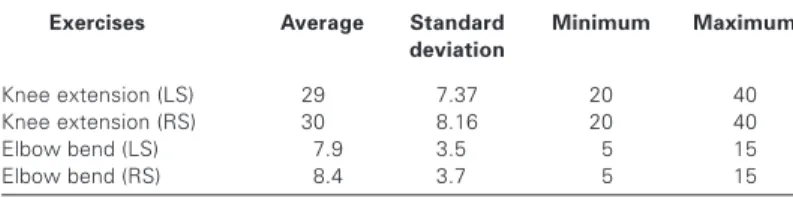
Table 1 presents the descriptive statistics in the comparison of load to 10RM in the left and right knee extension exercise. As can be seen, no statistics differences were shown to the manipulated loads in the two segments (p = 0.44). In the elbow bend exercise,
no significant differences were observed to the maximum repeti-tions in the evaluated sides (p = 0.13).
TABLE 1
Load comparison (kg) to 10RM relative to work done in knee extension and elbows bend in the two different body sides (n = 20)
Exercises Average Standard Minimum Maximum
deviation
Knee extension (LS) 29,0 7.37 20 40 Knee extension (RS) 30,0 8.16 20 40 Elbow bend (LS) 07.9 3.50 05 15 Elbow bend (RS) 08.4 3.70 05 15
LS = left side; RS = right side.
In table 2 data related to the comparison of the sum involving the load obtained in the unilateral movements with those resulting from the bilateral work in the knee extension are presented (p = 0.0007). Finally, the data referring to the comparison of the sum of the loads obtained in the unilateral movements in the elbow bend with the loads bilaterally developed are illustrated (p = 0.0001).
TABLE 2
Load comparison (kg) to 10RM relative to the sum of the unilateral works in the knee extension and elbow bend,
with the ones obtained bilaterally (n = 20)
Exercises Average Standard Minimum Maximum
deviation
Knee extension (U) 59,0* 15.1 40 80 Knee extension (B) 68.5* 13.9 50 90 Elbow bend (U) 16.3* 07.2 10 30 Elbow bend (B) 22.5* 08.2 12 40
U = unilateral sum; B = bilateral work.
* significant difference in relation to unilateral work.
DISCUSSION
Strength production can be obtained through uni and bilateral movements. When the sum of the strength developed by each limb isolatedly is greater than the one obtained bilaterally, we find the bilateral deficit. There is no consensus in the literature con-cerning the bilateral deficit phenomenum(8-12,15). Various aspects can
influence in the studies differences. Among them we can mention the different degree of training of the subjects and the distinct muscular groups evaluated.
Vandervoort et al.(10) studied the bilateral deficit in the horizontal
supino exercise in three different situations, involving isometric work and work in high and low speeds, developed in isocinectic equipment. The bilateral performance was lower than in the unilat-eral in high speeds. However, in low speeds, likewise in isometric work, the differences were not significant in the different ways of execution. Such fact shows that movement speed and the distinct worked angles can also influence differently in the bilateral deficit. It is important to highlight that the bilateral deficit was measured through the torque peak, making it impossible to exceed to the work involving many repetitions.
Simão et al.(11) studied the bilateral deficit in the maximum
106e
Rev Bras Med Esporte _ Vol. 12, Nº 3 – Mai/Jun, 2006limbs was higher than the maximum loads obtained in the works done bilaterally. About the loads obtained in the maximum muscu-lar power, no significant differences were verified between the limbs, likewise between the unilateral sum and the bilateral work. Such data showed that in the work with higher speeds bilateral deficit does not occur, clashing with the study of Vandervoort et al.(10).
Concerning the work involving lower limbs, Vandervoort et al.(9)
verified bilateral deficit in different angle speeds in exercise done in extension chair. In another study carried out by Simão et al.(12),
32 experienced women took the 1RM test in the legs extension in equipment with dynamic resistance with no variation. Comparing the maximum load in the uni and bilateral leg extension, no signif-icant difference between the measures of the left and right legs was verified (p = 0.50). On the other hand, in the unilateral sum compared to the bilateral work, significant differences were found (p = 0.02). The result of the unilateral sum was 5% higher than the one obtained bilaterally. Such data corroborate the ones verified by Vandervoort et al.(9).
More recently, Chaves et al.(15), compared the maximum load in
the 1RM test in the knee bend and extension, in the elbow bend alone, likewise in the sum of these two results with the simulta-neous development by two legs and two arms, respectively. The results to the left and right knee bend and extension movements and left and right elbow bend were similar and strongly associated (r = 0.96, 0.96 and 0.98). Comparing the sum of the unilateral fig-ures to the ones of the bilateral execution, the maximum load pre-sented a significant difference to the knee extension and elbow bend movements, what did not happen in the leg bend movement. The sum of the unilateral results was 9.8% and 4.0% higher for the knee extension and elbow bend movements, respectively, than the one bilaterally obtained. However, in the knee bend movement, the sum of the unilateral results was lower than the bilateral.
Other studies also demonstrated the presence of bilateral defi-cit, not only in lower limbs but also in higher limbs work(19,20). It is
important to stress that the studies that investigate the behavior of the bilateral deficit focused their attention on the phenomenon in 1RM tests, or even in few repetitions conducted in isocinectic equipment for measurement of torque peak. However, in a routine training situation, a range of 8 to 12 repetitions is conducted(1).
Thus, the data obtained in high intensity and short time tests, de-mand energetic systems and neuromuscular recruiting levels dif-ferent from those verified in works with many repetitions.
In the present study involving 10RM, bilateral deficit was not verified because the obtained loads in the carried work by the two segments together were higher than the sum of the unilateral work. Literature mentions the bilateral deficit phenomenon as a result of various physiological aspects. Among them, one of the most im-portant tells about the decrease of the neural activation in the
re-cruiting of motor units for bilateral movements, compared to the sum of unilateral works(21). In addition, factors as impulse diffusion
between the brain hemispheres, postural stabilization, motor learn-ing, reduction of antagonist activity, motivation and kind of muscu-lar fiber involved, can also interfere in the phenomenon(22-25).
Independently of the aspects that may explain the phenomenon studied here, it is important to stress that the duration of the max-imum effort seems to be a crucial aspect in bilateral deficit. As already shown, in experiments where few repetitions were done (1RM tests or tests with few maximum repetitions for measure-ment of torque peak), the bilateral deficit was clear. When 10RM are performed, the approximate effort time varies between 30 to 40 s. Although we admit that this time range may differ in the distinct exercises, or even to the fact that they are done in ma-chines or loose weight, such duration demands a recruiting of fi-bers differentiated from the one observed in few repetitions. In this study, the volunteers reported high fadigue in 10RM. Such fact is crucial to the analysis of the found results in this study and the others presented in literature(9-12,15,19,20). The most part of
ex-periments that have been conducted involved protocols of short duration to the need. In those protocols, the degree of fadigue tends to be smaller, due to the predominance of the ATP-PC sys-tem, while in the 10RM tests the acidose is higher.
Recently, McCurdy et al.(26) investigated the effect of eight weeks
training in the crouching exercise, being the sample divided in two groups. The first did unilateral training, while the second, bilateral. The training was conducted four times a week and both groups took power and strength works (pliometry), each one taken two times a week. Initially the volunteers did three series of 15 repeti-tions to 50% of 1RM, increasing until they reached six series of five repetitions to 87% of 1RM. The authors have come to the conclusion that, not only in the group that worked unilaterally, but also in the one that worked bilaterally, similar gains of strength and power were observed. In this study, when a greater number of repetitions in the strength tests occurred, the existence of bilater-al deficit was not observed, which seems to corroborate in the training chronic effect(26).
In conclusion, there was no difference in the load for 10RM be-tween the two body sides in the selected exercises, differently from the bilateral work in relation to the sum of both limbs. At least in the studied exercises, the bilateral practice promotes a greater load mobility than the one observed in the unilateral sum. Although the conclusion of this experiment relies on recent literature(26),
fu-ture studies should be carried to better understand the bilateral deficit phenomenon in routine training strength situations.
All the authors declared there is not any potential conflict of inter-ests regarding this article.
1. Kraemer WJ, Adams K, Cafarelli E, Dudley GA, Dooly C, Feigenbaum MS, et al. Progression models in resistance training for healthy adults. Med Sci Sports Exerc 2002;34:364-80.
2. Carpinelli RN, Otto RM, Winett RA. A critical analysis of the ACSM positions stand on resistance training: insufficient evidence to support recommended train-ing protocols. JEP online 2004;7:1-60.
3. Peterson MD, Rhea MR, Alvar BA. Maximizing strength development in ath-letes: a meta-analysis to determine the dose-response relationship. J Strength Cond Res 2004;18:377-82.
4. Beniamini Y, Rubenstein JJ, Faigenbaum AD, Lichtenstein AH, Crim MC. High-intensity strength training of patients enrolled in an outpatient cardiac rehabilita-tion program. J Cardiopulm Rehabil 1999;19:8-17.
5. Coelho CW, Hamar D, Araújo CGS. Physiological responses using 2 high-speed resistance training protocols. J Strength Cond Res 2003;17:334-7.
6. Augustsson J, Thomee R, Hörnstedt P, Lindblom J, Karlsson J, Grimby G. Effect of pre-exhaustion exercise on lower-extremity muscle activation during a leg press exercise. J Strength Cond Res 2003;17:411-6.
REFERENCES
7. Ebben WP, Kindler AG, Chirdon KA, Jenkins NC, Polichnowski AJ, Ng AV. The effect of high-load vs. high-repetition training on endurance performance. J Strength Cond Res 2004;18:513-7.
8. Fleck SJ, Kraemer WJ. Designing resistance training programs. Champaign: Hu-man Kinetics, 1997.
9. Vandervoot AA, Sale DG, Moroz J. Comparison of motor unit activation during unilateral and bilateral leg extension. J Appl Physiol 1984;56:46-51.
10. Vandervoot AA, Sale DG, Moroz JR. Strength velocity relation and fatigability of unilateral versus bilateral arm extension. Eur J Appl Physiol 1987;56:201-5.
11. Simão R, Monteiro WD, Araújo CGS. Potência muscular máxima na flexão do cotovelo uni e bilateral. Rev Bras Med Esporte 2001;7:157-62.
12. Simão R, Lemos A, Viveiros LE, Chaves CPG, Polito MD. Força muscular máxi-ma na extensão de perna uni e bilateral. Rev Bras Fisiol Exer 2003;2:47-57.
Rev Bras Med Esporte _ Vol. 12, Nº 3 – Mai/Jun, 2006
107e
14. Kraemer WJ, Fleck SJ, Evans WJ. Strength and power training; physiological mechanisms of adaptation. Exerc Sport Sci Rev 1996;24:363-97.
15. Chaves CPG, Guerra CPC, Moura SRG, Nicoli AIV, Félix I, Simão R. Déficit bilate-ral nos movimentos de flexão e extensão de perna e flexão de cotovelo. Rev Bras Med Esporte 2004;10:505-8.
16. Pollock ML, Franklin GJ, Balady GJ, Chaitman BL, Fleg JL, Fletcher B, et al. Resistance exercise in individuals with and without cardiovascular disease. Cir-culation 2000;101:828-33.
17. Shepard RJ. PAR-Q, Canadian home fitness test and exercise screening alterna-tives. Sports Med 1988;5:185-95.
18. Baechle TR, Earle RW. Essentials of strength training and conditioning. Cham-paign: Human Kinetics, 2000.
19. Schantz PG, Moritani T, Karlson E, Johansson E, Lundh A. Maximal voluntary force of bilateral and unilateral leg extension. Acta Physiol Scand 1989;136:185-92.
20. Howard JD, Enoka RM. Maximum bilateral contractions are modified by neurally mediated interlimb effects. J Appl Physiol 1991;70:306-16.
21. Gardiner PF. Neuromuscular aspects of physical activity. Champaign: Human Kinetics, 2001.
22. Rutherford OM, Jones DA. The role of learning and coordination in strength training. Eur J Appl Physiol 1986;55:100-5.
23. Lynch NA, Metter EJ, Lindle RS, Fozard JL, Tobin JD, Roy TA, et al. Muscle quality. I. Age-associated differences between arm and leg muscle groups. J Appl Physiol 1999;86:188-94.
24. De Ruiter CJ, Jones DA, Sargeant AJ, De Haan. The measurement of force/ velocity relationships of fresh and fatigued human adductor pollicis muscle. Eur J Appl Physiol 1999;80:386-93.
25. Zhou S. Chronic neural adaptations to unilateral exercise: mechanisms of cross education. Exerc Sport Sci Rev 2000;28:177-84.