141
Oral mucositis evolution after nutritional intervention in cancer
patients under palliative care*
Evolução da mucosite oral após intervenção nutricional em pacientes oncológicos no
serviço de cuidados paliativos
Emanuela Medeiros Schirmer
1, Ariana Ferrari
2, Lilian Cristine Teixeira Trindade
3* Received from Hospital Erasto Gaertner. Curitiba, PR.
1. Resident Nutritionist, Hospital Erasto Gaertner. Curitiba, PR, Brazil.
2. Nutricionist Specialit in Oncologic Nutrition, Hospital Erasto Gaertner. Curitiba, PR, Brazil.
3. Specialist Physician in Palliative Care, Hospital Erasto Gaertner. Curitiba, PR, Brazil.
Correspondence to:
Emanuela Medeiros Schirmer
Rua Prof. Paulo D´Assumpção, 1096, Sob 04 – Jardim das Américas
81540-260 Curitiba, PR.
E-mail: [email protected]
SUMMARY
BACKGROUND AND OBJECTIVES:Oral mucositis symptoms bring severe consequences to patients’ quality of life and may require partial or complete interruption of cancer treatment. This study aimed at evaluating oral mucositis evolution in cancer patients under palliative care after medical and nutritional intervention and orien-tation, in addition to analyzing how mucositis interferes with patients’ food ingestion.
METHOD:Participated in this study 23 patients under palliative care who answered questionnaires with ques-tions regarding number of meals/day, meals consistency, drugs used, oral complaints and life habits. Patients were individually interviewed in the irst visit and 15 days after by the physician and the nutritionist considering disease diagnosis and symptoms.
RESULTS:65.2% of patients had mucositis grade I and 46.6% of them consumed solid food. 4.3% of patients had mucositis grade IV and all of them consumed liquid food. At return, 73.9% of patients had no mucositis and from them, 64.7% reported no restriction with regard to diet consistency. Dry mouth had the highest incidence at irst visit (86.9%) being decreased to 34.7% at treatment completion. Candidiasis, diagnosed in 43.4% of patients was decreased to 13% after the intervention.
CONCLUSION:Oral mucositis is very common among cancer patients and the multiprofessional approach is critical for the eficient management of patients under pal -liative care, respecting their autonomy and quality of life.
Keywords:Nutritional physiology, Oncology, Oral mu-cositis, Palliative care.
RESUMO
JUSTIFICATIVA E OBJETIVOS: A sintomatologia da mucosite oral traz graves consequências para a quali-dade de vida dos pacientes, podendo exigir interrupção parcial ou completa do tratamento antineoplásico. O ob-jetivo deste estudo foi avaliar a evolução da mucosite oral em pacientes oncológicos atendidos pelo serviço de cuidados paliativos, após a intervenção e orientação médica e nutricional, além de analisar de que forma a mucosite interfere na ingestão alimentar dos pacientes.
MÉTODO: Foram avaliados 23 pacientes em cuidados paliativos, que responderam a questionários compos-tos por questões relacionadas ao número de refeições/ dia, consistência das refeições, medicamentos em uso, queixas orais e hábitos de vida. As entrevistas foram realizadas no primeiro atendimento e após 15 dias. Os atendimentos foram realizados pela nutricionista e pela médica, de maneira individualizada, considerando o di-agnóstico da doença e sintomas apresentados.
candidíase diagnosticada em 43,4% dos pacientes redu-ziu para 13% após a intervenção.
CONCLUSÃO: A mucosite oral é intercorrência mui-to comum nos pacientes em tratamenmui-to oncológico e a atuação multiproissional é fundamental para o manu -seio eiciente dos pacientes em cuidados paliativos, respeitando sua autonomia e qualidade de vida.
Descritores: Assistência paliativa, Fisiologia nutricional, Mucosite oral, Oncologia.
INTRODUCTION
Cancer is the second major cause of mortality in Brazil, being responsible for 13% of all deaths worldwide. An in-cidence of 518,510 new cancer cases is estimated for 2012 and from these, 90,940 will be in the Southern region1.
Every year, medicine brings new advances with regard to cancer management, however many patients only look for medical assistance when their disease is advanced, requiring speciic therapeutic care for these patients who can no longer be cured2. Patients under palliative care
may have different symptoms associated to the disease or to the use of drugs and which directly interfere with food consumption, such as inappetence2.
Oral mucositis is consequence of a local inlammatory process and cancer treatments, such as radiotherapy and chemotherapy for head and neck tumors, are a major cause of this disease4. It is also related to the most
im-portant acute side-effect of oral radiotherapy5.
Mucositis pathophysiology is divided into 4 phases: lammatory, epithelial, ulcerative and curative. In the in-lammatory phase, the epithelial tissue releases interleu-kin 1 (IL-1), interleuinterleu-kin 6 (IL-6) and tumor necrosis factor alpha (TNF-alpha) increasing local vascularization. In the epithelial phase there is decreased cells renewal due to radiotherapy and chemotherapy, which ulcerate the epi-thelium. The ulcerative phase itself occurs when there is colonization by micro-organisms and intensiication of le -sions. Finally, there is the curative phase, corresponding to cell renewal followed by mucositis healing4.
Oral mucositis symptoms bring severe consequences to patients’ quality of life. Major signs and symptoms are mucosal ulceration with severe pain, dificulty to eat, dificulty to talk and to make oral hygiene, and the presence of opportunistic infections4.
Severe oral mucositis may also require partial or total interruption of cancer treatment, such as radiotherapy, before the planned schedule is complete, increasing the risk of tumor cells proliferation and making dificult to control the disease6. In patients under chemotherapy,
mucositis in general appears in non-keratinized mucosa of the ventral face of the tongue, of mouth loor, of soft palate and also in the cheek mucosa.
In patients under head and neck radiotherapy, inlam-mation may affect both keratinized and non-keratinized mucosa. Alcohol and tobacco, chemotherapy, fungal infections and poor oral hygiene may increase the inci-dence or worsen mucositis6.
Patients with oral mucositis may have odynophagia, leading to malnutrition, dehydration, bacterial and fun-gal infections, mood and sleep disorders. It is believed that chamomile (Chamomilla recutita) has anti-inlam
-matory properties in wound healing, bacteriostatic and antiseptic activities. There are evidences that chamomile essence has strong activity against Gram-positive and Gram-negative bacteria7.
This study aimed at evaluating the evolution of oral mucositis in cancer patients under palliative care, after medical and nutritional intervention and guidance, in ad-dition to analyzing how the severity of mucositis inter-feres with patients’ food ingestion.
METHOD
We have evaluated 42 patients, however 19 did not com-plete the study for not having clinical conditions to re-main in the research.
So, the study continued with 23 patients admitted to the outpatient setting of the Palliative Care Ser-vice, Hospital Erasto Gaertner (HEG). Sample was delimited according to the demand of oral mucositis patients from August 2010 to September 2011. All patients were informed about the study methodology and objectives and only those who agreed to partici-pate by signing the Free and Informed Consent Term were included in the study.
Inclusion criteria were: cancer patients without curative possibilities, with oral mucositis, aged 18 years or above and functional capacity equal to or higher than 40% by the Karnofsky scale. Patients not agreeing to participate in the study or not meeting remaining inclusion crite-ria were excluded. Karnofsky scale is a tool to evaluate patients’ performance through physical ability and self-suficiency, with scores varying from 10% to 100%. Individuals with functional capacity equal to or be-low 40% by the Karnofsky scale were excluded for not having clinical conditions to follow medical and nutritional guidelines.
meals consistency (liquid, liquid-pasty, pasty, cooked or solid), drugs used and oral complaints such as dys -gesia, dry mouth, appetite loss, anorexia and candidi-asis. They were also asked whether they had already been submitted to chemotherapy and/or radiotherapy, whether they were currently smokers or drinkers. This same questionnaire has recorded patients’ medical di-agnosis of neoplasias.
The presence of mucositis was evaluated by inspec-tion of the oral cavity by the physician and was clas-siied according to the grade of mucositis developed by the World Health Organization (WHO), which is clinically divided into 4 groups: Group 1 (G1): burning and erythema; Group 2 (G2): erythema, ul -cers and patient able to swallow solid food; Group 3 (G3): ulcers, extensive erythema and patient unable to swallow solid food; and Group 4 (G4): ulcer, exten -sive mucositis and swallowing is impossible9.
Visual analog scale was used to evaluate oral cavity pain, considering zero no pain, 1 to 3 mild pain, 4 to 6 moderate pain and 5 to 10 severe pain.
Patients were re-evaluated 15 days later, as during the irst visit, again answering the questionnaire and being submitted to new oral cavity inspection.
Patients were interviewed by the same researcher in both visits, and the physician has classiied each patient by Karnofsky functional capacity scale (KPS).
All patients received dietary intervention, regardless of their grade of mucositis, contemplating the following as-pects: mouthwashes with cold industrialized chamomile tea three times a day; avoid very acid, dry, hard or spicy food; restrict salt; avoid very hot food or preparations. Medical approach was individualized considering disease diagnosis and symptoms. In the presence of can-didiasis, in addition to dietary guidelines, 5 mL nystatin was prescribed, corresponding to 1000,000 UI every 6 hours for 10 days if mild or moderate infection, and 100 mg luconazole/day for seven days if severe infection10,
according to the palliative care service routine.
Data were recorded in Microsoft Excel® and were
ana-lyzed by the SPSS 17.0 system, initially through descrip-tive statistics, frequency and percentage. Chi-square test was used to compare eficacies between beginning and end of the study for the variables: grade of mucositis, dysgeusia, dry mouth, appetite loss, anorexia and can-didiasis, with signiicance level of 5%.
Wilcoxon’s test for paired data was used to compare oral cavity pain decrease.
This study was approved by the Research Ethics Com-mittee, Hospital Erasto Gaertner (process 2031/2011).
RESULTS
From 23 patients, 13 were males (56.5%) and 10 females (43.4%). Mean age was 61 years varying from 24 to 85 years of age.
Most frequent neoplasias were urinary tract (26%), gastrointestinal tract (21.7%), gynecological (13%) and respiratory (13%), followed by head and neck tumors (8.6%) and skin tumors (8.6%). Breast can -cer corresponded to 4.3% and hematopoietic system cancer to 4.3%.
As to the number of meals, 8.6% of patients had only two meals/day in the beginning of the treatment, de-creasing to 4.3% at the end of 15 days. Three meals a day were taken by 17.3% of patients both before and after the intervention. Patients reporting four meals/day cor-responded to 43.4% in the irst visit and to 34.7% in the second evaluation. At the end of the intervention there were a higher number of patients having ive meals/day, from 26% to 30.4%. There has been an increase in the number of individuals having six meals/day at the end of the intervention, from 4.3% to 13%.
During the irst evaluation (Table 1) there has been grade I mucositis in 65.2% of patients and from them, 46.6% would eat solid food. From 17.3% with grade II mucositis, 50% had pasty food. Grade III mucositis was represented by 13% of patients, and from them 66% corresponded to patients with liquid ingestion and 33.3% with liquid-pasty ingestion. Only 4.3% of patients had grade IV mucositis and 100% of them had liquid food. At return, after 15 days of treatment and nutritional guidance, 73.9% of patients had no oral mucositis and from them, 64.7% referred no restriction to diet con-sistency. Grade I mucositis was found in 13% of pa-tients, without prevalence of any consistency. Grade II mucositis was found in 8.6% of patients and from them, 50% reported ingesting liquid food and 50% reported ingesting free consistency food. Grade III mucositis represented 4.3% of patients with 100% of them ingesting pasty food. No grade IV mucositis was detected during re-evaluation (Table 1).
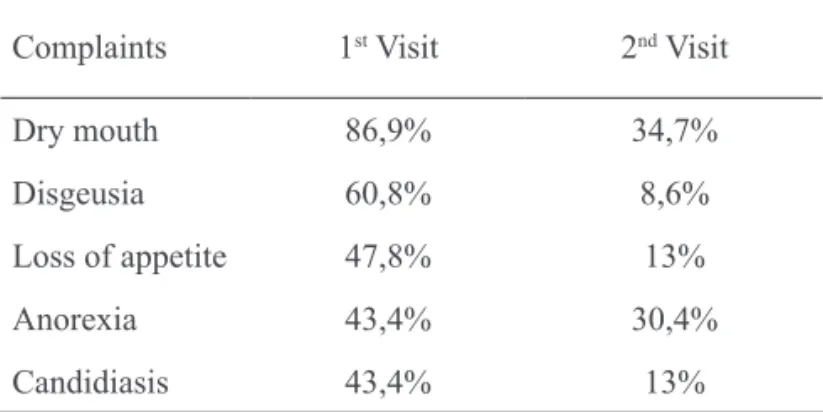
From major oral complaints (Table 2), dry mouth had the highest incidence during irst visit with 86.9%, de -creasing to 34.7% at the end of the intervention (p < 0.001). Second major complaint was dysgeusia, with 60.8% and decreasing to 8.6% (p < 0.01), followed by appetite loss with 47.8% and decreasing to 13% (p < 0.05). Anorexia had the lowest difference between both visits (43.4% to 30.4%).
Table 2 – Patients’ oral complaints
Complaints 1st Visit 2nd Visit
Dry mouth 86,9% 34,7%
Disgeusia 60,8% 8,6%
Loss of appetite 47,8% 13%
Anorexia 43,4% 30,4%
Candidiasis 43,4% 13%
Table 1 – Grade of mucositis and diet consistency in irst and second visits.
Mucositis Classiication
1st Visit 2nd Visit
% of Patients
Prevailing Diet Consistency
% of Patients
Prevailing Diet Consistency
No mucositis Zero - 73,9% Solid (64,7%)
Grade I Mucositis 65,2% Solid (46,6%) 13%
Liquid (33,3%) Pasty (33,3%) Solid (33,3%)
Grade II Mucositis 17,3% Pasty (50%) 8,6% Liquid (50%)Solid (50%)
Grade III Mucositis 13% Liquid (66,6%) 4,3% Pasty (100%)
Grade IV Mucositis 4,3% Liquid (100%) Zero
-during first evaluation and after the intervention it decreased to 13%.
Oral cavity pain during irst evaluation was classiied as absent in 21.74% of patients, mild in 52.18%, moder-ate in 17.39% and severe in 8.69%. No patient had pain during second evaluation (p < 0.001).
With regard to previous cancer treatment in a period shorter than one year, 39.1% of patients re-ceived chemotherapy and 21.7% radiotherapy, how-ever all patients had already interrupted these treat-ments for more than 30 days.
During the study, systemic antibiotics were used by 4.3% of patients, steroids by 69.5%, antifungal by 26% and anti-inlammatory drugs by 21.7%.
In terms of life habits, no patient has reported ingesting alcoholic beverages and 30.4% were tobacco-dependent during the treatment.
DISCUSSION
Palliative care services involve all types of tumors. So, results obtained with regard to types of cancer as com-pared to the grade of mucositis were not statistically sig-niicant in our study, probably due to the small number of individuals with each type of tumor.
Leukemia and lymphoma are examples of malignant tu -mors causing bone marrow suppression and tend to be more frequently associated to oral complications11.
In our study, 31.7% of patients had previous chemotherapy and 27.7% previous radiotherapy. Cancer patients very often start their treatment with the asso-ciation of therapies such as surgery and/or radiotherapy and/or chemotherapy5.
Treatment-related factors, such as type of radiation, drug used and daily doses are generally described with regard to their effects on normal tissues. Age, clinical and den-tal status are factors inherent to each patient and have been associated to the presence of oral mucositis12.
Our study has observed that a few number of patients had six meals a day in the beginning of the treatment, increasing to 13% at the end of the intervention. These data are in line with the literature according to which oral mucositis affects basic human activities, such as food ingestion and communication, and may impair in-terpersonal and social relationships13.
con-sistency. However, as from grade II, most patients have used modiied diets for better food ingestion, including cooked, pasty or liquid food.
Patients’ guidance about the type of food during this rehabilitation period is critical to prevent further worsening of the inlammatory process. We have ob-served major improvement in diet consistency during both visits, associated to decreased grade of mucositis and less pain, with no pain during second evaluation, al-lowing patients to ingest more variety and quantity of food following an adequate diet.
Information about type of food, consistency, acid and spicy food restriction is necessary to improve symp-toms. These guidelines depend on the severity of the le-sions and it is essential that the diet-therapeutic approach respects individual wills3.
During the second visit, there has been increased num-ber of patients ingesting food without consistency re-strictions. In addition, there was no mucositis in 73% of patients, thus assuring better quality of life.
From patients’ complaints, dry mouth was prevalent in 86.9% of patients during irst visit, with signiicant decrease to 34.7% at the end of the intervention. Our data are in line with the literature, which has observed that 90% of palliative cancer patients have dry mouth2,14.
This may be caused by the tumor itself, by inadequate hydration, by treatment with some drugs and by head and neck radiotherapy3.
Dysgeusia, second most important complaint, was sig-niicantly decreased between both visits, from 60.8% to 8.6%. This complaint is primarily a function of drugs such as tricyclic antidepressants, in addition to chemo-therapy and radiochemo-therapy, depending on tumor location3.
In our study, candidiasis had satisfactory results after the intervention, decreasing from 43.4% to 14.0% (p < 0.05). Oral candidiasis is caused by the prolifera -tion of candida species, especially C. albicans. Many
deaths of cancer patients are caused by fungal sepsis, being 60% of cases related to pre-existing infections14.
Oral candidiasis may be treated with local antifungal or systemic drugs10.
In our study, chamomile tea has improved inlamma-tory symptoms; however no comparative study was carried out to determine the signiicance of it to control mucositis symptoms.
Mouthwashes with chamomile tea, in spite of their unproven effect, seem to signiicantly decrease and relieve major mucositis complaints, which may be as-sociated to the anti-inlammatory action of this herb13.
Oral mucositis treatment approaches include systemic
analgesics, topic anesthetic or analgesic drugs15.
Other factors may increase the incidence or worsen mu-cositis, such as alcohol and tobacco consumption. In our study, no patient used alcohol, however 30.4% were to-bacco users, thus favoring taste changes, decreased food ingestion, dehydration and ineffective oral hygiene. Some authors refer that, regardless of mucositis classii -cation, oral hygiene is mandatory to decrease the inlu-ence of oral bacterial lora, pain symptoms and bleeding related to cancer therapy3,11. In general, smoker patients
do not have adequate oral hygiene.
Our study has not observed correlation between oral complaints and the use of antibiotics. In spite of steroids instituted during irst visit to control other symp -toms, there has been no increased incidence of mucositis caused by this drug. Antibiotics may have direct effects on mouth or side-effects, as a consequence of their ef-fects on accessory salivary glands, and steroids due to their immunosuppressive effects11.
Although the therapy to treat mucositis had support and palliation characteristics, the intervention of the multidisciplinary team was more effective with regard to global attention, thus providing integral treatment to patients.
Simultaneous medical and nutritional treatment pro-vides a better integration among professionals with regard to the choice of adequate drug therapy and diet-therapy for each patient, thus decreasing drugs potential adverse effects2.
CONCLUSION
Oral mucositis is very common among cancer patients and a multiprofessional intervention is critical for the ef-icient management of palliative care patients, respect -ing their autonomy and quality of life.
REFERENCES
4. Carvalho PAG, Pereira Júnior AJA, Negreiros WA. Avaliação da dor causada pela mucosite oral em pa-cientes oncológicos. Rev Dor 2009;10(1):47-50. 5. Albuquerque ILS, Camargo TC. Prevenção e tratamento da mucosite oral induzida por radi-oterapia: revisão de literatura. Rev Bras Cancerol 2007;53(2):195:209.
6. Bonan PRF, Lopes MA, Alves FA, et al. Aspectos clínicos, biológicos, histopatológicos e tratamen-tos propostratamen-tos para a mucosite oral induzida por ra-dioterapia: revisão de literatura. Rev Bras Cancerol 2005;51(3):235-42.
7. Shabanloei R, Ahmadi F, Vaez J. et al. Alloporinol, chamomile and normal saline mouthwashes for the prevention of chemotherapy-induced stomatitis. J Clin Diag Res 2009;(3)1537-42.
8. INCA/MS. Cuidados paliativos oncológicos – controle de sintomas. Rev Bras Cancerol 2002;48(2):191-211. 9. Trotti A, Bellm LA, Epstein JB, et al. Mucositis in -cidence, severity and associated outcomes in patients with head and neck cancer receiving radiotherapy with or without chemotherapy: a systematic literature review. Radiother Oncol 2003;66(3):253-62.
10. Miotto NML, Yurgel LS, Cherubini K.
Abordagem terapêutica da candidíase bucal. Sci Med 2004;14(4):364-70.
11. Volpato LER, Silva TC, Oliveira TM. et al. Mu -cosite oral rádio e quimioinduzida. Rev Bras Otor-rinolaringol 2007;73(4):562-8.
12. Almeida PNM, Albuquerque RA, Roesler E, et al. Avaliação epidemiológico-clínica da mucosite oral radioinduzida em pacientes com neoplasias malignas na região de cabeça e pescoço. Rev Odontol UNESP 2009;38(4):211-6.
13. Gondim FM, Gomes IP, Firmino F. Prevenção e tratamento da mucosite oral. Rev. Enfermagem UERJ 2010;18(1):67-74.
14. Hespanhol FL, Tinoco BEM, Teixeira HGC, et al. Manifestações bucais em pacientes submetidos à qui-mioterapia. Ciência e Saúde Coletiva 2010;15(Supppl 1):1085-94.
15. Vieira ACF, Lopes FF, Mucosite oral: efeito ad -verso da terapia antineoplásica. Rev Ciênc Méd Biol 2006;5(3):268-74.
Submitted in May 05, 2012.