INTENSIVE SPEECH THERAPY AND CLEFT PALATE:
CASE REPORT
Terapia fonoaudiológica intensiva e issura de palato: relato de caso
Daiane Pontes de Melo(1), Márcia Suely Souza de Castro Ramalho(2),
Viviane Castro de Araújo Perillo(3), Lidiane Cristina Barraviera Rodrigues(4)
(1) Speech-Language and Hearing Pathologist graduated by
São Lucas University – FSL, Porto Velho-RO, Brazil.
(2) Speech-Language and Hearing Pathologist graduated by
São Lucas University – FSL, Porto Velho-RO, Brazil; mas-ters in Health Sciences By the University of Brasília – UNB.
(3) Speech-Language and Hearing Pathologist graduated by
São Lucas University – FSL, Porto Velho-RO, Brazil; Mas-ters in Sciences by the post-graduation program in Human Communication Disturbs – Federal University of São Paulo – UNIFESP.
(4) Speech-Language and Hearing Pathologist graduated by
São Lucas University – FSL, Porto Velho-RO, Brazil; Mas-ters in Speech-Language and Hearing Sciences by Bauru School of Dentistry – FOB-USP.
Conlict of interest: non-existent
Disturbs can be of development, compensatory or obligatory. Development disturbs are those which may be present in any child and do not present direct relation to cleft. Articulatory compensatory disturbs (ACD) are prevenient from trying to
compensate the deicient velopharyngeal port, at
initial phases of language acquisition, seeking other spots to produce plosives and fricatives sounds,
in an attempt to block the phonatory air low. The ACDs are classiied as: glottal stroke, pharyngeal
fricative, mid-dorsum palate stop, pharyngeal plosive, posterior nasal fricative and velar fricative1.
Obligatory disturbs in VPD, resulting from struc-tural alteration, comprehend the hypernasality, the nasal air emission, low intraoral air pressure and nasal snort2.
The lack in the articulatory development of
the velopharyngeal structures, resulting from the residual velopharyngeal dysfunction (after surgical intervention) has, as the mains effects, the creation
of a intraoral pressure in insuficient levels for the
production of plosives consonants, fricatives and affricates, associated to nasal emission of the breathing air3.
INTRODUCTION
Cleft palate (CP) individuals or with other cranio-facial alterations may present articulatory disorders
related to a variety of causes, as palatal istula, malocclusion, luctuating or chronic hearing loss
and amygdala hypertrophy; causes which are not limited to the velopharyngeal dysfunction (VPD).
ABSTRACT
Intensive therapy has been reported in literature as an option module’s initial conventional therapy, because as the patient will realize improvements in his speech, replaced by greater involvement and
commitment to therapy. This article reports the experience with a case of intensive speech therapy,
comparing the performance in speech production of a patient of 25 years operated cleft palate before
and after intensive speech therapy. The service was conducted from July to August, 2009. Had the duration of 30 minutes daily, with the irst service was held history and speech and last only a
new evaluation, and 18 sessions of intensive care, totaling 20 sessions. Was videotaped sample of
spontaneous speech, repetition of a list of words and phrases, and inally, the therapeutic tests in
order to determine which phonemes the patient was easier to produce, contributing to development
of treatment planning. It was possible to automate setting a phoneme and another of the six worked during the 18 sessions of intensive care. This prompted the patient to continue the process by means
of conventional therapy.
Thus, the intelligibility level of the cleft speakers
will be determined by the way several structures of the vocal tract react to the VPD, not by its level4.
The speech assessment, in this cases, consists
in the observation of the orofacial structures (lips,
tongue, palate, uvula, palatal tonsils and pharynx)
as the morphologic and functional aspect, by means
an extra-oral and intra-oral inspection. Besides, it
should be performed perceptive-hearing analysis of speech, by the repetition of a word list and phrases and spontaneous speech samples, aiming to verify the articulation, resonance, nasal air emission, low pressure and the intelligibility level of speech5.
Complementary test also should be performed to
conirm the results of the perceptive-hearing analysis
as the nasal air emission test, using the mirror of Glatzel during blow, emission of the sounds /s/, /f/,
/∫/, /i/ and /u/ extended and isolated and some oral
words; and the hypernasality test, by the sustained vowel emission /i/ and /u/ and oral words, with or without nostrils occlusion5.
The evaluation of the velopharyngeal function
is based on the scores of hypernasality, nasal air scape and presence or not of the compensatory articulations obtained during the performance of
the speech perceptive-hearing assessment. The velopharingeal function can be classiied by a
three point scale: (1) correspondent to the proper velopharingeal function, (2) related to the marginal velopharyngeal function and (3) correspondent to the improper velopharyngeal function2.
The daily therapy, due to its proximity and
frequency of the appointments, enables the
gradual observation of patients’ speech modiica -tions, correcting them whenever it is necessary and helping the patients in the perception of their
dificulties and the correct way to pronounce the tongue sounds. The intense therapy may be an
initial module to the conventional therapy, since as the patient realizes the improvement in his speech, begins to have higher involvement and compro-mising to the therapy6.
In the state of Rondônia studies are narrow about the cleft lip palate. But, aiming to verify the number of speech therapists who treat cleft lip palate individuals in Rondônia and the therapeutic approach in these individuals, a study interviewed
55 speech therapists, using a questionnaire. The
most of participants of the study treated cleft lip palate individuals and the therapeutic approach referred by the professionals is based on the oral-motor area7.
The aim of this study was to describe and to
compare the speech assessment results of an individual cleft palate operated before and after intensive therapy.
CASE INTRODUCTION
This study initiated after the approval of the
Committee for Ethics in Research, under process no 387/09, following the recommendations of the
Resolution 196/96 of the National Health Council.
The subject participant on the research was
informed about the study development as from the
reading of the Information to the Research Subject
Letter and by his authorization, signing the Consent form.
The study was developing during July to August
2009, 30 minutes long each session, being 18 sessions of intensive therapy, with Monday to Friday appointments in the morning, totaling nine
hours of therapeutic intervention. In the irst
appointment was performed the anamnesis and
the speech assessment and in the last one just a
reassessment, summing up 20 sessions.
The case researched was from a 25 year old
woman living in Porto Velho (Rondônia), who oral language was acquired during the period in which
the palate istula post incisive foreman was opened,
what contributed to the development of the ACDs.
The surgical intervention happened only when she was 10 years old. The speech therapy follow up in
private clinic was developed for two months after
surgery. After a 14 years recess, in the irst semester
of 2009, the patient came back to the treatment in other clinic, remaining for four months with twice a
week appointments, 30 minutes each session. The patient informed that she performed the exercises at
home, conformingly therapist orientation, reporting that she considered the weekly therapy time too short and this demotivated her, since it was not realized an improvement in her speech.
The patient had awareness that she needed to
improve, mainly because presented hypernasal
voice, with air scape, dificultness to say her name,
to blow, to emit a few sounds, thus emphasizing that only her relatives considered her speech normal.
Although, she had conscience of the dificultness in
communicate with people who had no daily contact. Sometimes she felt embarrassed with moments of sadness and loneliness; however, these situations never brought considerable harm in her scholar,
social or work life. Her expectation, regarding the
intensive therapy, was that she could at least learn to say her name, the word “Jesus” and to blow.
When proposed the intensive therapy, the patient presented herself very enthusiastic, reporting satis-faction in knowing that she would have a daily follow
up, and needed the frequently practice exercises due to the demands in the luency of the phonemes.
In case of the productions are not being performed
corrected, and when it is necessary, the therapist would give other tips to make the process easier.
On the irst day of consultation was performed the
anamnesis and speech assessment by the analysis of the videotaping of speech spontaneous, repetition of a word list and phrases with phonemes oral occlusive and fricatives5. At last, it was performed
therapeutic proofs. It was selected two plosives and two fricative phonemes using tips visual (mirror and air paddle), hearing (garrote) and tactile-kinesthetic (hand dorsum to feel the air passing through the mouth), aiming to verify which phonemes the patient presented more easiness in produce, contributing to create the therapeutic planning.
On the last day, it was performed only the speech reassessment.
The assessments, before and after the therapy,
and the therapy were performed by the same professional.
In the speech therapy was deined that the irst 15 minutes would be to stimulate the correct
pronounce of the phonemes by the awareness and setting of an articulatory spot; and the 15 minutes
left, for guidance the air low to the oral cavity with
tips tactile-kinesthetic, visual, hearing, using host, paddle, scape-scope, birthday candy wrapping, air paddle and garrote5.
First there was stimulation of isolated sound
production, in syllables, words, phrases and texts, being possible to go to the next stage only when the therapist observed signiicant improvement.
The words, phrases and texts used were chosen
and adapted, when necessary, so the contained, besides the target phoneme, only sounds correctly
pronounced by the patient. It was initiated with the stimulation of the phonemes alveolar fricatives and velar occlusive (/s/, /z/, /k/ and /g/), from anterior
to posterior, respecting the dificultness and need of the patient, for example, exploring her daily use
words, her name and the name of her relatives, working them simultaneously until they were proper to the syllable level, so it could be introduced two lingua-dentals occlusive phonemes (/t/ and /d/).
The patient was guided to practice at home,
daily 15 minutes the phonemes approached in the therapy as from the seventieth session.
After the end of the study the patient continued the therapy twice a week, in the same institution, followed up by one of the researchers.
RESULTS
In Figure 1 is veriied the results of the speech
assessment before and after the intensive therapy.
There was decrease on the ACDs and on the nasal
air emission; the moderate hypernasality and the speech intelligibility harm on spontaneous conver-sation remained, but in disyllable words the hyper-nasality diminish. In spite of that, the velopharyngeal function6 classiication continued improper after the
therapy.
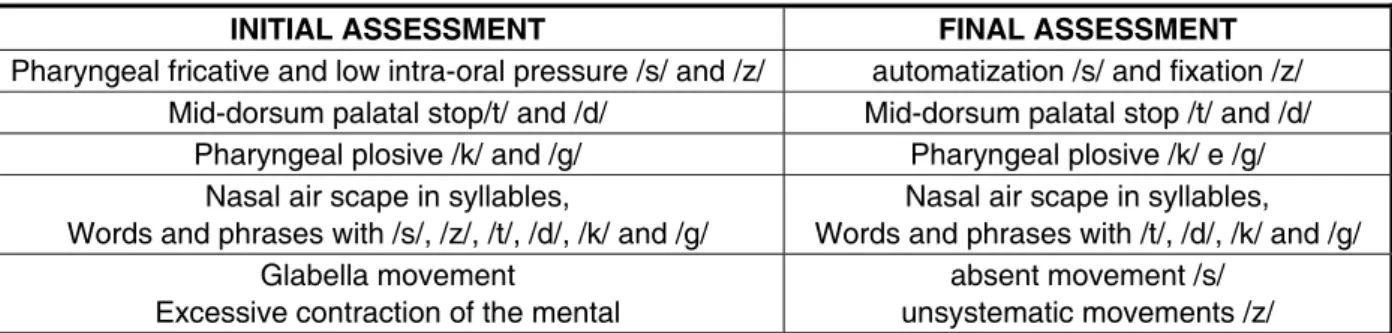
In Figure 2 there are the results of words and phrases repetition before and after the intensive
therapy. It was veriied an improvement on the luency of the phonemes /s/ and /z/, diminish on the
number of phonemes with nasal air emission and of facial movements associated.
HEARING-PERCEPTIVE OF SPEECH NASAL AIR EMISSION TEST HYPERNASALITY TEST
Articulation Resonance Inteligibility Words Blow /f/ and /∫/ /s/ /i/ and /u/ Oral Words /i/ and /u/
Before ACDs present in /s/, /z/, /k/, /g/, /t/ and /d/ moderate Hypernasal
moderately
damaged 6/10 Absent Unsystematic Present Present 6/10 Positive
After ACDs absent in /s/, unsystematic in /z/
moderate Hypernasal
moderately
damaged 0/10 Absent Absent Absent
Discreet (end of
the emission) 4/10 Discreet
Legend: ACDs= articulatory compensatory disturb
DISCUSSION
The speech treatment in operated patients of
CLP requires knowledge and utilization of proper techniques to eliminate the ACDs that are frequently present and do not make the treatment last too long.
In the state of Rondônia the interviewed speech therapists report they already treat clef lip palate individuals and the approach is based on oral-motor area. In this state of Brazil there are professionals to enable the action of a team in all the speech rehabilitation stages of the patients7.
The intensive process of the therapeutic strat -egies and the direct participation of responsible relatives during the therapy are essential to facilitate
the appropriation of a new speech module. Thus,
with daily intensive therapy programs and correct conducts of strategies come about greater results to
the patient. That is why two sessions a week, even that the strategies are proper, may be insuficient8.
In the present study, emotional factors as family issues and constantly colds interfered on the thera-peutic evolution, since the patient, in some appoint-ments, presented low self-esteem, fatigue and pneumo phonoarticulatory incoordination. It was realized decrease of the patient motivation level in
the moment of performing the exercises at home, a
few times also during the appointment and conse-quently on the intervention results.
Young adults feel higher dificultness to an inter
-personal relationship. These patients may present
psychological problems as depression, ease irrita-bility, frustration, low self-esteem, loneliness and suicide, but depending on the personality of the patient and the acceptance of the family, may do not present psychological disturbs9.
In the introduction of the correct articulatory spots of the phonemes, it was followed the stages of production of the isolated phoneme, in syllabic
context, words, phrases, readings, until sponta -neous speech using tips visual, tactile-kinesthetic, according suggested on literature5.
The patient reported that the tips facilitated to
observe her errors, emphasizing to have gradual
dificultness as going to the next stage, mainly in
reading, when realized that would be necessary to perform the punctuation rules and comprehension
of the read text.
It would be interesting that other studies concern to review the frequency on sessions of speech therapy of adult individuals carrying cleft lip palate that, seeking treatment, report be seen by the society as bad speakers. It is suggested to perform
the intensive therapy on the irst month, 30 minutes
sessions and only after that go to weekly therapy, as proposed in different study6.
Furthermore, it is suggested to studies, as an important procedure to ensure no manipulation on results, that the speech assessments pre and post be performed by different evaluator and/or to be added audio and/or video recording, although, such procedures were not considered in this research.
Based on the results of this study, there is the need of performing further researches outlining therapeutic results using the intensive therapy in different ages to show whether the age factor interfere in this progress.
CONCLUSION/FINAL COMMENTS
It was possible the automatization of a phoneme
and settling one of the six phonemes worked during the 18 sessions of intensive therapy, that is, beneit results in a short term. This motivated the patient
to continuing the process by conventional therapy. Regarding the patient has already performed two attempts of progress by means of weekly interven-tions without considerable results, reporting she did
not practice the exercises due to the large space
between the sessions and lack of daily effort, elements there are not present in intensive therapy, demonstrating its effectiveness as initial module of treatment in individuals with CLP.
INITIAL ASSESSMENT FINAL ASSESSMENT
Pharyngeal fricative and low intra-oral pressure /s/ and /z/ automatization /s/ and fixation /z/
Mid-dorsum palatal stop/t/ and /d/ Mid-dorsum palatal stop /t/ and /d/
Pharyngeal plosive /k/ and /g/ Pharyngeal plosive /k/ e /g/
Nasal air scape in syllables,
Words and phrases with /s/, /z/, /t/, /d/, /k/ and /g/
Nasal air scape in syllables, Words and phrases with /t/, /d/, /k/ and /g/ Glabella movement
Excessive contraction of the mental
absent movement /s/ unsystematic movements /z/
REFERENCES
1. Vicente MCZ, Buchala RG. Atualização da terminologia de distúrbios articulatórios encontrados
em falantes portadores de issura de lábio e palato.
Dist Comunic. 1991;(4):47-52.
2. Trindade IEK, Genaro KF, Yamashita RP, Miguel HC, Fukushiro AP. Proposta de classiicação
da função velofaríngea na avaliação perceptivo-auditiva da fala. Pró-Fono, 2005;17(2):259-62.
3. Tabith Jr A. O esfíncter velofaríngeo. Dist
Comunic. 1997;8(2):135-50.
4. Warren DW. Compensatory speech behaviors in individuals with cleft palate: A regulation/control phenomenon? Cleft Palate J. 1986;23(4):251-60.
5. Genaro KF, Yamashita RP, Trindade IEK. Avaliação clínica e instrumental na issura labiopalatina. In: Ferreira LP, Bei-Lopes DM, Limongi SCO (org). Tratado de fonoaudiologia. São
Paulo: Roca; 2004. cap 36, p. 456-77.
6. Lima MRF, Leal FB, Araújo SVS, Matos EF, Di Ninno CQMS, Britto ATBO. Atendimento
fonoaudiológico intensivo em pacientes operados
de issura labiopalatina: relato de casos. Rev Soc
Bras Fonoaudiol. 2007;12(3):240-6.
7. Silva JQA, Souza MS, Rodrigues LCB. Peril
do atendimento fonoaudiológico ao indivíduo com
issura labiopalatina em Rondônia. [monograia].
Rondônia, Porto Velho: Faculdade São Lucas; 2010.
8. Antunes DK. Intervenção fonoaudiológica nas issuras labiopalatinas: diagnóstico e tratamento [resumo 5]. Pró-Fono [Internet]. 2008 [Citado 2008 Out 13]; 20(Supl):14-6. [Apresentado Congresso
Brasileiro De Fonoaudiologia e Genética dos Distúrbios da Comunicação; 2008; Fortaleza,
Ceará]. Disponível em: www.revistaprofono.com.br
9. Ribeiro EM, Moreira ASCG. Atualização sobre
o tratamento multidisciplinar das issuras labiais e
palatinas. RBPS. 2005;18(1):31-40.
RESUMO
A terapia intensiva tem sido relatada na literatura como uma opção de módulo inicial da terapia con-vencional, pois a medida que o paciente vai percebendo melhoras em sua fala, passa a ter maior envolvimento e comprometimento com a terapia.Este artigo relata a experiência com um caso de atendimento fonoaudiológico intensivo, comparando o desempenho na produção da fala de uma
paciente de 25 anos, operada de issura palatina, antes e após a terapia fonoaudiológica intensiva. O atendimento foi realizado no período de julho a agosto de 2009, com duração de 30 minutos cada ses
-são, sendo 18 sessões de terapia intensiva, com encontros diários de segunda a sexta pela manhã, totalizando 9 horas de intervenção terapêutica. No primeiro atendimento foi realizada anamnese e
avaliação fonoaudiológica e no último apenas a reavaliação, totalizando 20 sessões. Foi gravada em
vídeo uma amostra de fala espontânea, repetição de uma lista de palavras e frases e, por im, reali
-zadas as provas terapêuticas com o objetivo de veriicar com quais fonemas a paciente apresentava maior facilidade na produção, contribuindo para elaboração do planejamento terapêutico. Foi possí
-vel a automatização de um fonema e ixação de outro dos seis trabalhados durante as 18 sessões
de terapia intensiva. Isto motivou a paciente para dar continuidade ao processo por meio de terapia convencional.
DESCRITORES: Fissura Palatina; Fonoterapia; Insuiciência Velofaríngea; Distúrbios da Fala; Adulto
Received on: April 17, 2012 Accepted on: March 7, 2013
Mailing address:
Lidiane Cristina Barraviera Rodrigues
Alexandre Guimarães St., 1927 – Areal
Porto Velho, RO-Brazil CEP: 78916-450