Agreement between perceptual tests and videofluoroscopy
in the diagnosis of velopharyngeal dysfunction
Concordância entre os testes perceptivos e a videofluoroscopia
no diagnóstico da disfunção velofaríngea
Maíra de Souza Périco1, Jeniffer de Cássia Rillo Dutka2, Melina Evangelista Whitaker3, Ana Flávia Rodrigues
da Silva4, Olivia Mesquita Vieira de Souza5, Maria Inês Pegoraro-Krook2
ABSTRACT
Purpose: To determine the agreement between the results of the Nasal Air Emission and Hypernasality tests and the videofluoroscopy findings in the diagnosis of velopharyngeal dysfunction in individuals with cleft lip and palate. Methods: The sample consisted of 89 scores of Nasal Air Emission and Hypernasality tests and 89 judgments of videofluoroscopy recordings, which were interpreted as consistent velopharyngeal closure, or as incon-sistent velopharyngeal closure, or as non velopharyngeal closure. The sensitivity, specificity and agreement between the interpretation of the re-sults of the perceptual tests and the findings of the videofluoroscopy were calculated. Results: The rates found for sensitivity of Nasal Air Emission and Hypernasality tests were 98% and 96%, respectively, and the rates for specificity of Nasal Air Emission and Hypernasality tests were 37% and 63%, respectively. Regarding the percentages of agreement between the Nasal Air Emission test scores and the videofluoroscopy judgments, it was found an agreement of 62% for the consistent velopharyngeal closure condition, 43% for the inconsistent velopharyngeal closure, and 68% for the non velopharyngeal closure. Between the scores of Hypernasality test and videofluoroscopy judgments the agreement found was 70% for the consistent velopharyngeal closure condition, 47% for the inconsistent velopharyngeal closure and 77% for the non velopharyngeal closure.
Conclusion: There was a good level of agreement between the perceptual tests and the videofluoroscopy judgments for the consistent velopharyn-geal closure and non velopharynvelopharyn-geal closure conditions, but not for the inconsistent velopharyngeal closure.
Keywords: Cleft palate; Fluoroscopy; Velopharyngeal insufficiency; Diagnosis; Speech
RESUMO
Objetivo: Verificar a concordância entre os resultados dos Testes de Emissão de Ar Nasal e de Hipernasalidade e os achados do exame de videofluorocopia no diagnóstico da disfunção velofaríngea, em indivídu-os com fissura labiopalatina. Métodos: A amostra foi constituída por 89 exames de videofluoroscopia e 89 escores dos Testes de Emissão de Ar Nasal e de Hipernasalidade, interpretados como fechamento velofaríngeo consistente, ou como fechamento velofaríngeo inconsistente, ou ainda, como não fechamento velofaríngeo. Foram calculadas a sensibilidade, a especificidade e a concordância entre a interpretação dos achados dos testes perceptivos e os achados da videofluoroscopia. Resultados: Foram encontrados índices de sensibilidade e especificidade de 98% e 37%, respectivamente, para o Teste de Emissão de Ar Nasal e de 96% e 63%, respectivamente, para o Teste de Hipernasalidade. As porcentagens de concordância entre os escores do Teste de Emissão de Ar Nasal e os exa-mes de videofluoroscopia e entre os escores do Teste de Hipernasalidade e os exames de videofluoroscopia, para a categoria fechamento velofarín-geo consistente, foram de 62% e 70%, respectivamente, de 43% e 47%, para a de fechamento velofaríngeo inconsistente, respectivamente, e de 68% e 77%, para a de não fechamento velofaríngeo, respectivamente.
Conclusão: Houve um bom nível de concordância entre os testes per-ceptivos e os exames de videofluoroscopia para as categorias fechamento velofaríngeo consistente e não fechamento velofaríngeo, mas não para a de fechamento velofaríngeo inconsistente.
Descritores: Fissura palatina; Fluoroscopia; Insuficiência velofaríngea; Diagnóstico; Fala
This study was performed at the Rehabilitation Sciences of the Hospital for Rehabilitation of Craniofacial Anomalies – HRAC/USP – Bauru (SP), Brazil, with a scholarship granted to the first author by the Fundação de Amparo à Pesquisa do Estado de São Paulo (FAPESP), number 2011/16733-1.
(1) Graduation Program (Master’s degree) in Sciences, Department of Speech, Language and Hearing Disorders, Bauru School of Dentistry, Universidade de São Paulo – USP – Bauru (SP), Brazil.
(2) Department of Speech, Language and Hearing Disorders, Bauru School of Dentistry, Universidade de São Paulo – USP – Bauru (SP), Brazil; Graduation Program in Rehabilitation Sciences of the Hospital for Rehabilitation of Craniofacial Anomalies – HRAC/USP – Bauru (SP), Brazil.
(3) Speech Appliances Service, Hospital for Rehabilitation of Craniofacial Anomalies – HRAC/USP – Bauru (SP), Brazil.
(4) Graduation Program (Master’s degree) in Rehabilitation Sciences of the Hospital for Rehabilitation of Craniofacial Anomalies – HRAC/USP – Bauru (SP), Brazil. (5) Department of Speech, Language and Hearing Disorders, Bauru School of Dentistry, Universidade de São Paulo – USP – Bauru (SP), Brazil.
Conflict of interests: No
Author’s contribution: MSP: principal investigator, development of the study and schedule, literature review, data collection and analysis, article writing, article submission; JCRD: development of the study and data analysis; MEW: development of the study and data analysis; HRF: collection and analysis of data; OMVS: literature review, data collection and analysis; MIPK: supervisor, concept and development of the study and schedule, data analysis, correction of article draft, and approval of the final version.
Correspondence address: Maria Inês Pegoraro-Krook. Departamento de Fonoaudiologia, Faculdade de Odontologia de Bauru, Universidade de São Paulo. Al. Octávio Pinheiro Brisolla, 9/75, Bauru (SP), Brazil, CEP: 17012-901. E-mail: [email protected]
INTRODUCTION
The velopharyngeal insufficiency and incompetence are types of velopharyngeal dysfunction (VPD) which require different kinds of treatment. For cases with velopharyngeal insufficiency, a physical procedure (surgery or palatal pros-thesis) is always indicated, and for those with velopharyngeal incompetence, the procedure to be indicated is speech therapy. However, it is quite common to find both types of VPD in the same patient. In this case, a physical procedure combined with speech therapy should be indicated(1).
No effective treatment can be performed if the precise differential diagnosis of the type of VPD is not made and to achieve it, it is necessary to perform a perceptual and ins-trumental evaluation. There are some procedures to evaluate the changes of the velopharyngeal mechanism (VPM) and thus diagnose the presence of VPD. Clinically, the speech pathologist has the perceptual assessment as an important tool in the diagnosis of VPD, and therefore indicators of the clinical significance of the changes in speech related to VPD can be performed(2,3). Instrumental methods such as
video-fluoroscopy and nasoendoscopy can provide information on the functional anatomy of the VPM, as well as nasometry and the pressure-flow technique can respectively measure the acoustic and aerodynamic parameters of the velopharyngeal function(4). They may also provide the perceptual critical
finding trial, enable the diagnosis of the velopharyngeal func-tion in cases where the clinical diagnosis by itself was not possible, and also determine the effectiveness of the proposed treatment(5-9).
Among the various methods for perceptual evaluation described in the literature, few of them provide the differential diagnosis of VPD, as the Tests of Hypernasality (THYPER) and Nasal Air Emission (TNAE)(5-10), with the aim of assisting
assessment of velopharyngeal function and dysfunction. The use of these tests is very practical and simple and can be perfor-med in children younger than 4 years. The tests are standardized on a set of 10 words, each with a base of 10 indicators of the frequency of occurrence of nasal air emission and hypernasality. The interpretation of each test is made so that the indicators 0/10, 1/10 or 2/10 indicate velopharyngeal closure and 3/10 to 10/10 indicate presence of VPD. From the analysis of these tests, it is possible to set a default for each patient. The score of 10/10 for both tests in a given patient might mean presence of velopharyngeal insufficiency by indicating the absence of consistent velopharyngeal closure. Scores between 1/10 and 9/10 in both tests might mean velopharyngeal incompetence, since these scores indicate the possibility of inconsistent velo-pharyngeal closure(10).
Videofluoroscopy is a videorecording instrumental direct technique that allows the dynamic evaluation of the VPM structures during speech. Although it is a technique which makes use of radiation, it is performed for a short time. With
the visualization of the anatomical and physiological charac-teristics of such structures, it is possible to identify the cause of VPD and the best treatment for the patient.
The perceptual tests of TNAE and THYPER have great value for professionals who do not have instrumental techniques in their routine, and even to large centers, which can better select patients for instrumental techniques. However, there are no studies that prove the indication of these tests as an option for the differential of VPD diagnosis(10).
Seeking to prove the validity of TNAE and THYPER tests in clinical assessment of patients with VPD, the aim of this study was to verify the correlation between the results of TNAE and THYPER tests and the videofluoroscopy findings in the diagnosis of VPD in individuals with cleft lip and p alate.
METHODS
This project was approved by the Ethics Committee (CEP) of the Hospital for Rehabilitation of Craniofacial Anomalies, Universidade de São Paulo (HRAC/USP), No 377/2011 and
5/2013- SVAPEPE -CEP. Data were collected from speech assessment and videofluoroscopy protocols pre-existing in the patients records.
Sample
The sample was formed by means of the scores obtained in the Tests of Nasal Air Emission (TEAN) and Hypernasality (THIPER) and the results of videofluoroscopy exams contained in patient charts. As inclusion criteria, both perceptual tests and videofluoroscopy should have been performed on the same patient visit to the HRAC/USP.
After defining the inclusion criteria it was found the number of patients undergoing the videofluoroscopy and how many of them presented the protocol of this exam in their respective charts. Two hundred and twenty one videofluoroscopic re-cordings were found from a total of 112 patients. The second step was to verify which of them had also undergone clinical evaluation of speech, including the THYPER and TNAE tests at the same visit at the hospital. That resulted in 187 exams. Subsequently it was found that 98 cases had not a complete videofluoroscopy protocol, according to the interests of this study. Thus, the sample consisted of 89 videofluoroscopy pro-tocols and 89 judgments of THYPER and TNAE scores from a series of 73 patients of both genders, with age between 5 and 15 years (mean = 9 years and 2 months).
Procedures
Test of Nasal Air Emission (TNAE)
To perform this test, a mirror was positioned directly under the patient’s nose, while he repeats ten words (papai, papel, piupiu, pepê, popô, babá, bebê, bobi, boba, bibi). This techni-que is based on viewing the presence or absence of the nasal air emission during the repetition of each word by condensation of air in the mirror. The score obtained reflects the number of words that presented nasal air emission (Figure 1).
Test of Hypernasality (THYPER)
To perform this test, the patient was asked to repeat 10 words (babá, bebê, bibi, bobó, bubu, baba, bebe, bobi, boba, buba) twice, once with the nostrils occluded and again with the nostril non-occluded. This technique is based on the difference in the quality of audible resonance, characterized by the presence of nasalization. Under the velopharyngeal closure conditions, in which there is no acoustic energy passing through the velopha-ryngeal mechanism, there should be no noticeable change in the quality of resonance, not even with the nostrils occluded, nor with the same left open. The score obtained reflects the number of words in which there was a difference in audible resonance (Figure 2).
For the analysis of the scores of THYPER and TNAE tests the following classification suggested by Bzoch (2004)(10)
was established: scores between 0/10 and 2/10 were clas-sified as consistent velopharyngeal closure (CC); between 3/10 and 7/10 as inconsistent velopharyngeal closure (IC), and scores between 8/10 and 10/10 as non velopharyngeal closure (NC).
Videofluoroscopy
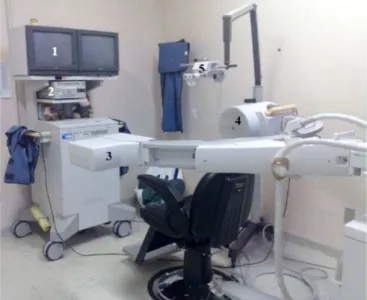
The equipment used for videofluoroscopy was the fluo-roscopic type, composed of a closed circuit television, one X-ray machine with an image intensifier and a videorecording system (Arch Arm BV - Pound Philips®). One cephalostat for fixing the individual’s head in a constant position was also used (Figure 3).
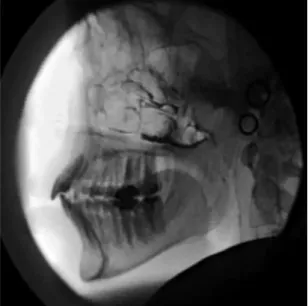
Videofluoroscopy was conducted by an experienced spe-ech pathologist in performing this procedure with the aid of a radiographer in handling the equipment. Before each exam, each patient ingested 5 mL of barium sulfate and 2 mL of this contrast was also applied in each nostril. The lateral view was taken during the emission of syllables, words and sentences with oral and nasal phonemes (Figure 4).
Although the videofluoroscopy protocol (Appendix 1) con-tains several information about the velopharyngeal mechanism structures and its function, it was of interest for this study to know whether or not the patient had a touch of the soft palate in the posterior pharyngeal wall (or in the pharyngeal tonsil when present). For this study it was established that an exam would be considered indicative of consistent velopharyngeal closure
(CC) when touching the soft palate in the posterior pharyngeal wall during all emissions; indicative of inconsistent velopha-ryngeal closure (IC), when the touch occurred in at least one emission, and indicative of non velopharyngeal closure (NC), if the touch never happened.
Figure 1. Procedures for Nasal Air Emission Test
Figure 2. Procedure for Hypernasality Test
Efficacy of TNAE and THYPER Perceptual Tests
The clinical applicability of an instrument can be defined by its level of efficiency, which is determined by the rates of Sensitivity and Specificity. In this analysis it was investigated the ability of the TNAE and THYPER Tests to distinguish between the presence and absence of velopharyngeal closure
and to provide an estimate of the value of the perceptual tests to confirm the findings of videofluoroscopy.
Sensitivity of the TNAE and THYPER refers to the fre-quency which each test identified the absence of velopharyngeal closure, when this absence is also been observed in videoflu-oroscopy. Specificity refers to the frequency which each test identified the presence of velopharyngeal closure, when this presence is also observed in videofluoroscopy. To perform this analysis, it was necessary to define only two categories, the
velopharyngeal closure and non velopharyngeal closure. The
velopharyngeal closure category consisted of the CC and IC groups and the non velopharyngeal closure category remained with the NC group.
Statistical analysis
Once the clinical sample did not allow a homogeneous dis-tribution of the exams in the three categories of closure (CC, IC, NC), the Kappa test was not considered appropriate to establish the correlation in this study. Statistical analysis was then perfor-med by calculating the percentage of agreement and through the establishment of efficiency levels of the tests (Sensitivity and Specificity). This analysis was performed considering the two tests separately, ie, the percentage of agreement was calculated between the interpretation of the findings of TNAE test and the videofluoroscopic findings, and between the interpretation of the THYPER test and videofluoroscopic findings.
RESULTS
Efficiency indices of the TNAE and THYPER tests
The indices of sensitivity and specificity were 98% and 37% for TEAN, and 96% and 63% for THYPER, respectively.
Agreement between the TNAE test scores and the videofluoroscopy findings
Out of the 8 patients with scores between 0/10 and 2/10 (interpreted as CC) in the TNAE test, 5 (62%) were considered to be CC for the videofluoroscopy and 3 (38%) as IC, showing a 62% of agreement between the results. Out of the 7 patients with scores between 3/10 and 7/10 (interpreted as IC), 3 (43%) were considered by videofluoroscopy as CC, 3 (43%) as IC, and 1 (14%) as NC, showing an agreement of 43% between the results. Out of the 74 cases with scores between 8/10 and 10/10 (interpreted as NC), 10 (13%) were considered CC by videofluoroscopy, 14 (19%) as IC, and 50 (68%) as NC, showing an agreement of 68% between the results (Table 1).
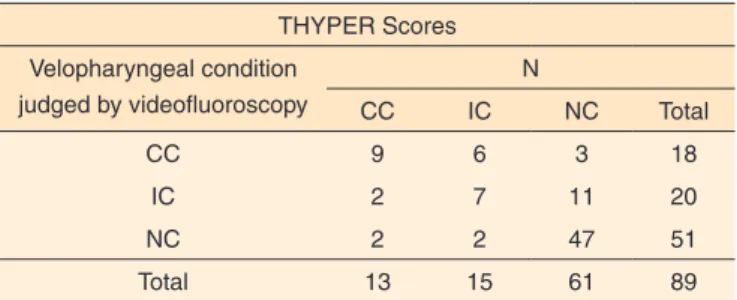
Agreement between the THYPER results and the videofluoroscopy findings
Out of the 13 patients with scores between 0/10 and 2/10 (interpreted as CC) in the THYPER test, 9 (70%) were also considered CC by videofluoroscopy, 2 (15%) as IC, and 2 (15%) as NC, showing an agreement of 70% between the results. Out of the 15 patients with scores between 3/10 and 7/10 (interpre-ted as IC), 6 (40%) were considered CC by videofluoroscopy, 7 (47%) as IC, and 2 (13%) as NC, showing an agreement of 47%. Out of the 61 patients with scores between 8/10 and 10/10 (interpreted as NC), 3 (5%) were considered CC by videoflu-oroscopy, 11 (18%) as IC, and 47 (77%) as NC, showing an agreement 77% between the results (Table 2).
DISCUSSION
The results of this study have shown that there was a poor agreement between the cases with scores of 3/10 and 7/10 for
Figure 4. Videofluoroscopy lateral view showing velopharyngeal closure during speech
Table 1. Distribution of scores obtained in the TNAE test
TNAE Scores Velopharyngeal condition
judged by videofluoroscopy
N
CC CI NC Total
CC 5 3 10 18
CI 3 3 14 20
NC 0 1 50 51
Total 8 7 74 89
the TNAE, as well as the THYPER and judgment of velopha-ryngeal condition by videofluoroscopy, unlike the cases with scores between 8/10 and 10/10, most of whom had agreement with the videofluoroscopic findings. The results agree with another study(9) which tested the agreement between
percep-tual tests (TNAE and THYPER) and nasoendoscopy for the diagnosis of VPD, using the same criteria adopted in this study. Since none study that has compared findings of TNAE and THYPER with the findings of videofluoroscopy has been found in the literature, the comparison of the obtained results with other studies was limited. However, one study found 91% of agreement between the THYPER and the aerodynamic measu-res of 10 normal subjects(11). It was found 100% of agreement
between the presence of nasal air emission, evaluated by a five-point scale and the presence of velopharyngeal gap, iden-tified by videofluoroscopy, in a study that investigated whether the speech symptoms were predictive of the velopharyngeal condition(12). Other authors compared the nasoendoscopy,
vi-deofluoroscopy and perceptual assessment for the diagnosis of VPD and found a strong relationship between velopharyngeal gap size and degree of hypernasality, with a better relation with nasoendoscopy(13). One study investigated the relationship
between perceptual characteristics of hypernasality, assessed by a three-point scale (mild, moderate, severe) and nasal air emission, measured by a dichotomous scale of presence and absence, and the size of the velopharyngeal gap, estimated by videofluoroscopy and nasoendoscopy. The findings have shown a higher association between severe hypernasality and velopharyngeal large gap(14). Another study used
videofluoros-copy, nasoendoscopy and perceptual assessment to evaluate the results of the secondary palatal surgery for correction of VPD. The results have shown that the perceptual assessment was confirmed by videofluoroscopy and it was compatible with the nasoendoscopy(15).
Similar to the NC velopharyngeal condition, the CC cate-gory also showed good levels of agreement for both the TNAE and THYPER tests, unlike the IC category, which showed lower levels of agreement. The vocal literature extensively discusses the fact that the tests and perceptual assessment tools have good agreement at the extremes, where the ear has good accuracy, and fails in the points between them, where the ear
has difficulty. In some studies it was found that voice judges disagreed about what constituted normality or severity, ie the extremes, while disagreed on the scores between them(16-18). In
some voice studies it was found that judges agreed more about what constituted normality or severity, ie the extremes, while disagreed on the scores between them(16-18).
Some hypotheses could explain the results found in this study for the IC velopharyngeal condition, one of them may be the limited number of cases in the sample representative of IC, as well as for the CC condition, which also had a small number of cases in the sample. On the other hand, it is not expected that a case that presents suggestive CC scores in lis-tening tests are referred to videofluoroscopy, since the clinical examination would be enough to perform the diagnosis, with no need to expose the patient to radiation without a real need. The cases in this study that present CC in the perceptual tests were referred to videofluoroscopy for other reasons than for the diagnosis of VPD, such as to evaluate the position of the tongue during velopharyngeal closure and for post-operative evaluation of tonsillectomy.
Another hypothesis that could explain the low agreement for the IC condition would be the possibility that some cases could have shown some degree of nasal obstruction, which could influence the results of TNAE. Patients with cleft lip and palate have deformities in the nasal cavity, which tend to reduce the size of the airways(19,20). Thus, if a patient from
this study presented with nasal obstruction during TNAE, this could mask the presence of the nasal air emission and interfere with the test results.
Another aspect that may have influenced the results of this study is the possibility of the occurrence of compensatory ar-ticulation (CA), even with the effort of the speech pathologist to eliminate it by means of diagnostic therapy. The CA usually occur in the pharynx or larynx, with an attempt of generating pressure to produce a plosive or fricative sound. When this happens, the individual does not make use of the velopharyn-geal mechanism, and therefore presents hypernasality and/or nasal air emission, but actually has anatomical conditions for velopharyngeal closure(21).
Some cases that were judged to present NC in the TNAE and/or in the THYPER presented judgement of CC or IC condition in the videofluoroscopy. One aspect that might have influenced this result is the presence of fistula in some case samples. Even with the attempt to seal that during evaluation, it is possible that air and/or acoustic energy detected in the tests went through the fistula(22). This finding may also be explained
by the fact that the videofluoroscopic analysis of the present study was performed only through the lateral view, which may have precluded the identification of cases that presented asymmetric velopharyngeal closure, in which only a portion of the soft palate touches the posterior pharyngeal wall, causing a velopharyngeal gap(23). Moreover, it appears that
videofluoros-copy may have indicated velopharyngeal closure, when in fact,
Table 2. Distribution of scores obtained in the THYPER test
THYPER Scores Velopharyngeal condition
judged by videofluoroscopy
N
CC IC NC Total
CC 9 6 3 18
IC 2 7 11 20
NC 2 2 47 51
Total 13 15 61 89
there was not the touch of the soft palate in the posterior wall of the pharynx or tonsil. A study found that videofluoroscopy in lateral view, often underestimates the degree of velopha-ryngeal insufficiency when compared with basal vision and nasoendoscopy(24). Another study found similar results, in which
videofluoroscopy overestimated velopharyngeal closure when compared with nasoendoscopy and perceptual assessment(13).
The efficacy of the tests in this study reported rates of 98% of sensitivity and 37% of specificity for the TNAE and 96% of sensitivity and 63% of specificity for the THYPER, indicating that the efficacy was good only for identifying the condition of non velopharyngeal closure.
Low levels of specificity can be justified by the need to include the IC condition in one of the closure or non-closure conditions for efficacy calculation. Arbitrary criterion for joi-ning the CC and IC into velopharyngeal closure was adopted. Thus, a good part of individuals who had IC on videofluoros-copy and were judged by perceptual tests as NC caused the specificity levels to be low, especially for TNAE.
CONCLUSION
There was a good level of agreement between the percep-tual tests and the videofluoroscopy for the consistent velopha-ryngeal closure (CC) and non-closure (NC), but not for the
inconsistent closure (IC).
ACKNOWLEDGEMENTS
We thank the Fundação de Amparo à Pesquisa do Estado de São Paulo (FAPESP) to support this study, number 2011/16733-1.
REFERENCES
1. Pegoraro-Krook MI, Dutka-Souza JCR, Telles-Magalhães LC, Feniman MR. Intervenção fonoaudiológica na fissura palatina. In: Ferreira LP, Befi-Lopes DM, Limongi SCO. Tratado de fonoaudiologia. São Paulo: Roca; 2010. Capítulo 35, p. 439-55.
2. Skolnick ML, Cohn ER. Videofluoroscopic studies of speech in patients with cleft palate. In: Skolnick ML. Why image the velopharyngeal portal. New York: Springer; 1989. Capítulo 1, p. 1-4. 3. Miguel HC, Genaro KF, Trindade IEK. Perceptual and instrumental assessment of velopharyngeal function in asymptomatic submucous cleft palate. Pró-Fono. 2007;19(1):105-12. http://dx.doi.org/10.1590/S0104-56872007000100012
4. Trindade IEK, Yamashita RP, Bento-Gonçalves CGA. Diagnóstico instrumental da disfunção velofaríngea. In: Silva Filho OG, Trindade IEK. Fissuras labiopalatinas: uma abordagem interdisciplinar.São Paulo: Santos; 2007. Capítulo 7, p.123-43.
5. Williams WN, Pegoraro-Krook MI, Dutka-Souza JCR, Marino VCC, Wharton W. Nasoendoscopy: the Role of the Speech-Language Pathologist. Braz J Dysmorphol Speech Hear Disord. 1999;3(2):23-36.
6. Smith B, Guyette T. Evaluation of cleft palate speech.Clinic Plastic Surg. 2004;31(2):251-60.
7. P eg o r a r o - K r o o k M I , D u t k a - S o u z a J C R , M a r i n o V C C . Nasoendoscopy of velopharynx before and during therapy. J Appl Oral Sci. 2008;16(3):181-8. http://dx.doi.org/10.1590/S1678-77572008000300004
8. Brunnegård K, Lohmander A, Doorn JV. Comparison between perceptual assessments of nasality and nasalance scores. Int J Lang Commun Disord. 2012;47(5):556-66. http://dx.doi.org/10.1111/j.1460-6984.2012.00165.x
9. LIMA, GN. Concordância entre testes perceptivo-auditivos e nasofaringoscopia no diagnóstico da disfunção velofaríngea [dissertação]. Bauru: Faculdade de Odontologia de Bauru da Universidade de São Paulo; 2012.
10. Bzoch KR. A battery of clinical perceptual tests, techniques and observations for reliable clinical assessment evaluation, and management of 11 categorical aspects of cleft speech disorders. Austin: Pro-ed; 2004. Capítulo 12, Communicative disorders related to cleft lip and palate; p. 375-462.
11. O’SHEA, MB. An analysis of two indexes of hypernasality [dissertação]. Gainesville: University of Florida; 1982.
12. Dudas JR, Deleyiannis FW, Ford MD, Jiang S, Losee JE. Diagnosis and treatment of velopharyngeal insufficiency: clinical utility of speech evaluation and videofluoroscopy. Ann Plast Surg. 2006;56(5):511-7. http://dx.doi.org/10.1097/01.sap.0000210628.18395.de
13. Lipira AB, Grames LM, Molter D, Govier D, Kane AA, Woo AS. Videofluoroscopic and nasendoscopic correlates of speech in velopharyngeal dysfunction. Cleft Palate Craniofac J. 2011;48(5):550-60. http://dx.doi.org/10.1597/09-203
14. Kummer AW, Briggs M, Lee L. The relationship between the characteristics of speech and velopharyngeal gap size. Cleft Palate Craniofac J. 2003;40(6):590-6. http://dx.doi.org/10.1597/1545-1569(2003)040<0590:TRBTCO>2.0.CO;2
15. Sommerlad BC, Mehendale FV, Birch MJ, Sell D, Hattee C, Harland K. Palate re-repair revisited. Cleft Palate Craniofac J. 2002;39(3):295-307. http://dx.doi.org/10.1597/1545-1569(2002)039<0295:PRRR>2.0. CO;2
16. Gerratt BR, Kreiman J, Antonanzas-Barroso N, Berke GS. Comparing internal and external standards in voice quality judgments. J Speech Hear Res. 1993;36(1):14-20. http://dx.doi.org/10.1044/ jshr.3601.14
17. Kreiman J, Gerratt BR, Kempster GB, Erman A, Berke GS. Perceptual evaluation of voice quality: review, tutorial, and a framework for future research. J Speech Hear Res.1993;36(1):21-40. http://dx.doi. org/10.1044/jshr.3601.21
18. Eadie TL, Doyle PC. Direct magnitude estimation and interval scaling of pleasantness and severity in dysphonic and normal speakers. J Acoust Soc Am. 2002;112(6):3014-21. http://dx.doi. org/10.1121/1.1518983
19. Fukushiro AP, Trindade IEK. Nasal airway dimensions of adults with cleft lip and palate: differences among cleft types. Cleft Palate Craniofac J. 2005;42(4):396-402. http://dx.doi.org/10.1597/03-081.1
LCT, Rossetto PC, Riski JE. Effect of nasal decongestion on nasalance measures. Cleft Palate Craniofac J. 2006;43(3):289-94.
21. Smith BE, Kuehn DP. Speech evaluation of velopharyngeal dysfunction. J Craniofac Surg,2007;18(2):251-67; quiz 266-7. http:// dx.doi.org/10.1097/SCS.0b013e31803ecf3b
22. Henningsson GE, Isberg AM. Velopharyngeal movement patterns in patients alternating between oral and glottal articulation: a clinical and cineradiographic study. Cleft Palate Craniofac J. 1986;23(1):1-9.
23. Williams WN, Henningsson G, Pegoraro-Krook MI. Radiografic assessment of velopharyngeal function for speech. In: Bzoch KR. Communicative disorders related to cleft lip and palate. Austin: Pro-ed; 2004. Capítulo 15, p.517-87.
24. Sinclair SW, Davies DM, Bracka A. Comparative reliability of nasal pharyngoscopy and videofluorography in the assessment of velopharyngeal incompetence. Br J Plast Surg. 1982;35(2):113-7. http:// dx.doi.org/10.1016/0007-1226(82)90146-1
Appendix 1. Speech Videofluoroscopy Protocol, the Hospital of Craniofacial Anomalies of Universidade de São Paulo
Date: _____ / _____ / _____ RG: ___________________
Patient’ name: __________________________________________________________ Age : _________________ Reason for referal: _____________________________________________________________________________ Cleft type: ___________________ tape no: __________________________________
Barium sulfate ( ) no ( ) yes ( ) mouth ( ) nose
Cephalostat
( ) não ( ) sim
Duration: __________________ Kv: _________ mA: ________
Soft palate
( ) NA ( ) no ( ) yes ( ) knee at palatal plane movement ( ) knee above palatal plane ( ) knee below plane ( ) knee absence
Passavant’ pad
( ) NA ( ) No ( ) Yes ( ) palatal plane
( ) below palatal plane
OBS:___________________________________
Posture of tongue ( ) NA
( ) normal function
( ) tongue retraction against soft palate
( ) tongue retraction towards posterior pharyngeal wall ( ) tongue contact with posterior pharyngeal wall
Front view: ( ) NA Movement of lateral walls ( ) no ( ) yes
( ) symmetric ( ) up tp 50 % of the midline ( ) asymmetric ( ) beyond 50 % of the midline ( ) touching in the midline
Cephalometric measurements: ( ) NA
Measures at rest Patient Min Max
VP Extension VP Thickness NF Depth PNF/EV
Suggestive of VP closure
( ) NA ( ) no ( ) yes soft palate contact: ( ) ppw
( ) adenoid ( ) passavant´s pad ( ) palatal prosthesis
Adenoid
Palatine tonsils
( ) NA ( ) not present ( ) not visible ( ) present
( ) occupy large space of oropharynx ( ) makes contact with the ppw ( ) compromise velar elevation
Basal view: ( ) NA Velopharyngeal closure
( ) no ( ) yes__________________________
In speech (better performance): Gap size : ___________ mm Gap height: ______________ mm Velar angle: _______________ degree
Conduct
( ) nasoendoscopy ( ) surgical correction
( ) tonsillectomy may favor speech ( ) assessment of respiratory function ( ) palatal prosthesis ( ) speech therapy
( ) adenoidectomy may facilitate breathing and / or speech ( ) adenoidectomy may impair speech
( ) other ____________________