(1) Universidade Federal de São Paulo – UNIFESP – São Paulo (SP), Brasil. (2) Departamento de Fonoaudiologia, Universidade Federal de São Paulo – UNIFESP – São Paulo (SP), Brasil. Work made at Departamento de Fonoaudiologia, Universidade Federal de São Paulo-UNIFESP-São Paulo (SP), Brasil.
Conlict of interest: non-existent
Mastication and deglutition in obese children and adolescents
Mastigação e deglutição de crianças e adolescentes obesos
Noemia Caroline de Souza(1) Zelita Caldeira Ferreira Guedes(2)
Received on: October 19, 2015 Accepted on: August 01, 2016
Mailing address:
Noemia Caroline de Souza Nunes R. Botucatu, 802, Vila Mariana São Paulo – SP – Brasil CEP: 04023-062
E-mail: [email protected]
ABSTRACT
Purpose: to characterize the orofacial myofunctional proile of children and adolescents with obesity com
-pared to a group of eutrophic and check which aspects inluence the functions of chewing and swallowing. Methods: they checked the organs of the Stomatognathic system, chewing and swallowing by applying the Myofunctional Assessment Protocol Orofacial with Expanded Scores (AMIOFE-E) in 50 female and male individuals, aged between 9 and 18 years, met in an outpatient of Nutrology. They were divided into two groups, the research group, obese group, and the control group, of eutrophic people. The statistical tests used were: analysis of variance (ANOVA), Fisher’s exact Test, conidence interval for mean and coeficient of Variation.
Results: the obese people, when compared to eutrophic people, showed worse performance in tonicity and mobility aspects of cheeks and swallowing (p < 0.05), and 71% of individuals with tonicity reduction presented multiple swallows against 25% of eutrophic individuals. In addition, 68% of obese children and adolescents from that research showed alternating bilateral chewing.
Conclusion: the obese children and adolescents studied in this research presented a higher occurrence of orofacial myofunctional changes when compared to eutrophic people in relation to tonicity and mobility of cheeks and swallowing. In this research, there was also a statistical association between the reduc
-tion of obese children and adolescents´s cheeks tonicity and the presence of multiple swallows during swallowing.
Keywords: Chewing; Obesity; Child; Adolescent
RESUMO
Objetivo: caracterizar o peril miofuncional orofacial de crianças e adolescentes com obesidade com
-parados a um grupo de eutróicos e veriicar quais aspectos inluenciam as funções de mastigação e deglutição.
Métodos: foramavaliados os órgãos do sistema estomatognático, a mastigação e a deglutição aplicando o protocolo de Avaliação Miofuncional Orofacial com Escores Expandidos (AMIOFE-E) em 50 indiví
-duos do sexo feminino e masculino, com idades entre 9 e 18 anos, atendidos em um ambulatório de Nutrologia. Eles foram divididos em dois grupos, o grupo pesquisa, de obesos, e o grupo controle, de eutróicos. Os testes estatísticos utilizados foram: análise de variância (ANOVA), Teste Exato de Fisher, Intervalo de Coniança para Média e Coeiciente da Variação.
Resultados: os obesos, quando comparados aos eutróicos, apresentaram pior desempenho nos aspec
-tos de tonicidade e mobilidade de bochechas e na deglutição (p<0,05), sendo que 71% dos indivíduos com redução da tonicidade apresentaram deglutições múltiplas contra 25% dos indivíduos eutróicos. Além disso, 68% das crianças e adolescentes obesos dessa pesquisa apresentaram mastigação bilateral
alternada.
Conclusão: as crianças e adolescentes obesos estudados nessa pesquisa apresentaram maior ocorrên
-cia de alterações miofuncionais orofa-ciais quando comparados aos eutróicos em relação à tonicidade e mobilidade de bochechas e na deglutição. Nesta pesquisa também houve associação estatística entre a redução da tonicidade de bochechas das crianças e adolescentes obesos e a presença de deglutições múltiplas durante a deglutição.
INTRODUCTION
According to the World Health Organization (WHO) obesity is deined as a chronic disease that is charac -terized as abnormal or excessive fat accumulation that presents a risk to health, causing problems to the health of the individual, causing problems to the health of the individual. In several studies in recent years, there was the demonstration of the signiicant increase of overweight due to epidemiological, demographic and socioeconomic changes1. According to the data of the World Health Organization (WHO) 1.6 billion people over 15 years old were classiied as overweight and 400 million people were obese in 20052. The projections for 2015 are approximately 2.3 billion overweight people and more than 700,000,0003 are obese.
A study in 2007 showed that genetic factors are less relevant in the incidence of obesity than the external socio-environmental factors, among them are: changes in eating habits (preference for processed foods, rich in fats and simple sugars) and in lifestyle, in which we can check the sedentary lifestyle of the population in recent decades4.
In the investigation of the nutritional aspects, the orofacial myofunctional assessment performed by the speech-language pathologist is important, especially in children. Direct analysis of the functions as chewing may show of eutrophic dificulties in feeding that impact directly the nutritional state5.
Commitment in the development of the Stomatognathic system or in the maintenance of its integrity will cause an inappropriate chewing function, interfering in food choice and diet quality6.
Studies show that obese individuals could present problems in the Stomatognathic system due to the accumulation of adipose tissue in the oral and pharyngeal7.8 cavity.
Some authors report that the obese individuals, due to facial feature reduced the tonus of lips and tongue, changing the chewing and swallowing (Berlese, 2012) 9.
Thus, the need to evaluate orofacial myofunc-tional conditions in obese children and adolescents is justiied, considering the increase of cases seen in clinical practice, in order to offer a speech-language therapy and the treatment that answers these issues. Such knowledge will help in the planning of speciic interventions against obesity, since there are few deeper studies on this topic.
In this context, the objective of this research was to characterize the orofacial myofunctional proile in
children and adolescents with obesity, compared to a group of people and check if there were associations in orofacial myofunctional aspects and functions of chewing and swallowing between obese and eutrophic individuals.
METHODS
This research has received approval from the Research Ethics Committee at the Universidade Federal de São Paulo/UNIFESP with the number 17914813.6.0000.5505.
Fifty individuals of both genders, aged between 9 and 18 years old, attended the outpatient clinic of the Nutrition Department of the Department of Pediatrics of UNIFESP. These individuals were monitored on a regular basis by specialties (Nutritionist, nutritional doctor, Pediatrician, speech therapist, pediatric dentist and Psychologist). The parents signed the Termo de Consentimento Livre e Esclarecido and the partici-pants signed the Termo de Assentimento. The sample was divided into two groups: obese individuals 25, who formed the research group, and 25 eutrophic individuals, who formed the control group. There was no distribution by gender and by age.
Inclusion criteria: were selected children and adolescents who after the assessment of nutritional status were classiied as obese to form the research group. The control group was formed by children and adolescents who were classiied as eutrophic people.
Individuals who after being evaluated by the team of Pediatric Dentistry were diagnosed with dental maloc-clusion and/or use of braces, in orofacial myofunctional therapy, with craniofacial abnormalities and mouth breathing, were excluded from the sample.
The measurement of waist circumference (CC) was measured using a lexible measuring tape made of inextensible iber glass (Fiber-Glass) positioned on the midpoint between the last rib and iliac crest and properly measured the midpoint.
The CC is an important tool to identify excess weight (overweight and obesity) in children and adolescents from risks to the development of metabolic and cardio-vascular complications (Hirschler et al. 2005)10. The
values of the CC were classiied according to the cut-off points proposed by McCarthy et al. (2001) 11.
The evaluations of the Stomatognathic system structures, as well as the functions of chewing and swallowing have been evaluated through the Orofacial Myofunctional Assessment Protocol Orofacial with Expanded Scores-AMIOFE-E (Felício, Folha, Ferreira, Medeiros; 2010) 12 a sensitive instrument to evaluate orofacial myofunctional disorders, such as malfunc-tions/changes of the appearance, posture and/or mobility and functions.
The myofunctional evaluation was applied by a speech therapist. In the evaluation the patients were sitting in a chair, with their feet on the ground. They ilmed with a digital camera placed one meter away from the individual.
were classiied on growth curves expressed in percen
-tiles and z-score of IMC and height for Age (5-19 years old for boys and girls), according to parameters of
nutritional status indicators established by the WHO, 2007. The rating is performed by means of percentiles and z-score obtained, as described below:
Table 1. Rating of nutritional status of children and teenagers from 5 to 19 years old. Points of IMC for age, WHO 2007.
Critical values Nutritional Diagnosis
< Percentile 0.1 < Z-Score -3 Severe thinness
≥ 0.1 Percentile and Percentile < 3 Z-Score ≥ -3 and < z-Score -2 Thinness ≥ 3 and ≤ 85 Percentile Percentile -2 z-Score ≥ and ≤ z-Score +1 Eutrophy > 85 Percentile and ≤ 97 Percentile +1 z-Score ≥ and ≤ z-Score +2 Overweight > 97 Percentile and ≤ 99.9 Percentile +2 z-Score ≥ and ≤ z-Score +3 Obesity
> 99.9 Percentile > Z-Score +3 Severe obesity
Table 2. Rating of nutritional status of children and teenagers from 5 to 19 years old. Points of height for age, WHO 2007
Critical values Nutritional Diagnosis
< Percentile 0.1 < Z-Score -3 Very low height
≥ 0.1 Percentile and Percentile < 3 Z-Score ≥ -3 and < z-Score -2 Low height
≥ 3 Percentile Z-Score ≥ -2 Adequate height
The structures of the phono-articulatory organs were analyzed according to the AMIOFE-E Protocol, which appears in the following reviews: appearance and posture: lips, tongue, jaw and cheeks.
The position of the lips was analyzed according to the following criteria: normal posture; occlusion of the lips with tension; if there has been increased activity of lips and mentalis; If there was absence of labial occlusion with mild dysfunction or excessive and opening of the mouth with severe dysfunction.
For the position of the jaw were considered: normal posture when there was functional space free; occlusion of the teeth without functional space free; open mouth with mild dysfunction; excessive mouth opening with severe dysfunction.
As for the posture of cheeks were adopted the following criteria: normal; increased volume or laccid/ mild or severe arch.
For the position of the tongue were considered: If is contained in the oral cavity; If is interposed between the dental arches with adaptation or dysfunction; brought to the dental arches with excessive protrusion.
Central Limit Theorem ensures that the distribution tends to a Normal distribution.
Aiming at comparisons between the groups, a model of analysis of variance (ANOVA) was used. The ANOVA is a fairly usual parametric test that does a comparison of averages using the variance. The Fisher´s Exact Test, which is a non-parametric test that allows one to calculate the likelihood of Association of the features that are under consideration, was used as well.
The conidence for interval range is a technique used to analyze how the average may vary within a given probability of conidence. The coeficient of variation is a statistical test that evaluates how much variability represents the average. The result of each comparison is expressed in p-value.
RESULTS
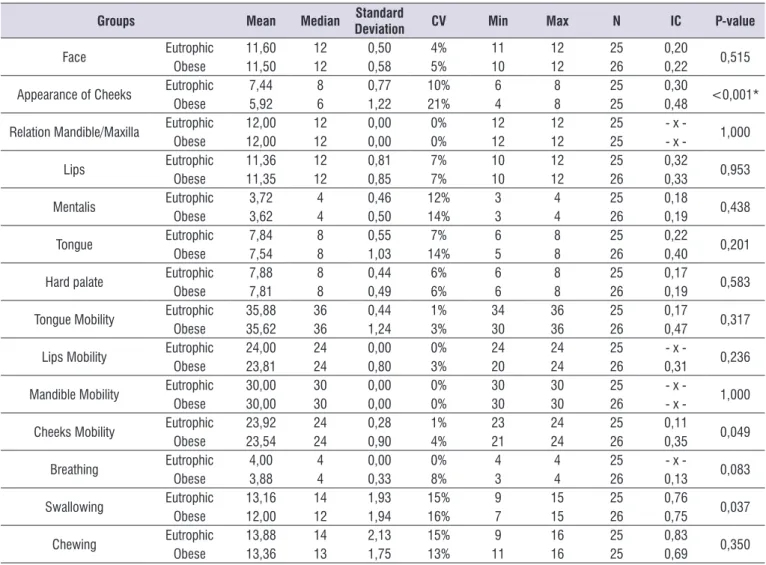
The data in table 3 show that there was no statis-tically signiicant difference between the groups for scores of cheek appearance, its mobility and swallowing. Note that the scores of the Obese were always lower than those of Eutrophic people, as for Swallowing in those who scored respectively 12.00 and 13.16 (p-value = 0.037).
Table 4 shows the link between facial symmetry and chewing for each group.
A statistical relation between facial symmetry with chewing was found in both groups. Thus, individuals with symmetric face had bilateral chewing and the individuals with asymmetric face tended to show unilateral chewing.
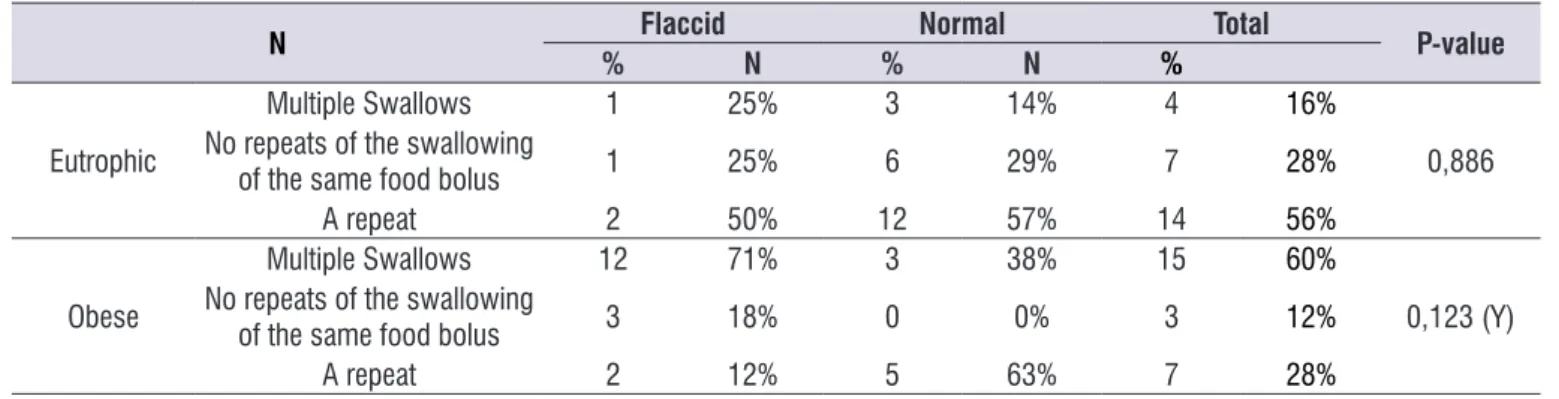
In Table 5 the degree of relation between tonicity and swallowing was analyzed separately for each group using the Fisher´s Exact Test. The data of Chart 3 show that there was no statistical relation between multiple swallows and tone reduction. 71% of obese individuals who presented cheek tone reduction performed multiple swallows, while only 25% of eutrophic individuals demonstrated the same relation. movements of protrusion, right lateralization, left
later-alization, lifting, lowering and ability to maintain the tongue stable in protrusion for ive seconds. For cheeks, inlate, suck, retract and keep the air; jaw protrusion moves, lowering, lifting, right and left lateralization. Considered as normal: isolated movements of each component, with precision and no tremor. Considered with changes: lack of precision in movement, shaking, movements associated with other components and the inability to perform the movement.
The analysis was performed by 4 speech language pathologists experienced in orofacial motor function, assigning a score 3 points scale: 3 = normal, precise movements and no tremors; 2 = insuficient capacity when lack precision in movements, there are tremors and associated movements of other components; 1 = lack of ability or inability to perform the task.
As for breathing, patients were observed at home, in a normal position, and the breathing mode was assessed. Breathing was analyzed and considered nasal when the lip closed effortlessly, during rest9.
Aiming at evaluating the chewing and swallowing, patients chewed and swallowed a piece of bread, as usual. As for chewing, the grinding, whether alternated, bilateral, simultaneous bilateral, chronic unilateral (95% of the time at the same side of the oral cavity), unilateral masticatory preference (66% of the same side), or anteriorly, and total time of food consumption9, were analyzed. As for swallowing, the analysis was considered normal when the tongue was kept within the oral cavity, if there was contraction of the elevator muscles and lip closed effortlessly9 .
After data collection and analysis, children and adolescents who had presented alteration to the masti-catory and standard nutritional status were referred for evaluation and treatment in clinics of UNIFESP.
Table 3. Comparison between the obese and normal weight groups for the results of Myofunctional Assessment Protocol Orofacial with
scores Expanded
Groups Mean Median Standard
Deviation CV Min Max N IC P-value
Face EutrophicObese 11,6011,50 1212 0,500,58 4%5% 1011 1212 2625 0,220,20 0,515
Appearance of Cheeks EutrophicObese 7,445,92 86 0,771,22 10%21% 46 88 2525 0,480,30 <0,001*
Relation Mandible/Maxilla EutrophicObese 12,0012,00 1212 0,000,00 0%0% 1212 1212 2525 - x -- x - 1,000
Lips Eutrophic 11,36 12 0,81 7% 10 12 25 0,32 0,953
Obese 11,35 12 0,85 7% 10 12 26 0,33
Mentalis EutrophicObese 3,723,62 44 0,460,50 12%14% 33 44 2625 0,190,18 0,438
Tongue EutrophicObese 7,847,54 88 0,551,03 14%7% 56 88 2625 0,400,22 0,201
Hard palate EutrophicObese 7,887,81 88 0,440,49 6%6% 66 88 2625 0,190,17 0,583
Tongue Mobility EutrophicObese 35,8835,62 3636 0,441,24 1%3% 3034 3636 2625 0,470,17 0,317
Lips Mobility EutrophicObese 24,0023,81 2424 0,000,80 0%3% 2024 2424 2625 0,31- x - 0,236
Mandible Mobility EutrophicObese 30,0030,00 3030 0,000,00 0%0% 3030 3030 2625 - x -- x - 1,000
Cheeks Mobility EutrophicObese 23,9223,54 2424 0,280,90 1%4% 2123 2424 2625 0,350,11 0,049
Breathing EutrophicObese 4,003,88 44 0,000,33 0%8% 34 44 2625 0,13- x - 0,083
Swallowing EutrophicObese 13,1612,00 1412 1,931,94 15%16% 79 1515 2625 0,750,76 0,037
Chewing EutrophicObese 13,8813,36 1413 2,131,75 15%13% 119 1616 2525 0,690,83 0,350
Test ANOVA
Table 4. Relationship between the results of Symmetry and Masticatory function per Group
N Asymmetric Symmetric Total P-value
% N % N %
Eutrophic UnilateralBilateral 19 10%90% 150 100%0% 169 64%36% <0,001 (Y)
DISCUSSION
The obese children showed worse performance compared to eutrophic children regarding the appea-rance and movement of cheeks. The results showed that there was a statistically signiicant difference in average between the groups concerning reduction of the cheeks, a inding that differs from a study with obese adults, which found that the integrity and shape of the tongue, cheeks and jaw was preserved13. In this research, it was found that 68% of the obese children showed reduced tonicity and mobility of cheeks against only 16% of the eutrophic children. It must be considered that the reduction of the muscular tonus of phono-articulatory organs can impair chewing14. Studies show that obese individuals could present problems in the stomatognathic system due to the accumulation of adipose tissue in the oral cavity and pharynx15.16. Though the ages in the researches are different, there is a study with children of 17 and 25 months, which found that 57.1% of children examined presented hypotonia of the cheek and 42.8%, hypotonia of lips which interfered in the eating pattern17.
The results showed that 68% of the obese individuals presented a bilateral alternating chewing, a inding consistent with the study by Berlese, et al., (2012)18 in which 82.1% of the population of obese children studied showed alternating bilateral chewing. It is important to highlight that in this research, individuals with change in dental occlusion and/or use of braces, in orofacial myofunctional therapy, with craniofacial abnormalities and mouth breathing, were excluded.
The obese individuals showed lower effectiveness of swallowing as compared to eutrophic individuals. There was a statistically signiicant difference between obese people, who presented lower scores when
compared to eutrophic people, regarding swallowing 12.00 and 13.16, respectively (p-value = 0.037). It should be noted that 71% of obese individuals who had reduced tonicity of cheeks presented multiple swallows, while only 25% of eutrophic individuals presented this feature. A statistical relation between tonicity reduction and multiple swallows was seen. The authors stated that multiple swallows indicate the presence of residues in the oral cavity and pharyngeal recesses, suggesting oral propulsion dificulties17.19.
This study found no signiicant differences between obese people and eutrophic ones as for posture and mobility of lips, tongue and jaw and breathing function. Similar data were found in a research carried out in 201320, with 28 obese people from 8 to 16 years old, when the majority presented the occlusion of the lips and vertical posture of normal jaw. In this study20, the tongue was kept in the oral cavity in 60% of the individuals.
The present study has not made comparisons between the variables of age, gender and nutritional status, in order to obtain a more detailed character-ization of the myofunctional proile of obese children and adolescents.
The results of this work show the need of devel-oping more detailed researches in the ield of speech therapy for individuals of the age studied and also younger ones. In addition, they show the importance of efforts of the joint medical team, nutrition, psychology, speech therapy, among others, for a better diagnosis and treatment of these individuals, since obesity is inluenced by biological, psychological and socio-economic21 factors.
Table 5. Relationship between the results of tonicity with swallowing function per Group
N Flaccid Normal Total P-value
% N % N %
Eutrophic
Multiple Swallows 1 25% 3 14% 4 16%
0,886 No repeats of the swallowing
of the same food bolus 1 25% 6 29% 7 28%
A repeat 2 50% 12 57% 14 56%
Obese
Multiple Swallows 12 71% 3 38% 15 60%
0,123 (Y) No repeats of the swallowing
of the same food bolus 3 18% 0 0% 3 12%
A repeat 2 12% 5 63% 7 28%
CONCLUSION
The obese children and adolescents studied in this research presented a higher occurrence of orofacial myofunctional changes when compared to eutrophic people, in relation to tonicity and mobility of cheeks and swallowing.
In this research, it was also possible to observe a statistical association between the reduction of tonicity of the cheeks in children and adolescents and the presence of multiple swallows.
REFERENCES
1. Ferrari TK, Ferrari GLM, Júnior JPS, Silva LJ, Oliveira LC, Matsudo VKR. Modiicações da adiposidade em escolares de acordo com estado nutricional:análise de 20 anos. J Pediatr. 2012;88(3):239-45.
2. WHOSIS: WHO Statistical Information System [Internet]. Geneva: World Health Organization. c2007 - [cited 2007 Feb 1]. Available from: http:// www.who.int/whosis/en/.
3. Tavares TB, Nunes SM, Santos MO. Obesidade e qualidade de vida: revisão da literatura. Rev Med Minas Gerais. 2010;20(3):359-66.
4. Lamounier JA, Parizzi MR. Obesidade e saúde pública. Cad. Saúde Pública. 2007;23(6):1495-500.
5. Cunha DA, Silva GAP, Mota MAFA, Lima CR, Silva HJ. A respiração oral em crianças e suas repercussões no estado nutricional. Rev CEFAC. 2007;9(1):47-54.
6. Carrascosa AC, Campos JADB, Faria JB. Disfunções temporomandibulares, alimentação e nutrição: revisão da literaruta. Alim. Nutr. 2008;19(4):499-504.
7. De Carli A. Ronco e Síndrome da Apnéia Obstrutiva do Sono. Rev cientíica AMECS. 2000;9(1):55-9. 8. Soares EB, Pires JB, Menezes MA, Santana SKS,
Frag J. Fonoaudiologia x ronco/apnéia do sono. Rev. CEFAC. 2010;12(2):317-25.
9. Berlese DB, Fontana PFF, Botton L, Weimmann ARM, Haeffner LSB. Características miofuncionais de obesos respiradores orais e nasais. Rev Soc Bras Fonoaudiol. 2012;17(2):171-6.
10. Hirschler V, Aranda C, Calcagno ML, Maccalini G, Jadzinsky M. Can waist circumference identify children with the metabolic syndrome? Arch Pediatr Adolesc Med. 2005; 159(8):740-744.
11. Mccarthy HD, Jarrett KV, Crawley HF. The
development of waist circumference percentiles in British children aged 5.0-16.9 y. Eur J Clin Nutr. 2001; 55:902-7.
12. Felício CM, Folha GA, Ferreira CLP, Medeiros APM. Expanded protocol of orofacial myofunctional evaluation with scores: validity and reliability. Int J Pediatr Otorhinolaryngol. 2010;74(11):1230-9. 13. Gonçalves RFM, Chehter EZ. Peril mastigatório de
obesos mórbidos submetidos à gastroplastia. Rev CEFAC. 2012;14(3):489-97.
14. De Carli A. Ronco e Síndrome da Apnéia Obstrutiva do Sono. Rev cientíica AMECS. 2000;9(1):55-9. 15. Soares EB, Pires JB, Menezes MA, Santana SKS,
Frag J. Fonoaudiologia x ronco/apnéia do sono. Rev. CEFAC. 2010;12(2):317-25.
16. Nicolielo AP, Gross C, Berretin-Felix G, Machado MAMP. Fatores interferentes na alimentação de crianças de 17 a 25 meses de uma creche municipal. Rev. CEFAC. 2009;11(3):291-7.
17. Padovani AR, Moraes DP, Mangili LD, Andrade CRFA. Protocolo Fonoaudiológico de Avaliação do Risco para Disfagia (PARD). Rev Soc Bras Fonoaudiol. 2007;12(3):199-205.
18. Berlese DB, Copetti F, Weimmann ARM, Fontana PF, Haefffne LSB. Atividade dos músculos masseter e temporal em relação às características miofuncionais das funções de mastigação e deglutição em obesos. Distúrb. Comun. 2012;14(2):215-21.
19. Sordi M, Mourão LF, Silva AA, Flosi LCL.
Importância da interdisciplinaridade na avaliação das disfagias: avaliação clínica e videoluoroscópica
da deglutição. Braz J Otorhinolaryngol.
2009;75(6):776-87.
20. Berlese DB, Copetti F, Weimmann ARM, Ferreira PF, Haefffne LSB. Características Miofuncionais e eletromagnéticas de crianças e adolescentes obesos. Rev. CEFAC. 2013;15(4):913-21.