2011 May-Jun;19(3):565-72
www.eerp.usp.br/rlae
Corresponding Author: Helena Eri Shimizu
Rua SQN 205 Bloco G Apto 605 Bairro: Asa Norte
CEP: 70843-070 Brasília, DF, Brasil E-mail: [email protected]
Pleasure and Suffering in Intensive Care Unit Nursing Staff
Helena Eri Shimizu
1Djalma Ticiani Couto
2Edgar Merchan-Hamann
3The aim of this study was to analyze the causal factors of pleasure and suffering in
Intensive Care Unit (ICU) nursing staff and to compare the occurrence of these factors at
the beginning and end of the career. This was a cross-sectional descriptive study conducted
with 26 nurses and 96 nursing technicians. The previously validated Pleasure and Suffering
Scale was used. The data were analyzed using descriptive statistics with the SPSS 12.0
software and the Kruskal Wallis test was used to assess the presence of these factors at
the beginning and end of the career. The results indicated that, for both the nurses and
the nursing technicians, the factors that contribute to feelings of pleasure, professional
achievement and freedom of expression, and the factors that cause suffering, professional
exhaustion and lack of recognition, were encountered at critical levels.
Descriptors: Nurses; Intensive Care Units; Occupational Health.
Prazer e sofrimento em trabalhadores de enfermagem de Unidade de Terapia Intensiva
O objetivo do estudo foi analisar os fatores causadores de prazer e sofrimento em
trabalhadores de enfermagem que atuam em unidade de terapia intensiva (UTI) e comparar a ocorrência desses fatores, no início e no inal da carreira. Este é um estudo descritivo transversal, realizado com 26 enfermeiros e 96 técnicos de enfermagem. Utilizou-se a escala de prazer e sofrimento, validada previamente. Os dados foram
analisados por meio da estatística descritiva, com software SPSS12.0, e, para avaliar a presença desses fatores, no início e no inal da carreira, o teste de Kruskal Wallis. Constatou-se que, tanto para enfermeiros como para os técnicos de enfermagem, os fatores que contribuem para os sentimentos de prazer, realização proissional e liberdade de expressão e os fatores que causam sofrimento, esgotamento proissional e falta de reconhecimento se encontram em níveis críticos.
Descritores: Enfermeiros; Unidade de Terapia Intensiva; Saúde do Trabalhador.
Placer y sufrimiento en trabajadores de enfermería de una Unidad de Terapia Intensiva
El objetivo del estudio fue analizar los factores causadores de placer y sufrimiento en
trabajadores de enfermería que actúan en una Unidad de Terapia Intensiva (UTI) y comparar la ocurrencia de esos factores en el inicio y al inal de la carrera. Se trata de un estudio descriptivo transversal, realizado con 26 enfermeros y 96 técnicos de enfermería. Se utilizó la Escala de Placer y Sufrimiento, validada previamente. Los datos
fueron analizados por medio de la estadística descriptiva, con software SPSS12.0, y, para evaluar la presencia de esos factores en el inicio y al inal de la carrera, se utilizó la prueba de Kruskal Wallis. Se constató que, tanto para enfermeros como para los técnicos de enfermería, los factores que contribuyen para los sentimientos de placer, realización
profesional y libertad de expresión y los factores que causan sufrimiento, agotamiento
profesional y falta de reconocimiento, se encuentran en niveles críticos.
Descriptores: Enfermeros; Unidade de Terapia Intensiva; Salud Laboral.
Introduction
The recognition is growing that health care workers,
especially those of the nursing team, experience
stressful situations in the work that lead to suffering.
Several studies have indicated the need to identify, in
critical areas such as the ICU, the causative factors
of the suffering, as well as the defensive strategies to
avoid this, in order to maintain the psycho-emotional
balance of the worker(1-5). Care for critically ill patients requires from the nurses and nursing technicians,
hereafter referred to as the nursing team, speed in
decision making, a heightened sense of responsibility in
the prioritization of actions, the resolution of complex
problems, the continuous reorganization of the activities
due to frequent interruptions, and the management of
a large and variable amount of information due to the
diverse interventions required(1-5). Furthermore, the nursing team are almost constantly confronted with
suffering and death of their fellows, and are exposed
to the ambiguous feelings that are transferred to them
by both the patient and their family members(1-2). These situations invariably provoke feelings of
intense anxiety, which contribute to the development
of mediation strategies that function to try to avoid
tensions which cumulatively threaten the integrity of
their health with the risk of evolving into a framework
The work carried out by the nursing team in
this environment, although essential, has little social
recognition; is undervalued and invisible to the other
health professionals and the patients(1-2,6). Additionally, in recent years in Brazil, mainly in the public health
institutions, nursing care in general has been penalized with a deiciency of human and material resources that directly inluences the quality of care provided to the population(1-2). It appears that the experience of suffering in the work in an ICU would be intense due to the
constant exposure of the workers to extremely stressful
situations, which are often unconsciously, characterized,
according to the psychodynamics of the work(7), as individual or shared experiences, which have their origins in situations of conlict between the desire/needs of the employee and the organization of the work(7). Distress in the work is manifested as a form of emotional, physical
and social exhaustion, and when this is pronounced
it may cause the impoverishment of the personality,
leading the individual to an emotional numbness, i.e.
an “erasure” of emotional manifestations(7-8). Such experiences also cause the failure of the professional if
confronted with their own feelings, which may lead them
to conceal from themselves the psychic suffering, their
painful emotional experiences(9).
Despite the possible health injuries arising from the organizational context, the positive signiicance of the work is being rediscovered as a means of preventing and
overcoming these negative effects, through a position
that emphasizes the positive subjective experiences in
improving the quality of life of the workers and preventing
pathologies(9-13). These work experiences, when positive, help to enrich the identity of the individual, leading to
the maximum development of their potential. From this
perspective, the process of caring for critically ill patients,
which involves a meeting between the subjects - who
care and who are cared for, due to its dynamism and
complexity, demands choices, arbitrations, prioritization
of actions and goals, and guidance in the decision making
of the workers, which makes it somewhat possible to
overcome the fragmentation of the work process. The
workers can appropriate the management of their work (10-11) by means of permanent negotiations between what is prescribed, i.e. the standards, routines, procedures and
unexpected demands of the care quotidian. It is possible
to discover a new way to develop the work that is more
rewarding for the workers and provides higher quality
care for the patients. It is important to investigate
whether there are differences in the factors associated
with pleasure and with suffering at the beginning and
the end of the career, to develop management strategies
that foster improvement in the work processes in order
to contribute to a more satisfying working life.
This study aims to analyze the factors that cause
pleasure and suffering in the work of nurses and nursing
technicians in the ICU, and to compare the degree of
occurrence of these factors at the beginning and end of
the career.
Methods
This was a cross-sectional descriptive study
conducted with nurses and nursing technicians of the ICU
of a tertiary public hospital, prominent within the network
of the Department of State and Health, the Federal
District Base Hospital. The sample was selected in a
non-probabilistic way and consisted of 122 participants who were divided into two categories: the irst composed of Nurses (n = 26), and the second of Nursing Technicians
(n = 96). The inclusion criterion adopted was for workers
to have more than 6 months of work and those who
were absent from work for more than 90 consecutive
days in the ICU studied were excluded. For the data
collection, a questionnaire was used to characterize the
study population which included: marital status, level of
schooling, number of jobs, and the Pleasure-Suffering
at Work Scale (PSWS). This scale includes a Work and
Risk of Illness Inventory (WRII), constructed based on
the Psychodynamics of Work theoretical framework,
comprising a total of four independent scales, and is an
auxiliary diagnostic instrument of critical indicators in
the work, having previously been validated(14).
The PSWS consists of four factors, two for joy
and two for suffering. The factors that are indicators of
pleasure are: professional achievement and freedom of
expression; and the factors that are indicators of suffering
are professional exhaustion and lack of recognition. The irst factor, professional achievement, consists of nine items, with an alpha = 0.89, and relates to the experience of professional gratiication, pride and identiication with the work performed. Factor two, freedom of expression, with ive items, and an alpha = 0.69, relates to the experiences of freedom to think, organize and talk
about their work. Factor three, professional exhaustion,
contains six items, with an alpha = 0.84, related to frustration, insecurity, worthlessness and disqualiication concerning performance expectations, producing
Rev. Latino-Am. Enfermagem 2011 May-Jun;19(3):565-72.
due to non-recognition of their work. It is a Likert type scale containing ive points, and aims to evaluate the occurrence, in the past six months, of the experience
of feelings of pleasure and suffering in the work. In
this scale, a value between 1 and 5 points is assigned,
where the value of 1 conforms to nothing present, and
5 to totally present. In the PSWS, for evaluation of the
factor pleasure, constituted by the factors professional
achievement and freedom of expression, the parameters
are as follows: above 3.7 = satisfactory evaluation;
2.3 to 3.7 = critical evaluation; 1.0 to 2.3 = severe
evaluation. For the evaluation of the factor suffering,
composed of the factors professional exhaustion and lack
of recognition the following parameters are considered:
1.0 to 2.3 = satisfactory evaluation; 2.3 to 3.7 = critical
evaluation; above 3.7 = severe evaluation.
The collected data were analyzed with the aid of
the software Statistical Package for the Social Sciences
for Windows (SPSS) version 12.0. They were later transferred to Microsoft Excel Ofice XP so that the data could be formatted. Descriptive statistics were used to
calculate measures of central tendency and dispersion
and the frequency distribution of the demographic data.
The Kruskal Wallis nonparametric test was also used to
analyze the data, based on the medians of the values,
in order to test the null hypothesis, which assumes
equality of the populations. The test evaluated, in the
PSWS, whether there were differences in professional
achievement, freedom of expression, professional
exhaustion and lack of recognition. The items were classiied into positions or ranks for the calculation of signiicance, where p<0.05 was considered. These factors were veriied among the nurses and nursing technicians at the beginning of their careers in comparison with the
professionals who were at the end of their careers, in
their respective categories. To perform this test, the
study universe was reduced from 122 to 94 people, i.e.
77% of the initial participants, given the restriction that,
up to 7 years of work was considered as the initiation
of the career and more than 15 years as the end of the
career, which excluded 28 workers in the intermediate
phase (7 to 15 years in the career).
Ethical issues related to the study
The research project was approved by the Research
Ethics Committee of the Health Department of the Federal District, under process No. 183/05. Subsequently, all the participants signed the Terms of Free Prior Informed Consent, conforming to Resolution No. 196/96 of the Ministry of Health
Results
Characterization of the study population
Regarding the proile of the study subjects, there was a strong participation of women (76.9% among the nurses, and 84.4% among the technicians), conirming the same trend in other areas of nursing work. With regard
to marital status, the predominance was observed of
married workers in both categories: 53.8% and 53.1%,
for the nurses and technicians respectively. In relation
to the level of schooling, it was found that among the
nurses postgraduates predominated (80.8%), while
among the nursing technicians complete high school
predominated (54.3%) - the minimum level required
for the performance of these duties. However, in this group, it is worth noting the signiicant participation of workers with tertiary or post-graduate education,
37.3%. Concerning the number of jobs, 65.4% of the
nurses had two or three jobs, i.e. they have a heavy
work load; among the nursing technicians, the majority
had only one job: 60.4%.
As shown in Table 1 that follows, it was found
that the factors that contribute to feelings of pleasure,
expressed in “professional achievement” and “freedom
of expression”, were encountered at critical levels for
both the nurses and the nursing technicians. The factors
that contribute to the experience of suffering in the work,
“professional exhaustion” and “lack of recognition”, were
also found at critical levels. It is worth noting that it
was found that the nursing technicians expressed
themselves to be slightly more exposed than the nurses
to “professional exhaustion” and “lack of recognition” in
relation to the work they develop.
Studied category
Nurses Nursing technicians Total
n Md M SD n Md M SD n Md M SD
Professional Achievement 26 3.2 3.2 0.8 96 3.1 3.2 0.9 122 3.1 3.2 0.9
Freedom of Expression 26 3.6 3.6 0.7 96 3.6 3.6 0.7 122 3.6 3.6 0.7
Professional Exhaustion 26 3.5 3.2 0.9 96 2.8 2.8 0.9 122 2.8 2.9 0.9
Lack of recognition 26 3.2 3.0 0.7 96 2.6 2.6 0.8 122 2.6 2.7 0.8
Table 1 - Factors for evaluation of suffering and pleasure in ICU nurses and nursing technicians (Brasilia, Brazil, 2009)
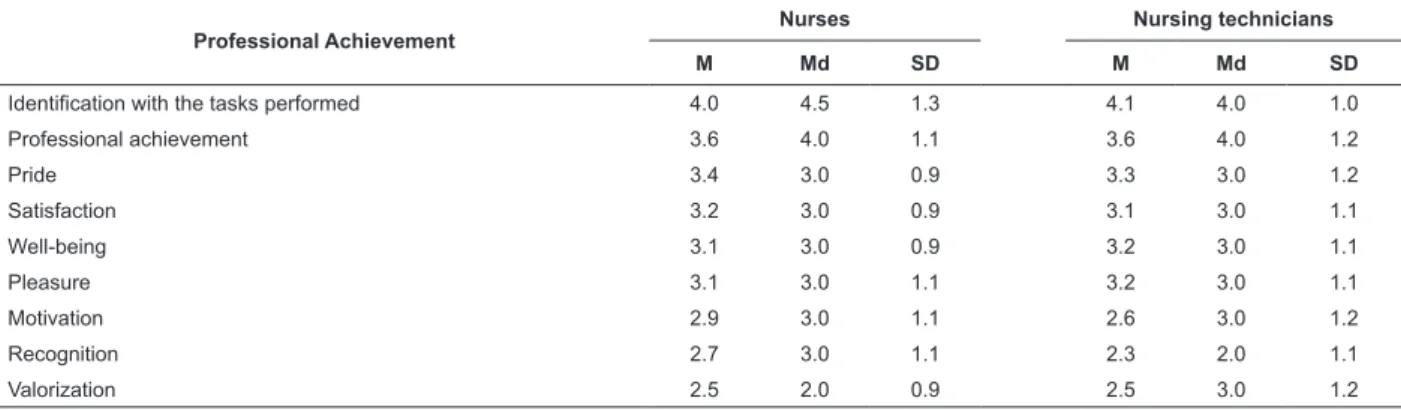
Regarding the feelings of pleasure, Table 2
shows the factors that contribute to the experience of professional achievement. It was veriied that two factors, “identiication with the tasks that are performed” and “professional achievement” were at satisfactory
levels for both professional categories. However, the
feelings of “pride, satisfaction, well-being, pleasure, and
Professional Achievement
Nurses Nursing technicians
M Md SD M Md SD
Identification with the tasks performed 4.0 4.5 1.3 4.1 4.0 1.0
Professional achievement 3.6 4.0 1.1 3.6 4.0 1.2
Pride 3.4 3.0 0.9 3.3 3.0 1.2
Satisfaction 3.2 3.0 0.9 3.1 3.0 1.1
Well-being 3.1 3.0 0.9 3.2 3.0 1.1
Pleasure 3.1 3.0 1.1 3.2 3.0 1.1
Motivation 2.9 3.0 1.1 2.6 3.0 1.2
Recognition 2.7 3.0 1.1 2.3 2.0 1.1
Valorization 2.5 2.0 0.9 2.5 3.0 1.2
motivation”, were found at levels considered critical.
There were differences in the perception of the factors
of “recognition” and “professional valorization” between
the two categories: while the nursing technicians felt less
recognized than the nurses (median = 2.0, considered a
severe evaluation), the nurses felt less valued than the
technicians (median = 2.0, a severe evaluation).
Table 2 - Evaluation of the factor professional achievement in ICU nurses and nursing technicians (Brasilia, Brazil,
2009)
M = Mean; Md = Median; and SD = Standard Deviation.
With regard to freedom of expression in the work, it
can be observed from the data obtained (Table 3) for both
categories, that the factors “solidarity with colleagues”,
“freedom to talk about the work with colleagues”
and “freedom to use a personal style” reached levels
considered satisfactory. However, the factors “freedom
to speak openly at work” and “trust in colleagues” were
found at levels considered critical for both categories.
Table 3 - Evaluation of the factor freedom of expression in ICU nurses and nursing technicians (Brasilia, Brazil,
2009)
Freedom of expression
Nurses Nursing technicians
M Md SD M Md SD
Solidarity with colleagues 3.9 4.0 0.9 4.0 4.0 0.9
Freedom to talk about the work with colleagues 3.8 4.0 1.1 3.9 4.0 1.0
Freedom to use a personal style 3.7 4.0 0.8 3.5 4.0 1.3
Freedom to speak openly at work 3.1 3.0 1.0 3.2 3.0 1.1
Trust in colleagues 3.0 3.0 1.0 3.0 3.0 1.0
M = Mean; Md = Median; and SD = Standard Deviation.
In the factor “professional exhaustion” (Table
4), it can be seen that the results indicate that the
factors “stress, distress and frustration” are at levels
considered severe for the nurses and at critical levels
for the nursing technicians. The factors “dissatisfaction”
and “emotional exhaustion” were evaluated at critical
levels for the two categories. The factor of “insecurity”
was encountered at a critical level only for the nurses.
Table 4 - Evaluation of the factor professional exhaustion
in ICU nurses and nursing technicians (Brasilia, Brazil,
2009)
Professional exhaustion
Nurses Nursing technicians M Md SD M Md SD
Stress 3.6 4.0 1.1 3.0 3.0 1.2
Distress 3.5 4.0 1.0 3.2 3.0 1.1 Dissatisfaction 3.3 3.0 0.9 3.0 3.0 1.1
Emotional exhaustion 3.3 3.5 1.1 2.7 3.0 1.2 Frustration 3.1 4.0 1.2 2.8 3.0 1.2 Insecurity 2.3 3.0 0.8 2.0 2.0 1.0
Rev. Latino-Am. Enfermagem 2011 May-Jun;19(3):565-72.
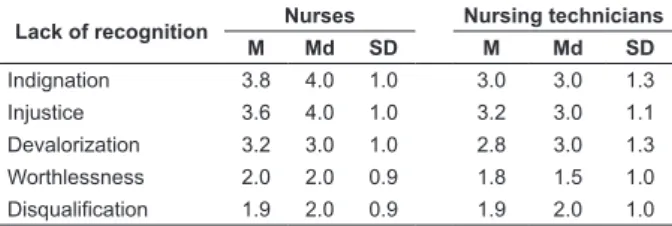
Concerning the evaluation of the lack of recognition
(Table 5), the results indicate that the factors “indignation” and “injustice” were classiied at severe level for the nurses, and critical for the nursing technicians. The factor “devalorization” was found at critical levels for
both categories. However, the feelings of worthlessness and disqualiication were at satisfactory levels for both categories.
Table 5 - Evaluation of the factor lack of recognition in ICU
nurses and nursing technicians (Brasilia, Brazil, 2009)
Lack of recognition Nurses Nursing technicians M Md SD M Md SD Indignation 3.8 4.0 1.0 3.0 3.0 1.3 Injustice 3.6 4.0 1.0 3.2 3.0 1.1 Devalorization 3.2 3.0 1.0 2.8 3.0 1.3
Worthlessness 2.0 2.0 0.9 1.8 1.5 1.0 Disqualification 1.9 2.0 0.9 1.9 2.0 1.0
M = Mean; Md = Median; and SD = Standard Deviation.
Analyzing the results of the PSWS regarding the
possible differences between feelings of pleasure and suffering at the beginning and end of the career, it was found that the “professional achievement” in 21 nurses had a slight increase (ranking 10.0 early in the career, and 12.8 at the end) This difference was not signiicant (p = 0.20). Among the 73 nursing technicians there was also an increase which was not signiicant from a statistical viewpoint (ranking 35.4 early in the career, and
40.1 at the end, p value = 0.21). Regarding “freedom of expression”, there was a signiicant increase among the 21 nurses when comparing the beginning and end of the career (ranking 8.3 early in the career, and 16.3 at the
end, p value = 0.01). Among the nursing technicians, the slight increase observed was not signiicant (ranking 36.3 early in the career, and 38.3 at the end, p value = 0.34). Regarding “professional exhaustion”, the slight decrease observed among the nurses was not signiicant (ranking 11.1 early in the career and 10.7 at the end,
p value = 0.48). In contrast, there was a signiicant
difference among the nursing technicians (ranking 40.6
early in the career, and 29.4 at the end, p value = 0.02). In relation to the “lack of recognition”, there was no signiicant differences in the observed decreases, both among the nurses (ranking 11.2 early in the career and
10.5 at the end, p value = 0.52), and among the nursing technicians (ranking 38.4 early in the career; and 34.0 at the end, p value = 0.23).
Discussion
The study results demonstrated that in the
perception of both the nurses and the nursing technicians,
the causal factors of feelings of pleasure, professional
achievement and freedom of expression, as well as
the causal factors of suffering in the work, professional
exhaustion and lack of recognition were encountered at
levels considered critical. This demonstrates the need
to further examine the expression of these factors in
the organization of the work process, considering that
they pose serious risks to the physical and mental health
of the workers and can lead to the acquisition of some
diseases(1-3,13-15).
Regarding the factors that generate experiences of feelings of pleasure in the work, identiication with the tasks performed and professional achievement were
found at satisfactory levels for both the nurses and the
nursing technicians. This is because the act of caring for
others who are fragile and dependent, normally makes it
possible for the nursing staff to have experiences of very
pleasant feelings, above all that of being useful, which
consequently gives them a sense of developing socially
noble work(1-2). It should be noted that the results also conirmed that the actions involved in the process of care for the seriously ill person, due to the variability,
along with the complexity, require workers to go beyond
what is prescribed, allowing them large spaces for acting
in a more personal way or with a unique style, providing
a singular meaning; therefore presenting itself as a
channel through which the professionals can express
themselves, pursue and achieve their desires, wishes
and possibilities(10-11). Furthermore, in most cases, the nurses and the nursing technicians felt privileged to
work in a sector considered one of the most important
of the hospital, to be specialized and to use advanced
technological resources to treat patients on the threshold
between life and death. This usually gives them a status
that generates feelings of pride, satisfaction, well-being
and pleasure(1-2), however, these feelings were not perceived in this study.
Despite the positive factors present in the
work process, it was found that there were signs of
intense exhaustion, slightly higher in the nurses who
occupy hierarchically superior positions to the nursing
technicians, certainly from assuming for themselves a
high degree of responsibility in the provision of care to
the critical patient. The nursing technicians expressed
that the distress is greater at the beginning than the end of the career, possibly because at irst they found themselves pressured to learn to cope with complex
tasks performed on humans beings at risk of imminent
death and that over time they adapt to the distress
distress in the ICU is usually intense, caused mainly
by the efforts expended to achieve the diverse care for
the patients who are bedridden, which causes various
types of pain, especially in the legs, the lumbar region
and the back(16-19). The mental distress originates from the frequent interruptions due to the unexpected and
from dealing with suffering and death(1-2). Death in the ICU has the connotation that there was ineficiency of the team, and therefore, that all the work was lost. The
feelings generated by the loss of patients are extremely dificult to elaborate, because they cause much anguish, however they cannot be freely expressed in the work
context(1-2). Suffering in the work also comes from the contact with the family members of patients who tend
to project feelings of depression and anxiety, caused by
hospitalization, onto the nursing staff, especially in times
of tension, with the worsening of the clinical framework
or death(1-2). Given the above, it appears that the forms of management and organization of the work in the ICU
should especially allow workers spaces for expression
of their various feelings arising from the task of caring, which are dificult to elaborate, in order to reduce the distress(1-2). In this sense, a satisfactory evaluation was observed in this study in relation to the factor freedom
of expression, which remains for the nursing technicians
at the beginning and end of their careers, but increases
towards the end for the nurses. It was inferred that
greater familiarity with the work process increases the security, creativity and ability to cope with teams/ groups, essential for the nurse who is the coordinator
of the team.
The results showed that there was solidarity and
freedom to talk about the work with colleagues, aspects
of extreme importance in the ICU, which dispense
with spontaneous help to ensure accuracy, speed and
promptness in the attendance. However, the factors
“freedom to speak openly at work” and “trust in
colleagues” were found at levels considered critical, which
demonstrates the need to strengthen the construction of
collective work, going beyond the concept of teamwork,
in the majority of cases comprehended as something
stable, inspired by the principles of Taylorism. Collective
work is constructed daily by the subjects involved in it
who, from the representation of the activity, negotiate
their commitments, whether implicit or explicit, for the
articulation of different actions by the different workers (10-11,20). The cooperation between the workers becomes motivated by the pursuit of quality, an essential condition for obtaining pleasure in the work. To this end, a lexible management model is necessary to allow the experience
of the feeling of recognition from the hierarchy and the
peers, which occurs when the organization emphasizes
the independence of the employees in an internal structure that allows negotiation in the deinition of hierarchical roles, in the standards and the rules(12-13,15). As a result this brings the possibility of a psycho-affective
structuring of the socio-professional relationships,
necessary for the strengthening of the identity through
the construction of the collective work(12-13,15).
To operate with managerial lexibility, power must not derive from the position at work, but from
the specialization, the knowledge, and the personal
relationships. It is therefore crucial to foster a form
of collective work which promotes articulation of the
actions and integration of the individuals. The search
for consensus of the team based on communicative
practice, i.e. on the communication oriented towards
understanding, permits the construction of a project
of common assistance most appropriate to the health
needs of the patients(20). Thus, it was found that both the nurses and the nursing technicians expressed that the
factor recognition, composed of feelings of indignation,
injustice and devalorization, was at critical levels. These
feelings are probably related to the lack of working
conditions they are exposed to in the public hospitals,
such as the lack of human resources, equipment and
materials, which generates an overload for the workers
and a lack of care for the patients(6,13).
Studies show that the indignation of the
ICU nursing team may have other motives and is
manifested individually or collectively, due to the lack
of humanization in the patient care: disregard for the
body after death, care in calling the patient by name,
treating them by the bed number, and categorizing the
patient by the procedure performed, among others(21). The feeling of injustice in the ICUs is usually related
to lack of valorization of the nursing professionals,
who are the ones taking care of the patients all the
time, but are not recognized by the patients nor by
the institution(1-2). Low wages are also considered one of the factors that characterize the devalorization of
nursing, imposing on the workers the need for double
shifts, which motivates absenteeism due to health
problems(22). It appeared that the nurses and the nursing technicians, to withstand the pressures and
psychological suffering originating from the adverse
working conditions, may develop individual and
collective defensive strategies, such as distancing,
denial and depersonalization. These defensive strategies
Rev. Latino-Am. Enfermagem 2011 May-Jun;19(3):565-72.
forms of existence. Moreover, the trivialization and the
denial of the suffering can lead to the crystallization of
individual and collective defensive strategies, making
them rigid workers who are resistant to changes.
Conclusion
One of the limitations of this study is the lack of
in-depth comprehension of the subjective dimension of the
causal factors of the suffering and pleasure in the work in
the ICU nurses and nursing technicians. A second limitation
is the possibility of bias in prevalence, characteristic of
the cross-sectional study. It was concluded that the
nurses and nursing technicians encounter, in their work
in the ICU, factors that contribute to experience feelings
of pleasure, above all due to the practice of care being extremely signiicant, and the factors related to freedom of expression in the work allowing them to exercise forms
of individual and collective work satisfactorily. However, it was veriied that the work causes intense emotional exhaustion, and produces feelings of dissatisfaction. The lack of recognition was seen to be signiicant, which is expressed by feelings of indignation and injustice. It is
therefore necessary to review the work process in order
to provide greater work satisfaction.
References
1. Shimizu HE, Ciampone MHT. As representações dos técnicos e auxiliares de enfermagem acerca do trabalho em equipe na unidade de terapia intensiva. Rev.
Latino-Am. Enfermagem. 2003;12(4):623-30.
2. Shimizu HE, Ciampone MHT. Sofrimento e prazer no
trabalho vivenciado pelas enfermeiras que trabalham em
Unidades de Terapia Intensiva em um hospital escola.
Rev Esc Enferm USP. 1999;33(1):95-106.
3. Van Den Touren M, De Jonge J. Managing job stress
in nursing: What kind of resources do we need? J Adv
Nurs. 2008;63(1):75-84.
4. Lautert L. O desgaste profissional: estudo empírico
com enfermeiras que trabalham em hospitais. Rev
Gaúcha Enferm. 1997;18(2):133-44.
5. Martins MCA. Situações indutoras de estresse no
trabalho de enfermeiros em ambiente hospitalar. MILLENIUM – Rev Instituto Superior Politécnico de Viseu [periódico de Internet]. out 2003. [acesso 12 ago 2007]; (28). Disponível em: WWW.ipv.pt/millenium/ millenium28/18.htm.
6. Spindola T, Santos RS. Mulher e trabalho: a história
de vida de mães trabalhadoras de enfermagem. Rev.
Latino-Am. Enfermagem. 2003;11:593-600.
7. Dejours C. Da psicopatologia a psicodinâmica do
trabalho. Rio de Janeiro: Fiocruz; 2004.
8. Dejours C. Psicodinâmica do trabalho: contribuições da
escola dejouriana à análise da relação prazer, sofrimento
e trabalho. São Paulo: Atlas; 1994.
9. Mendes AM. Da psicodinâmica à psicopatologia. In: Mendes AM. Psicodinâmica do trabalho: teoria, método e pesquisas. São Paulo (SP): Casa Psi; 2007. p. 29-48.
10. Schwartz Y. La conceptualisation du travail, le visible et l’ invisible. L’ Omme Societé. 2004;152-153:47-77. 11. Schwartz Y. Reconaissances Du travail: por une
aproche ergologique. Paris: PUF; 1998.
12. Kovner C, Brewer C, Wu Y, Cheng Y, Suzuki M. Factor
associated with work satisfaction of registered nurses. J
Nurs Scholarship. 2006;38(1):71-9.
13. Abrahão JI, Torres CC. Entre a organização do trabalho
e o sofrimento: o papel de mediação da atividade. Rev
Produção. 2004;14(3):67-76.
14. Ferreira MC, Mendes AM. Inventário sobre trabalho e
adoecimento – ITRA: Instrumento auxiliar de diagnóstico
de indicadores críticos no trabalho. In: Mendes AM. Psicodinâmica do trabalho: teoria, método e pesquisas. São Paulo (SP): Casa Psi.; 2007. p. 111-22.
15. Mendes AM, Tamayo A. Valores organizacionais
e prazer sofrimento no trabalho. Rev PSICO- USF.;
2001;6(1):39-46.
16. Kennedy BR. Stress and Burnout of nursing
staff working with geriatric in long term care. J Nurs
Scholarship. 2005;37(4):381-82.
17. Marziale MHP, Carvalho EC de. Condições ergonômicas
do trabalho da equipe de enfermagem em unidade de
internação de cardiologia. Rev. Latino-Am. Enfermagem.
1998;6 (1):99-117.
18. Marziale MHP, Robazzi MLCC. O trabalho de
enfermagem e a ergonomia. Rev. Latino-Am.
Enfermagem. 2000;8(6):124-7.
19. Célia RCRS, Alexandre NMC. Aspectos ergonômicos e sintomas osteomusculares em um setor de transporte
de pacientes. Rev Gaúcha Enferm. 2004;25(1):33-43.
20. Peduzzi M. Equipe multiprofissional de saúde: conceito
e tipologia. Rev Saúde Pública. 2001; 35(1):103-9.
21. Salicio DMB, Gaiva MAM. O significado de humanização
da assistência para enfermeiros que atuam em UTI. Rev
Eletronica Enferm. 2006;8(3):370-6.
22. Sentone ADD, Gonçalves AAF. Sofrimento no
trabalho: significado para o auxiliar de enfermagem
com dois vínculos empregatícios. Seminário Ciências
Biológicas e da Saúde 2002;23(1):33-8.
Received: Sep. 22nd 2010