92
Health-Related Physical Fitness in Brasilian
Schoolchildren: Data From The Brazil Sport Program
Andreia Pelegrini1,2 Diego Augusto Santos Silva2,4 Edio Luiz Petroski2
Maria Fátima Glaner3
1. State University of Western Paraná. Human Sciences, Education and Humanities Center. Physical Education Collegiate. Cândido Rondon Marshall, Paraná, Brazil. 2. Federal University of Santa Catarina. Sports Center. Graduation Program in Physical Education. Research Team in Kineanthropometry and Human Performance. Florianópolis, Santa Catarina, Brazil.
3. State University of Londrina. Physical Education Department. Londrina. PR, Brazil.
4. CAPES scholarship recipient.
Mailing Address:
Edio Luiz Petroski
Universidade Federal de Santa Catarina – Centros de Desportos Núcleo de Cineantropometria e Desempenho Humano – UFSC/ CDS/NuCIDH. Campus Universitário – Trindade – Caixa Postal 476 88040-900 – Florianópolis, SC, Brasil. E-mail: [email protected]
ABSTRACT
Objetive: To analyze the physical fitness of Brazilian schoolchildren, according to a health-refer-enced criteria assessment. Methods: This was a cross-sectional, school-based, epidemiological study of 7,507 schoolchildren (4,114 boys and 3,393 girls) aged 7 to 10 years. The following variables were measured: body weight, height, flexibility (sit-and-reach), muscle strength/resistance (1 minute modi-fied abdominal) and cardiorespiratory fitness (9- minute walk/run). The criteria and classifications used for the motor tests were recommended by the Physical Best. Results: The motor tests demonstrated low physical fitness, representing health risk in terms of flexibility (boys: 58.3%; girls: 51.2%, p<0.001), muscle strength/resistance (boys: 75.3%; girls: 73.8%, p<0.001) and cardiorespiratory fitness (boys: 80.8%; girls: 77.6%, p<0.001). The overall classification derived from all the three motor tests showed that very high proportion of the schoolchildren (~96%) did not meet the pre-established cut-offs for a satisfactory level of physical fitness. Conclusions: Effective intervention programs promoting changes in physical fitness standards are needed in order to contribute to the development of healthier levels of motor performance, especially based on public policy initiatives that provide opportunities for physical activity and sports in neighborhoods, parks and condominiums.
Keywords: anthropometry; physical fitness; students; measurements.
INTRODUCTION
Good motor performance is considered a crucial characteristic for the building of complete motor collection during infancy, and it becomes hence essential to effective participation in daily activities(1,2). It is in daily activities such as running, jumping and rolling that children develop basic
movement skills, which reflect on their levels of physical fitness and motor performance. Besides being determined by genetics, motor performance is related to conduct behavior and motor de-mand of these individuals(2,3).
Studies with children and adolescents have reported a straight association between motor perfor-mance and physical activity(4,5). Good motor performance and physical fitness level related to heath,
in the initial phases of life, is associated to good health indicators such as: low cholesterol and tri-glycerides levels(6,7), balanced heart rate and insulin sensitivity(6-8), lower obesity risk(9), low prevalence
of low back pain and posture problems(10-12), besides reflecting in good academic performance13,14).
The mostly used battery of motor tests in the investigations with students was proposed by the American Alliance for Health, PhysicalEducation, Recreation and Dance – AAHPERD(15), and the results
interpretation suggested by the Physical Best(15). This set (battery-criterion) presents as main advantage
the large number of published articles for comparison matters(16-19), as well as high reliability and easy
application. Moreover, it requires low operational cost and does not need robust physical infrastructures, being fairly appropriate for application in a large sample size. Nevertheless, other batteries are reported in the literature, for instance, the NCYFS, the Fitnessgram, the CAHPERD and the Eurofit.
International research was carried out to describe the motor performance profile as well as physical fitness related to health of schoolchildren(20-25). Some of these investigations as subsidized
public policies of health promotion for the children population(26). Koutedakis and Bouziotas(27)
re-vealed association between low physical fitness and educational performance. Other prospective investigations suggest that low physical fitness in infancy and adolescence negatively reflects on adulthood(12). In Brazil, the studies are not conclusive yet concerning the low pattern of physical
fitness of schoolchildren, especially for using small samples (17-19,28); however, the found results are
crucial to the understanding on the phenomenon of a given region.
Facing the importance of research which considers the different regions of a country as well as ORIGINAL ARTICLE EXERCISE AND SPORTS
93
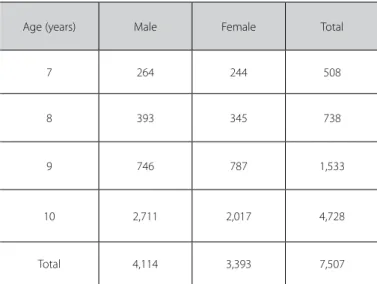
Table 1. Distribution of the total sample according to sex and age.
Age (years) Male Female Total
7 264 244 508
8 393 345 738
9 746 787 1,533
10 2,711 2,017 4,728
Total 4,114 3,393 7,507
Data of the Project Brazil Sport, 2004-2005.-2005.
the relevant evidence of good levels of motor performance to health, the aim of the present study was to assess physical fit-ness of Brazilian schoolchildren, according to a guideline using health criteria as reference.
METHODS
In order to have this transversal epidemiological study with educational grounding, the data were extracted from the Proj-ect Brazil Sport (PROESP-BR), a permanent observational ground of growth, somatomotor development and nutritional status indicators of Brazilian children and adolescents (seven to 17 years). The PROESP-BR is part of a series of projects carried out by the chain of the Sports Excellence Centers (CENESP) linked to the Department of Sports Excellence and Promotion of Events from the National Office of Performance Sports of the Sport Ministry and was approved by the Ethics in Research Committee of the Federal University of Rio Grande do Sul, in the meeting number 11, report number 91 from 09/08/2007.
The PROESP-BR has as main aim to outline the somatomotor profile, life habits as well as motor fitness factors in children and adolescents, to aggregate indicators to the design of physi-cal education and sports policies for children and youngsters in Brazil. More detailed information on the conception and methodological aspects of the PROESP-BR have been previ-ously published(29).
The population of the present study was composed of schoolchildren (seven to 17 years) enrolled in the public and private systems of the five Brazilian regions (North, Northeast Mid-Central, Southeast and South). However, the sample of the present study was composed only of schoolchildren from seven to 10 years of age, assessed in the years of 2004 and 2005 (n = 7.926). The schoolchildren who did not perform the flexibility (n = 114), abdominal (n = 31) and nine-minute running/walking (n = 274) motor tests were excluded from the sample, since only the schoolchildren who participated in all motor tests would enter in the general classification analysis of physical aptitude. Thus, the final sample was composed of 7,507 schoolchildren. The sample distribution according to sex and age is presented in table 1.
Anthropometry
The anthropometric and demographic data were obtained by the Physical education teachers of each school which engaged in the PROESP-BR. All teachers received training and had access to the application instructions of the tests and measurements in an elec-tronic site (www.proesp.ufrgs.br), which included a video prepared by members of the Physical Education School of the Federal Uni-versity of Rio Grande do Sul, for standardization and better visual presentation of the measurement techniques (29).
Body mass was determined on a digital anthropometrical scale, graded from 0 to 150kg, with resolution of 0.05kg and stature with the aid of a portable stadiometer, mounted on the wall, graded from 0 to 200cm, with precision of 0.2cm(29). Body
mass index (BMI) was calculated through the body mass quotient in kilograms, by the stature in square meters.
Motor tests
The schoolchildren were submitted to a battery of motor tests which was applied according to the following order: sit-and-reach (flexibility), abdominal one-minute modified (strength/muscular endurance) and nine-minute running/walking (cardiorespiratory fitness). health-related physical fitness (HRPF) was assessed through the battery of motor tests proposed by the AAPHERD(15) and, for
results interpretation, the criteria suggested by the Physical Best were used. This set (battery-criterion) has been applied in many investigations in Brazil due to their qualities related to reliability and easy applicability. Moreover, it requires low operational cost and does not need robust physical structures, being very suitable to be applied in public and/or private schools.
Statistical procedure
Data were initially treated by descriptive procedures (mean, standard deviation). Analysis if variance (two-way ANOVA) was used for comparisons between sex and age. The Scheffé post hoc test was applied for identification of specific differences in the variables in which the F values found were higher than the statistical significance criterion established (p < 0.05). The distri-bution of percentage frequencies was established to verify the proportion of students who did not meet the health criteria. In the comparison between sexes, the significance test for dif-ferences between proportions was applied. In all analyses the significance level of 5% was adopted and the statistical program SPSS, version 13.0 was used.
RESULTS
Table 2 presents the mean results of body weight, stature and BMI of the schoolchildren investigated, according to sex and age. Interaction between sex and age was observed in all inves-tigated variables (p < 0.05). The isolate effect of age was verified in all variables, demonstrating hence increasing values with age progression, both for male and female schoolchildren (p < 0.05).
94
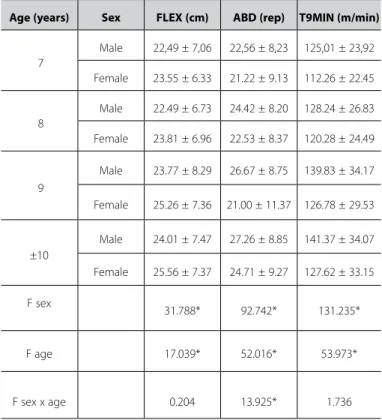
Concerning age, increase in the values of the motor tests with age progression was observed (p < 0.05).
The proportion of students who did not meet the criteria established for each motor test investigated, as well as for the set of tests is presented in figure 1.
Regarding flexibility, the majority of the schoolchildren did not meet the established health criteria, being it more
preva-lent in male than female sex. Significant differences were found between sexes in all ages, as well as in the collection of ages.
In the strength/muscular endurance test, it was observed that over 50% of the students were classified below the health criteria. Significant differences were found in the comparisons between proportions in all ages (p < 0.05). These results indicated higher prevalence of female children in the seven, eight and nine years of age while male ones at 10 years of age (p < 0.05) who were below the minimum criteria recommended to health.
Concerning cardiorespiratory aptitude, approximately 80% of the students presented performance below the levels estab-lished for health. Differences between sexes in the proportions of students who did not meet the criteria proposed by the Physical Best were verified in all ages. These findings point to a higher pro-portion of female schoolchildren in the ages of seven and nine years and male ones in the ages of eight, 10 and in the collection of all ages, classified below the criteria recommended to health. Regarding the general classification, it was observed high prevalence of students who did not meet simultaneously health criteria established by the adopted proposal in the three mo-tor tests. These results indicate that, approximately 96% of the schoolchildren did not meet the expected level to health.
DISCUSSION
The present study evaluated the motor performance of Brazilian schoolchildren aged between seven and 10 years, regularly enrolled in the public and private educational sys-tems, becoming a pioneering investigation performed with a large sampling from all Brazilian regions, which consequently decreases the cultural and socioeconomical differences which can affect motor performance.
Regarding flexibility, the female sex presented higher mean value than the male sex in all analyzed ages. Similar data have been reported in research from other countries(20-22,24). Concerning the
minimum criteria of flexibility established for health, more than half of the Brazilian schoolchildren did not meet the reference criteria. In developed countries the reverse phenomenon is ob-served, that is to say, the majority of students presents flexibility suitable to health(26,30). The low levels of flexibility are especially
of concern for the associated risks to low back pain and higher incidence of postural problems, besides a possible explanation for the low school performance(10-12). A longitudinal study
car-ried out in Finland revealed that, after 25 years, children with low levels of flexibility in the school period reported more back pain in adulthood(12).
Regarding abdominal strength/muscular endurance, three out of four students did not meet the recommended criteria to health. Prevalence of inadequate muscular strength was ob-served both in the male (75.3%) and female sexes (73.8%). These values were high when compared to the findings in other coun-tries(22,26,30) and specific Brazilian regions(17,28). This situation is of
great concern, since inadequate levels of abdominal strength/ endurance may cause postural and articular problems, as well as musculoskeletal injuries(31,32). In the United States it was verified
that the male sex presented higher mean values in abdominal muscular endurance compared to their pairs of the opposite sex in the entire school life(20,21).
Concerning the cardiorespiratory test, in both sexes with age
Table 2. Anthropometric characteristics of the schoolchildren (mean, stadanrad devia-tion and F statistics) according to sex and age.
Age (years) Sex BM (kg) EST (cm) BMI (kg/m²)
7
Male 27.51 ± 5.55 127.78 ± 6.76 16.75 ± 2.43
Female 27.10 ± 5.68 125.71 ± 6.88 17.07 ± 2.90
8
Male 30.00 ± 7.40 131.75 ± 7.48 17.15 ± 3.33
Female 30.21 ± 7.31 131.18 ± 818 17.45 ± 3.17
9
Male 33.26 ± 7.90 137.40 ± 7.64 17.51 ± 3.34
Female 31.96 ± 7.11 137.79 ± 6.75 16.75 ± 3.06
10
Male 34.36 ± 7.97 141.33 ± 7.20 17.15 ± 3.16
Female 35.33 ± 8.00 142.39 ± 7.53 17.33 ± 3.09
F sex 0.299 1.534 0.011
F age 210.848* 984.156* 2.147*
F sex x age 8.783* 8.759* 9.850*
BM: body mass; EST: stature; BMI: body mass index. *p < 0.05. Data of the Project Brazil Sport, 2004-2005.
Table 3. Performance of the schoolchidren (mean, standard deviation and F statistics) in motor tests according to sex and age.
Age (years) Sex FLEX (cm) ABD (rep) T9MIN (m/min)
7
Male 22,49 ± 7,06 22,56 ± 8,23 125,01 ± 23,92
Female 23.55 ± 6.33 21.22 ± 9.13 112.26 ± 22.45
8
Male 22.49 ± 6.73 24.42 ± 8.20 128.24 ± 26.83
Female 23.81 ± 6.96 22.53 ± 8.37 120.28 ± 24.49
9
Male 23.77 ± 8.29 26.67 ± 8.75 139.83 ± 34.17
Female 25.26 ± 7.36 21.00 ± 11.37 126.78 ± 29.53
±10
Male 24.01 ± 7.47 27.26 ± 8.85 141.37 ± 34.07
Female 25.56 ± 7.37 24.71 ± 9.27 127.62 ± 33.15
F sex
31.788* 92.742* 131.235*
F age 17.039* 52.016* 53.973*
F sex x age 0.204 13.925* 1.736
95
Figure 1. Proportion (%) of students who did not meet the health criteria established to each on the motor tests according to sex and age.
Data from the Project Brazil Sport, 2004-2005. *p < 0.05 for comparison between sexes.
FLEXIBILITY
Age (years)
Male Fem
Age (years)
Age (years) Age (years)
CARDIORESPIRATORY FITNESS
STRENGTH/MUSCULAR ENDURANCE
GENERAL CLASSIFICATION
progression decrease in the proportion of students who did not meet the minimum criteria to health has occurred. These data corroborate the ones found in the North American(20,21),
Ger-man(24) and Croatian populations(25). However, when the cohort
points to health from the Physical Best were established, high proportion of Brazilian male students who did not meet the health criteria was evidenced. Tomkinson and Olds(33) reported
that, in the last 45 years, decrease of –0.36% a year in the aerobic fitness of children and adolescents from all around the globe has occurred. This fact is alarming, since low aerobic fitness is associated with high levels of cholesterol and triglyderides(6,7),
imbalanced blood pressure and insulin sensitivity(6-8) and higher
obesity risk (9). Moreover, the literature has shown that students
with inadequate level of aerobic fitness presented worse aca-demic performance(13). Thus, the authors emphasize the need
for educational policies which consider the benefits of adequate levels of motor performance to health during the entire school life, promoting hence the development of these health indica-tors in school.
In the general physical fitness classification, more than 95% of the children of both sexes did not meet the recommended threshold to health. When these data are compared with an in-vestigation carried out in a Brazilian city(17) and with data from
the United States(34), it is possible to verify that the students of
the present study presented higher physical fitness deficit. The low levels of physical fitness are directly related to the increase of sedentarism in the contemporary society, especially due to the interest in passive activities such as portable games, televi-sion and computers(35). Minimum indices of motor performance
are necessary to maintain functional, motor and morphologi-cal levels to an expected physimorphologi-cal fitness concerning health. In order to better infer on the level of physical fitness of students, longitudinal studies which follow-up the entire childhood and adolescence become necessary, investigating also the life style of these subjects.
Therefore, it seems that the Brazilian children have had few opportunities to practice physical activities. However, it is known that schools do not present objective resources and conditions to meet the students’ demands due to several reasons which go from lack of work material to mistaken educational legislation which increasingly remove body practices from classes.
In Greece, Koutedakis and Bouziotas(27), when investigating the
association of the Physical Education curriculum with levels of mo-tor performance in children, evidenced that the curriculum applied in the schools is responsible for the low levels of physical fitness and motor performance, since their demands are not sufficient to bring benefits to health. The present study carried out with Brazilian students did not correlate the Brazilian Physical Education curricu-lum with the level of motor performance; therefore, the situation reported in Greece cannot be inferred. Nevertheless, investigations on this interrelation which aim to search for the causes for the high levels of schoolchildren who did not meet adequate levels of health in the physical fitness tests are widely recommended. Research on the life style of these students and of the physical activities in leisure time is also recommended.
96
samples form other countries; teachers training by video system and lack of pilot study. Among the advantages of the study, we can highlight the sample representativeness, including students from all the Brazilian geographic regions and outlining the national situation of motor performance, since no studies which presented this characteristic have been found in the literature.
According to the findings of the present study it is possible to conclude that the Brazilian students presented inadequate levels of
physical fitness. Therefore, we suggest that mechanisms which contribute to the promotion of physical fitness in children are implemented, especially with public policies in neighborhoods, parks and condominiums which enable physical activities and sports practice.
All authors have declared there is not any potential conflict of interests concerning this article.
REFERENCES
1. Okano AH, Altimari LA, Dodero SR, Coelho CF, Almeida PBL, Cyrino ES. Comparação entre o desempenho motor de crianças de diferentes sexos e grupos étnicos. Rev Bras Ci e Mov. 2001;9:39-44.
2. Haga M, The relationship between physical fitness and motor competence in children. Child Care Health Dev. 2008;34:329-34.
3. Guedes DP. Implicações associadas ao acompanhamento do desempenho motor de crianças e adoles-centes. Rev Bras Educ Fis Esp. 2007;21:37-60.
4. Ozdirenç M, Ozcan A, Akin F, Gelecek N. Physical fitness in rural children compared with urban children in Turkey. Pediatr Int. 2005;47:26-31.
5. Malina RM, Katzmarzyk PT. Physical activity and fitness in an international growth standard for preado-lescent and adopreado-lescent children. Food Nutr Bull. 2006;27:S295-S313.
6. Eisenmann JC, Welk GJ, Ihmels M, Dollman J. Fatness, fitness, and cardiovascular disease risk factors in children and adolescents. Med Sci Sports Exerc. 2007;39:1251-6.
7. Perry AC, Okuyama T, Tanaka K, Signorile J, Kaplan TA, Wang X. A comparison of health and fitness-related variables in a small sample of children of Japanese descent on 2 continents. Arch Pediatr Adolesc Med. 2002;156:362-8.
8. Carrel AL, Clark RR, Peterson SE, Nemeth BA, Sullivan J, Allen DB. Improvement of fitness, body composi-tion, and insulin sensitivity in overweight children in a school-based exercise program: a randomized, controlled study. Arch Pediatr Adolesc Med. 2005;159:963-8.
9. Kim J, Must A, Fitzmaurice GM, Gillman MW, Chomitz V, Kramer E, et al. Relationship of Physical Fitness to Prevalence and Incidence of Overweight among Schoolchildren. Obes Res. 2005;13:1246-54. 10. Hunt A. Musculoskeletal fitness: the keystone in overall well-being and injury prevention. Clin Orthop
Relat Res. 2003;409:96-105.
11. Ferrari K, Goti P, Sanna A, Misuri G, Gigliotti F, Duranti R, et al. Short-term effects of bracing on exercise performance in mild idiopathic thoracic scoliosis. Lung. 1997;175:299-310.
12. Mikkelsson LO, Nupponen H, Kaprio J, Kautiainen H, Mikkelsson M, Kujala UM. Adolescent flexibility, endurance strength, and physical activity as predictors of adult tension neck, low back pain, and knee injury: a 25 year follow up study. Br J Sports Med. 2006;40:107-13.
13. Castelli DM, Hillman CH, Buck SM, Erwin HE. Physical fitness and academic achievement in third- and fifth-grade students. J Sport Exerc Psychol. 2007;29:239-52.
14. Sallis JF, McKenzie TL, Kolody B, Lewis M, Marshall S, Rosengard P. Effects of health-related physical education on academic achievement: Project SPARK. Res Q Exerc Sport. 1999;70:127-38.
15. AAHPERD. Physical Best. Reston, VA: American Alliance for Health, Physical Education, Recreation and Dance, 1988.
16. Dórea V, Ronque VER, Cyrino ES, Serassuelo Junior H, Gobbo LA, Carvalho FO, et al. Aptidão física rela-cionada à saúde em escolares de Jequié, BA, Brasil. Rev Bras Med Esporte. 2007;14:494-9.
17. Ronque ERV, Cyrino ES, Dórea V, Serassuelo Júnior H, Galdi EHG, Arruda M. Diagnóstico da aptidão física em escolares de alto nível socioeconômico: avaliação referenciada por critérios de saúde. Rev Bras Med Esporte. 2007;13:71-6.
18. Pezzetta OM, Lopes AS, Pires Neto CS. Indicadores de aptidão física relacionados à saúde em escolares do sexo masculino. Rev Bras Cineantropom Desempenho Hum. 2003; 5:7-14. 19. Glaner MF. Aptidão física relacionada à saúde de adolescentes rurais e urbanos em relação a critérios
de referência. Rev Bras Educ Fis Esp. 2005;19:13-24.
20. US Department of Health and Human Services, Office of Disease Prevention and Health Promo-tion: Summary of findings from National Children and Youth Fitness Study II. J Phys Educ Rec Dance. 1987;58:49-96.
21. Reiff GG, Dixon WR, Jacoby D, Ye GX, Spain CG, Hunsicker PA. The President’s Council on Physi-cal Fitness and Sports 1985 National School Population Fitness Survey. Ann Arbor, University of Michigan, 1986.
22. Jürimäe T, Volbekiene V, Jürimäe J, Tomkinson GR. Changes in Eurofit test performance of Estonian and Lithuanian children and adolescents (1992-2002). Med Sport Sci. 2007;50:129-42. 23. Vlahović L, Bavcević T, Katić R. Biomotor development in 1992 and 2002 samples of seven-year-old
children. Coll Antropol. 2007;31:987-92.
24. Starker A, Lampert T, Worth A, Oberger J, Kahl H, Bös K. Motor Fitness. Results of the German Health Interview and Examination Survey for Children and Adolescents (KiGGS). Bundesgesundheitsblatt Gesundheitsforschung Gesundheitsschutz. 2007;50:775-83.
25. Katić R, Pejcić A, Babin J. Integration of aerobic power into the morphological-motor system in children aged 7-11 years. Coll Antropol. 2004;28:357-66.
26. California Physical Fitness Test Results: 2006–2007 California Physical Fitness Report Summary of results 2008. http://www.cde.ca.gov/ta/tg/pf/documents/overview.pdf, retrieved 17 May, 2008. 27. Koutedakis Y, Bouziotas C. National physical education curriculum: motor and cardiovascular health
related fitness in Greek adolescents. Br J Sports Med. 2003;37:311-4.
28. Bergmann GG, Araújo MLB, Garlipp DC, Lorenzi TDC, Gaya A. Alteração anual no crescimento e na aptidão física relacionada à saúde de escolares. Rev Bras Cineantropom Desempenho Hum. 2005;7:55-61.
29. Gaya ACA, Silva G. Manual de aplicação de medidas e testes, normas e critérios de avaliação. Avail-able at: http://www.proesp.ufrgs.br/institucional/index.php. Accessed April 18, 2008. 30. Corbin CB, Pangrazi RP: Are American children and youth unfit? Res Q Exerc Sport. 1992;63:96-106. 31. Knudson D. Issues in abdominal fitness: testing and technique. Journal of Physical Education,
Recreation & Dance, Reston 1999;70:49-55.
32. Silfies SP, Squillante D, Maurer P, Westcott S, Karduna AR. Trunk muscle recruitment patterns in specific chronic low back pain populations. Clin Biomech. 2005;20:465-73.
33. Tomkinson GR, Olds TS (editors): Pediatric Fitness. Secular Trends and Geographic Variability. Med Sport Sci Basel. 2007;50:67-90.
34. Malina RM. Physical fitness of children and adolescents in the United States: status and secular change. Med Sport Sci. 2007;50:67-90.