Original article (short paper)
The effect of the maintaining the ball possession
on the intensity of games
Felipe Lovaglio Belozo Eliel Calazans Ferreira Cristian J. R. Lizana Guilherme Grandim
Universidade de Campinas, UNICAMP, Campinas, SP, Brasil
João Claudio Machado
Universidade Federal do Amazonas, UFAM, Manaus, AM, Brasil
René Brenzikofer Denise Vaz Macedo Milton Shoiti Misuta
Alcides José Scaglia
Universidade de Campinas, UNICAMP, Campinas, SP, Brasil
Abstract––The use of small-sided games (SSG) for soccer training has increased considerably in recent years. Tactical principles can inluence the intensity and the movement of soccer players during training. The aim of this study was to evaluate the inluence of maintaining possession of the ball on the intensity and the time of motion characteristics of players during training in games. Eleven athletes of the U-20 category of a professional club in São Paulo, Brazil, participated in this study. To check the inluence of the tactical principle, we used a game control and an experimental game in three different ield dimensions and number of players. The results show that possession of the maintenance rule inluences the intensity of the games (p<0.05). However, it is concluded that the rule is fundamental for training through games. Keywords: soccer, training, small-sided games.
Introduction
Soccer is one of the most popular sports in the world, despite its creation spanning over hundreds of years, there are still many doubts about its physiological, technical, biomechanical and psychological requirements. These questions may be ex -plained by the fact that its initial training was inluenced and developed through individual sports (Aguiar, Botelho, Lago, Macas, & Sampaio, 2012). However, with the technological and scientiic developments applied to soccer, it has been recognized the need to develop training and evaluations that respect the principle of speciicity (Bangsbo, Norregaard, & Thorso, 1991; Hoff, Wisloff, Engen, Kemi, & Helgerud, 2002; Kelly, Gregson, Reilly, & Drust, 2013; Kemi, Hoff, Engen, Helgerud, & Wisloff, 2003; Stolen, Chamari, Castagna, & Wisloff, 2005). In recent years, studies with small-sided games (SSG) have increased considerably; several studies point out the importance of the training of soccer players through SSG, since they are able to develop the technical, physical and tactical aspects in addition to respecting the speciicity of the training (Bloomield, Polman, O’Donoghue, & McNaughton, 2007; Dellal et al., 2008; Eniseler, 2005; Hill-Haas, Dawson,
Impellizzeri, & Coutts, 2011; Impellizzeri et al., 2006;
Rampinini et al., 2007; Reilly, 2005; Scaglia, Reverdito.R., Leonardo, & Lizana, 2013).
In sports training, the monitoring of the training intensities is essential. Nowadays, it is possible to know the internal responses (heart rate and lactate concentration [La]) and the external respons -es, such as the distances covered in oficial games and in training (Gabbett & Mulvey, 2008; Hill-Haas, Rowsell, Dawson, & Coutts, 2009; Spencer et al., 2004). Several studies have been examining
where the accuracy is not high for a critical analysis (Coutts & Dufield, 2010; Johnston et al., 2012). Those speeds in small- and medium-sized games are often not reached, however, on oficial ields, these velocities are frequently reached.
Another tool used to assess the movement of the players is the video analysis through shooting with digital cameras (Gabbett & Mulvey, 2008). According to Barros (2007), the ki-nematic analysis for soccer players can offer useful information on their movement in games. Thus, the videogrammetry, because of its accuracy of data, has been reported to be an excellent tool for the study of the movement of players (Figueroa, Leite, & Barros, 2003). One of the most studied variables is the total distance covered. However, it is not enough to know only the total distance, but rather at what intensity they are covered, since athletes can cover the same distance at different intensities (Bangsbo, 1994; Gabbett & Mulvey, 2008). Consequently, it is believed that the Ventilatory Threshold (VT) of each athlete is a great variable to characterize individually the intensity of different games. Through the videogrammetry and the functions developed in the Matlab system, we can know the velocity rang -es that athlet-es travel during gam-es and, when correlating them with the ventilatory threshold (VT) test proposed by Lourenço et al.,(2011), individually establish four different intensity ranges (low intensity, moderate intensity, moderate/high and high intensity). Without knowing the velocity of the VT (VVT) of each athlete, it becomes dificult to carry out a controlled individualized training, since for some players the effort can be of high intensity, while for others, only of moderate intensity.
Several studies point out that the rules, the size of the ield, the absence of goalkeepers and the number of players directly inluence the intensity and time motion characteristics of the athletes during the SSG (Brandes, Heitmann, & Muller, 2012; Castellano, Casamichana, & Dellal, 2013; Coutts et al., 2009; Hill-Haas, Coutts, Rowsell, & Dawson, 2009; Hodgson, Akenhead, & Thomas, 2014; Kelly et al., 2013; Koklu et al., 2013). However, there are many variables in a single game, it is dificult to identify which directly interferes in the intensity and movement of the players. Therefore, the aim of this study was to examine the inluence of the rules, with the tactical principle of maintaining ball possession, in the control of the intensity of efforts and time motion characteristics of players during training in small-, medium- and large-sided games. The application of this work is to determine the effect of the rules change on the intensity and time motion characteristics of soccer players, since the manipulation of these rules should be well planned by the coaching staff to avoid negative adjustments on the team.
Methods
Experimental design
The design protocol lasted 12 days for each set of experi -mental analysis. In the irst and second days, anthropometric assessment and the incremental treadmill test to determine the VT proposed by Lourenço et al., (2011) were assessed. In the third, fourth, ifth and sixth days, the athletes went through a
period of familiarization to the games used in the research, they practiced the games for ten minutes before the training sessions. In the seventh and ninth days, in the afternoon, the athletes were submitted to 3x3+G and 6x6+G SSG only with the oficial FIFA rules. In the eighth and tenth days, following the same schedules as the previous collections, the 3x3+G and 6x6+G SSG hap -pened, respectively, with the effort rule to promote the tactical principle of maintaining possession (MP). In the eleventh and twelfth days, the 10x10+G control and 10x10+G experimental games were carried out. The control and experimental games were placed on alternate days avoiding an adaptation of the ath -letes to the MP rules. The game collections occurred in the irst two days of the week allowing a resting period to the athletes to the championship game that happened on Saturday mornings.
Subjects
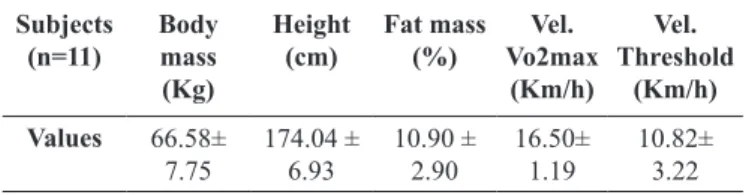
Eleven junior soccer players of the U-20 category (age 18±1.2) belonging to a federated Club in São Paulo, Brazil, all with a minimum of ive years of experience in the sport, accepted to participate in the study. The measures of body mass (BM) and height (HT) were performed in a digital scale equipped with stadiometer, brand Welmi®. For fat percentage (F%), we chose to register the subscapular, tricipital, biceptal, pectoral, suprail-iac, midaxillary, abdominal, thigh and calf skinfolds using an adipometer (brand Lange®). The calculations were done through the Jackson and Pollock Protocol (1978). The characterization of the sample can be seen in Table 1. This study was approved by the Research Ethics Committee of the School of Medical Sciences of UNICAMP, on 11/Feb/2012 (Opinion No. 208.298 and CAAE: 10855212.2.0000.5404).
Table 1. Characterization of the sample.
Subjects (n=11)
Body mass (Kg)
Height (cm)
Fat mass (%)
Vel. Vo2max
(Km/h)
Vel. Threshold
(Km/h) Values 66.58±
7.75
174.04 ± 6.93
10.90 ± 2.90
16.50± 1.19
10.82± 3.22
Procedures
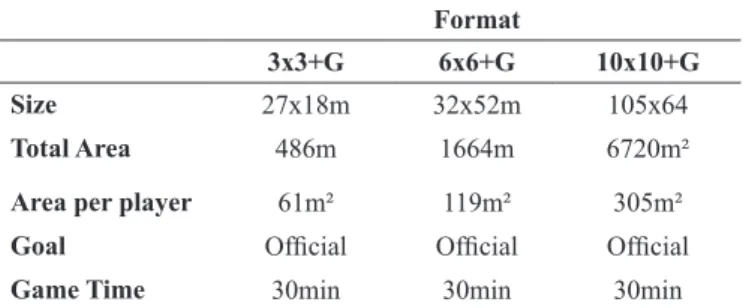
Description of the small-sided games: For the analysis of the games, we adopted two fields: control and experimental, with different sizes and number of players. The formats of the games used are described in Table 2. The games on the control field were carried out without external rules, only with the FIFA ones, including the offside rule; in the exper -imental field, some external rules were inserted to facilitate the tactical principle of maintaining the ball possession. They are:
• Only two touches on the ball, and every extra touch means a point to the opponent;
• Exchanging ive passes in the offensive ield (after the midield) means two points;
• Goal (only allowed after the exchange of ive passes) means eight points.
The rule that limits the number of touches on the ball, despite being a rule that contrasts with that one which determines the number of passes required for shot on the opponent’s goal (Almeida, Ferreira, & Volossovitch, 2012), when used together in a game, do not mischaracterize the prevalence of positional attacks, where teams tend to main -tain the ball possession, as can be seen in the study of Lizana
et al.,(2015). The dynamic of soccer matches has increased over the last years; therefore, the teams and players must seek not only maintain ball possession, but also search to quickly circulate the ball for the purpose of unbalancing the defense organization of the opponent´s team.
Table 2. Format of the ields where the games took place.
Format
3x3+G 6x6+G 10x10+G
Size 27x18m 32x52m 105x64
Total Area 486m 1664m 6720m²
Area per player 61m² 119m² 305m²
Goal Oficial Oficial Oficial
Game Time 30min 30min 30min
G - indicates the presence of goalkeepers.
Among the different matrices games proposed by Scaglia
et al. (2013), the conceptual games allow manipulation of the structural references (ball, size of the ield and targets) and functional (operational principles and rules of action). These changes emphasize the training of tactical principles, technical aspects and the various physical and physiological responses proposed by the coaching staff within the pedagogical and or -ganizational planning previously, and so it could not faithfully respect the logic of the competitive game.
Therefore, coaches and/or members of the coaching staff must understand how the handling of certain constraints in low games, the rules may inluence the modeling of speciic tacti -cal behavior, taking into account the playing style deined by the coach (Clemente, Couceiro, Martins, Ivanova, & Mendes, 2013). In this study the conceptual games were used to em -phasize the tactical principle of maintenance of ball possession (Bayer, 1994).
The teams were separated by the coaching staff so that the teams were balanced in relation to player positions (defense, mid -ield and attack) and also in relation to the technical and physical quality of the players. To reduce the variability between subjects, the same teams faced each other in the control and experimental ield on the three ield dimensions. Altogether, twenty ield athletes participated in the research study; however, we have considered only the players who participated in all games for the statistical analysis. To ensure that there was no interference in the intensity of the games, a statistical analysis was made in relation to the total
distance covered between the voluntary players and the sample. No signiicant difference was found between the groups (p<0.05).
Incremental treadmill test: Ventilatory Threshold was deter -mined by the incremental treadmill test proposed by Lourenço et al. (2011), in which, at the beginning of the test, the athletes performed a three-minute warm-up running at 8–8.5 km/hon the treadmill (Inbrasport ATL, 2000). The initial speed was 9 km/h and slope of 1%. The increase was 0.3 km/h every 25 seconds. The test was performed until voluntary exhaustion, during which it was continuously monitored the variables: heart rate (Polar RS100), oxygen consumption (VO2), carbon diox
-ide production (VCO2) and respiratory exchange ratio (RER).
The cardiorespiratory parameters (VO2, VCO2 and RER) were
measured breath by breath through a gas analyzer (CPX/D Med Graphics, St. Paul, MN). Immediately after exhaustion, the participants underwent a recovery test, in which the speed of the treadmill was decreased every minute to 60%, 55%, 50%, 45% and 40% of the maximum velocity reached.
For the visual determination of the VT, we used the V-slope method, which consists in the characterization of VT by loss of linearity of VCO2/VO2. The respiratory compensation point (RCP)
was also determined by visual inspection, which consists in the loss of linearity of the VE/VCO2 ratio. Therefore, we collected the variables Ventilatory threshold (VT), Velocity of the ventilatory threshold (VVT), Heart rate of the ventilatory threshold (HRvt), VO2max, Velocity of VO2max (VVO2max), VO2max heart rate
(VO2maxHR), which allows us to establish four training ranges,
stratiied by the low intensity below the Threshold, the moderate intensity between VT1 and peak respiratory compensation (PRC), the moderate/high between PRC and Ventilatory Threshold2 and the high intensity above the Ventilatory Threshold2 (VT2).
Data collection and kinematics analyses: The footage of the games was recorded with digital video cameras, with the NTSC standard and 30 Hz of acquisition rate. The cameras were positioned on the highest point of the bleachers, in a ixed position during the entire game, in order to it the entire playing ield. After ilming, the sequences of images from each camera were transferred to the computer’s hard drive (computer Intel® Core ™ i7-2600k, 3.40GHz, RAM memory, 16 GB, video card NVIDIA GeForce 9500 GT). The ile format used is the AVCHD (Advanced Video Codec High Deinition) with the resolution of 1080 lines per 1980 columns.
The study of the movement of the soccer players was carried out independent of the size of the body or rotational movements hence it is important that the description of the position of the player is made from the location of a single point (Misuta, Menezes, Figueroa, Cunha, & Barros, 2005). Obtaining the position of the player on the ield consists primarily in knowing the relationship between the screen coordinates (x, y) and the reference system associated with the ield. Thus, the calibration of each camera was made from at least four known points in the co -ordinate system associated with the ield and their corresponding coordinates in the image. The calibration and two-dimensional (2D) reconstruction method used was proposed by Abdel-Aziz, Karara (1971), named DLT (Direct Linear Transformation).
distance, divided into velocity ranges according to the assess-ment of VT. The functions to determine the physical variables were developed in the Matlab 7.0 system.
Statistical analysis
The Matlab 7.0 system was used for the elaboration of the functions related to the physical variables, such as total distance covered, maximum velocities, intervals between high intensity efforts, amount of high intensity efforts and distances covered at different velocity ranges according to the assessment of the VT of the athletes. The values are expressed as mean and standard deviation. The distribution of the data normality was veriied by the Shapiro-Wilk test. After conirming that the data was parametric, we used the t-Student test and the value of p<0.05 was considered statistically signiicant. The data were analyzed paired, comparing the variables within the same ield size.
Results
Ventilatory Threshold
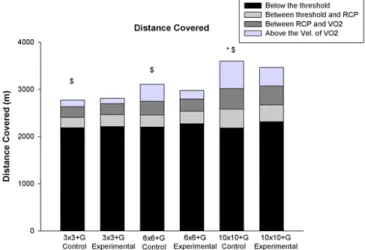
Figure 1 illustrates a signiicant difference between the control and experimental ields; on the 3x3+G control games, the athletes covered an average of 141.5±55.3m at high intensity, and just 101.6±55.6m on the experimental games. In the 6x6+G games, the total distance covered at high intensity was 389±179.6m (on the control ield) and 175.8±65.3 m (on the experimental ield). For the 10x10+G ields, it was found that the average of the total distance covered at high intensity was 560.5±165.9 m for the control ield and 361±135.1 m for the experimental ield. The distances covered below the VT, regarded as of low intensity, were signiicantly increase between the 10x10+G control and experimental games, in which the athletes covered 2182.8± 169.3m in the control ield and 2302.8±203.1 m in the experimental ield.
Figure 1. Comparison between the distances covered at different ve
-locity ranges between the control and experimental ields.
$ points to a signiicant difference in the distances covered at hight intensity between the control and experimental ields (p<0,05).
*demonstrate signiicant differences in the distances covered at low intensity between the control and experimental ields (p<0,05).Insert here Figure 1
Figure 2 presents the signiicant increase in the distance of the high intensity efforts between the 6x6+G control and experimental games, in which the distance of the efforts was 10.7±1.15m in the control ield and 9.4±1.0m in the experimen -tal ield (p<0.05). Similarly, we found in the 10x10+G games, in which the distance was 14±1.71m in the control ield and 11.8±1.56m in the experimental ield. In the 3x3+G games, no signiicant difference was seen in the distance of the high inten -sity efforts. At maximum velocity, there is a signiicant increase between the 3x3+G control and experimental games, in which the maximum velocity was of 7.15±0.4m/s in the control ield and 6.4±0.3m/s in the experimental ield. Higher maximum velocity was also found in the 6x6+G games for control ield, which was 8.2±0.7m/s and 6.9±0.6m/s in the control ield and in the experimental ield, respectively. In the 10x10+G games, no signiicant difference was found for the maximum velocity. In relation to the amount of high intensity efforts, we can verify a signiicant increase between the control and experimental ields for the 3x3+G and 6x6+G games. The athletes performed on average 29.2±9.4 high intensity efforts in the 3x3+G control game, and 23.4±10.4 in the 3x3+G experimental game (p<0.05). This difference was also veriied in the 6x6+G games, in which the athletes performed on average 45.8±18.5 high intensity ef-forts in the control ield and 31.8±9.3 in the experimental ield (p<0.05). In the 10x10+G ields, no signiicant difference was found regarding the amount of high intensity efforts. There was no signiicant difference between the intervals of high intensity efforts and the total distance covered in any of the games analyzed.
Figure 2. Comparison of the physical variables between the control and the experimental ields in the same ield size.
Discussion
The aim of this study was to evaluate the inluence of a single variable, i.e. the rule with the tactical principle of maintaining ball possession, in the control of the intensity of efforts and time motion characteristics of players during training in small-, medium- and large-sided games. The results indicate that there is a signiicant increase in the total distance covered at high intensity in the control ield in relation to the experimental ield in all ields evaluated, and they also point to signiicant increase in the distances of high intensity efforts, maximum velocity, and also in the number of such efforts. It is important to note that every time we refer to high intensity actions, we are analyzing the sprints; however, as the literature conceptualizes them above 18 km/h (Hill-Haas, Dawson, Coutts, & Rowsell, 2009; Koklu et al., 2013), we prefer to classify the efforts according
to the threshold test. Thus, every effort above the velocity of VO2max was classiied as a high intensity effort. For a better
understanding and discussion of the results, we have adopted the 3x3+G games as small-sided games, the 6x6+G games as medium-sided games, and the 10x10+G games as large-sided games (Hodgson et al., 2014; Owen, Wong D, Poul, & Dellal,
2013). Unlike the studies of Hill-Hass et al.,(2010), who used the rules to intensify the games, we believe that they have a key role in the development of the game model adopted by the coach and, thus, cannot simply be used to obtain physical results. They should establish the work with games, since the mere performance of these games, without the knowledge of the rules, can lead athletes to negative adjustments in the physical, technical and tactical aspects.
The physical, physiological, technical and tactical demands arising from the manipulation of the rules should be in accor-dance with the objectives proposed by the coaching staff. The stipulated rules must be designed to encourage and emphasize the aims of each training session. Thus, each of the small-sided games can provide different answers (technical, tactical, phys -ical and physiolog-ical) due to the handling of certain rules. In addition, the rules often need to be modiied during training to keep athletes in high state of concentration to the game, and ensure that the technical, tactical, physical and physiological objectives previously established are achieved.
Through conceptual games, the rules are intended to model the tactical behavior of the players and team. However, when considering the game as a complex environment, those rules will also influence the emergence of different physical and physiological stimuli to the players. Therefore, the coaching staff needs to be aware of the importance of training control leading to achieve all the objectives in an integrated manner.
The importance of the rules in the control of the physical variables could be observed, for example, on the amount of high intensity efforts, in which we can observe a signiicant differ -ence between the medium-sided games, in which the athletes performed on average 45 high intensity efforts on the control ield and only 31 on the experimental ield. It is important to highlight that, although no signiicant difference was found on the interval between the high intensity efforts in the control
ields, the interval between these efforts is an important variable in the effort/pause ratio and should be considered, as the smaller the interval time between one effort and another, the greater the physiological intensity of the athletes.
In the literature, it is well described the importance of the games for soccer training, because of their speciicity in train -ing, as well as the seamlessly development of the physical, technical and tactical aspects (Dellal et al., 2012; Eniseler, 2005; Impellizzeri et al., 2006). However, for a practical and scientiic advancement, it is important to know the intensities in different games. That is why the control of training loads must be conducted individually. Since it is not enough only to know the distances covered, but rather at which intensities they are carried out, as the distance may not change in different games by several factors, but the intensities can be different. In this study, when analyzing the total distance covered in small-, medium- and large-sided games between the control and experimental ields, we did not ind signiicant differences. However, when dividing the total distance covered into intensity ranges, we can note that there is a signiicant difference in the distances covered at high intensity between the control and experimental ields in the three ield sizes studied. These results corroborated with the studies of Hill-Haas et al.,(2009); although the author evaluated the inluence of the ield size. He found no difference in the total distance covered, but the intensity of the efforts was sig -niicantly different, since the distances covered above 18 km/h were higher in medium ields in relation to small ields. That is why it is essential to evaluate the intensity of the efforts and not only the distances covered. The author in his experiments used an external rule to intensify the games, in which the whole team needed to walk past the midield to validate the goal. With this rule, the game automatically becomes more positioned, less individualized and more collective; by becoming a collective team, the athletes remain closer and more compressed and there-fore do not need to run long distances to perform an offensive or defensive effort.
The signiicant difference in the distances covered at low intensity in large-sided games is another important factor that reinforces the greater physiological intensity of ields without external rules. It reinforces that the intensity of the control ield is greater than the experimental ield, as the athletes covered less at low intensity, which means that they spent less time standing and or walking during the training. Therefore, they performed more moderate and high intensity efforts. This difference in the intensity of the efforts can be explained by the fact that the ath -letes do not have a game model in the absence of the effort rule, and even in the oficial ield they play less positioned, making the game less structured and with a tactical disorganization. It is important to note that the position of the players on the ield and their tactical behavior inluence the physical variables (Clemente et al., 2013; Costa, Garganta, Greco, & Mesquita, 2009; Dellal et al., 2011).
rule induces the training of a more organized team, in which the athletes do not need to run long distances or spend energy to carry out an offensive or defensive action. In the studies of Dellal et al.,(2012), when comparing 4x4 games with 11x11 games, he noted that the rules of one or two touches on the ball increases the intensity of small-sided games in relation to the oficial game, precisely because this is a game with a lower amount of athletes and consequently has a greater number of efforts and movements. Unlike the oficial game with a greater number of athletes, the players remain tactically positioned and organized, therefore moving less.
In this study, by analyzing the maximum velocities reached between the control and experimental ields, we found that there was a statistically signiicant difference both in small-sid -ed games and m-edium-sid-ed games. The study of Koklu et al.,(2013) corroborates with our study in relation to the higher
intensities of the efforts in less sophisticated games. When comparing the physiological responses and the intensity of the efforts in SSG with and without the presence of goalkeepers, the author found that the intensities of the efforts and the physi-ological responses are signiicantly higher in the games without the presence of the goalkeepers. Hill-Haas et al.(2010), although he found no physiological differences in some changes in rules and ield, it was emphasized the importance of the rules on the intensity of efforts and the motivation of players. The motivation of the players is of paramount importance to ensure that the objectives are achieved, and the rules need to be well prepared and often changed during training for this end. Corroborating the importance of the motivation during training with games, Scaglia et al.,(2013) use the term “State of play”, which means that the athletes are in a state of maximum concentration and complete involvement, because only this way they can be certain that they are offering their maximum in every effort. However, the author points out that the complexity of the rule can with -draw the athlete from the state of play; thus, it is important for the coaches to know the effort rules to not inluence negatively the physiological responses, as well as to not generate negative adjustments on the game model of the team.
However, we conclude that the effort rule, with the principle of maintaining ball possession, is able to control directly the intensity of the efforts and the time motion characteristics of the players on the ield. We believe that the variables that were not signiicantly different between the control and experimental ields can be explained by the increase in size and number of players, but other studies need to be conducted to verify the inluence of ield size and number of players on the intensity of the efforts and the movement of players in training conducted through games.
We believed that this study allows researchers and football coaches to understand the effect of the effort rules on the prepa-ration of games. The elaboprepa-ration of small-sided games, without the knowledge on the rules – disregarding the periodization of workloads – and also on the game model that is going to be adopted which could lead players to negative adjustments, both in physical variables and in technical and tactical variables. The coaches need to be aware of which game to apply, as well as which rule to use to intensify the training. Another important
factor is to check the training intensity individually and not only the total distance covered, since athletes can cover the same distances, but at different intensities. As limitation of the study, we can highlight the use of biochemical or rating of perceived exertion (RPE) to ensure the different intensities of the applied games.
References
Abdel-Aziz, Y.I., & Karara, H.M. (1971). Direct linear transforma-tion from comparator coordinates into object-space coordinates Synposium Onclosee-Rane Photogrammetrry (pp. 1-18). Urbana: ASP/UI.
Aguiar, M., Botelho, G., Lago, C., Macas, V., & Sampaio, J. (2012).
A review on the effects of soccer small-sided games. Journal of Human Kinetics, 33, 103-113. doi: 10.2478/v10078-012-0049-x Aguiar, M., Botelho, G.M., Goncalves, B.S., & Sampaio, J.E. (2013).
Physiological responses and activity proiles of football small-sided games. [Research Support, N.I.H., Extramural Research Support, Non-U.S. Gov’t]. The Journal of Strength & Conditioning Research, 27(5), 1287-1294. doi: 10.1519/JSC.0b013e318267a35c Almeida, C. H., Ferreira, A. P., & Volossovitch, A. (2012). Manipulating
task constraints in small-sided soccer games: Performance analysis and
practical implications. The Open Sports Sciences Journal, 5, 174-180.
Bangsbo, J. (1994). The physiology of soccer - with special reference to intense intermittent exercise. [Review]. Acta Physiologica Scandinavica Supplementum, 619, 1-155.
Bangsbo, J., Norregaard, L., & Thorso, F. (1991). Activity proile of competition soccer. [Research Support, Non-U.S. Gov’t]. Canadian Journal of Sports Science, 16(2), 110-116.
Barros, R.M.L. (2007). Analysis of the distances covered by irst divi
-sion Brazilian soccer players obtained with an automatic tracking
method. Journal of Sports Science and Medicine, 6(2), 233-242. Bayer, C. (1994). O ensino dos desportos colectivos. Lisboa: Dina
Livros.
Bloomield, J., Polman, R., O’Donoghue, P., & McNaughton, L. (2007).
Effective speed and agility conditioning methodology for random intermittent dynamic type sports. [Comparative Study Randomized Controlled Trial]. The Journal of Strength & Conditioning Research, 21(4), 1093-1100. doi: 10.1519/R-20015.1
Brandes, M., Heitmann, A., & Muller, L. (2012). Physical responses of different small-sided game formats in elite youth soccer players.
[Research Support, Non-U.S. Gov’t]. The Journal of Strength & Conditioning Research, 26(5), 1353-1360. doi: 10.1519/ JSC.0b013e318231ab99
Castellano, J., Casamichana, D., & Dellal, A. (2013). Inluence of
game format and number of players on heart rate responses and physical demands in small-sided soccer games. The Journal of Strength & Conditioning Research, 27(5), 1295-1303. doi: 10.1519/ JSC.0b013e318267a5d1
Costa, I. T., Garganta, J.M., Greco, P.J., & Mesquita, I. (2009).
Princípios táticos do jogo de futebol: conceitos e aplicação. Revista Motriz, Rio Claro., 15, 657-668.
Coutts, A.J., & Dufield, R. (2010). Validity and reliability of GPS
units for measuring movement demands of team sports. Journal of Science and Medicine in Sport, 13, 133-135.
Coutts, A.J., Rampinini, E., Marcora, S.M., Castagna, C., & Impellizzeri, F.M. (2009). Heart rate and blood lactate correlates
of perceived exertion during small-sided soccer games. [Validation
Studies]. Journal of Science and Medicine in Sport, 12(1), 79-84.
doi: 10.1016/j.jsams.2007.08.005
Dellal, A., Chamari, K., Pintus, A., Girard, O., Cotte, T., & Keller,
D. (2008). Heart rate responses during small-sided games and
short intermittent running training in elite soccer players: a com -parative study. [Com-parative Study]. The Journal of Strength & Conditioning Research, 22(5), 1449-1457. doi: 10.1519/ JSC.0b013e31817398c6
Dellal, A., Chamari, K., Wong, D., Ahmaidi, S., Keller, D., Barros, R., . . . Carling, C. (2011). Comparison of physical and technical
performance in European soccer match-play: FA Premier League
and La Liga. European Journal of Sport Science, 11, 51- 59.
Dellal, A., Owen, A., Wong, D.P., Krustrup, P., van Exsel, M., &
Mallo, J. (2012). Technical and physical demands of small vs. large sided games in relation to playing position in elite soc-cer. Human Movement Science, 31(4), 957-969. doi: 10.1016/j. humov.2011.08.013
Eniseler, N. (2005). Heart rate and blood lactate concentrations as pre -dictors of physiological load on elite soccer players during various soccer training activities. The Journal of Strength & Conditioning Research, 19(4), 799-804. doi: 10.1519/R-15774.1
Figueroa, P.J., Leite, N.J., & Barros, R.M. (2003). A lexible software
for tracking of markers used in human motion analysis. Computer Methods and Programs in Biomedicine, 72(2), 155-165. Gabbett, T.J., & Mulvey, M.J. (2008). Time-motion analysis of
small-sided training games and competition in elite women soccer
players. The Journal of Strength & Conditioning Research,, 22(2),
543-552. doi: 10.1519/JSC.0b013e3181635597
Harrison, C.B., Gill, N.D., Kinugasa, T., & Kilding, A.E. (2013). Quantiication of physiological, movement, and technical outputs
during a novel small-sided game in young team sport athletes. The Journal of Strength & Conditioning Research, 27(10), 2861-2868.
doi: 10.1519/JSC.0b013e318280c98d
Hill-Haas, S.V., Coutts, A.J., Dawson, B.T., & Rowsell, G.J. (2010).
Time-motion characteristics and physiological responses of
small-sided games in elite youth players: the inluence of player number and rule changes. [Research Support, Non-U.S. Gov’t]. The Journal of Strength & Conditioning Research, 24(8), 2149-2156.
doi: 10.1519/JSC.0b013e3181af5265
Hill-Haas, S.V., Coutts, A. J., Rowsell, G.J., & Dawson, B.T. (2009).
Generic versus small-sided game training in soccer. [Comparative Study Randomized Controlled Trial]. International Journal of Sports Medicine, 30(9), 636-642. doi: 10.1055/s-0029-1220730 Hill-Haas, S.V., Dawson, B., Impellizzeri, F.M., & Coutts, A.J.
(2011). Physiology of small-sided games training in football: a systematic review. [Review]. Sports Medicine, 41(3), 199-220.
doi: 10.2165/11539740-000000000-00000
Hill-Haas, S.V., Dawson, B.T., Coutts, A.J., & Rowsell, G.J. (2009).
Physiological responses and time-motion characteristics of vari-ous small-sided soccer games in youth players. Journal of Sports Sciences, 27(1), 1-8. doi: 10.1080/02640410902761199
Hill-Haas, S.V., Rowsell, G.J., Dawson, B.T., & Coutts, A.J. (2009).
Acute physiological responses and time-motion characteristics of
two small-sided training regimes in youth soccer players. [Research Support, Non-U.S. Gov’t]. The Journal of Strength & Conditioning Research, 23(1), 111-115.
Hodgson, C., Akenhead, R., & Thomas, K. (2014). Time-motion analysis of acceleration demands of 4v4 small-sided soccer games played on different pitch sizes. Human Movement Science, 33,
25-32. doi: 10.1016/j.humov.2013.12.002
Hoff, J., Wisloff, U., Engen, L. C., Kemi, O.J., & Helgerud, J. (2002). Soccer speciic aerobic endurance training. [Clinical Trial
Comparative Study]. British Journal of Sports Medicine, 36(3), 218-221.
Impellizzeri, F.M., Marcora, S.M., Castagna, C., Reilly, T., Sassi, A., Iaia, F.M., & Rampinini, E. (2006). Physiological and performance
effects of generic versus speciic aerobic training in soccer players.
[Randomized Controlled Trial]. International Journal of Sports Medicine, 27(6), 483-492. doi: 10.1055/s-2005-865839
Jackson, A.S., & Pollock, M.L. (1978). Generalized equations for pre-dicting body density of men. British Journal of Nutrition, 40(03),
497-504. doi: doi:10.1079/BJN19780152
Johnston, R.J., Watsford, M.L., Pine, M.J., Spurrs, R.W., Murphy, A.J., & Pruyn, E.C. (2012). The validity and reliability of 5-Hz global positioning system units to measure team sport movement demands. The Journal of Strength & Conditioning Research, 26(3),
758-765. doi: 10.1519/JSC.0b013e318225f161
Kelly, D.M., Gregson, W., Reilly, T., & Drust, B. (2013). The
devel-opment of a soccer-speciic training drill for elite-level players.
[Comparative Study]. The Journal of Strength & Conditioning Research, 27(4), 938-943. doi: 10.1519/JSC.0b013e3182610b7d Kemi, O.J., Hoff, J., Engen, L.C., Helgerud, J., & Wisloff, U. (2003).
Soccer speciic testing of maximal oxygen uptake. [Comparative
Study]. Journal of Sports Medicine and Physical Fitness, 43(2), 139-144.
Koklu, Y., Sert, O., Alemdaroglu, U., & Arslan, Y. (2013). Comparison
of the Physiological Responses and Time Motion Characteristics
of Young Soccer Players in Small Sided Games: The Effect of
Goalkeeper. The Journal of Strength & Conditioning Research. doi: 10.1519/JSC.0b013e3182a744a1
Lizana, C., J, R., Reverdito, R.S., Brenzikofer, R., Macedo, D.V., Misuta, M.S., & Scaglia, A.J. (2015). Technical and tactical soccer
players’ performance in conceptual small-sided games. Motriz, Rio Claro, 21, 312-320.
Lourenco, T.F., Martins, L.E., Tessutti, L.S., Brenzikofer, R., & Macedo, D.V. (2011). Reproducibility of an incremental treadmill
VO(2)max test with gas exchange analysis for runners. [Research Support, Non-U.S. Gov’t]. The Journal of Strength & Conditioning Research, 25(7), 1994-1999. doi: 10.1519/JSC.0b013e3181e501d6 Misuta, M.S., Menezes, R.P., Figueroa, P.J., Cunha, S.A., & Barros,
R.M.L. (2005). Análise de distâncias percorridas e velocidades de jogadores de futebol durante uma partida. João Pessoa, PB.
professional soccer. International Journal of Sports Medicine, 35, 386-392.
Rampinini, E., Impellizzeri, F.M., Castagna, C., Abt, G., Chamari, K.,
Sassi, A., & Marcora, S.M. (2007). Factors inluencing physio -logical responses to small-sided soccer games. Journal of Sports Sciences, 25(6), 659-666. doi: 10.1080/02640410600811858 Reilly, T. (2005). An ergonomics model of the soccer
train-ing process. [Review]. J Sports Sci, 23(6), 561-572. doi: 10.1080/02640410400021245
Scaglia, A.J., Reverdito.R., Leonardo, L., & Lizana, C. (2013). Collective
sports games teaching: essential competencies and logic amid the
systemic organizational process. Movimento, 19(4), 227-249.
Spencer, M., Lawrence, S., Rechichi, C., Bishop, D., Dawson, B., & Goodman, C. (2004). Time-motion analysis of elite ield hockey, with special reference to repeated-sprint activity. [Comparative Study Research Support, Non-U.S. Gov’t]. Journal of Sports Sciences, 22(9), 843-850. doi: 10.1080/02640410410001716715 Stolen, T., Chamari, K., Castagna, C., & Wisloff, U. (2005). Physiology
of soccer: an update. [Research Support, Non-U.S. Gov’t Review]. Sports Medicine, 35(6), 501-536.
Authors’ note
Felipe Lovaglio Belozo, Eliel Calazans Ferreira, Cristian J. R.
Liza-na, Guilherme Grandim and Alcides José Scaglia are afiliated with
the Laboratory of Sports Pedagogy Studies, School of Applied
Sci-ence, University of Campinas (UNICAMP), Campinas, SP, Brazil.
João Claudio Machado is afiliated with the studies Laboratory of
Human Development, Federal University of Amazonas, UFAM, Manaus, AM, Brazil.
René Brenzikofer and Milton Shoiti Misuta are afiliated with the
studies Laboratory in Biomechanics, Faculty of Applied Sciences,
University of Campinas (UNICAMP), Campinas, SP, Brazil.
Denise Vaz Macedo is afiliated with the Biochemistry Laboratory Exercise, Biology Institute, University of Campinas (UNICAMP),
Campinas, SP, Brazil.
Corresponding author
Felipe Belozo
Laboratory of Sports Pedagogy Studies, School of Applied Science,
University of Campinas, UNICAMP, Campinas, SP, Brazil. Email: [email protected]
Manuscript received on June 01, 2015 Manuscript accepted on November 24, 2015
Kamyla Thais Dias de Freitas
Universidade do Estado de Santa Catarina, Florianópolis, SC, Brasil
Claudio Marcelo Tkac
Pontifícia Universidade Católica do Paraná, Curitiba, PR, Brasil
Kamyla Thais Dias de Freitas Claudio Marcelo Tkac
Universidade do Estado de Santa Catarina, Florianópolis, SC, Brasil
ERRATUM
In the article “Athletic Identity Measurement Scale”: Translation, Adaptation and Validation for Brazil, published in volume 22, number 1, 2016.
Should read:
In the article “The effect of the maintaining the ball possession on the intensity of games”, published in volume 22, number 1, 2016.
René Brenzikofe
Should read:
René Brenzikofer
page 56, second column, lines 30-31: